The Curse of Skeleton Munroe

Category: Stuart Taylor

  • ALIENS AND SO FORTH ROUND-UP 055

    More aliens? Just how many more can there be?

    Fantasans:

    When time/space traveller Whiz Wilson visits Earth of the year 4400 CE, he finds that it is being bombarded by comets originating from the far-off planet Fantasa. Going there with the aid of his trusty Futuroscope, he learns that Molla, the rightful ruler of Fantasa, has been deposed by the wicked Gorano and that Gorano has a fanatical (and unexplained) hatred of humanity that is his reason for the comet attack. One quick Futuroscope-aided counter-coup later and Fantasa is back in more peaceful hands and Earth is safe. (Lightning Comics v2 003, 1941)

    Mercurian Cave-People:

    The very first outer space adventure of the Space Rovers sees them taking an unexpected rocket trip and being forced to make a landing on Mercury to get their bearings. Once they disembark they discover that the fire caused by their landing has been taken as a sign that the local deity (the Fire God, God-Style: Animistic) is angry and demands sacrifice. Ted and Jane pitch in to save the poor sacrifice, and in a rare happy ending for such people she gets to haul ass across the river to marry a dude named Kulu. (Exciting Comics 002, 1940)

    Mercurians of Thian:

    Having ruined the sacrifice, Ted is next up for being burned at the stake, and to make matters worse, Jane is hauled off by a giant bird (which turns out to be called a Mercurian Roc) before she can free him.

    Ted manages to free himself, and the two both end up in the city of Thian, which is populated by a second kind of Mercurian who are possessed of more advanced technology than the Cave-People but who look absolutely terrible. They aren’t even particularly good hosts, as can be seen here when they drug and capture the Star Rovers before the main course arrives.

    And just what is the reason that these Mercurians had for treating their guests so rudely? Because they only live for twenty years and they need people from more long-lived species to study (i.e. vivisect) so that they can live to a somewhat riper old age. 

    Since these particular tests subjects are space heroes, things go poorly from here. Head Scientist Flaedo gets electrocuted, the Star Rovers escape on Roc-back and the Mercurians of Thian hopefully reconsider their commitment to scientific ethics. (Exciting Comics 002, 1940) 

    Mercurians:

    Time adventurer Stuart Taylor and his companions Dr and Laura Hayward encounter this society of possibly human-derived Mercurians when they voyage to the year 4000 in pursuit of a man named Rogro who has stolen Dr Hayward’s time technology. The major difference between Mercurians and humans is the fact that the former all have “synthetic blood” which makes them vulnerable to extreme heat and must be quite inconvenient for someone living on what is generally acknowledge to be a pretty hot planet.

    Though the Mercurian society seems peaceful when they arrive, things go south quickly once Rogro promises the Mercurian king that he can engineer new blood for everyone if he can use the blood inside of Stuart and his friends as raw materials. The time travellers only survive the resulting riots by smashing up the protective dome over the Mercurian city (and note the fact that the writer now says that the Mercurians have a problem with oxygen instead of heat. Why? Who knows). (Jumbo Comics 019, 1940)
  • ALIENS AND SO FORTH ROUND-UP 054

    ALIENS AND SO FORTH ROUND-UP 054

    Comic book aliens: one of the few inexhaustible resources.

    Martians:

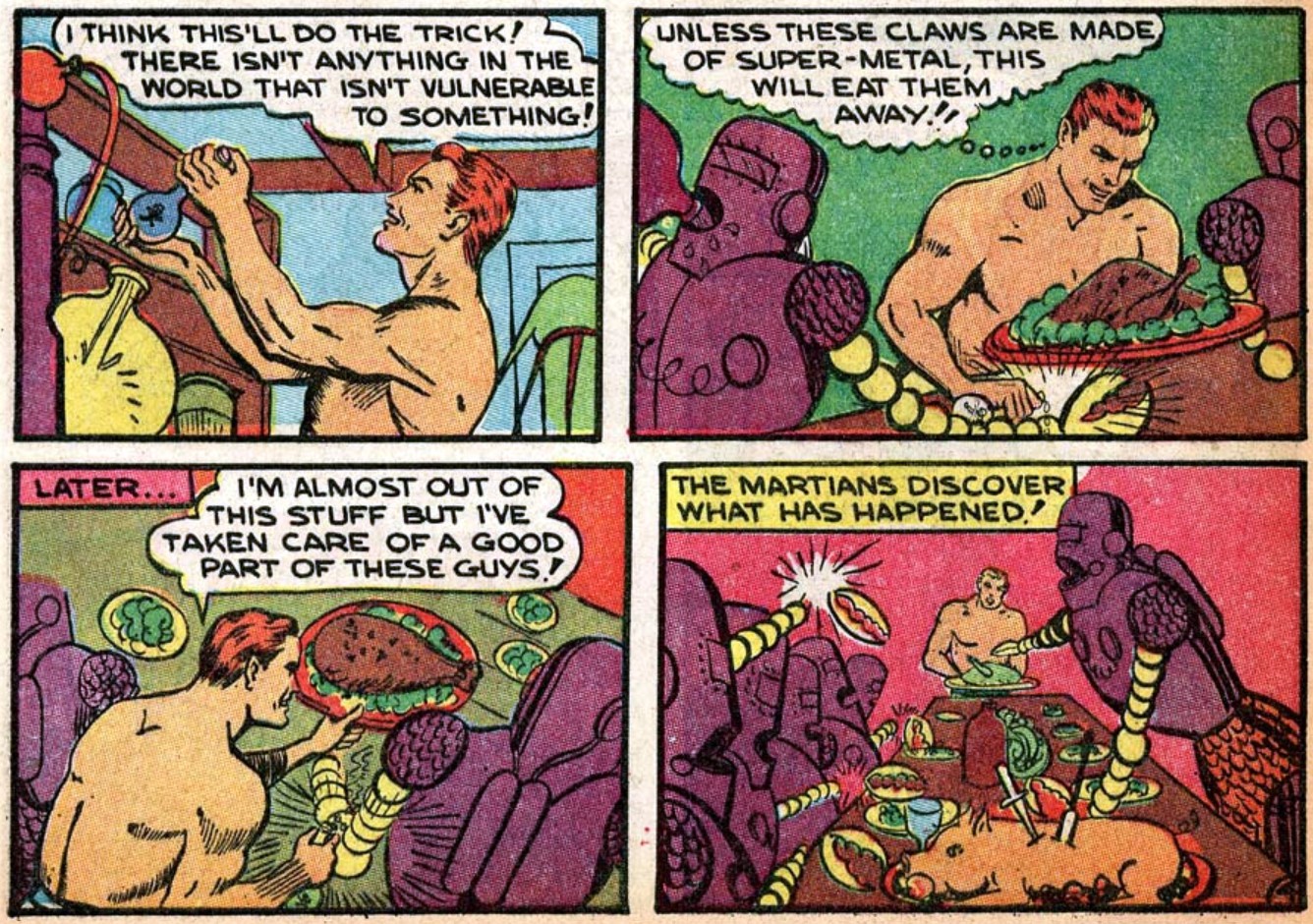
    Just as Doc Strong and his followers are starting to get the post-apocalyptic, WWII-lasted-a-century world of 2041 sorted out, a bunch of robot-looking Martians show up to ruin things by invading their territory on the Isle of Right. It’s just one thing after another with that year.

    Though they are fairly generic hostile invaders, these fellows really distinguish themselves among their class by immediately abandoning whatever plans that they had for Earth in order to indulge in a rager of a party. They want meat and they want booze, in that order and plenty of it. And as a bonus, the fact that the colourists at Blue Ribbon never really settled on a consistent colour scheme for these fellows means that the Party Issue is also the issue in which the Martians all look like they are wearing leopardskin briefs.

    Everything works out okay, however. After Doc and his pals are taken back to Mars for judgment by the King of the Martians they learn that he is a mere robot shell built by friendly Earthman Stinky Jones, who is more than happy to lend his subjects’ might to the task of cleaning up the war-ravaged Earth. (Blue Ribbon Comics 007, 1940)

    Masters of the Pit:

    These inhabitants of the Pit of Horrors aren’t given a lot of characterization, seeing as they are acting as more of an extension of Fantomah’s rough justice than as a functioning society. They live in caves underneath the liminal Jungle and can shape stone with a word and a gesture, and that’s all we really get. (Jungle Comics 007, 1940)

    Melubians:

    The interesting thing about planet Melubia is the fact that they use gravity control technology to surround their world with hundreds of small artificial satellites on which are built small cities or individual dwellings. The less interesting thing about Melubia is the fact that there are two intelligent species living on it, one of whom (the Melubians) want to overthrow the rule of the other (the unnamed, more humanoid species headed by King Molat). We never really get a sense of whether this is a colonial situation or if the two groups evolved on Melubia in parallel, but either way, time/space traveller Stuart Taylor and his pals are quick to uphold the established power structure and put down the rebellion. (Jumbo Comics 016, 1940) 

    Mongonians:

    The Mongonians, inhabitants of the planet Mongo (but a different Mongo than the Flash Gordon one) are some cool four-armed aliens with an unfortunate streak of paranoid xenophobia running through their society, as can be seen in their interaction with time/space traveller Whiz Wilson when he visits their planet in the year 2300 CE.

    It may be that the Mongonians are on to something, however, as they are attacked by hostile inhabitants of the planet Zania just after they toss Whiz – along with two hapless explorers from Earth – into their jail. Everything eventually resolves nicely, as the explorers’ spaceship makes an excellent weapon against the relatively fragile ranks of the Zanian Balloon Corps and peaceful Earth/Mongo relations are established. (Lightning Comics v2 001, 1941)

  • ALIENS AND SO FORTH ROUND-UP 036

    Once again we bring you some aliens.

    the Tribe of Gurban:

    The Tribe of Gurban come down out of “the upper valley of the Nile” and clash with the ancient superhuman Dynaman in his one Golden Age adventure, and there’s a part of me questions whether it’s even worth noting groups like this who are just humans but bigger (about eight to ten feet tall if I’m any judge). But no: giants in caveman singlets who attempt to conquer Egypt c. 2500 BCE and who use sauropods as beasts of burden always deserve recognition, particularly when they’re very technically canon to the Marvel Comics Universe.

    Dynaman doesn’t have too much trouble sending Chief Ribur and his compatriots packing, but not before they unleash their ultimate weapon: the Wild War Beasts. (Daring Mystery Comics 006, 1940)

    Inhabitants of Phobos:

    I didn’t really cover them in the entry on Spacehawk’s Martian enemy Glork, but his plan to smash Phobos into Mars in revenge for him losing an election wasn’t just bad news for the Martians but also for these adorable little dudes. They’re just trying to live on a very small moon, Glork! Why are you hassling them? (Target Comics v1 009, 1940)

    Insect-Men:

    Not two issues after his adventures with the Serviles and their enemies the Heidites, Flip Falcon is hopping back into his all-purpose machine and heading back to Mercury for a little aimless exploring. There, he is confronted by a completely different group of aliens than the two he had already met, and while the out-of-universe explanation for this is simply that the “Flip Falcon” comic was nobody’s baby and had a very loose relationship with internal continuity, it is fun to imagine that the sun-blasted surface of Mercury is just teeming with weird life forms. 

    Though the Insect-Men are huge cool-looking bug-men who communicate using long warbling cries (and are able to break the strand of energy that tethers Flip to his machine, a strand that can restrain Lucifer himself), by fat the most interesting thing about them is their unnamed queen, who shows up soon after her followers capture Flip and reveals that she is the child of a similarly-unnamed human man and an Insect. This raises an enormous number of questions: just who is this human? How did he get to Mercury? When did he decide to make love to an enormous humanoid bug? How is it possible to produce hybrid Earth mammal/ Mercurian insect offspring? Is it just her feet that are weird looking or does she have insectoid legs? None of these questions are in fact answered in the text.

    The Queen of the Insect-Men is, it seems, a more picky lover than her father, and so falls for Flip Falcon the instant she lays eyes on him. After watching a little light gladiatorial combat she is ready for the marriage to commence, and the only thing that saves Flip from a lifetime of caring for weird little grubs with baby faces is that his faithful assistant Adele reinstates the connection between Flip and his machine in time, which fries the wedding party and allows him to fly on home. (Fantastic Comics 007, 1940)

    Insects:

    Like Flip Falcon, Stuart Taylor has a time-space machine and a penchant for blasting himself into the void to see what is there. In this instance, Stuart has flung himself randomly forward in time and fetched up on the shores of the year 9250 CE to find that while humanity yet endures they are at the mercy of a species of giant intelligent insects. After helping to repel an Insect attack on one of the remaining human settlements, Stuart offers to infiltrate their capitol, where he is quickly captured and taken to the Insects’ long-winded ruler.

    Stuart jumps the ruler while it is busy manning the city’s defenses against an attack by the humans, and I must say that I really like the image of it in its little console chair. It really looks like the artist (Lou Fine) really sat down for a minute and thought about how that would work. Though the Insect ruler outclasses Taylor physically, it is undone by its own prowess, as it throws him into a control console and causes an electrical overload that leads to its own death (Taylor is fine). (Jumbo Comics 013, 1940)

  • ALIENS AND SO FORTH ROUND-UP 036

    Once again we bring you some aliens.

    the Tribe of Gurban:

    The Tribe of Gurban come down out of “the upper valley of the Nile” and clash with the ancient superhuman Dynaman in his one Golden Age adventure, and there’s a part of me questions whether it’s even worth noting groups like this who are just humans but bigger (about eight to ten feet tall if I’m any judge). But no: giants in caveman singlets who attempt to conquer Egypt c. 2500 BCE and who use sauropods as beasts of burden always deserve recognition, particularly when they’re very technically canon to the Marvel Comics Universe.

    Dynaman doesn’t have too much trouble sending Chief Ribur and his compatriots packing, but not before they unleash their ultimate weapon: the Wild War Beasts. (Daring Mystery Comics 006, 1940)

    Inhabitants of Phobos:

    I didn’t really cover them in the entry on Spacehawk’s Martian enemy Glork, but his plan to smash Phobos into Mars in revenge for him losing an election wasn’t just bad news for the Martians but also for these adorable little dudes. They’re just trying to live on a very small moon, Glork! Why are you hassling them? (Target Comics v1 009, 1940)

    Insect-Men:

    Not two issues after his adventures with the Serviles and their enemies the Heidites, Flip Falcon is hopping back into his all-purpose machine and heading back to Mercury for a little aimless exploring. There, he is confronted by a completely different group of aliens than the two he had already met, and while the out-of-universe explanation for this is simply that the “Flip Falcon” comic was nobody’s baby and had a very loose relationship with internal continuity, it is fun to imagine that the sun-blasted surface of Mercury is just teeming with weird life forms. 

    Though the Insect-Men are huge cool-looking bug-men who communicate using long warbling cries (and are able to break the strand of energy that tethers Flip to his machine, a strand that can restrain Lucifer himself), by fat the most interesting thing about them is their unnamed queen, who shows up soon after her followers capture Flip and reveals that she is the child of a similarly-unnamed human man and an Insect. This raises an enormous number of questions: just who is this human? How did he get to Mercury? When did he decide to make love to an enormous humanoid bug? How is it possible to produce hybrid Earth mammal/ Mercurian insect offspring? Is it just her feet that are weird looking or does she have insectoid legs? None of these questions are in fact answered in the text.

    The Queen of the Insect-Men is, it seems, a more picky lover than her father, and so falls for Flip Falcon the instant she lays eyes on him. After watching a little light gladiatorial combat she is ready for the marriage to commence, and the only thing that saves Flip from a lifetime of caring for weird little grubs with baby faces is that his faithful assistant Adele reinstates the connection between Flip and his machine in time, which fries the wedding party and allows him to fly on home. (Fantastic Comics 007, 1940)

    Insects:

    Like Flip Falcon, Stuart Taylor has a time-space machine and a penchant for blasting himself into the void to see what is there. In this instance, Stuart has flung himself randomly forward in time and fetched up on the shores of the year 9250 CE to find that while humanity yet endures they are at the mercy of a species of giant intelligent insects. After helping to repel an Insect attack on one of the remaining human settlements, Stuart offers to infiltrate their capitol, where he is quickly captured and taken to the Insects’ long-winded ruler.

    Stuart jumps the ruler while it is busy manning the city’s defenses against an attack by the humans, and I must say that I really like the image of it in its little console chair. It really looks like the artist (Lou Fine) really sat down for a minute and thought about how that would work. Though the Insect ruler outclasses Taylor physically, it is undone by its own prowess, as it throws him into a control console and causes an electrical overload that leads to its own death (Taylor is fine). (Jumbo Comics 013, 1940)

  • DIVINE ROUND-UP 009

    I came across Jumbo Comics 031 while filling in gods from my backlog in another Divine Round-Up entry and realized that the array of entities represented in the Stuart Taylor story in that issue should be presented as a block.

    Mercury: 

    This story begins as most Stuart Taylor stories do, with reckless use of time travel technology. Specifically, Taylor’s love interest Laura Hayward has travelled back to Ancient Greece to buy a new hat, because as we know: women be hat shopping. It’s practically all they think about!

    Laura’s Twentieth Century charms are apparently too much for the local deities to bear, because before Stuart can collect her and be condescending about headwear she is kidnapped by Mercury and spirited away to Olympus, which among other things places the gods of this issue in the hybrid Greco-Roman Pantheon.

    the Oracle of Delphi: 

    Stuart and Dr Hayward’s next move is to consult with the Oracle of Delphi to get a line on how exactly they might follow Mercury and recover Laura from him, and I must say that I really enjoy this weird wisp-of-air version of the Oracle, despite it being tremendously off-model. 

    Medusa: 

    The Oracle directs Our Heroes to seek information from Medusa, who turns out to be depicted in typical style, though somewhat more enormous than is generally the case. I do appreciate that this issue answers the age old question: “is Medusa vulnerable to ray gun blasts?” 

    the Evils Contained in Pandora’s Box: 

    The final stop on Stuart and Hayward’s quest is to retrieve a laurel wreath from inside of Pandora’s Box, which is just sitting in a field in the middle of nowhere. The comic kind of glosses over the fact that Stuart Taylor is responsible for unleashing the Evils of Mankind, but I am fully prepared to do so, as it might just be his worst snafu in a career full of the reckless and unthinking use of time travel. 

    The specific evils released from this version of Pandora’s Box are: 

    Disease – a classic for a reason. The generic ghost look suggests that the artist did not want to draw a lot of pustules.

    Greed – an evil little pig man. 

    Hunger – another one right out of the classic Four Horsemen of the Apocalypse set. Much more gruesome than Disease, when the opposite is usually the case.

    Intolerance – I was going to call this guy an unusual inclusion, but on reflection I’ll bet that most Pandora’s Box lineups include Hate, which isn’t far off. Definitely looks intolerant.

    and bringing up the rear… 

    War, aka Mars: 

    What is unusual inclusion is not War, who I reckon is there pretty often, but specifically Mars, God of War. Is the implication that this fairly major god was powerless until released by human hands? Is the War who is usually depicted in PB lineups some sort of aspect of war or a specific type of warfare? No clue. What is certain is that Stuart Taylor knocks this War’s block off.

    And speaking of block-knocking, that’s what also happens to Mercury once Taylor, Laurel wreath firmly on brow, makes his way to Olympus to finally rescue Laura. The story ends on a fairly limp callback joke about women and their genetic predilection for hat-shopping, one which I rolled my eyes at even before I realized that Laura wearing the divine laurel wreath as a regular hat at the end would be a much better bit. (Jumbo Comics 031, 1941)

  • DIVINE ROUND-UP 009

    I came across Jumbo Comics 031 while filling in gods from my backlog in another Divine Round-Up entry and realized that the array of entities represented in the Stuart Taylor story in that issue should be presented as a block.

    Mercury: 

    This story begins as most Stuart Taylor stories do, with reckless use of time travel technology. Specifically, Taylor’s love interest Laura Hayward has travelled back to Ancient Greece to buy a new hat, because as we know: women be hat shopping. It’s practically all they think about!

    Laura’s Twentieth Century charms are apparently too much for the local deities to bear, because before Stuart can collect her and be condescending about headwear she is kidnapped by Mercury and spirited away to Olympus, which among other things places the gods of this issue in the hybrid Greco-Roman Pantheon.

    the Oracle of Delphi: 

    Stuart and Dr Hayward’s next move is to consult with the Oracle of Delphi to get a line on how exactly they might follow Mercury and recover Laura from him, and I must say that I really enjoy this weird wisp-of-air version of the Oracle, despite it being tremendously off-model. 

    Medusa: 

    The Oracle directs Our Heroes to seek information from Medusa, who turns out to be depicted in typical style, though somewhat more enormous than is generally the case. I do appreciate that this issue answers the age old question: “is Medusa vulnerable to ray gun blasts?” 

    the Evils Contained in Pandora’s Box: 

    The final stop on Stuart and Hayward’s quest is to retrieve a laurel wreath from inside of Pandora’s Box, which is just sitting in a field in the middle of nowhere. The comic kind of glosses over the fact that Stuart Taylor is responsible for unleashing the Evils of Mankind, but I am fully prepared to do so, as it might just be his worst snafu in a career full of the reckless and unthinking use of time travel. 

    The specific evils released from this version of Pandora’s Box are: 

    Disease – a classic for a reason. The generic ghost look suggests that the artist did not want to draw a lot of pustules.

    Greed – an evil little pig man. 

    Hunger – another one right out of the classic Four Horsemen of the Apocalypse set. Much more gruesome than Disease, when the opposite is usually the case.

    Intolerance – I was going to call this guy an unusual inclusion, but on reflection I’ll bet that most Pandora’s Box lineups include Hate, which isn’t far off. Definitely looks intolerant.

    and bringing up the rear… 

    War, aka Mars: 

    What is unusual inclusion is not War, who I reckon is there pretty often, but specifically Mars, God of War. Is the implication that this fairly major god was powerless until released by human hands? Is the War who is usually depicted in PB lineups some sort of aspect of war or a specific type of warfare? No clue. What is certain is that Stuart Taylor knocks this War’s block off.

    And speaking of block-knocking, that’s what also happens to Mercury once Taylor, Laurel wreath firmly on brow, makes his way to Olympus to finally rescue Laura. The story ends on a fairly limp callback joke about women and their genetic predilection for hat-shopping, one which I rolled my eyes at even before I realized that Laura wearing the divine laurel wreath as a regular hat at the end would be a much better bit. (Jumbo Comics 031, 1941)

  • DIVINE ROUND-UP 004

    Can you ever have enough made-up gods? 

    the Goddess of Fire: 

    Crooks Raoul and Victor Ladron hatch a scheme while hiding out on the South Pacific island of Kumoni: since the idol of the local Goddess of Fire looks identical to former super-villain Elena they will engineer her kidnapping, hypnotize her into impersonating the goddess and then kill her to prove that they are more powerful than her and thus deserve to make off with the temple gold. This plan is of course complicated by the fact that Elena is engaged to the nigh-omnipotent super-hero Mr Mystic, and the Ladrons meet a fiery end. 

    God style: idol only (The Spirit Section, 3 November, 1940)

    the Gansha:

    Adam Starr of the Space Legion is on the hunt for space pirate extraordinaire Black Michael, and no mealy-mouthed warning about a “water-god” who has “destroyed all who ventured near his cursed waters” for “untold ages” is going to stop him from searching the Martian canals.

    Starr’s manly skepticism doesn’t pay off this time, as Gansha the Water-God turns out not only to be real but to be a monstrous carnivorous fish that almost devours both him and his submersible without even needing to chew.

    Sadly for monster fans and fish fans alike, Gansha is unceremoniously blown to smithereens when Black Michael attempts to use it as a deathtrap to get rid of Starr without checking to see if he might have a ludicrously overpowered atomic sidearm on his person. Presumably the Martians are happy – the ones who like boat rides and don’t belong to any kind of Gansha-worshipping sect, at least.

    God style: animist (Crash Comics Adventures 003, 1940) 

    Golo:

    We get little in the way of detail on Golo, save that they are worshipped “from Ubangi to the Sudan” and that displaying a Golo fetish can grant safe passage in those areas. And that adventurer Ted Crane thinks it’s all poppycock, of course.

    God style: idol only (Exciting Comics 005, 1940) 

    the Ice Gods: 

    Stuart Taylor and his pals have been time travelling again, and this time they’ve ended up in the clutches of a prehistoric trip at the surprisingly rapid dawn of the last Ice Age, the environmental effects of which have been personified as the malevolent Ice 

    God style: animist (Jumbo Comics 028, 1941)

  • DEMONIC ROUND-UP 001

    I think that demons and devils are the only category of comic book guy I don’t have a running round-up for yet (and having said that I’m sure that there will be more), so here we go:

    Satan: 

    If we’re going do do demons, why not start with the one with the most name recognition of all: Satan. As seen here he has been vexing jodhpured adventurer Tippy Taylor in the form of a mad scientist, only to be defeated when his own transformation of Taylor into a greasy-haired demon made him too powerful to handle. (The Arrow 002, 1940) 

    Mephisto: 

    Stuart Taylor and his pal Dr Hayward are up to their old time travelling tricks, and have stumbled across a wizened old alchemist named Scarpo who has made a deal with the demon Mephisto. Two notes about this exchange: 1. Scarpo is a very bad negotiator. Trading your soul for the secret of transmuting lead into gold is one thing, but then having to go kidnap a queen on top of that? Haggle a bit, bud. 2. Taylor and Hayward witness this demonic bargain and then just wait around for Scarpo to hobble off the Queen Lenore’s castle, kidnap her and then hobble back before they get concerned enough to step in.

    Once they do deign to get involved, the two time travellers are quite hands-on as demon battlers, and despite Mephisto’s jacked bod he is ultimately unable to contend with an axe to the skull from Dr Hayward. (Jumbo Comics 012, 1940)

    the Genii 

    Genies occupy a weird cosmological space and maybe if they were more prevalent in comics I’d find a more nuanced way to categorize them – I reckon we’ll just go on a case by case basis, and this here is a bad’un so he gets shelved with the demons.

    Time traveller Stuart Taylor and his pal Dr Hayward have been sent back in time yet again, this time to Baghdad in the very-hard-to-specify period in which pastiche Arabian Nights stories are set. Because Taylor and Hayward are riding on a flying carpet when they enter the city, Stuart is acclaimed as the legendary Cloud Prince, come to claim his throne. This arouses the ire of previous claimant Jir Haffa, who summons the Genii from its fountain home to wreak vengeance on the interlopers.

    There’s nothing too special about this genie, though he does have a very pleasing pomposity to his speech. The real fun thing about him is that you can explode him with a camera snap because “the genii, being non-physical fails to make an image on the film.” Fun! (Jumbo Comics 029, 1941) 

    the Kings of Darkness:

    By far the best thing about the Genii, however, is that he summons these fellows to deal with Stuart and Dr Hayward. Identical demonic swordsmen/kings? Named Ologa, Kahmo and Madru? And even if you defeat one, his body can be used as the material component to summon five more kings? Just excellent stuff all around. (Jumbo Comics 029, 1941) 

  • DIVINE ROUND-UP 003

    More gods for you to worship.

    Goddess of the Jungle: 

    The Goddess of the Jungle is an idol stolen by an adventurer named Stero while he was roving around Africa. Returning to America with it, he attains some fame and success as a film director, which he attributes to the influence of the Goddess on his life. Is the Goddess of the Jungle really real, or can the whole affair be blamed on the fact that Stero has apparently spent the decade or so that he’s had her whacked out of his gourd on jungle potions courtesy of his servant and Kailo, an acolyte of the Goddess?

    Stero attempts to bring the idol back to where he got it and assume the role of high priest or possibly king, but ultimately he ends up as sacrifice for his sacrilege.

    God style: idol, possible real powers. (The Arrow 001, 1940)

    Dong, God of War:

    Science adventurer Stuart Taylor spent the bulk of his early career being flung back in time by the mad scientist Ali Pasha, and on this particular jaunt he ends up in ~50 BCE helping to defend the Tibetan city of Manchung from invaders, and the key to his eventual success is that the people of Manchung (including Manchung, King of Manchung, natch) have seemingly accidentally invented gunpowder for use as a part of the ritual prayers to Dong, God of War. Thanks, Dong!

    God style: idol (Jumbo Comics 009, 1939)

    Eterno: 

    The comic series “Shangra”, in brief, is about a pair of newspaper correspondents, Joan Joyce and Jack Flynn, who crash their plane in the remote Tibet-adjacent country of Shangraland and get mixed up in the affairs of Shangraland ruler Shangra and his great-great-great granddaughter Lonna. Specifically, the super-powered, 200-year-old Shangra wants Jack to take his place and Lonna wants to marry Jack and murder Joan.

    Eterno here is the fun-looking and very specialized God of Eternal Life who bestows such on the rulers of Shangraland. Like I said, very specialized. 

    God style: idol, some real power (Crash Comics Adventures 003, 1940) 

    The Fire Monster: 

    Just some cavemen fearfully trying to appease a volcano, as you do.

    God style: animist (The Funnies 004, 1937) 

  • REAL PERSON ROUND-UP 002

    How did these real people come to be trapped in the 2D realm? We may never know

    Adolf Hitler:

    This one is more tenuous but Blitz Krieg here is Fuehrer of the pseudo-Nazi Bundonian forces in America. He’s not not a Hitler analog. (Blue Ribbon Comics 006, 1940)

    This is Boris Thorax, first foe of Rex Dexter of Mars, who collaborates with the Moon People in order to take over the Earth of 2000 AD. Look at that hair: that’s a Hitler analog. (Mystery Men Comics 001, 1939)

    Alexander the Great:

    Time traveller Stuart Taylor and pals visit Ancient Macedonia for a larf and get mixed up with Alexander and for some reason the Amazons in an adventure that will inspire much eye-rolling in the modern reader. (Jumbo Comics 017, 1940)

    Charlie Chaplin:

    A “Harly Shaplyn”, attacked by “Bundonians” for making a version of the Great Dictator. (Blue Ribbon Comics 006, 1940)

    Samuel Goldwyn: 

    The bald guy in the Harly Shaplyn panels above is named Sam Wyngold and it took me a concerningly long time to realize that he was an analog of Samuel Goldwyn, the G in MGM.

    Count Zaroff:

    Aristocrat Baron von Krasner wants a little of that “Most Dangerous Game” action, so he wrecks a ship and hunts adventurer Gypsy Johnson and his companions on his be-castled island (Blue Ribbon Comics 006, 1940)

    Heinrich Himmler:

    Unnamed head of secret police for Mr Justice foe and Hitler analog the Dictator. Ends up skewered by his own men. (Blue Ribbon Comics 014, 1941)

    Hermann Goering:

    As “Field Marshall Boreing” is manipulated into killing/ being killed by other Nazi analogs by Mr Justice. Boreing is the only survivor but Mr Justice gets him in the next issue. (Blue Ribbon 015, 1941)

    Kit Carson:

    It’s one of those “why did they bother obfuscating this” moments: “Kit Karston” here is probably meant to Kit Carson, formerly widely regraded as a hero of the Old West and now as a mass murderer. “Gravestone” is obviously Tombstone, Arizona. (Blue Ribbon Comics 007, 1940)

    Joachim von Ribbentrop:

    Nazi foreign minister. As “von Fibbenfop” is manipulated into killing/ being killed by other Nazi analogs by Mr Justice. (Blue Ribbon 015, 1941)

    Joseph Goebbels:

    The confusingly-named Deenbee serves as Minister of Propaganda for Mr Justice foe the Dictator (Blue Ribbon Comics 013, 1941) 

    Two issues later, Deenbee is out and “Gobbels” is manipulated into killing/ being killed by other Nazi analogs by Mr Justice. (Blue Ribbon 015, 1941)

    Mahatma Gandhi:

    Cast as “Mahatmama”, leader of a group of Italian-allied North African Arabs, a choice as baffling as it was racist (though it does fit with the sort of broad confusion between the Middle East and the Indian subcontinent I have noticed in other comics of the period) (Blue Ribbon Comics 013, 1941)