The Curse of Skeleton Munroe

Category: brung back

  • MINOR SUPER-VILLAIN 245: SATANA

    (Flash Comics v1 013, 1941)

     I am torn on Satana! Torn verily in twain!

    My standard critique of a comic book scientist-villain is that they would have been better off using their tech in a non-crime endeavor, but Satana is a brilliant and pioneering young surgeon living in 1941 and given what I know about the history of women in science I think it’s fair to say that if she had decided to make a go of it in academia then there’s a decent chance that all her research would have been stolen by some dude and she might have gotten credit years after her death, if ever. Also, her signature breakthrough involves transplanting human brains (and eyes!) into tigers, which while groundbreaking might be a hard sell to the ethics committee.

    On the other hand, her crime scheme is very bad. In short: she extorts rich men with threats of harm, then gets work as an entertainer called Satana the Tiger Girl at rich guy parties and has her tigers kill the ones that don’t pay up. She only does it once before getting caught by Hawkman, that we know of, but even if she varied the method by which the tiger was introduced to the rich guy, it’s not a sustainable business model. Stylish, yes, but not sustainable.

    Perhaps the best part of the story is when Hawkman comes across a couple of tigers engaging in humanlike behaviors and it nearly drives him insane, like he’s an HP Lovecraft character. Human habits like… sitting near a newspaper and holding a pipe in their mouth. 

    They kinda hint at a return appearance for Satana at the end of the story but she doesn’t actually come back until 2004, in the same Hawkman story that brought back the Thought Terror. She’s a substantially different character by that point, with ties to the Ultra-Humanite and a focus on making humanoid animals via genetic modification. I’ll revisit her when and if I manage to keep doing this long enough to get to that era. It’s good that they brought her back! She’s a fun character!

  • MINOR SUPER-VILLAIN 232: THE THOUGHT TERROR

    (Flash Comics v1 004, 1940)

    I have complicated feelings about the Thought Terror! He has both good and bad traits! 

    Off the bat, the basics. His costume choice is pretty entry level for the Golden Age, but suitable for a guy who employs eye-based super-powers (which he does) and wants to project a certain aura of fear. 

    His name, by contrast, is both unusual and bad, and made all the worse for the fact that it’s almost good. Terror is usually a decent word to use in a name but it just doesn’t have the gravitas to work with a mealy word like Thought. The Thought Tyrant, the Thought Titan, the Thinking Terror… there had to be a better name.

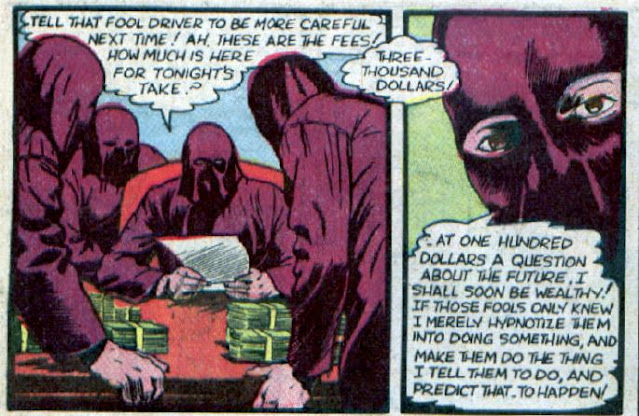
    But maybe a poorly thought-out name is appropriate for this guy, because he’s not a very good planner in general. See, he has these amazing hypnotic powers, and he uses them to convince a little cult of people that he has amazing precognitive powers. He tells fortunes at a hundred bucks a pop and then fulfils them by planting hypnotic suggestions in his subjects’ minds, causing them to act out his predictions.

    Ordinarily, I’d be cheering for this guy – the thing that thinking a lot about super-villains does is give you a lot of opinions about how they should all just stick to easy small-scale scores and that’s what this is – but TT must be getting bored, because he’s making predictions like “you’re going to get drunk and wander into traffic,” and if you’re running a cult complete with costumed goons in New York City in a SUPER-HERO UNIVERSE the thing you absolutely do not want to do is draw attention to yourself by, for instance, killing someone.

    (this does of course happen – Hawkman shows up and ruins the whole operation, including the Thought Terror’s mind)

    One point in the Thought Terror’s favour is his use of costumed goons, in this case dressed just like him and given a dose of hypnotic mind-over-matter treatment such that they are physical powerhouses. Always a great choice, costumed goons. Plus they’re called the Mesmerized Men, a great name!

    Wildly, Thought Terror (without the “the”, not that it improves the name) was brought back in the year of our Lord 2005 along with several other Golden and Silver Age Hawkman foes (Thought Terror specifically in Hawkman v4 039). He’s just kind of a super-torturer, though, and he just kind of disappears halfway through the issue. I guess that’s about as good as he could hope to get.

  • MINOR SUPER-VILLAIN 230: ALEXANDER THE GREAT

    (Flash Comics v1 002, 1940)

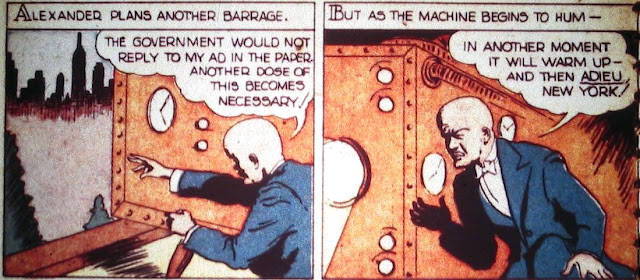
    On the one hand, Alexander the Great is your standard criminal scientist with an ego as big as his great big head who tries to extort the city of New York just as soon as he has developed the technology necessary to do so, in this case a density increasing ray.

    On the other hand, I like him a whole lot more than most criminal scientists. He’s cool! he wears a tux and is kind of suave! He does have that big ol’ dome, which I love on a science villain. He invites Carter Hall and Shiera Sanders over for dinner in an attempt to negotiate Hawkamn’s uninvolvement with his scheme in a sequence that is so cordial and charming that he might have also been angling for a threesome. Hawkman stabs him in the neck with a trident, which is if nothing else, not a common way to die. 

    Top marks to Alexander the Great, in other words. I wish he had showed up again outside of that one All-Star Squadron story that also had Sieur Satan in it.

    BONUS:

    Hawkman takes the density ray as a trophy!

  • MINOR SUPER-VILLAIN 229: THE FAULTLESS FOUR

    (Flash Comics v1 001, 1940)

    I have a lot of fondness for the Faultless Four, the first super-foes of original Flash Jay Garrick. Firstly and most simply, they are a perfect illustration of the power creep that super-heroes introduced to comic books: where this group of criminal scientists armed with mildly-fantastic skills and tactics would have been sufficient to occupy your traditional adventure hero for months if not years, the Flash walks all over them without a care in the world. Crime must adapt to this new reality!

    The second reason for my fondness requires a breakdown of the membership, so here we go, from left to right above:

    Sieur Satan: The biggest talker of the group and absolutely the one with the best look. I don’t think I’m alone in thinking of him as the leader of the Faultless Four even though the only real indication of this is his big mouth. The only thing he actually accomplishes, in fact, is to kill the other three as part of an attempt to get the Flash.

    Serge Orloff: Does absolutely nothing aside from looking cool. He might be suggesting that he is a great enough surgeon that he can bring the dead back to life in the above panel but I wouldn’t believe that he could do it unless I saw the frankenstein in question myself.

    Duriel: I always remember Duriel as “the handsome one” but he’s actually a very weird looking dude! In charge of torturing the Flash’s future father in-law Major Williams for information, he also is the group’s resident pilot.

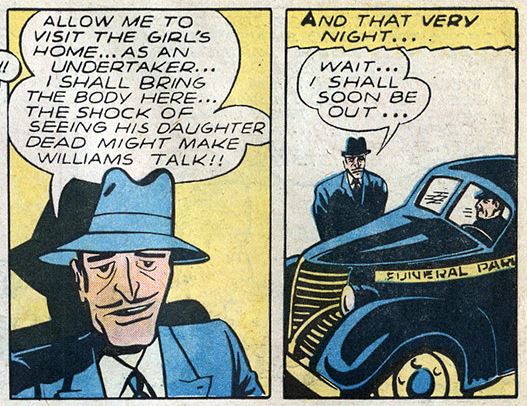
    Smythe: Absent from the first panel for a very good reason – Smythe is the guy who seems to do all of the footwork for the group. He’s the one who does a drive-by assassination attempt on Joan Williams and then later the one who goes to steal the (nonexistent) corpse in order to taunt Major Williams with it. He even has a minion of his very own! A little hearse driver guy!

    There’s a correlation here: how visually interesting a member of the Faultless Four is is inversely proportional to how useful they are. Thus, the one member of the gang to make a second appearance (in a Roy Thomas-penned All-Srar Squadron annual, natch) is Sieur Satan, the biggest fuckup and coolest-looking of the bunch. And as an indignity for poor Smythe alone, his entire role is taken by Duriel in the Secret Origins retelling of the story, leaving him to just stand around like some sort of Serge Orloff until he gets electrocuted.

    In conclusion, Sieur is a semi-archaic French honorific that is a root of the more familiar monsieur.

  • MINOR SUPER-HERO 022: MADAM FATAL

    (Crack Comics 001-022, 1940-1942)

    Madam Fatal is the alter ego of one Richard Stanton, famous actor and female impersonator. Shortly after retiring to settle down, Stanton’s young daughter was kidnapped by a vengeful enemy and his wife died of grief. Going undercover as the elderly Madam Fatal in order to avoid recognition Stanton spent the next nine years looking for his child. In the first Madam Fatal adventure, he finds the kidnapper but not the kid and since the kidnapper ends up dead, the case of Richard Stanton’s missing child just… never gets addressed again.

    Madam Fatal comics are pretty fun as a rule. They’re short and snappy, and since a big part of the character’s appeal is the incongruity of a little old lady (as mentioned in the past, they got no respect in the Golden Age) being in adventure situations, she is extremely kinetic and rough and tumble.

    There’s absolutely no exploration of gender roles or sexuality because, duh, it’s the 1940s, but Stanton and Fatal are generally treated as being two different genders. A modern revival of the character could do interesting things if done right, by the right people. Mostly though, Madam Fatal is a punchline in modern comics.

    The exception to this came in The Shade v2 006, 2012. James Robinson (and Darwyn Cooke) introduced Hot Older Lady Madam Fatal, made her just as much of a shitkicker as the original, and even (finally) resolved the case of Richard Stanton’s missing child. A worthy if brief revival!

  • MINOR SUPER-HERO 020: THE RED TORPEDO

    (Crack Comics 001-020, 1940-1942)

    The Red Torpedo is Jim Lockhart, a guy who came up with a design for the ultimate one-man submarine and turned that into his whole personality. This is a not-uncommon Golden-Age comics trope that kind of petered out once the world was no longer awash with mechanized combat – Silver Age super-vehicles tended more toward the exploration side of things.

    So: Jim Lockhart, young US Navy officer resigns his commission after being told that his submarine design was unworkable. He builds it anyway, with the help of his fiancé, Meg, then seemingly leaves her behind as well – a “Peggy” show up as his assistant a few issues later but after that he’s a strictly one-man operation. 

    Lockhart shows up here and there in the extended DCU – most notably in a Roy Thomas engineered cull of the old Quality Comics characters in All-Star Squadron back in the day. Like most of the others killed off in that ish, Red Torpedo got better and shows up whenever someone needs a really good submarine for something.

    Good luck finding it but the thing that really cemented my love for this guy is the Crack Comics installment of the Next Issue Project. A really lovely, simple, melancholy story about a submarine man.

  • MINOR SUPER-VILLAIN 163: PROFESSOR RADIUM

    (Batman Comics 008, 1941)

    Professor Henry “Radium” Ross has things stacked against him from at least three different angles by my count. First, he’s a classic Victim of Orthodoxy as his research is rejected as too fantastic by a stick-in-the-mud institute director and he feels compelled to test his radium-based cure for death on himself. It works, but turns him into a radioactive man in the process, and he starts to go mad from a combination of radiation poisoning and (presumably) grief after he accidentally kills both his partner and his sweetheart (that’s angle no. 2, by the way).

    The third misfortune to strike Professor Radium is Batman, who is much more of a protector of capital than he will be later and consequently is more concerned with preventing Ross from stealing the valuable drug that he need to treat his condition than with helping him get better. They fight and Prof Rad goes into the harbour, presumably to drown. OR DOES HE, the final caption box asks? No, depending on which comic book reality you live in. He makes an appearance as part of a squad of radioactive bad guys in Infinite Crisis, so at least one version of him evidently hangs out for up to 70 years before getting motivation to do some evil.

    They should have brought him back beforehand (or used him since). He’s neat.

  • MINOR SUPER-VILLAIN 163: PROFESSOR RADIUM

    (Batman Comics 008, 1941)

    Professor Henry “Radium” Ross has things stacked against him from at least three different angles by my count. First, he’s a classic Victim of Orthodoxy as his research is rejected as too fantastic by a stick-in-the-mud institute director and he feels compelled to test his radium-based cure for death on himself. It works, but turns him into a radioactive man in the process, and he starts to go mad from a combination of radiation poisoning and (presumably) grief after he accidentally kills both his partner and his sweetheart (that’s angle no. 2, by the way).

    The third misfortune to strike Professor Radium is Batman, who is much more of a protector of capital than he will be later and consequently is more concerned with preventing Ross from stealing the valuable drug that he need to treat his condition than with helping him get better. They fight and Prof Rad goes into the harbour, presumably to drown. OR DOES HE, the final caption box asks? No, depending on which comic book reality you live in. He makes an appearance as part of a squad of radioactive bad guys in Infinite Crisis, so at least one version of him evidently hangs out for up to 70 years before getting motivation to do some evil.

    They should have brought him back beforehand (or used him since). He’s neat.

  • MINOR SUPER-VILLAIN 156: OOM THE MIGHTY

    (All-Star Comics 003, 1940)

    Oom the Mighty is, by his own description, a sort of low-rent Gozer the Gozerian: a murderous entity of the ancient past who has returned to kill again. Only instead of whole civilizations boiling in his belly or what have you, Oom kills a handful of people every full moon – still bad, but not quite as much cosmic terror.

    The original appearance of Oom (involving a dimension-hopping battle with the Spectre) maybe kind of implied that he was a spirit that was possessing a bronze grotesque, but later appearances – Oom, like Nyola before him, was Roy Thomased into the Monster Society of Evil in the pages of All-Star Squadron – treat the body as his own, thus introducing the question of why the city of Cliffland New Jersey was festooning their buildings with prehistoric statuary. Whichever is the case, possibly the most interesting thing about Oom is the fact that sometime in the last 30ish years he seems to have made the leap from Justice Society/ Spectre villain to Marvel Family foe, presumably via the Monster Society link.

  • MINOR SUPER-VILLAIN 153: KULAK

    (All-Star Comics 002, 1940)

    Kulak is the High Priest of Brztal, which is originally implied to be an ancient lost civilization but I believe is later defined as extra-dimensional in some way. His deal is ostensibly that he is upset that his tomb was disturbed so he is going to destroy humanity, but I don’t know that he wasn’t just looking for an excuse to flex his magical muscles. He gets up to a lot of fun stuff with disasters – worldwide flooding and riots, plagues of lucusts etc – and summons armies of ancient Brztalan dead to smite his enemy but ultimately is put down again by the Spectre.

    In what is going to be an ongoing theme with these one-off All-Star villains, he eventually gets Roy Thomased into the pages of All-Star Squadron to mix it up with the Spectre one more time.