The Curse of Skeleton Munroe

Category: Cat Man

  • CATALOGUE OF WOUNDS 013

    If I see a wound, I catalogue it.

    Camilla, Queen of the Lost Empire:

    Shot in the back with an arrow. (Jungle Comics 019, 1941)

    Captain Flag:

    Nearly dies of the Black Hand’s horrible hand disease. (Blue Ribbon Comics 016, 1941)

    the Cat-Man:

    Stabbed in the chest, to death (he gets better). (Crash Comics Adventures 004, 1940)

    Killed by a blood-freezing ray. He gets better again. (Crash Comics Adventures 005, 1940)

    Dynamo:

    Dynamo gets his skull creased by a bullet in the classic fashion. (Science Comics 005, 1940)

    the Green Mask:

    Michael Shelby is shot in the chest, prompting pal Professor Lascomb to stick him in the machine that turns him into the Green Mask. (Green Mask v1 001 1940)

    Domino the Miracle Boy:

    Later in the same issue, the boy known only as Don gets seriously exploded and must also be placed in the machine. (Green Mask v1 001, 1940)

    Kaänga: 

    Not even being an off-brand Tarzan can save you from being shot in the left shoulder,, as Kaänga learns here. (Jungle Comics 010, 1940)

    the Mask:

    District Attorney Colby is blinded by acid as part of his journey to becoming the Mask. (Exciting Comics 001, 1940)

    Tabu, Wizard of the Jungle:

    Tabu is shot in the right shoulder by this jerk. (Jungle Comics 019, 1941)

    Just one issue later, Tabu is speared in the right arm by a different jerk. (Jungle Comics 020, 1941)

  • FASCIST GOON CLEARING HOUSE 012

    I know we’re all tired of fascist, but these are fake, historical fascists who get beat up, so it’s cathartic at least. 

    the Blitzys:


    The Blitzys, aka the Yellowshirts, have a never-clearly-articulated plan to divide American society by beating people up for not joining the Army. I assume that there must be more to it than that but the focus of the adventure is not on Spy Smasher beating up these particular fascists (though beat them he does) but in avoiding them long enough to get to Washington and warn the President about this fifth column activity. (Whiz Comics 020, 1941)

    The Blitzys, armed with a completely silent bomber plane, continue to vex Spy Smasher and America on behalf of their boss the War Lord through to Whiz Comics 022, when their leader Kurt Bund is finally run to ground in his base underneath a local cemetery and properly walloped.

    Categorized in: Crime as Theme (Naziism), Objects (Shirts)

    the Ring:

    A gang of airplane saboteurs with so little assigned motivation that they might as well be in it for the love of the game, the Ring is undone by FBI agent Dick Star and his aide, the unusually-named Pinky Dink. (Bang-Up Comics 001, 1941)

    Categorized in: Generica (Rings), Ideologies (Crypto-Fascists)

    Unnamed Giant Robot Unit: 

    Eventually the comic timeline that I’m working on is going to get to the point that the US is World War II, and the flow of vague Nazi-adjacent antagonist groups is going to dry up and be replaced mainly with overt Nazi and Japanese super-villains. Does this mean the end of the Fascict Goon Round-Up? surely not, because there needs to be a place to document the weird over-the-top schemes that the comic book version of the Axis powers get up to.

    Take this one: two enormous robots rise out of the depth of New York Harbor and destroy a patrol boat before stomping into the city proper. 

    Then, after making their way downtown, they disgorge a bunch of Nazi soldiers to… do something. Honestly it’s unclear what these guys are up to and more to the point just what havoc they could raise that a giant Robot couldn’t. In any case they don’t have long on the ground before they are beaten up by the Flag-Man and Rusty. 

    All this action in the city is especially baffling as the actual plan is to blow up a chunk of the US fleet with a minefield. Maaaybe the idea is to draw them in with the giant robot attack? In any case, the Flag-Man steers one of the robots into the minefield and takes care of the entire problem with one huge explosion. (Captain Aero Comics 001, 1941)

    Categorized in: Accessories (Mecha)

    the Swastika Council:

    It’s not entirely clear just what kind of fascist group the Swastika Council is, thanks to the fact that their sole appearance concerns the fact that David Merrywether, aka the Cat-Man, is about to expose their membership to the papers and their efforts to prevent him from doing that. My money’s on them being some sort of fifth columnists. (Cat-Man Comics 004, 1941)

    Categorized in: Crime as Theme (Naziism), Generica (Councils)

  • FASCIST GOON CLEARING HOUSE 012

    I know we’re all tired of fascist, but these are fake, historical fascists who get beat up, so it’s cathartic at least. 

    the Blitzys:


    The Blitzys, aka the Yellowshirts, have a never-clearly-articulated plan to divide American society by beating people up for not joining the Army. I assume that there must be more to it than that but the focus of the adventure is not on Spy Smasher beating up these particular fascists (though beat them he does) but in avoiding them long enough to get to Washington and warn the President about this fifth column activity. (Whiz Comics 020, 1941)

    The Blitzys, armed with a completely silent bomber plane, continue to vex Spy Smasher and America on behalf of their boss the War Lord through to Whiz Comics 022, when their leader Kurt Bund is finally run to ground in his base underneath a local cemetery and properly walloped.

    Categorized in: Crime as Theme (Naziism), Objects (Shirts)

    the Ring:

    A gang of airplane saboteurs with so little assigned motivation that they might as well be in it for the love of the game, the Ring is undone by FBI agent Dick Star and his aide, the unusually-named Pinky Dink. (Bang-Up Comics 001, 1941)

    Categorized in: Generica (Rings), Ideologies (Crypto-Fascists)

    Unnamed Giant Robot Unit: 

    Eventually the comic timeline that I’m working on is going to get to the point that the US is World War II, and the flow of vague Nazi-adjacent antagonist groups is going to dry up and be replaced mainly with overt Nazi and Japanese super-villains. Does this mean the end of the Fascict Goon Round-Up? surely not, because there needs to be a place to document the weird over-the-top schemes that the comic book version of the Axis powers get up to.

    Take this one: two enormous robots rise out of the depth of New York Harbor and destroy a patrol boat before stomping into the city proper. 

    Then, after making their way downtown, they disgorge a bunch of Nazi soldiers to… do something. Honestly it’s unclear what these guys are up to and more to the point just what havoc they could raise that a giant Robot couldn’t. In any case they don’t have long on the ground before they are beaten up by the Flag-Man and Rusty. 

    All this action in the city is especially baffling as the actual plan is to blow up a chunk of the US fleet with a minefield. Maaaybe the idea is to draw them in with the giant robot attack? In any case, the Flag-Man steers one of the robots into the minefield and takes care of the entire problem with one huge explosion. (Captain Aero Comics 001, 1941)

    Categorized in: Accessories (Mecha)

    the Swastika Council:

    It’s not entirely clear just what kind of fascist group the Swastika Council is, thanks to the fact that their sole appearance concerns the fact that David Merrywether, aka the Cat-Man, is about to expose their membership to the papers and their efforts to prevent him from doing that. My money’s on them being some sort of fifth columnists. (Cat-Man Comics 004, 1941)

    Categorized in: Crime as Theme (Naziism), Generica (Councils)

  • MINOR SUPER-HERO ROUND-UP 074

    Some more of those “minor super-heroes” you like so much. 

    the Cat-Man **Update**:

    Hey, it’s the Cat-Man! As you may or may not recall, the Cat Man (sans hyphen) debuted in Crash Comics Adventures in 1940 and was the only survivor of that comics short run. The most obvious change to his character is his costume, which goes from its former jungle chic look through a blue-and-orange phase  before settling on the orange-and-darker orange look that he will stick with for the rest of his career.

    In addition to the costumes and the hyphen, Cat-Man got a slight tweak to his origin: rather than being orphaned by a hostile tribe in India, David Merrywether’s parents are now said to have been killed by bandits in Burma. David also has a job now: he’s a private detective for the first four issues of Cat-Man Comics, after which he enlists and becomes a lieutenant in the US Army.

    The Cat-Man also gets a couple of new powers in 1941: he is able to see otherwise-invisible radiation and displays some degree of super strength.

    Finally: his nine lives. Though he still has this power, David manages to only die once during the whole of 1941, bringing his total remaining lives down to six.

    the Kitten: 

    Actually, not quite finally, as this is also the year that the Cat-Man gets a sidekick. While en route to investigate a series of train explosions, Lt David “the Cat-Man” Merrywether picks up a hitchhiking man and his niece. The man turns out to be a real scumbag, but the girl, named Katie Conn, turns on her uncle rather than see him rob and possibly murder Merrywether. Once the uncle is tossed in the hoosegow it’s a classic case of a child just entering a super-hero’s orbit and getting auto-adopted.

    Katie turns out to be the orphaned child of a pair of circus acrobats, which as we know is a perfect background for a potential super-hero’s sidekick to have. She also appears to be a few years younger than your typical kid sidekick – if they average in at about 13-15 I’d call her 11 or 12, though as usual the limitations of Golden Age art make estimating the age of kids difficult at best.

    Merrywether does his best to conceal his dual identity from his new ward but doesn’t quite manage it, and her self-assigned new role as the Cat-Man’s sidekick is announced in the final panel of the last Cat-Man story of 1941. More specifics on her in action as a sidekick in 1942. I will say that it’s nice to see a kid sidekick with both a costume and a code name. (Cat-Man Comics 005, 1941)

    Blaze Baylor: 

    Blaze Baylor is the son of the famous fire chief Smoky Baylor, who was killed by arsonists, and who is now a very specific anti-arson crimefighter. Though the name of the strip is “‘Blaze’ Baylor and the Arson Ring,” there is no indication in any of his adventures that the arsonists he battles are connected to one another in any way. (Cat-Man Comics 001 1941)

    Dr Diamond: 

    Dr Drake Gorden is bound for the South Seas when the freighter he is travelling on is sunk by a waterspout. He passes out after washing up on a beach at the base of an unscaleable cliff and is carried off by an eagle that takes him to the home of a frankly weird guy who has dressed him in a generic super-hero costume.

    This never-named man explains that thirty years prior he had come into possession of a legendary black diamond that conferred great physical power to its wielder, and that he had retired to the island to await the arrival of someone worthy enough to receive it. Dr Gorden, a man who he just met and who has spoken all of thirty-three words to him, several of which were to refer to a pair of brown pants as his “American clothes,” is his pick.

    Whatever the opposite of the Refusal of the Call part of the Hero’s Journey is, that’s what Dr Gorden has. He immediately renames himself Dr Diamond and launches into a monologue about just how hard he’s going to bust up crime that is so over the top that it would make me personally reconsider giving him any sort of power whatsoever. Despite my misgivings, Dr Diamond does an adequate job of using the powers conferred by the gem (super strength, enhanced speed, some degree of invincibility) to battle crime for four issues before fading into the mists of obscurity. (Cat-Man Comics 001, 1941) 

  • MINOR SUPER-HERO ROUND-UP 074

    Some more of those “minor super-heroes” you like so much. 

    the Cat-Man **Update**:

    Hey, it’s the Cat-Man! As you may or may not recall, the Cat Man (sans hyphen) debuted in Crash Comics Adventures in 1940 and was the only survivor of that comics short run. The most obvious change to his character is his costume, which goes from its former jungle chic look through a blue-and-orange phase  before settling on the orange-and-darker orange look that he will stick with for the rest of his career.

    In addition to the costumes and the hyphen, Cat-Man got a slight tweak to his origin: rather than being orphaned by a hostile tribe in India, David Merrywether’s parents are now said to have been killed by bandits in Burma. David also has a job now: he’s a private detective for the first four issues of Cat-Man Comics, after which he enlists and becomes a lieutenant in the US Army.

    The Cat-Man also gets a couple of new powers in 1941: he is able to see otherwise-invisible radiation and displays some degree of super strength.

    Finally: his nine lives. Though he still has this power, David manages to only die once during the whole of 1941, bringing his total remaining lives down to six.

    the Kitten: 

    Actually, not quite finally, as this is also the year that the Cat-Man gets a sidekick. While en route to investigate a series of train explosions, Lt David “the Cat-Man” Merrywether picks up a hitchhiking man and his niece. The man turns out to be a real scumbag, but the girl, named Katie Conn, turns on her uncle rather than see him rob and possibly murder Merrywether. Once the uncle is tossed in the hoosegow it’s a classic case of a child just entering a super-hero’s orbit and getting auto-adopted.

    Katie turns out to be the orphaned child of a pair of circus acrobats, which as we know is a perfect background for a potential super-hero’s sidekick to have. She also appears to be a few years younger than your typical kid sidekick – if they average in at about 13-15 I’d call her 11 or 12, though as usual the limitations of Golden Age art make estimating the age of kids difficult at best.

    Merrywether does his best to conceal his dual identity from his new ward but doesn’t quite manage it, and her self-assigned new role as the Cat-Man’s sidekick is announced in the final panel of the last Cat-Man story of 1941. More specifics on her in action as a sidekick in 1942. I will say that it’s nice to see a kid sidekick with both a costume and a code name. (Cat-Man Comics 005, 1941)

    Blaze Baylor: 

    Blaze Baylor is the son of the famous fire chief Smoky Baylor, who was killed by arsonists, and who is now a very specific anti-arson crimefighter. Though the name of the strip is “‘Blaze’ Baylor and the Arson Ring,” there is no indication in any of his adventures that the arsonists he battles are connected to one another in any way. (Cat-Man Comics 001 1941)

    Dr Diamond: 

    Dr Drake Gorden is bound for the South Seas when the freighter he is travelling on is sunk by a waterspout. He passes out after washing up on a beach at the base of an unscaleable cliff and is carried off by an eagle that takes him to the home of a frankly weird guy who has dressed him in a generic super-hero costume.

    This never-named man explains that thirty years prior he had come into possession of a legendary black diamond that conferred great physical power to its wielder, and that he had retired to the island to await the arrival of someone worthy enough to receive it. Dr Gorden, a man who he just met and who has spoken all of thirty-three words to him, several of which were to refer to a pair of brown pants as his “American clothes,” is his pick.

    Whatever the opposite of the Refusal of the Call part of the Hero’s Journey is, that’s what Dr Gorden has. He immediately renames himself Dr Diamond and launches into a monologue about just how hard he’s going to bust up crime that is so over the top that it would make me personally reconsider giving him any sort of power whatsoever. Despite my misgivings, Dr Diamond does an adequate job of using the powers conferred by the gem (super strength, enhanced speed, some degree of invincibility) to battle crime for four issues before fading into the mists of obscurity. (Cat-Man Comics 001, 1941) 

  • MINOR SUPER-VILLAIN 914: THE BRIDGE-DESTROYERS

    (Cat-Man Comics 001, 1941)

    Some villains are puzzles, high-concept enigmas whose motivations and goals are a mystery that must be solved to understand them. The Bridge-Destroyers are not that. They are exactly what their name declares them to be: a couple of guys in a tower who destroy bridges using a long-range heat-ray cannon.

    But why the Bridge-Destroyers destroy bridges, that must be a mystery, yes? Perhaps it is, but the authorities are pretty certain that they are working for “some foreign power” to disrupt America’s ability to move troops and war materiel from place to place. Despite this, the official response to the group seems to be resigned acceptance as their defenses are so good that it is considered foolhardy to even try to stop them.

    Despite their fearsome reputation, Cat-Man is determined to face the Bridge-Destroyers head-on, which means that he meets their fist line of defense: a bunch of guys who live in a hole just outside the tower and suck up intruders using a giant vacuum. This might be enough to stop your every-day lawman, but the Cat-Man has all the powers of a cat, man. He simply avoids being battered to death by the whirling storm of debris and beats up the hole-dwellers when they come to retrieve his corpse.

    To their credit, the Bridge-Destroyers do manage to kill Cat-Man with a blast from their heat-ray as he makes his second approach to the tower but then they are treated to a lesson about how the “nine lives” part of his super-powers works. Stripped of their ray, their tower and their hole full of men, the masterminds between the war on America’s infrastructure are swiftly subdued.

  • MINOR SUPER-VILLAIN 914: THE BRIDGE-DESTROYERS

    (Cat-Man Comics 001, 1941)

    Some villains are puzzles, high-concept enigmas whose motivations and goals are a mystery that must be solved to understand them. The Bridge-Destroyers are not that. They are exactly what their name declares them to be: a couple of guys in a tower who destroy bridges using a long-range heat-ray cannon.

    But why the Bridge-Destroyers destroy bridges, that must be a mystery, yes? Perhaps it is, but the authorities are pretty certain that they are working for “some foreign power” to disrupt America’s ability to move troops and war materiel from place to place. Despite this, the official response to the group seems to be resigned acceptance as their defenses are so good that it is considered foolhardy to even try to stop them.

    Despite their fearsome reputation, Cat-Man is determined to face the Bridge-Destroyers head-on, which means that he meets their fist line of defense: a bunch of guys who live in a hole just outside the tower and suck up intruders using a giant vacuum. This might be enough to stop your every-day lawman, but the Cat-Man has all the powers of a cat, man. He simply avoids being battered to death by the whirling storm of debris and beats up the hole-dwellers when they come to retrieve his corpse.

    To their credit, the Bridge-Destroyers do manage to kill Cat-Man with a blast from their heat-ray as he makes his second approach to the tower but then they are treated to a lesson about how the “nine lives” part of his super-powers works. Stripped of their ray, their tower and their hole full of men, the masterminds between the war on America’s infrastructure are swiftly subdued.

  • MINOR SUPER-HERO ROUND-UP 021

    They’re just these guys, you know?

    the Solar Legion:

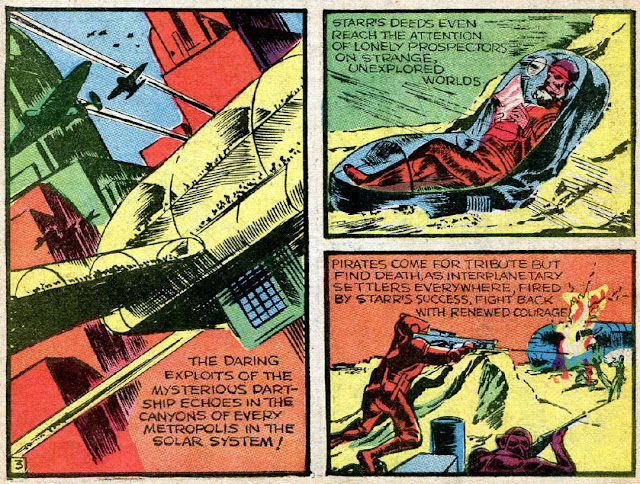
    The Solar Legion is the brainchild of Adam Starr, a 23rd Century man about whom very little is ever revealed. Emerging from a concealed base on Io, he sets out to rid the Solar System of the scourge of space piracy via the most direct route possible: blowing up all of the space pirates.

    Starr’s exploits have their intended effects: 1. many pirates are blown up and 2. the authorities are convinced of the need for an interplanetary peacekeeping force, aka the Solar Legion, with Starr as the head.

    Despite his new position of authority, the remaining four Solar Legion stories feature Adam Starr as a solo operator, hunting down pirates and settling factional disputes with his ray gun and two-fisted attitude. (Crash Comics Adventures 001, 1940)

    the Cat Man:

    The Cat Man is David Merrywether, who is orphaned in India after his father William brings his entire family along on a scientific expedition to collect butterflies and they run afoul of a hostile tribe (no word on whether William did something to draw their ire or if they were universally hostile to intruders – in either case the question of just why he would have his wife and two young children along on such a dangerous endeavour remains unaddressed). David, the only survivor, ends up being adopted by a tiger and spends his youth with her in an expository caption.

    (I really appreciate this “yadda yadda yadda” version of the Raised by Animals origin story. You’ve heard it all before, folks: he lived among the tigers and now he has tiger powers. He’s back in civilization because he saved a tiger’s life and that tiger’s mother owed him a favour. Now let’s get to the costumed antics!)

    Cat Man has all of the expected cat-related superpowers – enhanced dexterity, strength, speed and jumping ability – plus a few less common ones like the ability to speak to tigers and the ability to fall any distance and land on his feet without harm. He also has a cat’s enhanced night vision, which takes the form of literal beams of light that emit from his eyes. Fun!

    The Cat Man’s most striking power is that of having nine lives, bestowed on him by his adoptive tiger mama when he saved her cub. The problem with the “multiple lives” superpower has always been that it’s not interesting if it’s not used, with the result being that after two 1940 appearances Cat Man is down to seven lives. Surely this cannot be sustained going forward.

    Speaking of going forward, we will be hearing more out of Cat Man, one of the minor successes of the Golden Age. Changes are afoot once he has his own title in 1941, starting with a revisions to his much-derided original costume (personally, I like this costume. It very much feels like the sort of thing that someone who had spent their youth alone in a jungle might put together). See you then! (Crash Comics Adventures 004, 1940)

    UPDATE 1941

    Tornado Tom:

    Like the word-box says: Tornado Tom is just some guy who was sucked up by a tornado one day and when he came down again he was inhumanly strong, fast and durable. He also had amnesia, so even though he shares the name Tom Kenny with the famous voice actor of such characters as Spongebob Squarepants, he himself did not know that.

    Tornado Tom’s origin is never really explored and the two hints we get about the nature of his powers are a bit contradictory:

    Possible Mystical Origin: in Cyclone Comics 002, Tom battles some thugs in a stuffy apartment and is drained of vitality by the lack of fresh breezes. In a moment of desperation he calls out to Boreas, “God of Wind” and is revived and re-energized by a gust of air that blasts through the window. Talking points: was it a mystic tornado sent by the gods? Is Tom Kenny a descendant of Boreas or another Greco-Roman figure?

    Possible Biological Origin: In Cyclone Comics 005* Tornado Tom’s blood is asserted to have miraculous healing properties, possibly as  a result of his being some sort of mutant or mutate. Talking points: was it a radioactive tornado?

    This is all ultimately clutching at straws because Tornado Tom is a classic Golden Age cipher, much as I would like to know otherwise. (Cyclone Comics 001, 1940)

    * his blood is reportedly transfused into a dying man in Cyclone Comics 004 but that issue is currently unavailable.

    Mister Q:

    Your typical master of disguise style hero, with a manservant named Ying and a dog named Satan. I quite like Mister Q because I’m pretty sure that his name is derived from the idea of wartime Q-Ships, ie, warships disguised as harmless merchant vessels. It’s a neat name for a disguise-based crimefighter! (Cyclone Comics 001, 1940)

  • MINOR SUPER-HEROES 007-014: AMAZING-MAN COMICS ROUNDUP 1939

    (Amazing-Man Comics 005-026, 1939-1942)

    All the ephemeral Golden Age heroes who stalked the pages of Amazing-Man Comics:

    The Iron Skull! I love him. His origin and so forth is doled out after a few issues so initially you don’t know that he is a cyborg war casualty in the far future world of 1970. The most important things are there from the start, though: his huge anime eyes and the fact that every bullet or attack made against him unerringly hit him in his invulnerable head.

    SKULL SCORE: 2/5 Not very skully but he gets a point for the lack of nose.

    Minimidget: Just a super-small guy with a problematic name. He and his galpal Ritty were shrunk and employed as henchmen by a pervert scientist before redeeming themselves via acts of public service. 

    Chuck Hardy: Chuck and Jerry, a couple of deep sea divers, end up in the subterranean land of Aquatania, beneath the Marquesas Islands. They turn out to be super-strong there for murkily-explained reasons and have adventures with the monstrous flora and fauna and the various near-human races. The best part is absolutely the little lobster antennae that all of the various types of Aquatanians have.

    Mighty Man is a huge dude who is the last descendant of folk who settled in a valley where everything is huge. After murdering a bunch of evil cowboys, he emerges from his valley to fight crime. Eventually he gets the power to change size.

    UPDATE 1940

    The Shark! A water-based hero who can talk to sea life and must hit the water regularly, which is about standard for water guys!

    ADDENDUM: Later on he meets his father Neptune and his adventures turn into father/son outings, which rules.

    UPDATE 1940

    Magician from Mars: Not only is Jane 6em35 an Earthian/Martian hybrid from an unspecified future, and not only was she accidentally irradiated as a baby in a way that activated a lot of vague superpowers (including flight, super-strength and a seemingly complete control over matter) but she is a practical and morally flexible hero who takes advantage of the chaos surrounding a rocket crash to make off with $3 million in gold before saving the day. Very fun. Plus: jodhpurs!

    The Cat Man: a very marginal entry on this list. In his first appearance, he develops his signature technique of dressing like an old lady and having his trained cat scratch people with poisoned claws to murder three former criminal confederates, which isn’t particularly heroic? His second appearance is in more of a vigilante role as he murders a gang of wanted men. How could I not include this loveable murderous scamp, really?