What is Samson’s signature move? Pushing down two pillars while standing between them. What do we want to see? That!


Honorable mention:

(hover for issue numbers)
What is Samson’s signature move? Pushing down two pillars while standing between them. What do we want to see? That!
Honorable mention:
(hover for issue numbers)
(Fantastic Comics 011, 1940)


Sometimes it’s nice to read a story about a straightforwardly criminal scientist, and that’s just what Professor Donaldson is. He’s invented an “electronic exploder” which can turn steel to dust and by gar if he isn’t going to use that to extort some money out of people with steel things that they would like to stay intact, such as the superstructure of a skyscraper.

Donaldson is also prepared to pivot: when his original attempt to set up a protection racket fails he attempts to extort NYC itself. This also fails, because Samson is in the city and the Generic New York Mayor has a guy on staff who knows how super-heroes work. Why, they often don’t even ask to be paid!

But Professor Donaldson just won’t stop pivoting! If extortion isn’t going to pay off then a steel-dissolving ray is the perfect thing for bank robbery!


The bank robbery is, alas, Donaldson’s last pivot before Samson and David catch up to him. He puts up a very brave front but ultimately a pasty-faced lab rat, even armed with a fire axe, is no match for David, let alone Samson.

At least Donaldson’s death is somewhat poetic, as he is run down, or “wrecked” by a train, just as he himself had wrecked a train in his earlier campaign to extort the city.
Shout out also Professor Donaldson’s unusually large number of named henchmen. Good luck looking for new employment Buck, Butch, Silky, Mike, Slinky and Bill. Except not Buck because Samson killed him. Rest in peace, Buck.
(Fantastic Comics 011, 1940)
Sometimes it’s nice to read a story about a straightforwardly criminal scientist, and that’s just what Professor Donaldson is. He’s invented an “electronic exploder” which can turn steel to dust and by gar if he isn’t going to use that to extort some money out of people with steel things that they would like to stay intact, such as the superstructure of a skyscraper.
Donaldson is also prepared to pivot: when his original attempt to set up a protection racket fails he attempts to extort NYC itself. This also fails, because Samson is in the city and the Generic New York Mayor has a guy on staff who knows how super-heroes work. Why, they often don’t even ask to be paid!
But Professor Donaldson just won’t stop pivoting! If extortion isn’t going to pay off then a steel-dissolving ray is the perfect thing for bank robbery!
The bank robbery is, alas, Donaldson’s last pivot before Samson and David catch up to him. He puts up a very brave front but ultimately a pasty-faced lab rat, even armed with a fire axe, is no match for David, let alone Samson.
At least Donaldson’s death is somewhat poetic, as he is run down, or “wrecked” by a train, just as he himself had wrecked a train in his earlier campaign to extort the city.
Shout out also Professor Donaldson’s unusually large number of named henchmen. Good luck looking for new employment Buck, Butch, Silky, Mike, Slinky and Bill. Except not Buck because Samson killed him. Rest in peace, Buck.
(Fantastic Comics 009, 1940)

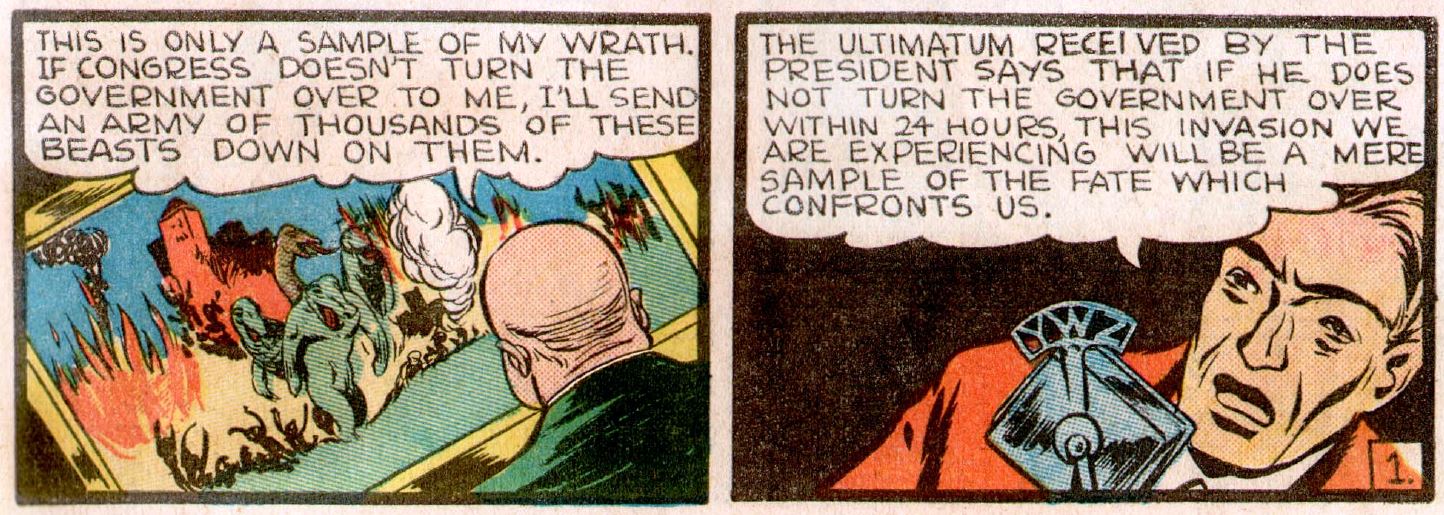
We open on a very exciting scene! Professor Simm has unleashed giant monsters on an unnamed US city! Chaos reigns!


I unironically love these monsters. They have that half-baked quality that you get in generic kids toys – the kind of thing you got as a cheap way for your parents to occupy you on a trip and because they have no built-in lore you end up inventing a whole backstory for them. That picture of the humanoid reptile standing next to the giant anthropoid would be on the packaging.

Having front-loaded a lot of positivity (one last dollop: look at the cavemen riding away on the creatures! It’s very cute!) I must now reveal that this is a pretty bad comic book adventure. I don’t know what was going on at Fox Features in mid-to-late 1940 but they were wildly swapping writer/artists in and out of serials – this very issue features both a Stardust the Super Wizard and a Space Smith story drawn by someone other than Fletcher Hanks!
While this is a minor problem in terms of narrative consistency – this is as far as I know the only time that Samson it depicted as being three times taller than an average human, for example – it also feels like the story was put together in haste or as the third or fourth thing on someone’s mind. Nothing quite hangs together – Professor Simm starts out demanding control over the US government and later is purely interested in money, for example.


Once Samson makes his way to Simm’s island castle the story becomes a series of loosely connected vignettes: Samson finds a cage full of cavemen and gets inside, only to immediately leave again. Samson finds a room full of prisoners and skeletons and frees the prisoners. Samson confronts Simm, who escapes. Samson frees more prisoners. Samson kills Simm. It could all be assembled into a coherent plot but very much is not.


That said, it certainly is a comic full of incident, such as this scene in which Samson sets off a volcano to destroy all the monsters (and hopefully not the prisoners. Hopefully they escaped off-panel) and flies away on a giant bird.It just doesn’t all hold together as a narrative. Things can only get more coherent as we make our way through the Golden Age, right? (SPOILER: not necessarily)
(Fantastic Comics 009, 1940)
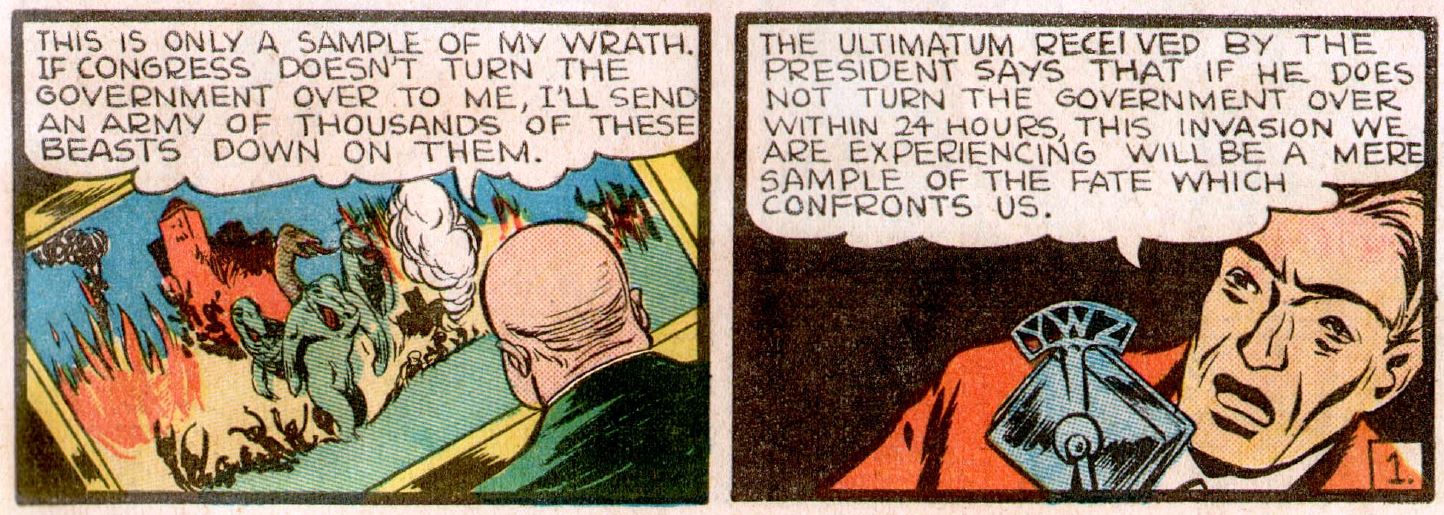
We open on a very exciting scene! Professor Simm has unleashed giant monsters on an unnamed US city! Chaos reigns!
I unironically love these monsters. They have that half-baked quality that you get in generic kids toys – the kind of thing you got as a cheap way for your parents to occupy you on a trip and because they have no built-in lore you end up inventing a whole backstory for them. That picture of the humanoid reptile standing next to the giant anthropoid would be on the packaging.
Having front-loaded a lot of positivity (one last dollop: look at the cavemen riding away on the creatures! It’s very cute!) I must now reveal that this is a pretty bad comic book adventure. I don’t know what was going on at Fox Features in mid-to-late 1940 but they were wildly swapping writer/artists in and out of serials – this very issue features both a Stardust the Super Wizard and a Space Smith story drawn by someone other than Fletcher Hanks!
While this is a minor problem in terms of narrative consistency – this is as far as I know the only time that Samson it depicted as being three times taller than an average human, for example – it also feels like the story was put together in haste or as the third or fourth thing on someone’s mind. Nothing quite hangs together – Professor Simm starts out demanding control over the US government and later is purely interested in money, for example.
Once Samson makes his way to Simm’s island castle the story becomes a series of loosely connected vignettes: Samson finds a cage full of cavemen and gets inside, only to immediately leave again. Samson finds a room full of prisoners and skeletons and frees the prisoners. Samson confronts Simm, who escapes. Samson frees more prisoners. Samson kills Simm. It could all be assembled into a coherent plot but very much is not.
That said, it certainly is a comic full of incident, such as this scene in which Samson sets off a volcano to destroy all the monsters (and hopefully not the prisoners. Hopefully they escaped off-panel) and flies away on a giant bird.It just doesn’t all hold together as a narrative. Things can only get more coherent as we make our way through the Golden Age, right? (SPOILER: not necessarily)
(Fantastic Comics 008, 1940)


Prince Fernando Diablo, scion of an unnamed European royal family (though given his name, style of dress and headquarters in the Pyrenees I think it’s safe to say that he’s heavily implied to be Spanish), has a plan: take advantage of the wars raging in 1940 to violently reinstate monarchy across the continent! Specifically, he and his scientists have developed a horrible plague that they plan on releasing throughout Europe to reduce the population to manageable Feudal levels. He’s a real stinker, Prince Fernando Diablo.


The thing about this plan is that it’s predicated on the idea that people could get too tired of war to keep going after only a couple of years. It’s weirdly optimistic for a story that also includes wholesale germ warfare on the streets of Paris. Also, this is a wild start to your return to monarchical rule: “yes, we killed most of you with disease-spewing tanks, now acknowledge our god-given right to lord over the remaining population.”
I do always love to see a drill-tank.

Luckily for the remaining people of Paris, Samson’s pal Professor Brun is a true comic book polymath as capable of whipping up a cure for a new super-disease as he is at designing a teleportation machine. Pretty soon they’re being sprayed with a good gas to counteract the bad plague gas. Parisians are going to have a very complicated relationship with mists and fogs going forward, I reckon.

There are quite a lot of hoops to jump through, minions to smash and war machines to destroy but Samson eventually makes his way to Diablo’s mountain fastness to beat him up and chuck him off a cliff. No monarchist, he!
(Fantastic Comics 007, 1940)


Sanglor starts out strong. He immediately charms me with his aesthetic sense: his ‘Automatic Subplane’ spy drones are delightful, his ‘Flying Castle’ is simultaneously one of the most ridiculous and great-looking mobile bases I have ever seen and his costume manages to evoke the dress sense of a 1940s comic book movie villain in a way I have not seen since the Vampire, almost exactly 300 entries ago.

He manages to mess things up almost immediately, of course. His plan is to take over the world by hypnotizing key politicians and diplomats etc., and then presumably induce them to shift the reins of political power his way. This is the kind of scheme that requires some degree of care to set up – you have to get all of your assets in place without causing undue suspicion, so having them for example act all weird and then disappear is problematic. People are noticing your plan, Sanglor.
This is the first evidence of what I will call Sanglor Self-Sabotages. This one seems to stem from the fact that Sanglor works completely solo, without even a weird little lab assistant to test his hypnotic ray on to see if it makes people freak out in noticeable ways before using it in a sensitive espionage operation.

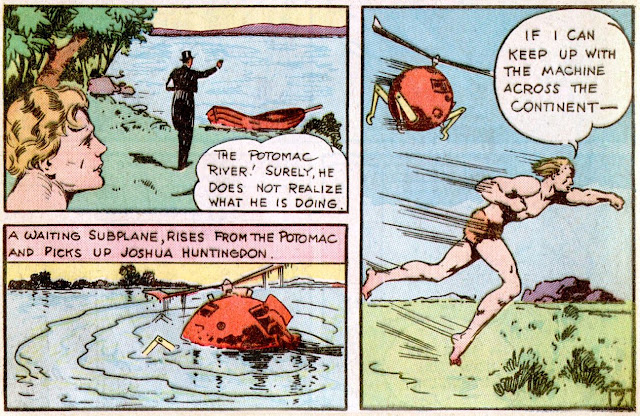
The big upshot of this Sanglor Self-Sabotage is that Samson is on the case basically the instant that the scheme is put in motion


The second Sanglor Self-Sabotage is an extension of the first: he has no real defenses. Once Samson makes his way to the Flying Castle his only real opposition is a crowd of tuxedo-clad diplomats flailing away with their soft fists.

Sanglor does think to call out his drone army to deal with the intruder but they don’t seem to even be armed, despite their little gun barrels – they just fly at Samson until he smashes them all.

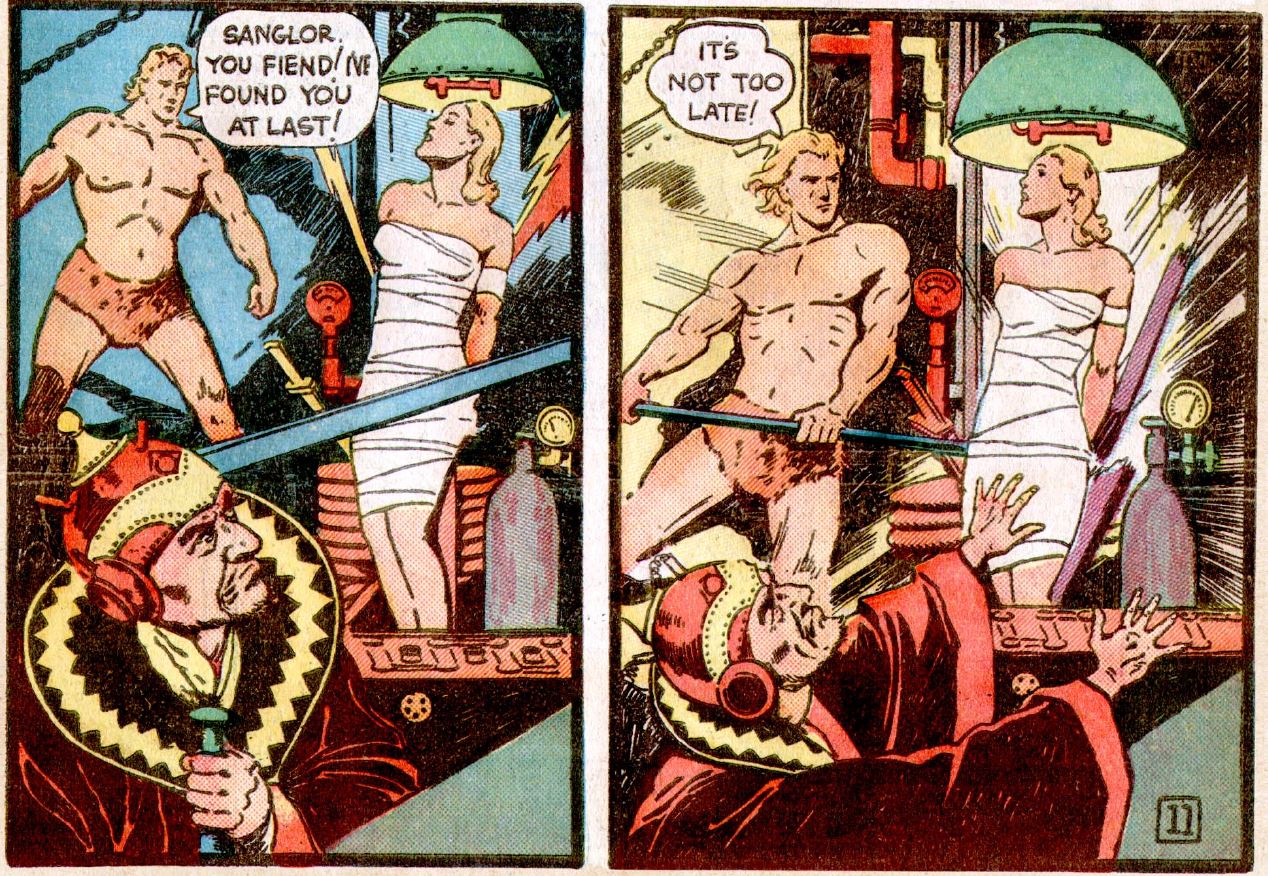
The really big final Sanglor Self-Sabotage is revealed once Samson bursts into his inner sanctum: Sanglor is too busy being a weird creep to actively manage the defense of his headquarters. It’s not exactly clear what he’s doing with this young woman or who she is (it’s unlikely to be Miss Royce, a politician’s daughter in England and the only named female character in the story) but it’s real creep shit and it’s an unnecessary distraction from the approaching vigilante.

Sanglor is probably still distracted as he flees through an industrial section of his base, because he can’t even run correctly – he manages to heave himself off what looks to be a pretty solid catwalk into the first available cauldron of boiling chemicals.
I think that ultimately Sanglor serves as an object example of the need for villains to do a couple of trial runs before attempting world domination. If he’d attempted to take over a county or a small business first, maybe some of these kinks would’ve been worked out.
(Fantastic Comics 007, 1940)
Sanglor starts out strong. He immediately charms me with his aesthetic sense: his ‘Automatic Subplane’ spy drones are delightful, his ‘Flying Castle’ is simultaneously one of the most ridiculous and great-looking mobile bases I have ever seen and his costume manages to evoke the dress sense of a 1940s comic book movie villain in a way I have not seen since the Vampire, almost exactly 300 entries ago.
He manages to mess things up almost immediately, of course. His plan is to take over the world by hypnotizing key politicians and diplomats etc., and then presumably induce them to shift the reins of political power his way. This is the kind of scheme that requires some degree of care to set up – you have to get all of your assets in place without causing undue suspicion, so having them for example act all weird and then disappear is problematic. People are noticing your plan, Sanglor.
This is the first evidence of what I will call Sanglor Self-Sabotages. This one seems to stem from the fact that Sanglor works completely solo, without even a weird little lab assistant to test his hypnotic ray on to see if it makes people freak out in noticeable ways before using it in a sensitive espionage operation.
The big upshot of this Sanglor Self-Sabotage is that Samson is on the case basically the instant that the scheme is put in motion
The second Sanglor Self-Sabotage is an extension of the first: he has no real defenses. Once Samson makes his way to the Flying Castle his only real opposition is a crowd of tuxedo-clad diplomats flailing away with their soft fists.
Sanglor does think to call out his drone army to deal with the intruder but they don’t seem to even be armed, despite their little gun barrels – they just fly at Samson until he smashes them all.
The really big final Sanglor Self-Sabotage is revealed once Samson bursts into his inner sanctum: Sanglor is too busy being a weird creep to actively manage the defense of his headquarters. It’s not exactly clear what he’s doing with this young woman or who she is (it’s unlikely to be Miss Royce, a politician’s daughter in England and the only named female character in the story) but it’s real creep shit and it’s an unnecessary distraction from the approaching vigilante.
Sanglor is probably still distracted as he flees through an industrial section of his base, because he can’t even run correctly – he manages to heave himself off what looks to be a pretty solid catwalk into the first available cauldron of boiling chemicals.
I think that ultimately Sanglor serves as an object example of the need for villains to do a couple of trial runs before attempting world domination. If he’d attempted to take over a county or a small business first, maybe some of these kinks would’ve been worked out.
Incorrigible scamps the lot of them.


This unnamed scientist uses fake spirits, death traps and so forth to drive adventurer Ted Crane and his companions away from the jungle temple he is looting. BUT! He has made a classic mistake: they weren’t planning on entering the temple in the first place and based on their action in earlier issues they certainly don’t object to white people hauling off as much ancient African swag as possible. He gets punched out a window to his death for no reason! (Exciting Comics 004, 1940)


This fellow, name of Terro, has a scheme to peddle his noiseless super explosive bombs to the hostile Kordian government, a sound, if evil, plan. His inventive genius is not however matched by his common sense, however, and he makes the key mistake of demonstrating his explosive by bombing the village just outside his front door. Like, if his castle wasn’t on top of a mountain I reckon it would be about a ten minute walk from the crater. Needless to say, Yank Wilson explodes him with extreme prejudice. (Fantastic Comics 004, 1940)
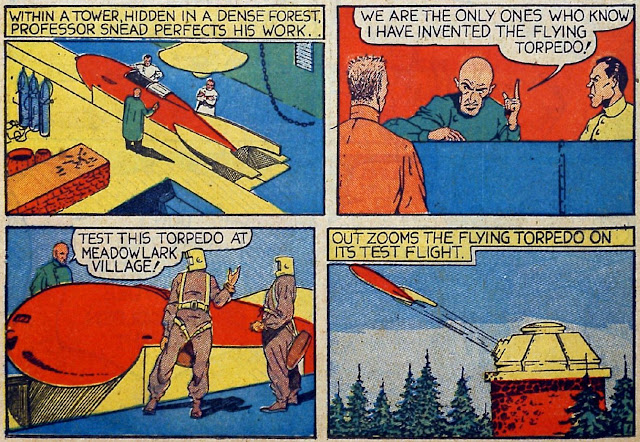

Like Terro, Professor Snead here is a scientist of the near future who makes the critical error of testing his new explosive (in this case one of the military holy grails of the 40s, the flying torpedo, or to us savvy moderns, the guided missile) on a small town instead of, for example, a big rock. Wholesale loss of human life again leads Yank Wilson to show up and Snead too is exploded by his own creation. (Fantastic Comics 005, 1940)


These unnamed Mexican scientists have an okay plan – sabotage the US agricultural industry so that they are forced to import food from South of the border – but I question the efficacy of giant crop-eating rat-lizards over, say, a plague of regular-sized mice. I also question the sanity of everyone who sees these things and calls them “giant insects”, i.e., everyone in the story.
Samson of course steps in and defeats not only the – ugh – “giant insects” but also some chemically mutated bulls, and given the sensitive depictions of Mexicans above would it surprise you that the comic ends with him building a wall along the US-Mexico border? (Fantastic Comics 006, 1940)
(Fantastic Comics 005, 1940)


I guess I have some initial sympathy for Eelo the Fish Man. It can’t be easy being a whatever-he-is in regular human society, let alone a resort island in the middle of the Indian Ocean. He might even be a sympathetic villain if literally his first act wasn’t to kidnap three women as breeding stock for his proposed new amphibian master race.


Eelo’s plans also confound me: are they long or short term? He gasses on about creating a perfect amphibian race but that’s gotta take at least twenty years (setting aside unpleasant speculations about how one would scale up production in such an endeavour) but meanwhile he’s sinking entire resort islands for his own use. Is he merely counting on surface world society to not look for their island?

A lot of my confusion about Eelo’s plans stems from the fact that the story never really goes into what exactly he represents. Is he a member of an underwater civilization and his henchmen (somewhat boringly called “the Amphibians” throughout) the same? Then why does he need to kidnap all those wives? Is he a human mutant? Then what are the Amphibians – costumed goons? Mutated goons? If they all stem from the same mutation source then why not just get a bunch of guys and run them through it?


Regardless of his plans, origin or disposition, Eelo the Fish Man ends up just like so many Samson foes do: dead via the force of a big punch.