The Curse of Skeleton Munroe

Category: fiction in fiction

  • MINOR SUPER-VILLAIN 831: THE BLACK DEATH

    (Thrilling Comics 010, 1940)

    Perry Knight has a problem: instead of starring as the titular costumed antagonist of stage production “The Black Death” he has been jailed for murder. He can’t remember doing it, but evidently he gunned down his costar Tinker in cold blood during the dress rehearsal.

    Enter Peggy Allen, the Woman in Red, who quickly discovers that there is a second Black Death running around when they have a confrontation in the wings. Is this a foolish move on the part of the second Black Death, who presumably wants Perry Knight to be the sole suspect in the murder? Absolutely it is.

    Peggy manages to get Knight bailed out to continue the role of the Black Death as bait for the real killer, and indeed the false Black Death attempts to murder Tinker’s replacement at the same point in the show as before. The Woman in Red of course manages to prevent this second murder, and after some running around etc the Black Death is unmasked to reveal… Weber, the theatre owner!

    It turns out that Weber is in love with lead actress Linda Lytell and that this murder/framing/attempted murder/kidnapping (he kidnaps Lytell before the second murder attempt) is all part of an effort to get him out of the way so that Weber can woo her. A foolish plan, and not just because Weber does not appear to have shared his feelings with Lytell at any point, but because literally the first thing that happens in the story is Lytell rejecting Knight, something that Weber might have learned if he had engaged in some conventional human conversation and courtship before jumping straight to adopting a costumed persona.

    Also, the critics hate the play.

  • MINOR SUPER-VILLAIN 831: THE BLACK DEATH

    (Thrilling Comics 010, 1940)

    Perry Knight has a problem: instead of starring as the titular costumed antagonist of stage production “The Black Death” he has been jailed for murder. He can’t remember doing it, but evidently he gunned down his costar Tinker in cold blood during the dress rehearsal.

    Enter Peggy Allen, the Woman in Red, who quickly discovers that there is a second Black Death running around when they have a confrontation in the wings. Is this a foolish move on the part of the second Black Death, who presumably wants Perry Knight to be the sole suspect in the murder? Absolutely it is.

    Peggy manages to get Knight bailed out to continue the role of the Black Death as bait for the real killer, and indeed the false Black Death attempts to murder Tinker’s replacement at the same point in the show as before. The Woman in Red of course manages to prevent this second murder, and after some running around etc the Black Death is unmasked to reveal… Weber, the theatre owner!

    It turns out that Weber is in love with lead actress Linda Lytell and that this murder/framing/attempted murder/kidnapping (he kidnaps Lytell before the second murder attempt) is all part of an effort to get him out of the way so that Weber can woo her. A foolish plan, and not just because Weber does not appear to have shared his feelings with Lytell at any point, but because literally the first thing that happens in the story is Lytell rejecting Knight, something that Weber might have learned if he had engaged in some conventional human conversation and courtship before jumping straight to adopting a costumed persona.

    Also, the critics hate the play.
  • MINOR SUPER-VILLAIN 243: CRIME & CORRUPTION INC

    (Flash Comics v1 013, 1941)

    I almost didn’t include these guys because Johnny Thunder lives in a heightened cartoon reality that only exists within the same world as the Spectre or Hawkman because of the technicality of them all being in the same club and hanging out together. But then, is the fact that New York is full of goofy-ass cartoon people in Johnny’s reality any more implausible than Alexander the Great blowing up a portion of the city without apparent consequence in Hawkman’s? I say thee nay. Besides, Johnny’s adventures almost never verge into super-villain territory… we gotta strike while we can!

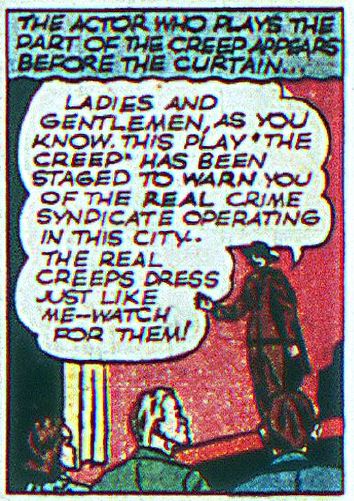
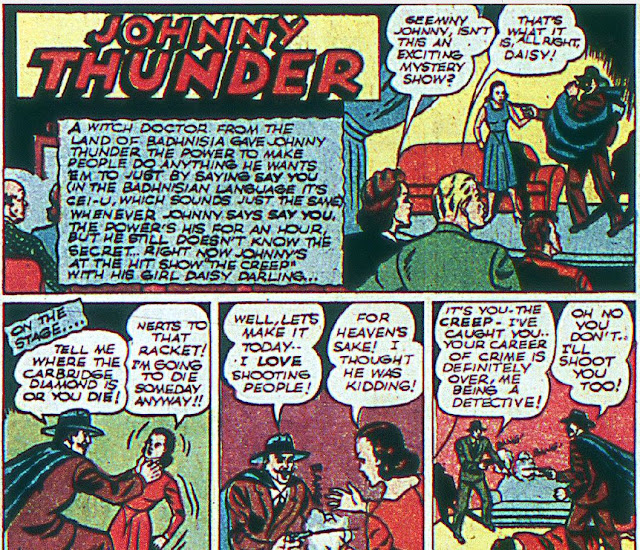
    So: we find Johnny and his best gal Daisy Darling attending a production of “the Creep”, starring actor Jan Marrimore (!) as the titular Creep (a stand-in for a real person playing a fictional villain in a super-hero universe: all my very specific interests are colliding!).

    At the end of the play, Marrimore reveals that the show is a stunt designed to publicize the existence and uniform of a crime syndicate operating in the city. Johnny of course immediately encounters one of these men, does not recognize him and is pickpocketed by him. After some back and forth involving ridiculous magic powers, the pickpocket swears to reform and all is well. OR IS IT?

    It’s not! The remaining members of the gang (which we only now learn the name of – thanks for nothing, Marrimore) swear bloody vengeance and set out to murder Johnny. It’s only the fact that he’s juiced up on Badhnisian thunderbolt magic that saves the poor oaf.

    And that’s that, really. Just a gang of costumed crooks, but they’re Johnny’s gang and he almost never gets to fight proper villains. Since they’re comedy characters they end up as paper-thin props for Johnny to bounce around, so there’s not much to say about them beyond what I will always say about the suit/cape combo: that I love it.

  • MINOR SUPER-VILLAIN 243: CRIME & CORRUPTION INC

    (Flash Comics v1 013, 1941)

    I almost didn’t include these guys because Johnny Thunder lives in a heightened cartoon reality that only exists within the same world as the Spectre or Hawkman because of the technicality of them all being in the same club and hanging out together. But then, is the fact that New York is full of goofy-ass cartoon people in Johnny’s reality any more implausible than Alexander the Great blowing up a portion of the city without apparent consequence in Hawkman’s? I say thee nay. Besides, Johnny’s adventures almost never verge into super-villain territory… we gotta strike while we can!

    So: we find Johnny and his best gal Daisy Darling attending a production of “the Creep”, starring actor Jan Marrimore (!) as the titular Creep (a stand-in for a real person playing a fictional villain in a super-hero universe: all my very specific interests are colliding!).

    At the end of the play, Marrimore reveals that the show is a stunt designed to publicize the existence and uniform of a crime syndicate operating in the city. Johnny of course immediately encounters one of these men, does not recognize him and is pickpocketed by him. After some back and forth involving ridiculous magic powers, the pickpocket swears to reform and all is well. OR IS IT?

    It’s not! The remaining members of the gang (which we only now learn the name of – thanks for nothing, Marrimore) swear bloody vengeance and set out to murder Johnny. It’s only the fact that he’s juiced up on Badhnisian thunderbolt magic that saves the poor oaf.

    And that’s that, really. Just a gang of costumed crooks, but they’re Johnny’s gang and he almost never gets to fight proper villains. Since they’re comedy characters they end up as paper-thin props for Johnny to bounce around, so there’s not much to say about them beyond what I will always say about the suit/cape combo: that I love it.

  • MINOR SUPER-HERO 027: THE DESTROYING DEMON

    (Feature Comics 039-040, 1940-1941) 

    This is a bit of a complicated one. So: “Captain Bruce Blackburn – Counterspy” was a strip that started in Feature Comics 032 in media res with the cover of the titular Captain and his colleague Lieutenant Jackson having been blown. The two then fake their deaths and a government plastic surgeon alters their appearances so that they are virtually identical, thus allowing them to operate as an incredibly efficient spy team with a flawless ability to generate alibis.

    Then, in Feature Comics 038, Blackburn, posing as a man named Black, joins the Un-American Band, a thinly-veiled analog of the German-American Bund, a group whose shadow loomed much larger in the pages of the comics than they ever did in history. And in Feature 039, Blackburn, as Black, encounters this guy:

    “Colossal Guy” here does two things: 1. prove my thesis that kids playing super-heroes in comics is always great and 2. give Bruce Blackburn a good idea.

    See, the Un-American Band, being pseudo-Germans, are all intensely superstitious. This is a known thing about Germans and pseudo-Germans! Thus, the simple application of a cheap devil costume and a bungee rig is enough to throw their entire plot into confusion.

    Sadly, Blackburn only wheels out the Destroying Demon (AKA the Destroying Devil, AKA the Avenging Demon) rig one more time, to contend with a force of crypto-Nazi dwarf saboteurs posing as refugee orphans. He does borrow a technique from the Jay Bird and dangle perilously from a plane for this one, though. I really wish he’d kept it up and that this strip had just kept adding more and more layers: government agent who faked his own death and was surgically altered to look like another guy posing as a bundist who is also a super-hero and then the other guy ends up posing as his arch-enemy and then they both pretend to be space aliens battling for control of Earth’s water and then…

    The Destroying Demon is one of the few Golden Age hero identities that I wouldn’t like to see as a returning legacy character. Rather, I want it to reappear as an officially sanctioned super-hero identity for government agents in the DCU – just agent after agent complaining about having to dress up like a pantomime devil in order to infiltrate a super-hero fight club or whatever. Fun!