The Curse of Skeleton Munroe

Category: Johnny Thunder

  • MEDIA IN COMICS 016

    MEDIA IN COMICS 016

    Production on these Media in Comics showcases must sadly slow down now, for I have worked my way through my backlog. As evidence of this, today we are showcasing some magical books, which are genrally unique items that fall under nobody’s definition of mass media but which I want to include anyway, for fun’s sake.

    Books of Magic:
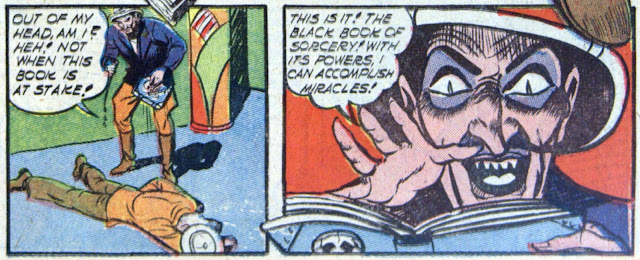
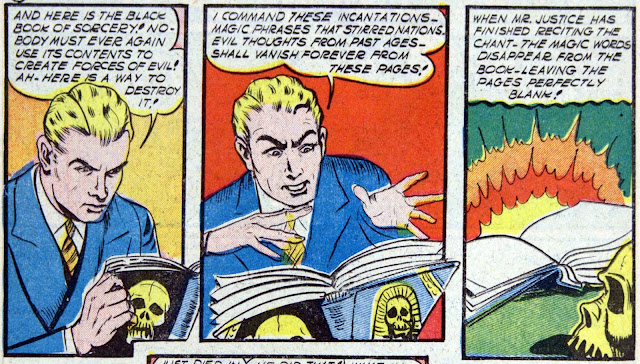
    You all remember the fabled Black Book of Sorcery that the wicked Egyptologist Ford committed all those murders for, well here it is! Until Mr Justice wipes its pages with a convenient self-destruct spell contained within it, that is.

    Origin: Ancient Egyptian 

    Status: Destroyed (Jackpot Comics 003, 1941)
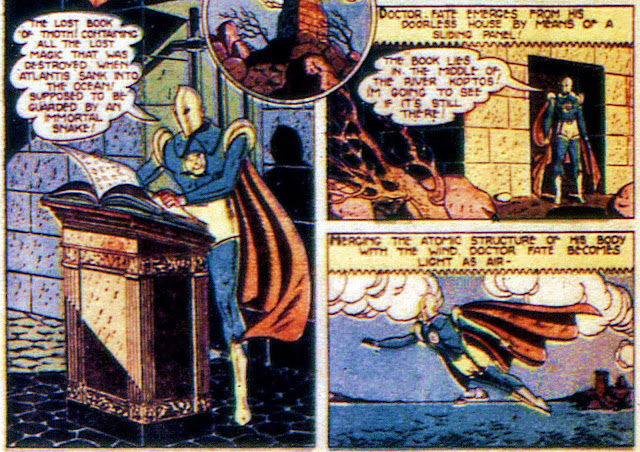
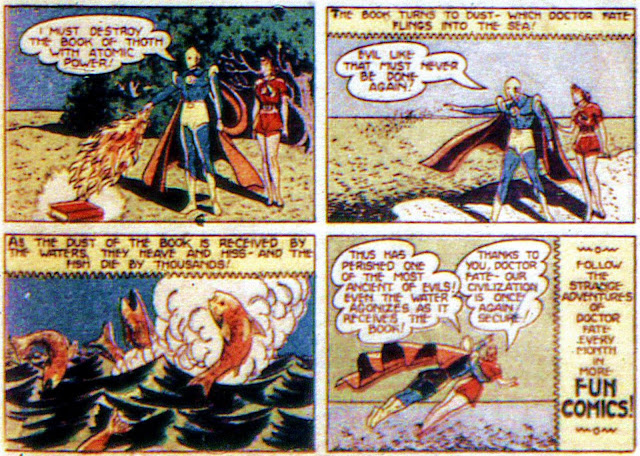
    The Lost Book of Thoth, containing all the magics of sunken Atlantis, is supposed to rest on the bottom of the Nile under the watchful eye of an immortal serpent. The plans of mice and men and whoever is in charge of everlasting snakes often go astray, alas, and the book is stolen by an unnamed mage and nearly used to destroy the world. Having solved that particular problem, Dr Fate doesn’t take any chances and reduces the book to a powder.

    Origin: Ancient Atlantis

    Status: Destroyed (More Fun Comics 058, 1941)
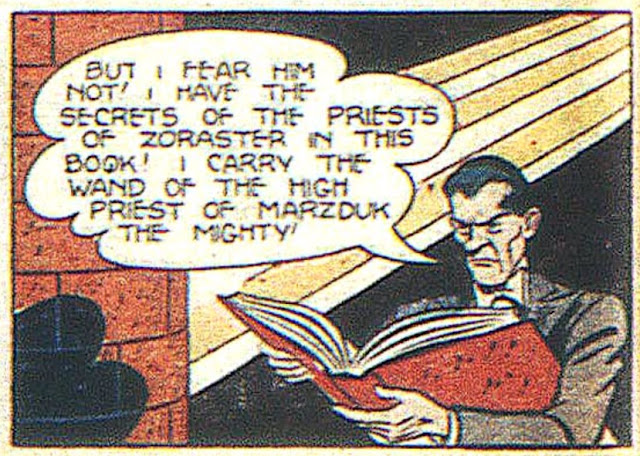
    The Secrets of the Priests of Zoraster (sic) might not be the official title of the book used by Haldane the Sorcerer, but it’s a pretty good title for a made-up book of magic and we have no other options. This one gets left behind in a secret passage rather than being destroyed, so it’s technically up for grabs.

    Origin: Persian? 

    Status: Extant (More Fun Comics 063, 1941)
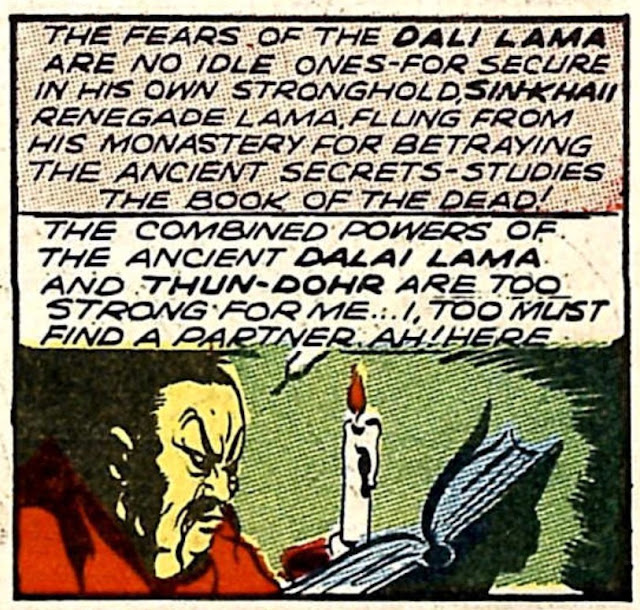
    Though Sin Khaii is an apostate Tibetan Buddhist, the Book of the Dead that he is referencing here is more likely to be the Egyptian on than the Tibetan, as he is using it to research the Black Pharaoh. He also casts spells out of it later!

    Origin: Ancient Egyptian 

    Status: Extant (Silver Streak Comics 014, 1941) 

    Theatre:
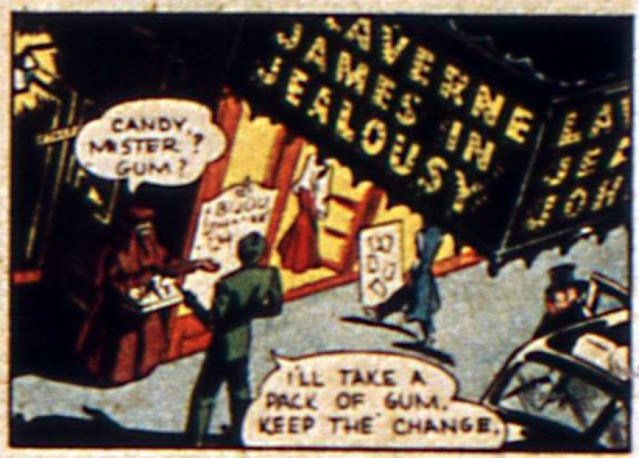
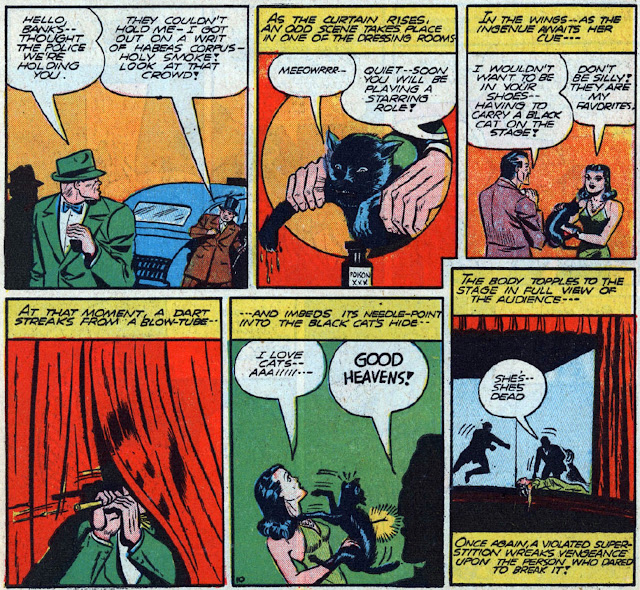
    Detective Larry Steele is called to the set of Jealousy to look into threats against star Laverne James, and then stays to solve the murder of Laverne James. More interesting than the murder mystery, however, is the mystery of just what is going on in this production.
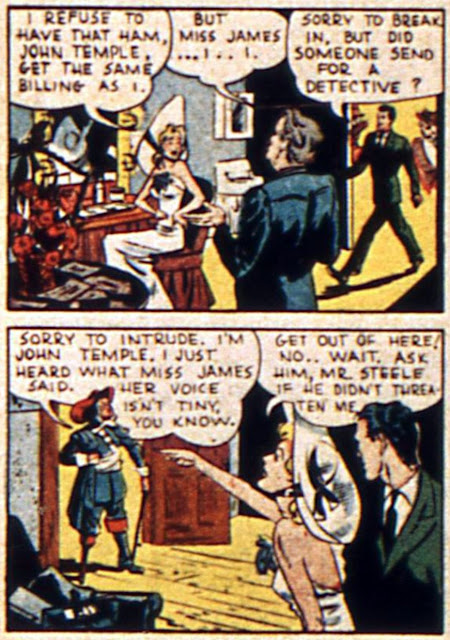
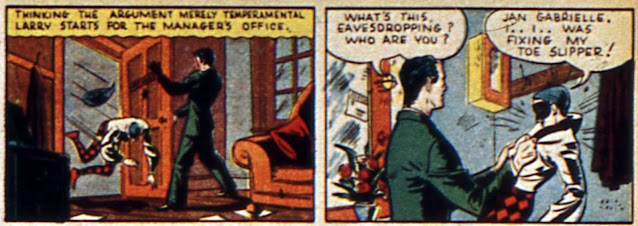
     

    We don’t actually see any of the on-stage action, but the costuming is extremely intriguing: James’ co-stars John Temple and Jan Gabrielle are dressed like off-model commedia dell’arte characters, while she looks more like a character from a Southern Gothic. Finally we have Peggy, who is part of the chorus line and is dressed like she is in a high-budget napkin advertisement. It’s a baffling selection. (Detective Comics v1 047, 1941) 
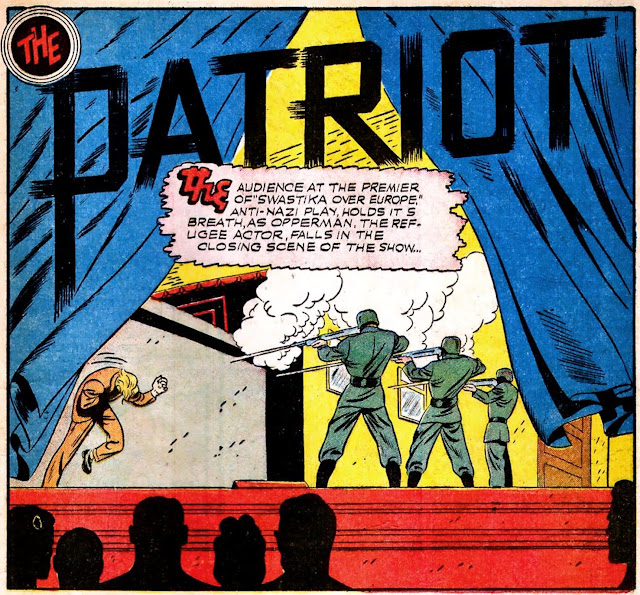
    Swastika Over Europe is a play designed to rally American support for the beleaguered nations of the Continent and as such is a target for sabotage by Nazi fifth columnists, as seen here when lead actor Opperman is murdered on-stage. (Marvel Mystery Comics v1 023, 1941)
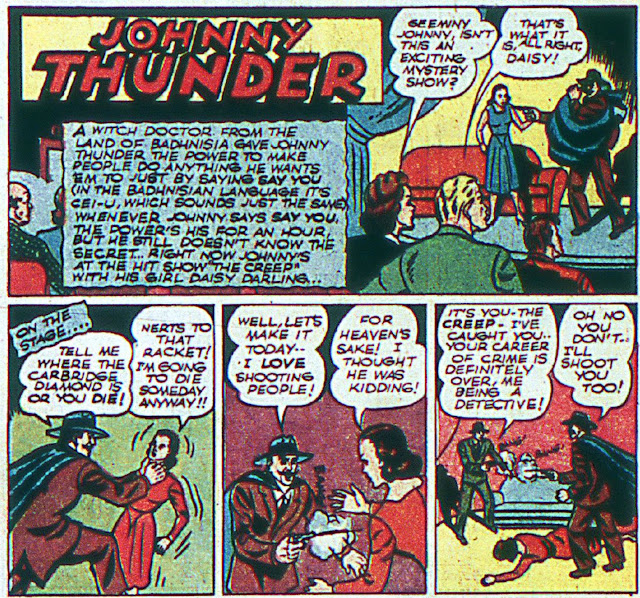
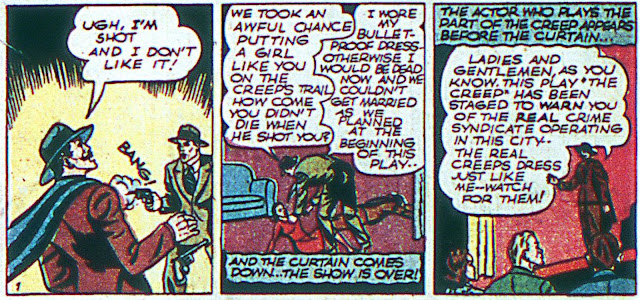
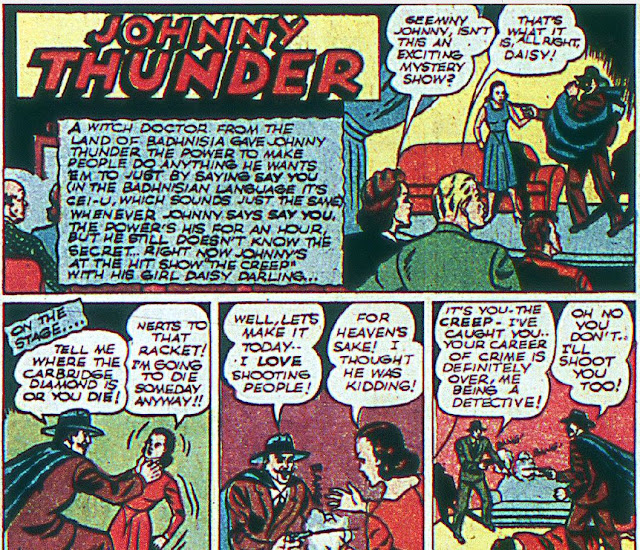
    Here we have The Creep, a play written expressly to warn the people of NYC about the threat of Crime & Corruption, Inc. I guess it works, because Johnny Thunder slapsticks them out of existence. (Flash Comics 013, 1941)
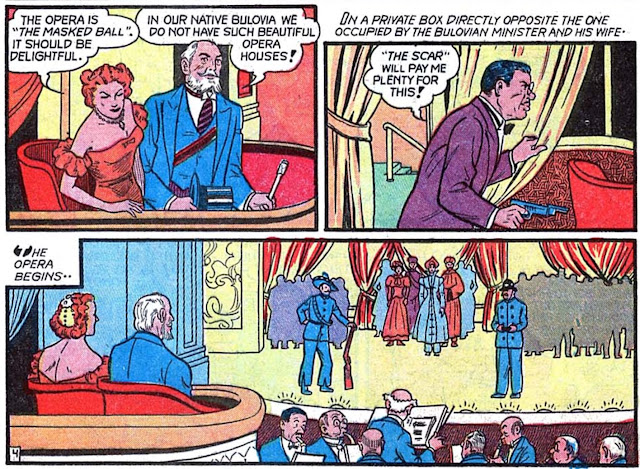
    Ordinarily getting such a good view of the stage would be very exciting to me as it would be a chance to divine some information about the production. Alas, this is an opera called The Masked Ball and so the only thing we can learn is that someone at the titular ball has come dressed as a police officer. (More Fun Comics 067, 1941)
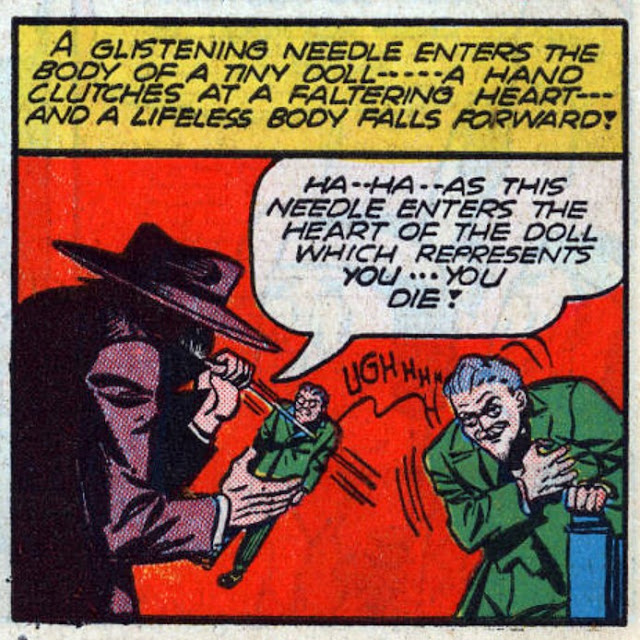
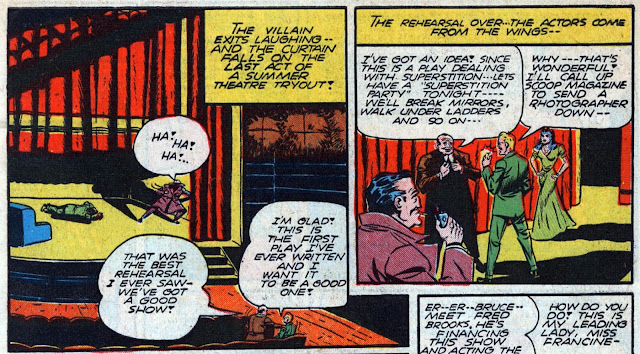
    The Superstition Murders is of course the play written by Johnny Glim the alter ego of the villainous Masked Man, who commits a series of superstition-themed murders in the hopes of tanking the production and thus securing the movie rights for his work. Though the motivation for the fictional killer is unrevealed, this seems to essentially be what the play is about as well. (Batman Comics v1 008, 1941)
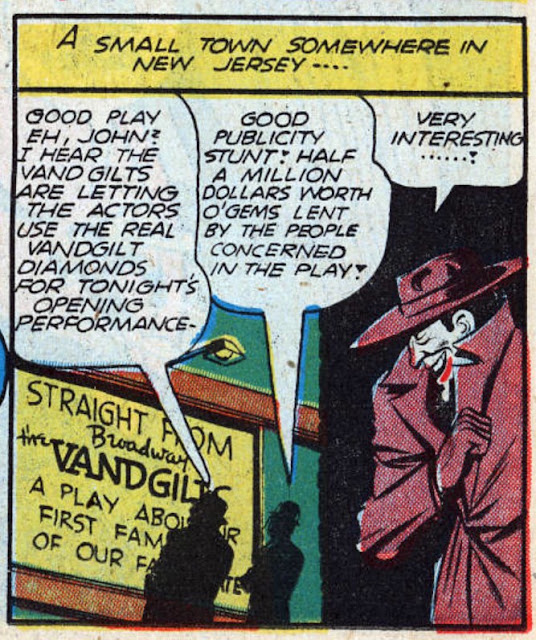
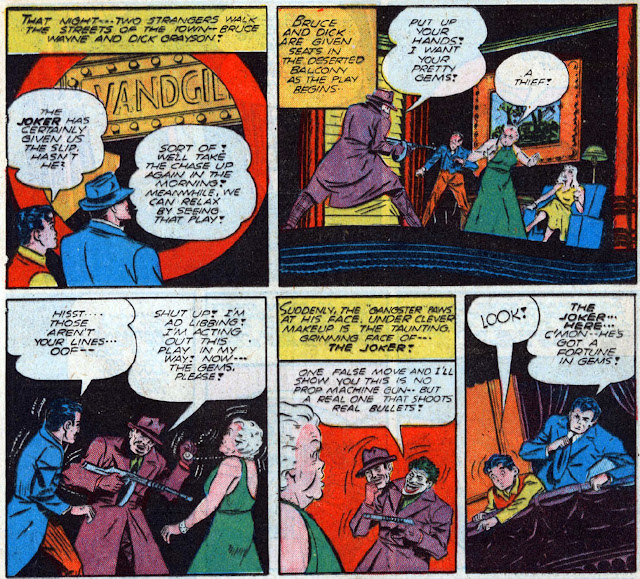
    Though there are many fine plays about the lives of the wealthy, there is no way The Vandgilts, about a real-life family who are on good enough terms with the production to lend them half a million dollars worth of jewellery, isn’t complete sycophantic mush. Luckily the Joker spices things up by robbing the actors mid-performance. (Batman Comics v1 008, 1941)

  • MEDIA IN COMICS 011

    I’ve heard of comics in the media, but media in comics?

    Books:

    This book is only our second example of a piece of media called Crime Does Not Pay! but I am confident in predicting that that particular phrase – the regular shouting of which appears to be the major means by which people in the 1940s discouraged children from adopting a life outside the law – is going to be the one we see the most as time goes on.

    We don’t learn too much about the contents of this particular book, but it makes a decent projectile for Robin here. (Detective Comics v1 050, 1941)

    Spider Craft, on the other hand, is pretty clearly just a reference book on spiders, albeit one with a very charming name. (Detective Comics v1 057, 1941)

    Movies:

    While attending to his extremely unruly supporting cast, Captain Terry Thunder happens upon a movie improbably being shot in North Africa in 1941. This movie is unnamed, but G.G., the director, is also responsible for the film Lost Souls, about which nothing else is known. (Jungle Comics 020, 1941)

    Radio:

    Radio Quiz show How Do You Know is your place to try your luck at winning two dollars and a big double box of Kracked Korn in a knock down quiz-off against Dolliver King. (Feature Comics 034, 1940)

    If there’s one kind of radio program that comic books love the most it’s the “man on the street” style with their handy remote microphone for all your evidence-gathering or (as seen here) confession-broadcasting needs. This particular show is called Public Opinion. (Nickel Comics 004, 1940)

    Theatre:

    The Fancy Follies of 1940 is a revue-style show that is the site of the first in a series of entertainment industry murders investigated by the Flash. (Flash Comics 002, 1940)

    Billed as a musical, In the Groove is another show plagued by crime. The Purple Trio clear things up after they manage to scrape together enough dough to get inside. (Smash Comics 015, 1940)

    Thanks to the fact that they had to pose as performers to solve the In the Groove case, the Purple Trio get their own self-titled show. The Purple Trio show probably involves more than the acrobatics we see here, but that’s all that the group gets through in this issue before they realize that a) one man has bought out the entire theatre and b) he has been murdered. (Smash Comics 016, 1940)

    This backstage conversation is all we get to see of the melodrama Remote Control, which is a real shame. What does a play with that title look like in 1940? (Crack Comics 008, 1940)

    Finally we have The Totsy Revue, attended by Johnny Thunder in one of his many attempts to impress the ever-fickle Daisy Darling, thanks to a tip that the show’s headliner Hoco tThe One and Only) is passing counterfeit money as part of his act. (Flash Comics 008, 1940)

  • MINOR SUPER-VILLAIN 243: CRIME & CORRUPTION INC

    (Flash Comics v1 013, 1941)

    I almost didn’t include these guys because Johnny Thunder lives in a heightened cartoon reality that only exists within the same world as the Spectre or Hawkman because of the technicality of them all being in the same club and hanging out together. But then, is the fact that New York is full of goofy-ass cartoon people in Johnny’s reality any more implausible than Alexander the Great blowing up a portion of the city without apparent consequence in Hawkman’s? I say thee nay. Besides, Johnny’s adventures almost never verge into super-villain territory… we gotta strike while we can!

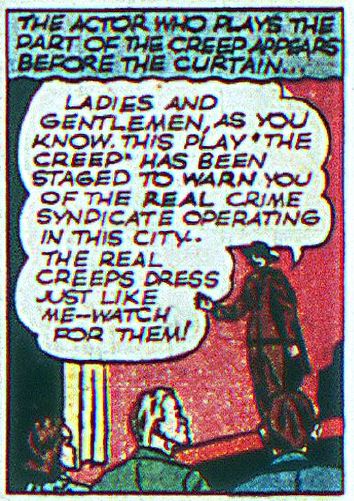
    So: we find Johnny and his best gal Daisy Darling attending a production of “the Creep”, starring actor Jan Marrimore (!) as the titular Creep (a stand-in for a real person playing a fictional villain in a super-hero universe: all my very specific interests are colliding!).

    At the end of the play, Marrimore reveals that the show is a stunt designed to publicize the existence and uniform of a crime syndicate operating in the city. Johnny of course immediately encounters one of these men, does not recognize him and is pickpocketed by him. After some back and forth involving ridiculous magic powers, the pickpocket swears to reform and all is well. OR IS IT?

    It’s not! The remaining members of the gang (which we only now learn the name of – thanks for nothing, Marrimore) swear bloody vengeance and set out to murder Johnny. It’s only the fact that he’s juiced up on Badhnisian thunderbolt magic that saves the poor oaf.

    And that’s that, really. Just a gang of costumed crooks, but they’re Johnny’s gang and he almost never gets to fight proper villains. Since they’re comedy characters they end up as paper-thin props for Johnny to bounce around, so there’s not much to say about them beyond what I will always say about the suit/cape combo: that I love it.

  • MINOR SUPER-VILLAIN 243: CRIME & CORRUPTION INC

    (Flash Comics v1 013, 1941)

    I almost didn’t include these guys because Johnny Thunder lives in a heightened cartoon reality that only exists within the same world as the Spectre or Hawkman because of the technicality of them all being in the same club and hanging out together. But then, is the fact that New York is full of goofy-ass cartoon people in Johnny’s reality any more implausible than Alexander the Great blowing up a portion of the city without apparent consequence in Hawkman’s? I say thee nay. Besides, Johnny’s adventures almost never verge into super-villain territory… we gotta strike while we can!

    So: we find Johnny and his best gal Daisy Darling attending a production of “the Creep”, starring actor Jan Marrimore (!) as the titular Creep (a stand-in for a real person playing a fictional villain in a super-hero universe: all my very specific interests are colliding!).

    At the end of the play, Marrimore reveals that the show is a stunt designed to publicize the existence and uniform of a crime syndicate operating in the city. Johnny of course immediately encounters one of these men, does not recognize him and is pickpocketed by him. After some back and forth involving ridiculous magic powers, the pickpocket swears to reform and all is well. OR IS IT?

    It’s not! The remaining members of the gang (which we only now learn the name of – thanks for nothing, Marrimore) swear bloody vengeance and set out to murder Johnny. It’s only the fact that he’s juiced up on Badhnisian thunderbolt magic that saves the poor oaf.

    And that’s that, really. Just a gang of costumed crooks, but they’re Johnny’s gang and he almost never gets to fight proper villains. Since they’re comedy characters they end up as paper-thin props for Johnny to bounce around, so there’s not much to say about them beyond what I will always say about the suit/cape combo: that I love it.

  • MINOR SUPER-HERO 031: THUNDERBOLT

    (Flash Comics v1 007, 1940) 

    The epitome of minor: Johnny Thunder spent one issue as a costumed hero named Thunderbolt. It’s possible that he tried his hand at the costumed crimefighter game some other time – I’m hardly a Johnny Thunder expert – but this is the only time I know of.

  • MINOR SUPER-HERO 031: THUNDERBOLT

    (Flash Comics v1 007, 1940) 

    The epitome of minor: Johnny Thunder spent one issue as a costumed hero named Thunderbolt. It’s possible that he tried his hand at the costumed crimefighter game some other time – I’m hardly a Johnny Thunder expert – but this is the only time I know of.

  • HONOURS – JOHNNY THUNDER

    (Flash Comics v1 005, 1940)

    Johnny Thunder is made an FBI Agent. (fired in issue 7)

  • HONOURS – JOHNNY THUNDER

    (Flash Comics v1 003, 1940)

    Johnny Thunder accidentally becomes heavyweight boxing champion of the world. 

  • HONOURS – JOHNNY THUNDER

    (Flash Comics v1 001, 1940)

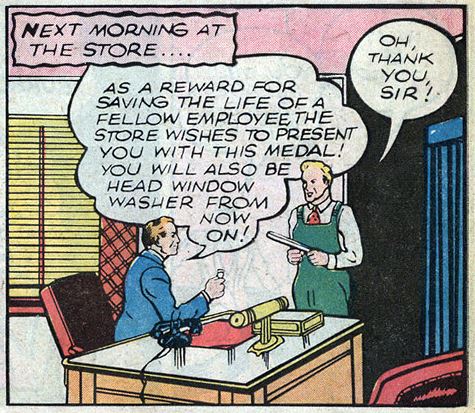
    Johnny Thunder is given a medal and a promotion to head window washer. In true Johnny Thunder fashion he is fired the next day.

  • HONOURS – JOHNNY THUNDER

    (Flash Comics v1 001, 1940)

    Johnny Thunder is given a medal and a promotion to head window washer. In true Johnny Thunder fashion he is fired the next day.