The Curse of Skeleton Munroe

Category: Slam Bradley

  • MEDIA IN COMICS 015

    Comics love to have media in them, and I love telling you about those media.

    Music:

    Though the radio debut Roger Midas and His Melodeers is a hopeful sign for the relationship between former absentee workaholic father and snob Harvey Midas and his progeny, one can’t help but be a little cynical about the sudden success of a rich man’s passion project. (Detective Comics v1 047, 1941)

    When I detailed the musical output of the Murder Maestro in the last Media Round-Up I somehow missed that a) “I’m Getting Up in the World” was in fact written not by the Maestro but by Johnny Quick as part of a plan to trap the villain and b) it was performed by a radio ensemble called the Bandoliers. (More Fun Comics 072, 1941)

    Newspaper Columns:

    Golden Age Marvel Comics detective Ferret writes a column called “Crime Doesn’t Pay” for the Tribune. (Marvel Mystery Comics v1 004 1940)

    Radio:

    If Lester Pry’s radio gossip column is called anything other than “Lester Pry” then we get no indication of it in this Slam Bradley story. (Detective Comics v1 051, 1941)

    “The Scarlet Terror” is our first radio show featuring a pulp-style action hero, the eponymous “red-cloaked man from the planet Jupiter!” Sounds like a hoot. (Hit Comics 010, 1941)

    “The Happy Hour” features live music to delight all (but bemuse the Shining Knight). Just why the singer is dressed in a “hack comedian” outfit is unexplained but probably would have made sense to someone from the 1940s. Featuring the real-life novelty hit “the Hut-Sut Song.” (Adventure Comics 069, 1941)

    I assume that “Uncle Dan’s Kiddie Hour” is more than just a venue for sending messages to specific children over the airwaves, but that’s the part of the broadcast that we get to see as it is used by Spy Smasher as a semi-secure channel to convey information to Eve and Admiral Corby. (Whiz Comics 024, 1941)

    Alan “Green Lantern” Scott moves from radio engineer to radio presenter after his boss notices his pleasant voice and sticks him on “Man on the Street” duty. (Green Lantern v1 002, 1941)

    Further Apex Broadcasting System programming includes “What’s Your Trouble?” which involves a jury of smug-looking experts giving advice to those with problems (explained in All-American Comics 030 and then actually seen in action in Green Lantern v1 002, 1941)

    Apex also broadcasts “You the Public,” a forum for community members to tell their own stories, though only those stories that involve absolutely no controversy, as illustrated here by the unnamed Apex head choosing to let a huge slave ring go uncommented-upon rather than invite a bit of legal trouble. (All-American Comics 024, 1941)

    “You the Public” returns in All-American Comics 033 as the venue for a discussion of an ongoing conflict between unionizing cab drivers and the mob.

  • MEDIA IN COMICS 007

    We’ve got some real early media for you today, so get ready for the crustiest scans of microfiche you ever saw.

    Movies:

    Steve Rogers and Bucky almost get to the movies to see a flick called Million Dollar Robbery before being interrupted by a real, if smaller-scale, robbery. BONUS: a classic case of real movies stars barely obfuscated by having their first names swapped, in Humphrey Raft and George Bogart, aka George Raft and Humphrey Bogart. (Captain America Comics 004, 1941)

    Hired to look into dirty dealings on the Stupendous Films lot, Slam Bradley and Shorty Morgan go undercover as stunt doubles. The comedy film that Shorty works on is never named, but Slam briefly works on a film called Jungle Man. (Detective Comics v1 004, 1937)

    Larry Steele’s own investigations into a series of high-profile kidnappings take him to the set of Too Much Money, a movie we never learn anything about. (Detective Comics v1 005, 1937)

    It’s just barely possible to make out that this movie that the Radio Squad boys watch is called The Fighting Cop. A bit on the nose, boys! (More Fun Comics 038, 1938)

    Music:

    Detective Bruce Nelson investigates a series of murders committed on stage while each victim was singing the same song. That song was originally called “The Night is Blue,” but is now known as “The Song of Death.” (Detective Comics 020, 1938)

    In Action Comics 006, a grifter named Nick Williams falsifies some contracts and begins licensing Superman’s name all over town, and one of the results of this is a song! Specifically, a big band tune called “You’re a Superman!”

    I wouldn’t call it the greatest song ever written (no song should include the word “resistless,” for example), but it’s not entirely terrible. (Action Comics v1 006, 1938)

    Newspaper Columns:

    Written by Paul Revere Sr, ultra-patriot and father to comic book adventure kid Paul Revere Jr, “America Awake!” is one of those exciting titles that works for an anti-Nazi column in 1941 and also potentially for a pro-Nazi one in the present. (Banner Comics 003, 1941)

    Jay Garson Jr, aka the Ragman, wrote his “Crime Does Not Pay” column right up until someone tried to kill him for it and he was forced to fake his own death. And then kept on writing it for a while afterward, seemingly mostly in order to give his old editor a hard time. (Cat-Man Comics 001, 1941)

    Radio Shows:

    In addition to “You’re a Superman!” Nick Wilson’s Superman-licensing deals included a Superman radio show, meaning that the DC Universe had one a full two years before we did.

    Wilson also mentions having sold movie and comic book rights, but as he is beaten up and forced to stop his scheme by the real Superman not long after this conversation it’s likely that those never saw the light of day. (Action Comics v1 006, 1938)

    Theatre:

    Slam Bradley and Shorty Morgan investigate the crimes of the Broadway Bandit by getting jobs on Broadway, specifically as tap dancers in a production called Love on Ice that despite its name seems to be a variety show rather than anything with a discernible plot. (Detective Comics v1 016, 1938)

    Renick’s Frolics, the show in which “The Song of Death” appears, is another of these variety productions. (Detective Comics v1 020, 1938)

    We learn nothing about Darkest Dawn other than the fact that someone is trying to kill the lead actress and Nadir, Master of Magic, is on the case. (New Adventure Comics 028, 1938)

  • MEDIA IN COMICS 007

    We’ve got some real early media for you today, so get ready for the crustiest scans of microfiche you ever saw.

    Movies:

    Steve Rogers and Bucky almost get to the movies to see a flick called Million Dollar Robbery before being interrupted by a real, if smaller-scale, robbery. BONUS: a classic case of real movies stars barely obfuscated by having their first names swapped, in Humphrey Raft and George Bogart, aka George Raft and Humphrey Bogart. (Captain America Comics 004, 1941)

    Hired to look into dirty dealings on the Stupendous Films lot, Slam Bradley and Shorty Morgan go undercover as stunt doubles. The comedy film that Shorty works on is never named, but Slam briefly works on a film called Jungle Man. (Detective Comics v1 004, 1937)

    Larry Steele’s own investigations into a series of high-profile kidnappings take him to the set of Too Much Money, a movie we never learn anything about. (Detective Comics v1 005, 1937)

    It’s just barely possible to make out that this movie that the Radio Squad boys watch is called The Fighting Cop. A bit on the nose, boys! (More Fun Comics 038, 1938)

    Music:

    Detective Bruce Nelson investigates a series of murders committed on stage while each victim was singing the same song. That song was originally called “The Night is Blue,” but is now known as “The Song of Death.” (Detective Comics 020, 1938)

    In Action Comics 006, a grifter named Nick Williams falsifies some contracts and begins licensing Superman’s name all over town, and one of the results of this is a song! Specifically, a big band tune called “You’re a Superman!”

    I wouldn’t call it the greatest song ever written (no song should include the word “resistless,” for example), but it’s not entirely terrible. (Action Comics v1 006, 1938)

    Newspaper Columns:

    Written by Paul Revere Sr, ultra-patriot and father to comic book adventure kid Paul Revere Jr, “America Awake!” is one of those exciting titles that works for an anti-Nazi column in 1941 and also potentially for a pro-Nazi one in the present. (Banner Comics 003, 1941)

    Jay Garson Jr, aka the Ragman, wrote his “Crime Does Not Pay” column right up until someone tried to kill him for it and he was forced to fake his own death. And then kept on writing it for a while afterward, seemingly mostly in order to give his old editor a hard time. (Cat-Man Comics 001, 1941)

    Radio Shows:

    In addition to “You’re a Superman!” Nick Wilson’s Superman-licensing deals included a Superman radio show, meaning that the DC Universe had one a full two years before we did.

    Wilson also mentions having sold movie and comic book rights, but as he is beaten up and forced to stop his scheme by the real Superman not long after this conversation it’s likely that those never saw the light of day. (Action Comics v1 006, 1938)

    Theatre:

    Slam Bradley and Shorty Morgan investigate the crimes of the Broadway Bandit by getting jobs on Broadway, specifically as tap dancers in a production called Love on Ice that despite its name seems to be a variety show rather than anything with a discernible plot. (Detective Comics v1 016, 1938)

    Renick’s Frolics, the show in which “The Song of Death” appears, is another of these variety productions. (Detective Comics v1 020, 1938)

    We learn nothing about Darkest Dawn other than the fact that someone is trying to kill the lead actress and Nadir, Master of Magic, is on the case. (New Adventure Comics 028, 1938)

  • ALIENS AND SO FORTH ROUND-UP 024

    Today we journey into the far future! 

    Cave-Dwellers: 

    The hunt for Atom Blake’s father takes him from Earth to Mercury, to Mercury but millions of years in the future, where he encounters these little fellows. Driven out of their surface city by invaders, the Cave-Dwellers are understandably hostile to outsiders, but Atom manages to win them over eventually, free his father (the hunt, though long in distance and time, was short in terms of steps) and retake the city.

    What I really appreciate about these guys his how much they resemble a version of the sensory homunculus. (Wow Comics 003, 1941)

    Peoples of the Year 2 000 000 000: 

    Not to be outdone by some kid, in Detective Comics v1 023, Slam Bradley and Shorty Morgan travel two billion years into the future after meeting scientist Professor Kenton, fresh off of completing his time machine and not interested in any sort of half measures like trying to go to next week.

    Please note the “city rises and falls outside the window to mark the passage of time” bit, later used to much effect in Futurama. 

    Slam and Shorty are almost immediately separated from Kenton and captured by a big bird that flies them into a fantastic futuristic metropolis nearby. There. they are confronted and captured by three beings: a human, a bird-man and a plant-man, and this is our first inkling that this isn’t the lame kind of future where everything is just a reskin of the present, not only because Earth is populated by three distinct intelligent species but completely alien technology, such as the weaponized recorders used to paralyze our heroes.. 

    More alien weirdness follows, as it is revealed that these three fellows have been condemned to death for gambling on a holy day (the anniversary of their leader’s tonsillectomy, which is silly, yes, but culturally very interesting. They have a god-emperor of some kind!). They also do not speak English but communicate via a thought transmission device. 

    Despite their seeming reverence for their leader, these three fellows want to take advantage of the time machine to get out of town and avoid their fate. They eventually try to steal the device outright and are killed in a firefight with Slam, Shorty and Kenton but before that the plant-man gets to show off this cool and very thematic flower weapon.

    He’s not really an alien, but as long as I’m talking about this adventure I would like to mention Iron-Fingers, a giant cyborg pitted against Slam Bradley in gladiatorial combat as a form of execution after Slam refuses to grant the petulant god-king access to the time machine. Specifically, Slam is sentenced to be “plucked to pieces” by Iron-Fingers, which is an image that really sticks with you. (Detective Comics v1 023, 1939) 

  • GENERIC COSTUMED VILLAIN ROUND-UP 003

    Yet another collection of also-rans and never-weres.

    Philip White: 

    Philip White here got exactly one panel into his career as a masked spy chief before Madam Fatal unmasked him. (Crack Comics 014, 1941)

    Basil: 

    An auctioneer named Basil ran an overly complicated scheme to steal the fabled Five Bloodstones of Mu. His plans were also undone by Madam Fatal and ended in his grisly demise. (Crack Comics 016, 1941)

    Unnamed Crook: 

    This unnamed thief almost got away with the Dare Diamond under the very nose of detective Larry Steele. (Detective Comics v1 049, 1941)

    Howard: 

    A baseball pitcher named Howard got up to some shady betting schemes and ended up a generic costumed villain. Let this be a lesson, kids. Also part of his big plan involved shooting himself in the arm with a gimmicked up baseball mitt-gun, which is an early sign that you might not be cut out for costumed villainy. (Detective Comics v1 052, 1941)

  • MINOR SUPER-VILLAIN 214: THE TERROR

    (Detective Comics v1 049, 1941)

    This is one of your technical qualifications: a singer’s former partner, jealous of his success, comes back for revenge. He calls himself the Terror and has a camera-gun and a bunch of hired goons with names like Smokey Joe. It all adds up to just enough to land him in the theoretical super-villain wing of the prison when Slam Bradley busts him.

  • MINOR SUPER-VILLAIN 015: THE BROADWAY BANDIT

    (Detective v1 016, 1938)

    The Broadway Bandit is just a disgruntled actor who puts on a mask and robs box offices until Slam Bradley shows up to settle his hash but he might be out first illustration of the very basic level of super-villainy: a good name, a basic but distinctive costume and the commission of crimes while in the possession of both.

    SHOULD THEY BE BROUGHT BACK? No, but in a super-hero universe I reckon that there should be way more guys adopting this kind of persona to do basic crimes like armed robbery. In a world with cosmic threats named Molecule Man and such running around you might not even need a weapon to stick up a corner store if you strolled in in a plausible enough costume.

  • MINOR SUPER-VILLAIN 014: CHESTER GLASS

    (Detective v1 015, 1938)

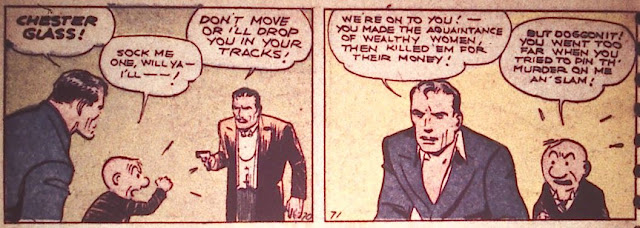
    Chester Glass almost accidentally frames Slam Bradley and Shorty Morgan for murder, and that’s the main thrust of the story. As things develop, you learn that he has wooed and then murdered at least two dozen women for their money, which alone is enough to get him on this list, but then he captures Slam and Shorty in his murder dungeon basement, which is filled with “dozens” of bodies! And he has up to this point gone completely unnoticed by the Cleveland police!

    SHOULD THEY BE BROUGHT BACK? I mean, a century-old serial killer probably doesn’t have a place in the DCU, so no. He really should be acknowledged somewhere, though – the real berries would have been if there was a Chester Glass Lifetime Achievement Award at the Cereal Convention in Sandman, but alas and alack that ship has sailed.

  • MINOR SUPER-VILLAIN 008: THE HUMAN FLY

     (Detective Comics 009, 1937)


    A very marginal entry on the list, but he really makes the concept of “guy who can climb” work as a masterful crime skill. Plus he’s an early Slam Bradley foe, so more charming Siegel and Shuster fun as Slam demonstrates his early tendency to be amazing at all tasks by following him up the side of a building for a trademark fight.