The Curse of Skeleton Munroe

Category: Columbia

  • DIVINE ROUND-UP 008

    Some more dubious theology for you. 

    the Stone Tablet:

    The pompous jackasses at the British Archaeological Club really get Mr Mystic’s goat when they treat the theories of his friend Doctor Gadasky like trash, so he does the only sensible thing and uses his magic to travel back to 1 000 000 CE to see for himself. Gadasky claims that Cro-Magnons had a religion based around the worship of a stone tablet, and wouldn’t you know it, he’s right!

    Mr Mystic’s jaunt through time is about as well-considered as those things normally are, and he ends up causing the deaths of two Cro-Magnons, including the Stone Tablet’s keeper, plus the loss of the Tablet itself in a quicksand pit, which is a boon for Gadasky, as he is able to dig it up in the present and prove his theories. Take that, establishment jerks!

    Speaking of those theories, just where did they come from? Is the fact that Gada, the Stone Tablet’s guardian, is a dead ringer for Gadasky and that Gadasky carries an echo of the wound that killed Gada (reptile-bird beak to the skull) on his flesh an indication that the Tablet posesses some measure of actual power? Could be!

    God style: idol (the Spirit Section, 8 December, 1940)

    Oona, the Angry God: 

    Oona is the Angry God, a generically sinister Asian deity who requires the sacrifice of a good English girl now and then. Inspector Dayton is of course having none of that, particularly as the sacrifice happens to be his love interest Wini. Oona worship in England is ended at the barrel of a gun.

    God style: idol (Jumbo Comics 022, 1940) 

    Orga: 

    In a near-deserted lost city of gold, Sheena, Queen of the Jungle and her paramour Bob Reynolds come across an unnamed mad king and his court of trained gorillas. The King has been sacrificing travellers (and implicitly his own people, leading to the city’s depleted population) to his gods. I can only assume that the fantastic idol behind the king’s throne is a representation of Orga, the only god mentioned by name. 

    God style: idol (Jumbo Comics 009, 1939) 

    Orta the Sun-God: 

    Captured and sentenced to death by a Peruvian tribe, Marvelo, Monarch of Magicians pulls a variant on the old “we are divine beings, you primitives” gag by transforming his companion into a fireball. Is Orta the Sun-God something that Marvelo makes up on the spot or is he exploiting these (admittedly inhospitable) people’s extant beliefs? We shall never know.

    God style: fake (Big-Shot Comics 014, 1941) 

  • DIVINE ROUND-UP 008

    Some more dubious theology for you. 

    the Stone Tablet:

    The pompous jackasses at the British Archaeological Club really get Mr Mystic’s goat when they treat the theories of his friend Doctor Gadasky like trash, so he does the only sensible thing and uses his magic to travel back to 1 000 000 CE to see for himself. Gadasky claims that Cro-Magnons had a religion based around the worship of a stone tablet, and wouldn’t you know it, he’s right!

    Mr Mystic’s jaunt through time is about as well-considered as those things normally are, and he ends up causing the deaths of two Cro-Magnons, including the Stone Tablet’s keeper, plus the loss of the Tablet itself in a quicksand pit, which is a boon for Gadasky, as he is able to dig it up in the present and prove his theories. Take that, establishment jerks!

    Speaking of those theories, just where did they come from? Is the fact that Gada, the Stone Tablet’s guardian, is a dead ringer for Gadasky and that Gadasky carries an echo of the wound that killed Gada (reptile-bird beak to the skull) on his flesh an indication that the Tablet posesses some measure of actual power? Could be!

    God style: idol (the Spirit Section, 8 December, 1940)

    Oona, the Angry God: 

    Oona is the Angry God, a generically sinister Asian deity who requires the sacrifice of a good English girl now and then. Inspector Dayton is of course having none of that, particularly as the sacrifice happens to be his love interest Wini. Oona worship in England is ended at the barrel of a gun.

    God style: idol (Jumbo Comics 022, 1940) 

    Orga: 

    In a near-deserted lost city of gold, Sheena, Queen of the Jungle and her paramour Bob Reynolds come across an unnamed mad king and his court of trained gorillas. The King has been sacrificing travellers (and implicitly his own people, leading to the city’s depleted population) to his gods. I can only assume that the fantastic idol behind the king’s throne is a representation of Orga, the only god mentioned by name. 

    God style: idol (Jumbo Comics 009, 1939) 

    Orta the Sun-God: 

    Captured and sentenced to death by a Peruvian tribe, Marvelo, Monarch of Magicians pulls a variant on the old “we are divine beings, you primitives” gag by transforming his companion into a fireball. Is Orta the Sun-God something that Marvelo makes up on the spot or is he exploiting these (admittedly inhospitable) people’s extant beliefs? We shall never know.

    God style: fake (Big-Shot Comics 014, 1941) 

  • DIVINE ROUND-UP 006

    More gods means more options. 

    Katagwah, the Rain God: 

    An unseen Native American rain god whose most fanatical adherent is attempting to perform a human sacrifice to bring rain to the Mojave Desert when Mr Mystic steps in to help the intended victim’s brother put a stop to the ceremony. I felt certain that the story would end with a rainstorm brought on by Mystic chucking the aggressor into the sacrificial canyon, but no such luck.

    God style: invoked. (The Spirit Section, 18 August, 1940) 

    the Sacred Lion:

    Real-life big game trapper Clyde Beatty heads into the African jungle to prevent evil men from stealing the Sacred Lion God from the Ugandi Tribe who worship him. Not because it’s wrong to swan into someone else’s temple and steal their god, mind you, but rather because Beatty wants the Sacred Lion for his own circus.

    God style: animist (Crackajack Funnies 018, 1939) 

    the Living Tribe God: 

    Clyde Beatty is back again, in the Amazon jungle this time, and thanks to the machinations of his rival Bart Slay he almost gets eaten by/sacrificed to the Living Tribe God, an enormous tarantula. Strangely, even after clearing things up and avoiding death, Beatty doesn’t bother stealing this god to take home.

    God style: animist (Crackajack Funnies 037, 1941)

    Naga Goona: 

    Naga Goona, God of the Silvery Moon, is worshipped by the near-human Troglodytes of Matto Grosso. On the one hand, this is just another idol that a white explorer has to be saved from being sacrificed to, but on the other hand… just look at that face! Naga Goona might just be the most charmingly goofy-looking god on record, especially after his idol is animated by Marvelo, Monarch of Magicians and starts walking around and telling people off. 

    God style: idol (Big Shot Comics 010, 1941) 

  • DIVINE ROUND-UP 006

    More gods means more options. 

    Katagwah, the Rain God: 

    An unseen Native American rain god whose most fanatical adherent is attempting to perform a human sacrifice to bring rain to the Mojave Desert when Mr Mystic steps in to help the intended victim’s brother put a stop to the ceremony. I felt certain that the story would end with a rainstorm brought on by Mystic chucking the aggressor into the sacrificial canyon, but no such luck.

    God style: invoked. (The Spirit Section, 18 August, 1940) 

    the Sacred Lion:

    Real-life big game trapper Clyde Beatty heads into the African jungle to prevent evil men from stealing the Sacred Lion God from the Ugandi Tribe who worship him. Not because it’s wrong to swan into someone else’s temple and steal their god, mind you, but rather because Beatty wants the Sacred Lion for his own circus.

    God style: animist (Crackajack Funnies 018, 1939) 

    the Living Tribe God: 

    Clyde Beatty is back again, in the Amazon jungle this time, and thanks to the machinations of his rival Bart Slay he almost gets eaten by/sacrificed to the Living Tribe God, an enormous tarantula. Strangely, even after clearing things up and avoiding death, Beatty doesn’t bother stealing this god to take home.

    God style: animist (Crackajack Funnies 037, 1941)

    Naga Goona: 

    Naga Goona, God of the Silvery Moon, is worshipped by the near-human Troglodytes of Matto Grosso. On the one hand, this is just another idol that a white explorer has to be saved from being sacrificed to, but on the other hand… just look at that face! Naga Goona might just be the most charmingly goofy-looking god on record, especially after his idol is animated by Marvelo, Monarch of Magicians and starts walking around and telling people off. 

    God style: idol (Big Shot Comics 010, 1941) 

  • DIVINE ROUND-UP 002

    Oh so spiritual, we are.

    Koli Tow: 

    Hal Hazard and his brother Hoagy are adventuring in the South Seas when they get shipwrecked, which is not really an excuse for just wandering into a local temple to eat the food offerings but I guess when you’re hungry a little sacrilege is easy to justify. Even so, the local worshippers of Koli Tow aren’t particularly understanding about it, and given the nature of the comic there’s a human sacrifice in the offing until Hal and Hoagy escape to take their brand of cultural sensitivity to another island. 

    God Style: idol (Circus, the Comic Riot 001, 1938)

    the Canal God: 

    An adventure on Mars brings the Space Rovers to the temple of the Canal God, who basically just looks like a dude because this is a Mars populated by basic-ass humanoids. Just what persentage of Martian gods are going to turn out to be canal-related, anyway? 

    God style: idol (Exciting Comics 004, 1940)

    Death: 

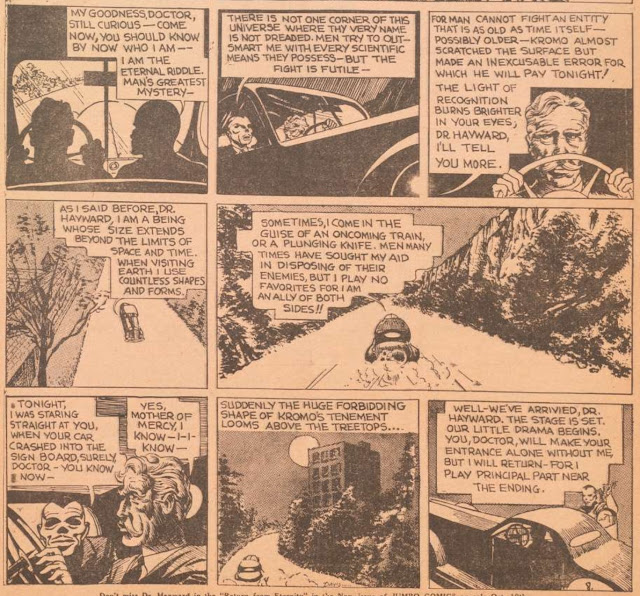
    There are a few ways that the anthropomorphic personification of death is commonly written -compassionate, dispassionate, cruel, goofy – but this particular one crops up in genre fiction a fair amount: personally offended by people attempting to extend their lifespan. This particular version of Death is both pissy about the scientist Kromo’s attempt to live forever via soul transfer and willing to take a hand in preventing him from doing so. He also seems to really enjoy freaking people out, as seen in his car ride with heroic scientist Dr Hayward. 

    God style: real, anthropomorphic personification. (Jumbo Comics 002-004, 1938) 

    Deli-Deli: 

    As is often the case I am torn between finding Malaysian idol-god Deli-Deli charmingly goofy looking and knowing that the goofiness is part of the sneering “these primitive people will worship anything at the heart of many this kind of jungle adventure.

    God-style: idol (Big Shot Comics 013, 1941) 

  • DIVINE ROUND-UP 002

    Oh so spiritual, we are.

    Koli Tow: 

    Hal Hazard and his brother Hoagy are adventuring in the South Seas when they get shipwrecked, which is not really an excuse for just wandering into a local temple to eat the food offerings but I guess when you’re hungry a little sacrilege is easy to justify. Even so, the local worshippers of Koli Tow aren’t particularly understanding about it, and given the nature of the comic there’s a human sacrifice in the offing until Hal and Hoagy escape to take their brand of cultural sensitivity to another island. 

    God Style: idol (Circus, the Comic Riot 001, 1938)

    the Canal God: 

    An adventure on Mars brings the Space Rovers to the temple of the Canal God, who basically just looks like a dude because this is a Mars populated by basic-ass humanoids. Just what persentage of Martian gods are going to turn out to be canal-related, anyway? 

    God style: idol (Exciting Comics 004, 1940)

    Death: 

    There are a few ways that the anthropomorphic personification of death is commonly written -compassionate, dispassionate, cruel, goofy – but this particular one crops up in genre fiction a fair amount: personally offended by people attempting to extend their lifespan. This particular version of Death is both pissy about the scientist Kromo’s attempt to live forever via soul transfer and willing to take a hand in preventing him from doing so. He also seems to really enjoy freaking people out, as seen in his car ride with heroic scientist Dr Hayward. 

    God style: real, anthropomorphic personification. (Jumbo Comics 002-004, 1938) 

    Deli-Deli: 

    As is often the case I am torn between finding Malaysian idol-god Deli-Deli charmingly goofy looking and knowing that the goofiness is part of the sneering “these primitive people will worship anything at the heart of many this kind of jungle adventure.

    God-style: idol (Big Shot Comics 013, 1941) 

  • ALIENS AND SO FORTH ROUND-UP 004

    ALIENS AND SO FORTH ROUND-UP 004

    Now’s the time that we start pulling aliens from the vaults! So look out for a lot of A-names for the next while! Not the first one though, because something has to come up organically.

    Crillionites:

    Hailing from the planet Crillon (which boasts the majestic Crillion City, natch), the Crillionites are a caste-based society in which the Lords of Crillon (like from the title of the comic!) rule over a slave population via some sort of divine right. This societal order is threatened by Professor Wendall Keene and his crew of space explorers: Hugh, Celeste, and the also-titular Ken Craig, but whether this is due to some innate sense of justice on their part or for some other reason is never quite spelled out in their one extant appearance, as things start in media res and Mort Cowen there presumably thought he could go back and explain what was going on a bit later. No dice, Mort. (Circus, the Comics Riot 001, 1938)

    the Ancient Ones: 

    It’s that old staple of adventure, the ancient hidden civilization! Not all of them are different enough from regular humanity to qualify as an Alien and So Forth, but I reckon a society of prehistoric Antarcticans who retreated underground when the ice crept across their lands and have indefinite lifespans must surely count. The Ancient Ones are kind of boringly benevolent, but they do have a lot of gold, which inspires hero Rocky Ryan’s crew to mutiny and thus provides a bit of excitement.

    This also allows the Ancient Ones to show off their somewhat ghoulish hobby: collecting gold-hungry adventurers in suspended animation. Or possibly practicing human taxidermy. (Big Shot Comics 009, 1940)

    Antarenes: 

    The Antarenes, inhabitants of the planet Antar, have a problem: their sun has gone out. Their solution? Head underground and set out through the void of space with their whole dang planet to find a new one. Unfortunately for Earth, rather than one of the presumably many uninhabited stars in the galaxy the Antarenes have chosen Earth’s orbit as the coziest place to pull up their planet, and the Earth is just going to have to move out of the way (and into the Sun), whether they like it or not. Fortunately for Earth, Marvo 1○2 Go+ is on the case and Antar is rerouted back out of the Solar System to find somewhere elese to park.

    One small detail that I appreciate about the Antarenes: as a society that seems to mimic the eusocial nature of our world’s ants they of course have a Queen but we never see her, for the simple reason that she is way too important to let two weird randos just rock up and meet with her. (Superworld Comics 003, 1940)

    the Ants:

    Captain Tornado, along with Professor Bordani and his daughter Jane, are stranded on the extrasolar planet Barrang. They meet and shoot a variety of intelligent aliens while there, the first of which are these giant alien ants, who don’t figure too heavily into the plot but who do engage in intraspecies warfare and melon farming. (Popular Comics 046, 1939)

  • ALIENS AND SO FORTH ROUND-UP 004

    Now’s the time that we start pulling aliens from the vaults! So look out for a lot of A-names for the next while! Not the first one though, because something has to come up organically.

    Crillionites:

    Hailing from the planet Crillon (which boasts the majestic Crillion City, natch), the Crillionites are a caste-based society in which the Lords of Crillon (like from the title of the comic!) rule over a slave population via some sort of divine right. This societal order is threatened by Professor Wendall Keene and his crew of space explorers: Hugh, Celeste, and the also-titular Ken Craig, but whether this is due to some innate sense of justice on their part or for some other reason is never quite spelled out in their one extant appearance, as things start in media res and Mort Cowen there presumably thought he could go back and explain what was going on a bit later. No dice, Mort. (Circus, the Comics Riot 001, 1938)

    the Ancient Ones: 

    It’s that old staple of adventure, the ancient hidden civilization! Not all of them are different enough from regular humanity to qualify as an Alien and So Forth, but I reckon a society of prehistoric Antarcticans who retreated underground when the ice crept across their lands and have indefinite lifespans must surely count. The Ancient Ones are kind of boringly benevolent, but they do have a lot of gold, which inspires hero Rocky Ryan’s crew to mutiny and thus provides a bit of excitement.

    This also allows the Ancient Ones to show off their somewhat ghoulish hobby: collecting gold-hungry adventurers in suspended animation. Or possibly practicing human taxidermy. (Big Shot Comics 009, 1940)

    Antarenes: 

    The Antarenes, inhabitants of the planet Antar, have a problem: their sun has gone out. Their solution? Head underground and set out through the void of space with their whole dang planet to find a new one. Unfortunately for Earth, rather than one of the presumably many uninhabited stars in the galaxy the Antarenes have chosen Earth’s orbit as the coziest place to pull up their planet, and the Earth is just going to have to move out of the way (and into the Sun), whether they like it or not. Fortunately for Earth, Marvo 1○2 Go+ is on the case and Antar is rerouted back out of the Solar System to find somewhere elese to park.

    One small detail that I appreciate about the Antarenes: as a society that seems to mimic the eusocial nature of our world’s ants they of course have a Queen but we never see her, for the simple reason that she is way too important to let two weird randos just rock up and meet with her. (Superworld Comics 003, 1940)

    the Ants:

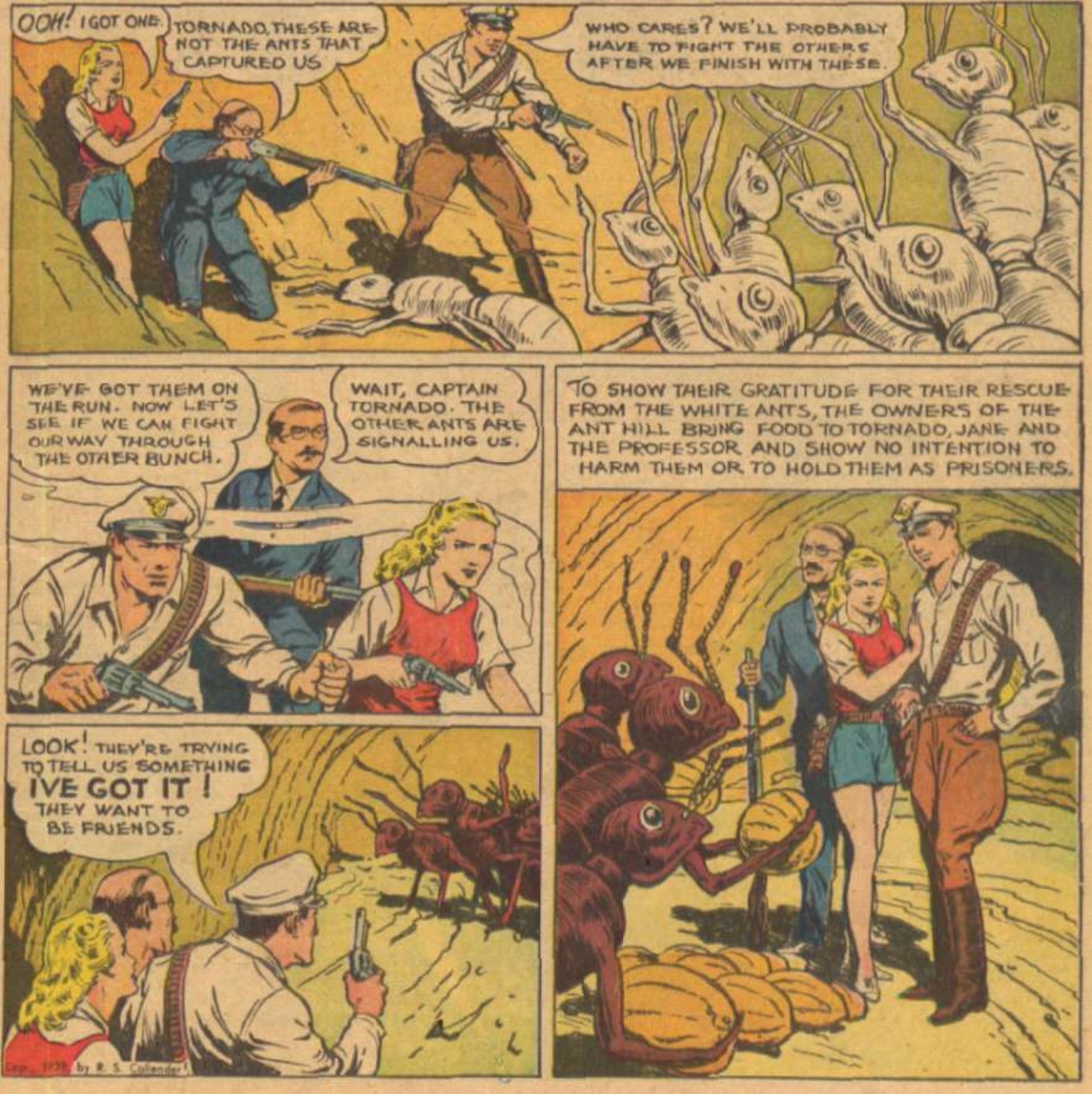
    Captain Tornado, along with Professor Bordani and his daughter Jane, are stranded on the extrasolar planet Barrang. They meet and shoot a variety of intelligent aliens while there, the first of which are these giant alien ants, who don’t figure too heavily into the plot but who do engage in intraspecies warfare and melon farming. (Popular Comics 046, 1939)

  • REAL PERSON ROUND-UP 005

    REAL PERSON ROUND-UP 005

    You can’t deny that they were real people.

    Adolf Hitler:

    This unnamed leader of the unnamed forces that the Flying Trio are battling on behalf of the little nation of Sylvania is a real Hitlerian fellow (Crash Comics Adventures 005, 1940) 

    Amelia Earhart:

    Two variations on a theme: using the story of the disappearance of Amelia Earhart as fodder for a damsel-in-distress story. The first (Amazing-Man Comics 018, 1940) involves the Shark rescuing Amelia Reinhardt from an old man who has her trapped in the jungle in hopes that she will fall for him. The second (Big Shot Comics 019, 1941) features aviator Rocky Ryan and his pal rescuing Amy Every from cartoonishly racist cannibals.

    Captain Kidd:

    Crooks try to pull a fast one by purchasing Captain Kidd’s authentic treasure chest and then “discovering” it after filling it with stolen gold (Cyclone Comics 001, 1940)

    Ethan Allen: 

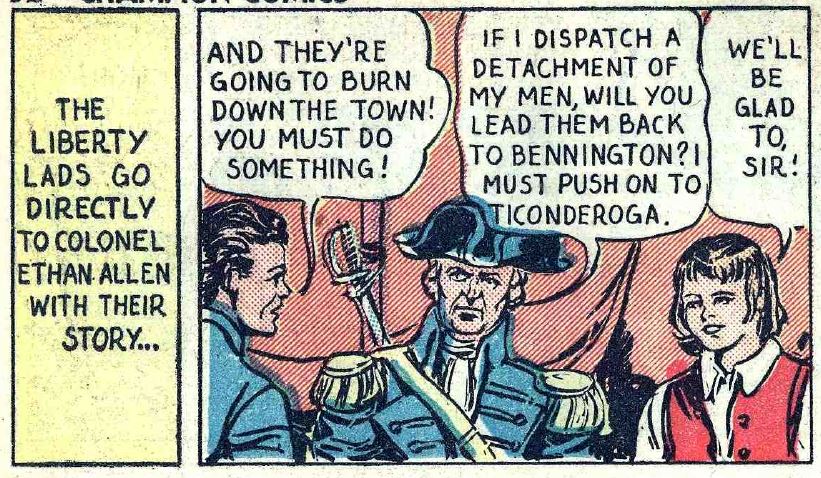
    The Liberty Lads are back at it, getting their grubby mitts all over the American Revolutionary War. This time they meet Ethan Allen and the Green Mountain Boys on the eve of the capture of Fort Ticonderoga. (Champion Comics 009, 1940)

    John Hancock and Samuel Adams:

    More Liberty Lads shenanigans. This time they’re saving Samuel Adams and John Hancock from capture by the British, something that as far as I can tell almost happened in our timeline. (Champ Comics 011, 1940)  

    Joseph Stalin:

    “Nilats,” leader of “Aissur” is tracked to his office in “Wocsom” by Strongman, who objects to the Aissurans’ invasion of the Balkan country of Rutania (Crash Comics Adventures 003, 1940)

    Orson Welles:

    For a while, Orson Welles’ ‘War of the Worlds’ broadcast is used as a shorthand for a reason that the cops blithely ignore multiple calls about some fantastic threat, only they certainly never do more than allude to the real thing. This time it’s giant mutant ivy plants and the dumb police are talking about a broadcast by “Worsen Welds”. (Amazing-Man Comics 006, 1939)

    Saladin:

    Makes a one-panel appearance in the otherwise undistinguished Crusades comic “Reynard the Fox”. (Cyclone Comics 005, 1940)

    Tecumseh:

    Whether “Metumseh” is a stand-in for Shawnee leader Tecumseh or they just mushed around his name to make up one for this fellow I cannot say, but they were certainly thinking of him while they did it. (Champion Comics 010, 1940)

  • GENERIC COSTUMED VILLAIN ROUND-UP 010

    The thing is that they have some but not all of the attributes of a super-villain.

    A sea-raider who uses a stolen acid gun to build a psychically-controlled army of skeleton men? If only he had a name or had a bit more swagger! Alas for him the Shark puts him down before he could do enough to elevate himself out of this gathering of also-rans. (Amazing-Man Comics 021, 1941)

    This gang of guys dressed as mailmen don’t give the Blue Beetle much trouble even when wielding compressed air guns that fire explosive pellets. I admire the visual, though. (Big 3 005, 1941)

    The Scooby-Doo style “fake haunting to drive people away from treasure/natural resource/property” is of course super-villain adjacent, but there are so many instances of in comics that I tend to disregard them as generic criminality. This unnamed fellow, however… not only was he attempting to scare off a homeowner so that he could look for pirate treasure in her basement but he went and “I would have gotten away with it…” -ed at that meddling Marvelo, Monarch of Magicians. (Big Shot Comics 009, 1941)

    Just some nameless goons that take part in an usurpation attempt against Blue Bolt villain the Green Sorceress but they’re Jack Kirby goons so they look fantastic. (Blue Bolt v1 004, 1940)