The Curse of Skeleton Munroe

Category: Columbia

  • MINOR SUPER-VILLAIN 494: THE INVENTOR

    (Big Shot Comics 008, 1940) 

    It’s a very big stretch, even by the standards of my own Unofficial Name convention, to call this guy the Inventor but it’s literally the only thing he’s referred to as other than “the man” and I just can’t keep calling these guys “Unnamed Scientist.” I just can’t.

    So! The Inventor has invented a very cool remote-controlled humanoid robot with a special poison-spraying device in the chest. We’ll skip my usual speculation into the potential value that could be reaped by selling this design for industrial purposes rather than using it for mere bank robbery because the Inventor is in fact a mad scientist and thus cannot be held to the same fiscal standards as his more rational colleagues.

    Let’s take a second to appreciate the classic stylings of this robot: cylinder head, pincer claws, speaker ears… all the great robot features in one cool guy.

    This might be a Tom Kerry story but the real hero of the piece is this night watchman who chooses not to pointlessly die in an attempt to protect the bank he works at and instead lives to clue the two-fisted District Attorney in on the culprit’s identity as a robot. I appreciate you, fella.

    Tom Kerry tracks the robot back to its lair by the simple expedient of clinging to the underside of the remote-controlled auto-gyro used to ferry both it and the money back to the Inventor. There he takes advantage of the fact that like a surprising percentage of Golden and Silver Age robots, this one’s exterior shell is easily removed and repurposed as a costume.

    The Inventor is essentially epically pranked into signing a confession, Tom Kerry battles a knife-wielding maniac in his boxer shorts and the whole thing wraps up with a sock to the jaw. No word on what became of that poor nude robot, though.

  • MAD AND CRIMINAL SCIENTIST ROUND-UP 007

    The mad scientists are usually up to something criminal, but the criminal scientists are often completely rational.

    Like a fair few of the scientists I speak of here, Dr Hayles here talks a big game but gets caught in the planning stages before he has the chance to prove to the world that he was right all along. In Hayles’ case it was kidnapping a bunch of boys that got him in trouble and operating on young boys’ brains in order to make them geniuses that he never got to prove before he was corralled by Marvelo, Monarch of Magicians. (Big Shot Comics 002, 1940)

    This here Count Alexis fellow is an agent of an unspecified foreign power who employs his extremely cool fleet of giant flying magnifying glasses in an attempt to destroy Boston. This, in turn, will cow the States into serving said unnamed country. It’s a bit of a flimsy plan, especially once you see Skyman beat the tar out of the mere two men operating one of the lenses and using that lens to melt the other four three (almost forgot that he captures two of them, as well as Count Alexis himself) 

    Count Alexis also lives in Vermont and is 100% the only villain on this blog as it currently stands to do so. Congratulations, Vermont! You made it! (Big Shot Comics 007, 1940)

    This unnamed scientist developed a steerable electrically-charged tornado called a “Force-Top” and attempted to extort the US into buying it but got pinched by Jeff Cardiff, Spy-Chief basically as soon as he put his plan into motion. (Big Shot Comics 007, 1940)

    As far as ways to extort the US (in this case into acclaiming Our Villain here as dictator), freezing entire cities solid isn’t a bad way to go, and Norgo goes for some big targets after his initial test freeze of a Florida beach: Boston, Chicago, San Francisco, St Louis and Washington DC. He might have gotten in with a chance if it hadn’t been for Skyman completely owning his plan and unfreezing all the cities in about half an hour – though the fact that he does so by exploding balls of “atomic power” over each city is at least a bit concerning. (Big Shot Comics 008, 1940)

  • MINOR SUPER-VILLAIN 493: THE MOON-MISTRESS

    (Big Shot Comics 006, 1940)

    Moora, Queen of the People of the Moon, is technically only called the Moon-Mistress by her enemies, but what can I say, I love alliteration. As introduced, she is merely the leader of a troublesome “hill tribe” that pistol-packing adventurer Rocky Ryan is asked to settle down on behalf of a local Maharajah (where exactly this takes place is ambiguous: Ryan is one of those Golden Age soldier-of-fortune characters who perpetually bums around an “India” that is really a sort of pan-Asian pastiche).

    The People of the Moon have a temple in the hills that does double duty as a laboratory for the wizened scientist La Chega, who has “gathered solar energy” into a series of rectangular prisms that the characters insist on calling cubes. Everyone gasses on for a while about how powerful this is without saying why so I assume that it’s just going to be a power source when world domination time comes. Also yes solar power is a bit off-brand for a moon cult but consider: the Moon shines due to reflected sunlight. Makes you think.

    The People of the Moon also have some sort of dark spirit that they worship as the moon-god Luna. If we accept the caption box info as canon then Luna is a remnant of a “long-dead god”, which is heady stuff. That’s unfortunately all we learn before Rocky Ryan, following standard operating protocol for meathead adventuremen, attempts to blow Luna away with a six-shooter.

    Whether or not Ryan manages to make Luna even more dead, he does somehow hit one of the solar energy cubes rectangular prisms, setting off a chain reaction that ends up blowing the temple and everything in it sky high (though Rocky Ryan survives, of course). Another ancient culture wiped off the map – all in a day’s work.

  • MINOR SUPER-VILLAIN 492: THE BLUE DEATH KILLER

    (Big Shot Comics 006, 1940)

    Someone is killing old policemen! And furthermore, they’re doing it in such a way that their skin is tinted blue as they die! Unsurprisingly, this ends up being called the Blue Death. But Who is administering it, and why?

    It’s a short story, so we find out pretty quickly that the culprit is one Doctor Swanson and he’s getting revenge on the eight police officers who arrested him twenty-three years earlier, using special arsenic/ phosphorous/ radium darts. What was he arrested for? What is he a doctor of? These questions are not answered before he is killed in a shootout with gunslinging District Attorney Tom Kerry.

    Spotlight On: the article on Swanson’s initial arrest including the partial text “… throat cut… eyes… gouged out… tongue… pulled out…” It really was a heck of an arrest.

    JUDGE AND JURY ARRESTING OFFICER REVENGE KILLING SCORE: 3/8

  • MINOR SUPER-VILLAIN 491: THE WEASEL

    (Big Shot Comics 001, 1940)

    Just a simple head of a gang that specializes in stealing furs (and I would call that over-specialized but we’re just a couple of years off from wartime rationing and with it gangs that specialize in meat, tires and scrap metal theft) but he has a number of super-villainous aspects:

    -the biggest one has to go first and it’s that he has the chutzpah to track a police informant through the streets of New York with a pack of bloodhounds. It’s a real power move!

    -the name and the cape don’t hurt

    Okay, that’s actually about it. Those bloodhounds are doing a lot of heavy lifting. The Weasel eventually decides to push his luck re: the cops and their willingness to use deadly force in defense of property and meets his end in a burning fur warehouse.

  • MINOR SUPER-VILLAIN 490: THE HOOK

    (Big Shot Comics 003, 1940)

    Is a hook hand the most basic gimmick that automatically flips a gang boss over to being a super-villain in my mind? We don’t have enough data to call it yet but all signs point to Probably. 

    This Hook is Hook Horner and there’s not too much to say about him: he kidnaps a young woman sometime between the death of someone she is set to inherit millions from but before she herself knows about it, ie, while the money is still going to be in legal limbo for a while yet, ie, way too early. He gives the Face a run for his money but like a lot of hook-handed villains in the end he dies because his hook gets caught on something, in this case a speeding car.

  • MINOR SUPER-VILLAIN 490: THE HOOK

    (Big Shot Comics 003, 1940)

    Is a hook hand the most basic gimmick that automatically flips a gang boss over to being a super-villain in my mind? We don’t have enough data to call it yet but all signs point to Probably. 

    This Hook is Hook Horner and there’s not too much to say about him: he kidnaps a young woman sometime between the death of someone she is set to inherit millions from but before she herself knows about it, ie, while the money is still going to be in legal limbo for a while yet, ie, way too early. He gives the Face a run for his money but like a lot of hook-handed villains in the end he dies because his hook gets caught on something, in this case a speeding car.

  • MINOR SUPER-VILLAIN 489: THE GOLDMASTER

    (Big Shot Comics 002, 1940) 

    The Goldmaster is one of my very favourite subtypes of super-villain: the guy who really leans into the bit. Specifically, he is a fellow who has discovered the secret of making gold and subsequently adopted all of the trappings of a Medieval alchemist. Or possibly he was a guy who was really into the alchemy lifestyle who made the luckiest find ever. Either way, he doesn’t have to live like this! It’s a choice!

    No matter what the Goldmaster’s route to infinite gold production was, he certainly has all the fighting skills of a quicksilver-raddled mystic. He and his gang of would-be economic titans are gathered up with very little effort by the Face, with the Goldmaster himself ultimately choosing the coward’s way out.

  • MINOR SUPER-HERO ROUND-UP 005

    All Columbia Comic Corporation edition!

    Skyman: 

    Skyman (properly the Skyman but it just doesn’t scan for me) is a pilot hero, normally a ho-hum sort of character for me. But between his sci-fi super plane (the Wing), his blood-freezing stun ray (the Stasimatic) and his cool on-the-edge-of-being-too-busy costume there’s just enough super-hero peanut butter mixed in with the pilot chocolate to make it appealing (bonus running list of Skyman’s super science: atomic explosives, invisible glass phonograph, disitegrator ray, explosives-detonating ray and a ray that fuses gun barrels shut)

    After a few issues we learn that the Skyman is actually Allan Turner, wealthy good-for-nothing playboy who lost his parents to a plane crash when he was a child. If the Bruce Wayne parallel was 1:1 he would have grown up to become a noted slayer of planes, but that’s a villain’s origin. Instead, Allan Turner dresses up as a plane to fight criminals. It doesn’t make quite as much narrative sense as Batman does but it’s probably more fun to read than the other way around.

    Early Skyman also might just hold the record for the most overinflated torso in comics outside of parody characters. He gets a bit more proportional eventually but for a while there you’re concerned for his ability to live a normal life.

    the Face:

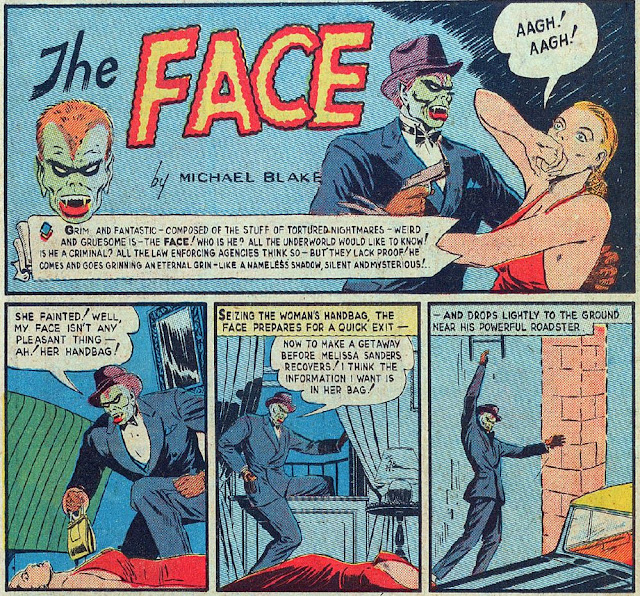
    The Face, like a lot of early comics heroes, draws a lot of elements from the pulps: a tuxedo-clad hero drives around in a souped up roadster fighting crime with his fists and an automatic – a pretty regular early super-guy. Even his secret identity of Tony Trent, radio station owner/ radio announcer is in the pulp-adjacent character wheelhouse.

    It was very exciting to me when I realized that the Face’s face is frequently referred to as a rubberoid mask, my favourite term for the kind of masks that only exist in comic books – perfectly realistic and naturalistic but also very easy to don and doff. This particular mask was made specially for Tony Trent by someone whose other major characteristic is being dead, which is apparently a combination that makes Trent feel quite jolly.

    Weirdly, in Big Shot Comics 006, the Face has a new, slightly less grotesque mask. No word on where he got this one but he goes back to the original pretty quickly.

    Marvelo, Monarch of Magicians:

    Created by Fred Guardineer, who also created Zatara over at DC Comics, Marvelo is… extremely similar to Zatara. Aside from their different approaches to dressing like a stage magician, I’d say that there are two slight differences between the characters: 

    1. Rather than speaking backward to cast spells, Marvelo shouts “Kalora!” as an all-purpose magic word.

    2. Marvelo’s manservant Zee is just a hair more racist than Zatara’s manservant Tong. It’s pretty close but I reckon Zee takes it.

    Big Shot Comics 017 reveals that Marvelo is the son of the ruler of the generically foreign South Pacific island of Brahama (hell on autocorrect). This doesn’t seem to have anything to do with him being a magic man but it’s nice to know. (Big Shot Comics 001, 1940)

    the Cloak:

    Jeff Cardiff, Spy Chief was a feature in Big Shot Comics from issue 1 (well, it was Jeff Cardiff, Spy-Master for the first issue or two but the point stands) with all kinds of foiled plots and plans and spies of both the vaguely fascist and vaguely communist varieties. In Issue 15, however, the spies adopt the reasonable policy of attempting to shoot on sight the man who has foiled so many of their plans and a wounded Jeff Cardiff goes to recuperate at his brother’s house.

    Long story short, Jed Cardiff is a coal magnate with a collection of “adventure curios”, including the namesake cloak of Revolutionary War-era costumed spy the Cloak and it being 1941 and a comic book, Jeff immediately adopts the Cloak identity as his own. It’s a fairly basic costumed hero shtick but I appreciate the effort and it’s always nice to see a more elaborate cape and cowl getup now and then. (Big Shot Comics 015, 1941)

    The original Cloak eventually shows up in a flashback and it turns out that his impact on the history of the American Revolution is only slightly less impactful than Superboy’s in the 1949 story in which he goes back in time and takes part in about half the major events of the war. I must say that I do love a retcon of a historical event. (Big Shot Comics 021, 1942)

  • MINOR SUPER-HERO ROUND-UP 005

    All Columbia Comic Corporation edition!

    Skyman: 

    Skyman (properly the Skyman but it just doesn’t scan for me) is a pilot hero, normally a ho-hum sort of character for me. But between his sci-fi super plane (the Wing), his blood-freezing stun ray (the Stasimatic) and his cool on-the-edge-of-being-too-busy costume there’s just enough super-hero peanut butter mixed in with the pilot chocolate to make it appealing (bonus running list of Skyman’s super science: atomic explosives, invisible glass phonograph, disitegrator ray, explosives-detonating ray and a ray that fuses gun barrels shut)

    After a few issues we learn that the Skyman is actually Allan Turner, wealthy good-for-nothing playboy who lost his parents to a plane crash when he was a child. If the Bruce Wayne parallel was 1:1 he would have grown up to become a noted slayer of planes, but that’s a villain’s origin. Instead, Allan Turner dresses up as a plane to fight criminals. It doesn’t make quite as much narrative sense as Batman does but it’s probably more fun to read than the other way around.

    Early Skyman also might just hold the record for the most overinflated torso in comics outside of parody characters. He gets a bit more proportional eventually but for a while there you’re concerned for his ability to live a normal life.

    the Face:

    The Face, like a lot of early comics heroes, draws a lot of elements from the pulps: a tuxedo-clad hero drives around in a souped up roadster fighting crime with his fists and an automatic – a pretty regular early super-guy. Even his secret identity of Tony Trent, radio station owner/ radio announcer is in the pulp-adjacent character wheelhouse.

    It was very exciting to me when I realized that the Face’s face is frequently referred to as a rubberoid mask, my favourite term for the kind of masks that only exist in comic books – perfectly realistic and naturalistic but also very easy to don and doff. This particular mask was made specially for Tony Trent by someone whose other major characteristic is being dead, which is apparently a combination that makes Trent feel quite jolly.

    Weirdly, in Big Shot Comics 006, the Face has a new, slightly less grotesque mask. No word on where he got this one but he goes back to the original pretty quickly.

    Marvelo, Monarch of Magicians:

    Created by Fred Guardineer, who also created Zatara over at DC Comics, Marvelo is… extremely similar to Zatara. Aside from their different approaches to dressing like a stage magician, I’d say that there are two slight differences between the characters: 

    1. Rather than speaking backward to cast spells, Marvelo shouts “Kalora!” as an all-purpose magic word.

    2. Marvelo’s manservant Zee is just a hair more racist than Zatara’s manservant Tong. It’s pretty close but I reckon Zee takes it.

    Big Shot Comics 017 reveals that Marvelo is the son of the ruler of the generically foreign South Pacific island of Brahama (hell on autocorrect). This doesn’t seem to have anything to do with him being a magic man but it’s nice to know. (Big Shot Comics 001, 1940)

    the Cloak:

    Jeff Cardiff, Spy Chief was a feature in Big Shot Comics from issue 1 (well, it was Jeff Cardiff, Spy-Master for the first issue or two but the point stands) with all kinds of foiled plots and plans and spies of both the vaguely fascist and vaguely communist varieties. In Issue 15, however, the spies adopt the reasonable policy of attempting to shoot on sight the man who has foiled so many of their plans and a wounded Jeff Cardiff goes to recuperate at his brother’s house.

    Long story short, Jed Cardiff is a coal magnate with a collection of “adventure curios”, including the namesake cloak of Revolutionary War-era costumed spy the Cloak and it being 1941 and a comic book, Jeff immediately adopts the Cloak identity as his own. It’s a fairly basic costumed hero shtick but I appreciate the effort and it’s always nice to see a more elaborate cape and cowl getup now and then. (Big Shot Comics 015, 1941)

    The original Cloak eventually shows up in a flashback and it turns out that his impact on the history of the American Revolution is only slightly less impactful than Superboy’s in the 1949 story in which he goes back in time and takes part in about half the major events of the war. I must say that I do love a retcon of a historical event. (Big Shot Comics 021, 1942)