The Curse of Skeleton Munroe

Category: mind control

  • PROBLEMATIC ROUND-UP 009

    It it the nature of comic books that we will always be doing Problematic Updates.

    Dr Finkle:

    Dr Finkle himself is nothing special: he’s a psuedo-Nazi teamed up with the pseudo-Japanese Matsui in a scheme to steal securities belonging to Axis-conquered countries that are held in America. The real issue lies with Finkle’s primary agents, who you may notice being referred to as “Indian Monsters” in the final panel above.

    These “Indian Monsters” are straight out of something like Bone Tomahawk: inhumanly huge, fast and strong, barely verbal, ravenous cannibals that Finkle keeps under control with a steady diet of human flesh… literally monsters, in other words.

    I was going to say that the only good thing about them is that they eventually eat Dr Finkle but no, I must be thinking about some other monster-men. Instead, a special agent named Betty shoots Finkle and they immediately transfer allegiance to her thanks to “ancient Indian folklore.” It’s enough to tire a guy out. (Four Favorites 002, 1940)

    Loanga:

    Loanga is your regular old 1940s voodoo witch doctor, though he deviates from the norm by not being from Haiti but from another Caribbean island named Naseba, a name that feels like it should be in reference to something but if it is I cannot figure it out. Loango aims to take over the world with his zombie hordes and is starting with the United States, having captured and zombified Secretary of State Brant and compelled him to push for the disarmament all US military installations.

    As usual it is interesting to note the specifics of Loanga’s zombies. They are created out of living people using a combination of drugs and mind control and though they are still alive and able to speak, they cannot be killed by conventional means. They are cured and go back to normal when Loanga dies – whether this means that the ones who were dealt lethal wounds just fully die is not explored. Finally, they cast no shadows, and there’s something going on with their eyes – the ones who we see trying to pass as regular folk all wear dark glasses, but no reason for doing so is given.

    Loanga is ultimately undone by his own belief in the power of sympathetic magic: when comic relief artist character J. Rembrandt Speedball paints his portrait and then destroys it in a fit of pique at the thought of being executed by firing squad, he drops dead. All the zombies are freed or dead and the world is saved! (Fantastic Comics 023, 1941)

    the Big Boss:

    The Big Boss, a mysterious masked Chinese man who controls the opium trade in the Western city of Middletown (highly inaccurate name btw) unsurprisingly turns out to be J Harold Stetson, the prominent banker who has been making a lot of noise about how much he hates all this opium smuggling (and please note the misspelling that initially has his middle name as the weirdly amusing “Harlod”). (Lightning Comics v2 002, 1941)

    the Death Patrol:

    Here’s the tragic thing about the Death Patrol: it’s mostly something that I really like. I’ll lay out the setup and you see if you can spot when we get into Problematic territory.

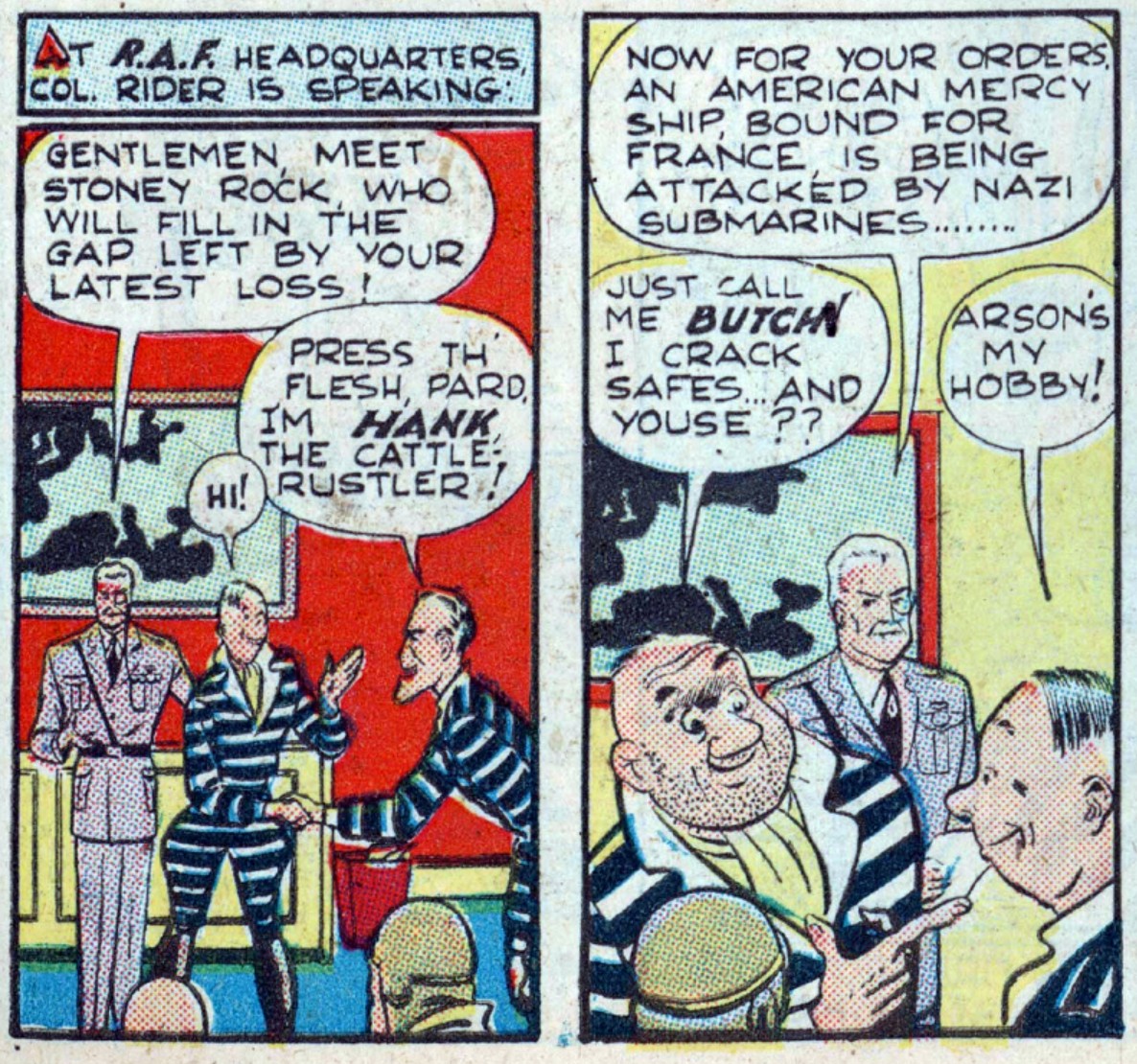
    The Death Patrol is formed when wealthy pilot/failure Del van Dyne’s plane is hijacked by a quartet of escaped convicts (and the pal who helped them break out). Del manages to weaponize his sense of rich guy ennui/ desire to make a difference in the world to convince the five to join him in volunteering to help the RAF defend the UK from Axis aggression, and thankfully all five are expert pilots in addition to their professional skills so this is a bit more plausible than it might otherwise be.

    The hook of the early Death Patrol stories, and the source of their name, is the fact that they only take on the most dangerous missions and have an attrition rate of one member per adventure. (Military Comics 001, 1941)

    The original lineup of the Death Patrol is as follows:

    Del van Dyne: Wealthy failure and leader of the group. Alive at the end of 1941.

    Butch O’Keefe: Safecracker. Sacrifices himself to stop a Nazi bomber group by crashing into them.

    Gramps: Pickpocket. Alive at the end of 1941.

    Hank: Rustler. Alive at the end of 1941.

    Peewee: Forger. Shot in the back by Nazis in the very first Death Patrol adventure.

    Slick Ward: Con artist. Dies in an exploding Nazi dirigible.

    Additional members added in 1941 as the death toll rises: 

    Stoney Rock: Arsonist. Shot by Nazis on his first mission. (Military Comics 002, 1941)

    Zazzy: Kleptomaniac. Dies while rescuing workers from an exploding Nazi factory. (Military Comics 003, 1941)

    Chief Chuck-a-lug: Former Wild West show performer stranded in Europe due to the conflict, and yes, congratulations, you spotted it. This is where the Death Patrol officially becomes Hard to Recommend, because from this point forward there will always be one or more racist comic relief characters running around and, for instance, yelling about scalping people. Alive at the end of 1941. (Military Comics 004, 1941)

    King Hotentot: The ruler of a small African country that has been occupied by the Axis, King Hotenetot is a prime example of the Educated Savage, a classic unfunny comedy trope in which a character speaks eloquently due to a classical education but still, for example, runs around with a spear threatening to eat people like he’s just flown in from a hateful jungle adventure. Still alive at the end of 1941. (Military Comics 005, 1941)

    Jumping back to some of the fun things about the Death Patrol, here are their fun prison-themed flightsuits and skull-in-a-hat insignia which is personalized with a custom hat for each pilot. Fun! 

    The Death Patrol also flies around in eccentric homemade airplanes, which is whimsical! It’s the sort of thing that makes you want to recommend the comic to a friend, until you remember all the Problems.

  • PROBLEMATIC ROUND-UP 009

    PROBLEMATIC ROUND-UP 009

    It it the nature of comic books that we will always be doing Problematic Updates.

    Dr Finkle:

    Dr Finkle himself is nothing special: he’s a psuedo-Nazi teamed up with the pseudo-Japanese Matsui in a scheme to steal securities belonging to Axis-conquered countries that are held in America. The real issue lies with Finkle’s primary agents, who you may notice being referred to as “Indian Monsters” in the final panel above.

    These “Indian Monsters” are straight out of something like Bone Tomahawk: inhumanly huge, fast and strong, barely verbal, ravenous cannibals that Finkle keeps under control with a steady diet of human flesh… literally monsters, in other words.

    I was going to say that the only good thing about them is that they eventually eat Dr Finkle but no, I must be thinking about some other monster-men. Instead, a special agent named Betty shoots Finkle and they immediately transfer allegiance to her thanks to “ancient Indian folklore.” It’s enough to tire a guy out. (Four Favorites 002, 1940)

    Loanga:

    Loanga is your regular old 1940s voodoo witch doctor, though he deviates from the norm by not being from Haiti but from another Caribbean island named Naseba, a name that feels like it should be in reference to something but if it is I cannot figure it out. Loango aims to take over the world with his zombie hordes and is starting with the United States, having captured and zombified Secretary of State Brant and compelled him to push for the disarmament all US military installations.

    As usual it is interesting to note the specifics of Loanga’s zombies. They are created out of living people using a combination of drugs and mind control and though they are still alive and able to speak, they cannot be killed by conventional means. They are cured and go back to normal when Loanga dies – whether this means that the ones who were dealt lethal wounds just fully die is not explored. Finally, they cast no shadows, and there’s something going on with their eyes – the ones who we see trying to pass as regular folk all wear dark glasses, but no reason for doing so is given.

    Loanga is ultimately undone by his own belief in the power of sympathetic magic: when comic relief artist character J. Rembrandt Speedball paints his portrait and then destroys it in a fit of pique at the thought of being executed by firing squad, he drops dead. All the zombies are freed or dead and the world is saved! (Fantastic Comics 023, 1941)

    the Big Boss:

    The Big Boss, a mysterious masked Chinese man who controls the opium trade in the Western city of Middletown (highly inaccurate name btw) unsurprisingly turns out to be J Harold Stetson, the prominent banker who has been making a lot of noise about how much he hates all this opium smuggling (and please note the misspelling that initially has his middle name as the weirdly amusing “Harlod”). (Lightning Comics v2 002, 1941)

    the Death Patrol:

    Here’s the tragic thing about the Death Patrol: it’s mostly something that I really like. I’ll lay out the setup and you see if you can spot when we get into Problematic territory.

    The Death Patrol is formed when wealthy pilot/failure Del van Dyne’s plane is hijacked by a quartet of escaped convicts (and the pal who helped them break out). Del manages to weaponize his sense of rich guy ennui/ desire to make a difference in the world to convince the five to join him in volunteering to help the RAF defend the UK from Axis aggression, and thankfully all five are expert pilots in addition to their professional skills so this is a bit more plausible than it might otherwise be.

    The hook of the early Death Patrol stories, and the source of their name, is the fact that they only take on the most dangerous missions and have an attrition rate of one member per adventure. (Military Comics 001, 1941)

    The original lineup of the Death Patrol is as follows:

    Del van Dyne: Wealthy failure and leader of the group. Alive at the end of 1941.

    Butch O’Keefe: Safecracker. Sacrifices himself to stop a Nazi bomber group by crashing into them.

    Gramps: Pickpocket. Alive at the end of 1941.

    Hank: Rustler. Alive at the end of 1941.

    Peewee: Forger. Shot in the back by Nazis in the very first Death Patrol adventure.

    Slick Ward: Con artist. Dies in an exploding Nazi dirigible.

    Additional members added in 1941 as the death toll rises: 

    Stoney Rock: Arsonist. Shot by Nazis on his first mission. (Military Comics 002, 1941)

    Zazzy: Kleptomaniac. Dies while rescuing workers from an exploding Nazi factory. (Military Comics 003, 1941)

    Chief Chuck-a-lug: Former Wild West show performer stranded in Europe due to the conflict, and yes, congratulations, you spotted it. This is where the Death Patrol officially becomes Hard to Recommend, because from this point forward there will always be one or more racist comic relief characters running around and, for instance, yelling about scalping people. Alive at the end of 1941. (Military Comics 004, 1941)

    King Hotentot: The ruler of a small African country that has been occupied by the Axis, King Hotenetot is a prime example of the Educated Savage, a classic unfunny comedy trope in which a character speaks eloquently due to a classical education but still, for example, runs around with a spear threatening to eat people like he’s just flown in from a hateful jungle adventure. Still alive at the end of 1941. (Military Comics 005, 1941)

    Jumping back to some of the fun things about the Death Patrol, here are their fun prison-themed flightsuits and skull-in-a-hat insignia which is personalized with a custom hat for each pilot. Fun! 

    The Death Patrol also flies around in eccentric homemade airplanes, which is whimsical! It’s the sort of thing that makes you want to recommend the comic to a friend, until you remember all the Problems.
  • MINOR SUPER-VILLAIN 1002: MASTERMIND

    (Lightning Comics v2 001, 1941)

    Lash Lightning, while aimlessly flying around the countryside at night, encounters a footsore scientist named Amy Lane. Turns out that her castle (!) has been stolen by a man named Mastermind and that she has been walking for several hours in an attempt to get help. In a move that always seems kind of rude to me, Lightning immediately flies her all the way back to the castle to investigate. The mysterious Mastermind is no longer present when they arrive, but the castle’s laboratory is now filled with strange electrical equipment.

    But just where is Mastermind (who is also frequently called the Mastermind)? As you may recall from our one thousandth entry, he is in the middle of breaking Lightning’s recurring foe the Mummy out of jail in an attempt to wrangle the formula for his invulnerability coating out of him. You don’t see this kind of thing very often and I have to assume that the inherent egomania required to become a super-villain prevents most of them from acknowledging that anyone else might have a good idea.

    Upon returning to the castle and discovering Lightning and Lane in his newly-stolen laboratory, Mastermind demonstrates what the electrical equipment is for by using it to charge himself with lightning in this state he is immune to electricity (and only electricity, hence the need for the Mummy’s radium solution), can throw destructive bolts of lightning, and is able to teleport both himself and others, though just why this makes him resemble a dracula with glowing eyes is not explained.

    Mastermind and the Mummy demonstrate the value of teamwork by subduing Lightning with relatively little effort, then immediately revert to super-villain type and engage in a struggle for dominance that sees the Mummy reduced to a smouldering pile of medical gauze and Mastermind is left forever vulnerable to being punched in the face.

    Undeterred, Mastermind sets out to enact his ultimate scheme: to extort money from the US government in exchange for not helping the Axis to take over America, and as the government (in the form of this room full of Army officers) refuses to pay up based solely on the threats of a goth, he sets out to do just that.

    Mastermind seeks out a nearby cell of pseudo-Nazi spies and offers his services as a saboteur, then proves that he can deliver the goods by blowing up the Washington Monument. I am not ashamed to admit that I yelled aloud when I read this part of the book – that’s the sort of high-tier, messing-with-national-symbols villainy that you don’t get a lot of in this era.

    Mastermind’s pitch to the spies is of course successful and he goes on a real sabotage tear, though none of it is as crazy or memorable as that initial salvo. By this point Lash Lightning has recovered and escaped, and the two have a final confrontation back at Amy Lane’s castle as Mastermind is nipping back for a quick recharge. Instead of that pick-me-up, however, he gets thrown to his doom on the rocks below.

    OR DOES HE??

    No he does not, because Mastermind is back in Lightning Comics v2 002 and he’s explicitly rather than implicitly collaborating with the Nazis. This time, he’s got a mind control serum that he uses to take over the minds of everyone at Fort Hancock.

    And just why does he mind control an entire fort worth of soldiers? Why, to both prevent them from operating the shore defenses as the Nazi fleet is sailing into the nearby city’s harbour and as auxiliary troops for the subsequent shelling and invasion of that city, of course.

    Lightning is of course not going to stand for this kind of thing: he blows up/drives off the fleet, cures the men of the Mastermind’s control with a careful application of electricity and takes care of Mastermind himself with the careful application of a sock on the jaw.

    In his third appearance in Lightning Comics v2 003, Mastermind escapes jail by arranging to have himself sent a tiny recharging device that appears to just plug into the electrical outlet that I never really pictured 1940s prison cells as having but which gives him enough juice for one teleport away.

    This time around, Mastermind steals an experimental dirigible equipped with heat and paralysis rays and uses it to prep the way for yet another Nazi invasion by attacking US defense facilities.

    Not only does Lash Lightning show up and take him down with an almost insulting level of ease, but he does so accompanied by a pretty devastating put-down. It’s the old law of diminishing returns, as a villain who started out as a formidable opponent becomes more and more of a pushover as time goes on. Mastermind jumps to his death rather than being captured this time, only of course he doesn’t because he is a teleporter.

    Sure enough, when Mastermind returns in Lightning Comics v2 004, he confirms that teleportation saved his bacon. This time around he is working for the Nazis yet again, but rather than paving the way for invasion he is attempting to destroy some war materiel making its way from America to the UK via Canada. And speaking of Canada, since Lash Lightning prevents the supplies from being destroyed as they cross the border, the bulk of this issue takes place in my home country. Specifically, Mastermind is the very first super-villain who we have encountered doing supercrime in the province of Quebec!

    Not great supercrime, mind you. He does manage to poison Lightning, but instead of taking proper advantage of this he just throws him off of a roof, something that he would ordinarily survive and something I think would be reasonable to assume he would survive even while half dead.

    And yes, he does survive, returning to to punch out Mastermind’s lights and foil all of his plans. It’s back to prison for our pale friend, and this time they must have made sure to check all of his incoming cake deliveries a bit more thoroughly because as far as I can tell he never appears again.

    Categorized in: Origins (Evil Equivalents), Powers (Teleportation), Professions in Crime (Masterminds)

  • MINOR SUPER-VILLAIN 989: THE ARTIST

    (Jackpot Comics 004, 1941)

    An otherwise-unnamed portraitist, the Artist finds himself down on his luck because he refuses to flatter his clients by painting them in anything but complete realism. After his latest client, a banker, literally kicks him out onto the street, he continues to work on the man’s portrait in a hate-fueled haze until he unlocks a power within himself: once he has painted someone’s portrait realistically enough, their soul becomes trapped inside and the husk of their body is forced to do the Artist’s bidding. It’s the ultimate service worker power fantasy!

    As befits a power born out of hatred and frustration at being rejected, the Artist sets out to enrich himself at the cost of others. He begins with the banker, who he forces to rob his own bank and then allows to be carted off to jail. And he still has his soul stuck in the painting, so in a way he’s in double jail.

    If the Artist’s first crime was at least a little bit justified (I personally would not say that a rude client should be sent to jail for twenty years but I know a fair few artists who might disagree), his subsequent crime spree is exclusively aimed at making money and damn the consequences. In short succession he: forces a woman to kill her husband and then fork over the insurance money, enslaves the leader of Tomania to enable a Nazi invasion of that country, and sells his services as a trial fixer (by way of a desouled District Attorney) to gangster Knuckles Werner.

    You just can’t get away with this kind of thing forever, and especially not in Mr Justice’s unnamed town. Thanks to a little ghostly trickery, the Artist is forced to paint own portrait and confess to his crimes, and I guess that the jury was in a mood to accept the existence of the supernatural because he is found guilty and executed. Perhaps targeting the District Attorney like he did was not the best long-term strategy for the Artist.

    Categorized in: Accessories (Henchmen (Mind-Controlled Thralls), Power (Magic (Soul Theft)), Profession (Artists)

  • MAD AND CRIMINAL SCIENTIST ROUND-UP 025

    I feel like we could avoid some of this unpleasantness if we made the Mad Arts a required part of the curriculum again.

    Unnamed Sorcerer:

    The Golden Knight and Alice are up to some good old-fashioned adventure, as they travel into the land of Kongola to seek out the cause of mysterious disappearances of people in adjoining Kooran. Just where are Kongola and Kooran? I’m going to say somewhere in what is now the United Kingdom since that that is where the Golden Knight is headquartered, but they could literally be anywhere given that he has started visiting his supernatural brothers in-law on the Moon and the Sun and thus has an interplanetary range.

    Kongola turns out to be a good place for adventure, as it is filled with magical and monstrous threats including:

    – hypnotic illusions

    – carnivorous trees hiding behind those illusions

    – club-wielding minotaurs

    – giant bats

    – ape men, who manage to carry off Alice

    Pressing on, the Golden Knight arrives at a huge tower that he says has been built by the enslaved people of Kooran, but I never see them.

    So just who is responsible for the kidnappings, the tower and the monsters? Why, this insane magician, who claims to have done it all so that he can be safe from floods and then promptly jumps off the tower into a… lake? and drowns. More importantly, why is he listed here in the space reserved for low-rent mad scientists? Because while comic book magic users fill a very similar ecological niche as super-scientists they don’t have as great a population and consequently a far lesser rate of one-note losers, and I had to put him somewhere. (Fantastic Comics 019, 1941)

    the Professor:

    The Professor is a hypnotist of some stripe who uses his powers to turn lawmen into agents of his gang. He meets his match in detective Spencer Steel, who as a comic book protagonist is of course immune to such feeble things as mind control and quickly turns the tables on his would-be master. (Fight Comics 011, 1941)

    Unnamed Scientist:

    Though this unnamed scientist talks a bit like a kindly mentor who gives you super-powers in order to save mankind from aliens etc, in practice he just has a kid tied up in his jungle compound who he feeds potions to. Perhaps he had some sort of important plan that would justify this behaviour but if so it is lost to the ages when he wanders out into the jungle to get hilariously killed by an extremely jumpy snake.

    The poor kid, meanwhile, grows into a giant and aimlessly wanders the countryside battling various world militaries until Power-Man shows up and tosses a bomb at his gut. It’s a bummer ending that wouldn’t happen in most comics and I kind of respect it. (Fight Comics 012, 1941)

    Dr Moluk:

    Dr Moluk and his assistant Scorpo have developed a machine that takes germs and bacteria and assembles them into multicellular organisms that resemble golden dragon-dogs. He intends to use these creatures to sow mass panic and ultimately take over the world. An evil plan, but a cool one. 

    Unfortunately for Moluk, his assigned heroic enemy is Guy Gorham, who is billed as the World’s Greatest Chemist but acts like the World’s Most Thorough Ass-Kicker. He busts in, beats ten kinds of hell out of Moluk and Scorpo, and ends up feeding the former to his own dragons. It honestly feels like bullying by the end. (Great Comics 001, 1941)

  • MAD AND CRIMINAL SCIENTIST ROUND-UP 024

    Let’s spare a thought for all the mad lab assistants who do so much for so little credit. 

    Rokula:

    Rokula’s plan is simple: kidnap inventors and then use his mind control machine to force them to work for him. Hey, it’s a classic for a reason, but it’s also a plan with a high chance of attracting super-heroic attention such as that of Zongar the Miracle Man.  

    Rokula might be a fan of the classics but like so many of his peers he is no as into workplace safety, and he meets his end when Zongar sends him careening into his own equipment with a forceful punch. (Silver Streak Comics 007, 1941)

    Quislor:

    Quislor is a fellow who has developed technology that turns aircraft into remote-controlled drones, and is using it to send bombers out to destroy airfields across the US, thus reducing its ability to field an air force. Though he never quite gets around to saying just why he’s doing this it is presumably in service to some sort of fascist plot.

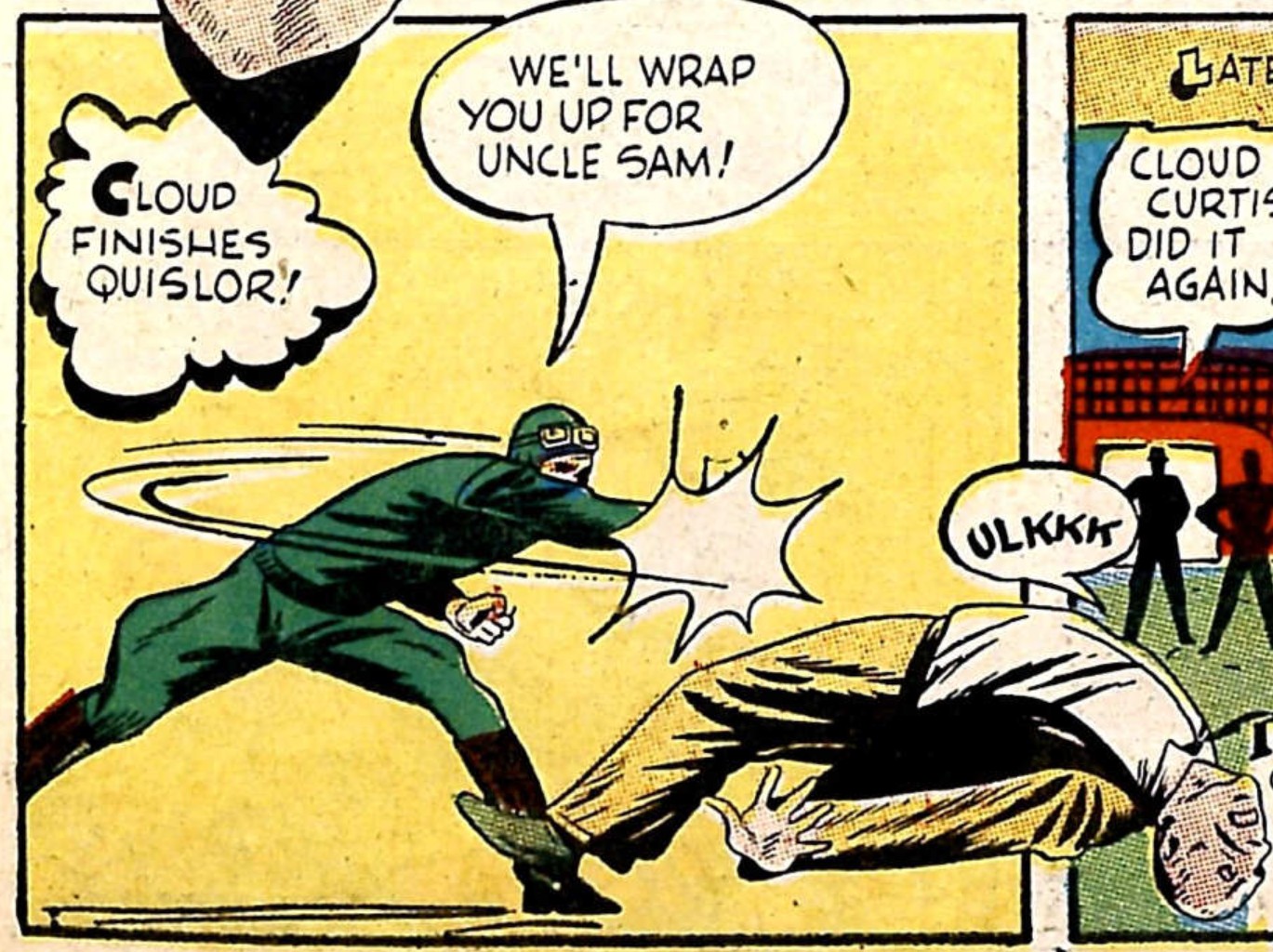
    Like all air-based crooks within Cloud Curtis’ flight range, Quislor soon learns that the only reward for messing with the sanctity of the wild blue yonder is a sock to the jaw and a trip to the hoosegow. (Silver Streak Comics 014, 1941)

    Professor Giess:

    Professor Giess, a crypto-fascist scientist with some very interesting eyebrows, has developed a fuel additive called Thanotane (great name) that causes vehicles using it to give off deadly fumes in their exhaust. His plan to distribute this fuel throughout the US to spread terror is stymied somewhat when the test shipment is hijacked by gangsters, but the plan is still on track until John Thesson, aka the Son of the Gods, gets involved and beats everyone up. This must be especially galling for Giess, who noted that Thesson was going to pose a challenge but put off dealing with him for too long. Live and learn, I guess, until you’re shot as an enemy agent. (Exciting Comics 007, 1941)

    Doctor Mord:

    Dr Mord is, like, the Platonic ideal of the comic book mad scientist. He lives in a castle that he explicitly just kind of found in the South African jungle and is attempting to scientifically extract the human soul and place it into a big jar of acid by electrocuting people’s brains. He claims that this will make him a god among men, but fails to lay out how, exactly.

    The old storytelling rule of Chekhov’s Unsealed Vat of Acid comes into play here and Doctor Mord ends up doused in the stuff before being chucked out a window by Captain Kidd. (Fantastic Comics 014, 1941)

  • MAD AND CRIMINAL SCIENTIST ROUND-UP 024

    MAD AND CRIMINAL SCIENTIST ROUND-UP 024

    Let’s spare a thought for all the mad lab assistants who do so much for so little credit. 

    Rokula:

    Rokula’s plan is simple: kidnap inventors and then use his mind control machine to force them to work for him. Hey, it’s a classic for a reason, but it’s also a plan with a high chance of attracting super-heroic attention such as that of Zongar the Miracle Man.  

    Rokula might be a fan of the classics but like so many of his peers he is no as into workplace safety, and he meets his end when Zongar sends him careening into his own equipment with a forceful punch. (Silver Streak Comics 007, 1941)

    Quislor:

    Quislor is a fellow who has developed technology that turns aircraft into remote-controlled drones, and is using it to send bombers out to destroy airfields across the US, thus reducing its ability to field an air force. Though he never quite gets around to saying just why he’s doing this it is presumably in service to some sort of fascist plot.

    Like all air-based crooks within Cloud Curtis’ flight range, Quislor soon learns that the only reward for messing with the sanctity of the wild blue yonder is a sock to the jaw and a trip to the hoosegow. (Silver Streak Comics 014, 1941)

    Professor Giess:

    Professor Giess, a crypto-fascist scientist with some very interesting eyebrows, has developed a fuel additive called Thanotane (great name) that causes vehicles using it to give off deadly fumes in their exhaust. His plan to distribute this fuel throughout the US to spread terror is stymied somewhat when the test shipment is hijacked by gangsters, but the plan is still on track until John Thesson, aka the Son of the Gods, gets involved and beats everyone up. This must be especially galling for Giess, who noted that Thesson was going to pose a challenge but put off dealing with him for too long. Live and learn, I guess, until you’re shot as an enemy agent. (Exciting Comics 007, 1941)

    Doctor Mord:

    Dr Mord is, like, the Platonic ideal of the comic book mad scientist. He lives in a castle that he explicitly just kind of found in the South African jungle and is attempting to scientifically extract the human soul and place it into a big jar of acid by electrocuting people’s brains. He claims that this will make him a god among men, but fails to lay out how, exactly.

    The old storytelling rule of Chekhov’s Unsealed Vat of Acid comes into play here and Doctor Mord ends up doused in the stuff before being chucked out a window by Captain Kidd. (Fantastic Comics 014, 1941)

  • MINOR SUPER-VILLAIN 961: DR ZINN

    MINOR SUPER-VILLAIN 961: DR ZINN

    (Exciting Comics 009, 1941)

    Dr Zinn feels like a character who is somehow aware of my classification system and who is desperate not to be relegated to the ranks of the Generic Costumed Villain (yes, the “costumed” part has lost all meaning, I know) and so has shoehorned as many extra details into his appearance as possible to force me to give him Minor Super-Villain status. “what if I wasn’t just a super tall hypnotist, but also obsessed with snakes? And what if I ran a cult, the Cult of the Serpent, full of mind controlled thralls and they were also obsessed with snakes?” And I guess it worked.

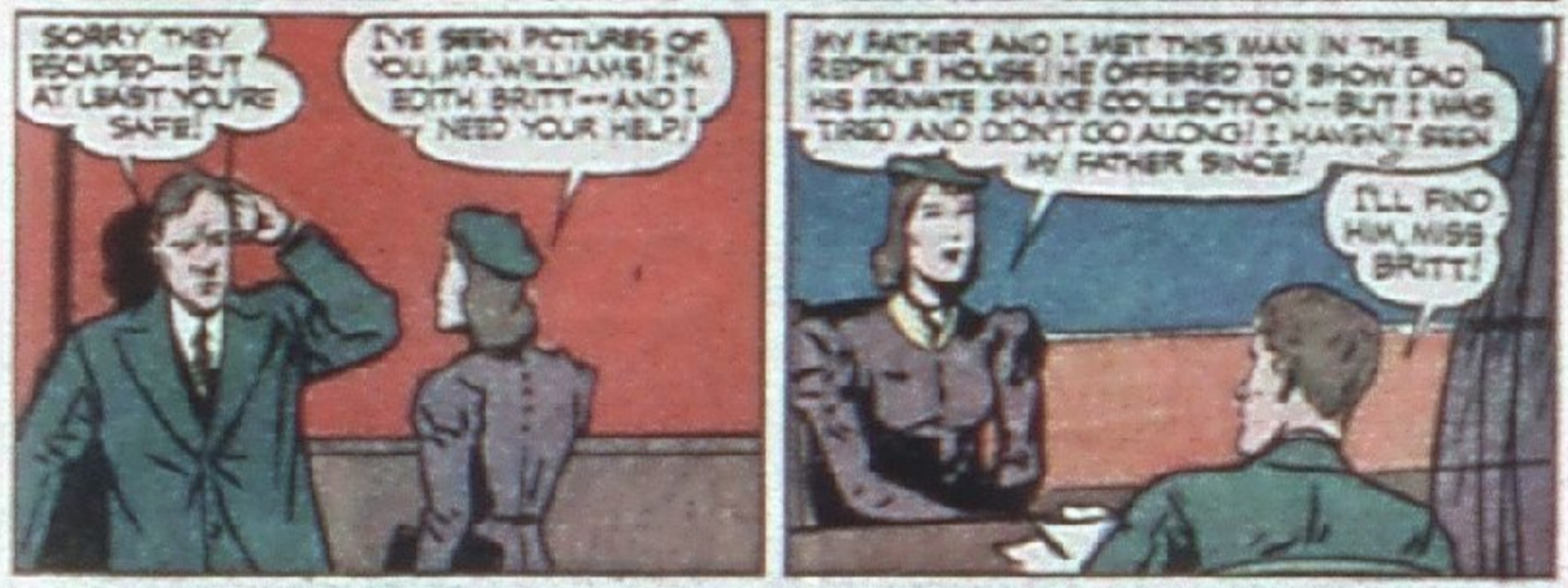
    Dr Zinn’s main goal in his one appearance is to get ahold of the contents of a safe deposit box owned by a Mr Britt and his daughter, and while they never lay out what exactly is in there I certainly hope it’s securities or deeds to property or something, because if that little bundle of paper is meant to be cash then it’s like ten thousand dollars tops (I guess the Britts could have gotten their hands on some vanishingly-rare ten thousand dollar bills but we’re still not talking about multiple millions) and even in 1941 that’s not enough money to go to so much effort for.

    Zinn is captured after Edith Britt hires PI par excellence Dan Williams, who really undercuts the threat of hypnotic mind control by giving him a couple of eyes full of black pepper. 

    Addendum: I almost forgot to mention that Dr Zinn (whose first name is Mephiste, by the way) comes to the attention of the law when he orders some poisonous snakes through the mail and some get out and kill two postal workers, and he just grabs the rest and skedaddles out of there.

  • MINOR SUPER-VILLAIN 539 UPDATE: THE CLAW (post-Daredevil, 1941)

    In keeping with my decision to split the Claw updates for 1941 by heroic foe, here are the details of his three-issue dalliance with engineer Bill Hopkins.

    When last we saw the Claw… he was in the Pacific, roughing up Adolf Hitler. But before that, at the end of his long back-and-forth with the Daredevil, there was the small matter of his asking Lucifer for aid and getting it, with the caveat that if he still lost in his next encounter with Daredevil he would be “banished into Asia forever!” And since he did lose, that means that he can’t return to America, right?

    Evidently not, because in  Daredevil Comics 002, the Claw kidnaps a train filled with 2000 soldiers as it passes through Pennsylvania, then sends a note to the president (note the custom signature) to ask for the complete US gold supply in ransom.

    Meanwhile, the Claw is showing his prisoners home movies designed to bend them to his will. Note the Hitler impression: in 1941 this is shorthand for being a megalomaniac rather than a genocidal megalomaniac (though in all cases it marks you as being a bit of an uninspired hack). Whether he gets the gold or not, the Claw intends to use these men in yet another attempt to conquer the US.

    One of these soldiers, Dick Hopkins, has a brother named Bill Hopkins, who has the radical idea to retrace the path of the original train in a second one and see if anything happens, which it does. This really erodes my confidence in the authorities of this fictional reality, frankly. You’d think “take a couple of lads and check the tracks between here and where the train disappeared” would be the logical first step to take but Bill seems to be the first one to think of it. 

    Perhaps the Claw was able to return to America by sacrificing some of his power to Lucifer, because Bill Hopkins’ thrown rocks and pistol shots are much more effective than such things as artillery and machine guns have been in the past.

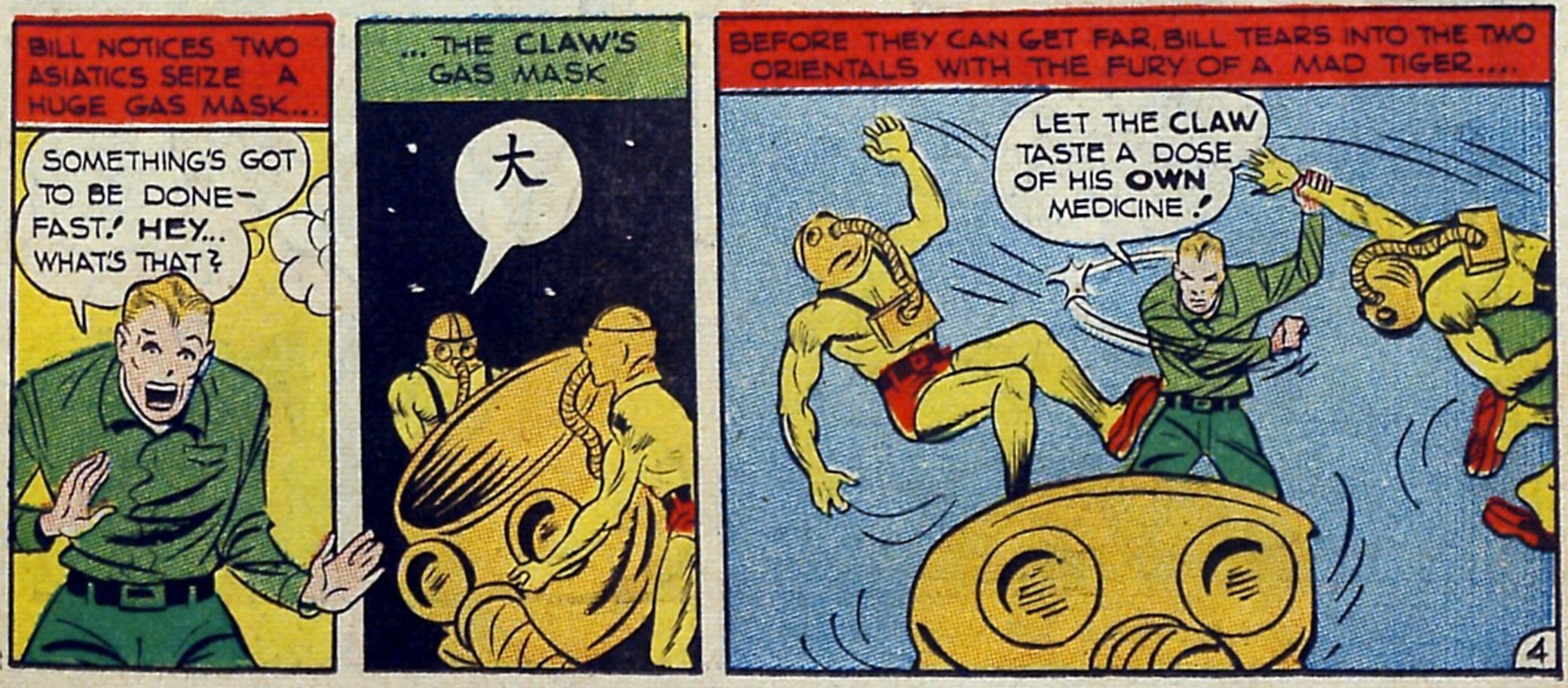
    The second part of Bill’s plan, after “find out where the Claw has stashed 2000 men” is “come find me if I disappear” and accordingly, in Daredevil Comics 003, the US Army locates the Claw’s base by following the extra set of train tracks that split off the main trunk and head directly into a cliff face. Once again, the Claw seems weaker than usual and the Army is pushing his forces back successfully enough that he orders his men to flood the base with poison gas. It is at this point that Bill has his best idea yet, as he steals the Claw’s enormous gas mask and chucks it down a convenient bottomless pit.

    The Claw is more affected by poison gas than the regular-sized humans in the room thanks to the fact that his big body needs more oxygen and thus are breathing in more gas, and while I love a well-rationalized weakness in a character it does call into question all future Claw foes for not immediately tear gassing him on sight.

    What I don’t love is that the Claw, already a distillation of Yellow Peril tropes, is one-upping himself by adopting what I just learned is called a wonton font in his speech bubbles. I think that it’s supposed to be adding emphasis when he is yelling but at this point he is almost always yelling.

     Daredevil Comics 004: The Claw brought into NYC in chains/in triumph. He almost instantly escapes.

    Seeking vengeance on Bill Hopkins, the Claw fords the Hudson River and in so doing becomes the first-ever super-villain to enter Hoboken.

    Bill doesn’t take this aggression lying down, and meets the Claw on a handy rooftop with a can of kerosene and a match, and this is a pretty good illustration of a though I have had while writing this: the Claw battling super-heroes is all well and good, but what I really enjoy is seeing him get it from regular folks. Bill Hopkins and his Home Alone energy might just be the best that the “Claw” feature ever gets, and it’s a real shame that this is the last we will be seeing of him.

    The Claw very reasonably exits via the river. So long forever, Bill. Next time: the Ghost!

  • MINOR SUPER-VILLAIN 539 UPDATE: THE CLAW (post-Daredevil, 1941)

    MINOR SUPER-VILLAIN 539 UPDATE: THE CLAW (post-Daredevil, 1941)

    In keeping with my decision to split the Claw updates for 1941 by heroic foe, here are the details of his three-issue dalliance with engineer Bill Hopkins.

    When last we saw the Claw… he was in the Pacific, roughing up Adolf Hitler. But before that, at the end of his long back-and-forth with the Daredevil, there was the small matter of his asking Lucifer for aid and getting it, with the caveat that if he still lost in his next encounter with Daredevil he would be “banished into Asia forever!” And since he did lose, that means that he can’t return to America, right?

    Evidently not, because in  Daredevil Comics 002, the Claw kidnaps a train filled with 2000 soldiers as it passes through Pennsylvania, then sends a note to the president (note the custom signature) to ask for the complete US gold supply in ransom.

    Meanwhile, the Claw is showing his prisoners home movies designed to bend them to his will. Note the Hitler impression: in 1941 this is shorthand for being a megalomaniac rather than a genocidal megalomaniac (though in all cases it marks you as being a bit of an uninspired hack). Whether he gets the gold or not, the Claw intends to use these men in yet another attempt to conquer the US.

    One of these soldiers, Dick Hopkins, has a brother named Bill Hopkins, who has the radical idea to retrace the path of the original train in a second one and see if anything happens, which it does. This really erodes my confidence in the authorities of this fictional reality, frankly. You’d think “take a couple of lads and check the tracks between here and where the train disappeared” would be the logical first step to take but Bill seems to be the first one to think of it. 

    Perhaps the Claw was able to return to America by sacrificing some of his power to Lucifer, because Bill Hopkins’ thrown rocks and pistol shots are much more effective than such things as artillery and machine guns have been in the past.

    The second part of Bill’s plan, after “find out where the Claw has stashed 2000 men” is “come find me if I disappear” and accordingly, in Daredevil Comics 003, the US Army locates the Claw’s base by following the extra set of train tracks that split off the main trunk and head directly into a cliff face. Once again, the Claw seems weaker than usual and the Army is pushing his forces back successfully enough that he orders his men to flood the base with poison gas. It is at this point that Bill has his best idea yet, as he steals the Claw’s enormous gas mask and chucks it down a convenient bottomless pit.

    The Claw is more affected by poison gas than the regular-sized humans in the room thanks to the fact that his big body needs more oxygen and thus are breathing in more gas, and while I love a well-rationalized weakness in a character it does call into question all future Claw foes for not immediately tear gassing him on sight.

    What I don’t love is that the Claw, already a distillation of Yellow Peril tropes, is one-upping himself by adopting what I just learned is called a wonton font in his speech bubbles. I think that it’s supposed to be adding emphasis when he is yelling but at this point he is almost always yelling.

     Daredevil Comics 004: The Claw brought into NYC in chains/in triumph. He almost instantly escapes.

    Seeking vengeance on Bill Hopkins, the Claw fords the Hudson River and in so doing becomes the first-ever super-villain to enter Hoboken.

    Bill doesn’t take this aggression lying down, and meets the Claw on a handy rooftop with a can of kerosene and a match, and this is a pretty good illustration of a though I have had while writing this: the Claw battling super-heroes is all well and good, but what I really enjoy is seeing him get it from regular folks. Bill Hopkins and his Home Alone energy might just be the best that the “Claw” feature ever gets, and it’s a real shame that this is the last we will be seeing of him.

    The Claw very reasonably exits via the river. So long forever, Bill. Next time: the Ghost!