The Curse of Skeleton Munroe

Category: henchman

  • MINOR SUPER-VILLAIN 557: DEATH

    (Wonderworld Comics 003, 1939)

    Like I said in the Devil’s entry yesterday: Death and the Devil have teamed up as a sort of Yarko the Great Revenge Squad because Yarko saves so many live and souls, respectively. I also mentioned that Death did all of the legwork toward getting Yarko just where they wanted him, and here that is: Death kills a seemingly random London man then delivers him to the police, leaving only a calling card behind.
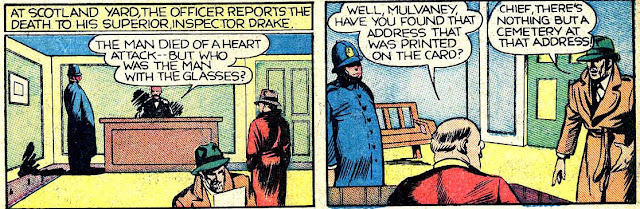
    The discovery that the calling card’s address was that of a cemetery is enough to convince Inspector Drake of Scotland Yard that this is a case for Yarko the Great, and… obviously Drake is right because even the most well-trained officer is going to have a hard time dealing with Death himself, but have some gumption, man. Try to track down where the card was printed or something before abdicating all responsibility.

    Yarko makes his way to Death and the Devil’s Limehouse lair, where he is promptly captured, put in a deathtrap, escapes and banishes the Devil back to the netherworld. Death takes more of a background role in this latter part of the adventure, but that’s okay because he looks great – mostly quite cool but a bit sleazy too, because this ain’t your regular Death, this is Bad Boy Death.

    In the end, the Devil having been vanquished, Death just leaves. Yarko can’t actually affect him, and there’s even some hinting that the man in the car was not killed so much as dies naturally and was just used as bait, which implies that Death has no way of affecting someone who isn’t about to die anyway. He does kill a reluctant henchman who refuses to go up against Yarko, but maybe he was about to die too – working for the Devil has to be a dangerous profession, right?

    Death returns in Wonderworld Comics 008 after a Madame Punjai finds the creatively-named Golden Amulet, which compels his service. Punjai is obsessed with her lost youth and beauty and because of this commands Death to kill the young and beautiful Carla Dennis, a former passing acquaintance. This is done seemingly on a whim? There’s no real exploration of Madame Punjai’s plans, whether toward regaining her lost youth or revenging herself on the beautiful women of the world.

    Yarko the Great of course becomes involved in these shenanigans and the more-hapless-than-evil Madame Punjai is tricked into trading her life for that of Carla’s. Death is again cheesed off about this. BUT WHY IS HE? He’s going to get basically everyone eventually, even in a comic book world with immortals and so forth. Why care? Is this a Discworld style Death who gets into human roles like hobbies? Maybe.

  • MINOR SUPER-VILLAIN 527: THE GREEN GHOUL

    (Blue Ribbon Comics 016, 1941)

    The Green Ghoul is a demonic creature either summoned or created by the demon known as the Dictator as a very successful method of getting Mr Justice to leave him alone. He appears on a US beach and lays waste to an unfortunate couple before heading to the unnamed New York City-alike that Mr Justice calls home.

    Like I said, the Green Ghoul is a distraction, so it’s understandable that its plans lack nuance. To whit, his initial plan is just indiscriminate slaughter.

    Having lured Mr Justice back from Europe, the Green Ghoul now needs to occupy his attention, and having murdered and possessed Assistant Mayor Tracey Keen he sets his sights on conquering Unnamed City.

    Also, he LOOKS GREAT. There could e a conversation about how nobody noticed that Keen was obviously a possessed corpse but he is a previously unseen character created expressly for the purpose of being killed off in this story, so maybe he was just Like That already and the Green Ghoul got lucky.

    For a being of great if undefined infernal power, the Ghoul’s plans for municipal domination are surprisingly conventional: he wants to become the mayor. Granted, he wants to do so by killing and possessing the incumbent but it’s still fairly mundane as far as demonic power plays go. Fortunately for Mayor Clark he is unlike his assistant a member in good standing of Mr Justice’s supporting cast and so the various attempts on his life are foiled.

    There’s a bit of story padding in which Mr Justice and the Green Ghoul (plus Mr Justice love interest Pat Clark) duke it out in a dinosaur-infested subatomic world but things eventually come to a head in the space between the mundane world and the spiritual one, one of the few places that an immortal being can be killed, where the Ghoul hopes to do just that to Mr Justice. Unfortunately for the Ghoul, the immortal killing golden knife cuts two ways and he ends up as a cloud of green ocean pollutants.

    killed because he challenges mr justice to a battle to the death in the void between – cuts both ways

  • MINOR SUPER-VILLAIN 525: RIALB

    MINOR SUPER-VILLAIN 525: RIALB

    (Blue Ribbon Comics 012, 1941)

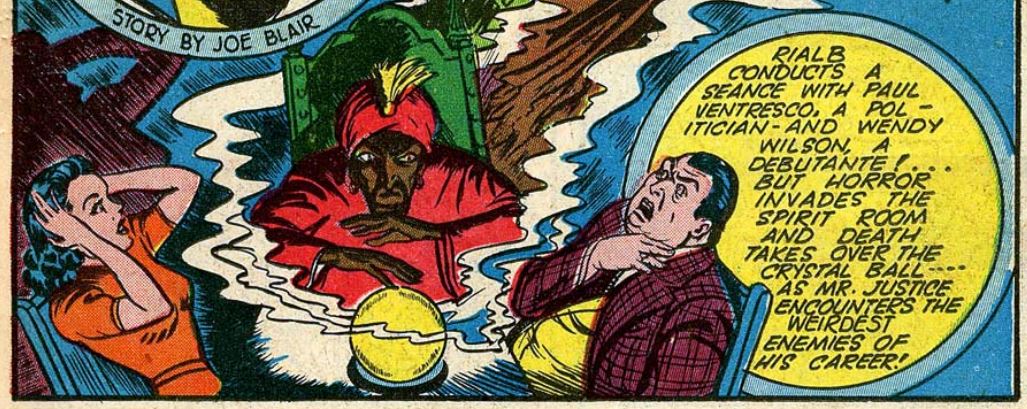
    Here’s a story about my powers of observation: I immediately noticed that our friend Rialb here had a backward name and spent a good half hour trying to figure out which Blair he might be named in reference to (a 1940s spiritualist? a famous skeptic?) before my eyes drifted slightly to the left and I took in the fact that the story was written by Joe Blair. I still have no idea why Joe Blair named the wet-rag villain of the story after himself, but let’s all be happy I figured it out before moaning about it here.

    Speaking of wet rags: let’s discuss Rialb. He’s a fake medium who accidentally discovers that he can actually summon the spirits of the dead but seems to have a knack for bringing back spirits who wish their descendants harm. Further, the first time he does so is witnessed by crooked politician Paul Ventresco, who puts the easily pushed-over Rialb to work as his personal ghost-powered hitman.

    The real stars of the story are the extremely grody ghosts that Rialb manages to conjure up. Just look at this gross old misogynist.

    Shadow imp, skull-faced spectre, pointillism lizard-man… this comic has it all!

    The real star is absolutely this skeleton-limbed hair-face who gets his bony ass kicked back to the netherworld he came from by Mr Justice before he can get up to any mischief. I really enjoy how the unchanging expression on his face reads as both menacing and sad depending on which side of the ass kicking he is.

    Just a regular ghost.

    It’s a bit of a letdown that the last ghosts we see are three sad sack victims of Ventrusco who Mr Justice calls up to cow the pair into surrendering, though he really only needed them for Ventrusco, given that Rialb shows no actual evidence of having a spine during the story – Mr Justice could have just thrown a sheet over a chair and gotten the same result.

  • MINOR SUPER-VILLAIN 525: RIALB

    (Blue Ribbon Comics 012, 1941)

    Here’s a story about my powers of observation: I immediately noticed that our friend Rialb here had a backward name and spent a good half hour trying to figure out which Blair he might be named in reference to (a 1940s spiritualist? a famous skeptic?) before my eyes drifted slightly to the left and I took in the fact that the story was written by Joe Blair. I still have no idea why Joe Blair named the wet-rag villain of the story after himself, but let’s all be happy I figured it out before moaning about it here.

    Speaking of wet rags: let’s discuss Rialb. He’s a fake medium who accidentally discovers that he can actually summon the spirits of the dead but seems to have a knack for bringing back spirits who wish their descendants harm. Further, the first time he does so is witnessed by crooked politician Paul Ventresco, who puts the easily pushed-over Rialb to work as his personal ghost-powered hitman.

    The real stars of the story are the extremely grody ghosts that Rialb manages to conjure up. Just look at this gross old misogynist.

    Shadow imp, skull-faced spectre, pointillism lizard-man… this comic has it all!

    The real star is absolutely this skeleton-limbed hair-face who gets his bony ass kicked back to the netherworld he came from by Mr Justice before he can get up to any mischief. I really enjoy how the unchanging expression on his face reads as both menacing and sad depending on which side of the ass kicking he is.

    Just a regular ghost.

    It’s a bit of a letdown that the last ghosts we see are three sad sack victims of Ventrusco who Mr Justice calls up to cow the pair into surrendering, though he really only needed them for Ventrusco, given that Rialb shows no actual evidence of having a spine during the story – Mr Justice could have just thrown a sheet over a chair and gotten the same result.

  • MINOR SUPER-VILLAIN 509: KING ROCKY THE FIRST

    (Blue Bolt v1 010, 1941)

    Some preamble: in Blue Bolt v1 007 the Green Sorceress managed to capture the Blue Bolt and thus in Blue Bolt v1 008 she was able to force Dr Bertoff to surrender to her forces. Her incompetent scientists subsequently triggered a series of devastating explosions while attempting to extract radium from Bertoff’s mineral fields, with the one positive effect of opening a passage to the surface world. The Green Sorceress then travelled to the surface to do espionage, followed by the Blue Bolt, who had escaped paralysis and freed Bertoff’s people since her departure.

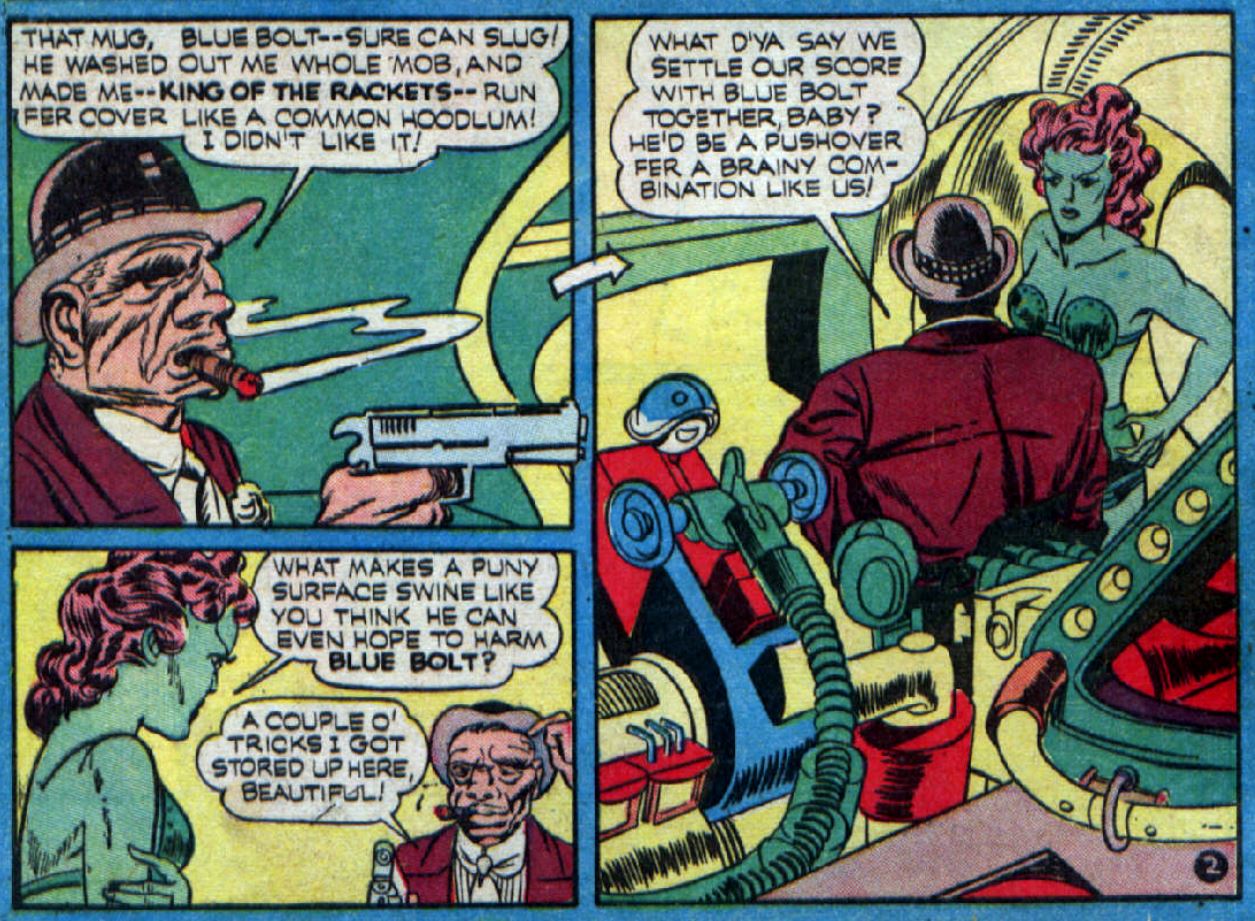
    The Green Sorceress’ main surface henchman was gang boss Rocky Roberts, King of the Rackets, who got pretty thoroughly beaten up by the Blue Bolt but then manages to pop out of a little hatch in the Green Sorceress’ escape rocket and propose an alliance against Dr Bertoff and the Blue Bolt, to which the Sorceress agrees.

    This goes poorly! Rocky immediately takes over the Green Kingdom and declares himself King Rocky the Foist.

    Rather than rule in a traditional manner, King Rocky establishes himself as the head of a gang consisting of the Green Sorceress’ former army, with the citizens of the Green Kingdom being subjected to gang-style protection rackets, kidnappings, torture and garden-variety murder. This is a Jack Kirby idea, it has to be – even if he never made up another one to vex someone like Jimmy Olsen with the Sci-Fi Gangsterocracy is one of the most Kirby ideas I can think of.

    It’s tough to articulate but I respect King Rocky for his decision to murder the Green Sorceress. Believe it or not, it’s a refreshing change for a Golden Age villain, most of whom would see an attractive captive and start yelling about making her “my Queen!”

    But of course if you shoot at a super-villain you best not miss. King Rocky the Foist’s plans are interrupted by Blue Bolt and he meets the traditional end for a super-usurper: giant laser blast.

  • MINOR SUPER-VILLAIN 509: KING ROCKY THE FIRST

    MINOR SUPER-VILLAIN 509: KING ROCKY THE FIRST

    (Blue Bolt v1 010, 1941)

    Some preamble: in Blue Bolt v1 007 the Green Sorceress managed to capture the Blue Bolt and thus in Blue Bolt v1 008 she was able to force Dr Bertoff to surrender to her forces. Her incompetent scientists subsequently triggered a series of devastating explosions while attempting to extract radium from Bertoff’s mineral fields, with the one positive effect of opening a passage to the surface world. The Green Sorceress then travelled to the surface to do espionage, followed by the Blue Bolt, who had escaped paralysis and freed Bertoff’s people since her departure.

    The Green Sorceress’ main surface henchman was gang boss Rocky Roberts, King of the Rackets, who got pretty thoroughly beaten up by the Blue Bolt but then manages to pop out of a little hatch in the Green Sorceress’ escape rocket and propose an alliance against Dr Bertoff and the Blue Bolt, to which the Sorceress agrees.

    This goes poorly! Rocky immediately takes over the Green Kingdom and declares himself King Rocky the Foist.

    Rather than rule in a traditional manner, King Rocky establishes himself as the head of a gang consisting of the Green Sorceress’ former army, with the citizens of the Green Kingdom being subjected to gang-style protection rackets, kidnappings, torture and garden-variety murder. This is a Jack Kirby idea, it has to be – even if he never made up another one to vex someone like Jimmy Olsen with the Sci-Fi Gangsterocracy is one of the most Kirby ideas I can think of.

    It’s tough to articulate but I respect King Rocky for his decision to murder the Green Sorceress. Believe it or not, it’s a refreshing change for a Golden Age villain, most of whom would see an attractive captive and start yelling about making her “my Queen!”

    But of course if you shoot at a super-villain you best not miss. King Rocky the Foist’s plans are interrupted by Blue Bolt and he meets the traditional end for a super-usurper: giant laser blast.

  • MINOR SUPER-VILLAIN 500: DR VYLE AND THE VULTURE MEN

    MINOR SUPER-VILLAIN 500: DR VYLE AND THE VULTURE MEN

    (Big Shot Comics 020, 1941)

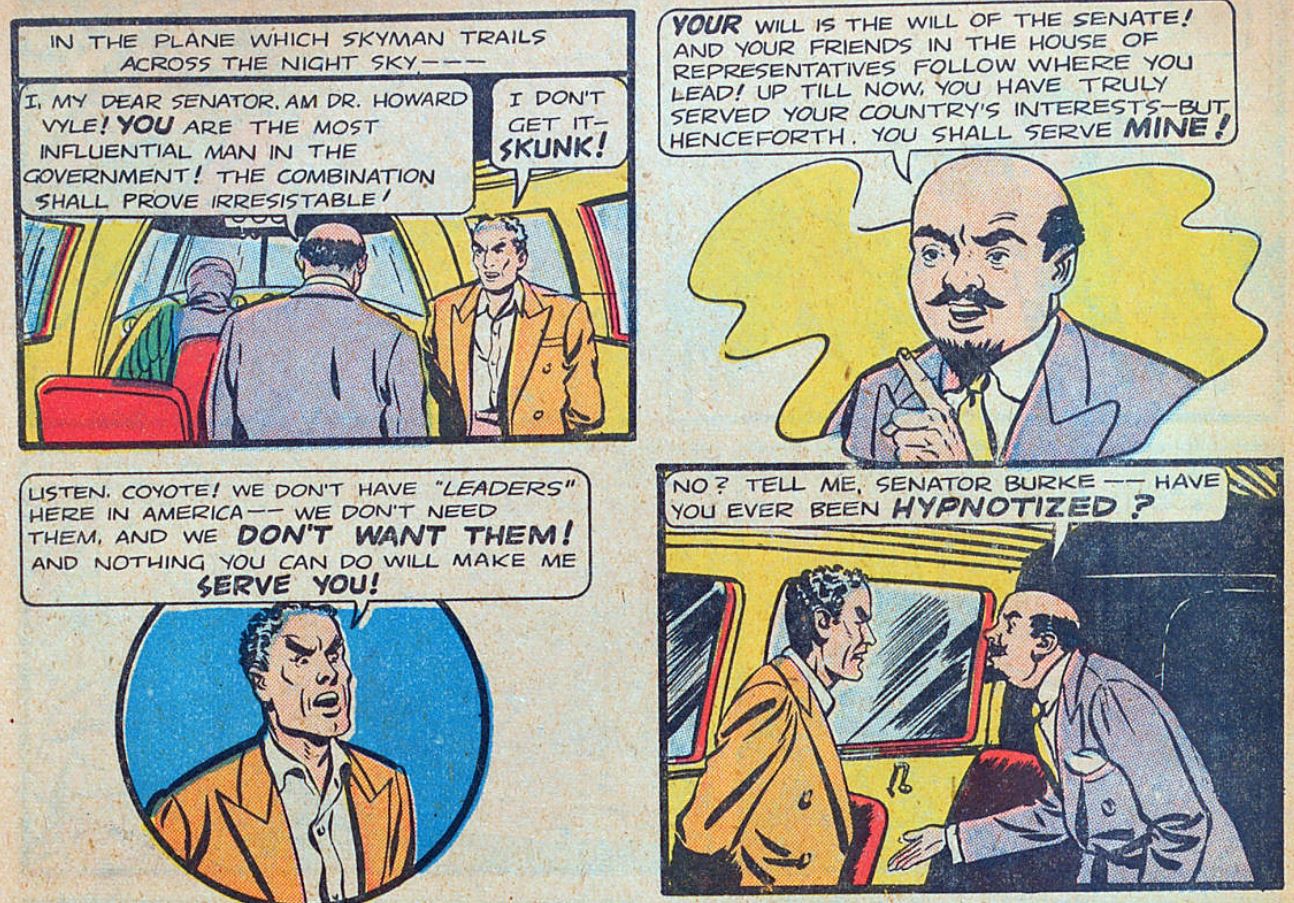
    Dr Howard Vyle is a pretty disappointing villain to land on for the big Number 500, if I’m honest. He’s just some guy from some country (Big Shot Comics 1940-1941 is rife with spies but the folks at Columbia Comic Corporation were even more cagey than the rest of the industry about indicating where those spies might actually be from – it’s faintly possible he might be supposed to be a commie, even as late as December ’41) who kidnaps a US Senator with colossal eyebrows in order to hypnotize him and use his influence over the government for the glory of his home country. 

    This is all pretty regular comics stuff and depending on my mood on the day I encountered him Dr Vyle would normally find himself in the Mad and Criminal Scientist Round-Up or maybe not even there. Lucky for him as well as for my sense that there should be something interesting in these big round number entries, Dr Vyle did not limit himself to using his hypnotic gifts for dull old political plots:

    He also used them to recruit hapless goons to be his costumed Vulture Men! So cool they appear on the cover!

    I can’t say there’s too much to the Vulture Men beyond being a bunch of mind controlled goons in cool wingsuits, but after reading two years’ worth of Big Shot Comics‘ array of spies and gang bosses a flock of guys in proper gaudy villain garb are a breath of fresh air.

    Unfortunately for Dr Vyle while mind controlled goons are certainly cheaper and less concerned with their personal safety than your more conventional salaried minions they also seem to lack some of the verve and personal initiative that you need to give a super-hero a run for their money. Skyman beats them up and then beats up their boss, in other words. The senator is saved!

  • MINOR SUPER-VILLAIN 500: DR VYLE AND THE VULTURE MEN

    (Big Shot Comics 020, 1941)

    Dr Howard Vyle is a pretty disappointing villain to land on for the big Number 500, if I’m honest. He’s just some guy from some country (Big Shot Comics 1940-1941 is rife with spies but the folks at Columbia Comic Corporation were even more cagey than the rest of the industry about indicating where those spies might actually be from – it’s faintly possible he might be supposed to be a commie, even as late as December ’41) who kidnaps a US Senator with colossal eyebrows in order to hypnotize him and use his influence over the government for the glory of his home country. 

    This is all pretty regular comics stuff and depending on my mood on the day I encountered him Dr Vyle would normally find himself in the Mad and Criminal Scientist Round-Up or maybe not even there. Lucky for him as well as for my sense that there should be something interesting in these big round number entries, Dr Vyle did not limit himself to using his hypnotic gifts for dull old political plots:

    He also used them to recruit hapless goons to be his costumed Vulture Men! So cool they appear on the cover!

    I can’t say there’s too much to the Vulture Men beyond being a bunch of mind controlled goons in cool wingsuits, but after reading two years’ worth of Big Shot Comics‘ array of spies and gang bosses a flock of guys in proper gaudy villain garb are a breath of fresh air.

    Unfortunately for Dr Vyle while mind controlled goons are certainly cheaper and less concerned with their personal safety than your more conventional salaried minions they also seem to lack some of the verve and personal initiative that you need to give a super-hero a run for their money. Skyman beats them up and then beats up their boss, in other words. The senator is saved!

  • MINOR SUPER-VILLAIN 496: THE CHIEF AND THE COBRA

    (Big Shot Comics 016, 1941)

    The Cobra technically works for the Chief if you want to exclusively go by the criminal org chart, but the Cobra is also the only reason for the Chief being mentioned at all and not just thrown into my big bin of nondescript gang bosses. Thus: a dual entry.

    Like I said, the Chief is your regular degular gang boss, albeit one who swans around in a green smoking jacket the whole time. Feeling the pinch as the Face cracks down on crime, he hires the Cobra, a rare super-powered Columbia Comics Corporation character. It’s not much – she can do comic book hypnotism that causes her target to see what she wants and also scry her hypnotized target using a crystal ball – but it’s more than most of her criminal peers have.

    The Chief and the Cobra essentially prank the Face’s secret identity Tony Trent by making him think that a man and then an entire house have disappeared, with the idea being that Trent, who at this point “knows” the Face in the same way Clark Kent knows Superman, will bring him in to investigate. And it works, only instead of being easily killed the Face does his regular schtick and beats everyone up. It’s your classic villain’s 2/3 of a plan – no consideration for how to deal with their foe, only how to draw them out.

    The Chief and the Cobra are pretty swiftly rounded up. Is hypnotizing a guy not to see a house and then looking at him in a crystal ball a crime? If not I assume that the Cobra was released pretty swiftly. I mean, she did try to shoot the Face at the end of the story but good luck ever convicting someone of attempted murder of a masked vigilante, amiright?

  • MINOR SUPER-VILLAIN 459: THE STAR-GAZER

    (Mystic Comics v1 003, 1940)

    It must be something of a point of pride for a super-hero to get to the point where they are effective enough that super-villains are being hired specifically to get rid of them, and that’s where the Star-Gazer comes in. A criminal astronomer and/or astrologer, the Star-Gazer is approached by crimelord Dr Gair to get rid of the pesky Blue Blaze.

    In fact, not only has the Blue Blaze reached “super-villain contract hit” levels, he has reached the level where a custom monster is created just to destroy him! Rarefied stuff for a mere third appearance.

    The Star-Monster is a cool humanoid made out of a pile of chemicals and powered by the light of a particular star. It’s invulnerable and strong and more than a match for even the Blue Blaze’s enhanced strength, so it’s lucky for him that its activity is limited to the times that its patron star is visible in the sky.

    The Blue Blaze survives his initial encounter with the Star-Monster due to it adorably falling asleep once morning comes, then puts his respite to good use in his personal laboratory and discovers that stellar rays can be blocked by common or garden variety lead and lucky for him this is the 1940s when lead is easily sourced. One visit to a print shop with no Health and Safety officer on staff and the Star-Monster is safely encased in molten lead until I get my way and he is BRUNG BACK to take Snorlax-style naps all over modern comics.

    As for the Star-Gazer, he just doesn’t know when to admit defeat, in classic super-villain style. “Just after the hero neutralizes your invulnerable super-beast” is in fact the perfect time to either flee or surrender and live to fight another day. Sure, using crystals and prisms to hand-focus a stellar deathray is incredibly badass and if you manage to pull it off you will never pay for another drink at the 40s equivalent of the Bar With No Name again in your life, but realistically you’re an old man in a showdown with a Civil War-era post-human and it’s going to end, well, like it did, with the deaths of both the Star-Gazer and Dr Gair.