The Curse of Skeleton Munroe

Category: henchman

  • MINOR SUPER-VILLAIN 452: THE DEATH MASTER

    (Mystery Men Comics 029, 1941)

    Really very strong showing from the Death Master in the splash panel, with artist Louis Cazenueve (as Lester Raye) doing some great Kirby-esque monster-man work on the man himself.

    And the story version of the character almost measures up! The Death Master is head of a counterfeiting gang who completely buys into his own hype – he’s a sneering, gloating villain of the type I love.

    But why is the Death Master called that? Why, because he can kill a man with but a gesture! He’ll mess you up with magic death powers! Well okay – he’ll mess you up by shooting poison into your eye using a wrist-mounted poison shooter, which is still pretty hard to do. Plus you’re just as dead as if it was done with magic.

    The Death Master is in fact such a good over-the-top bombastic villain that it is for once somewhat surprising to learn that he is acting as a lieutenant for one Mr Hunter, a “famous criminologist” who accompanied the prosecutor to his doom in the panels above. It’s a pretty good scheme, though perhaps it would have been better to beg off helping to pursue the Death Master rather than bump off the pursuer.

    In any case, the Lynx figures out the scheme and brings in not only Mr Hunter but the Death Master via the simple method of shielding his eyes, which is where you want to have magic death powers I suppose. Also if you ever meet a foe with goggles or large glasses.

  • MINOR SUPER-VILLAIN 452: THE DEATH MASTER

    (Mystery Men Comics 029, 1941)

    Really very strong showing from the Death Master in the splash panel, with artist Louis Cazenueve (as Lester Raye) doing some great Kirby-esque monster-man work on the man himself.

    And the story version of the character almost measures up! The Death Master is head of a counterfeiting gang who completely buys into his own hype – he’s a sneering, gloating villain of the type I love.

    But why is the Death Master called that? Why, because he can kill a man with but a gesture! He’ll mess you up with magic death powers! Well okay – he’ll mess you up by shooting poison into your eye using a wrist-mounted poison shooter, which is still pretty hard to do. Plus you’re just as dead as if it was done with magic.

    The Death Master is in fact such a good over-the-top bombastic villain that it is for once somewhat surprising to learn that he is acting as a lieutenant for one Mr Hunter, a “famous criminologist” who accompanied the prosecutor to his doom in the panels above. It’s a pretty good scheme, though perhaps it would have been better to beg off helping to pursue the Death Master rather than bump off the pursuer.

    In any case, the Lynx figures out the scheme and brings in not only Mr Hunter but the Death Master via the simple method of shielding his eyes, which is where you want to have magic death powers I suppose. Also if you ever meet a foe with goggles or large glasses.

  • FASCIST GOON CLEARING HOUSE 005

    FASCIST GOON CLEARING HOUSE 005

    Fascist, Smascist

    The Volunteers for Peace are another group that advocates for the US not to get involved in WWII as shorthand for them being full-on fascist fifth columnists setting the country up for an invasion by the evocatively-named Nation X. Don’t worry, not even Golden Age Superman has any trouble beating down a bunch of pseudo-Nazis (Action Comics 036, 1941)

    Another batch of Yellow Shirts, this time with a space! This bunch are some more bundists and they have the misfortune to tangle with ultranationalist adventurer Don Glory (Hit Comics 013, 1941)

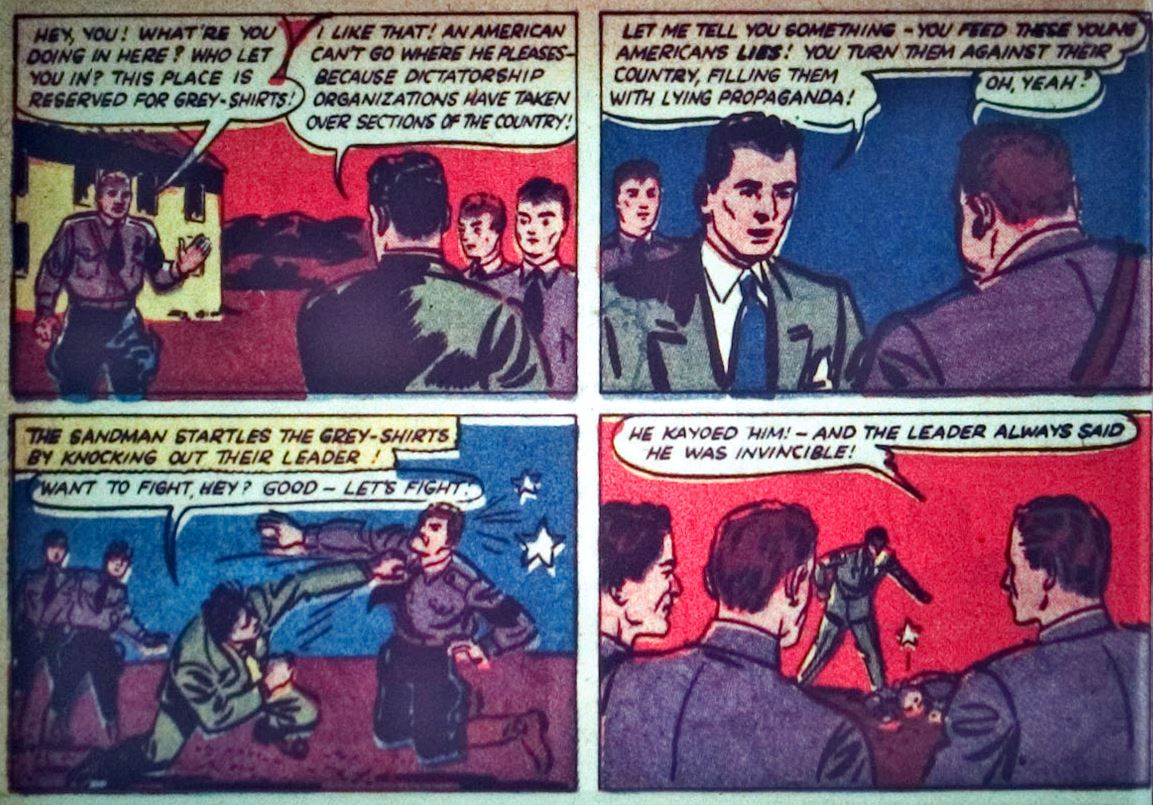
    The Grey-Shirts were the personal army of early Justice Society villain the Leader. They were a diverse group – most cells were bundists but some were imported from the non-German Teutonic Fatherland that the Leader himself called home. (All-Star Comics 004, 1941)

    The Peace Clan are willing to kill for their ideals of US non involvement in foreign wars, and Doc Savage is willing to kill them to keep them from doing so. Also they dress and act a lot like the KKK. Also they’re actually literal Nazis. (Doc Savage Comics v1 006, 1940)

  • MINOR SUPER-VILLAIN 412: THE TEN KNIGHTS OF DOOM

    (Amazing Mystery Funnies v2 012, 1939)

    The Ten Knights of Doom! Like the Brain of the Robot, more an excuse to talk about their foe than anything else! But here we have to front-load it because you can’t get into these guys without setting things up by talking about Speed Centaur.

    Speed Centaur is great because he’s one of the very first super-heroes and yet he’s still also one of the weirdest super-hero concepts that isn’t some sort of psychedelic metafiction. To begin with, he has a Superman origin: he’s the last survivor of an Arctic city of super-centaurs that inexplicably exploded one day in the early 1900s. He was found and raised by a kindly old trapper named Norton who brought him up to believe in Truth, Justice and the American Way.

    Following Norton’s death, Speed relocates to the crime-ridden City of Rackets, befriends crusading reporter “Reel” McCoy and proceeds to clean up the city’s eponymous gangs using his enhanced strength, super-jumping and ability to cram his human torso into a horse-head disguise. 

    After a while having Speed beat up regular gangsters must have gotten monotonous for the writers because they added a feature to the mountain cave in which he lived: a portal to… the past? An alternate dimension full of Arthurian weirdos? Somewhere knightly at any rate, which brings us to the Ten Knights of Doom.

    (brief aside: the “centaur with fully armoured human half” is always a top-notch visual. Speed Centaur should have stuck with it)

    The Ten Knights of Doom are, in fact, a bunch of regular knights with a very good name. They work for the villainous Sir Morbid in aid of his quest to defraud his nephew Prince Albert of his lands. There’s a lot of back and forth over two issues and it all ends when Speed Centaur knocks over Sir Morbid’s entire castle and the mountain it sits on, presumably killing the whole lot of them.

  • MINOR SUPER-VILLAIN 374: THE MAN WHO WAS DEAD

    (More Fun Comics 063, 1941)

    I’m just as guilty as I was with the Jungle Scientist of being immediately seduced by the subject’s name as presented in the title of the story. The Man Who Was Dead – a terrific name if I’ve ever seen one. Pure bonus points to the guy for being a weird little imp about it.

    The Man Who Was Dead of course escapes from police custody and so the Radio Squad here are forced to follow up on their only clue: a cufflink with some weird writing on it which they of course take to a university History Department and of course discover that the Man Who Was Dead is in fact History Professor Greene, who recently had a nervous breakdown. Also there is a sinister Indian gentleman named Professor Silna.

    It all comes to a head in an abandoned house on the edge of town, in which Silna is of course revealed to have drugged and hypnotized Greene into an obedient and invulnerable servant using his Ancient Hindu Magicks. Silna realizes too late that he should have made himself immune to gunfire as well, as he is gunned down by Radio Squad member Sandy Kean. Greene gets to heal from the tremendous amount of abuse his body endured while under Silna’s control and all the loot gets returned – a happy ending for all!

  • MINOR SUPER-VILLAIN 374: THE MAN WHO WAS DEAD

    (More Fun Comics 063, 1941)

    I’m just as guilty as I was with the Jungle Scientist of being immediately seduced by the subject’s name as presented in the title of the story. The Man Who Was Dead – a terrific name if I’ve ever seen one. Pure bonus points to the guy for being a weird little imp about it.

    The Man Who Was Dead of course escapes from police custody and so the Radio Squad here are forced to follow up on their only clue: a cufflink with some weird writing on it which they of course take to a university History Department and of course discover that the Man Who Was Dead is in fact History Professor Greene, who recently had a nervous breakdown. Also there is a sinister Indian gentleman named Professor Silna.

    It all comes to a head in an abandoned house on the edge of town, in which Silna is of course revealed to have drugged and hypnotized Greene into an obedient and invulnerable servant using his Ancient Hindu Magicks. Silna realizes too late that he should have made himself immune to gunfire as well, as he is gunned down by Radio Squad member Sandy Kean. Greene gets to heal from the tremendous amount of abuse his body endured while under Silna’s control and all the loot gets returned – a happy ending for all!

  • MINOR SUPER-VILLAIN 369: ILLYRIA, QUEEN OF SPIES

    (Master Comics 012-014, 016-017, 019-020; Minute-Man Comics 001-002, 1941)

    Illyria, Queen of Spies! (AKA Queen Spy, Spy Queen, Queen of All Spies, Queen of Foreign Spies, etc) Definitely in the running for my favourite of the “recurring femme fatale spymaster” subgenre of super-villain, particularly as she is a foe to Minute-Man, one of the most bland piles of wallpaper paste ever to wear a patriotic costume.

    Beyond merely distracting me from how bored I am by Minute-Man, Illyria provides interest via a fairly wide range of plots and schemes and thus is kind of hard to boil down into a pithy summary. So: a numbered list:

    1. In her first appearance Illyria wears a snazzy orange robe, the better to whip off when captured so as to take advantage of Minute-Man’s “won’t hit girls” policy and get away. She and her three distinctive henchmen spend the issue shooting down US Army aircraft on behalf of their unspecified nation using a special blindingly-bright plane (Master Comics 012, 1941)

    2.In her second outing, Illyria engages in the already-old gag of using war games as a cover to massacre soldiers with real bullets. The interesting aspect of the story is that she is established as an explicit Axis agent (though of a never-specified power) and recruits spies from the other Axis powers to aid her in her schemes (Master Comics 014, 1941)

    3. This one’s just an attempt to kidnap a scientist who has developed a new explosive. It is the origin of the “Queen of Spies” part of her moniker, though. This adventure also marks the first time that Illyria is actually captured, as she is just as slippery as any recurring femme fatale  (Master Comics 014, 1941)

    4. After precisely one issue in the hoosegow, Illyria breaks out (that poor nurse) and attempts to blow up a Fourth of July celebration. (Master Comics 016, 1941)

    5. In service to a pretty rote kidnapping, Illyria deploys both a remote-controlled bomber and X-33, an extremely cool robot soldier who is sadly (for him) not at all waterproof. (Master Comics 017, 1941)

    6. Master Comics 019 & 020 are concerned with boring old espionage focused on stealing bombers and bomber plans: ho hum. Illyria does step up the villainy to include slavery in the latter appearance, though.

    7. Minute-Man 001 features Illyria and her drum-playing chum in a scheme to cause a native uprising on the US-held island of Barracoon in the Gulf of Mexico. The main draw of the story is Illyria’s keen voodoo dance hat but if you want to read a comic that inadvertently highlights the evils of colonialism then this is the one for you, along with about 90% of all Golden Age comics set outside of Europe or North America. And some of the ones set in North America, too.

    8. Illyria’s final appearance in Minute-Man 002 retroactively establishes that the Queen of Spies has been working for the heretofore unmentioned Green Hood, who is tired of her getting foiled all of the time. It’s a bit of an anticlimax for her, as the story is much more concerned with the Green Hood than her. Still, she manages to get away at the end, joining the ranks of the surprisingly populous “recurring femme fatale spies who don’t end up getting caught by dint of not recurring that extra time.”

    (at least I reckon that was her last appearance. She was captured at the end of Master Comics 020, dated November 1941, while Minute-Man 002 was the Winter Issue, dated September to December 1941)

  • MINOR SUPER-VILLAIN 333: THE FIVE FINGERS OF THE HAND

    MINOR SUPER-VILLAIN 333: THE FIVE FINGERS OF THE HAND

    (Leading Comics 001, 1941)

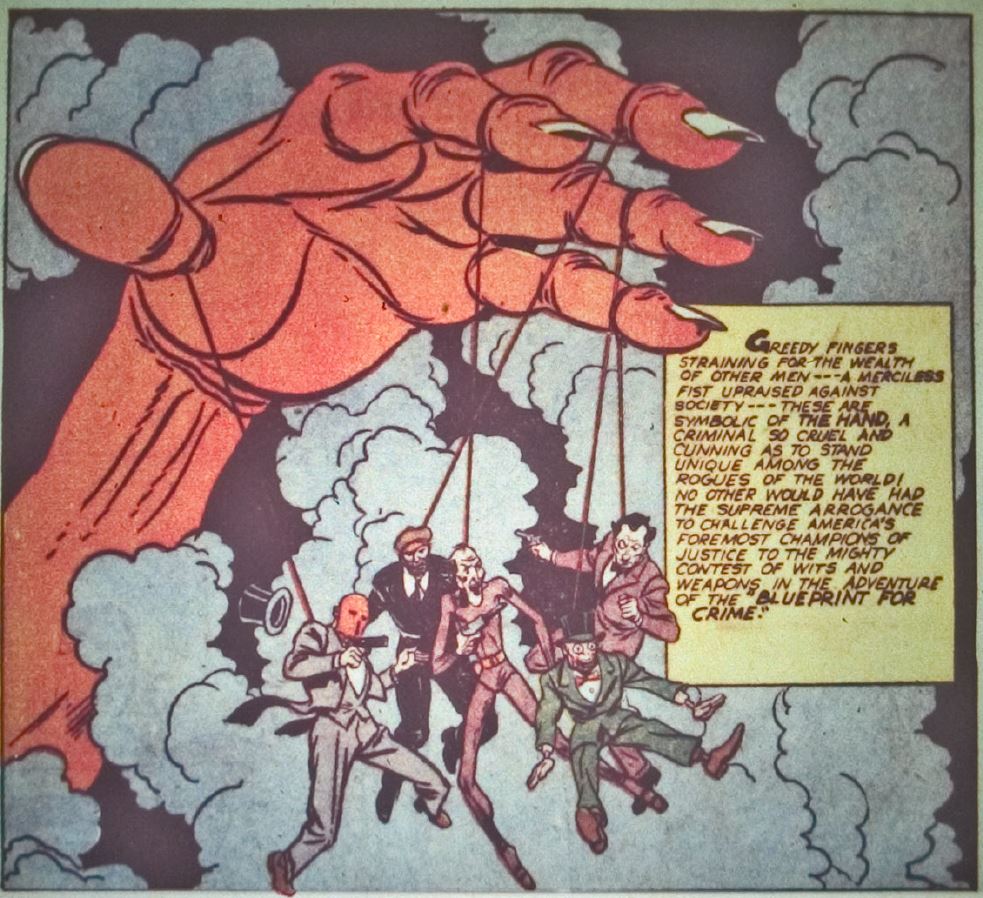
    As promised: the Five Fingers of the Hand! Though the Seven Soldiers would go on the fight more than a few teams of super-henchmen, the Fingers are distinguished by being (mostly) pre-established characters. Fun!

    Big Caesar:

    Big Caesar is whatever. A regular-style gang boss with a good name, elevated by being included in the gang. He appears just this once, in a scheme that involves cutting the power to Broadway and then doing a crimewave in the dark. The Crimson Avenger and Wing take him down without significant effort.

    The Dummy:

    Like Big Caesar, the Dummy appears for the first time in this issue. Unlike Big Caesar, the Dummy would go on to bigger things – so much so that I am declaring him a very marginal full super-villain, which makes this a cheeky Yearbook entry for his 1941. 

    When first seen, the Dummy has two points of interest: 1. he is an “infamous kidnapper” and 2. he may or may not be a real, inanimate ventriloquist’s dummy. Even his gang is convinced that he is a front for one of their number. 

    Per his talents, the Hand sets the Dummy up with a sweet kidnapping job: he grabs various Hollywood types and leaves behind a lifelike statue in their place. The ransom is thus to “return them to life”. Sadly, the sculptor that they must have had on retainer to produce the statues is not shown.

    The Dummy is eventually revealed to be alive, though whether he is a very short human with a penchant for sitting still or some sort of animate wooden doll is not explored. Also unexplored: why the Dummy’s back room is full of duplicates of the statues that he has already left in place of his victims, and why he has statues of the Vigilante and his second-best sidekick Billy Gunn – it’s tough to imagine a scenario in which they might be useful (other than as a heavy object under which to trap the Dummy, of course).

    Number of Episodes of the “Super-Villains of Hollywood” podcast: part of a compilation episode about villains who come to Hollywood to do crimes.

    Body Count: 0

    End-of-Year Status: Captured

    The Needle:

    The Needle is a recurring foe of the Star-Spangled Kid and Stripesy, a tall thin guy with a needle gun and a wild look in his eyes. Due to the fact that I only pay attention to the cover date on comics and that that never actually lines up with the release date, his first appearance in 1942 won’t hit this blog for some time – he’ll likely be Minor Super-Villain 555 or the like.

    Anyway, he steals a ray gun and tries to blow up the Panama Canal for some reason.

    Professor Merlin:

    As with the Needle, Professor Merlin’s first appearance doesn’t take place until 1942. This is especially embarrassing because he actually dies before his first appearance, like one of those RPGs where you can die during character creation.

    Merlin’s scheme involves scamming gold out of a rich old prospector by exploiting his well-known fear of freezing to death, then managing to collapse a mine on himself when he uses dynamite to blow open a lock that looks like you could pick it with a small enough finger. Nobody comes out on top here: Prof Merlin dies a dummy despite ostensibly being a Smart Crook and Green Arrow and Speedy don’t even play that much of a role in his downfall.

    Red Dragon:

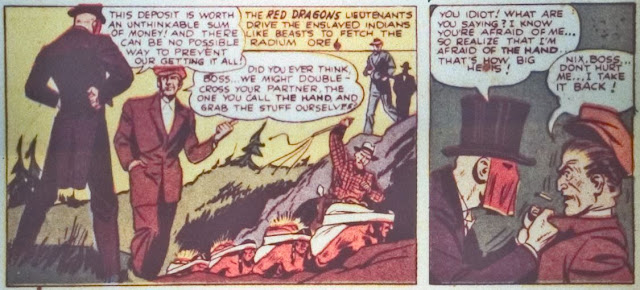
    Our final Finger and the only one to have already shown up previously here, the Red Dragon is his usual terrible self: he takes advantage of an old myth in order to enslave a Native American tribe and force them to mine radium. Lucky for them that the Shining Knight turns up to actually fulfill the prophecy and  kick the Dragon’s rear. It’s a real evil comic book crime rendered a fair bit less enjoyable to read because of all the racism.

    So: the Five Fingers of the Hand. Top notch themed name for a henchman group hampered somewhat by the ease with which they were all taken out. Any time the Hand shows up he should have a different iteration of the Fingers with him, and that’s that. Bring ’em back, at least in name.

  • MINOR SUPER-VILLAIN 333: THE FIVE FINGERS OF THE HAND

    MINOR SUPER-VILLAIN 333: THE FIVE FINGERS OF THE HAND

    (Leading Comics 001, 1941)

    As promised: the Five Fingers of the Hand! Though the Seven Soldiers would go on the fight more than a few teams of super-henchmen, the Fingers are distinguished by being (mostly) pre-established characters. Fun!

    Big Caesar:

    Big Caesar is whatever. A regular-style gang boss with a good name, elevated by being included in the gang. He appears just this once, in a scheme that involves cutting the power to Broadway and then doing a crimewave in the dark. The Crimson Avenger and Wing take him down without significant effort.

    The Dummy:

    Like Big Caesar, the Dummy appears for the first time in this issue. Unlike Big Caesar, the Dummy would go on to bigger things – so much so that I am declaring him a very marginal full super-villain, which makes this a cheeky Yearbook entry for his 1941. 

    When first seen, the Dummy has two points of interest: 1. he is an “infamous kidnapper” and 2. he may or may not be a real, inanimate ventriloquist’s dummy. Even his gang is convinced that he is a front for one of their number. 

    Per his talents, the Hand sets the Dummy up with a sweet kidnapping job: he grabs various Hollywood types and leaves behind a lifelike statue in their place. The ransom is thus to “return them to life”. Sadly, the sculptor that they must have had on retainer to produce the statues is not shown.

    The Dummy is eventually revealed to be alive, though whether he is a very short human with a penchant for sitting still or some sort of animate wooden doll is not explored. Also unexplored: why the Dummy’s back room is full of duplicates of the statues that he has already left in place of his victims, and why he has statues of the Vigilante and his second-best sidekick Billy Gunn – it’s tough to imagine a scenario in which they might be useful (other than as a heavy object under which to trap the Dummy, of course).

    Number of Episodes of the “Super-Villains of Hollywood” podcast: part of a compilation episode about villains who come to Hollywood to do crimes.

    Body Count: 0

    End-of-Year Status: Captured

    The Needle:

    The Needle is a recurring foe of the Star-Spangled Kid and Stripesy, a tall thin guy with a needle gun and a wild look in his eyes. Due to the fact that I only pay attention to the cover date on comics and that that never actually lines up with the release date, his first appearance in 1942 won’t hit this blog for some time – he’ll likely be Minor Super-Villain 555 or the like.

    Anyway, he steals a ray gun and tries to blow up the Panama Canal for some reason.

    Professor Merlin:

    As with the Needle, Professor Merlin’s first appearance doesn’t take place until 1942. This is especially embarrassing because he actually dies before his first appearance, like one of those RPGs where you can die during character creation.

    Merlin’s scheme involves scamming gold out of a rich old prospector by exploiting his well-known fear of freezing to death, then managing to collapse a mine on himself when he uses dynamite to blow open a lock that looks like you could pick it with a small enough finger. Nobody comes out on top here: Prof Merlin dies a dummy despite ostensibly being a Smart Crook and Green Arrow and Speedy don’t even play that much of a role in his downfall.

    Red Dragon:

    Our final Finger and the only one to have already shown up previously here, the Red Dragon is his usual terrible self: he takes advantage of an old myth in order to enslave a Native American tribe and force them to mine radium. Lucky for them that the Shining Knight turns up to actually fulfill the prophecy and  kick the Dragon’s rear. It’s a real evil comic book crime rendered a fair bit less enjoyable to read because of all the racism.

    So: the Five Fingers of the Hand. Top notch themed name for a henchman group hampered somewhat by the ease with which they were all taken out. Any time the Hand shows up he should have a different iteration of the Fingers with him, and that’s that. Bring ’em back, at least in name.

  • MINOR SUPER-VILLAIN 276: THE INVISIBLE SLAYER

    (Marvel Mystery Comics v1 019, 1941)

    There’s a bit in the introductions to the Top 10 anthologies in which Neopolis mayor John Q. Public lays out the exponential propagation of super-heroes, -villains, -pets, -monsters and so forth that takes place in a comic universe that I think of often as I read through these old adventures. Heroes inspire sidekicks and imitators; their enemies build robots and create doppelgangers to counter them, etc, until you have superhumans everywhere. 

    There’s one thing that isn’t brought up in that intro that absolutely contributes to the proliferation of the extranormal in a super-hero universe: any friend, family member or acquaintance (and especially any old college classmate, for some reason) is highly likely to either become a super-villain or to be targeted by one. Out of universe, it is of course an easy way to bring the hero in on a case, but in-universe: what a wild series of coincidences!

    In this case, we find Professor Zog summoned to the side of his old college pal Sir John Chadwick, who has seen almost his entire family killed by a mysterious set of floating hands in recent weeks. Zog is of course a bro and immediately flies to England to solve this problem via Applied Robot Violence. The first battle between Electro and the Invisible Slayer ends in a robo-defeat, but Zog manages to shoot the killer and follows its trail of blood to…

    The nearby mansion of Basil Drake, who turns out to be behind the whole thing to such a degree that one must wonder about Sir Chadwick’s powers of observation. Drake’s mansion contains a herd of gorillas, for heaven’s sake. His motivation for five murders and many more attempteds is that Chadwick’s daughter sensibly rejected his marriage proposal, which is, I must say, a stupid reason to delve into super-villainy.

    And of course even after Drake bumps himself off rather than be captured we must deal with the Invisible Slayer itself, or himself, as it turns out, because the Slayer is in fact Drake’s servant Chandi, cast as a monster due to his size and race.

    A story featuring disembodied hands and herds of gorillas, ruined for me by racism and misogyny. I hope you’re happy, Basil Drake.