The Curse of Skeleton Munroe

Category: King

  • PROBLEMATIC ROUND-UP 008

    Once again I must regretfully inform you that some comic books are problematic. Like, racially.

    the Laughing Hyenas: 

    Hey, it’s our first racial hate group, and I think I’m just going to preemptively file these under “problematic” because they’re a) not fun to talk about and b) necessitate talking about hate-crimes even if I, for example, choose not to use the panels with lynchings in them.

    The Laughing Hyenas are actually kind of a hate group by proxy, as they have been hired to keep the Black residents of the geographically-nonspecific town of Souda “in line” by murdering one of them every once in a while, and have been doing so frequently enough and/or long enough that even the local folks willing to volunteer for such a task have gotten sick of it, so boss Bull Karson had to import some Chicago toughguys to do his dirty work for him.

    Oddly, given the sheer volume of murder that the Laughing Hyenas were perpetrating, the Silver Streak doesn’t actually bring them in to the authorities ore even extra-judiciously kill them. Instead, he just dumps them on a slow boat to Rangoon. (Silver Streak Comics 013, 1941)

    the Modern Thief of Bagdad:

    Ali Hassan, aka the Modern Thief of Bagdad, is an Iraqi thief who comes to NYC to steal the Konoor Diamond, and as a result comes into conflict with Captain Battle and his young protege Hale Battle. A simple story that would ordinarily wrap up quite quickly, but this is a book-length yarn, which means that there is an extended chase sequence that occupies the 28 pages between the theft and Hassan’s arrival back in Baghdad. Some highlights:

    Chapter 1, “The Modern Thief of Bagdad!”: Hassan steals the gem, then give Battle and Hale the slip in Chinatown. Olyra, the mysterious guardian of the Konoor Diamond, is kidnapped.

    Chapter 2, “Perils of the Sargasso Sea!”: Hassan’s submarine becomes mired in sargassum and is attacked by a sea monster. Battle and Hale kill the beast. Hassan and his men dress up like ghost pirates. Olyra is rescued and then kidnapped again.

    Chapter 3, “Lost in the Underground World!”: Hassan’s plane crashes in Africa and he and Olyra are captured by cannibals (lil’ bonus racism for you there). Battle and Hale rescue them before being betrayed and dumped in a pit of quicksand. There is a brief interlude in an cave system full of monsters before it suddenly blows up. Hassan and his men dress up like ghosts. Olyra is rescued.

    Chapter 4, “House of Giants”: Battle & co track Hassan to a castle in Tibet, where they are captured and subjected to a shrink ray. They have various adventures as tiny men before resuming their original size. Olyra is kidnapped.

    I would call Hassan himself… an average amount of racist. He’s depicted in much the same generically foreign vein as I’ve seen in a South American president or a Basque fisherman (or indeed a Cape Breton fisherman at least once). As a villain, he’s pretty great: bombastic, treacherous, fond of leaving boastful notes for his enemies. If it was just him I might have skipped making this a Problematic Round-Up entry.

    It’s not just him, however, and once the story hits Chapter 5, “Magic Spell of the Arabian Nights” we get a real dose of Orientalism full in the face, as our heroes touch down in a Baghdad straight out of the Arabian Nights, complete with a wicked ruler (confusingly named Emperor Pasha Golu) who Hassan has been working for the whole time.

    It’s such a pastiche of a city, in fact, that Hale and Olyra just kind of stumble across Aladdin’s lamp and flying carpet while they are escaping from a dungeon. I suppose that all this is at least a little thematically appropriate, as Ali Hassan, the Modern Thief of Bagdad, is a reference to a movie that is a remake of a different movie that is itself a pastiche of the Arabian Nights.

    The Modern Thief of Bagdad meets his end in a pretty underwhelming manner: Captain Battle ducks as he swings a sword at him and he falls off of a balcony. A pretty terrible way to go for a villain who clearly thought that he was very cool, to be honest. The evil Pash Golu also meets his end in the process, leaving Olyra free to reveal that she is actually Olyria, Princess and true ruler of Bagdad. A truly impenetrable alias! 

    Finally, such is Hale Battle’s hunger for souvenirs that he uses his third genie with to acquire a replica of the diamond for his collection, even though for my money the real deal Lamp of Aladdin with one wish left on it would be the ultimate keepsake. (Captain Battle Comics 002, 1941)

    the King:

    The King is a fellow who gains control over a Romani group by showing them a… birthmark? tattoo? that proves his right to rule and that looks so intensely falsifiable that I am shocked there isn’t some sort two-factor authentication, or even a code phrase. And just what is is reason for exerting this control? Why, so that he can turn his new subjects into a child kidnapping ring. You can see how I would consider this problematic.

    The King is of course not the real ruler, that is not a real skull birthmark and he is no match for Dynamic Man. He turns out to be a crooked newspaper publisher named Brower who loves money more than making good plans to acquire it. (Dynamic Comics 002, 1941)

    the Dragon:

    The Dragon is a very ordinary Yellow Peril villain who is after some top secret bomber plans on behalf of an unspecified Asian nation. There are exactly four interesting things about him: 1) he is the first villain faced by Samson and David in their brief New Look era before they disappear along with most of Fox Features’ other characters during their financial trouble. 2) he is a classic calling card leaver in the form of a claw mark on the chests of men he has killed

     3) he works alongside his sister Orchid, which isn’t the rarest arrangement but is always fun to note

     4) he has these stone lions outside of his HQ that grab intruders as they come through. It’s a fun trap but never actually explained: are they some sort of mechanism, or demonic magic like the caption box suggests?

    Much of the issue in questioned is concerned with Samson chasing the Dragon and Orchid around. Once he catches up to them it’s all over. (Fantastic Comics 022, 1941)

  • PROBLEMATIC ROUND-UP 008

    Once again I must regretfully inform you that some comic books are problematic. Like, racially.

    the Laughing Hyenas: 

    Hey, it’s our first racial hate group, and I think I’m just going to preemptively file these under “problematic” because they’re a) not fun to talk about and b) necessitate talking about hate-crimes even if I, for example, choose not to use the panels with lynchings in them.

    The Laughing Hyenas are actually kind of a hate group by proxy, as they have been hired to keep the Black residents of the geographically-nonspecific town of Souda “in line” by murdering one of them every once in a while, and have been doing so frequently enough and/or long enough that even the local folks willing to volunteer for such a task have gotten sick of it, so boss Bull Karson had to import some Chicago toughguys to do his dirty work for him.

    Oddly, given the sheer volume of murder that the Laughing Hyenas were perpetrating, the Silver Streak doesn’t actually bring them in to the authorities ore even extra-judiciously kill them. Instead, he just dumps them on a slow boat to Rangoon. (Silver Streak Comics 013, 1941)

    the Modern Thief of Bagdad:

    Ali Hassan, aka the Modern Thief of Bagdad, is an Iraqi thief who comes to NYC to steal the Konoor Diamond, and as a result comes into conflict with Captain Battle and his young protege Hale Battle. A simple story that would ordinarily wrap up quite quickly, but this is a book-length yarn, which means that there is an extended chase sequence that occupies the 28 pages between the theft and Hassan’s arrival back in Baghdad. Some highlights:

    Chapter 1, “The Modern Thief of Bagdad!”: Hassan steals the gem, then give Battle and Hale the slip in Chinatown. Olyra, the mysterious guardian of the Konoor Diamond, is kidnapped.

    Chapter 2, “Perils of the Sargasso Sea!”: Hassan’s submarine becomes mired in sargassum and is attacked by a sea monster. Battle and Hale kill the beast. Hassan and his men dress up like ghost pirates. Olyra is rescued and then kidnapped again.

    Chapter 3, “Lost in the Underground World!”: Hassan’s plane crashes in Africa and he and Olyra are captured by cannibals (lil’ bonus racism for you there). Battle and Hale rescue them before being betrayed and dumped in a pit of quicksand. There is a brief interlude in an cave system full of monsters before it suddenly blows up. Hassan and his men dress up like ghosts. Olyra is rescued.

    Chapter 4, “House of Giants”: Battle & co track Hassan to a castle in Tibet, where they are captured and subjected to a shrink ray. They have various adventures as tiny men before resuming their original size. Olyra is kidnapped.

    I would call Hassan himself… an average amount of racist. He’s depicted in much the same generically foreign vein as I’ve seen in a South American president or a Basque fisherman (or indeed a Cape Breton fisherman at least once). As a villain, he’s pretty great: bombastic, treacherous, fond of leaving boastful notes for his enemies. If it was just him I might have skipped making this a Problematic Round-Up entry.

    It’s not just him, however, and once the story hits Chapter 5, “Magic Spell of the Arabian Nights” we get a real dose of Orientalism full in the face, as our heroes touch down in a Baghdad straight out of the Arabian Nights, complete with a wicked ruler (confusingly named Emperor Pasha Golu) who Hassan has been working for the whole time.

    It’s such a pastiche of a city, in fact, that Hale and Olyra just kind of stumble across Aladdin’s lamp and flying carpet while they are escaping from a dungeon. I suppose that all this is at least a little thematically appropriate, as Ali Hassan, the Modern Thief of Bagdad, is a reference to a movie that is a remake of a different movie that is itself a pastiche of the Arabian Nights.

    The Modern Thief of Bagdad meets his end in a pretty underwhelming manner: Captain Battle ducks as he swings a sword at him and he falls off of a balcony. A pretty terrible way to go for a villain who clearly thought that he was very cool, to be honest. The evil Pash Golu also meets his end in the process, leaving Olyra free to reveal that she is actually Olyria, Princess and true ruler of Bagdad. A truly impenetrable alias! 

    Finally, such is Hale Battle’s hunger for souvenirs that he uses his third genie with to acquire a replica of the diamond for his collection, even though for my money the real deal Lamp of Aladdin with one wish left on it would be the ultimate keepsake. (Captain Battle Comics 002, 1941)

    the King:

    The King is a fellow who gains control over a Romani group by showing them a… birthmark? tattoo? that proves his right to rule and that looks so intensely falsifiable that I am shocked there isn’t some sort two-factor authentication, or even a code phrase. And just what is is reason for exerting this control? Why, so that he can turn his new subjects into a child kidnapping ring. You can see how I would consider this problematic.

    The King is of course not the real ruler, that is not a real skull birthmark and he is no match for Dynamic Man. He turns out to be a crooked newspaper publisher named Brower who loves money more than making good plans to acquire it. (Dynamic Comics 002, 1941)

    the Dragon:

    The Dragon is a very ordinary Yellow Peril villain who is after some top secret bomber plans on behalf of an unspecified Asian nation. There are exactly four interesting things about him: 1) he is the first villain faced by Samson and David in their brief New Look era before they disappear along with most of Fox Features’ other characters during their financial trouble. 2) he is a classic calling card leaver in the form of a claw mark on the chests of men he has killed

     3) he works alongside his sister Orchid, which isn’t the rarest arrangement but is always fun to note

     4) he has these stone lions outside of his HQ that grab intruders as they come through. It’s a fun trap but never actually explained: are they some sort of mechanism, or demonic magic like the caption box suggests?

    Much of the issue in questioned is concerned with Samson chasing the Dragon and Orchid around. Once he catches up to them it’s all over. (Fantastic Comics 022, 1941)

  • CATALOGUE OF WOUNDS 003

    It’s a dangerous ol’ job, heroing. Thus, the Catalogue of Wounds!

    Green Lantern:

    While tied up in a burning house, Green Lantern must thrust his hands into the flames to escape. (All American Comics 031, 1941)

    Hawkgirl: 

    Hawkgirl is shot in the back by an agent of Mister X while acting as a Hawkman decoy on her very first outing in costume (All-Star Comics 005, 1941)

    Hawkman:

    Shot in the left shoulder by Alexander the Great. (Flash Comics 002, 1940)

    Shot in – I think – the left shoulder again while working on the case of the Hand. (Flash Comics 015, 1941) 

    Shot in the right shoulder for a change, as Carter Hall. (Flash Comics 019, 1941) 

    Perhaps Hawkman preferentially takes bullets to the left shoulder because he took an arrow there during his original incarnation as Prince Khufu. (Flash Comics 001, 1940)  

    Speaking of Prince Khufu, he (along Princess Shiera, off-panel) is famously stabbed by the evil Hath-Set. Hey, a fatal wound is still a wound. (Flash Comics 001, 1940)

    the Human Torch:

    During one of the periods in which the Human Torch is being hunted by the law, he takes a police slug to his right arm. (Marvel Mystery Comics v1 011, 1940)

    the King: 

    Gets his scalp creased by a bullet. (Flash Comics 003, 1940)

    And again a year later. (Flash Comics 016, 1941)

    Aquatic toughie the Scarlet Mermaid gives the King a fashionable bullet wound in the left shoulder while making her escape. (Flash Comics 019, 1941)

    the Pied Piper: 

    Shot in the right arm while wrasslin’ with the Black Panther’s panther. (Cat-Man Comics 004, 1941)

  • MINOR SUPER-VILLAIN 857: THE KING

    (Wham Comics 001, 1940)

    In what is sadly the final appearance of Speed Centaur, he and his pal “Reel” McCoy travel to the Arctic ruins of the City of Centaurs to explore Speed’s birthplace. Almost immediately upon setting foot inside, they are ambushed and captured by wild-eyed men who escort them to their leader, a man called the King, who unusually has gone with an eccentric hair choice in every available part of his face but the mustache zone, and is also some sort of insane tyrant.

    The King decrees that Speed Centaur must provide entertainment to the assembled inhabitants of the city via gladiatorial combat with three polar bears, a challenge that the super-powered centaur rises to with ease. The next trial that the King decrees is a kind of extended electrical torture that is designed to go on until it kills Speed, only he chooses to take the other way out: beating the daylights out of everyone within reach. 

    It turns out that the King and his men were the survivors of a lost Arctic expedition who were in the grips of some kind of extended group blizzard madness and that getting their asses kicked by a centaur was just what they needed to break them out of it. The King turns out to be Professor Dillon, the leader of the expedition, and denies all knowledge of what has been happening in Centaur City for the last five years. I suppose you have to take him at his word, though I personally wouldn’t put him in a position of authority again. It’s like learning that someone is a mean drunk, you know? 

  • MINOR SUPER-VILLAIN 857: THE KING

    (Wham Comics 001, 1940)

    In what is sadly the final appearance of Speed Centaur, he and his pal “Reel” McCoy travel to the Arctic ruins of the City of Centaurs to explore Speed’s birthplace. Almost immediately upon setting foot inside, they are ambushed and captured by wild-eyed men who escort them to their leader, a man called the King, who unusually has gone with an eccentric hair choice in every available part of his face but the mustache zone, and is also some sort of insane tyrant.

    The King decrees that Speed Centaur must provide entertainment to the assembled inhabitants of the city via gladiatorial combat with three polar bears, a challenge that the super-powered centaur rises to with ease. The next trial that the King decrees is a kind of extended electrical torture that is designed to go on until it kills Speed, only he chooses to take the other way out: beating the daylights out of everyone within reach. 

    It turns out that the King and his men were the survivors of a lost Arctic expedition who were in the grips of some kind of extended group blizzard madness and that getting their asses kicked by a centaur was just what they needed to break them out of it. The King turns out to be Professor Dillon, the leader of the expedition, and denies all knowledge of what has been happening in Centaur City for the last five years. I suppose you have to take him at his word, though I personally wouldn’t put him in a position of authority again. It’s like learning that someone is a mean drunk, you know? 

  • MINOR SUPER-VILLAIN 288: THE KING

    (Marvel Mystery Comics v1 025, 1941)

    The King is your regular old gang boss who decides to pivot from running a numbers racket to selling counterfeit pharmaceuticals, and if that was it he wouldn’t be listed here. The dang guy just wasn’t content to be regular, though. Some salient features of his crime time:

    -he made the fake drugs in a sprawling underground lab using kidnapped doctors

    -recalcitrant doctors ended up in a giant vat of boiling acid

    -he has a full suite of gadgets including acid, gas and regular bombs and a remote controlled exploding car for blowing up excess henchmen

    -he leaves a king playing card at the scene of his crimes

    -he uses a cigar holder, which isn’t villainous per se but always stands out so much to me that I must make note of it.

    He’s also very dumb? Like, the calling cards tie together various crimes in a way that they might not otherwise have been, and he leaves a license plate that’s registered in his name on the bomb-car. Plus he does a lot of unnecessary murdering and kidnapping that does a lot less to make people respect him and more to make them want to stop him, or, as in the case of the henchman he fails to fully blow up, kill him.

  • MINOR SUPER-VILLAIN 249: THE SCARLET MERMAID

    (Flash Comics v1 019, 1941)

    The Scarlet Mermaid is elegant in her simplicity: she’s a good swimmer who lives near a river where a lot of rich people hang out on boats, so she swims out and robs them. That plus a great name (and an okay costume – could use a contrasting colour) make for a winning combo.

    Even a cool villain must eventually reckon with a super-hero, however, and the Scarlet Mermaid ends up being one of the King’s few non-Witch opponents and is captured without much complication, never to appear again. This is a shame, because, like the Black Gondolier before her, I reckon that the Scarlet Mermaid is exactly the sort of low-level supercrook that should be lurking around every city in every super-hero universe. Some great grandniece of hers should be robbing megayachts to this day, dang it. BRING BACK the Scarlet Mermaid!

  • MINOR SUPER-VILLAIN 234: THE WITCH

    (Flash Comics v1 005, 1940) 

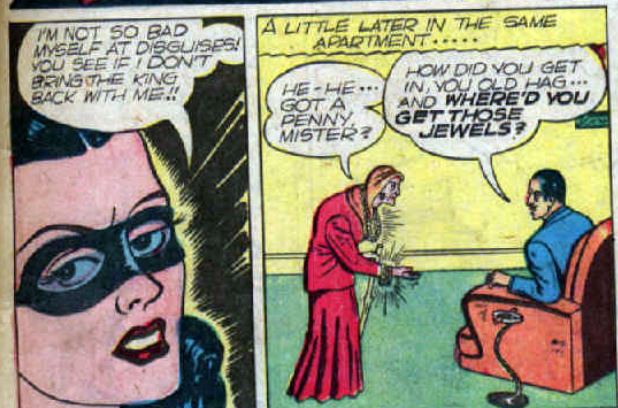
    Long-running foe/ally/love interest of Golden Age master of disguise the King (or King Standish, if you want to go by his full name), the Witch probably deserves a more thorough examination than I’m going to give her, but the fact is that though she is a good character and an admirable foil to the King, the King himself is a bit dull. Sorry, Witchie.

    I will say that the New Orleans-set King story in World’s Finest 002, in which the Witch is revealed to be a descendent of pirate Jean Lafitte and that her father was actually a crook who had kidnapped her as a baby to spite a different crook and in which she loses not one but two fathers… is a good time, will read again.

    ADDENDUM: I don’t know if she’s telling the truth here, but the idea tht the Witch’s criminal upbringing was messed up enough that she doesn’t even have a name is enough to make me like her 10x more. (Flash Comics v1 009, 1940)