The Curse of Skeleton Munroe

Category: living zombies

  • PROBLEMATIC ROUND-UP 009

    It it the nature of comic books that we will always be doing Problematic Updates.

    Dr Finkle:

    Dr Finkle himself is nothing special: he’s a psuedo-Nazi teamed up with the pseudo-Japanese Matsui in a scheme to steal securities belonging to Axis-conquered countries that are held in America. The real issue lies with Finkle’s primary agents, who you may notice being referred to as “Indian Monsters” in the final panel above.

    These “Indian Monsters” are straight out of something like Bone Tomahawk: inhumanly huge, fast and strong, barely verbal, ravenous cannibals that Finkle keeps under control with a steady diet of human flesh… literally monsters, in other words.

    I was going to say that the only good thing about them is that they eventually eat Dr Finkle but no, I must be thinking about some other monster-men. Instead, a special agent named Betty shoots Finkle and they immediately transfer allegiance to her thanks to “ancient Indian folklore.” It’s enough to tire a guy out. (Four Favorites 002, 1940)

    Loanga:

    Loanga is your regular old 1940s voodoo witch doctor, though he deviates from the norm by not being from Haiti but from another Caribbean island named Naseba, a name that feels like it should be in reference to something but if it is I cannot figure it out. Loango aims to take over the world with his zombie hordes and is starting with the United States, having captured and zombified Secretary of State Brant and compelled him to push for the disarmament all US military installations.

    As usual it is interesting to note the specifics of Loanga’s zombies. They are created out of living people using a combination of drugs and mind control and though they are still alive and able to speak, they cannot be killed by conventional means. They are cured and go back to normal when Loanga dies – whether this means that the ones who were dealt lethal wounds just fully die is not explored. Finally, they cast no shadows, and there’s something going on with their eyes – the ones who we see trying to pass as regular folk all wear dark glasses, but no reason for doing so is given.

    Loanga is ultimately undone by his own belief in the power of sympathetic magic: when comic relief artist character J. Rembrandt Speedball paints his portrait and then destroys it in a fit of pique at the thought of being executed by firing squad, he drops dead. All the zombies are freed or dead and the world is saved! (Fantastic Comics 023, 1941)

    the Big Boss:

    The Big Boss, a mysterious masked Chinese man who controls the opium trade in the Western city of Middletown (highly inaccurate name btw) unsurprisingly turns out to be J Harold Stetson, the prominent banker who has been making a lot of noise about how much he hates all this opium smuggling (and please note the misspelling that initially has his middle name as the weirdly amusing “Harlod”). (Lightning Comics v2 002, 1941)

    the Death Patrol:

    Here’s the tragic thing about the Death Patrol: it’s mostly something that I really like. I’ll lay out the setup and you see if you can spot when we get into Problematic territory.

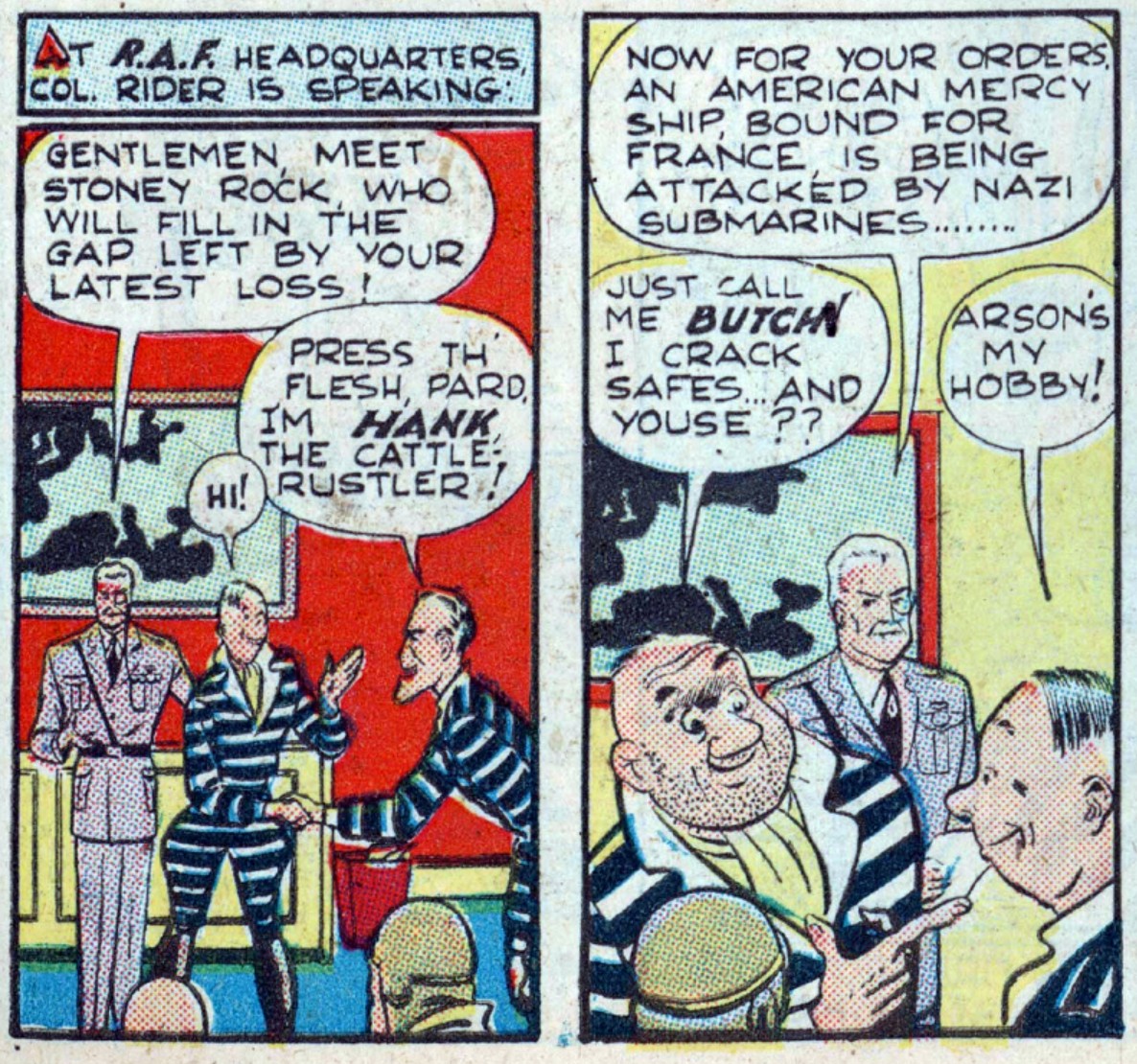
    The Death Patrol is formed when wealthy pilot/failure Del van Dyne’s plane is hijacked by a quartet of escaped convicts (and the pal who helped them break out). Del manages to weaponize his sense of rich guy ennui/ desire to make a difference in the world to convince the five to join him in volunteering to help the RAF defend the UK from Axis aggression, and thankfully all five are expert pilots in addition to their professional skills so this is a bit more plausible than it might otherwise be.

    The hook of the early Death Patrol stories, and the source of their name, is the fact that they only take on the most dangerous missions and have an attrition rate of one member per adventure. (Military Comics 001, 1941)

    The original lineup of the Death Patrol is as follows:

    Del van Dyne: Wealthy failure and leader of the group. Alive at the end of 1941.

    Butch O’Keefe: Safecracker. Sacrifices himself to stop a Nazi bomber group by crashing into them.

    Gramps: Pickpocket. Alive at the end of 1941.

    Hank: Rustler. Alive at the end of 1941.

    Peewee: Forger. Shot in the back by Nazis in the very first Death Patrol adventure.

    Slick Ward: Con artist. Dies in an exploding Nazi dirigible.

    Additional members added in 1941 as the death toll rises: 

    Stoney Rock: Arsonist. Shot by Nazis on his first mission. (Military Comics 002, 1941)

    Zazzy: Kleptomaniac. Dies while rescuing workers from an exploding Nazi factory. (Military Comics 003, 1941)

    Chief Chuck-a-lug: Former Wild West show performer stranded in Europe due to the conflict, and yes, congratulations, you spotted it. This is where the Death Patrol officially becomes Hard to Recommend, because from this point forward there will always be one or more racist comic relief characters running around and, for instance, yelling about scalping people. Alive at the end of 1941. (Military Comics 004, 1941)

    King Hotentot: The ruler of a small African country that has been occupied by the Axis, King Hotenetot is a prime example of the Educated Savage, a classic unfunny comedy trope in which a character speaks eloquently due to a classical education but still, for example, runs around with a spear threatening to eat people like he’s just flown in from a hateful jungle adventure. Still alive at the end of 1941. (Military Comics 005, 1941)

    Jumping back to some of the fun things about the Death Patrol, here are their fun prison-themed flightsuits and skull-in-a-hat insignia which is personalized with a custom hat for each pilot. Fun! 

    The Death Patrol also flies around in eccentric homemade airplanes, which is whimsical! It’s the sort of thing that makes you want to recommend the comic to a friend, until you remember all the Problems.

  • PROBLEMATIC ROUND-UP 009

    PROBLEMATIC ROUND-UP 009

    It it the nature of comic books that we will always be doing Problematic Updates.

    Dr Finkle:

    Dr Finkle himself is nothing special: he’s a psuedo-Nazi teamed up with the pseudo-Japanese Matsui in a scheme to steal securities belonging to Axis-conquered countries that are held in America. The real issue lies with Finkle’s primary agents, who you may notice being referred to as “Indian Monsters” in the final panel above.

    These “Indian Monsters” are straight out of something like Bone Tomahawk: inhumanly huge, fast and strong, barely verbal, ravenous cannibals that Finkle keeps under control with a steady diet of human flesh… literally monsters, in other words.

    I was going to say that the only good thing about them is that they eventually eat Dr Finkle but no, I must be thinking about some other monster-men. Instead, a special agent named Betty shoots Finkle and they immediately transfer allegiance to her thanks to “ancient Indian folklore.” It’s enough to tire a guy out. (Four Favorites 002, 1940)

    Loanga:

    Loanga is your regular old 1940s voodoo witch doctor, though he deviates from the norm by not being from Haiti but from another Caribbean island named Naseba, a name that feels like it should be in reference to something but if it is I cannot figure it out. Loango aims to take over the world with his zombie hordes and is starting with the United States, having captured and zombified Secretary of State Brant and compelled him to push for the disarmament all US military installations.

    As usual it is interesting to note the specifics of Loanga’s zombies. They are created out of living people using a combination of drugs and mind control and though they are still alive and able to speak, they cannot be killed by conventional means. They are cured and go back to normal when Loanga dies – whether this means that the ones who were dealt lethal wounds just fully die is not explored. Finally, they cast no shadows, and there’s something going on with their eyes – the ones who we see trying to pass as regular folk all wear dark glasses, but no reason for doing so is given.

    Loanga is ultimately undone by his own belief in the power of sympathetic magic: when comic relief artist character J. Rembrandt Speedball paints his portrait and then destroys it in a fit of pique at the thought of being executed by firing squad, he drops dead. All the zombies are freed or dead and the world is saved! (Fantastic Comics 023, 1941)

    the Big Boss:

    The Big Boss, a mysterious masked Chinese man who controls the opium trade in the Western city of Middletown (highly inaccurate name btw) unsurprisingly turns out to be J Harold Stetson, the prominent banker who has been making a lot of noise about how much he hates all this opium smuggling (and please note the misspelling that initially has his middle name as the weirdly amusing “Harlod”). (Lightning Comics v2 002, 1941)

    the Death Patrol:

    Here’s the tragic thing about the Death Patrol: it’s mostly something that I really like. I’ll lay out the setup and you see if you can spot when we get into Problematic territory.

    The Death Patrol is formed when wealthy pilot/failure Del van Dyne’s plane is hijacked by a quartet of escaped convicts (and the pal who helped them break out). Del manages to weaponize his sense of rich guy ennui/ desire to make a difference in the world to convince the five to join him in volunteering to help the RAF defend the UK from Axis aggression, and thankfully all five are expert pilots in addition to their professional skills so this is a bit more plausible than it might otherwise be.

    The hook of the early Death Patrol stories, and the source of their name, is the fact that they only take on the most dangerous missions and have an attrition rate of one member per adventure. (Military Comics 001, 1941)

    The original lineup of the Death Patrol is as follows:

    Del van Dyne: Wealthy failure and leader of the group. Alive at the end of 1941.

    Butch O’Keefe: Safecracker. Sacrifices himself to stop a Nazi bomber group by crashing into them.

    Gramps: Pickpocket. Alive at the end of 1941.

    Hank: Rustler. Alive at the end of 1941.

    Peewee: Forger. Shot in the back by Nazis in the very first Death Patrol adventure.

    Slick Ward: Con artist. Dies in an exploding Nazi dirigible.

    Additional members added in 1941 as the death toll rises: 

    Stoney Rock: Arsonist. Shot by Nazis on his first mission. (Military Comics 002, 1941)

    Zazzy: Kleptomaniac. Dies while rescuing workers from an exploding Nazi factory. (Military Comics 003, 1941)

    Chief Chuck-a-lug: Former Wild West show performer stranded in Europe due to the conflict, and yes, congratulations, you spotted it. This is where the Death Patrol officially becomes Hard to Recommend, because from this point forward there will always be one or more racist comic relief characters running around and, for instance, yelling about scalping people. Alive at the end of 1941. (Military Comics 004, 1941)

    King Hotentot: The ruler of a small African country that has been occupied by the Axis, King Hotenetot is a prime example of the Educated Savage, a classic unfunny comedy trope in which a character speaks eloquently due to a classical education but still, for example, runs around with a spear threatening to eat people like he’s just flown in from a hateful jungle adventure. Still alive at the end of 1941. (Military Comics 005, 1941)

    Jumping back to some of the fun things about the Death Patrol, here are their fun prison-themed flightsuits and skull-in-a-hat insignia which is personalized with a custom hat for each pilot. Fun! 

    The Death Patrol also flies around in eccentric homemade airplanes, which is whimsical! It’s the sort of thing that makes you want to recommend the comic to a friend, until you remember all the Problems.
  • MAD AND CRIMINAL SCIENTIST ROUND-UP 003

    They may not be the top of the class, but they did their time in the evil sciences!

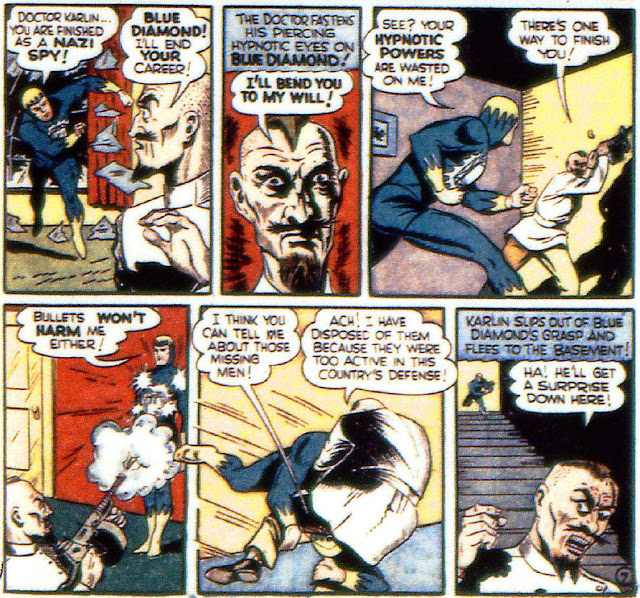
    Dr Eric Karlin has a lot of moxie on paper: a Nazi psychologist with a sideline in Egyptology, he dissolves the enemies of the Reich in acid and keeps their jellied remains in a series of jars in his basement. He also employs mind controlled pseudo-zombies in a scheme to recover frozen Nazi assets from a bank vault. The problem is that while all of this makes for a dynamite summary, the Blue Diamond story that he appears in is… not very good. (Daring Mystery Comics 008, 1942)

    DeVaux here had a plan to grow regular guys into huge guys and use them to take over the world but made the elementary mistake of trying to kill a friend of super-magician El Carim as his literal first step toward that end – it didn’t go well. (Master Comics 011, 1941)

    I’m not sure if this guy is even a scientist, but if you’re “the worst foreign spy living” and your name is Dr Evil and your cover as you plan to blow up a NYC analog is to call yourself “Dr Live” well then I can’t help but love you, even if you do get electrocuted by extremely generic Golden Age hero Lightning. (Jumbo Comics 015, 1940)

    And speaking of Lightning, he also battled Dr Tol, who used remote stone-crumbling technology to open up banks for his gang to loot. He also had very cool goggles. (Jumbo Comics 020, 1940)

  • MINOR SUPER-VILLAIN 207: THE BLACK WITCH

    (Crack Comics 018, 1941)

    The Black Witch is a member of a long comic book tradition: Haitian voodoo practitioners who use their sinister powers to get up to no good – in this case kidnapping the wife of one of Richard “Madam Fatal” Stanton’s friends as raw material in a search for eternal youth.

    The Black Witch is also part of a long-term demographic shift in comics: while the Haitian voodoo character is a staple villain s(and sometimes hero) into at least the 90s, in the early days they were basically all white folks like the Black Witch here, or the Master of Corpses. A question that I’m not qualified to answer: is this more racist than the state of things post 1960 or so when the population of voodoo villains more accurately represents the demographic makeup of Haiti or is it semi-vilifying an entire ethnoreligious group?