The Curse of Skeleton Munroe

Category: yellowface

  • PROBLEMATIC ROUND-UP 009

    It it the nature of comic books that we will always be doing Problematic Updates.

    Dr Finkle:

    Dr Finkle himself is nothing special: he’s a psuedo-Nazi teamed up with the pseudo-Japanese Matsui in a scheme to steal securities belonging to Axis-conquered countries that are held in America. The real issue lies with Finkle’s primary agents, who you may notice being referred to as “Indian Monsters” in the final panel above.

    These “Indian Monsters” are straight out of something like Bone Tomahawk: inhumanly huge, fast and strong, barely verbal, ravenous cannibals that Finkle keeps under control with a steady diet of human flesh… literally monsters, in other words.

    I was going to say that the only good thing about them is that they eventually eat Dr Finkle but no, I must be thinking about some other monster-men. Instead, a special agent named Betty shoots Finkle and they immediately transfer allegiance to her thanks to “ancient Indian folklore.” It’s enough to tire a guy out. (Four Favorites 002, 1940)

    Loanga:

    Loanga is your regular old 1940s voodoo witch doctor, though he deviates from the norm by not being from Haiti but from another Caribbean island named Naseba, a name that feels like it should be in reference to something but if it is I cannot figure it out. Loango aims to take over the world with his zombie hordes and is starting with the United States, having captured and zombified Secretary of State Brant and compelled him to push for the disarmament all US military installations.

    As usual it is interesting to note the specifics of Loanga’s zombies. They are created out of living people using a combination of drugs and mind control and though they are still alive and able to speak, they cannot be killed by conventional means. They are cured and go back to normal when Loanga dies – whether this means that the ones who were dealt lethal wounds just fully die is not explored. Finally, they cast no shadows, and there’s something going on with their eyes – the ones who we see trying to pass as regular folk all wear dark glasses, but no reason for doing so is given.

    Loanga is ultimately undone by his own belief in the power of sympathetic magic: when comic relief artist character J. Rembrandt Speedball paints his portrait and then destroys it in a fit of pique at the thought of being executed by firing squad, he drops dead. All the zombies are freed or dead and the world is saved! (Fantastic Comics 023, 1941)

    the Big Boss:

    The Big Boss, a mysterious masked Chinese man who controls the opium trade in the Western city of Middletown (highly inaccurate name btw) unsurprisingly turns out to be J Harold Stetson, the prominent banker who has been making a lot of noise about how much he hates all this opium smuggling (and please note the misspelling that initially has his middle name as the weirdly amusing “Harlod”). (Lightning Comics v2 002, 1941)

    the Death Patrol:

    Here’s the tragic thing about the Death Patrol: it’s mostly something that I really like. I’ll lay out the setup and you see if you can spot when we get into Problematic territory.

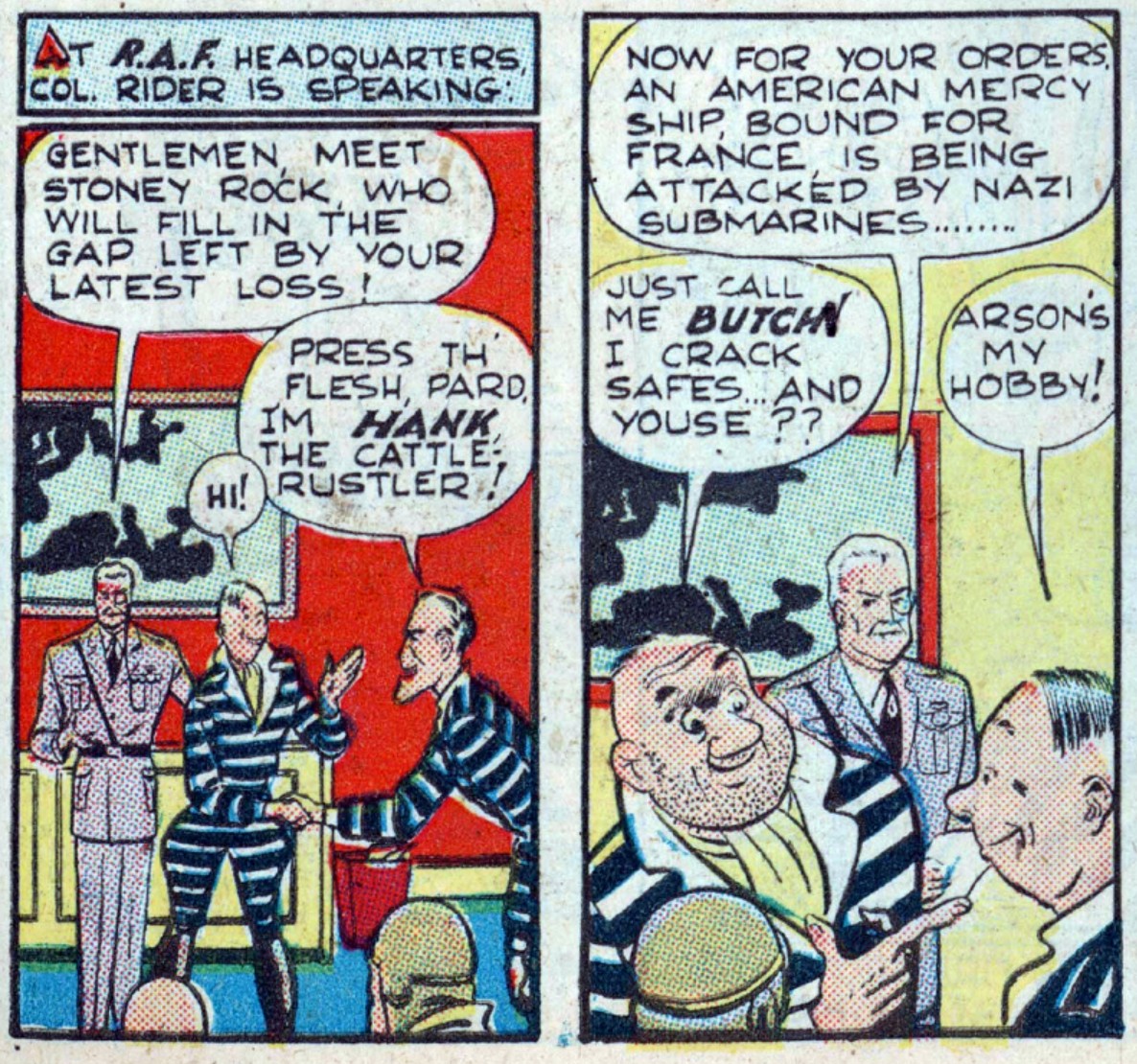
    The Death Patrol is formed when wealthy pilot/failure Del van Dyne’s plane is hijacked by a quartet of escaped convicts (and the pal who helped them break out). Del manages to weaponize his sense of rich guy ennui/ desire to make a difference in the world to convince the five to join him in volunteering to help the RAF defend the UK from Axis aggression, and thankfully all five are expert pilots in addition to their professional skills so this is a bit more plausible than it might otherwise be.

    The hook of the early Death Patrol stories, and the source of their name, is the fact that they only take on the most dangerous missions and have an attrition rate of one member per adventure. (Military Comics 001, 1941)

    The original lineup of the Death Patrol is as follows:

    Del van Dyne: Wealthy failure and leader of the group. Alive at the end of 1941.

    Butch O’Keefe: Safecracker. Sacrifices himself to stop a Nazi bomber group by crashing into them.

    Gramps: Pickpocket. Alive at the end of 1941.

    Hank: Rustler. Alive at the end of 1941.

    Peewee: Forger. Shot in the back by Nazis in the very first Death Patrol adventure.

    Slick Ward: Con artist. Dies in an exploding Nazi dirigible.

    Additional members added in 1941 as the death toll rises: 

    Stoney Rock: Arsonist. Shot by Nazis on his first mission. (Military Comics 002, 1941)

    Zazzy: Kleptomaniac. Dies while rescuing workers from an exploding Nazi factory. (Military Comics 003, 1941)

    Chief Chuck-a-lug: Former Wild West show performer stranded in Europe due to the conflict, and yes, congratulations, you spotted it. This is where the Death Patrol officially becomes Hard to Recommend, because from this point forward there will always be one or more racist comic relief characters running around and, for instance, yelling about scalping people. Alive at the end of 1941. (Military Comics 004, 1941)

    King Hotentot: The ruler of a small African country that has been occupied by the Axis, King Hotenetot is a prime example of the Educated Savage, a classic unfunny comedy trope in which a character speaks eloquently due to a classical education but still, for example, runs around with a spear threatening to eat people like he’s just flown in from a hateful jungle adventure. Still alive at the end of 1941. (Military Comics 005, 1941)

    Jumping back to some of the fun things about the Death Patrol, here are their fun prison-themed flightsuits and skull-in-a-hat insignia which is personalized with a custom hat for each pilot. Fun! 

    The Death Patrol also flies around in eccentric homemade airplanes, which is whimsical! It’s the sort of thing that makes you want to recommend the comic to a friend, until you remember all the Problems.

  • PROBLEMATIC ROUND-UP 009

    PROBLEMATIC ROUND-UP 009

    It it the nature of comic books that we will always be doing Problematic Updates.

    Dr Finkle:

    Dr Finkle himself is nothing special: he’s a psuedo-Nazi teamed up with the pseudo-Japanese Matsui in a scheme to steal securities belonging to Axis-conquered countries that are held in America. The real issue lies with Finkle’s primary agents, who you may notice being referred to as “Indian Monsters” in the final panel above.

    These “Indian Monsters” are straight out of something like Bone Tomahawk: inhumanly huge, fast and strong, barely verbal, ravenous cannibals that Finkle keeps under control with a steady diet of human flesh… literally monsters, in other words.

    I was going to say that the only good thing about them is that they eventually eat Dr Finkle but no, I must be thinking about some other monster-men. Instead, a special agent named Betty shoots Finkle and they immediately transfer allegiance to her thanks to “ancient Indian folklore.” It’s enough to tire a guy out. (Four Favorites 002, 1940)

    Loanga:

    Loanga is your regular old 1940s voodoo witch doctor, though he deviates from the norm by not being from Haiti but from another Caribbean island named Naseba, a name that feels like it should be in reference to something but if it is I cannot figure it out. Loango aims to take over the world with his zombie hordes and is starting with the United States, having captured and zombified Secretary of State Brant and compelled him to push for the disarmament all US military installations.

    As usual it is interesting to note the specifics of Loanga’s zombies. They are created out of living people using a combination of drugs and mind control and though they are still alive and able to speak, they cannot be killed by conventional means. They are cured and go back to normal when Loanga dies – whether this means that the ones who were dealt lethal wounds just fully die is not explored. Finally, they cast no shadows, and there’s something going on with their eyes – the ones who we see trying to pass as regular folk all wear dark glasses, but no reason for doing so is given.

    Loanga is ultimately undone by his own belief in the power of sympathetic magic: when comic relief artist character J. Rembrandt Speedball paints his portrait and then destroys it in a fit of pique at the thought of being executed by firing squad, he drops dead. All the zombies are freed or dead and the world is saved! (Fantastic Comics 023, 1941)

    the Big Boss:

    The Big Boss, a mysterious masked Chinese man who controls the opium trade in the Western city of Middletown (highly inaccurate name btw) unsurprisingly turns out to be J Harold Stetson, the prominent banker who has been making a lot of noise about how much he hates all this opium smuggling (and please note the misspelling that initially has his middle name as the weirdly amusing “Harlod”). (Lightning Comics v2 002, 1941)

    the Death Patrol:

    Here’s the tragic thing about the Death Patrol: it’s mostly something that I really like. I’ll lay out the setup and you see if you can spot when we get into Problematic territory.

    The Death Patrol is formed when wealthy pilot/failure Del van Dyne’s plane is hijacked by a quartet of escaped convicts (and the pal who helped them break out). Del manages to weaponize his sense of rich guy ennui/ desire to make a difference in the world to convince the five to join him in volunteering to help the RAF defend the UK from Axis aggression, and thankfully all five are expert pilots in addition to their professional skills so this is a bit more plausible than it might otherwise be.

    The hook of the early Death Patrol stories, and the source of their name, is the fact that they only take on the most dangerous missions and have an attrition rate of one member per adventure. (Military Comics 001, 1941)

    The original lineup of the Death Patrol is as follows:

    Del van Dyne: Wealthy failure and leader of the group. Alive at the end of 1941.

    Butch O’Keefe: Safecracker. Sacrifices himself to stop a Nazi bomber group by crashing into them.

    Gramps: Pickpocket. Alive at the end of 1941.

    Hank: Rustler. Alive at the end of 1941.

    Peewee: Forger. Shot in the back by Nazis in the very first Death Patrol adventure.

    Slick Ward: Con artist. Dies in an exploding Nazi dirigible.

    Additional members added in 1941 as the death toll rises: 

    Stoney Rock: Arsonist. Shot by Nazis on his first mission. (Military Comics 002, 1941)

    Zazzy: Kleptomaniac. Dies while rescuing workers from an exploding Nazi factory. (Military Comics 003, 1941)

    Chief Chuck-a-lug: Former Wild West show performer stranded in Europe due to the conflict, and yes, congratulations, you spotted it. This is where the Death Patrol officially becomes Hard to Recommend, because from this point forward there will always be one or more racist comic relief characters running around and, for instance, yelling about scalping people. Alive at the end of 1941. (Military Comics 004, 1941)

    King Hotentot: The ruler of a small African country that has been occupied by the Axis, King Hotenetot is a prime example of the Educated Savage, a classic unfunny comedy trope in which a character speaks eloquently due to a classical education but still, for example, runs around with a spear threatening to eat people like he’s just flown in from a hateful jungle adventure. Still alive at the end of 1941. (Military Comics 005, 1941)

    Jumping back to some of the fun things about the Death Patrol, here are their fun prison-themed flightsuits and skull-in-a-hat insignia which is personalized with a custom hat for each pilot. Fun! 

    The Death Patrol also flies around in eccentric homemade airplanes, which is whimsical! It’s the sort of thing that makes you want to recommend the comic to a friend, until you remember all the Problems.
  • PROBLEMATIC ROUND-UP 004

    Sax Rohmer has a lot to answer for.

    the Golden Dragon:

    We’ve seen it before and we’ll see it again – the Golden Dragon is yet another Fu Manchu-style Yellow Peril crimelord bent on bending the world to his will. He messes up by making his campaign of kidnapping and extortion a bit too obvious, which attracts the attention of the Invisible Hood, who in turn rallies various kidnap victims etc into a fighting force to take the Dragon’s organization down from within. (Smash Comics 013, 1940)

    the Key: 

    The Key is a Chinese gang boss operating out of London who specializes in getting his men out of prison almost as soon as they go in, by the simple expedient of faking their deaths with an exotic drug then recovering their “corpses” once they’re trucked off for burial. The twist is that the Key is in fact the very non-Chinese warden of Yorkshire Prison, where all of these guys are escaping from. Two things about the Key: 1. while his mask is presumably just as effective and lifelike as any other rubberoid prosthetic in comics it is also just king of hilariously and obviously strapped onto his face as you can see above, and 2. dovetailing from this, I do not think that the Key was originally going to be the warden. I think that someone took a look at a story about a regular gang boss who was just very good at jailbreaks and decided that it needed something more and so went through and added some extra juice via the addition of the mask and a few lines (“Hmm… That voice is familiar…”) to the already-drawn panels. For what it’s worth, which is not much. (Smash Comics 013, 1940)

    the Scarlet Seal:

    The Scarlet Seal! A character who I absolutely was thinking of when I established the Problematic Round-Up, because he is Very Problematic!

    The basic concept of the Scarlet Seal is fairly innocuous, and in fact is one that creator Harry Campbell returned to again and again: the hero who excels at their first career but then casts that aside to take up scientific pursuits, and then is forced into the role of detective by circumstance. There’s been Wizard Wells (football star to scientist to reluctant detective), Dean Denton (world’s greatest ventriloquist to scientist to detective), John Law, kind of (scientist to lawyer to detective, but really all at once), and now Barry Moore, who leaves a lucrative career as a film star to become a police scientist back in his home town of Center City, and eventually segues into the role of vigilante.

    As far as the problematic aspect of the character goes, there are actually two distinct strains of the stuff going on here. The first involves the Center City Police Commissioner, a namby-pamby former social worker and bleeding heart liberal strawman who doesn’t even believe in torturing confessions out of people (and also bans the use of informants and undercover police officers for unclear reasons). As it turns out, it was only the threat of the rubber hose that was keeping the Center City underworld in check, and the press is having a field day at the expense of  Barry Moore’s dad, Police Chief Moore.

    It’s at this point that Barry decides that what Center City really needs is some sort of vigilante willing to go out and do the hard work that this soft-hearted Commissioner didn’t have the stones for. And you know, if that was it, if he had just put on a costume and set off into the night to beat people up, then it would just be a more extreme version of the authoritarian streak that comic book fans of a more thoughtful nature have always had to reckon with.

    But no, because Barry Moore it turns out was not just any actor, he was a villainous character actor, and the last movie he made was one in which he played a sinister Asian. Thus, he makes the decision to weaponize his skill at yellowface by establishing a secondary identity as Wen au Chung, importer of Chinese goods, who in turn is the sinister Scarlet Seal, bane of the underworld and the police alike. It’s the old classic Green Hornet setup where the Scarlet Seal acts like he’s horning in on various criminal enterprises while actually setting up the crooks to be arrested or (more frequently) killed.

    Two further things: 1. He’s called the Scarlet Seal because he leaves a red stamp on the foreheads of his victims and 2. In the above panels the Scarlet Seal has just allowed the issue’s crooks to kill each other in a gunfight and then arranges things so that one of them, a corrupt cop, is posthumously acclaimed as a hero rather than being held accountable for his crimes. An infuriating character in every respect, that’s our Scarlet Seal. (Smash Comics 016, 1940)

    Dr Feng: 

    Yet another Fu Manchu Yellow Peril villain who is actually a white guy in yellowface. This time we have Dr Feng, head of the Ling Yung Tong aka the Yellow Death Society, but in actuality Blaine Moffat, wealthy real estate mogul. Much of his appearance is taken up with a self-kidnapping scheme to get out of the fact that he has murdered an investigator who got too close, so his actual motivation for becoming a problematic super-villain are left unexplored. (Startling Comics 001, 1940)

  • MINOR SUPER-HERO ROUND-UP 003

    King of Darkness: 

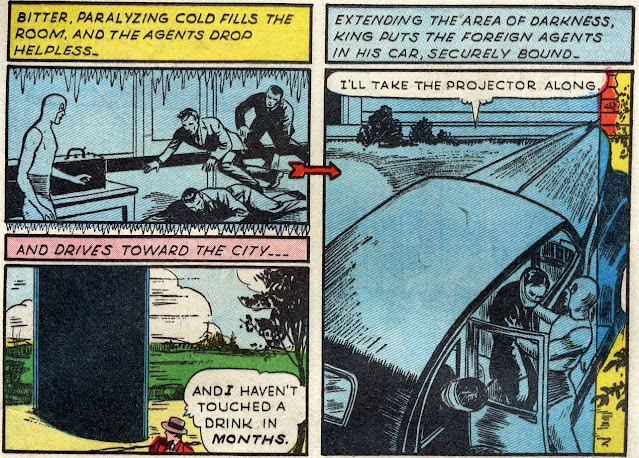
    Radio engineer Bruce King develops the amazingly-named Black Zero Transmitter that selectively allows him to negate light and/or heat in its range of operation, plus an insulated costume and night-vision goggles so that he is immune to its effects. He ends up dealing with nosy reporters and spies inadvertently egged on by said nosy reporters and so adopts the alias of the King of Darkness. Probably the best thing about him is the fact that he will just drive around with the Black Zero Transmitter in his car (or boat! or plane!), with a column of darkness travelling at highway speeds and presumably giving people religious experiences. (Amazing-Man Comics 024, 1941)

    The Blue Lady:

    The Blue Lady is Lucille Martin, who gets mixed up in an attempt to smuggle gold out of China to aid the war effort and ends up gaining super strength from a weird gas released from inside an ancient ring. And since the ring had a bird on it, she has a bird on her hat! Delightful! Unfortunately, this comic came out in 1941 and involved Chinese people, so while it doesn’t indulge in every racist Yellow Peril storytelling trope it does hit a lot of them, including multiple instances of yellowface by the Blue Lady herself. Far less delightful! (Amazing-Man Comics 024, 1941)

    Nightshade:

    Howard Hall is Nightshade, who has the power to control, see, speak etc via his own shadow, with his strength increasing proportional to the shadow’s size. This is, frankly, much cooler than most shadow powers in comics. He’s got little ankle-mounted spotlights to throw shadows with! (Amazing-Man Comics 024, 1941)

    Captain Courageous:

    It’s not especially clear from the couple of appearances I have access to but Captain Courageous seems to be the Uncle Sam kind of patriotic hero – a guy made up of free-floating patriotism. He has the standard array of superpowers – flight, enhanced strength, invulnerability to small arms fire – and I would classify him as a medium-level annoying patriot. He also has a mask that looks very annoying to wear. (Banner Comics 003, 1941)

  • MINOR SUPER-HERO ROUND-UP 003

    King of Darkness: 

    Radio engineer Bruce King develops the amazingly-named Black Zero Transmitter that selectively allows him to negate light and/or heat in its range of operation, plus an insulated costume and night-vision goggles so that he is immune to its effects. He ends up dealing with nosy reporters and spies inadvertently egged on by said nosy reporters and so adopts the alias of the King of Darkness. Probably the best thing about him is the fact that he will just drive around with the Black Zero Transmitter in his car (or boat! or plane!), with a column of darkness travelling at highway speeds and presumably giving people religious experiences. (Amazing-Man Comics 024, 1941)

    The Blue Lady:

    The Blue Lady is Lucille Martin, who gets mixed up in an attempt to smuggle gold out of China to aid the war effort and ends up gaining super strength from a weird gas released from inside an ancient ring. And since the ring had a bird on it, she has a bird on her hat! Delightful! Unfortunately, this comic came out in 1941 and involved Chinese people, so while it doesn’t indulge in every racist Yellow Peril storytelling trope it does hit a lot of them, including multiple instances of yellowface by the Blue Lady herself. Far less delightful! (Amazing-Man Comics 024, 1941)

    Nightshade:

    Howard Hall is Nightshade, who has the power to control, see, speak etc via his own shadow, with his strength increasing proportional to the shadow’s size. This is, frankly, much cooler than most shadow powers in comics. He’s got little ankle-mounted spotlights to throw shadows with! (Amazing-Man Comics 024, 1941)

    Captain Courageous:

    It’s not especially clear from the couple of appearances I have access to but Captain Courageous seems to be the Uncle Sam kind of patriotic hero – a guy made up of free-floating patriotism. He has the standard array of superpowers – flight, enhanced strength, invulnerability to small arms fire – and I would classify him as a medium-level annoying patriot. He also has a mask that looks very annoying to wear. (Banner Comics 003, 1941)

  • MINOR SUPER-VILLAIN 346: THE DRAGON

    (Master Comics 011, 1941)

    It’s our second villain named the Dragon and our second Dragon who turns out to be a white dude in yellowface. Will it happen again? Only time will tell.

    The only really interesting thing about this guy is that a key part of his plan was to divert suspicion from himself by repeatedly sending his gang to kill his own secret identity (see above). Whether he was banking on Zoro the Mystery Man to show up and keep him alive is unspoken but if he wasn’t it’s a frankly baffling plan.

  • MINOR SUPER-VILLAIN 346: THE DRAGON

    (Master Comics 011, 1941)

    It’s our second villain named the Dragon and our second Dragon who turns out to be a white dude in yellowface. Will it happen again? Only time will tell.

    The only really interesting thing about this guy is that a key part of his plan was to divert suspicion from himself by repeatedly sending his gang to kill his own secret identity (see above). Whether he was banking on Zoro the Mystery Man to show up and keep him alive is unspoken but if he wasn’t it’s a frankly baffling plan.

  • MINOR SUPER-VILLAIN 123: THE DRAGON

    (Slam-Bang Comics 004, 1940)

    What makes them a super-villain? Why, that snazzy outfit! Comics are full of people who run opium smuggling rings but very few look as good while doing it.

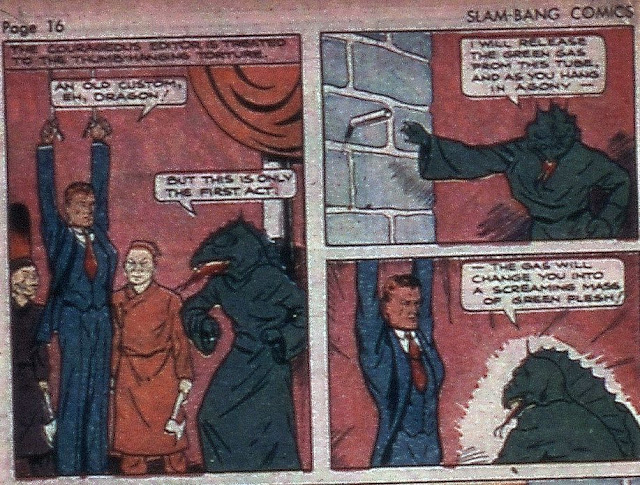
    What makes them interesting? It depends on your definition of interesting, but this is the first costumed criminal on our list whose disguise includes pretending to be another race – specifically, the Dragon is a white hardware store owner named Jones who passes himself off as a Chinese master criminal until Jim Dolan, heroic magazine editor gets involved.

  • MINOR SUPER-VILLAIN 123: THE DRAGON

    (Slam-Bang Comics 004, 1940)

    What makes them a super-villain? Why, that snazzy outfit! Comics are full of people who run opium smuggling rings but very few look as good while doing it.

    What makes them interesting? It depends on your definition of interesting, but this is the first costumed criminal on our list whose disguise includes pretending to be another race – specifically, the Dragon is a white hardware store owner named Jones who passes himself off as a Chinese master criminal until Jim Dolan, heroic magazine editor gets involved.