The Curse of Skeleton Munroe

Category: mass destruction

  • MINOR SUPER-VILLAIN 666: MARK LORD

    (Jungle Comics 009, 1940)

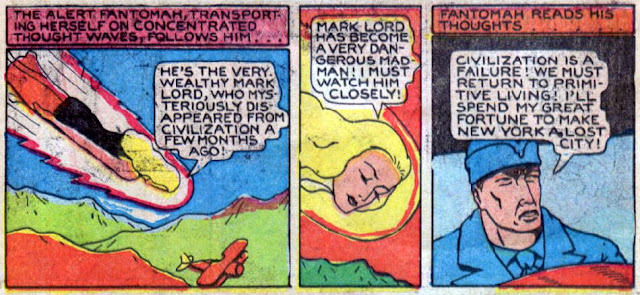
    Minor Super-Villain 666 is somewhat in line with how underwhelming our milestone numbers in the past have been. Just two entries away from being the Devil his own two-headed self. I suppose I could have shuffled things around to make it work out in a more satisfying way but that would really taint the pure joy we’ll experience when entry 1000 or 1600 or 69420 turn out to be amazingly apropos.

    Who we have instead is poor little rich boy Mark Lord, a villain in the classic Fletcher Hanks sense in that he has a real problem with civilization and wants to destroy it. To that end, he has seemingly been flying aimlessly around until he finds something that he can use to advance his plans – in this case a valley full of royal panthers, the largest big cats in the world! Hanks really seems to enjoy writing about and drawing these beefy felines and dedicates large swathes of the narrative to the mechanics of Lord capturing and transporting 50 000 of them.

    Lord’s plan – bomb New York and release tens of thousands of enormous hungry panthers into the ensuing panic – is certainly an effective terror attack but I can’t see it leading to a total dissolution of human civilization. For one thing, you probably wouldn’t get even half your panthers back if you wanted to keep up the momentum and move on to another city quickly. Hell, NYC’s population was about 7.5 million in 1940 and I don’t know that you’re going to kill or scare off enough of them with this stunt that you could declare human civilization ended in the city. I suppose we aren’t looking to a guy like Mark Lord for cold rational thought but come on.

    As is her way, Fantomah, though she has been watching and warning Lord the entire time, only steps in once things his a crisis point. We are treated to one of Hanks’ signature images, a bunch of levitating creatures, as Lord and the panthers are transported back to Africa.

    And of course Lord is ironically punished for his transgressions by being transformed into an uncivilized caveman and left to deal with a valley full of cheesed-off panthers on his own. Maybe next time he has a beef against civilization he’ll reflect on where his last one got him.

  • MINOR SUPER-VILLAIN 650: RANGO OF SLAVONIA/ MINOR SUPER-HERO: THE MASTER MYSTIC

    (Green Giant Comics 001, 1940)

    We join Rango, a science villain of some description, after he has failed to conquer Europe. His next move: total destruction.

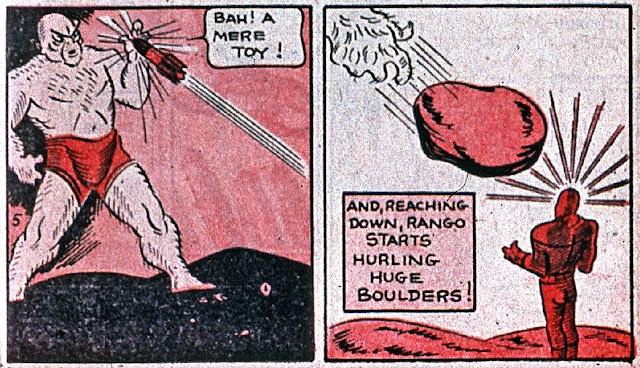
    After absolutely devastating a city in what is probably Slavonia, Rango heads for the United States by the simple expedient of swimming across the Atlantic.

    And now we encounter the main attraction, Master Mystic! What a character! Master Mystic is very much ahead of his time, both in his art style and degree of superhuman omnipotence.

    Master Mystic’s entire battle with Rango feels like something out of a 60s underground comic, slightly unreal and rubbery and full of visual excess. Appropriately, Master Mystic was created by Victor E. Pazmino, whose other credits tended more toward the funny animal content that informed so much of the underground comix scene.

    (see also Pazmino’s other super-heroic creation, TNT Todd, for some fun costume compare-and-contrast)

    It really is a shame that Pazmino didn’t do more work along these lines, assuming that he wanted to. Stuff like this visualization of the Master Mystic’s telekinesis stands out as innovative by any era’s standards.

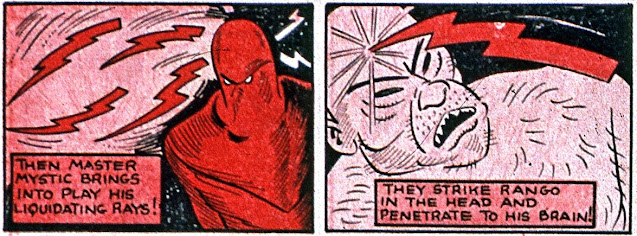
    Master Mystic eventually melts Rango into horrible goo and then returns to his Arctic stronghold to resume his protective watch over humanity North America, and if the super-powered one-upsmanship of their battle felt like something out of 60s counterculture comics then this detached, omnipotent man routine feels very 1980s post-Watchmen, or at least one step away from that. Should some entrepeneur BRING BACK the Master Mystic the next time metatextual super-hero analysis characters like Miracleman come into vogue? It’s worth a shot!

  • MINOR SUPER-VILLAIN 624: MOLOKA

    (Fantastic Comics 009, 1940)

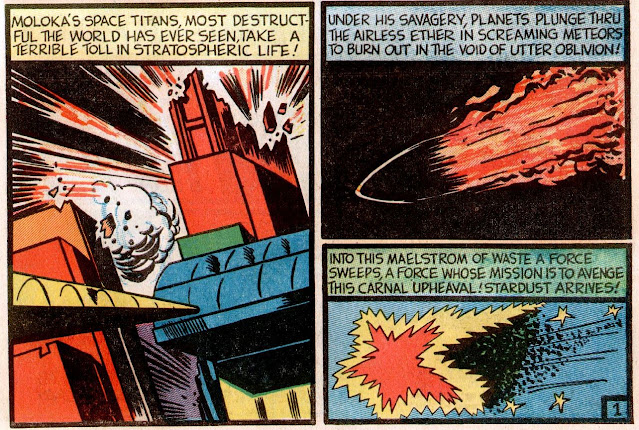
    Moloka is our second Stardust the Super Wizard foe from a story not penned by Fletcher Hanks and I’d say that our unknown scribe gets things mostly right: there’s certainly enough wanton destruction for this to be a Hanks comic. Moloka is a humanoid alien who has developed world-wrecking super weapons and as the comic opens is using them to blast away at various inhabited planets.

    Where exactly this is happening is a little unclear. If Fletcher Hanks’ idea of how outer space is structured is a little fuzzy then his stand-in is even more vague on the particulars. It’s equally possible that Moloka is based in another star system and using weapons with an interstellar range as it is that he’s in our own Solar System and there are just a heap of extra planets to blow up.

    Moloka’s goal is also a bit unclear. I think that he’s looking to become some sort of Galactic or Solar Dictator but he spends an awful lot of time just blasting away at inhabited planets without really asking to be put in charge. It’s possible that the power is an excuse and the blasting is the point.

    Moloka is based on Pluton, which is either an alternate spelling of Pluto (that I have seen before to be honest) or as mentioned above a completely extrasolar one. There’s no way of working out which it is though I will say that none of Pluto’s satellites were discovered before 1978 so I have no idea where Nemus is supposed to be.

    Moloka does give some hints as to his mental state when he mistakes a vengeful Stardust for some sort of elemental being created by the hellish energies at his command. It’s kind of charming! It’s also wildly out of character for Stardust “the shortest distance between two lines is a punch” the Super Wizard. Stardust’s goal with this little ruse is to goad Moloka into firing his weapon at Earth, then using his own patented ray-reversal technology to redirect it back to its source.

    As to whyhe bothers to do this when he’s perfectly capable of blowing the whole of Pluton to hell and gone? I guess it’s a bit more of an ironic punishment to leave a warmonger stranded on a planet that they themself have devastated? Sure, we’ll go with that.

  • MINOR SUPER-VILLAIN 586: THE RED BLIGHT

    (Exciting Comics 003, 1940)

    Technically, the Red Blight is a ray weapon developed by mad scientist Dr Hodl on behalf of ideologically nonspecific aggressor General Pasko in order to facilitate the conquest of Europe, but just like when a guy with a regular name is tooling around in a vehicle with a cool codename I reckon that the good name should take precedence, particularly as 1) Dr Hodl never returns and 2) people make reference to the Red Blight as an entity more than once during the course of the story.

    Besides, the Red Blight is a super-weapon worth being named after: a ray that rapidly corrodes inorganic matter with a range of at least 2000 kilometres (Hodl’s Transylvanian castle to the North Sea) – why sleep on that, Hodl? Be the Red Blight!

    Dr Hodl spends most of his time attempting to eliminate John “Son of the Gods” Thesson, who he correctly views as his only real opposition. Why, before Thesson shows up, none of the authorities concerned with the Red Blight’s attacks even thought about discovering his location by triangulation. Clearly this is a case where the villain is right: the hero is the only thing standing between him and complete victory.

    Ultimately, Hodl and the Red Blight come up against the real problem with the weapon of mass destruction as an all-purpose tool: it’s very hard to select your targets. Despite an army of spies attempting to stymie him at every turn, the Son of the Gods makes his way to Hodl’s castle and chucks him off a wall.

  • MINOR SUPER-VILLAIN 586: THE RED BLIGHT

    (Exciting Comics 003, 1940)

    Technically, the Red Blight is a ray weapon developed by mad scientist Dr Hodl on behalf of ideologically nonspecific aggressor General Pasko in order to facilitate the conquest of Europe, but just like when a guy with a regular name is tooling around in a vehicle with a cool codename I reckon that the good name should take precedence, particularly as 1) Dr Hodl never returns and 2) people make reference to the Red Blight as an entity more than once during the course of the story.

    Besides, the Red Blight is a super-weapon worth being named after: a ray that rapidly corrodes inorganic matter with a range of at least 2000 kilometres (Hodl’s Transylvanian castle to the North Sea) – why sleep on that, Hodl? Be the Red Blight!

    Dr Hodl spends most of his time attempting to eliminate John “Son of the Gods” Thesson, who he correctly views as his only real opposition. Why, before Thesson shows up, none of the authorities concerned with the Red Blight’s attacks even thought about discovering his location by triangulation. Clearly this is a case where the villain is right: the hero is the only thing standing between him and complete victory.

    Ultimately, Hodl and the Red Blight come up against the real problem with the weapon of mass destruction as an all-purpose tool: it’s very hard to select your targets. Despite an army of spies attempting to stymie him at every turn, the Son of the Gods makes his way to Hodl’s castle and chucks him off a wall.

  • MINOR SUPER-VILLAIN 519: THE GHOST OF THE CYCLOPS

    (Blue Bolt v2 004-005, 1941)

    We open on a bit of… not hubris but it’s often framed as hubris. I’m sure that TV Tropes has a name for it but danged if I’m going to go hunting for it. It’s the phenomenon in which a character in an ongoing fictional setting jokes about how they’re sure glad that *SPECIFIC THING* isn’t real etc and that thing is the focus of the next story. In this case, Sergeant Spook says he’s glad that mythology doesn’t real and so Ghost Town doesn’t have to contend with the ghosts of mythological characters and BAM the ghost of the Cyclops starts destroying Alaska.

    Although the human world sees these attacks as merely a bizarre and terrifying natural disaster the ghosts of Ghost Town know what’s up and dispatch Sergeant Spook northward. On arrival he is met and guided by several of the Cyclops’ recent victims – always a handy part of being a ghost cop.

    Spook’s encounter with the Cyclops follows a fairly predictable pattern: cornered in a cave, he anages to temporarily blind the other ghost and then trace him back to his lair by clinging to his cyclopean sandals. This encounter does serve to further muddy the waters of how ghosts workin Sergeant Spook comics, however: can a ghost hit another ghost with a corporeal snowball? Is Alaska covered in a layer of ghost snow? Or is the Cyclops just super-vulnerable to eye-damaging attacks like a video game boss?

    The second issue of this two-parter is a bit perfunctory: Spook arrives at the Cyclops’ lair where we learn that when not translucent to signify that he is a ghost in the corporeal world the Cyclops is green. He is also served by other, unidentified ghosts who are presumably being bullied into servitude with the threat of violence like the Ghost of King Tut’s slaves. He also captures Sergeant Spook with very little trouble. Things look bad, but then:

    HERCULES! Because of course if the Cyclops is real then there’s gotta be guys like Hercules (famous foe of the Cyclops) running around too. There’s a bit of a scuffle and then he plants a slobberknocker on the Cyclops that decisively concludes things.

    Hercules’ reward: eternal vigilance. His ghost pledges to guard the Cyclops’ ghost for the rest of time, which will presumably entail regular brawls whenever his charge wakes up and wants to cause more chaos. Maybe this is a good outcome for Hercules? I just hope that someone in Ghost Town thinks to ship him some ghost books or the like.

  • MAD AND CRIMINAL SCIENTIST ROUND-UP 008

    Mad or criminal, it’s the science that matters.

    This fellow is known only as “the hypnotist” and has an unspecified plan to do… something that involves taking control of flights of Army bombers and having them blow up targets of his choosing. If the details seem thin on the ground it’s because this fellow speaks precisely three words (see above) before being captured by Jeff Cardiff, Spy-Chief and so the only knowledge we have about his plans is that which can be extrapolated from his actions.

    Bonus details: 1. he hypnotizes people with his large purple eyes 2. his plan requires a video hookup to the planes he is controlling, which I personally did not know was standard or even possible in 1940. (Big Shot Comics 008, 1940)

    De Carva here developed an earthquake causing ray and almost managed to conquer the US with it but made the classic mistake of trusting in his deathtraps to finish off Skyman without bothering to confirm if he was, in fact, dead. This is known as hubris, kids. (Big Shot Comics 015, 1941)

    Professor Scorp here is a mad Egyptologist! That’s right, folks, we’ve got a mad social science case on our hands! Scorp suffered some sort of breakdown and his family made the unfortunate and retrograde decision to confine him on their island estate rather than, say, seek treatment for him. Eventually, two unscrupulous servants helped him escape as part of a plan to steal and resurrect the mummy of evil pharaoh Tut-Akum-Aut so as to learn the location of his legendary lost treasure. The reanimated mummy above is sadly merely an illusion conjured by Marvelo, Monarch of Magicians. But on a happy note, Professtor Scorp is taken somewhere for proper treatment at the end of the story! (Big Shot Comics 015, 1941)

    UPDATE: Astonishingly, Professor Scorp returns in The Face 001!

    This is Humpy Hudson, who has a moderately foolproof scheme (develop a substance that explodes the air around it but is itself unharmed and make it an innocuous shape, thus giving yourself a hard-to-spot, untraceable bomb, then bomb utilities until you can extort money out of them) hampered by some poor planning (he only has one reusable bomb and he made it in the shape of an onyx statuette). Humpy spends most of the issue trying to get his bomb back after it gets picked up by a youngster and sold at a pawnshop, then gets captured by Skyman. (Big Shot Comics 019, 1941)

  • MAD AND CRIMINAL SCIENTIST ROUND-UP 007

    The mad scientists are usually up to something criminal, but the criminal scientists are often completely rational.

    Like a fair few of the scientists I speak of here, Dr Hayles here talks a big game but gets caught in the planning stages before he has the chance to prove to the world that he was right all along. In Hayles’ case it was kidnapping a bunch of boys that got him in trouble and operating on young boys’ brains in order to make them geniuses that he never got to prove before he was corralled by Marvelo, Monarch of Magicians. (Big Shot Comics 002, 1940)

    This here Count Alexis fellow is an agent of an unspecified foreign power who employs his extremely cool fleet of giant flying magnifying glasses in an attempt to destroy Boston. This, in turn, will cow the States into serving said unnamed country. It’s a bit of a flimsy plan, especially once you see Skyman beat the tar out of the mere two men operating one of the lenses and using that lens to melt the other four three (almost forgot that he captures two of them, as well as Count Alexis himself) 

    Count Alexis also lives in Vermont and is 100% the only villain on this blog as it currently stands to do so. Congratulations, Vermont! You made it! (Big Shot Comics 007, 1940)

    This unnamed scientist developed a steerable electrically-charged tornado called a “Force-Top” and attempted to extort the US into buying it but got pinched by Jeff Cardiff, Spy-Chief basically as soon as he put his plan into motion. (Big Shot Comics 007, 1940)

    As far as ways to extort the US (in this case into acclaiming Our Villain here as dictator), freezing entire cities solid isn’t a bad way to go, and Norgo goes for some big targets after his initial test freeze of a Florida beach: Boston, Chicago, San Francisco, St Louis and Washington DC. He might have gotten in with a chance if it hadn’t been for Skyman completely owning his plan and unfreezing all the cities in about half an hour – though the fact that he does so by exploding balls of “atomic power” over each city is at least a bit concerning. (Big Shot Comics 008, 1940)

  • MINOR SUPER-VILLAIN 474: KING OF THE USA

    (Amazing-Man Comics 020, 1941)

    The King of the USA, not unlike the Emperor of America before him, is a weirdo megalomaniac who lives in a hole, with the major difference being that while the Emperor was of course known for being surrounded by hunks the King lives alone. Note that this means that he personally scurried up to this office boy and delivered his own unhinged manifesto.

    If the King of the USA did have a few hunks around then maybe one of them might have pointed out a potential flaw in his plan: that basing your operation out of sewer might lead to some complications related to eg, flooding when you do things like collapse major parts of New York’s infrastructure with your disintegrator. And this theoretical hunk would be right! It’s just such a flood that brings Minimidget and Ritty to his door!

    Even more to the point: after Our Small Heroes drug his coffee and tie him up he ends up drowning in his sleep due to a flood caused when he collapses the Chrysler Building. Drainage: just one of the many oft-overlooked aspects of successful villain lair design.

  • MINOR SUPER-VILLAIN 442: GAT ARAT

    (Mystery Men Comics 023, 1941)

    I think that Gat Arat’s name doesn’t mean anything, that it’s just a guy with the unusual surname “Arat” and the nickname “Gat”, but it bothers me. I feel like I should be able to extract meaning from it. Is it a reference to 40s popular culture? Is he supposed to look like a rat? No idea.

    Confusing name or not, it turns out that Gat Arat has taken a lesson from the dearly departed Dr Krug, he of the exploding gorillas, only instead of trying to destroy NYC York City using hard-to-acquire primates he is extorting NYC York City using easily-sourced birds. He also demonstrates his temper via one of the more striking methods I have ever seen: hurled explosive pigeon.

    There’s a lot of running around and birds exploding and deathtraps but what it all comes down to in the end is that Gat Arat never considers that any of his explosive pigeons might return to him, a frankly major oversight. Still, he manages to survive a bird-based train explosion unlike his three cronies so he has a chance to learn from his mistakes.

    BONUS HONOURS: the Blue Beetle is thanked on the radio by the Mayor of New York York City, whoever he is.