The Curse of Skeleton Munroe

Category: chemical mutate

  • MINOR SUPER-HERO ROUND-UP 102

    MINOR SUPER-HERO ROUND-UP 102

    You won’t believe what I just found: more super-heroes!

    the Liberty Scouts:

    When fascist forces armed with high-tech weaponry begin attacking targets calculated to cripple US war capacity, they are repeatedly driven away by a trio of anonymous heroes who leave behind Liberty Bell calling cards. Both the fascists and US officials are eager to learn just who these so-called Liberty Patriots are, but President Roosevelt is the one who actually gets to find out, thanks to his association with patriotic millionaire Patrick Henry.

    Henry drives FDR out to his country estate, Liberty House, where he introduces him to three mysterious youths beginning with Smokey, the inventive genius of the group, and whose amphibious tank is counted as a land vehicle for the air/sea/land theme that the three have going on.

    Skipper, “the best sailor on the Seven Seas,” is also clearly the group member who is most invested in the paramilitary aspect of the whole operation. He has a super-powerful miniature submarine.

    Finally, we have Strut, the youngest of the group. He’s got a souped up fighter plane called the Comet (initially the only named super vehicle in the bunch, though the tank is later named Ironsides), plus a cool-ass wingsuit. He’s also the only one of the three with any discernible personality, even if it’s “won’t shut up about cherry pie.”

    So just how does Mr Henry know these three youngsters and why are they living in his house? Because they are his own sons! He loves his country so much that he has moulded his children into weapons designed to defend it, and the President loves it. (Liberty Scouts Comics 002, 1941)

    The Liberty Scouts eventually change their name to the Liberty Guards after the Boy Scouts of America complain about their monopoly on the word “scout” being infringed.

    Categorized in: Accessories (Calling Card Leavers), Groups, Origin (Patriotic Heroes)

    Man of War:

    Impatient with the slow progress of World War II, the god Mars decides to create a divine being imbued with the powers of the Greco-Roman pantheon and send them down to help the Axis conquer Europe faster and with more bloodshed. He gifts his champion with “the Strength of Hercules, the Speed of Mercury, the Wisdom of Zeus” (making him about 0.5 of a Captain Marvel) and arms him with the infinitely sharp Sword of Mars before sending him on his way.

    In a legitimately funny twist, Mars forgets to account for the rotation of the Earth during the presumably-lengthy demigod-crafting process and shoots his new creation at Dayton, Ohio (okay, at one of the more than thirty Daytons in the United States. Or in another city that has an unrelated Dayton Munitions Factory. Probably Dayton, Ohio, though) instead of Berlin or wherever he intended for it to go. Thus, Man of War (as he calls himself) is instantiated in the “peace-loving nation” of the USA and is dedicated to virtuous, defensive warfare instead of awful slaughter in the name of power-hungry politicians (insert joke about the US war machine here. Man of War must have had a rough go of things as the 20th Century progressed).

    So what are the powers of the gods? Mostly generic super strength and invulnerability, though Man of War is able to breathe and move freely underwater thanks to the gifts of Neptune. He also has one bespoke power gifted upon him by Mars: to disappear or appear in any explosion, up to and including those created when bullets are fired (which would be a bit more useful if he weren’t already bulletproof). (Liberty Scouts Comics 002, 1941)

    In Man of War Comics 001, Mars reveals Man of War’s weakness to the dictator Luko: that he is powered by rays emitted by the planets of the Solar System, and that confining him in a lead-lined chamber will block those rays and render him merely human. This nearly works, but as the Sword of Mars is not planet-powered he is soon able to carve his way free.

    Categorized in: Accessories (Swords), Activities (War), Origins (Demigods)

    Vapo-Man:

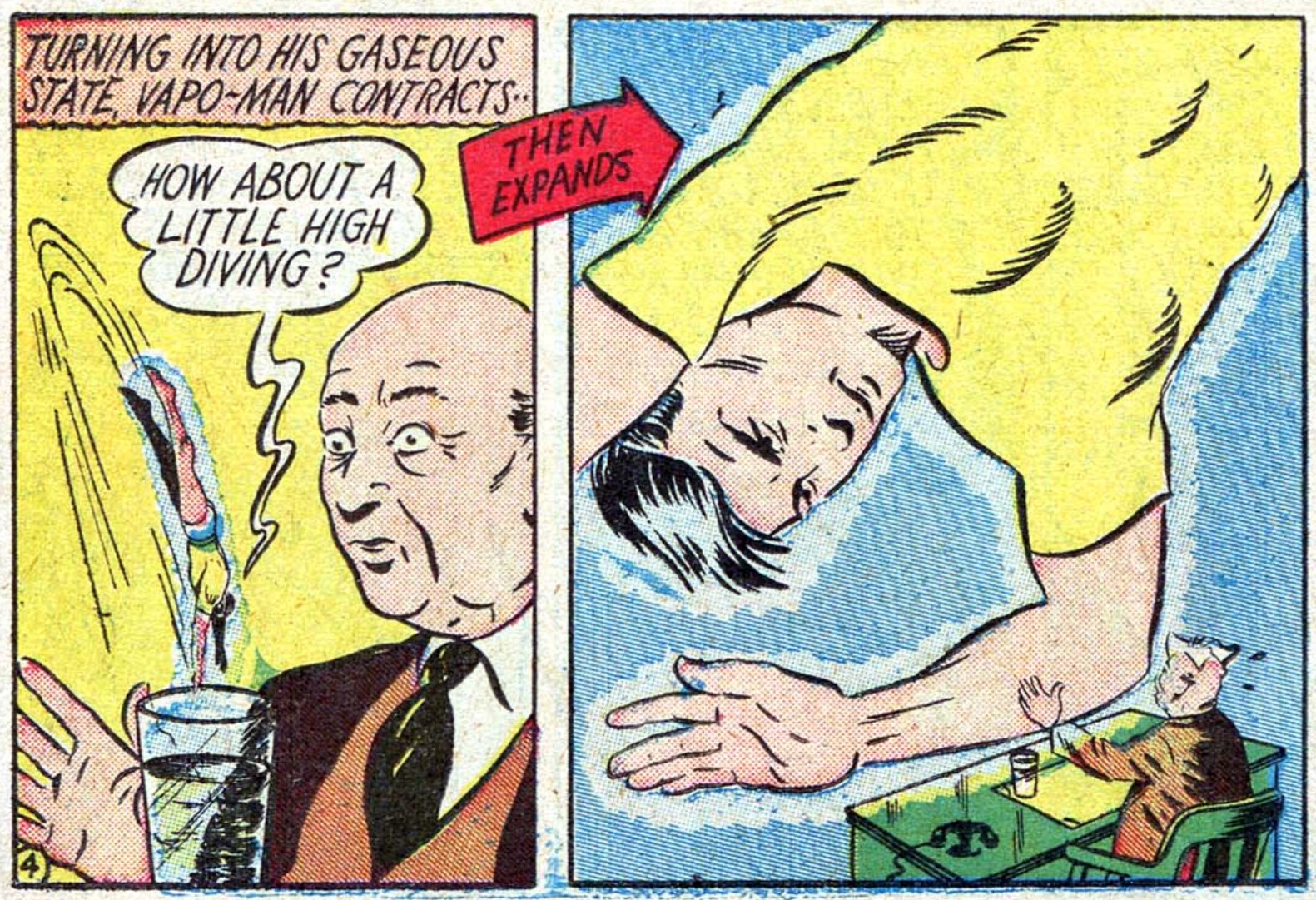
    Bradford “Brad” Cole is a chemist assisting at the laboratory of Dr Kreiner, who in turn is performing unspecified research that is evidently valuable enough to the US government that some fascist saboteurs blow it up. Cole, unlike Kreiner, is lucky enough not to be exploded but instead is showered with a randomized mix of chemicals that change him into a man of vapour.

    The dying Kreiner explains that he is now a chemical man, which is apparently something that chemists have been trying to create for centuries. He extracts a promise from Cole that he will use this power to fight evil, and saddles him with the terrible name of Vapo-Man just before dying, thus ensuring that Crawford can never change it without feeling very guilty.

    As Vapo-Man, Crawford can change all or part of his size, can fly, has at least some super strength, can disintegrate matter with a touch, and can become intangible at will. All of this adds up to make him feel a lot like a more mystical character like Phantasmo, though he lacks the charm to support it. (Liberty Scouts Comics 002, 1941)

    Categorized in: Elements (Steam and Mist), Origins (Chemical Mutates), Powers (Intangibility)

    Fire-Man:

    Jim, a man working for the Civilian Conservation Corps in Utah sets out to battle the latest in a series of mysterious fires and finds himself being kidnapped by a mysterious silver-clad giant.

    This turns out to be Gaston, henchman to a fellow known only as the Mad Scientist. The Mad Scientist has a dream: to incinerate a human in such a way that they remain alive and coherent but composed of gaseous rather than solid matter, and Jim is his latest unwilling experimental subject. Luckily for Jim, this time it works, and the only real change appears to be a significantly lower density, such that he is obliged to wear a weighted uniform (that doubles nicely for a super suit, natch) in order to keep from floating away. Even with it on, he light enough to leap around as if he were flying.

    Jim is otherwise an ordinary human, but a miscalculation on the part of the Mad Scientist (dunking him in a vat of chemicals while trying to destroy him) also endows him with super strength.

    Finally, Jim’s new metabolism causes him to give off fire-retardant gasses as a part of his respiration, which is handy, as he chooses to go by Fire-Man, meaning that he, alongside the Mad Scientist’s niece Nancy, ends up fighting a lot of arsonists (Liberty Scouts Comics 002, 1941)

    Categorized in: Elements (Fire), Origins (Electrical Mutates), Powers (Decreased Density)

  • MINOR SUPER-HERO ROUND-UP 102

    You won’t believe what I just found: more super-heroes!

    the Liberty Scouts:

    When fascist forces armed with high-tech weaponry begin attacking targets calculated to cripple US war capacity, they are repeatedly driven away by a trio of anonymous heroes who leave behind Liberty Bell calling cards. Both the fascists and US officials are eager to learn just who these so-called Liberty Patriots are, but President Roosevelt is the one who actually gets to find out, thanks to his association with patriotic millionaire Patrick Henry.

    Henry drives FDR out to his country estate, Liberty House, where he introduces him to three mysterious youths beginning with Smokey, the inventive genius of the group, and whose amphibious tank is counted as a land vehicle for the air/sea/land theme that the three have going on.

    Skipper, “the best sailor on the Seven Seas,” is also clearly the group member who is most invested in the paramilitary aspect of the whole operation. He has a super-powerful miniature submarine.

    Finally, we have Strut, the youngest of the group. He’s got a souped up fighter plane called the Comet (initially the only named super vehicle in the bunch, though the tank is later named Ironsides), plus a cool-ass wingsuit. He’s also the only one of the three with any discernible personality, even if it’s “won’t shut up about cherry pie.”

    So just how does Mr Henry know these three youngsters and why are they living in his house? Because they are his own sons! He loves his country so much that he has moulded his children into weapons designed to defend it, and the President loves it. (Liberty Scouts Comics 002, 1941)

    The Liberty Scouts eventually change their name to the Liberty Guards after the Boy Scouts of America complain about their monopoly on the word “scout” being infringed.

    Categorized in: Accessories (Calling Card Leavers), Groups, Origin (Patriotic Heroes)

    Man of War:

    Impatient with the slow progress of World War II, the god Mars decides to create a divine being imbued with the powers of the Greco-Roman pantheon and send them down to help the Axis conquer Europe faster and with more bloodshed. He gifts his champion with “the Strength of Hercules, the Speed of Mercury, the Wisdom of Zeus” (making him about 0.5 of a Captain Marvel) and arms him with the infinitely sharp Sword of Mars before sending him on his way.

    In a legitimately funny twist, Mars forgets to account for the rotation of the Earth during the presumably-lengthy demigod-crafting process and shoots his new creation at Dayton, Ohio (okay, at one of the more than thirty Daytons in the United States. Or in another city that has an unrelated Dayton Munitions Factory. Probably Dayton, Ohio, though) instead of Berlin or wherever he intended for it to go. Thus, Man of War (as he calls himself) is instantiated in the “peace-loving nation” of the USA and is dedicated to virtuous, defensive warfare instead of awful slaughter in the name of power-hungry politicians (insert joke about the US war machine here. Man of War must have had a rough go of things as the 20th Century progressed).

    So what are the powers of the gods? Mostly generic super strength and invulnerability, though Man of War is able to breathe and move freely underwater thanks to the gifts of Neptune. He also has one bespoke power gifted upon him by Mars: to disappear or appear in any explosion, up to and including those created when bullets are fired (which would be a bit more useful if he weren’t already bulletproof). (Liberty Scouts Comics 002, 1941)

    In Man of War Comics 001, Mars reveals Man of War’s weakness to the dictator Luko: that he is powered by rays emitted by the planets of the Solar System, and that confining him in a lead-lined chamber will block those rays and render him merely human. This nearly works, but as the Sword of Mars is not planet-powered he is soon able to carve his way free.

    Categorized in: Accessories (Swords), Activities (War), Origins (Demigods)

    Vapo-Man:

    Bradford “Brad” Cole is a chemist assisting at the laboratory of Dr Kreiner, who in turn is performing unspecified research that is evidently valuable enough to the US government that some fascist saboteurs blow it up. Cole, unlike Kreiner, is lucky enough not to be exploded but instead is showered with a randomized mix of chemicals that change him into a man of vapour.

    The dying Kreiner explains that he is now a chemical man, which is apparently something that chemists have been trying to create for centuries. He extracts a promise from Cole that he will use this power to fight evil, and saddles him with the terrible name of Vapo-Man just before dying, thus ensuring that Crawford can never change it without feeling very guilty.

    As Vapo-Man, Crawford can change all or part of his size, can fly, has at least some super strength, can disintegrate matter with a touch, and can become intangible at will. All of this adds up to make him feel a lot like a more mystical character like Phantasmo, though he lacks the charm to support it. (Liberty Scouts Comics 002, 1941)

    Categorized in: Elements (Steam and Mist), Origins (Chemical Mutates), Powers (Intangibility)

    Fire-Man:

    Jim, a man working for the Civilian Conservation Corps in Utah sets out to battle the latest in a series of mysterious fires and finds himself being kidnapped by a mysterious silver-clad giant.

    This turns out to be Gaston, henchman to a fellow known only as the Mad Scientist. The Mad Scientist has a dream: to incinerate a human in such a way that they remain alive and coherent but composed of gaseous rather than solid matter, and Jim is his latest unwilling experimental subject. Luckily for Jim, this time it works, and the only real change appears to be a significantly lower density, such that he is obliged to wear a weighted uniform (that doubles nicely for a super suit, natch) in order to keep from floating away. Even with it on, he light enough to leap around as if he were flying.

    Jim is otherwise an ordinary human, but a miscalculation on the part of the Mad Scientist (dunking him in a vat of chemicals while trying to destroy him) also endows him with super strength.

    Finally, Jim’s new metabolism causes him to give off fire-retardant gasses as a part of his respiration, which is handy, as he chooses to go by Fire-Man, meaning that he, alongside the Mad Scientist’s niece Nancy, ends up fighting a lot of arsonists (Liberty Scouts Comics 002, 1941)

    Categorized in: Elements (Fire), Origins (Electrical Mutates), Powers (Decreased Density)

  • SUPER HERO FILE 003: CAPTAIN AMERICA

    (Captain America Comics 001, 1940)

    Captain America! Hitler-Puncher Number One! Quite possibly in the top five of super-heroics’ most well-known origins – a young man, physically unfit for the military but wishing to serve his country, is transformed into a super soldier with a combination of chemicals and radiation. The scientist responsible for this is murdered by an enemy spy rendering the young man a unique hero rather than the first of many. His first act as a hero is to bring the assassin to justice. A classic origin story, and one so well-trodden that my dad probably knows it. The really interesting thing about this origin is all the elements of it that were not there at first but rather accreted over time.

    Perhaps the biggest difference between the initial presentation of Captain America’s origin and the ones that would come later is the fact that Steve Rogers is simply not a character in the original. Okay, perhaps that is too far, but there is absolutely none of the stuff with Steve heading in to volunteer and getting turned away, and certainly none of the later addition of him as the downtrodden but good-hearted patriot. He’s merely an emaciated canvas for the doctors to work on – he doesn’t even get a word out until after Erskine is shot.

    Not quite as thematically potent, perhaps, but the absence of the Vita-Ray treatment after Steve gets his Super Soldier Formula is very notable when you’re expecting it. Turns out that that isn’t added until the 60s! 

    The assassination of Dr Erskine and its aftermath play out essentially the same as they always will, though the assassin is eventually specifically said to be electrocuted after crashing into the Vita-Ray machine, which obviously can’t be the case here. Please also note Dr Erskine being called Professor Reinstein here, something that has been given a few different explanations over the years.

    Steve Rogers is installed in the US Army as the lowest-ranked Private in history, which might be limiting to an on-the-go young super-hero except for the fact of the vexing conundrum of Camp Lehigh’s location, which places him in close proximity to both East and West Coast locations depending on the needs of the story. Rogers’ immediate superior, the belligerent Sergeant Duffy, has sadly all but disappeared from modern retellings. 

  • MINOR SUPER-HERO ROUND-UP 091

    Have a few mid-tier minor super-heroes, for a change.

    the Black Terror:

    Pharmacist Bob Benton is the kind of guy who will step in when a little kid is being roughed up by thugs, but despite this he is pretty relentlessly bullied by city Comptroller Rodney Clark* and (in a less overt but still insidious way) their mutual love interest Jean Starr.

    * Clark is such a bully, in fact, that I assumed that he was going to eventually turn out to be crooked but instead he gets murdered** after a couple of issues.

    ** In fact I was wrong when I wrote this: he is merely almost  murdered and seemingly never recovers sufficiently to return to the comic. I guess I was just hoping that he would get murdered because he is, again, such a bully.

    Perhaps because of this, Benton spends his spare time working on a “tonic for run-down people,” or so he says. I assume that he’s going for something closer to anabolic steroids, and thanks to his new assistant Tim Roland (the kid who was getting beaten up earlier), he stumbles upon the formula for something even better: formic ether! 

    Thanks to those sweet sweet formic ether fumes, Benton becomes a super-human and in a real break for society decides to keep on being a decent guy rather than setting out for revenge on all those people who pushed him around when he was weak (though he does take the opportunity to give Rodney Clark a black eye every issue until he’s murdered he retires). He gets his super suit in the most efficient way possible: by sending Tim down to the costume shop to see what they have in stock.

    The formic ethers give Benton tremendous strength and a sort of mid-tier invulnerability: he can shrug off a sock on the jaw no problem, and eventually proves to be bulletproof, but he gets knocked around and knocked out an awful lot. (Exciting Comics 009, 1941)

    Tim Roland:

    Though Bob tells Tim that he can’t join him on his quest for vigilante glory, he also just kind of leaves a smoking bottle of super power serum sitting out where anyone can get it – frankly he’s lucky not to have to team up with Rodney Clark. Instead, Tim – who has had the foresight to pick up a second costume for himself, but not to pick a super-hero name – huffs a little formic ether and gets straight to busting heads.

    Tim is the rare Golden Age sidekick who appears to be legitimately around eight to ten years old, instead of a stocky thirteen to fifteen like so many of his peers. Even more remarkably, he stays roughly in this age bracket for a couple of years, as far as can be ascertained (multiple artists mean that his height fluctuates quite a lot, but he pretty consistently wears short pants in his civilian identity). He’s also one of those orphan boys who just kind of falls into a super-guy’s orbit and becomes adopted by default. (Exciting Comics 009, 1941)

    The Black Terror dabbles in the common practice of leaving a calling card in his first appearance, and makes the baffling decision to go with his domino mask as a design, rather than the cool skull-and-crossbones on his chest.

    Categorized in: Accessories (Calling Cards), Body (Emotions – Terror), Origins (Chemical Mutates), Origins (Sidekicks)

    the Sphinx **UPDATE**:

    The Sphinx adopts the identity of the Domino Kid in order to have a very brief boxing career. (Exciting Comics 012, 1941)

    Categorized in: Origins (Secondary Identities)

    the Liberator:

    Like many super-heroes, the Liberator starts out as a weedy nerd. Specifically, he is Dr Nelson Drew, lecturer in Chemistry at Claflin College. He is, troublingly, in love with Annabel, one of his students, who also serves as one of his major bullies – she is not only bored by chemistry (but you chose to take the course, Annabel!) but also scornful of Drew for caring about it when so much is afoot in the world, but… I don’t actually know what her problem is? Like, chemistry was wildly consequential to the US war effort? Perhaps if he taught a social science I could see her point of view, if not agree with it. 

    While doing a little light research into Ancient Egyptian poisons (okay, this is arguably inconsequential), Drew discovers the lost formula for a drug called Lamesis which will supposedly make one into their physical ideal. Though skeptical, he brews up a batch and since his lab safety appears to be nonexistent (troubling indeed for a guy who is researching poisons) he immediately gets a snootful of the stuff, and  turns into a big ol’ hunk. I really enjoy how viscerally unpleasant the transformation process looks here – sadly this transformation conceit doesn’t last more than a couple of issues.

    This unexpected transformation isn’t a dream come true for Drew, and he spends his first outing in his new body – the Lamesis turns out to be a temporary thing, you see – trying to figure out how to turn back, and engages in his first bout of super-heroism after discovering that the scientist he was trying to consult with had been murdered by fascists. 

    I also enjoy the origin of the Liberator’s costume: there are plenty of super-heroes going around in their old Halloween costumes, but he might be the only one who gets his outfit by stealing someone else’s. Would he have become such an explicitly patriotic hero if he hadn’t ended up in a star-spangled shirt? (Exciting Comics 015, 1941)

    Categorized in: Accessories (Drugs), Day Jobs (College Professors), Origins (Patriotic Heroes)

    VERY MINOR UPDATES:

    John Thesson, aka the Son of the Gods, after being a character of no fixed address for his first several appearances, finally settles down: he was in Washington DC in Exciting Comics 006, but it wasn’t until 007 that it became clear that that is where he chose to hang his hat and offer his services to the US Government.

    The Mask sheds two of his assistants, Silk and Butch, as of Exciting Comics 007, and becomes of interest to the law somewhere between 009 and 010. 

  • MINOR SUPER-VILLAIN 959: THE INVISIBLE MENACE

    (Dynamic Comics 002, 1941)

    It’s a story as old as comics and then some: an inventor has come up with a cool superscientific gizmo – in this case an invisibility serum – and no sooner are they done than some gangsters come stiffing around looking to exploit it. This particular gang is headed by an unnamed and trigger-happy fellow who guns down the scientist and then his own men in order to get his mitts on the single available dose of the stuff.

    The gangster dubs himself “the Invisible Menace” and this is the only reason I am calling him that instead of “the Invisible Killer” as everyone else in the story including the caption boxes does. 

    There’s a kind of critical and/or cultural debate over the madness of the main character in HG Wells’ the Invisible Man, over whether the titular character goes mad with the power inherent in being invisible or the process itself has some flaw that warps the human mind. Whichever way you slice it, the Invisible Menace has Invisibility Madness: no sooner does he fade from sight than he is slaughtering people left and right. Not that he wasn’t killing people while he was still visible but at least that was to some purpose. This is just wanton murder.

    The big question is: is this guy invisible forever? Neither he nor we ever find out, and frankly it matters quite a lot because it’s going to be pretty difficult to enjoy your riches as an invisible guy if the only other invisible guy anyone has ever heard of is famous for attacking a garden party with a tommy gun.

    The question never really gets resolved thanks to one of the great flaws in any invisibility-related plan: that you are still detectable via other senses. Accordingly, the Invisible Menace is stopped at the fangs of the dog hero K-9.

    Categorized in: Abstract Concepts (Menace), Body (Physical Qualities – Invisibility), Powers (Invisibility)

  • MINOR SUPER-HERO ROUND-UP 081

    Lev Gleason characters filling every available ecological niche over here. 

    Thun-Dohr:

    We’ve seen it before and we’ll see it again: Thun-Dohr (Thun-dohr?) is a white guy brought up in the traditions of a Tibetan monastery and he’s just the best dang mystic anyone’s ever seen, much better than all those Tibetan monks could ever be. 

    Like Iron Fist, the 1970s version of this character archetype, Thun-Dohr was orphaned when his parents succumbed to the elements while attempting to reach the fabled monastery. Baby Thun-Dohr (and I can no longer think of new ways to ask why these people brought their baby along on this super dangerous expedition) was found and brought to safety by the monks, who acclaimed him as some sort of prophesied kid. 

    Thanks to his training in “the arts of the Gom-Pa,” Thun-Dohr has a wide variety of mystic powers, including invisibility, teleportation, invulnerability to a variety of environmental conditions, the ability to see the last moments of a person’s life in their corpse’s eyes, astral projection and so on and so forth. He also has a mystical bracelet that allows him to remain in mental contact with the 300+ year-old Dalai Lama (not the one you’re thinking of) who raised him as he goes out into the world to battle evil (i.e., the other guy from the same monastery who is attempting to end the world – could’ve used a prophecy telling them not to let him in, amirite?). (Silver Streak Comics 013, 1941)

    Categorized in: Day Jobs (Lamas), Elements (Thunder), Origin (Mystic Traditions)

    Undercover Man:

    Police Detective Phil Barrows is unpopular at the Centre Street Homicide Department due to his habit of working alone (I think? Nobody seems to like him and this is the only stated reason why) so what does he do? Create a secondary identity called the Undercover Man so that he can work even more alone while adopting a variety of disguises. During his one published adventure he takes down corrupt politician Eduardo Donati and while I’m not normally one to critique someone’s decision to adopt a costumed identity I think he probably could have done it as a regular cop if he’d tried to. (Captain Battle Comics 001, 1941)

    Categorized in: Day Jobs (Police Detective), Powers (Master of Disguise), Professions (Law Enforcement)

    Blackout: 

    Blackout is the new name adopted by Dr Basil Brusiloff after he is mutated by chemicals randomly mixed together during a Nazi air raid on the hospital in which he is working. Unlike many other super-heroes who undergo physical transformations, Brusiloff’s new, jet-black form appears to be a permanent change and not something that he can switch on and off.

    Blackout is able to fly at speed comparable to a fighter plane, but his main power is the ability to emit a thick black smoke from his pores, the specificity of which somehow makes it seem more gross than a smoke power usually does.

    In addition to being opaque, this smoke is thick enough to suffocate someone in an unventilated environment (this is also gross. Huff my gas, miscreants!). Blackout is able to direct this smoke and even shape it to some degree (such as when he forms a long tunnel out of it to shield fleeing civilians from Nazi eyes), but most remarkably is able to emit it in large enough quantities that at one point he escapes a sealed room by bursting the walls through sheer air pressure.

    Aside from his powers, there are two remarkable things about Blackout: firstly, his origin takes place in Belgrade, which makes him the first in what is sure to be a pretty short list of Yugoslavian superhumans. Secondly, Blackout is the subject of some very minor debate vis-a-vis just how hairy/furry he is, with the two sides boiling down to “the text never says he’s hairy so it must just be something else” versus “he looks very hairy.” I am inclined to side with the latter side. He looks very hairy!

    Related to the hairiness question is a third interesting thing about Blackout: it is quite possible that he is completely nude, aside from that stylish green mask. (Captain Battle Comics 001, 1941)

    Categorized in: Activities (Blackouts), Colours (Black), Origin (Chemical Mutates)

    Nightro: 

    Nightro is Hugh Goddard, a scientist who was betrayed and left to die by his associates after they found a rich radium deposit in Alaska and Goddard expressed his desire to donate it to medical research, and though I do have some sympathy for his partners’ position that as the expedition’s financial backers they should see some profit from the mine they resort to murder a bit too quickly for my tatse. Surely this is a case for the courts!

    If you look Nightro up online, odds are that you will be told that he is blinded by the ambient radiation from the deposit. This is not true! What actually happens is that he wanders around in the snow until he is found by some helpful Inuit fellows and ends up with an extreme case of snow-blindness. Radiation doesn’t even come up.

    Goddard eventually makes his way back to the US, where a Dr Frank Miller (!) discovers that polarized lenses will allow him to see. Unlike his blind super-hero contemporaries the Mask and Dr Mid-Nite, Nightro does not appear to have any kind of enhanced dark vision. Instead, his stated reason for adopting a costumed alias is that his goggles are too ugly for him to be accepted in polite society.

    Goddard continues to live as a blind man as part of maintaining his secret identity as Nightro, meaning that from his second appearance onward he has a seeing eye dog companion named Blackie. He is called the “Streamlined Robinhood,” supposedly because he takes money from crooks and redistributed it to the needy – I reckon that it’s just a way to attach a buzzword to the character – if he had debuted tenyears later he might’ve been “the Jet Age Robinhood.”  (Daredevil Comics 002, 1941)

    Categorized in: Accessories (Dogs), Locations (Temporal), Origins (Blind Characters)

  • MINOR SUPER-HERO ROUND-UP 081

    Lev Gleason characters filling every available ecological niche over here. 

    Thun-Dohr:

    We’ve seen it before and we’ll see it again: Thun-Dohr (Thun-dohr?) is a white guy brought up in the traditions of a Tibetan monastery and he’s just the best dang mystic anyone’s ever seen, much better than all those Tibetan monks could ever be. 

    Like Iron Fist, the 1970s version of this character archetype, Thun-Dohr was orphaned when his parents succumbed to the elements while attempting to reach the fabled monastery. Baby Thun-Dohr (and I can no longer think of new ways to ask why these people brought their baby along on this super dangerous expedition) was found and brought to safety by the monks, who acclaimed him as some sort of prophesied kid. 

    Thanks to his training in “the arts of the Gom-Pa,” Thun-Dohr has a wide variety of mystic powers, including invisibility, teleportation, invulnerability to a variety of environmental conditions, the ability to see the last moments of a person’s life in their corpse’s eyes, astral projection and so on and so forth. He also has a mystical bracelet that allows him to remain in mental contact with the 300+ year-old Dalai Lama (not the one you’re thinking of) who raised him as he goes out into the world to battle evil (i.e., the other guy from the same monastery who is attempting to end the world – could’ve used a prophecy telling them not to let him in, amirite?). (Silver Streak Comics 013, 1941)

    Categorized in: Day Jobs (Lamas), Elements (Thunder), Origin (Mystic Traditions)

    Undercover Man:

    Police Detective Phil Barrows is unpopular at the Centre Street Homicide Department due to his habit of working alone (I think? Nobody seems to like him and this is the only stated reason why) so what does he do? Create a secondary identity called the Undercover Man so that he can work even more alone while adopting a variety of disguises. During his one published adventure he takes down corrupt politician Eduardo Donati and while I’m not normally one to critique someone’s decision to adopt a costumed identity I think he probably could have done it as a regular cop if he’d tried to. (Captain Battle Comics 001, 1941)

    Categorized in: Day Jobs (Police Detective), Powers (Master of Disguise), Professions (Law Enforcement)

    Blackout: 

    Blackout is the new name adopted by Dr Basil Brusiloff after he is mutated by chemicals randomly mixed together during a Nazi air raid on the hospital in which he is working. Unlike many other super-heroes who undergo physical transformations, Brusiloff’s new, jet-black form appears to be a permanent change and not something that he can switch on and off.

    Blackout is able to fly at speed comparable to a fighter plane, but his main power is the ability to emit a thick black smoke from his pores, the specificity of which somehow makes it seem more gross than a smoke power usually does.

    In addition to being opaque, this smoke is thick enough to suffocate someone in an unventilated environment (this is also gross. Huff my gas, miscreants!). Blackout is able to direct this smoke and even shape it to some degree (such as when he forms a long tunnel out of it to shield fleeing civilians from Nazi eyes), but most remarkably is able to emit it in large enough quantities that at one point he escapes a sealed room by bursting the walls through sheer air pressure.

    Aside from his powers, there are two remarkable things about Blackout: firstly, his origin takes place in Belgrade, which makes him the first in what is sure to be a pretty short list of Yugoslavian superhumans. Secondly, Blackout is the subject of some very minor debate vis-a-vis just how hairy/furry he is, with the two sides boiling down to “the text never says he’s hairy so it must just be something else” versus “he looks very hairy.” I am inclined to side with the latter side. He looks very hairy!

    Related to the hairiness question is a third interesting thing about Blackout: it is quite possible that he is completely nude, aside from that stylish green mask. (Captain Battle Comics 001, 1941)

    Categorized in: Activities (Blackouts), Colours (Black), Origin (Chemical Mutates)

    Nightro: 

    Nightro is Hugh Goddard, a scientist who was betrayed and left to die by his associates after they found a rich radium deposit in Alaska and Goddard expressed his desire to donate it to medical research, and though I do have some sympathy for his partners’ position that as the expedition’s financial backers they should see some profit from the mine they resort to murder a bit too quickly for my tatse. Surely this is a case for the courts!

    If you look Nightro up online, odds are that you will be told that he is blinded by the ambient radiation from the deposit. This is not true! What actually happens is that he wanders around in the snow until he is found by some helpful Inuit fellows and ends up with an extreme case of snow-blindness. Radiation doesn’t even come up.

    Goddard eventually makes his way back to the US, where a Dr Frank Miller (!) discovers that polarized lenses will allow him to see. Unlike his blind super-hero contemporaries the Mask and Dr Mid-Nite, Nightro does not appear to have any kind of enhanced dark vision. Instead, his stated reason for adopting a costumed alias is that his goggles are too ugly for him to be accepted in polite society.

    Goddard continues to live as a blind man as part of maintaining his secret identity as Nightro, meaning that from his second appearance onward he has a seeing eye dog companion named Blackie. He is called the “Streamlined Robinhood,” supposedly because he takes money from crooks and redistributed it to the needy – I reckon that it’s just a way to attach a buzzword to the character – if he had debuted tenyears later he might’ve been “the Jet Age Robinhood.”  (Daredevil Comics 002, 1941)

    Categorized in: Accessories (Dogs), Locations (Temporal), Origins (Blind Characters)

  • MINOR SUPER-HERO ROUND-UP 065

    Our themes today are “scarlet,” “family tragedy,” and “inadvisable human experimentation.”

    Mr Scarlet: 

    Brian Butler, NYC* district attorney,** is frustrated by the limitations inherent in working within the law and so like so many of his peers adopts a costumed identity in order to get the better of crime via acrobatics and punching. A classic origin, but Mr Scarlet’s real claim to fame is in being created by Jack Kirby (with Ed Herron) and thus starting off with a real dose of comic book charisma that subsequent artist Jack Binder manages to keep going – both, for example, illustrate his acrobatic explots with such flair that to this day people assume that he’s meant to be flying.

    * although it’s referred to as “Gotham City” in the one caption that names his location, I simply must assume that it’s meant to be the NYC nickname rather than some Earth-S version of Batman’s hometown, earlier than both concepts even exist.

    ** he’s pretty consistently called a “special prosecutor”, but there’s just enough evidence to clarify that he’s a DA rather than an impartial lawyer brought in to prosecute cases involving possible conflicts of interest, which I just learned is what a special prosecutor is.

    Brian Butler’s secretary/love interest Cherry Wade learns his secret in Mr Scarlet’s first published adventure, and I must say as always that I appreciate a Golden Age comics with a straightforward hero romance to contrast with the widespread aping of the Clark Kent/Lois Lane situation. Even if it is an HR nightmare. (Wow Comics 001, 1940)

    Atom Blake, Boy Wizard: 

    Atom Blake, a youngster attending Lincoln High in Collegetown, USA, is curious about why he has a different last name than the people who are raising him, and perhaps more pointedly, why his is physically and mentally superhuman. His foster father, Professor Joseph Page, has the answer in the form of a note left for Atom by his biological father, Stuart Blake. Written in a mathematical code that Atom is instinctively able to read, the note tells of the elder Blake’s experiments in creating a super-element composed of all 93 known regular elements* and how the infant Atom was given treatments to make him super-human enough to utilize the power of the super-element (called sun-metal in later Atom Blake stories but not here) without evaporating like Blake Sr’s poor experimental orangutan.

    *always a good bit when it crops up. I just looked up the history of the discovery of elements to see how long the count of 93 was good for and it looks like about 4 years, though plutonium was discovered in 1941 but kept secret until 1948. More impressive is the fact that at least four of the elements known in 1940 weren’t yet discovered in 1923 when Blake did his work!

    An encounter between Atom and some bank robbers soon reveals that the super-element was stored in the ring that Stuart Blake left with Atom as a baby, and he gains access to a suite of deus ex machina powers. Will this sixteen or seventeen year old boy be able to deal with unlimited power in a healthy way? Stay tuned! (Wow Comics 001, 1940)

    UPDATE 1941 

    Steel Sterling: 

    John Sterling is your classic crime orphan: after losing his father to gangsters at a young age, he devotes his life to battling crime. But rather than become a living weapon through intense training, Sterling takes a note from his father’s death by gunfire and spends his formative years developing a chemical treatment that will give his body the properties of steel, dramatically catalyzed by a dip into a vat of molten metal in a sequence with more on-panel male nudity than you usually see. Please also note the final panel above, which showcases Sterling’s weird riveted metal briefs.

    And Sterling isn’t just blowing smoke about having all the properties of steel: in addition to being bulletproof and super strong thanks to his new density, he also has the magnetic properties of the alloy, which he, like many of his magnetic brethren, employs to fly around by “magnetizing himself to” various things. Later this is rounded up to simply being able to fly and thank goodness for that.

    Finally, Steel Sterling has one of the better secret identities, as he establishes private detective John Sterling as his own twin brother (and also as a sort of cowardly jerk so that he can establish the usual Lois Lane/Clark Kent dynamic with love interest Dora Cummings). (Zip Comics 001, 1940)

    the Scarlet Avenger: 

    I know I bagged on the Defender for just being the Avenger with the serial numbers filed off, but dang it if the Scarlet Avenger doesn’t feel even more like someone just took Richard Benson out back and slapped a little red paint on him. Real name Jim Kendall, the Scarlet Avenger loses his wife and child as a result of a gold robbery on the airplane they are riding in. Kendall alone survives the subsequent crash but loses the ability to form facial expressions, leading to his nickname as The Man Who Never Smiles. 

    The Scarlet Avenger’s calling card, seen above making the text box hard to read, is a flaming arrow for no discernible or stated reason. Later on it is often depicted with a decorative skull.

    The Scarlet Avenger lacks the ability to reshape his facial features that his inspiration possessed, and instead of being a master of disguise is more of a gadgeteer, variously employing a paralysis ray, bulletproof cloak, electrically wired suit that allows him to deliver lethal shocks, mind reading device, compact miniature parachute, shoe knife, personal smokescreen, rocket car and rocket ship in his pursuit of justice. 

    The other point of similarity between the Scarlet and regular Avengers is the extensive network of agents that both employ, though the Scarlet Avenger’s narrows somewhat over time as he begins a romantic relationship with Inez Courtney, aka Operative 1. More trouble for HR.  (Zip Comics 001 1940)

  • MINOR SUPER-VILLAIN 858: THE FROST

    (Wham Comics 002, 1940)

    Just after Blue Fire gets his powers and vows to use them to beat up “criminals, racketeers and foreign spies” he is served a chance to do so on a silver platter when his local newspaper carries an account of a ship at sea being sabotaged by a very cold man who just stood around in the engine room until everything broke. 

    Making his way to the ship in question, Blue Fire uses his intangibility power to invade the passengers’ privacy by searching every stateroom until he finds some orders written in “a foreign language” that prove the saboteur’s identity, just in time for the man himself to make an appearance. One hastily-gulped-down pill later, the man is revealed to be the Frost, which is a very good name for a cold guy. More importantly, the Frost might just be the best look for a cold-based character that I have ever seen – the heavy shading combined with the thick coat of clear ice is dynamite.

    Since Blue Fire is not actually a fire guy but an intangibility guy, he and the Frost are purely thematic and not elemental opposites, and it in fact turns out that thanks to the always-on nature of Blue Fire’s powers they are hilariously unable to do any harm to one another (though thanks to the Frost’s motor mouth we do learn his precise weight, a bit of a rare occurrence in the days before the likes of the Official Handbook of the Marvel Universe). 

    Blue Fire ends up retreating after the fight drags on long enough that he is at risk of becoming tangible again, and the Frost is able to make a getaway while his foe is rounding up the ship’s crew to deal with him. And since Blue Fire never makes another appearance, the Frost is yet another super-crook left at large by default. Damn you, whims of the early comics industry!

    (someone should absolutely steal the Frost’s look for another cold cguy. It’s dynamite, I tell you!

  • MINOR SUPER-HERO ROUND-UP 041

    Another assortment of guys for your delectation.

    the Sky Wolf:

    Just another masked pilot in a souped-up named plane (originally the Silver Bullet, followed by the Golden Bullet), the Sky Wolf loses both his place in Silver Streak Comics and his plane’s name to fellow pilot Cloud Curtis once 1941 rolls around, and to add insult to injury, in 1942 the far more successful character of Skywolf debuts over at Hillman, ensuring that he doesn’t even have good SEO. (Silver Streak Comics 004, 1940)

    Whiz, King of Falcons:

    The Silver Streak is not immune to the sting of pride, so when aviator Sir Cedric Baldwin challenges him to a race around the world to prove who is the fastest man on Earth, he accepts, and is of course fast enough that he not only wins but is able to have a very culturally-sensitive adventure in Saudi Arabia along the way. Silver Streak is knocked out and captured at one point, and the falconry-obsessed villain takes advantage of this to inject his favourite bird with some super-fast blood. 

    Astonishingly, this works, despite our only account of the Silver Streak’s origin being as a result of hypnotic conditioning coupled with a near-death experience – perhaps the hypnosis was so deep that it mesmerized his very blood? That would explain the falcon’s immediate shift in loyalty from its owner to its super-heroic blood doner, at least.

    “Whiz, King of Falcons” is technically not this guy’s name until Silver Streak Comics 007, which was published in 1941, but I reckon that calling him “Unnamed Falcon Companion” here and then correcting it in six months’ time would be extremely wilfully obtuse of me. (Silver Streak Comics 006, 1940)

    UPDATE 1941 

    the Daredevil:

    The Daredevil is Bart Hill, a vigilante in the Batman mould, having lost his parents to a gang of crooks and subsequently vowed to revenge himself on crime. Further, those same crooks tortured Bart himself, rendering him mute in the process, and due to a boomerang-shaped brand they left on his chest he devoted himself to the study of the weapon, adopting it as one of his heroic signatures. The Daredevil is one of the longer-running non-Marvel or DC/Fawcett/Quality characters of the Golden Age so he will be making a few appearances here going forward, but there are a few notable things about him:

    – his origin will undergo some revision between his first and second appearances, most notably the fact that his muteness is discarded – presumably to enable for easier storytelling

    – his costume is also somewhat revised, which is fun particularly because, like his Silver Age namesake, he switches from a yellow to a red colour scheme

    – this Daredevil’s Golden Age popularity, combined with his public domain status, means that he’s a popular choice for modern revivals, but the fact that there is a currently-published character with the same name (and owned by Disney, to boot) means that nobody dares to actually call him Daredevil in their stories and so the more recent versions of him have a wide range of variably terrible alternate names including the Death Defying ‘Devil, the Daring Devil and Doubledare. (Silver Streak Comics 006, 1940)

    UPDATE 1941 

    Iron Vic:

    Iron Vic is a frustrating beast. He first appears as a mostly-dead body washing up near the island laboratory of Professor Carvel, who applies a “certain rare serum” to the task of saving his life before dropping dead from the strain. Vic, as the man comes to be known, is rendered both amnesiac and superhuman by the process. He has one proper super-heroic adventure against Carvel’s old colleague Dr Spagna before the strip transitions into one primarily about baseball (and in case you’re wondering there is no mention of the ethical quandary that a superhuman participating in regular human sports would cause). The really frustrating part is that Dr Spagna implies that he knows something about Iron Vic, but the Spagna story is never actually resolved anywhere. Vic is merely an amnesiac baseball player until I think he enters the Army at some point? WHERE OH WHERE IS MY RESOLUTION (Single Series 022, 1940)