The Curse of Skeleton Munroe

Category: the Guy Behind WWII

  • DIVINE ROUND-UP 034

    DIVINE ROUND-UP 034

    Here come some more gods and god-adjacent beings for you.

    the Golden Skull:

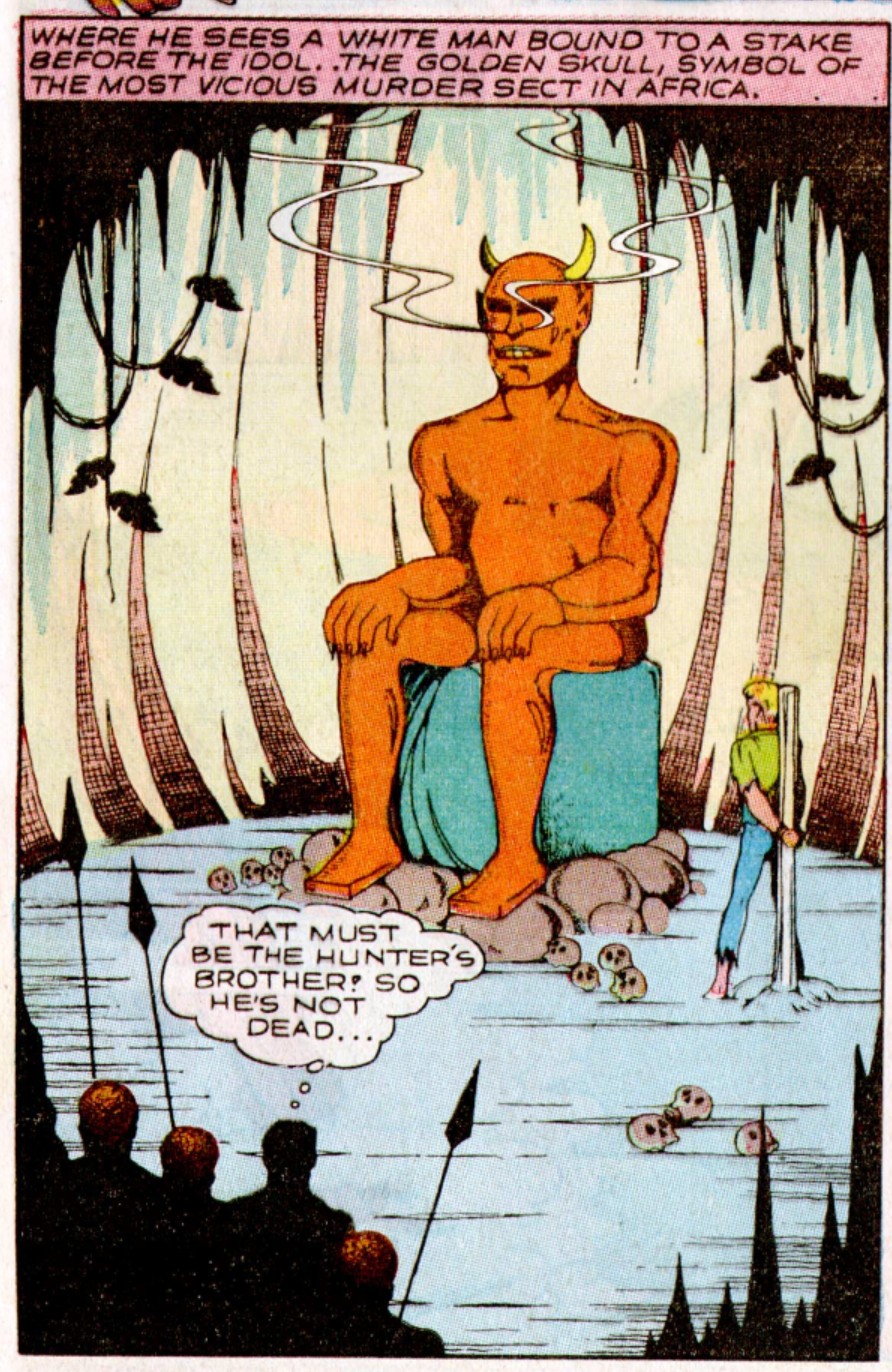
    While I must of course frown and shake my head at the concept of human sacrifice, you really have to hand it to the worshippers of the Golden Skull (who is, yes, very much not golden and also not especially skully), for giving their god a name that guarantees that a constant stream of American and European treasure hunters would arrive on their doorstep in search of swag. It’s the perfect sustainable human sacrifice supply solution!

    Sadly, the Golden Skull sect are not quite as canny about the location of their temple as they are about marketing, and the whole operation gets blown sky high when the volcano it is housed in erupts at an inopportune time.

    God Style: Idol (Jungle Comics 024, 1941)

    God of the Apes:

    We don’t learn much about the God of the Apes other than the fact that it is presumably worshipped or otherwise connected to apes and that it is real enough that Fantomah can call upon it to turn some crooked big game hunters into gorillas.

    God Style: Invoked (Real) (Jungle Comics 024, 1941)

    Mars:

    This right here is a pretty traditional comic book depiction of Mars, God of War, right down to the fact that he is loving the carnage and slaughter in Europe (and is implicitly the Guy Behind WWII). He loves it so much, in fact, that he creates Man of War as his personal agent on Earth to speed the whole process up, but he then fumbles the process so badly that he accidentally creates an Allied super-hero instead. 

    God Style: Real (Liberty Scouts Comics 002, 1941)

    the Spirit of America:

    This Spirit of America is in the Columbia mode, being an ethereal and star-spangled woman who implicitly comes into existence as a result of the American Revolution. In 1783 she primes a cannon with “powders of patriotism” just in case she ever needs to create a mystic champion at some point in the future (i.e., upcoming super-hero the Sentinel). 

    God Style: Real (Anthropomorphic Personification) (Liberty Scouts Comics 003, 1941)
  • MINOR SUPER-VILLAIN 930: THE BLACK DRAGON

    MINOR SUPER-VILLAIN 930: THE BLACK DRAGON

    (Silver Streak Comics 010, 1941)

    Here’s the thing about the Black Dragon: though he looms large in the early adventures of Captain Battle and is a key player in the origin of Hale Battle, he doesn’t personally do that much villainy.

    So just what is the Black Dragon’s deal? Well, he’s a magic using tyrant who lives in a secret castle in some unspecified Asian mountains, and he’s the secret mastermind behind the Axis Axian Powers, making him the guy behind WWII! Like I said above: he doesn’t personally get his hands dirty.

    So what kind of evil does the Black Dragon get up to? Mostly he captures people and turns them into monsters with his fell majicks, such as when he attempts to do so to Captain Battle, above. This attempt fails because the Black Dragon fails to think to take his prisoner’s iconic jet pack away.

    In his second appearance, in Silver Streak Comics 011, the Black Dragon captures Captain Battle’s assistant Jane Lorrain and offers her the creep villain’s choice of becoming his queen or being transformed into a monster. He then attempts to take on Captain Battle in hand-to-hand combat and is quickly disabused of any illusions he might have had about his martial prowess. 

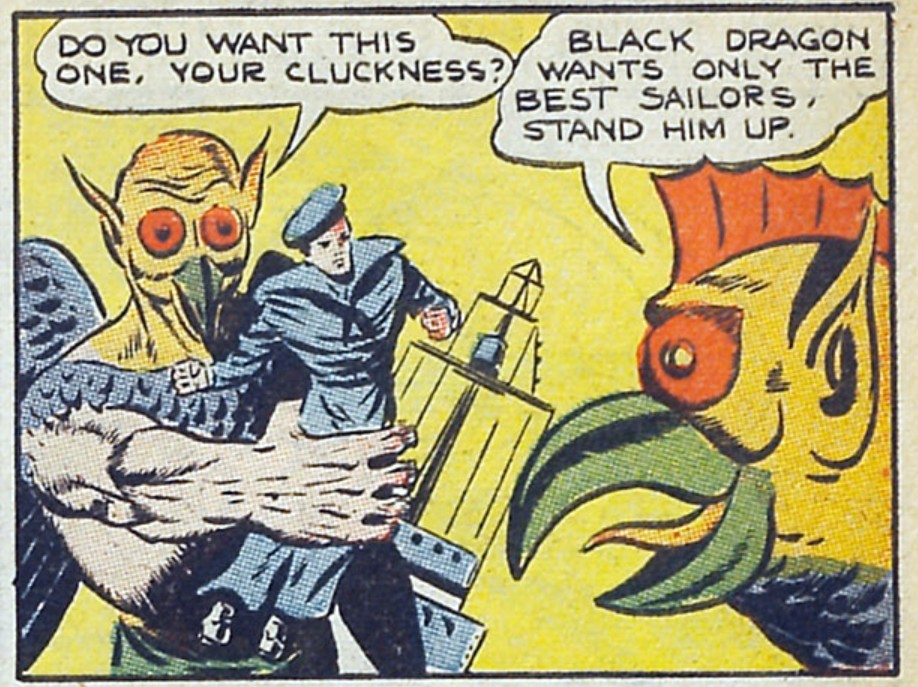
    The reason that the Black Dragon is so personally unimpressive as a villain is that all of his important evil works are done by Deaglos, giant bird-men that he makes out of captives. Monstrous humanoid mutates are nothing new in comics even this early in their history, but the Deaglos have one very cool feature that almost feels like it comes from a Vertigo-era New Weird comic: they are created using the spirits of the extinct dodo and so are immune to death.

    (the Deaglos also have field commanders referred to a “your cluckness,” which is very fun)

    By Silver Streak Comics 012: Captain Battle gets on the right page and realizes that if he cuts off the Black Dragon from his Deaglo supply he will have little to no ability to do evil. Plus the Deaglos are technically also victims, so his prior solutions of horrifically melting them with his dissolvo ray or using their inexplicable vulnerability to radio waves to kill them all are no very heroic acts. Accordingly, he brews up a “de-witcher solution” and applies it to a captive Deaglo, restoring him to his human form of Major Ling Fu.

    Captain Battle and the Major then go on to blast all the other Deaglos with the de-witcher, which coincidentally places a hostile force within the very walls of the Black Dragon’s fortress (this is where Hale Battle comes from).

    In his final act as a super-villain, the Black Dragon responds to this invasion by making what is probably the funniest evil exit of the Golden Age. “Ha Ha-Haaaaaa!” *strikes evil pose* *sinks into floor* *is never seen again*. I can’t endorse the whole thing where he started World War Two, but this exit really engenders a lot of affection for the guy in my heart.

    Categorized in: Animals (Dragons), Henchmen (Deaglos), Supercrime (Attempted World Conquest) 

  • DIVINE ROUND-UP 025

    Gods gods gods. 

    Puni, God of Fire: 

    Sea-faring adventurer Lance O’Casey almost gets sacrificed to this fire god by the cannibalistic inhabitants of a tropical Antarctic island before escaping, entering the volcano in question and meeting the other Puni. Not sure how much the volcano-dwelling madman and the actual religion influenced each other, but it must have been at least a little. Also: cool idol.

    God Style: Idol (Whiz Comics 019, 1941) 

    the War God:

    This War God idol functions like one of those hollow dog statues you see at grocery stores, that you put your change in to help raise money for people to get seeing eye dogs (and if that’s not a thing where you live then sorry for the unrelatable analogy), only the money is meant to go to the defense of China against Japanese invasion, and instead of a dog it is a sick-ass god-monster. It’s never entirely clear if this is supposed to be a representation of an actual god or just a marketing gimmick.

    God Style: Idol (More Fun Comics 059, 1940)

     Wotan:

    As was established when he beat up Mars that one time, Merlin the Magician hates war, and seeing as he has a magic cloak and a can-do attitude he sets out to do something about it. His first step is to go back in time and save a couple of young Ancient Britons from being human sacrificed by some Druids. What does this have to do with ending war? No idea, but then again I don’t have a magic cloak so my perspective might just be too mundane to comprehend the intricacies.

    Having reviewed the plan, I must conclude that Merlin just needed a couple of people with no ties who would be grateful enough to him to do whatever he wanted and that Druidic sacrifices were his first thought. Specifically, he asks these young folk to act as peace ambassadors to an unnamed fascist nation in order to undermine the efforts of the war god Wotan, who has been roaming the Earth inciting men to war.

    (It would have been quite thematically satisfying if the two young people had been rescued from being sacrificed to Wotan, and while that might have implicitly been the intent, it’s just not there on the page) 

    The young people are somewhat successful, in that they are immediately killed by a similarly young and idealistic pair of enemy soldiers (and what a progressive fascist nation, to field female soldiers in 1941!) who then become overwhelmed with remorse and swear of war forever, at which point Merlin appears and restores his agents to life – an effective but painful strategy, it seems.

    All this talk of pacifism and understanding between nations draws the ire of Wotan himself, who shows up to kill Merlin and ends up on the end of a killing sword-blow from the magician, making the current score Gods: 0 Merlin the Magician: 4.

    God Style: Real (National Comics 011, 1941)

    Death: 

    This version of Death is bound to obey an artifact known as the Sceptre of Eternity, and as such has been commanded to replace the lost daughter of a guy called the Sheik of Kamroon in the 12th Century, and as such has made off with a present-day woman named Betty Jekil. I’m pretty sure that this was a calculated move, as Betty’s father turns to super-magician El Carim for help, which ultimately results in El Carim trading the Sceptre of Eternity for Betty’s life, which is a pretty good deal for Death.

    God Style: Anthropomorphic Personification (Master Comics 019, 1941)

  • DIVINE ROUND-UP 025

    Gods gods gods. 

    Puni, God of Fire: 

    Sea-faring adventurer Lance O’Casey almost gets sacrificed to this fire god by the cannibalistic inhabitants of a tropical Antarctic island before escaping, entering the volcano in question and meeting the other Puni. Not sure how much the volcano-dwelling madman and the actual religion influenced each other, but it must have been at least a little. Also: cool idol.

    God Style: Idol (Whiz Comics 019, 1941) 

    the War God:

    This War God idol functions like one of those hollow dog statues you see at grocery stores, that you put your change in to help raise money for people to get seeing eye dogs (and if that’s not a thing where you live then sorry for the unrelatable analogy), only the money is meant to go to the defense of China against Japanese invasion, and instead of a dog it is a sick-ass god-monster. It’s never entirely clear if this is supposed to be a representation of an actual god or just a marketing gimmick.

    God Style: Idol (More Fun Comics 059, 1940)

     Wotan:

    As was established when he beat up Mars that one time, Merlin the Magician hates war, and seeing as he has a magic cloak and a can-do attitude he sets out to do something about it. His first step is to go back in time and save a couple of young Ancient Britons from being human sacrificed by some Druids. What does this have to do with ending war? No idea, but then again I don’t have a magic cloak so my perspective might just be too mundane to comprehend the intricacies.

    Having reviewed the plan, I must conclude that Merlin just needed a couple of people with no ties who would be grateful enough to him to do whatever he wanted and that Druidic sacrifices were his first thought. Specifically, he asks these young folk to act as peace ambassadors to an unnamed fascist nation in order to undermine the efforts of the war god Wotan, who has been roaming the Earth inciting men to war.

    (It would have been quite thematically satisfying if the two young people had been rescued from being sacrificed to Wotan, and while that might have implicitly been the intent, it’s just not there on the page) 

    The young people are somewhat successful, in that they are immediately killed by a similarly young and idealistic pair of enemy soldiers (and what a progressive fascist nation, to field female soldiers in 1941!) who then become overwhelmed with remorse and swear of war forever, at which point Merlin appears and restores his agents to life – an effective but painful strategy, it seems.

    All this talk of pacifism and understanding between nations draws the ire of Wotan himself, who shows up to kill Merlin and ends up on the end of a killing sword-blow from the magician, making the current score Gods: 0 Merlin the Magician: 4.

    God Style: Real (National Comics 011, 1941)

    Death: 

    This version of Death is bound to obey an artifact known as the Sceptre of Eternity, and as such has been commanded to replace the lost daughter of a guy called the Sheik of Kamroon in the 12th Century, and as such has made off with a present-day woman named Betty Jekil. I’m pretty sure that this was a calculated move, as Betty’s father turns to super-magician El Carim for help, which ultimately results in El Carim trading the Sceptre of Eternity for Betty’s life, which is a pretty good deal for Death.

    God Style: Anthropomorphic Personification (Master Comics 019, 1941)

  • MINOR SUPER-VILLAIN 677: MARS

    (National Comics 001, 1940) 

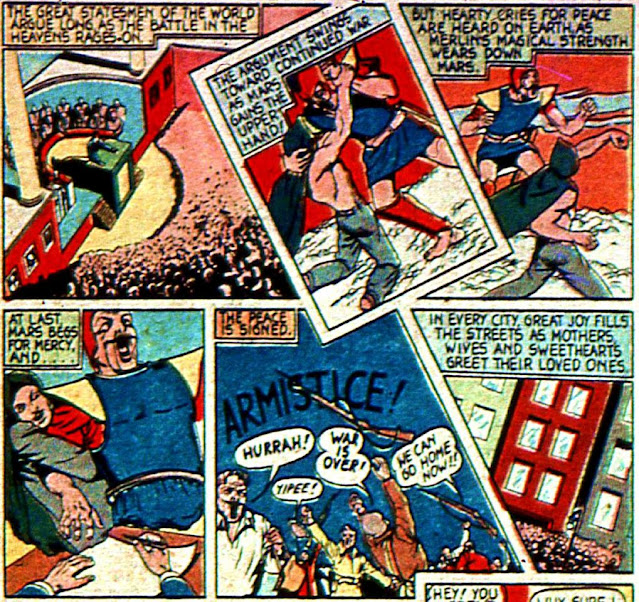
    Once Jock Kellog decides to turn his back on his playboy ways and put his inherited magic cloak to use as Merlin the Magician, he really goes for it. He hits the battlefields of WWII to aid the beleaguered soldiers of the front and ultimately rises into the realm of the gods to confront Mars, God of War and Destruction himself. 

    Mars turns out to be a huge jerk bully who is inciting nations to fight for his own amusement – a bit more Ares than Mars to be honest but I’ll let it go.

    Eventually, Merlin and Mars engage in Thrilling Hand to Hand Combat with the continuation of the war as the stakes, and after some back and forth that is cleverly mirrored in the progress of some armistice talks, Merlin wins! World War Two is over! As usual, this kind of “war can and will be avoided” story is very depressing in hindsight.

    But wait, there’s more! As in any story involving gods, demons and so forth, there is a high chance of some of my favourites the anthropomorphic personifications showing up, and show up they do! First off, Merlin encounters the embodiment of Peace chained to a bunch of weaponry like something out of a political cartoon and pledges to free her.

    Merlin also has to battle Mars’ henchmen Hunger and Poverty before he can get to the main event, and while there is a certain logic to the two of them making a person more susceptible to being either the perpetrator or victim of war I am sad that they don’t have a bit more allegorical oomph. Why couldn’t Hunger use those big fangs of his to sap Merlin’s life force or something? Still, even a bargain basement anthropomorphic personification is an anthropomorphic personification and I love me some anthropomorphic personifications. Hunger and Poverty can stay. The guys, not the things that they stand for. Those suck.

  • MINOR SUPER-VILLAIN 662: THE GUY BEHIND WORLD WAR II

    (N/A)

    This is perhaps the ultimate narrative football. At the very least it is in the running. Will there be more villains claiming credit for, say, the Fall of Rome or the French Revolution? Only time will tell.

    CLAIMANTS:

    the Black Dragon (Silver Streak Comics 010, 1941) 

    the Dictator (Blue Ribbon Comics 013, 1941)

    the Devil (Blue Ribbon Comics 019, 1941)

    Mars (Liberty Scouts Comics 002, 1941)

    Mars (National Comics 001, 1940)

    Wotan (National Comics 011, 1941)