The Curse of Skeleton Munroe

Category: spy

  • MINOR SUPER-VILLAIN 567: THE FALCON

    (The Comics 001, 1937)

    The Falcon is a mercenary spy and Doctor Doom’s opposite number in the conflict between the kingdoms of Returia and Merovia. It’s somewhat debatable whether a couple of spies-for-hire can be classified as either heroes or villains in such a situation, but the story certainly presents them as such, with Merovia being vaguely Nazi German and Doctor Doom being proudly American to underline things.

    The Falcon’s espionage is also a bit more dastardly than Doctor Doom’s, as well as being a bit more effective. In particular, the Falcon’s kidnapping of Doom’s son Stephen from a Swiss boarding school with egregiously poor security comes very close to spelling Returia’s end.

    Like the Masked Czar before him, the Falcon provides some insight into the ups and downs of serialized storytelling – in this case, it’s the all-too-often case of a serial being axed before it actually comes to a conclusion,leaving the Falcon in the ascendant. Don’t worry, though! This comic was evidently assembled out of the plot of a Big Little Book, so if you want to find out what happens and how exactly Doctor Doom comes out on top you can probably find out by buying the two extant Doctor Doom books for… looks like around $150 US plus shipping. Have fun!

  • MINOR SUPER-HERO ROUND-UP 016

    A pretty motley collection this time.

    the Ermine:

    A frontier vigilante who wears a reversible ermine skin outfit (white for winter wear, brown for regular), leaves an ermine tail as his calling card and can communicate/ is friends with with all the creatures of the forest (except for the ermine, presumably). The Ermine would be an interesting character if he wasn’t explicitly and murderously racist against Native peoples. He’s classed as a minor hero here because all of his recorded adventures involve him acting as the protector of two youths but I assume that he has a lot of hate crimes under his belt. (Star Ranger Funnies v1 015, 1938)

    the Lone Marshal:

    I have a strong suspicion that the Lone Marshal is a Lone Ranger knockoff. Obviously there’s no way to peer into the past and be sure, and admittedly the name was a really big influence on my opinion, but I’m sticking with it. He’s got a Sioux companion named Vajo and a horse named Lobo, so he’s just as not-technically-Lone as the Ranger is. (The Comics 001, 1937)

    Doctor Doom:

    Doctor Doom, “the Robin Hood of International Spies,” is some sort of freelance spy chief who we join as he works for the small Balkan nation of Returia as they fend off invasion plans by their rival, the similarly-small, not-as-Balkan Kingdom of Merovia. Doctor Doom and his double handful of associates are on the back foot for the entirety of their time battling the Falcon and never really manage to get the upper hand before the feature is cancelled but I assume that they would have come out on top eventually. (The Comics 001, 1937)

    Jungleman:

    Jungleman is your typical white-kid-raised-by-beasts jungle hero, in this case based out of Cambodia. He lives in a temple and collects treasure and repeatedly kidnaps a young woman named Louise until she falls in love with him – like I said, typical stuff. 

    The real thing that sets Jungleman apart from his peers is both the sheer number and variety of his animal companions and their tremendous attrition rate – he goes through two tigers in his first three appearances when most jungle heroes have to make one big cat last their entire career! 

    Eventually, Louise and her dad convince Jungleman to relocate to the US under the more civilized alias of “Mister Jay” and I was all set for a lot of the same kind of fish-out-of-water stuff that Ty-Gor spent a lot of his time on but no! Their ship gets wrecked and they just end up in a different jungle! It’s the old jungle switcherooo and I never saw it coming! (Champion Comics 002, 1939)

    **UPDATE** Bob Phantom **UPDATE**

    Star Comics 001, 1938 features a different guy named Bob Phantom, which only reinforces my paranoia vis-a-vis there being a joke or a reference that I’m missing about the last name Phantom. Also, given the slapdash nature of early comics and their record keeping, nobody actually knows who created this guy and so it’s entirely possible that he’s the same Bob Phantom and Harry Shorten and/or Irv Novick just took him from Centaur to MLJ and upgraded him from stage magician to super-hero.

  • MINOR SUPER-VILLAIN 565: THE BLACK WIDOW

    (The Funnies 030, 1939)

    The Black Widow is a sinister femme fatale spy chief in the classic mode, complete with cigarette holder, tight red dress and imperious attitude. A few things that make her fun:

    -the vague European country she works on behalf of is Bosylvania, a country about which nothing is revealed aside from the fact that it has the best geographical suffix: -sylvania

    -the Black Widow is in fact Princess Maxine of Bosylvania so her activities have an even greater potential for international incident than your typical spy, and certainly there’s an even greater risk than usual of tying her to her employers.

    -the Black Widow does not leave her castle HQ (located in the Castle District of the Northeastern US, presumably) for the duration of the story. This is because she knows how to delegate.

    When Secret Service agent Tom Beatty and his teen pal Danny show up despite the bomb the Black Widow had placed in their plane she takes another pass at killing them using an assassin’s teapot, which is always fun to see.

    Beatty is eventually captured and though it doesn’t turn out well for her I must say that any villain who takes the time for a bit of hero-taunting before their triumph gets a gold star in my book. Just stay well away from the bars!

    Beatty is of course recaptured because this is a serialized story and getting captured is good cliffhanger fodder. The Black Widow and her cronies come really close to getting away but instead she gets horribly killed just off panel. I guess exploding princess heads were too much even for the heady days of the pre-Code Golden Age – we’ll have to wait until the late 80s at earliest before we get an explosive decapitation in a mainstream comic if I’m any judge.

  • MINOR SUPER-VILLAIN 548: MADAME DOOM

    (Smash Comics 004, 1939)

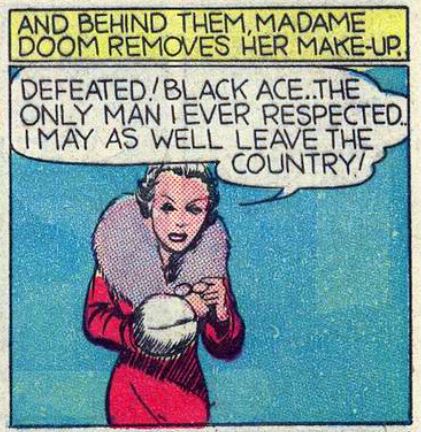
    We will be seeing more of Madame Doom, as she is Black X’s only real recurring foe (I think), but as far as 1939 goes she made one appearance and this is it. 

    Madame Doom, a freelance spy, is working for “the dictators” in an attempt to steal US defense plans and prevent the signing of a pretty vague treaty that acts as a deus ex machina reason for war not to have broken out yet (war with the US, that is).

    In this first appearance Madam Doom is a very by-the-book Will Eisner femme fatale: a ruthless lady with the hots for the hero (reciprocated).

    Black X doesn’t quite let her go on purpose but he certainly doesn’t try very hard to catch her. This is a mistake! The bloom definitely wears off the rose in this relationship later on.

    UPDATE: Madame Doom 1940

  • MINOR SUPER-HERO ROUND-UP 013

    More. MORE!

    Spiritman: 

    It’s impossible to say if Spiritman’s real name is Spirit Malcolm or if Spirit is just a nickname. The Golden Age is definitely a time in which nicknames are clearly signposted with quotation marks (including names like “Hank” half the time) but they’re also an age of inconsistent editorial standards. Let’s assume it is his given name, because then it’s another fun case of comic book nominative determinism.

    Spiritman is a scientific hero: armed with a Rayodine Pistol, he uses his Futurscope remote viewing device to hunt out evildoers and then – and this is where the “Spirit” part comes in – employs his Mistodine device to teleport to their location, or possibly to astrally project to their location. Either way, the effects are the same: the projected Spiritman can fly and is selectively invisible and intangible, allowing him to really just do whatever he wants. In his sole recorded adventure, this means killing about a dozen men for stealing US gold reserves. (Silver Streak Comics 001, 1939)

    the Wasp:

    Daily Free Press reporter Burton Slade is also masked vigilante the Wasp, so named because his weird cape looks a bit like insect wings if you squint. He also makes a buzzing sound sometimes. (Silver Streak Comics 001, 1939)

    Black X:

    Black X is Richard Spencer, a US espionage agent who travels around with his Indian manservant Batu (who of course is gifted with assorted mental powers). His stories are interesting enough to read but Black X himself is, appropriately enough, a bit of a cipher. Probably the most interesting thing about him is that the monocle he always wears is in fact more of an eye patch to cover his gouged-out eye. He also briefly went by the moniker Black Ace but that failed to stick. (Feature Funnies 013, 1938)

    the Invisible Hood:

    The fun thing about the Invisible Hood is that he doesn’t get his signature invisibility cloak until his second appearance, which means that for an unknown number of adventures he was just a Sandman-style two-fisted gas gun jockey in a very impractical full length form-fitting robe. Perhaps he was simply looking for a challenge. (Smash Comics 001, 1939)

  • MINOR SUPER-VILLAIN 529: RATZER

    (Blue Ribbon Comics 018, 1941)

    Ratzer is a Nazi agent who tangles with American-serving-in-the British-Army Corporal Collins a couple of times. There’s not a lot to say about him, honestly: the first time he meets Collins he’s trying to spring a load of Nazi prisoners and destroy a lot of British gun cotton in then-Bombay, while the second time he’s stealing oil in Iraq. He is not notably villainous, particularly in the ranks of Nazi super-villains.

    He does, however, have a certain style, so I’ll speak on that. Starting with his plane! I really like the question mark! Custom planes are absolutely the on the list of things that make aviator characters at least a bit interesting.

    I wouldn’t call Ratzer’s costume one of the greatest of all time but it does have some flair, particularly with the little scarf dangling off the top of his head. And as a bonus it doesn’t have any swastikas on it, which I appreciate a lot more than I did before I started posting pictures of super-villains online regularly.

    Ratzer’s second appearance doesn’t really involve flying and so he’s dressed in what I guess is his Desert Combat Costume – perhaps he has a whole closet full of slight variations on the theme, like a 1990s action figure line. Look out for Ocean Exploration Ratzer!

    In any case, I like this costume best – he looks a bit like a pro wrestler.

    At the end of his second appearance Ratzer gets away again and just… never returns. This is probably down to the end of Blue Ribbon Comics when Corporal Collins moved over to being a supporting character to MLJ’s other military hero Sergeant Boyle. No room for the secondary characters to have their own villains, after all.

  • MINOR SUPER-VILLAIN 529: RATZER

    (Blue Ribbon Comics 018, 1941)

    Ratzer is a Nazi agent who tangles with American-serving-in-the British-Army Corporal Collins a couple of times. There’s not a lot to say about him, honestly: the first time he meets Collins he’s trying to spring a load of Nazi prisoners and destroy a lot of British gun cotton in then-Bombay, while the second time he’s stealing oil in Iraq. He is not notably villainous, particularly in the ranks of Nazi super-villains.

    He does, however, have a certain style, so I’ll speak on that. Starting with his plane! I really like the question mark! Custom planes are absolutely the on the list of things that make aviator characters at least a bit interesting.

    I wouldn’t call Ratzer’s costume one of the greatest of all time but it does have some flair, particularly with the little scarf dangling off the top of his head. And as a bonus it doesn’t have any swastikas on it, which I appreciate a lot more than I did before I started posting pictures of super-villains online regularly.

    Ratzer’s second appearance doesn’t really involve flying and so he’s dressed in what I guess is his Desert Combat Costume – perhaps he has a whole closet full of slight variations on the theme, like a 1990s action figure line. Look out for Ocean Exploration Ratzer!

    In any case, I like this costume best – he looks a bit like a pro wrestler.

    At the end of his second appearance Ratzer gets away again and just… never returns. This is probably down to the end of Blue Ribbon Comics when Corporal Collins moved over to being a supporting character to MLJ’s other military hero Sergeant Boyle. No room for the secondary characters to have their own villains, after all.

  • MINOR SUPER-VILLAIN 528: THE BLACK HAND

    (Blue Ribbon Comics 016, 1941) 

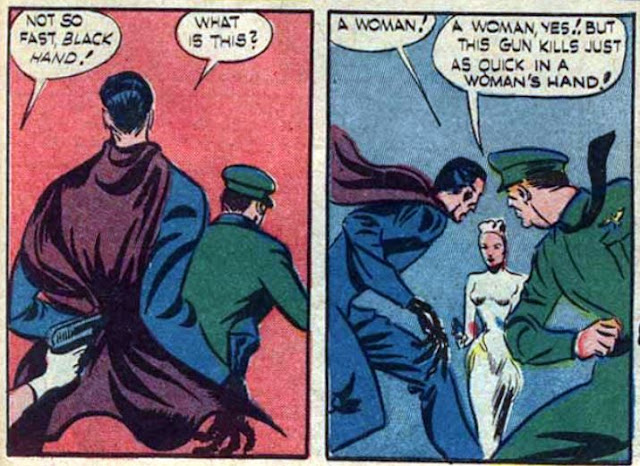
    There’s a quality that some comic book characters have and some do not and I never knew about it until I started writing this blog. That quality is called Standing in Clear View So That I Can Get a Screengrab of Them, and buddy, the Black Hand does not have it. This is about as good of a full look as you get of the guy in his first appearance.

    Enough complaining! The Black Hand is a spy of the Unaffiliated Freelancer subtype, which since he operates out of the US means that he steals US secrets for sale to the Nazis. Is a character who does business with Nazis better than one who is a Nazi? Marginally. The Black Hand is also the recurring villain of Captain Flag, who he is also responsible for becoming a super-hero due to his murder of Flag’s father and failure to proof his lair against narratively significant eagles.

    The Black Hand is called the Black Hand because of his black hand, which he usually conceals beneath a black glove and which is riddled with a deadly disease that the Black hand can transfer to a victim via a simple scratch of his horrible fingernails. It’s definitely a useful power (affliction?) for a villain to have but not one that has a chance of coming up in anyone’s super-power wishlist.

    Throughout his five appearances the Black Hand sports three distinct looks: the initial iteration (either afflicted with a deathly pallor or just overenthusiastic when applying foundation), a sort of suave mustachioed cat-burglar getup with no hint of the grave and then back to the deathly complexion with an added skull-like quality to the face. Realistically this can be put down to Captain Flag being a secondary character without a dedicated artist, but if that was the point of this blog then it would swiftly cease to be much fun.

    Notably, the suave version of the Black Hand wears his glove on the opposite side – could this indicate that he and the corpselike Black Hand are different characters? Perhaps the disease that gives them their name is also slowly killing them, which could account for the more ghoulish appearance of the original Hand over time?

    These questions will never be answered, sadly, as in-universe the Black Hand made a transition from spy the thief to pirate and Captain Flag was quick to invoke the Law of the Sea to hang him from the nearest yardarm. Out of universe, Captain Flag’s feature didn’t survive the cancellation of Blue Ribbon Comics and so the Black Hand had nobody to come back from the dead to torment.

  • MINOR SUPER-VILLAIN 524: THE KING OF THE VAMPIRES

    MINOR SUPER-VILLAIN 524: THE KING OF THE VAMPIRES

    (Blue Ribbon Comics 011, 1941) 

    We open not on the King of the Vampires but on a different vampire, one with a monocle. This is Carlos Hubbello, a diplomatic envoy from South America who has been sent to discuss a trade deal with the US that would leave the Nazis in the cold. The two gentlemen with him are no gentlemen at all but rather Nazi spies who are controlling Hubbello by the simple expedient of having turned him into a vampire, which is certainly harder to get out of than say kidnapping his loved ones but comes with a whole lot of extra risk for his handlers.

    This story is rife with lore. To whit:

    LORE: Vampires are easily cowed with a cross, even when wielded by evil men.

    Hubbello comes very close to vampiring Mr Justice’s love interest Pat Clark while they watch a performance of the very weird and cool “Waltz of the Vampire”. A ghost/ vampire brawl ensues.

    LORE: A vampire can lose control when exposed to great art.

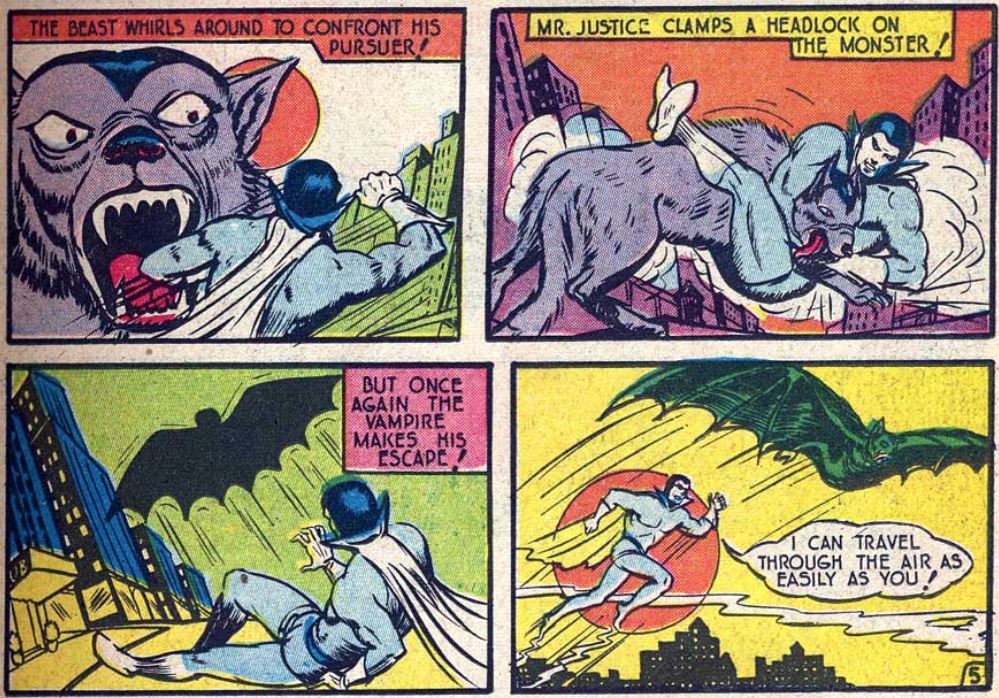
    LORE: vampires can transform into wolves and bats and retain their special vampire haircut in both forms (you can just make out a teeny tiny widow’s peak on the bat if you squint).

    Hubbello, defeated, spills the beans. The Nazis imported the King of the Vampires from Transylvania as part of their scheme to control the trade negotiations. Is the King of the Vampires a Nazi or merely using them to his own ends? This is not explored. Is the King of the Vampires supposed to be Dracula or is Transylvania just a good place for a vampire to come from? We can never know.

    LORE: Kill the head vampire in time and its under-vampires can be saved. What is “in time”? Not sure but it isn’t “before the under-vampire takes a life/ drinks human blood” as in a lot of vampire media, because Hubbello has already done both.

    Enter the King of the Vampires, freshly gorged on the blood of the innocent and battle commences. And I sure hope that Mr Justice knew the LORE that vampire cannot fight vampire because it means that he is on his own.

    LORE: this is the kind of vampire that seemingly isn’t harmed by light so much as by not physically being in his coffin at dawn. And he isn’t, so he dies.

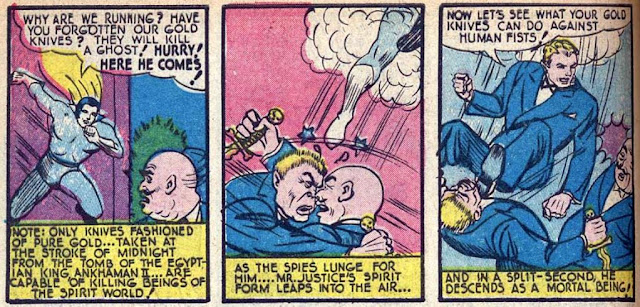
    Hubbello is saved! The trade deal can go forward! And back in the US we are reacquainted with the Nazi vampire-handlers, who come with one last piece of LORE: that knives fashioned of pure gold taken from the tomb of the Egyptian King Ankhaman II are capable – possibly the only things capable – of killing a ghost. A potent weapon against Mr Justice, if only they were any good at knifing. But they aren’t so they get captured immediately and the knives are presumably never seen again.

  • MINOR SUPER-VILLAIN 524: THE KING OF THE VAMPIRES

    MINOR SUPER-VILLAIN 524: THE KING OF THE VAMPIRES

    (Blue Ribbon Comics 011, 1941) 

    We open not on the King of the Vampires but on a different vampire, one with a monocle. This is Carlos Hubbello, a diplomatic envoy from South America who has been sent to discuss a trade deal with the US that would leave the Nazis in the cold. The two gentlemen with him are no gentlemen at all but rather Nazi spies who are controlling Hubbello by the simple expedient of having turned him into a vampire, which is certainly harder to get out of than say kidnapping his loved ones but comes with a whole lot of extra risk for his handlers.

    This story is rife with lore. To whit:

    LORE: Vampires are easily cowed with a cross, even when wielded by evil men.

    Hubbello comes very close to vampiring Mr Justice’s love interest Pat Clark while they watch a performance of the very weird and cool “Waltz of the Vampire”. A ghost/ vampire brawl ensues.

    LORE: A vampire can lose control when exposed to great art.

    LORE: vampires can transform into wolves and bats and retain their special vampire haircut in both forms (you can just make out a teeny tiny widow’s peak on the bat if you squint).

    Hubbello, defeated, spills the beans. The Nazis imported the King of the Vampires from Transylvania as part of their scheme to control the trade negotiations. Is the King of the Vampires a Nazi or merely using them to his own ends? This is not explored. Is the King of the Vampires supposed to be Dracula or is Transylvania just a good place for a vampire to come from? We can never know.

    LORE: Kill the head vampire in time and its under-vampires can be saved. What is “in time”? Not sure but it isn’t “before the under-vampire takes a life/ drinks human blood” as in a lot of vampire media, because Hubbello has already done both.

    Enter the King of the Vampires, freshly gorged on the blood of the innocent and battle commences. And I sure hope that Mr Justice knew the LORE that vampire cannot fight vampire because it means that he is on his own.

    LORE: this is the kind of vampire that seemingly isn’t harmed by light so much as by not physically being in his coffin at dawn. And he isn’t, so he dies.

    Hubbello is saved! The trade deal can go forward! And back in the US we are reacquainted with the Nazi vampire-handlers, who come with one last piece of LORE: that knives fashioned of pure gold taken from the tomb of the Egyptian King Ankhaman II are capable – possibly the only things capable – of killing a ghost. A potent weapon against Mr Justice, if only they were any good at knifing. But they aren’t so they get captured immediately and the knives are presumably never seen again.