The Curse of Skeleton Munroe

Category: group

  • MINOR SUPER-VILLAIN 1004: THE GREEN HOOD GANG

    (Lightning Comics v2 002, 1941)

    The Green Hood Gang, who are unsurprisingly a gang who wear green hoods (and please note the rare and stylish nose cutouts on those numbers), make their debut by barging in and robbing the Raven after he himself had just gone to the trouble of holding up the guests of a party at the home of retired gangster Joe Russo.

    From there, the Green Hoods embark on a crime spree so ambitious in scope that Police Chief Lash is compelled to set aside his personal crusade against the Raven and team up with him to hunt them down.

    For most of this story I had assumed that the leader of the Green Hood Gang would turn out to be Joe Russo, coming out of retirement and starting out by robbing his own party guests, and I suspect that the writer of this comic was also of this opinion right up until they got to page eight out of ten, at which point the men under the hoods – previously very clearly regular American gangsters – are revealed to be Native South Americans. Further investigation by Lash and the Raven reveals that these men are dupes who have been promised that the funds they are stealing are to be put toward the construction of a temple in their homeland, but who are really working for a former bootlegger named Larue.

    While I wouldn’t call the Joe Russo version of this story very original or exciting, the Larue reveal is so out of left field that I am left baffled and bamboozled. If I can’t trust a comic book writer 85 years ago, just who can I?

    Categorized in: Colours (Green), Generica (Gangs), Objects (Hoods)

  • GENERIC COSTUMED VILLAIN ROUND-UP 046

    Here’s to all the crooks who just didn’t have enough oomph.

    the Despot:

    The Despot (not really his name, but literally the only thing he is called throughout the story) has the magic power to transform himself and others into living plants and animals, a power which he uses to trap Camilla and Sir Champion in his mountain fastness after luring them there on a magical golden road. Thus stripped of its leaders, the Lost Empire proves no match for the Despot’s invading armies (who might be animals that have been turned into humans or might also have the power to turn into animals – it is unclear). 

    The Despot’s reign over the Lost Empire is short, as Camilla and Sir Champion are able to outwit the single, albeit magical, dog that he had left to guard them. Cornered, he makes a real shapeshifter mistake and turns into a potato, whereupon he is trapped in that form forever by Sir Champion’s magic sword. 

    This adventure comes at the very end of Camilla’s time in the original Lost Empire location, which is very sad because I think that knowing that a magical evil potato was stuck to the floor somewhere just off-panel would have really enhanced those stories. (Jungle Comics 014, 1941)

    the Acrobat Bandits:

    The Acrobat Bandits are a trio of rope-swinging jewel thieves who terrorize NYC for a few weeks before they tangle with reporter Dopey Day and are undone by his semi-slapstick ways. They are in fact pretty cool villains but really don’t get a lot of time to shine while Dopey is tripping over himself and dropping things, alas. (Liberty Scouts Comics 003, 1941)

    Jasper Fennel:

    Seemingly mild-mannered jewellery store clerk Jasper Fennel turns out to be the brains behind the notorious Panther Gang in this Marvo the Magician story. He might never have been caught if he hadn’t robbed his own place of employment – a valuable lesson for all would-be criminals not to shit where you eat. He also has one of the more upsetting masks I have seen in a while. (Lightning Comics v2 004, 1941)

    Hook:

    Hook is the leader of a gang who are attempting to run a protection racket on New York’s dry cleaners. He’s just a guy with a hook prosthetic who has decided to go with it and that’s what this lowest level of super-villainy is all about. Plus that nail bomb that he attempts to kill Ferret with is truly gnarly. (Marvel Mystery Comics v1 009, 1940)

  • MINOR SUPER-HERO ROUND-UP 102

    MINOR SUPER-HERO ROUND-UP 102

    You won’t believe what I just found: more super-heroes!

    the Liberty Scouts:

    When fascist forces armed with high-tech weaponry begin attacking targets calculated to cripple US war capacity, they are repeatedly driven away by a trio of anonymous heroes who leave behind Liberty Bell calling cards. Both the fascists and US officials are eager to learn just who these so-called Liberty Patriots are, but President Roosevelt is the one who actually gets to find out, thanks to his association with patriotic millionaire Patrick Henry.

    Henry drives FDR out to his country estate, Liberty House, where he introduces him to three mysterious youths beginning with Smokey, the inventive genius of the group, and whose amphibious tank is counted as a land vehicle for the air/sea/land theme that the three have going on.

    Skipper, “the best sailor on the Seven Seas,” is also clearly the group member who is most invested in the paramilitary aspect of the whole operation. He has a super-powerful miniature submarine.

    Finally, we have Strut, the youngest of the group. He’s got a souped up fighter plane called the Comet (initially the only named super vehicle in the bunch, though the tank is later named Ironsides), plus a cool-ass wingsuit. He’s also the only one of the three with any discernible personality, even if it’s “won’t shut up about cherry pie.”

    So just how does Mr Henry know these three youngsters and why are they living in his house? Because they are his own sons! He loves his country so much that he has moulded his children into weapons designed to defend it, and the President loves it. (Liberty Scouts Comics 002, 1941)

    The Liberty Scouts eventually change their name to the Liberty Guards after the Boy Scouts of America complain about their monopoly on the word “scout” being infringed.

    Categorized in: Accessories (Calling Card Leavers), Groups, Origin (Patriotic Heroes)

    Man of War:

    Impatient with the slow progress of World War II, the god Mars decides to create a divine being imbued with the powers of the Greco-Roman pantheon and send them down to help the Axis conquer Europe faster and with more bloodshed. He gifts his champion with “the Strength of Hercules, the Speed of Mercury, the Wisdom of Zeus” (making him about 0.5 of a Captain Marvel) and arms him with the infinitely sharp Sword of Mars before sending him on his way.

    In a legitimately funny twist, Mars forgets to account for the rotation of the Earth during the presumably-lengthy demigod-crafting process and shoots his new creation at Dayton, Ohio (okay, at one of the more than thirty Daytons in the United States. Or in another city that has an unrelated Dayton Munitions Factory. Probably Dayton, Ohio, though) instead of Berlin or wherever he intended for it to go. Thus, Man of War (as he calls himself) is instantiated in the “peace-loving nation” of the USA and is dedicated to virtuous, defensive warfare instead of awful slaughter in the name of power-hungry politicians (insert joke about the US war machine here. Man of War must have had a rough go of things as the 20th Century progressed).

    So what are the powers of the gods? Mostly generic super strength and invulnerability, though Man of War is able to breathe and move freely underwater thanks to the gifts of Neptune. He also has one bespoke power gifted upon him by Mars: to disappear or appear in any explosion, up to and including those created when bullets are fired (which would be a bit more useful if he weren’t already bulletproof). (Liberty Scouts Comics 002, 1941)

    In Man of War Comics 001, Mars reveals Man of War’s weakness to the dictator Luko: that he is powered by rays emitted by the planets of the Solar System, and that confining him in a lead-lined chamber will block those rays and render him merely human. This nearly works, but as the Sword of Mars is not planet-powered he is soon able to carve his way free.

    Categorized in: Accessories (Swords), Activities (War), Origins (Demigods)

    Vapo-Man:

    Bradford “Brad” Cole is a chemist assisting at the laboratory of Dr Kreiner, who in turn is performing unspecified research that is evidently valuable enough to the US government that some fascist saboteurs blow it up. Cole, unlike Kreiner, is lucky enough not to be exploded but instead is showered with a randomized mix of chemicals that change him into a man of vapour.

    The dying Kreiner explains that he is now a chemical man, which is apparently something that chemists have been trying to create for centuries. He extracts a promise from Cole that he will use this power to fight evil, and saddles him with the terrible name of Vapo-Man just before dying, thus ensuring that Crawford can never change it without feeling very guilty.

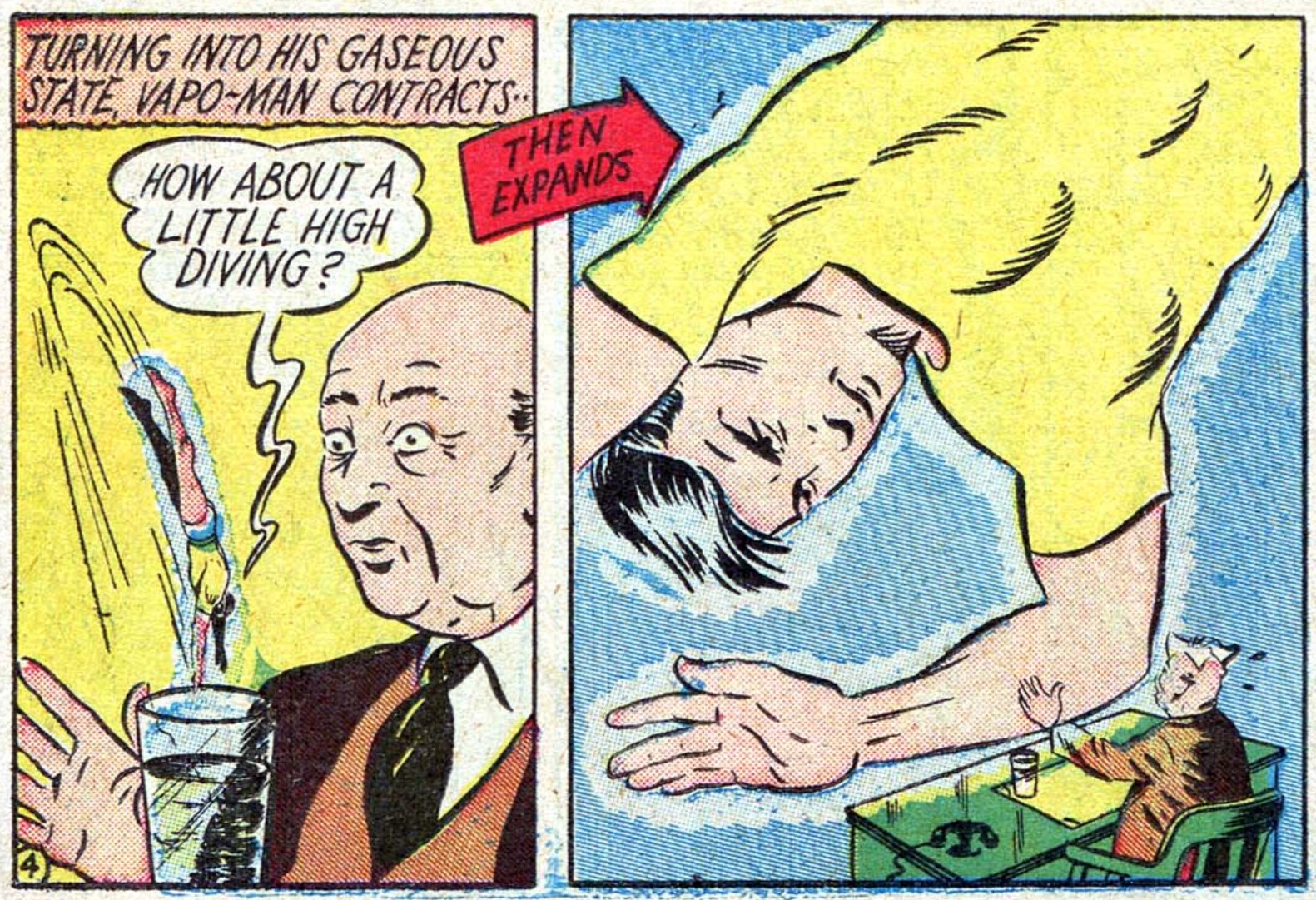
    As Vapo-Man, Crawford can change all or part of his size, can fly, has at least some super strength, can disintegrate matter with a touch, and can become intangible at will. All of this adds up to make him feel a lot like a more mystical character like Phantasmo, though he lacks the charm to support it. (Liberty Scouts Comics 002, 1941)

    Categorized in: Elements (Steam and Mist), Origins (Chemical Mutates), Powers (Intangibility)

    Fire-Man:

    Jim, a man working for the Civilian Conservation Corps in Utah sets out to battle the latest in a series of mysterious fires and finds himself being kidnapped by a mysterious silver-clad giant.

    This turns out to be Gaston, henchman to a fellow known only as the Mad Scientist. The Mad Scientist has a dream: to incinerate a human in such a way that they remain alive and coherent but composed of gaseous rather than solid matter, and Jim is his latest unwilling experimental subject. Luckily for Jim, this time it works, and the only real change appears to be a significantly lower density, such that he is obliged to wear a weighted uniform (that doubles nicely for a super suit, natch) in order to keep from floating away. Even with it on, he light enough to leap around as if he were flying.

    Jim is otherwise an ordinary human, but a miscalculation on the part of the Mad Scientist (dunking him in a vat of chemicals while trying to destroy him) also endows him with super strength.

    Finally, Jim’s new metabolism causes him to give off fire-retardant gasses as a part of his respiration, which is handy, as he chooses to go by Fire-Man, meaning that he, alongside the Mad Scientist’s niece Nancy, ends up fighting a lot of arsonists (Liberty Scouts Comics 002, 1941)

    Categorized in: Elements (Fire), Origins (Electrical Mutates), Powers (Decreased Density)

  • MINOR SUPER-HERO ROUND-UP 102

    You won’t believe what I just found: more super-heroes!

    the Liberty Scouts:

    When fascist forces armed with high-tech weaponry begin attacking targets calculated to cripple US war capacity, they are repeatedly driven away by a trio of anonymous heroes who leave behind Liberty Bell calling cards. Both the fascists and US officials are eager to learn just who these so-called Liberty Patriots are, but President Roosevelt is the one who actually gets to find out, thanks to his association with patriotic millionaire Patrick Henry.

    Henry drives FDR out to his country estate, Liberty House, where he introduces him to three mysterious youths beginning with Smokey, the inventive genius of the group, and whose amphibious tank is counted as a land vehicle for the air/sea/land theme that the three have going on.

    Skipper, “the best sailor on the Seven Seas,” is also clearly the group member who is most invested in the paramilitary aspect of the whole operation. He has a super-powerful miniature submarine.

    Finally, we have Strut, the youngest of the group. He’s got a souped up fighter plane called the Comet (initially the only named super vehicle in the bunch, though the tank is later named Ironsides), plus a cool-ass wingsuit. He’s also the only one of the three with any discernible personality, even if it’s “won’t shut up about cherry pie.”

    So just how does Mr Henry know these three youngsters and why are they living in his house? Because they are his own sons! He loves his country so much that he has moulded his children into weapons designed to defend it, and the President loves it. (Liberty Scouts Comics 002, 1941)

    The Liberty Scouts eventually change their name to the Liberty Guards after the Boy Scouts of America complain about their monopoly on the word “scout” being infringed.

    Categorized in: Accessories (Calling Card Leavers), Groups, Origin (Patriotic Heroes)

    Man of War:

    Impatient with the slow progress of World War II, the god Mars decides to create a divine being imbued with the powers of the Greco-Roman pantheon and send them down to help the Axis conquer Europe faster and with more bloodshed. He gifts his champion with “the Strength of Hercules, the Speed of Mercury, the Wisdom of Zeus” (making him about 0.5 of a Captain Marvel) and arms him with the infinitely sharp Sword of Mars before sending him on his way.

    In a legitimately funny twist, Mars forgets to account for the rotation of the Earth during the presumably-lengthy demigod-crafting process and shoots his new creation at Dayton, Ohio (okay, at one of the more than thirty Daytons in the United States. Or in another city that has an unrelated Dayton Munitions Factory. Probably Dayton, Ohio, though) instead of Berlin or wherever he intended for it to go. Thus, Man of War (as he calls himself) is instantiated in the “peace-loving nation” of the USA and is dedicated to virtuous, defensive warfare instead of awful slaughter in the name of power-hungry politicians (insert joke about the US war machine here. Man of War must have had a rough go of things as the 20th Century progressed).

    So what are the powers of the gods? Mostly generic super strength and invulnerability, though Man of War is able to breathe and move freely underwater thanks to the gifts of Neptune. He also has one bespoke power gifted upon him by Mars: to disappear or appear in any explosion, up to and including those created when bullets are fired (which would be a bit more useful if he weren’t already bulletproof). (Liberty Scouts Comics 002, 1941)

    In Man of War Comics 001, Mars reveals Man of War’s weakness to the dictator Luko: that he is powered by rays emitted by the planets of the Solar System, and that confining him in a lead-lined chamber will block those rays and render him merely human. This nearly works, but as the Sword of Mars is not planet-powered he is soon able to carve his way free.

    Categorized in: Accessories (Swords), Activities (War), Origins (Demigods)

    Vapo-Man:

    Bradford “Brad” Cole is a chemist assisting at the laboratory of Dr Kreiner, who in turn is performing unspecified research that is evidently valuable enough to the US government that some fascist saboteurs blow it up. Cole, unlike Kreiner, is lucky enough not to be exploded but instead is showered with a randomized mix of chemicals that change him into a man of vapour.

    The dying Kreiner explains that he is now a chemical man, which is apparently something that chemists have been trying to create for centuries. He extracts a promise from Cole that he will use this power to fight evil, and saddles him with the terrible name of Vapo-Man just before dying, thus ensuring that Crawford can never change it without feeling very guilty.

    As Vapo-Man, Crawford can change all or part of his size, can fly, has at least some super strength, can disintegrate matter with a touch, and can become intangible at will. All of this adds up to make him feel a lot like a more mystical character like Phantasmo, though he lacks the charm to support it. (Liberty Scouts Comics 002, 1941)

    Categorized in: Elements (Steam and Mist), Origins (Chemical Mutates), Powers (Intangibility)

    Fire-Man:

    Jim, a man working for the Civilian Conservation Corps in Utah sets out to battle the latest in a series of mysterious fires and finds himself being kidnapped by a mysterious silver-clad giant.

    This turns out to be Gaston, henchman to a fellow known only as the Mad Scientist. The Mad Scientist has a dream: to incinerate a human in such a way that they remain alive and coherent but composed of gaseous rather than solid matter, and Jim is his latest unwilling experimental subject. Luckily for Jim, this time it works, and the only real change appears to be a significantly lower density, such that he is obliged to wear a weighted uniform (that doubles nicely for a super suit, natch) in order to keep from floating away. Even with it on, he light enough to leap around as if he were flying.

    Jim is otherwise an ordinary human, but a miscalculation on the part of the Mad Scientist (dunking him in a vat of chemicals while trying to destroy him) also endows him with super strength.

    Finally, Jim’s new metabolism causes him to give off fire-retardant gasses as a part of his respiration, which is handy, as he chooses to go by Fire-Man, meaning that he, alongside the Mad Scientist’s niece Nancy, ends up fighting a lot of arsonists (Liberty Scouts Comics 002, 1941)

    Categorized in: Elements (Fire), Origins (Electrical Mutates), Powers (Decreased Density)

  • MINOR SUPER-VILLAIN 992: THE VAHINES

    (Jungle Comics 013, 1941)

    The Vahines, aka the Tiger-Women of Wildmoon Mountain, have a plan: kill every other woman in the world, which will then give them ultimate power over all men. Some thoughts on this setup:

    1. The logistics of this plan are trash. There are maybe 15 to 20 Vahines total and estimates put world population at around 2.3 billion in 1940, so murdering half of those people will be a full-time job that will probably take the rest of their lives*. And if they succeed, what then? They rule over a population that is going to die out in a single generation? They certainly can’t repopulate the planet because they spent their fertile years slaughtering people.

    *It’s just possible that “the world” referred to by the Vahines is the weird liminal Jungle-Dimension that Fantomah comics seem to be set in, but seeing as how that’s mostly something I made up to explain how weird the worldbuilding in these stories is, I doubt it.

    2. I keep saying that we’re almost out of Fletcher Hanks stories but I really mean it this time, so it’s nice to get one last instance of women surfing around on the backs of big cats.

    3. “The Vahines have come down off of Wildmoon Mountain to murder all other women” sounds like the synopsis of a MADtv sketch about PMS. 

    Regardless of the canonicity of the liminal Jungle, that’s where their mountain is located and so that is where they start murdering women. This goes against Fantomah’s mission to protect Jungle life, and so they meet resistance in the form of All Animals. The Vahines, however, are no fools. They knew that Fantomah wouldn’t be cool with their insane mission and so they have prepared a salve that makes them glow in a way that is scary to animals. Problem solved!

    Or is it? in a classic blunder, the Vahines have failed to contend with the fact that Fantomah a) is not afraid of a mild glowing effect and b) is a minor deity. It takes the merest exertion of her powers to remove the glow, and soon the Vahines’ tigers are a mere smudge on the jungle floor.

    As for the Vahines themselves, it is now the time for the extreme retribution. Fantomah begins this by extracting the enormous moonstone called the Wild Moon from inside of Wildmoon Mountain – it seems that the name was more than just cool but that it also meant something – and sticking the Vahines to it. This is initially very concerning to the Vahines because of a prophecy about their lives ending if the Wild Moon leaves…

    … and then very, very concerning, as the Wild Moon, with its Vahine cargo, is blasted off to slam into the surface of Mars. The prophecy was correct! If unhelpful!

    Categorized in: Animals (Tigers), Ideologies (Misogyny), Murder (Mass Murderers)

  • FASCIST GOON CLEARING HOUSE 015

    If there’s one thing I know it’s that the world has a seemingly-inexhaustible supply of odious little fascist worms.

    the All-American League:

    The All-American League is nothing so exciting as your Nazi spies trying to poison the reservoir or prevent and/or encourage the US entrance into WWII. Instead, they are the more banal type of fascism that is popular nowadays, in which patriotism is weaponized as a way to enrich and empower a few petty men (yes, yes that’s what the Axis was too but they killed a lot of people while doing it so we hold them in higher esteem). The Flame is more than a match for a collection of small-minded opportunists.

    Please note that this is the one and only adventure in which the Flame is said to live in a place called Metropolis before someone presumably thought better of it, and that it features an ethnic neighbourhood with the hilariously on-the-nose name of “Foreign Town.” (The Flame 007, 1941)

    the Nazi Bund:

    This is our second instance of a group called the Nazi Bund and as the other one occurred in Fantastic Comics I would be tempted to posit that it represents a rare connection between two Fox Features titles. Not a strong connection, as this particular branch is completely annihilated by the Green Mask, just as that other was by Samson. (Green Mask v1 005, 1941)

    the Yellow-Jackets:

    Though the Yellow-Jackets, the recurring foes of America’s Air Ace Bill Barnes, are described as a kind of freelance band of international bandit spies, in practice they are just another bunch of Nazis-by-another-name. It’s a good name, though. Menacing. (Shadow Comics v1 002, 1940)

    Unnamed Saboteurs:

    This band of Nazi saboteurs are not the most distinguished but also not the least. Their big plan involves starting a forest fire outside of the war production centre of Brownstown and then burning down the town itself while everyone is out fighting the first blaze. Not a bad plan, if doomed to failure because of the presence of human fire extinguisher Fire-Man, but what really sets these guys apart is their weird cloth masks that sport one big central lens to see out of. These are not given any sort of narrative justification, so one must presume that they are worn solely to look cool. (Man of War Comics 001, 1941)

  • MINOR SUPER-VILLAIN 977: THE HOODED MEN

    MINOR SUPER-VILLAIN 977: THE HOODED MEN

    (The Flame 006, 1941)

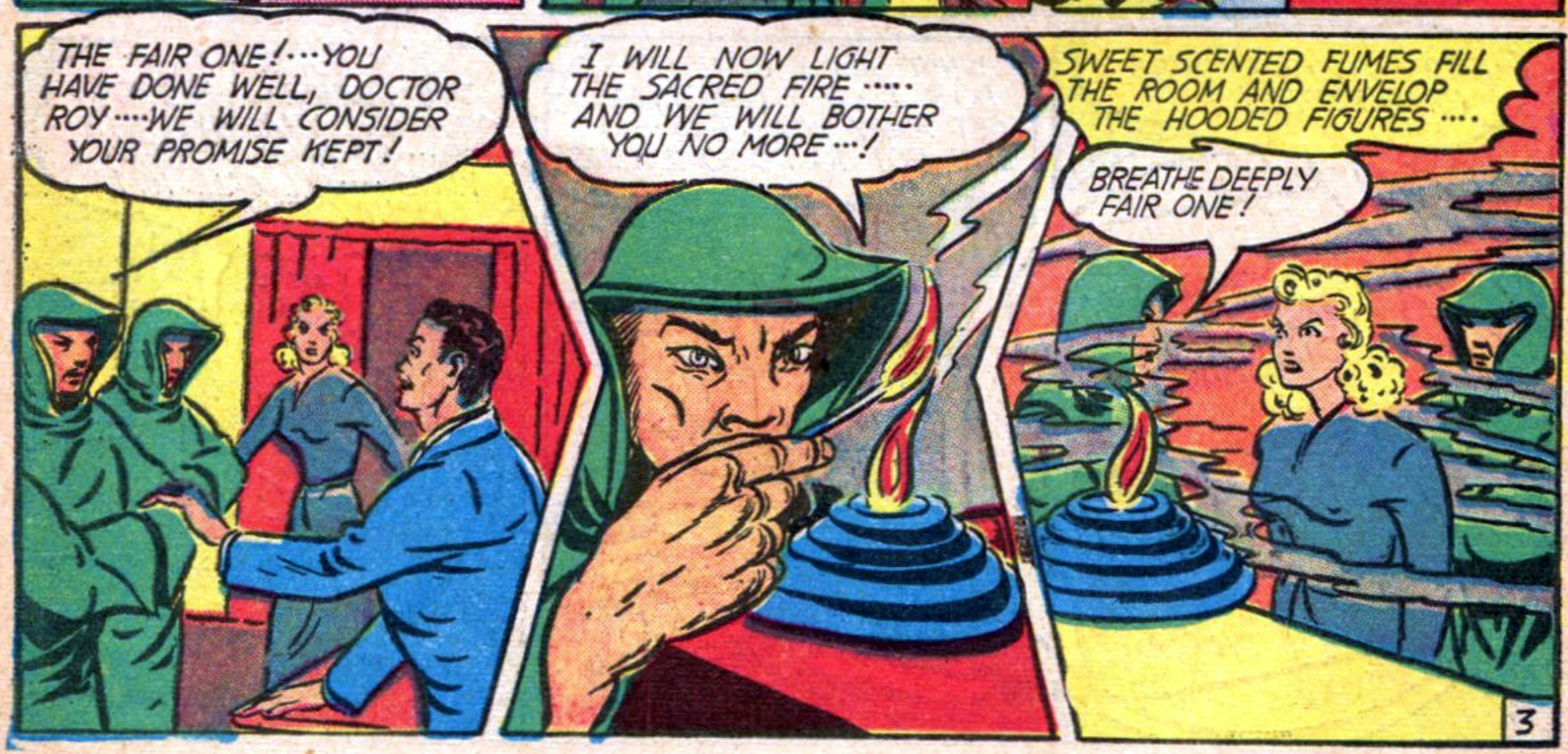
    The Hooded Men are a cult of Tibetan fire worshippers who show up one day and kidnap the daughter of the Flame’s friend Doctor Roy. This is a huge coincidence, as the Flame (as I’m sure you all remember) is also a member of a sect of Tibetan fire worshippers! How lucky for Doctor Roy and his child, No First Name Given!

    The Flame is able to follow the cult back to Tibet thanks to the fact that he, like they, can teleport himself through fire. Once there, he engages them in thrilling hand-to-hand combat and sends them all plummeting to the bottom of a cliff to explode, and while history tells us that attempting to settle which religion is best through violent conflict is a net negative proposition there is something very satisfying about this in a strict Fire Worshippers Power Ranking kind of way.

    So just why did the Hooded Men show up to steal Nameless Girlchild Roy anyway? Turns out that the Hooded Men offered Dr Roy shelter while he was backpacking around Asia in his youth and he had to promise that they could have his firstborn child in order to not be sacrificed himself, and he subsequently just… failed to mention this to either the child in question or his good friend who might be able to offer some crucial insight. Father of the year, folks.

    Categorized in: Misc (Cults), Origin (Ancient Tradition Followers), Powers (Elemental Teleportation)

  • GENERIC COSTUMED VILLAIN ROUND-UP 044

    GENERIC COSTUMED VILLAIN ROUND-UP 044

    Bored? Unemployed? Why not explore a career in low-tier supercrime? 

    the ABC Gang:

    I must regretfully inform you that the ABC Gang that is described here does not appear in this issue, as Spencer Steel and his pal Doakes instead get sidetracked by a different gang that is looking to rob the bank that they pegged as the logical next target in the ABCs’ pattern. This is a real shame, because “gang who robs banks in alphabetical order by name, but only if the town also conforms to alphabetical order” is a 1950s Batman villain-level of crime-as-compulsive puzzle and I would love to see a 1940s interpretation of that.

    Logically, Steel and Doakes would pick up the hunt for the ABC Gang in the next issue but no, they are completely forgotten by then. Golden Age comics, baybee! (Fight Comics 011, 1941)

    the Vultures:

    The Vultures, an elite Nazi air squadron, owe their success to the fact that they get all hopped up on “dope” (weed? heroin? are either of those going to help you do a dogfight? My lack of familiarity with both hard drugs and aerial combat is showing) before taking to the air.

    The Vultures show up to defend the German military assets that Chip Collins and what I will charitably still call the Skull Squadron are busy blowing up. Disappointingly, the fact that the Vulture leader is high as hell throughout the ensuing dogfight and parachute duel does not come up at all.  (Fight Comics 014, 1941)

    the Dust Bandits:

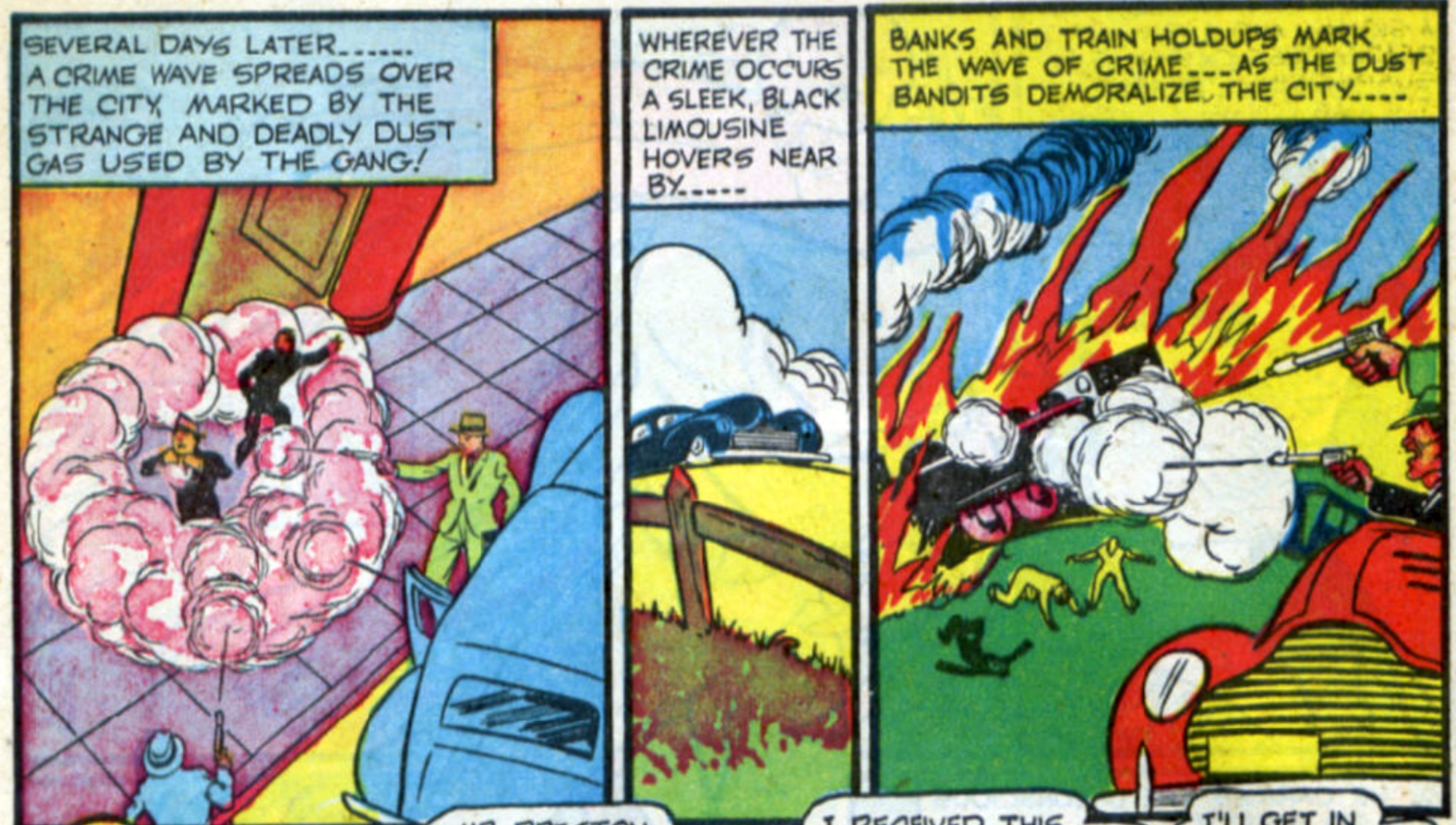
    When Professor Fraser’s incendiary dust gas bullets are rejected by the US Government for being a horrible war crime, he is determined to destroy the formula rather than, say, selling it to the Nazi Baron lurking in his home. Objecting to this lack of initiative, Fraser’s lab assistant and step-daughter conspire to kill him, then hook up with a crooked banker to organize the Dust Bandits, aka the Dust-Gas Gang, for a quick crime spree before taking the Baron up on his offer. As is so often the case with fire-based super-villains they find themselves opposed by a fire-based super-hero, in this case the Flame. (The Flame 007, 1941)

    the Leopard Men:

    To my shame, this instance of the Leopard Man trope marks the first time that I thought to look into whether there was a reason that it was so common in jungle fiction other than that leopards are cool. It turns out that as has so often been the case a cultural practice among a colonized people was vilified and outlawed as a part of the process of cultural subjugation. Leopard Societies appear to have filled a pretty diverse set of roles across West and Central Africa, ranging from pro-trade fraternal orders to vigilante groups, but thanks to sensationalist reporting and pulp writing we are going to keep on encountering them as generic jungle villains. 

    This particular bunch is after explorer Buck Johnson for some bullshit reason. (Great Comics 002, 1941)

  • PROBLEMATIC ROUND-UP 008

    Once again I must regretfully inform you that some comic books are problematic. Like, racially.

    the Laughing Hyenas: 

    Hey, it’s our first racial hate group, and I think I’m just going to preemptively file these under “problematic” because they’re a) not fun to talk about and b) necessitate talking about hate-crimes even if I, for example, choose not to use the panels with lynchings in them.

    The Laughing Hyenas are actually kind of a hate group by proxy, as they have been hired to keep the Black residents of the geographically-nonspecific town of Souda “in line” by murdering one of them every once in a while, and have been doing so frequently enough and/or long enough that even the local folks willing to volunteer for such a task have gotten sick of it, so boss Bull Karson had to import some Chicago toughguys to do his dirty work for him.

    Oddly, given the sheer volume of murder that the Laughing Hyenas were perpetrating, the Silver Streak doesn’t actually bring them in to the authorities ore even extra-judiciously kill them. Instead, he just dumps them on a slow boat to Rangoon. (Silver Streak Comics 013, 1941)

    the Modern Thief of Bagdad:

    Ali Hassan, aka the Modern Thief of Bagdad, is an Iraqi thief who comes to NYC to steal the Konoor Diamond, and as a result comes into conflict with Captain Battle and his young protege Hale Battle. A simple story that would ordinarily wrap up quite quickly, but this is a book-length yarn, which means that there is an extended chase sequence that occupies the 28 pages between the theft and Hassan’s arrival back in Baghdad. Some highlights:

    Chapter 1, “The Modern Thief of Bagdad!”: Hassan steals the gem, then give Battle and Hale the slip in Chinatown. Olyra, the mysterious guardian of the Konoor Diamond, is kidnapped.

    Chapter 2, “Perils of the Sargasso Sea!”: Hassan’s submarine becomes mired in sargassum and is attacked by a sea monster. Battle and Hale kill the beast. Hassan and his men dress up like ghost pirates. Olyra is rescued and then kidnapped again.

    Chapter 3, “Lost in the Underground World!”: Hassan’s plane crashes in Africa and he and Olyra are captured by cannibals (lil’ bonus racism for you there). Battle and Hale rescue them before being betrayed and dumped in a pit of quicksand. There is a brief interlude in an cave system full of monsters before it suddenly blows up. Hassan and his men dress up like ghosts. Olyra is rescued.

    Chapter 4, “House of Giants”: Battle & co track Hassan to a castle in Tibet, where they are captured and subjected to a shrink ray. They have various adventures as tiny men before resuming their original size. Olyra is kidnapped.

    I would call Hassan himself… an average amount of racist. He’s depicted in much the same generically foreign vein as I’ve seen in a South American president or a Basque fisherman (or indeed a Cape Breton fisherman at least once). As a villain, he’s pretty great: bombastic, treacherous, fond of leaving boastful notes for his enemies. If it was just him I might have skipped making this a Problematic Round-Up entry.

    It’s not just him, however, and once the story hits Chapter 5, “Magic Spell of the Arabian Nights” we get a real dose of Orientalism full in the face, as our heroes touch down in a Baghdad straight out of the Arabian Nights, complete with a wicked ruler (confusingly named Emperor Pasha Golu) who Hassan has been working for the whole time.

    It’s such a pastiche of a city, in fact, that Hale and Olyra just kind of stumble across Aladdin’s lamp and flying carpet while they are escaping from a dungeon. I suppose that all this is at least a little thematically appropriate, as Ali Hassan, the Modern Thief of Bagdad, is a reference to a movie that is a remake of a different movie that is itself a pastiche of the Arabian Nights.

    The Modern Thief of Bagdad meets his end in a pretty underwhelming manner: Captain Battle ducks as he swings a sword at him and he falls off of a balcony. A pretty terrible way to go for a villain who clearly thought that he was very cool, to be honest. The evil Pash Golu also meets his end in the process, leaving Olyra free to reveal that she is actually Olyria, Princess and true ruler of Bagdad. A truly impenetrable alias! 

    Finally, such is Hale Battle’s hunger for souvenirs that he uses his third genie with to acquire a replica of the diamond for his collection, even though for my money the real deal Lamp of Aladdin with one wish left on it would be the ultimate keepsake. (Captain Battle Comics 002, 1941)

    the King:

    The King is a fellow who gains control over a Romani group by showing them a… birthmark? tattoo? that proves his right to rule and that looks so intensely falsifiable that I am shocked there isn’t some sort two-factor authentication, or even a code phrase. And just what is is reason for exerting this control? Why, so that he can turn his new subjects into a child kidnapping ring. You can see how I would consider this problematic.

    The King is of course not the real ruler, that is not a real skull birthmark and he is no match for Dynamic Man. He turns out to be a crooked newspaper publisher named Brower who loves money more than making good plans to acquire it. (Dynamic Comics 002, 1941)

    the Dragon:

    The Dragon is a very ordinary Yellow Peril villain who is after some top secret bomber plans on behalf of an unspecified Asian nation. There are exactly four interesting things about him: 1) he is the first villain faced by Samson and David in their brief New Look era before they disappear along with most of Fox Features’ other characters during their financial trouble. 2) he is a classic calling card leaver in the form of a claw mark on the chests of men he has killed

     3) he works alongside his sister Orchid, which isn’t the rarest arrangement but is always fun to note

     4) he has these stone lions outside of his HQ that grab intruders as they come through. It’s a fun trap but never actually explained: are they some sort of mechanism, or demonic magic like the caption box suggests?

    Much of the issue in questioned is concerned with Samson chasing the Dragon and Orchid around. Once he catches up to them it’s all over. (Fantastic Comics 022, 1941)

  • PROBLEMATIC ROUND-UP 008

    Once again I must regretfully inform you that some comic books are problematic. Like, racially.

    the Laughing Hyenas: 

    Hey, it’s our first racial hate group, and I think I’m just going to preemptively file these under “problematic” because they’re a) not fun to talk about and b) necessitate talking about hate-crimes even if I, for example, choose not to use the panels with lynchings in them.

    The Laughing Hyenas are actually kind of a hate group by proxy, as they have been hired to keep the Black residents of the geographically-nonspecific town of Souda “in line” by murdering one of them every once in a while, and have been doing so frequently enough and/or long enough that even the local folks willing to volunteer for such a task have gotten sick of it, so boss Bull Karson had to import some Chicago toughguys to do his dirty work for him.

    Oddly, given the sheer volume of murder that the Laughing Hyenas were perpetrating, the Silver Streak doesn’t actually bring them in to the authorities ore even extra-judiciously kill them. Instead, he just dumps them on a slow boat to Rangoon. (Silver Streak Comics 013, 1941)

    the Modern Thief of Bagdad:

    Ali Hassan, aka the Modern Thief of Bagdad, is an Iraqi thief who comes to NYC to steal the Konoor Diamond, and as a result comes into conflict with Captain Battle and his young protege Hale Battle. A simple story that would ordinarily wrap up quite quickly, but this is a book-length yarn, which means that there is an extended chase sequence that occupies the 28 pages between the theft and Hassan’s arrival back in Baghdad. Some highlights:

    Chapter 1, “The Modern Thief of Bagdad!”: Hassan steals the gem, then give Battle and Hale the slip in Chinatown. Olyra, the mysterious guardian of the Konoor Diamond, is kidnapped.

    Chapter 2, “Perils of the Sargasso Sea!”: Hassan’s submarine becomes mired in sargassum and is attacked by a sea monster. Battle and Hale kill the beast. Hassan and his men dress up like ghost pirates. Olyra is rescued and then kidnapped again.

    Chapter 3, “Lost in the Underground World!”: Hassan’s plane crashes in Africa and he and Olyra are captured by cannibals (lil’ bonus racism for you there). Battle and Hale rescue them before being betrayed and dumped in a pit of quicksand. There is a brief interlude in an cave system full of monsters before it suddenly blows up. Hassan and his men dress up like ghosts. Olyra is rescued.

    Chapter 4, “House of Giants”: Battle & co track Hassan to a castle in Tibet, where they are captured and subjected to a shrink ray. They have various adventures as tiny men before resuming their original size. Olyra is kidnapped.

    I would call Hassan himself… an average amount of racist. He’s depicted in much the same generically foreign vein as I’ve seen in a South American president or a Basque fisherman (or indeed a Cape Breton fisherman at least once). As a villain, he’s pretty great: bombastic, treacherous, fond of leaving boastful notes for his enemies. If it was just him I might have skipped making this a Problematic Round-Up entry.

    It’s not just him, however, and once the story hits Chapter 5, “Magic Spell of the Arabian Nights” we get a real dose of Orientalism full in the face, as our heroes touch down in a Baghdad straight out of the Arabian Nights, complete with a wicked ruler (confusingly named Emperor Pasha Golu) who Hassan has been working for the whole time.

    It’s such a pastiche of a city, in fact, that Hale and Olyra just kind of stumble across Aladdin’s lamp and flying carpet while they are escaping from a dungeon. I suppose that all this is at least a little thematically appropriate, as Ali Hassan, the Modern Thief of Bagdad, is a reference to a movie that is a remake of a different movie that is itself a pastiche of the Arabian Nights.

    The Modern Thief of Bagdad meets his end in a pretty underwhelming manner: Captain Battle ducks as he swings a sword at him and he falls off of a balcony. A pretty terrible way to go for a villain who clearly thought that he was very cool, to be honest. The evil Pash Golu also meets his end in the process, leaving Olyra free to reveal that she is actually Olyria, Princess and true ruler of Bagdad. A truly impenetrable alias! 

    Finally, such is Hale Battle’s hunger for souvenirs that he uses his third genie with to acquire a replica of the diamond for his collection, even though for my money the real deal Lamp of Aladdin with one wish left on it would be the ultimate keepsake. (Captain Battle Comics 002, 1941)

    the King:

    The King is a fellow who gains control over a Romani group by showing them a… birthmark? tattoo? that proves his right to rule and that looks so intensely falsifiable that I am shocked there isn’t some sort two-factor authentication, or even a code phrase. And just what is is reason for exerting this control? Why, so that he can turn his new subjects into a child kidnapping ring. You can see how I would consider this problematic.

    The King is of course not the real ruler, that is not a real skull birthmark and he is no match for Dynamic Man. He turns out to be a crooked newspaper publisher named Brower who loves money more than making good plans to acquire it. (Dynamic Comics 002, 1941)

    the Dragon:

    The Dragon is a very ordinary Yellow Peril villain who is after some top secret bomber plans on behalf of an unspecified Asian nation. There are exactly four interesting things about him: 1) he is the first villain faced by Samson and David in their brief New Look era before they disappear along with most of Fox Features’ other characters during their financial trouble. 2) he is a classic calling card leaver in the form of a claw mark on the chests of men he has killed

     3) he works alongside his sister Orchid, which isn’t the rarest arrangement but is always fun to note

     4) he has these stone lions outside of his HQ that grab intruders as they come through. It’s a fun trap but never actually explained: are they some sort of mechanism, or demonic magic like the caption box suggests?

    Much of the issue in questioned is concerned with Samson chasing the Dragon and Orchid around. Once he catches up to them it’s all over. (Fantastic Comics 022, 1941)