The Curse of Skeleton Munroe

Category: magic

  • MINOR SUPER-HERO ROUND-UP 103

    Soon there will be more minor super-heroes than there are humans for them to protect.

    the Sentinel:

    In 1783, on the Boston Common, the newly-minted Spirit of America charges a cannon with the “powders of patriotism” in anticipation that someday a champion will be needed to defend the new nation from destruction. Finally, in 1941 (the Civil War not, apparently, being enough of a reason), the cannon fires on its own and releases the Sentinel, mystic champion of the American people.

    As one might expect, the Sentinel is broadly superhuman: he can fly, is super strong and is immune to most harm. He also has a halo of fire that he can disappear into and shrink to a tiny flame, effectively rendering him invisible and allowing him to vex friend and foe alike with his comings and goings. Oddly, he has no other control over fire. (Liberty Scouts Comics 003, 1941)

    Doctor Nemesis:

    Doctor Nemesis is really Dr Jim Bradley, intern at Mercy Hospital in an unnamed city (that is probably meant to be NYC but later retconned as San Francisco) who has developed a foolproof truth serum and decided to keep it to himself rather than risk criminals getting their hands on it – presumably the concern is that they would use it to learn bank vault combinations and other secret information. Since he himself continually runs into situations in which a foolproof truth serum is a handy way to solve a crime, Bradley adopts a costumed identity and sets out to achieve a better tomorrow via a series of injections. 


    Doctor Nemesis might just be the most calling card-using super-person who we have yet encountered. He hands out at least four of them in his first adventure alone.

    Doctor Nemesis has a pretty simple crimefighting routine: identify a potential injustice and then drug everyone involved until he has a clear idea of who is responsible, then beat them up and have them give a drugged confession in front of a police witness. The police in turn are perfectly happy to receive these confessions that they technically haven’t coerced from people, though there has to be a clever defense attorney somewhere in Unnamed City who is just waiting to get a Doctor Nemesis client so that they can really dig into the admissibility of admissions given under the influence of mysterious vigilante juice.

    It’s been a while since we have encountered a character who was later revived and incorporated into the Battle-Axis, Marvel’s team of disaffected public domain Golden Age super-heroes who went over to the Nazis, but Doctor Nemesis here is one of them under the technically-but-not-really more badass name of Dr Death. As always, it’s hard to say just who got done dirtiest by Roy Thomas when he was assembling the Battle-Axis roster but Doctor Nemesis is certainly a candidate, if only because he doesn’t even have the Human’s Meteor’s flimsy “I’m Irish American and fuck the British” or the Spider Widow’s “the Commies killed my husband” excuses. Instead, he simply implies that the Nazis are paying him well.

    Subsequent writers (specifically Matt Fraction, if I have things right) clearly thought that Doctor Nemesis was worth revisiting. He was given a long career as a Nazi hunter to counteract his short career as a Nazi and briefly became a core X-Man, though nowadays every time I look up what he’s up to it seems that he has become weirder and more peripheral to the action than the last. (Lightning Comics v1 006, 1941)

    Lash Lightning **UPDATE**:

    I haven’t been very careful to delineate whether the character has been going by “Flash” or “Lash” Lightning due to the fact that it profoundly does not matter (they just call him “Lightning” in the stories themselves, for instance) but I might as well make note of this, the issue in which the actual change was made. (Lightning Comics v2 002, 1941)

    Marvo the Magician **UPDATE**:

    Up until the exact point pictured above, Marvo the Magician was unique among magical comic book super-heroes, for though many of them (including Zatara, the big cheese himself) are said to be using their magic to create illusions and fool the minds of others, it is all demonstrably lies (or more charitably a different definition of “illusion” than I am using), as they all produce material effects in the world. Only pure, beautiful Marvo can claim that he uses illusions and nothing more to frighten and confound his foes, and I have been checking.

    That is, up to this issue, when Marvo creates the “illusion” of an ocean liner (complete with a crooked sailor who kidnaps her and hands her over to pirates!) that the woman he is helping proceeds to board and sail away on. Unless the implication is that she has been so convinced that the liner exists that she has swum or perhaps hovered her way to her destination (well, part way to her destination), the inescapable fact is that this ship is more than a mere illusion. Nothing is certain in this wicked world, folks. (Lightning Comics v2 003, 1941)

  • MINOR SUPER-VILLAIN 997: THE ZOMBIE WITCH

    (Jungle Comics 024, 1941)

    The Zombie Witch (aka the Queen of the Zombies, aka Celie) is, as the name suggests, a witch with a penchant for raising the dead – often while they are still actively being mourned. She demonstrates a few other magic powers (e.g., scrying in a bowl of water, crocodile charming) but the zombie thing is her bread and butter.

    So what, specifically, does she want a bunch of reanimated corpses for? Well! I won’t say that it’s for a good reason but it certainly an innovative one: Celie has pulled a con on some unscrupulous fellows and convinced them that a worthless mountain is full of gold, and is now going to sell them zombie labour to work the mines. It’s not a bad way to use up surplus zombies, if you ignore the horror.

    Tabu of course objects to the fraud just as hard as he does to the necromancy, and wastes no time in ratting the Zombie Witch out to her clients. They in turn waste no time in murdering her, but not before she orders her zombies to “kill the white men,” thus in turn sealing their dooms. Only Tabu makes it out alive.

    Categorized in: Accessories (Henchmen (Zombies)), Careers in Magic (Witches), Fraud (Con Artistry)

  • MINOR SUPER-VILLAIN 997: THE ZOMBIE WITCH

    (Jungle Comics 024, 1941)

    The Zombie Witch (aka the Queen of the Zombies, aka Celie) is, as the name suggests, a witch with a penchant for raising the dead – often while they are still actively being mourned. She demonstrates a few other magic powers (e.g., scrying in a bowl of water, crocodile charming) but the zombie thing is her bread and butter.

    So what, specifically, does she want a bunch of reanimated corpses for? Well! I won’t say that it’s for a good reason but it certainly an innovative one: Celie has pulled a con on some unscrupulous fellows and convinced them that a worthless mountain is full of gold, and is now going to sell them zombie labour to work the mines. It’s not a bad way to use up surplus zombies, if you ignore the horror.

    Tabu of course objects to the fraud just as hard as he does to the necromancy, and wastes no time in ratting the Zombie Witch out to her clients. They in turn waste no time in murdering her, but not before she orders her zombies to “kill the white men,” thus in turn sealing their dooms. Only Tabu makes it out alive.

    Categorized in: Accessories (Henchmen (Zombies)), Careers in Magic (Witches), Fraud (Con Artistry)

  • MINOR SUPER-VILLAIN 991: ZIRA

    (Jungle Comics 013, 1941)

    While searching for her champion Sir Champion (annoying thing to have to write and the main reason I’m happy that he eventually fades into obscurity), who has failed to return from a hunt, Camilla, Queen of the Lost Empire is confronted by the ghostly vision of a blonde lady who rules an ancient lost castle. This is just a kind of person you get in the undefined part of Africa that houses the Lost Empire.

    The lady’s name, by the way, is Zira, Princess of the Palace of the Black Heart. She also refers to herself as a “wizardess,” and while I am generally of the opinion that gendered job titles like that are retrograde and unhelpful I must admit to being charmed. Wizardess!

    This vision leads Camilla back to the aforementioned Palace of the Black Heart, where her mortal form is revealed to be a middle-aged lady, or “old hag” as our hero so tactfully puts it. Zira states that Sir Champion is locked up in her dungeon and she will return him in exchange for all of Camilla’s magic powers. The sum total of these powers, from my notes, being the ability to talk to gorillas and the power to call upon Thor and Baal to freeze someone. Frankly not a bad trade for someone’s life. Do we include her eternal life? She got that from a potion, after all.

    Camilla evidently wishes to continue to speak to apes and so she and her men battle with Zira’s forces until they are ironically defeated by some apes.

    It then turns out that Camilla has more tricks up her sleeve than I had in my notes. She offers to brew up a potion to make Zira good looking in exchange for freedom for her and her men, and since this is the same comic that made a point of calling Zira a wizardess, she is of course very vain by default and takes the deal immediately.

    The thing about taking advantage of a woman’s default vanity in such a comic is of course the fact that the vain woman will also be extremely fickle, as seen when the newly-hot Zira reneges on her deal in favour of keeping Sir Champion for her own horny purposes. Things quickly turn violent and Sir Champion is forced to slay Zira to save Camilla’s life. All in all it’s a real eleventh-hour fumble on Zira’s part.

    Categorized in: Accessories (Castles), Genrica (Ends in -a), Powers (Various Magics)

  • MINOR SUPER-VILLAIN 988: FORD

    MINOR SUPER-VILLAIN 988: FORD

    (Jackpot Comics 003, 1941)

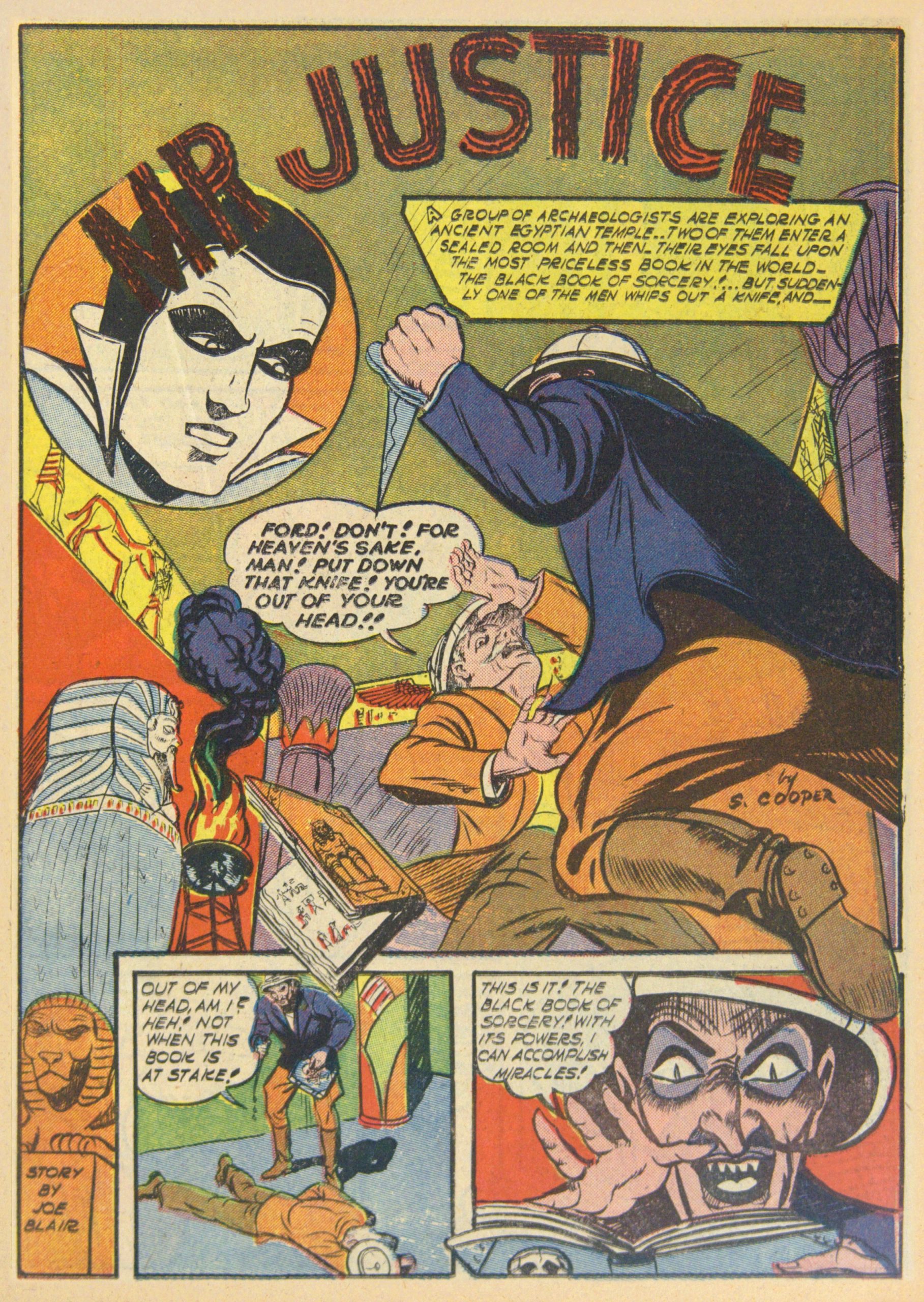
    We meet Ford for the first time as he is knifing his fellow archaeologist Baker to death in an ancient Egyptian tomb, in order to be the sole possessor of the fabled Black Book of Sorcery which they have just found.

    Two points about Ford right off the bat: 1. he is only ever called Ford. No first name, even! This is what I get for grumbling internally about how boring William Scott’s name was. 2. He looks like the Devil. This makes sense in the context of a Mr Justice comic, as artist Sam Cooper was never shy about tying one’s morality to their appearance, but in-universe, is it a reflection of the corruption of his soul or was he always that one archaeologist who looked like Satan?

    Having secured the Black Book of Sorcery, Ford is now subject to critiques of how he uses it. His first effort involves raising the mummies that are housed in the temple from the dead in order to murder the remaining six archaeologists in the expedition and thus cover up his crime. I would call this a rash act, but then again I would probably try stealing the book before committing murder in the first place. I suppose Ford and I are just different people.

    Next, he covers up the mummy murders by collapsing the entire temple on top of the bodies. This is a pretty wild stunt for an archaeologist of all people to pull, and on top of that it’s not even a great way to conceal some bodies, as rubble is famously clearable. It’s also a waste of a number of perfectly good mummies, mummies who might have been some help in cleaning up a crime scene.

    Having made his way back to the unnamed city that both he and Mr Justice call home, Ford attempts to profit off of his new mastery of the necromantic arts by raising deceased millionaire’s son John Grant from the dead to hit up his parents for a loan. Ethical considerations aside, this kind of thing isn’t the worst way to make some dough via dark magic: you could emotionally blackmail the parents with the thought of their child being condemned to a miserable half-dead existence, or maybe use privileged family information to commit some sort of financial fraud or very precise burglary, for example. 

    Ford just sends Grant to bust down the front door and demand cash, which is a total bust as Grant’s parents are left feeling more existentially horrified than inclined to pay out.  Honestly, if smash-and-grab stuff like this is all that you’re going to use necromancy for you might as well stick with the squad of beefcake mummies rather than raising up bespoke dead guys for every job.

    This is the point that Mr Justice gets involved in the story, by the way. You can’t do dark majick inside the borders of [CITY NAME NOT FOUND] and hope to escape his gaze.

    For his final trick, Ford summons the very off-model spirit of Nero, “the most horrible tyrant the world has ever known” as a counter to Mr Justice. Nero in turn proposes a sort of ghost road trip to the Edge of Infinity to access the Immunity Vacuum and become immortal in a way that is distinct from the immortality already enjoyed by the souls of the dead in the Mr Justice cosmology.

    Perhaps the Immunity Vacuum confers a version of immortality that prevents one’s soul from being beaten up by another ghost and thrown into the “depths of eternal nothingness,” never to emerge, and if it is it’s too bad for Ford and Nero that the latter’s chariot isn’t faster because that’s exactly what Mr Justice does to them.

    Unsurprisingly, this kills Ford’s body, which makes it simplicity itself for Mr Justice to collect the Black Book of Sorcery and use the convenient self-destruct spell that it holds to render it blank.

    Categorized in: Accessories (Book of Magic), Day Jobs (Archaeologists), Supercrime (Necromancy)

  • MINOR SUPER-VILLAIN 988: FORD

    (Jackpot Comics 003, 1941)

    We meet Ford for the first time as he is knifing his fellow archaeologist Baker to death in an ancient Egyptian tomb, in order to be the sole possessor of the fabled Black Book of Sorcery which they have just found.

    Two points about Ford right off the bat: 1. he is only ever called Ford. No first name, even! This is what I get for grumbling internally about how boring William Scott’s name was. 2. He looks like the Devil. This makes sense in the context of a Mr Justice comic, as artist Sam Cooper was never shy about tying one’s morality to their appearance, but in-universe, is it a reflection of the corruption of his soul or was he always that one archaeologist who looked like Satan?

    Having secured the Black Book of Sorcery, Ford is now subject to critiques of how he uses it. His first effort involves raising the mummies that are housed in the temple from the dead in order to murder the remaining six archaeologists in the expedition and thus cover up his crime. I would call this a rash act, but then again I would probably try stealing the book before committing murder in the first place. I suppose Ford and I are just different people.

    Next, he covers up the mummy murders by collapsing the entire temple on top of the bodies. This is a pretty wild stunt for an archaeologist of all people to pull, and on top of that it’s not even a great way to conceal some bodies, as rubble is famously clearable. It’s also a waste of a number of perfectly good mummies, mummies who might have been some help in cleaning up a crime scene.

    Having made his way back to the unnamed city that both he and Mr Justice call home, Ford attempts to profit off of his new mastery of the necromantic arts by raising deceased millionaire’s son John Grant from the dead to hit up his parents for a loan. Ethical considerations aside, this kind of thing isn’t the worst way to make some dough via dark magic: you could emotionally blackmail the parents with the thought of their child being condemned to a miserable half-dead existence, or maybe use privileged family information to commit some sort of financial fraud or very precise burglary, for example. 

    Ford just sends Grant to bust down the front door and demand cash, which is a total bust as Grant’s parents are left feeling more existentially horrified than inclined to pay out.  Honestly, if smash-and-grab stuff like this is all that you’re going to use necromancy for you might as well stick with the squad of beefcake mummies rather than raising up bespoke dead guys for every job.

    This is the point that Mr Justice gets involved in the story, by the way. You can’t do dark majick inside the borders of [CITY NAME NOT FOUND] and hope to escape his gaze.

    For his final trick, Ford summons the very off-model spirit of Nero, “the most horrible tyrant the world has ever known” as a counter to Mr Justice. Nero in turn proposes a sort of ghost road trip to the Edge of Infinity to access the Immunity Vacuum and become immortal in a way that is distinct from the immortality already enjoyed by the souls of the dead in the Mr Justice cosmology.

    Perhaps the Immunity Vacuum confers a version of immortality that prevents one’s soul from being beaten up by another ghost and thrown into the “depths of eternal nothingness,” never to emerge, and if it is it’s too bad for Ford and Nero that the latter’s chariot isn’t faster because that’s exactly what Mr Justice does to them.

    Unsurprisingly, this kills Ford’s body, which makes it simplicity itself for Mr Justice to collect the Black Book of Sorcery and use the convenient self-destruct spell that it holds to render it blank.

    Categorized in: Accessories (Book of Magic), Day Jobs (Archaeologists), Supercrime (Necromancy)

  • MINOR SUPER-VILLAIN 986: THE ZOMBIE MASTER

    (Jackpot Comics 001, 1941)

    Zarro, the Zombie Master, is yet another take on an evil Haitian voodoo practitioner: we’ve seen ’em before and we’ll see ’em again. He is recruited by a couple of pseudo-Nazis named Karl Bezdek and Hugo Kempf for help in setting up a factory that uses zombies as workers in the production of war material for the Axis. Like the other Zombie Master we have covered, this one is a vibrant shade of green, just like a cartoon zombie, though I’m not entirely sure when that particular colour association started.

    I am going to lay out Karl and Hugo’s plan before telling you why I’m mad about it:

    1. Pose as magazine photographers in order to get total access to the defense factories in the as-yet unnamed city that Mr Justice calls home (the risk of targeting a city with a super-hero is leavened by the fact that it has the world’s most gullible mayor).

    2. Photograph as many workers as possible.

    3. Zarro uses the photographs as sympathetic magic links to the workers (plucking them out of the photographs = very cool) and kills them.

    4. The worker’s bodies are stolen and shipped to Haiti for use in the factory.

    So why does this plan make me mad? Because I want to critique it but I can’t. See, it’s a bad and inefficient plan with a lot of unnecessary steps, but only if the only goal is to make money. But that isn’t the goal! Karl and Hugo are spies for a fascist nation! Their goal is to hamper US war production while simultaneously boosting that of their own country using the Haitian zombie factory, and they have done both! It’s maddening! The only real flaw I can find is that the graverobbing and body shipping are a bit involved but I can’t really think of a good alternative that doesn’t introduce more points of failure to the plan.

    The risk of super-hero vs reward of gullible mayor calculation that we discussed earlier does in fact prove to be the trio’s downfall, as Mr Justice is able to make his way to Haiti (and please note the surprisingly grody-looking zombies that he finds there) thanks to a minor kidnapping subplot and strangle the Zombie Master, which in turn restores the workers to life. One smashed up Axis factory later, everyone is on the way back to [CITY NAME NOT FOUND].

    Categorized in: Generica (Masters), Powers (Magic (Create Zombies)), Supranormal Beings (Zombies))

  • MAD AND CRIMINAL SCIENTIST ROUND-UP 025

    I feel like we could avoid some of this unpleasantness if we made the Mad Arts a required part of the curriculum again.

    Unnamed Sorcerer:

    The Golden Knight and Alice are up to some good old-fashioned adventure, as they travel into the land of Kongola to seek out the cause of mysterious disappearances of people in adjoining Kooran. Just where are Kongola and Kooran? I’m going to say somewhere in what is now the United Kingdom since that that is where the Golden Knight is headquartered, but they could literally be anywhere given that he has started visiting his supernatural brothers in-law on the Moon and the Sun and thus has an interplanetary range.

    Kongola turns out to be a good place for adventure, as it is filled with magical and monstrous threats including:

    – hypnotic illusions

    – carnivorous trees hiding behind those illusions

    – club-wielding minotaurs

    – giant bats

    – ape men, who manage to carry off Alice

    Pressing on, the Golden Knight arrives at a huge tower that he says has been built by the enslaved people of Kooran, but I never see them.

    So just who is responsible for the kidnappings, the tower and the monsters? Why, this insane magician, who claims to have done it all so that he can be safe from floods and then promptly jumps off the tower into a… lake? and drowns. More importantly, why is he listed here in the space reserved for low-rent mad scientists? Because while comic book magic users fill a very similar ecological niche as super-scientists they don’t have as great a population and consequently a far lesser rate of one-note losers, and I had to put him somewhere. (Fantastic Comics 019, 1941)

    the Professor:

    The Professor is a hypnotist of some stripe who uses his powers to turn lawmen into agents of his gang. He meets his match in detective Spencer Steel, who as a comic book protagonist is of course immune to such feeble things as mind control and quickly turns the tables on his would-be master. (Fight Comics 011, 1941)

    Unnamed Scientist:

    Though this unnamed scientist talks a bit like a kindly mentor who gives you super-powers in order to save mankind from aliens etc, in practice he just has a kid tied up in his jungle compound who he feeds potions to. Perhaps he had some sort of important plan that would justify this behaviour but if so it is lost to the ages when he wanders out into the jungle to get hilariously killed by an extremely jumpy snake.

    The poor kid, meanwhile, grows into a giant and aimlessly wanders the countryside battling various world militaries until Power-Man shows up and tosses a bomb at his gut. It’s a bummer ending that wouldn’t happen in most comics and I kind of respect it. (Fight Comics 012, 1941)

    Dr Moluk:

    Dr Moluk and his assistant Scorpo have developed a machine that takes germs and bacteria and assembles them into multicellular organisms that resemble golden dragon-dogs. He intends to use these creatures to sow mass panic and ultimately take over the world. An evil plan, but a cool one. 

    Unfortunately for Moluk, his assigned heroic enemy is Guy Gorham, who is billed as the World’s Greatest Chemist but acts like the World’s Most Thorough Ass-Kicker. He busts in, beats ten kinds of hell out of Moluk and Scorpo, and ends up feeding the former to his own dragons. It honestly feels like bullying by the end. (Great Comics 001, 1941)

  • MINOR SUPER-VILLAIN 955: THE YELLOW SPOT

    (Dynamic Comics 001, 1941)

    Scientists across the US are going missing, kidnapped by  the magical madman known as the Yellow Spot!

    This brain-draining crime spree inspires the magical scholar Professor Moore to create the super-hero Dynamic Man, which in turn inspires the Yellow Spot to murder Professor Moore. He is just a wee bit too late, however, and instead of preventing the creation of Dynamic Man he merely provides him with a bit of extra motivation in the form of a dying father figure.

    But just why is the Yellow Spot after these men of science? Why, to push back against the death of superstition (very funny in retrospect, as in out world the avowed hyper-rationalism of the 40s and 50s gave way to the mystic syncretism of the 60s and ultimately to the proud anti-science of today). He’s got a machine that shrinks a man’s head and renders him like unto a child, and presumably he plans to keep on shrinking heads until it has an effect on the global scientific consensus.

    Dynamic Man shows up just in time to witness a head shrinking, and while it looks to be a pretty uneven contest at first, he is captured in a net made of woven black magic (very cool) that can only be cut using a knife “forged from the bones of a dying murderer” (even cooler, if hard to imagine).

    The thing about a net that can only be cut by a special knife is that it’s only as effective as your ability to keep that knife away from your prisoner, and I would argue that leaving it unattended on a table in the same room as the prisoner while a bunch of easily suggestible man-children wander around is tantamount to just handing it over. Which is a long-winded way of saying that Dynamic Man gets free with the help of a headshrunken scientist and starts beating up the Yellow Spot’s men.

    The Yellow Spot makes a break for it, but in an eleventh hour bit of plot contrivance it turns out that his bat form (i.e., the main way he gets around) is also the only form in which he can be harmed, and as it flies slower than Dynamic Man, he ends up as a flat bat. Personally, I would sacrifice a bit of convenience to avoid being squashed on the wing like this, but then again I am not an insane magic man.

    Finally, I would like to highlight the Yellow Spot’s minions, a bunch of low-grade monster men who he calls the Hideous Ones at least once. Particularly that last fellow, who I swear has half a mustache. A bold choice!

    Categorized in: Abstract Concepts (Shapes), Colours (Yellow), Origins (Henchmen)

  • MINOR SUPER-VILLAIN 955: THE YELLOW SPOT

    (Dynamic Comics 001, 1941)

    Scientists across the US are going missing, kidnapped by  the magical madman known as the Yellow Spot!

    This brain-draining crime spree inspires the magical scholar Professor Moore to create the super-hero Dynamic Man, which in turn inspires the Yellow Spot to murder Professor Moore. He is just a wee bit too late, however, and instead of preventing the creation of Dynamic Man he merely provides him with a bit of extra motivation in the form of a dying father figure.

    But just why is the Yellow Spot after these men of science? Why, to push back against the death of superstition (very funny in retrospect, as in out world the avowed hyper-rationalism of the 40s and 50s gave way to the mystic syncretism of the 60s and ultimately to the proud anti-science of today). He’s got a machine that shrinks a man’s head and renders him like unto a child, and presumably he plans to keep on shrinking heads until it has an effect on the global scientific consensus.

    Dynamic Man shows up just in time to witness a head shrinking, and while it looks to be a pretty uneven contest at first, he is captured in a net made of woven black magic (very cool) that can only be cut using a knife “forged from the bones of a dying murderer” (even cooler, if hard to imagine).

    The thing about a net that can only be cut by a special knife is that it’s only as effective as your ability to keep that knife away from your prisoner, and I would argue that leaving it unattended on a table in the same room as the prisoner while a bunch of easily suggestible man-children wander around is tantamount to just handing it over. Which is a long-winded way of saying that Dynamic Man gets free with the help of a headshrunken scientist and starts beating up the Yellow Spot’s men.

    The Yellow Spot makes a break for it, but in an eleventh hour bit of plot contrivance it turns out that his bat form (i.e., the main way he gets around) is also the only form in which he can be harmed, and as it flies slower than Dynamic Man, he ends up as a flat bat. Personally, I would sacrifice a bit of convenience to avoid being squashed on the wing like this, but then again I am not an insane magic man.

    Finally, I would like to highlight the Yellow Spot’s minions, a bunch of low-grade monster men who he calls the Hideous Ones at least once. Particularly that last fellow, who I swear has half a mustache. A bold choice!

    Categorized in: Abstract Concepts (Shapes), Colours (Yellow), Origins (Henchmen)