The Curse of Skeleton Munroe

Category: theft

  • MINOR SUPER-VILLAIN 846: THE WIZARD

    (Weird Comics 003, 1940)

    The Wizard is the first of five villains to challenge the Sorceress of Zoom for the role of top villain in her own dang feature. He is unique among that group for being the only villain in the story he appears in, as while the rest of his peers come at the Sorceress while she is engaged in some nefarious activity, the Wizard shows up while she is peacefully hanging out with her friend Allan. 

    Once the Wizard’s weird humanoids have slaughtered all of the citizens of Zoom, he smashes the Sorceress’ never-before-seen magic mirror, which in this story only is the source of her magical power. He then absconds with the entire damn city.

    The Sorceress and Allan set out to restore the mirror by re-forging it in the heart of a volcano, only to find the Wizard and his goons waiting on the rim of the caldera to beat them up.

    This turns out to be a bad decision on the Wizard’s part, as the Sorceress is able to perform an extremely sick move that is let down somewhat by the art, wherein she leaps into the volcano holding the mirror and is thus able to use her magic to fly back out/become immune to flame/heal her horrific wounds once it re-forms. And the volcano does double duty, since she is able to dispose of the Wizard in there!

  • MINOR SUPER-VILLAIN 768: THE PURPLE PLAGUE

    (Startling Comics 001, 1940)

    Shortly after acquiring his super powers, Andrew “Captain Future” Bryant uses them to sniff out a criminal conspiracy to rob a gold shipment from the nation of Finvania and then use that capital to finance a bid for world domination by someone called the Purple Plague. Exactly the sort of thing that a fledgling super-hero is going to be against!

    Captain Future spends the bulk of the issue in a back-and-forth tussle with the Purple Plague’s henchmen (called variously the Purple Plague Mob, the Followers of the Purple Plague and the very cool Knights of the Purple Plague), and also with the not-very-genre-savvy police, who keep thinking that the brightly-dressed superhuman is doing the crimes instead of the horde of concussed gangsters littering the landscape around him.

    Future does eventually locate the actual Purple Plague himself and at that point it’s just a case of one übermensch versus a room full of regular guys plus one older guy in a robe. Even a gang of moderately cool-looking killbots barely slows down the inevitable mass pummelling.

    As a side note, one of the Knights of the Purple Plague is Andrew Bryant’s boss, Mr Devlin, who fires Bryant as a cost-cutting measure and thus inspires him to pursue the reckless line of research that ends with the accident that turns him into Captain Future. Was Devlin cutting costs in order to funnel profits from the Pacific Electrical Corporation to the Purple Plague, or was the Plague’s brand of villainy just an attractive prospect to a small-minded capitalist like Devlin? Either way this is a classic case of the villain inadvertently creating the hero who would destroy them.

  • MINOR SUPER-VILLAIN 338: THE BANDIT FORCE

    (Master Comics 004, 1940)

    This is a simple one because it’s simply a matter of scale, plus the fact that everyone involved is wearing a stylish purple cloak/ robe combo. A mass of bandits loot arsenals across the Eastern US, stealing tanks, artillery and armoured cars. Panic ensues!

    Soon enough, the band makes its goals known with a bold attack on that sweetest of targets: Fort Knox. And they almost get away with it! They actually have the gold loaded up and are speeding away before second-rate Fawcett character Master Man shows up and absolutely ruins everyone’s day.

    And of course the leader of the pack turns out to be the unnamed altruistic banker who somehow manages to sit in on every meeting about how to deal with the situation. What a surprise!

    ADDENDUM: I absolutely forgot to mention the most notable if underplayed thing about these guys: they use golden bullets for some unstated reason. A bizarre choice for a buncha gold thieves!

  • MINOR SUPER-VILLAIN 338: THE BANDIT FORCE

    (Master Comics 004, 1940)

    This is a simple one because it’s simply a matter of scale, plus the fact that everyone involved is wearing a stylish purple cloak/ robe combo. A mass of bandits loot arsenals across the Eastern US, stealing tanks, artillery and armoured cars. Panic ensues!

    Soon enough, the band makes its goals known with a bold attack on that sweetest of targets: Fort Knox. And they almost get away with it! They actually have the gold loaded up and are speeding away before second-rate Fawcett character Master Man shows up and absolutely ruins everyone’s day.

    And of course the leader of the pack turns out to be the unnamed altruistic banker who somehow manages to sit in on every meeting about how to deal with the situation. What a surprise!

    ADDENDUM: I absolutely forgot to mention the most notable if underplayed thing about these guys: they use golden bullets for some unstated reason. A bizarre choice for a buncha gold thieves!

  • MINOR SUPER-VILLAIN 331: THE LEGION OF DESPAIR

    (Human Torch v1 006, 1941)

    A fairly simple one today: am man named Haskell advertises for people with no hope in life, then selects the most desperate of them into a gang. Since they were all prepared to die already, the members of the Legion of Despair are prone to, say, blowing themselves up with grenades in order to see that their compatriots get away with whatever loot they’re scampering off with.

    Aside from this radical investment in the goals of the group, Haskell’s other thematic concept for the Legion is the Dice of Death, which are used to determine who goes on these potential suicide missions by who wins a game of craps (I think? It’s not exactly spelled out).

    It all comes tumbling down once the Human Torch and Toro get involved, because even with five guys willing to blow themselves up to ensure success there’s only so much you can do against a couple of fire men. Haskell turns out to have been cheating in order to avoid risking his life on missions but only after everyone has been captured, offering no real comeuppance other than, presumably, a bad reputation once they’re all in prison. Unsatisfying!

  • MINOR SUPER-VILLAIN 331: THE LEGION OF DESPAIR

    (Human Torch v1 006, 1941)

    A fairly simple one today: am man named Haskell advertises for people with no hope in life, then selects the most desperate of them into a gang. Since they were all prepared to die already, the members of the Legion of Despair are prone to, say, blowing themselves up with grenades in order to see that their compatriots get away with whatever loot they’re scampering off with.

    Aside from this radical investment in the goals of the group, Haskell’s other thematic concept for the Legion is the Dice of Death, which are used to determine who goes on these potential suicide missions by who wins a game of craps (I think? It’s not exactly spelled out).

    It all comes tumbling down once the Human Torch and Toro get involved, because even with five guys willing to blow themselves up to ensure success there’s only so much you can do against a couple of fire men. Haskell turns out to have been cheating in order to avoid risking his life on missions but only after everyone has been captured, offering no real comeuppance other than, presumably, a bad reputation once they’re all in prison. Unsatisfying!

  • MINOR SUPER-VILLAIN 259: THE POWER STEALERS

    (Hit Comics 008, 1941)

    I gotta say: I really like these guys. Now, obviously they’re stinkers of the highest order – their plan involves siphoning all electrical power in the US until they are paid an unspecified amount of big bucks or possibly even placed in charge – but when you spend a little (or a lot of) time thinking about supercrime in a super-hero universe you get opinions about these kinds of things. If these guys had developed this technology I’d have something to say about the risk/reward of crime vs commercial application, but they’re clearly a bunch of criminal goons and probably stole it, so using it for crime makes sense!

    Further, they are genre-savvy enough to recognize Hercules as the only super-hero in their particular pocket of the Quality Comics proto-universe. Setting out to preemptively take care of the super-opposition never actually works, but I always appreciate the effort involved.

    (also I love that they call Hercules a hick. So often the little interesting details about a character fall by the wayside – it’s great that Hercules is consistently the super-hero from the country)

    The guy in purple is a bad liar.

    The guy in green is a loveable jerk.

    The gang of shirtless goons is everything I could wish in a bunch of cannon-fodder henchmen, down to the guy with a knife clutched in his teeth.

    Finally (well, for my purposes. Finally finally, they get beat up), they actually have a plan! They manage to chuck Hercules into quick-drying cement and cheekily make him into a statue to be displayed on their front porch! And he’s there for weeks! Very good job, boys.

    (though if they hadn’t chiseled off all that extra cement then maybe he wouldn’t have managed to get free. Food for thought, dead fictional men)

  • MINOR SUPER-VILLAIN 237: CZAR THE UNKILLABLE MAN

    (Flash Comics v1 007, 1940)

    Like Echo or Hugo Strange’s Monster Men before him, Czar the Unkillable Man is arguably less a super-villain than a tool created by a super-villain, but where’s the fun in listing a buncha guys named Dr Samuels and Professor Tompkins or in this case Boris Nickaloff?

    Nickaloff is a bit of a mystery – he creates Czar by sculpting a complete human body – inside and out – out of “plasm-clay” and then shocking it to life with a shot of adrenaline. Is this meant to be mad science? Magic? A modern day Pygmalion story? No clues are given. Probably science if the adrenaline is any hint, but I prefer to think it’s reality-bending mad art.

    Nickaloff gets Czar to rob some banks and kill a bunch of people, and it’s here that he maybe turn out to be a bit less of a tool than old Echo after all, as he sets about his rampages with  a bit more gusto than is required. He also kidnaps Shiera Sanders in a fit of man-monster horniness, which is both telling and gross.

    Hawkman of course can’t let such wanton killing and reallocation of funds stand, and he eventually stumbles upon the Unkillable Man’s weakness: he still has to breathe. To be clear, he stumbles upon it because Nickaloff repeatedly states that it is Czar’s only weakness in a loud, clear voice, which favour Hawkman repays by killing the both of them via a set of bolas to the neck.

    (as seen above, Hawkman initially thinks that he is dealing with a vampire rather than a living statue and I must say that I love this kind of thing much much more than when the hero jumps to a wild conclusion that is correct. Keep up the dumbass guesses, Hawkman!)

    As an addendum, an honour! Hawkman gets a vote of thanks from the banks!

  • MINOR SUPER-VILLAIN 237: CZAR THE UNKILLABLE MAN

    (Flash Comics v1 007, 1940)

    Like Echo or Hugo Strange’s Monster Men before him, Czar the Unkillable Man is arguably less a super-villain than a tool created by a super-villain, but where’s the fun in listing a buncha guys named Dr Samuels and Professor Tompkins or in this case Boris Nickaloff?

    Nickaloff is a bit of a mystery – he creates Czar by sculpting a complete human body – inside and out – out of “plasm-clay” and then shocking it to life with a shot of adrenaline. Is this meant to be mad science? Magic? A modern day Pygmalion story? No clues are given. Probably science if the adrenaline is any hint, but I prefer to think it’s reality-bending mad art.

    Nickaloff gets Czar to rob some banks and kill a bunch of people, and it’s here that he maybe turn out to be a bit less of a tool than old Echo after all, as he sets about his rampages with  a bit more gusto than is required. He also kidnaps Shiera Sanders in a fit of man-monster horniness, which is both telling and gross.

    Hawkman of course can’t let such wanton killing and reallocation of funds stand, and he eventually stumbles upon the Unkillable Man’s weakness: he still has to breathe. To be clear, he stumbles upon it because Nickaloff repeatedly states that it is Czar’s only weakness in a loud, clear voice, which favour Hawkman repays by killing the both of them via a set of bolas to the neck.

    (as seen above, Hawkman initially thinks that he is dealing with a vampire rather than a living statue and I must say that I love this kind of thing much much more than when the hero jumps to a wild conclusion that is correct. Keep up the dumbass guesses, Hawkman!)

    As an addendum, an honour! Hawkman gets a vote of thanks from the banks!

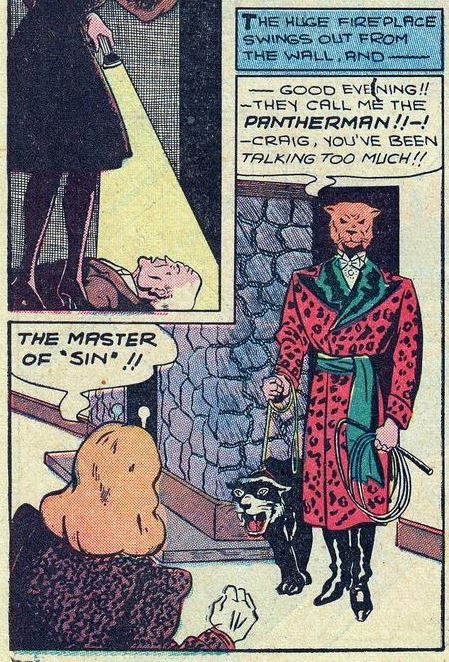
  • MINOR SUPER-VILLAIN 209: THE PANTHERMAN

    MINOR SUPER-VILLAIN 209: THE PANTHERMAN

    (Crackajack Funnies 031-033, 1941) 

    The first costumed foe to face Dell Comics’ answer to Batman, the Owl, Pantherman strikes a very impressive figure and knows how to make an entrance. He does seem to be a very sloppy operator, however, as he initially attracts the attention of the Owl after mind controlling a man into stealing his own jewels but not somehow thinking to keep him from calling in the police (and renowned private investigator Nick “the Owl” Terry, natch) afterward.

    Subsequent issues reveal that the Pantherman’s sloppiness is more a recent thing, as he has been operating out of the city’s sewers for at least the past 4 years and is well on his way to uniting the underworld with himself at the head. It doesn’t take much to ruin a promising crime career, however, and once the Owl is on the case, Pantherman is soon caught.