The Curse of Skeleton Munroe

Category: Lev Gleason

  • DIVINE ROUND-UP 028

    Religions of the world: you are not being well-represented in fiction.

    the Dream Warner: 

    While they never actually say the words “Tibetan Buddhism” in either of Thun-Dohr’s two appearances, he was brought up in a lamasery in Tibet and is personally mentored by the Dalai Lama (though not the one you’re thinking of), so I think that we can extrapolate and assign the Dream Warner to that religious tradition. Though it does not actually appear on-panel, the Dream Warner does give the Dalai Lama an accurate heads-up on the machinations of the villainous Sin Khaii, so me must conclude that it actually exists. It also has a very fun if on-the-nose name.

    God Style: Real (Silver Streak Comics 014, 1941)

    Ratzinatzi: 

    In Cloud Curtis’ final adventure he sets out alone to solve the mystery of some mysterious disappearances and air raids across South America, and ends up crashing his plane in the middle of the jungle. There he stumbles upon an idol to “Ratzinatzi, the Demon-God of the Ancient Incas” and is seemingly about to enter a chamber that opens up underneath it when the story ends. Sadly for all the completionists out there the story never concludes and so we never learn what kind of pseudo-Nazi air base or whatever lies below, though I think that we can safely assume that it continues to be pretty disrespectful to the Incas.

    God Style: Idol (Silver Streak Comics 017, 1941)

    the Devil-Flower:

    Trojak the Tiger Man’s friend Edith’s brother is sick, and according to the nearest wise man the only thing that will aid him is the juice of the sacred Devil-Flower, as worshipped by the Gemba tribe.

    Trojak and Edith brave fanatical cultists and flower-charmed animals until they are able to harvest the sacred juice and seemingly kill the plant. One can only hope that the Devil-Flower, which not only has magical powers but also seemingly some degree of self-awareness, had the foresight to do a little precautionary propagation.

    God style: Animist (Real?) (Daring Mystery Comics 005, 1940)

    Mars:

    Seen overlooking the Axis war machine in an image I would say is meant to be purely allegorical if it wasn’t from the origin of Marvel Boy, a reincarnation of Hercules in whose story Jupiter figures prominently. Were the Marvel Boy stories to have continued I’m sure that this version of Mars would have gotten a sock on the jaw in due time.

    God style: Real (Daring Mystery Comics 006, 1940)

  • MINOR SUPER-VILLAIN 539 UPDATE: THE CLAW (vs. The Ghost, 1941)

    MINOR SUPER-VILLAIN 539 UPDATE: THE CLAW (vs. The Ghost, 1941)

    (Daredevil Comics 005, 1941)

    Everything gonna be all right – the Claw hasn’t been seen for 10 days after he was set on fire and disappeared into the Hudson River.

    Psych, he’s back after maybe a month or two total, getting his huge fingerprints all over the skyscrapers and gassing on about taking over the US. And who will stop him this time, with the Daredevil out of the Claw-fighting game, Bill Hopkins understandably keeping a low profile and Jerry Morris a distant memory?

     A NEW CHALLENGER APPEARS!

    The Ghost’s self-appointed crusade against the Claw gets off to a great start, as he whales on him across the Manhattan skyline for seven solid hours and then forces his retreat with a crate of TNT. Given the punishment that we have seen the Claw take in the past I must ask: is any of this actually harming him, or does it just hurt? It’s not like he is ever visibly harmed, after all. In any case, the day is saved!

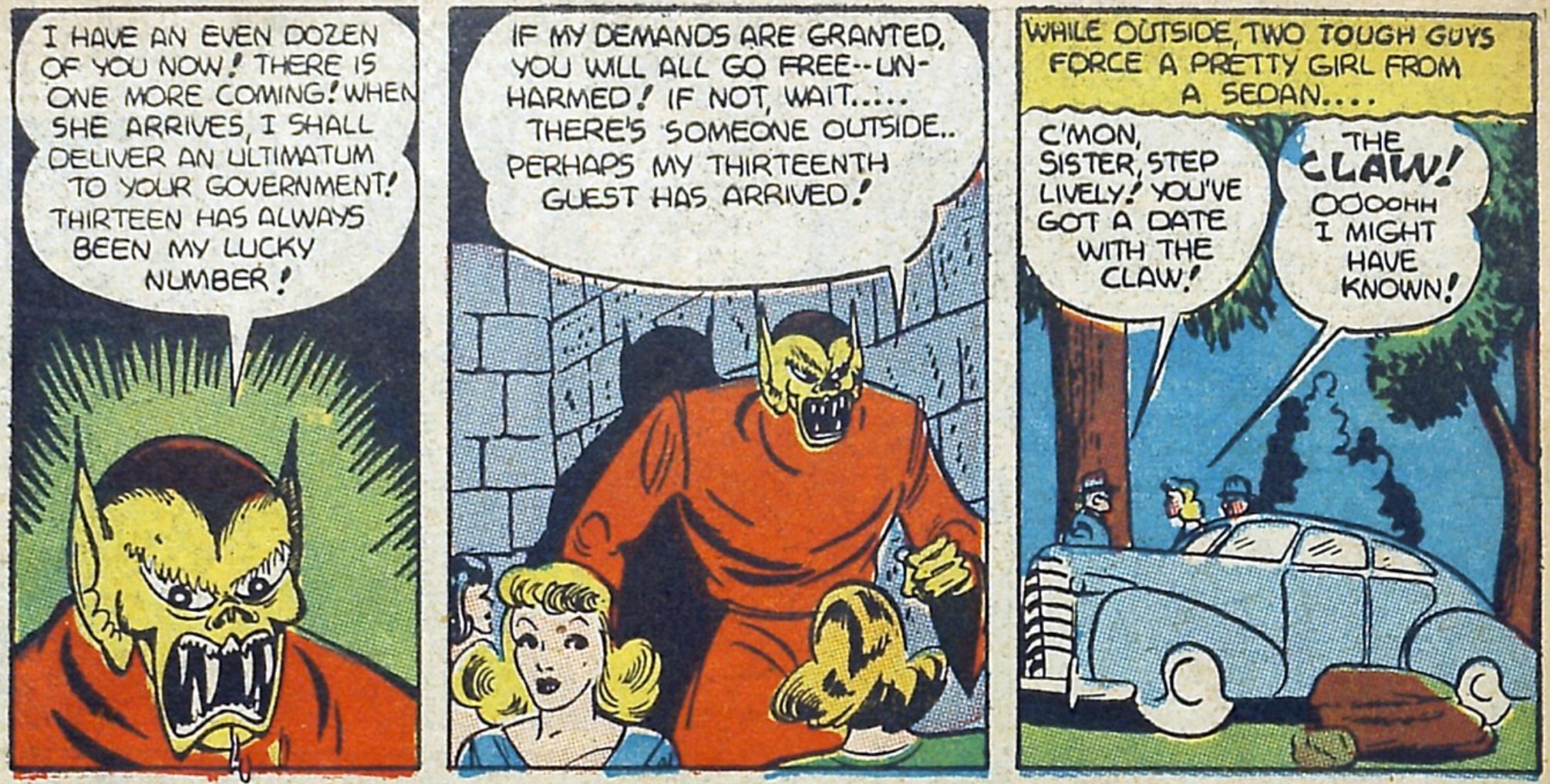
    Daredevil Comics 006: The Claw hatches a plan to demoralize the US that involves kidnapping 13 women and which is never actually explained.

    The reason that it is never explained is because the Ghost shows up just before the Claw can finish his expository sentence and proceeds to bounce rocks off of his head until he passes out. Presumably this also takes several hours. The Ghost rescues the ladies and the Claw wakes up with an enormous headache. Here’s hoping that he expands his villain portfolio in 1942, because there are only so many interesting variations on “the Claw attempts to conquer the US and gets his ass beaten for it.”

    Miss X:

    Miss X is a spy sent by Adolf Hitler to organize the fifth column in the US during that ten day gap in which everyone was hoping that he might be dead, only to find him alive and just as huge as ever.

    The Claw somehow gets wind of Miss X’s presence in NYC and arranges a meeting with her to discuss a Claw/Nazi alliance to conquer North America. Hitler agrees despite his one unsuccessful and one disastrous prior alliance with the Claw. As a result, super spy Miss X spends the majority of her two 1941 appearances en route between German and NYC. (Daredevil Comics 005, 1941)

  • MINOR SUPER-HERO ROUND-UP 083

    MINOR SUPER-HERO ROUND-UP 083

    Oh boy! Minor super-heroes!

    13: 

    13 (aka Thirteen, although the numerical version of the name is the official one) is the alias of Harold Higgins, whose life has been haunted by a series of misfortunes related to the number thirteen. A timeline of some of them:

    February 13, 1940: Harold’s brother Bob dies in a plane crash.

    March 13, 1940: Harold loses his life savings in the stock market.

    May 13, 1940: Harold’s sister Margy is paralyzed in a car accident.

    July 13, 1940: Harold’s father is lost at sea.

    September 13, 1940: Harold’s fiance is killed in a hit and run.

    April 13, 1941: Harold loses his job as a reporter to a crooked editor looking to cover up a story. 

    All of this (and more! A text story in Daredevil Comics 005 adds the facts that he was born on Friday the 13th, that minor tragedies like a broken leg or academic failure had frequently befallen him on the 13th of any given month and that at his thirteenth birthday party his childhood sweetheart Helen was killed by a falling chandelier) has clearly preyed on Harold’s mind, to the point that he is finding the number everywhere including his own name.

    Rather than, say, moving to a small shack in the woods to keep others safe from his constant misfortune, Harold decides to weaponize his bad luck by bringing it to criminals via his fists. Does this work, logically? Not really, but it’s a decent enough comic book origin.

    Like many super-heroes and villains, 13 flirts with the idea of leaving a calling card in his first adventure but doesn’t maintain the practice. In this case, it’s a calendar page with the 13th of the month circled. (Daredevil Comics 003, 1941)

    Finally, a couple of minor things about 13: In Daredevil Comics 004 we learn that like many of his peers he wears his costume under his clothes for quick-change action. Intriguingly, the above panel seems to imply that this includes his mask, which appears to be either acting as a liner for his hat or worn as a kind of bandana under it.

    Finally, in Daredevil Comics 006, 13 moves from the super-hero crammed streets of NYC to the lesser-served Boston.

    Categorized in: Abstract Concepts (Luck), Accessories (Calling Cards), Alphanumeric (Thirteen)

    Jinx: 

    Recently orphaned Darrel Creig has just inherited the family steel fortune, something that rankles his guardian, uncle and the only other potential heir Moldon Creig. Thus, a family outing to the Statue of Liberty, where Moldon and Darrel’s tutor Travers expedite the inheritance process by tossing him off the statue’s torch.

    Luckily for young Darrel, 13 happens to be present to stop an unrelated attempt to bomb the statue, and after saving the lad the two of them beat up Moldon and Travers and hand them over to the authorities.

    As we all know, if a costumed vigilante happens across an orphaned boy who can throw a punch they are allowed to keep them, which is just what happens with 13 and Darrel, and though Darrel’s connection to the bad luck theme is much more tenuous than Higgins (he is an orphan, if a wealthy one, and he is the very spooky age of thirteen years old) he is promptly given a slightly worse costume than 13’s and anointed as his sidekick Jinx. (Daredevil Comics 005, 1941)

    Categorized in: Abstract Concepts (Luck), Day Job (High School Students), Origin (Sidekicks)

    the Ghost: 

    The Ghost is a super-hero who seemingly exists solely to combat the menace of the Claw as he troubles America’s shores once more, Daredevil having moved on to less stressful pursuits.

    Though presented as a normal human man, the Ghost not only has the acrobatic prowess necessary to fight a giant across the rooftops of New York City but enough stamina to do so for seven hours straight. In their first encounter he manages to drive the Claw away by simply punching him thousands of times.

    The Ghost’s origin is unrevealed as of his final 1941 appearance but rest assured: we will learn it in 1942 (spoiler: it is not very interesting). (Daredevil Comics 005, 1941)

    Categorized in: Origin (Unknown), Supranormal Beings (Ghosts)

    the Fiery Mask: 

    The Fiery Mask! A hero whose modern depictions have consistently involved a morning star despite only ever actually wielding on on this cover. I’m not complaining, mind you – it’s just interesting to note where things come from.

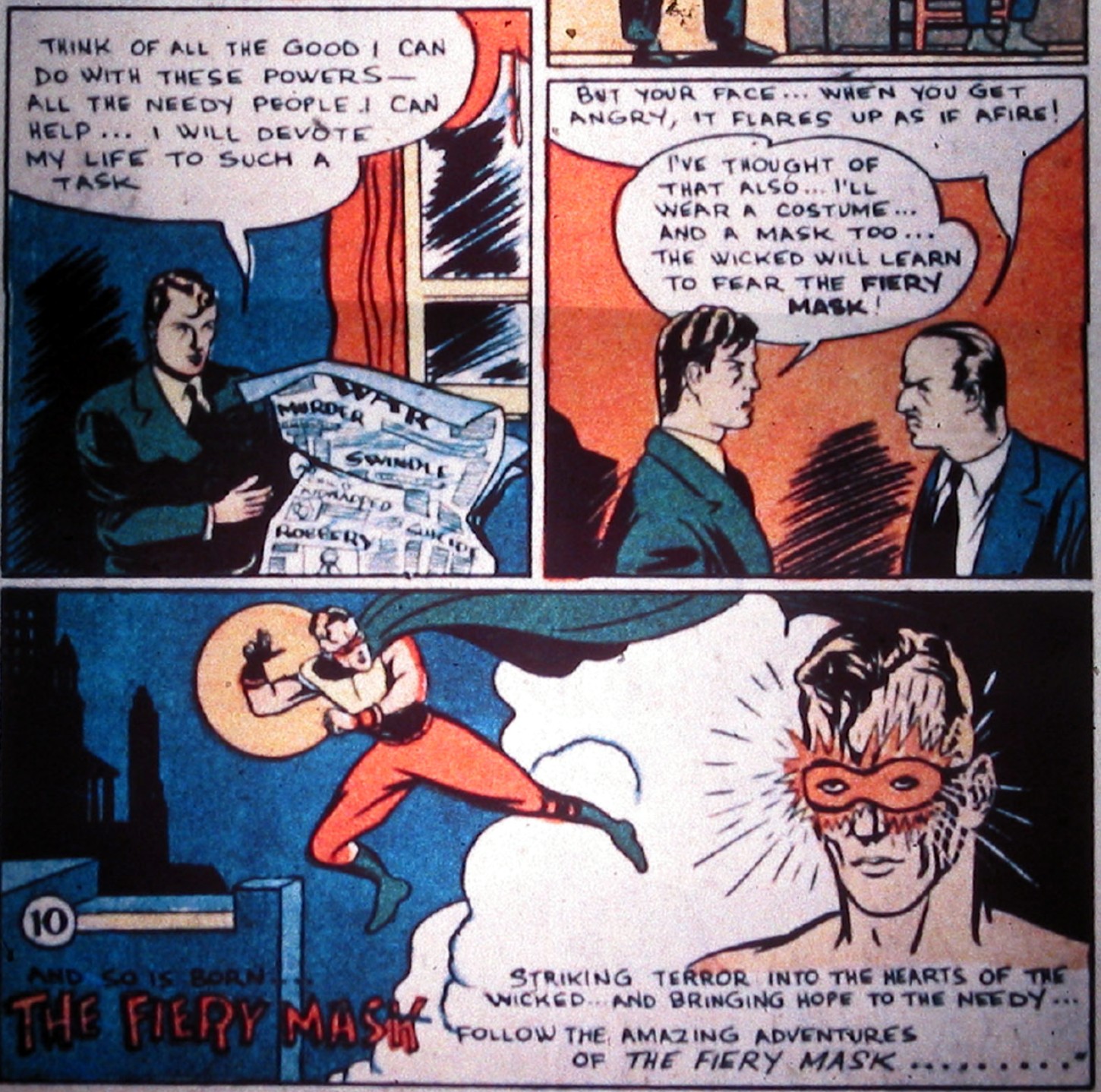
    The Fiery Mask is in reality Jack Castle, a young doctor who accidentally tracks down the lair of the villainous Zombie Master and is in quick order captured and subjected to the fiend’s mind control device. Jack manages to resist the device long enough to enrage the Zombie Master, and in an effort to boost the power and overcome this resistance he causes it to explode.

    The strange energies given off by the device cause Jack to develop strange abilities, the most striking of which is a fiery glow that plays around his face when he is worked up, and which gives him his super moniker. He also has an invulnerability to heat and flame, a fiery touch and a range of non-heat-related powers like super strength, super breath and a hypnotic gaze. Also his origin is later heavily revised, but we can save that for the hundred years or so it will take to get to The Twelve. (Daring Mystery Comics 001, 1940)

    Categorized in: Elements (Fire), Objects (Masks), Origin (Radioactive Mutate)

  • MINOR SUPER-HERO ROUND-UP 083

    MINOR SUPER-HERO ROUND-UP 083

    Oh boy! Minor super-heroes!

    13: 

    13 (aka Thirteen, although the numerical version of the name is the official one) is the alias of Harold Higgins, whose life has been haunted by a series of misfortunes related to the number thirteen. A timeline of some of them:

    February 13, 1940: Harold’s brother Bob dies in a plane crash.

    March 13, 1940: Harold loses his life savings in the stock market.

    May 13, 1940: Harold’s sister Margy is paralyzed in a car accident.

    July 13, 1940: Harold’s father is lost at sea.

    September 13, 1940: Harold’s fiance is killed in a hit and run.

    April 13, 1941: Harold loses his job as a reporter to a crooked editor looking to cover up a story. 

    All of this (and more! A text story in Daredevil Comics 005 adds the facts that he was born on Friday the 13th, that minor tragedies like a broken leg or academic failure had frequently befallen him on the 13th of any given month and that at his thirteenth birthday party his childhood sweetheart Helen was killed by a falling chandelier) has clearly preyed on Harold’s mind, to the point that he is finding the number everywhere including his own name.

    Rather than, say, moving to a small shack in the woods to keep others safe from his constant misfortune, Harold decides to weaponize his bad luck by bringing it to criminals via his fists. Does this work, logically? Not really, but it’s a decent enough comic book origin.

    Like many super-heroes and villains, 13 flirts with the idea of leaving a calling card in his first adventure but doesn’t maintain the practice. In this case, it’s a calendar page with the 13th of the month circled. (Daredevil Comics 003, 1941)

    Finally, a couple of minor things about 13: In Daredevil Comics 004 we learn that like many of his peers he wears his costume under his clothes for quick-change action. Intriguingly, the above panel seems to imply that this includes his mask, which appears to be either acting as a liner for his hat or worn as a kind of bandana under it.

    Finally, in Daredevil Comics 006, 13 moves from the super-hero crammed streets of NYC to the lesser-served Boston.

    Categorized in: Abstract Concepts (Luck), Accessories (Calling Cards), Alphanumeric (Thirteen)

    Jinx: 

    Recently orphaned Darrel Creig has just inherited the family steel fortune, something that rankles his guardian, uncle and the only other potential heir Moldon Creig. Thus, a family outing to the Statue of Liberty, where Moldon and Darrel’s tutor Travers expedite the inheritance process by tossing him off the statue’s torch.

    Luckily for young Darrel, 13 happens to be present to stop an unrelated attempt to bomb the statue, and after saving the lad the two of them beat up Moldon and Travers and hand them over to the authorities.

    As we all know, if a costumed vigilante happens across an orphaned boy who can throw a punch they are allowed to keep them, which is just what happens with 13 and Darrel, and though Darrel’s connection to the bad luck theme is much more tenuous than Higgins (he is an orphan, if a wealthy one, and he is the very spooky age of thirteen years old) he is promptly given a slightly worse costume than 13’s and anointed as his sidekick Jinx. (Daredevil Comics 005, 1941)

    Categorized in: Abstract Concepts (Luck), Day Job (High School Students), Origin (Sidekicks)

    the Ghost: 

    The Ghost is a super-hero who seemingly exists solely to combat the menace of the Claw as he troubles America’s shores once more, Daredevil having moved on to less stressful pursuits.

    Though presented as a normal human man, the Ghost not only has the acrobatic prowess necessary to fight a giant across the rooftops of New York City but enough stamina to do so for seven hours straight. In their first encounter he manages to drive the Claw away by simply punching him thousands of times.

    The Ghost’s origin is unrevealed as of his final 1941 appearance but rest assured: we will learn it in 1942 (spoiler: it is not very interesting). (Daredevil Comics 005, 1941)

    Categorized in: Origin (Unknown), Supranormal Beings (Ghosts)

    the Fiery Mask: 

    The Fiery Mask! A hero whose modern depictions have consistently involved a morning star despite only ever actually wielding on on this cover. I’m not complaining, mind you – it’s just interesting to note where things come from.

    The Fiery Mask is in reality Jack Castle, a young doctor who accidentally tracks down the lair of the villainous Zombie Master and is in quick order captured and subjected to the fiend’s mind control device. Jack manages to resist the device long enough to enrage the Zombie Master, and in an effort to boost the power and overcome this resistance he causes it to explode.

    The strange energies given off by the device cause Jack to develop strange abilities, the most striking of which is a fiery glow that plays around his face when he is worked up, and which gives him his super moniker. He also has an invulnerability to heat and flame, a fiery touch and a range of non-heat-related powers like super strength, super breath and a hypnotic gaze. Also his origin is later heavily revised, but we can save that for the hundred years or so it will take to get to The Twelve. (Daring Mystery Comics 001, 1940)

    Categorized in: Elements (Fire), Objects (Masks), Origin (Radioactive Mutate)

  • MINOR SUPER-VILLAIN 953: THE COUPLE KILLER

    MINOR SUPER-VILLAIN 953: THE COUPLE KILLER

    (Daredevil Comics 006, 1941)

    New York’s dating scene is in trouble, as courting couples are being murdered at a blazing clip: six couples in two weeks as the story begins and a seventh just one page in – that’s fourteen people! That’s a person a day! On average!

    Nightro is on the case, but merely patrolling the parks and other canoodling spots is a bust as the killer knows to look out for costumed vigilantes and even leaves a taunting note with the bodies of the unfortunate Mert and Rita. 

    Nightro’s next move is to set up a sting, featuring him in a dress alongside a dummy boyfriend that he can “make love to,” and here I must pause to say that the physical transformation achieved by the Streamlined Robinhood by merely putting on a dress is phenomenal, no matter what kind of shaping undergarments he has on. He goes from a fairly beefy superdude to a slender woman who might be a few inches shorter than he is normally, despite wearing high heels. His face changes shape! This is a Bugs Bunny-level crossdress, is what I’m saying, which means that once the Couple Killer takes the bait he is immediately attracted to the disguised Nightro and so leaves himself open to a left hook.

    There’s a full page of Nightro beating up the Couple Killer, which is a lot for a five pages story but you just have to get as much mileage as you can out of having your hero in a dress when it’s 1941 and that it the height of comedy.

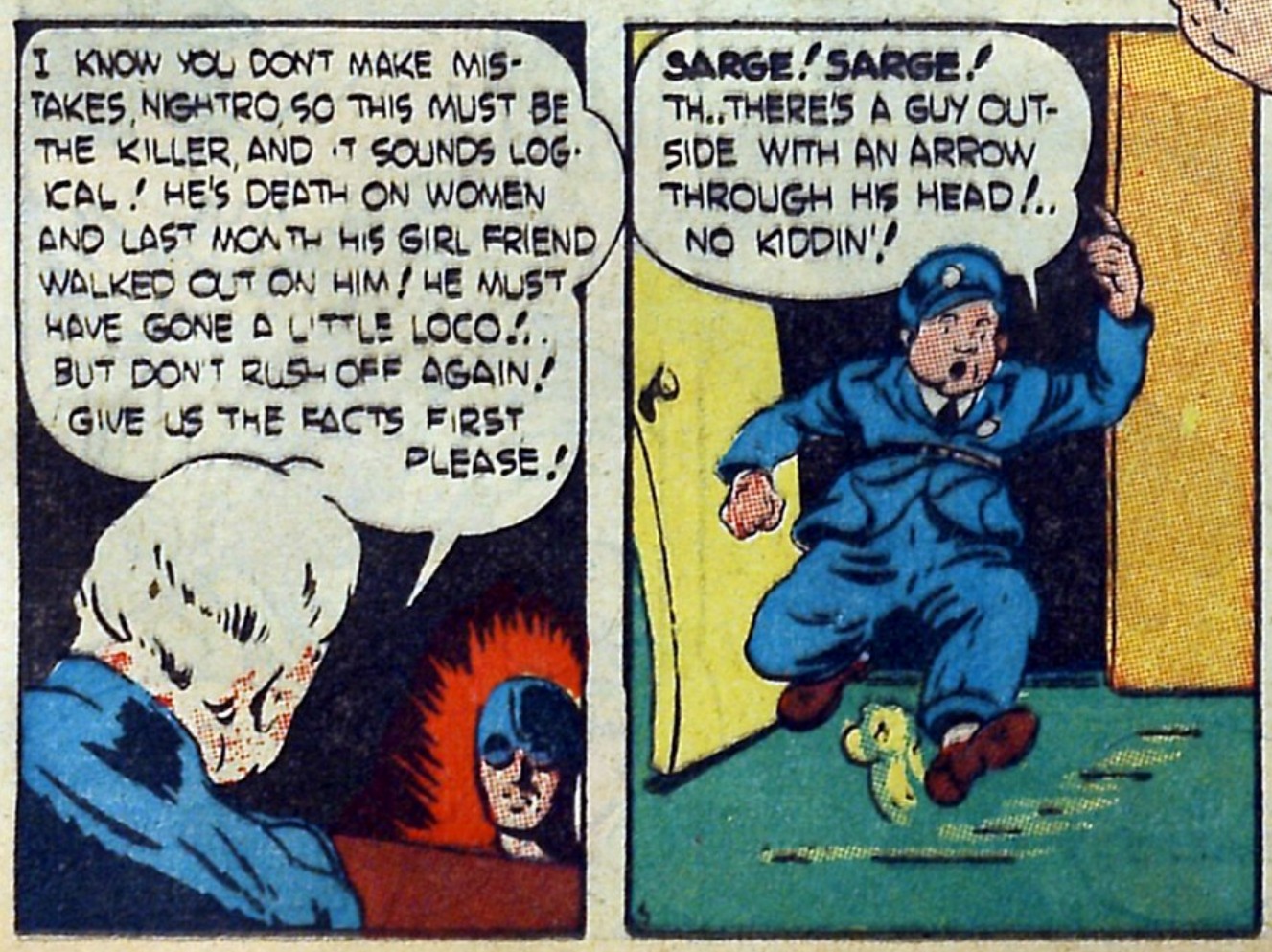
    So, after all that bloodshed and gender-bending, just what was the Couple Killer’s motivation? Turns out that he is actually a fellow known as Lonesome Larry, a known arsonist and misogynist who just got dumped and went “a little loco” and killed fourteen people. It’s not quite a “boys will be boys” situation but these cops sure do give him a lot more grace than he deserves.

    Categorized in: Crime (Killers), Ideology (Misogynists), Murder (Serial Killers)

  • REAL PERSON ROUND-UP 024

    You just can’t keep ’em out of comics, those real people.

    Adolf Hitler:

    Dispatches super-spy Miss X to America. (Daredevil Comics 005, 1941)

    Raymond Stokes, the actor playing Hitler in a British propaganda film about London (the super-hero, not the city) inexplicably also turns out to be a Nazi agent who attempts to murder the Prime Minister when he makes a cameo appearance in the movie. (Daredevil Comics 005, 1941)

    Al Capone:  

    No-first-name Perrone here is another classic example of a crook lent a bit of legitimacy via a Capone-alike name. (Daring Mystery Comics 001, 1940)

    Charles Biro:

    Carnival stunt-eater Ydlab Orib is a transparent Biro name-drop, though the “Baldy” part of his backward name doesn’t really jibe with the pictorial record of the man himself. Whether he was a prodigious eater or not is unrecorded as far as I can find. I would venture that we are witness to a series of in-jokes here. (Daredevil Comics 005, 1941)

    Comics Folk:

    Give a Golden Age comic creator like Edd Ashe a chance to write a list and you’ll get a bunch of references to other Golden Age comics guys. For example, this collection of football stats features a (Harry “A”) Chesler College, a (Gil) Fox University and a (Mort) Meskin Mining & Mech. And a double-barrelled reference to Bob Wood, with Wood Military College and also Woodro College, referencing a Bob Wood/Charles Biro combination pen name. (Daredevil Comics 006, 1941)

    The list of schools also includes one called Lamont and I was ready to discount it, but then remembered that there was a reference to a Lamont in the previous issue, as a circus freak called the “Man of Wood,” which made me think that this might be a third Bob Wood reference and wouldn’t you know it some places list his middle name as Lamont or Lemont. What’s with all the Bob Wood references, Edd Ashe? 

    Franklin Roosevelt: 

    Once again, President Roosevelt is placed in the unenviable position of being in charge of a country plagued by the Claw’s particular brand of bullshit. He’s also placed in shadow and a 3/4 reverse view, because comic artists didn’t like to draw his face, presumably out of respect. (Daredevil Comics 002, 1941)

    Fritz Julius Kuhn: 

    I’ll be honest: I had no idea who Fritz Kuhn was and certainly didn’t twig to “Herr Kahn” here being a version of him until I took a look to see if “Nordic infested […] Yorkville” was a real place and spotted his name associated with our favourite band of overhyped losers the German-American Bund on its Wikipedia page. Like the Bund itself, the spectre of Kuhn seems to have haunted comics long after he himself was relevant – he had already been slung in jail for tax evasion by the time this comic was published. (Daredevil Comics 005, 1941)

    I was curious, so I looked back at the various Bunds we have thusfar encountered to see if any of them had their own version of Kuhn, and the only real candidates to jump out at me were Fritz Kessel, leader of the Termania Bund (Wonderworld Comics 018, 1940) and Fritz Hewn – presumably rhymes with Kuhn – leader of the Young Bundists (Blue Ribbon Comics 014, 1941)

    George Roussos: 

    Given the uncommon nature of the surname “Roussos” I have to assume that the crooked newspaper editor in this 13 story is yet another example of Lev Gleason reference-your-coworkers style yuck-em-ups. (Daredevil Comics 003, 1941)

    Three issues later sees a murder be committed above the Roussos Pool Room. (Daredevil Comics 006, 1941)

    And in the same issue, an index of insane asylum inmates yields a Roussos, a (Jerry) Robinson and a (Bob) Wood. And possibly others, but I can’t place them.

    Heinrich Himmler:

    One of several Nazi officials vexed by the hero London and his “L” campaign (Daredevil Comics 006, 1941)

    Rudolph Hess:

    Rudolph Hess (or Hesst) and his flight to England are framed as a straightforward espionage mission, with Hesst landing along with fifty picked men via black parachutes. He is immediately captured by London. (Daredevil Comics 003, 1941)

    Winston Churchill: 

    Initially, I was all set to point out that this “London” adventure featured a completely made-up niece of Winston Churchill making a daring escape from Nazi-occupied Holland, but imagine my surprise when her uncle showed up and was a store-brand imitation Churchill with a mustache. I was particularly caught off guard by this as while US-based comics had a weird reluctance to portray or name FDR they usually had no such qualms about doing so with the PM. (Daredevil Comics 002, 1941)

    The False-Churchill returns in the “London” feature in Daredevil Comics 004, and this time his inexplicable presence is highlighted by the unaltered name of Lloyd’s of London in the upper left.

    Finally, the Churchill-alike in Daredevil Comics 005 looks different enough from both the real deal and Mustache Churchill that we must assume that there has been some sort of regime change between issues. 

  • MINOR SUPER-VILLAIN 952: WOLF CARSON

    (Daredevil Comics 006, 1941)

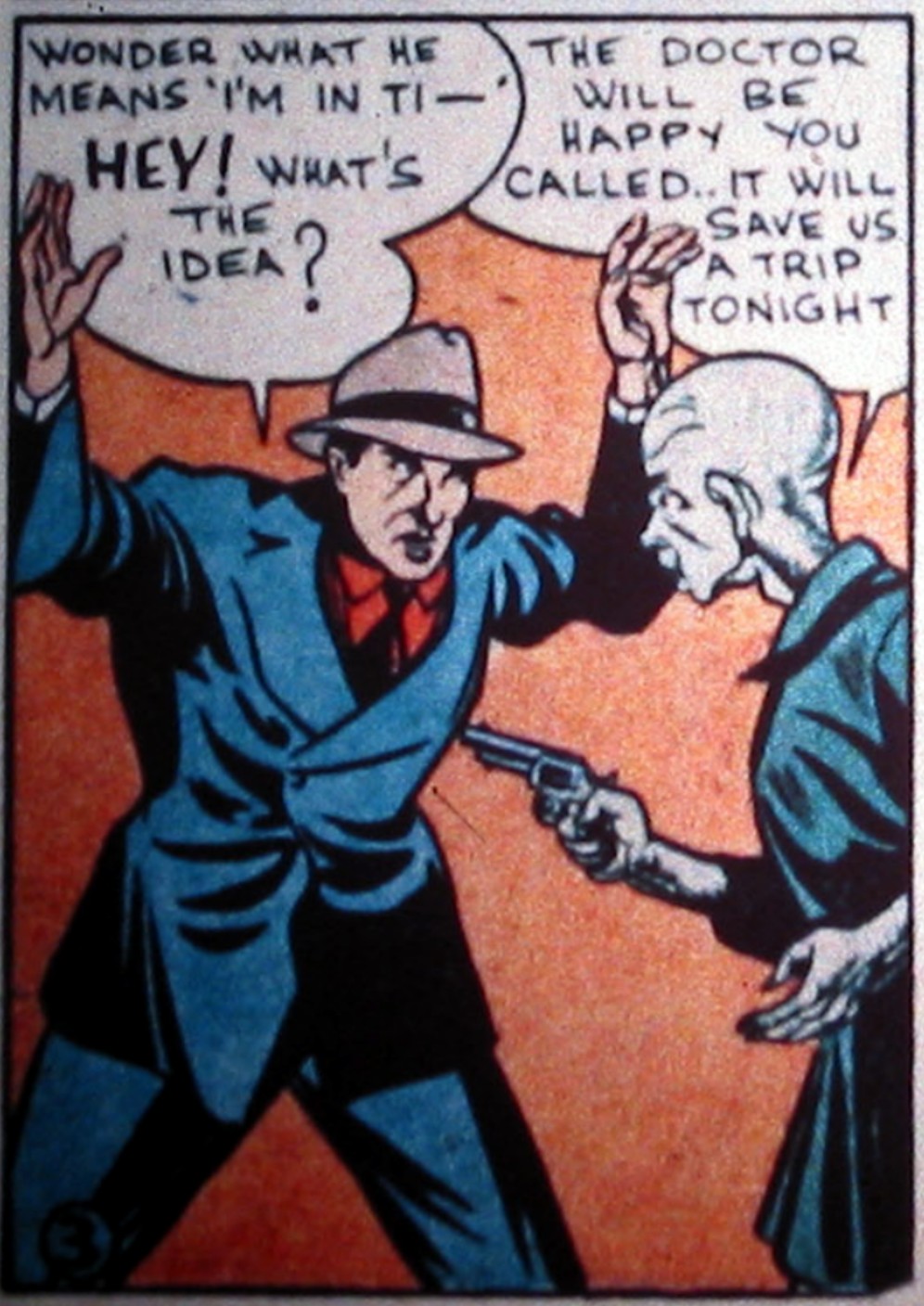
    Wolf Carson, gang boss, is in the hospital after being gunned down by his own traitorous associates. Faced with a choice between 1) dying of his wounds or 2) recovering so that the authorities can scoop him up and take him to jail, Carson takes the ever-popular option 3) take the nearby unethical doctor up on his offer to help cheat death via experimental science, in this case a total brain transplant!

    True to his word, the never-named doctor digs up Carson’s corpse that night and extracts its brain, then in a feat of pure super science (particularly given the state the brain must been in after sitting in a corpse for 12+ hrs) transplants it into…

    … A WOLF BODY! Now, just why the doctor chose to do this is never actually stated but I have a couple of theories that boil down to either him doing so as a way to control Carson with the promise of a human body later etc or doing so because he was a terrible guy with a bad sense of humour. Either way, he pays for his choice of donor body with his life. In retrospect, I reckon that his mistake was in leaving Carson unrestrained and then pissing him off severely.

    With nothing else to live for, Carson turns to revenge as his motivation and systematically hunts down the members of the gang that betrayed him. Each murder is accompanied by a trademark “death howl,” which I am counting as a calling card.

    Major complication: Carson has been found, mistaken for a regular dog and taken in by Bart “Daredevil” Hill’s fiance Tonia Saunders, which means that a jealous wolf is now after both Bart and the Daredevil and also Tonia once she realizes just where her dog has been sneaking off to at night. 

    Wolf or not, Carson is no match for the Daredevil and is soon captured. In a rare addendum, we get to see the villain’s trial (and please note the use of the term “brain wolf” to describe him in that newspaper headline – I dearly wanted to use that as his villain name but it’s clearly being used as a description of what he is rather than a moniker). Bart Hill actually manages to put two and two together and determine that the wolf is Carson, upon which the judge sets what I personally would consider a troubling precedent for a super-hero universe by ordering that the brain wolf be summarily sent to the pound and put down. I mean, I’m not a lawyer but that seems bad – some super-intelligent ape c.1976 is going to have to go to the Supreme Court to argue that he shouldn’t be summarily destroyed over a parking ticket.

    Revenge Killer Score: 4/7 (counting Bart and Daredevil as two separate targets)

    Categorized in: Animals (Wolves), Murder (Revenge Killers), Origin (Human Brain in Animal Body) 

  • MINOR SUPER-VILLAIN 539 UPDATE: THE CLAW (post-Daredevil, 1941)

    MINOR SUPER-VILLAIN 539 UPDATE: THE CLAW (post-Daredevil, 1941)

    In keeping with my decision to split the Claw updates for 1941 by heroic foe, here are the details of his three-issue dalliance with engineer Bill Hopkins.

    When last we saw the Claw… he was in the Pacific, roughing up Adolf Hitler. But before that, at the end of his long back-and-forth with the Daredevil, there was the small matter of his asking Lucifer for aid and getting it, with the caveat that if he still lost in his next encounter with Daredevil he would be “banished into Asia forever!” And since he did lose, that means that he can’t return to America, right?

    Evidently not, because in  Daredevil Comics 002, the Claw kidnaps a train filled with 2000 soldiers as it passes through Pennsylvania, then sends a note to the president (note the custom signature) to ask for the complete US gold supply in ransom.

    Meanwhile, the Claw is showing his prisoners home movies designed to bend them to his will. Note the Hitler impression: in 1941 this is shorthand for being a megalomaniac rather than a genocidal megalomaniac (though in all cases it marks you as being a bit of an uninspired hack). Whether he gets the gold or not, the Claw intends to use these men in yet another attempt to conquer the US.

    One of these soldiers, Dick Hopkins, has a brother named Bill Hopkins, who has the radical idea to retrace the path of the original train in a second one and see if anything happens, which it does. This really erodes my confidence in the authorities of this fictional reality, frankly. You’d think “take a couple of lads and check the tracks between here and where the train disappeared” would be the logical first step to take but Bill seems to be the first one to think of it. 

    Perhaps the Claw was able to return to America by sacrificing some of his power to Lucifer, because Bill Hopkins’ thrown rocks and pistol shots are much more effective than such things as artillery and machine guns have been in the past.

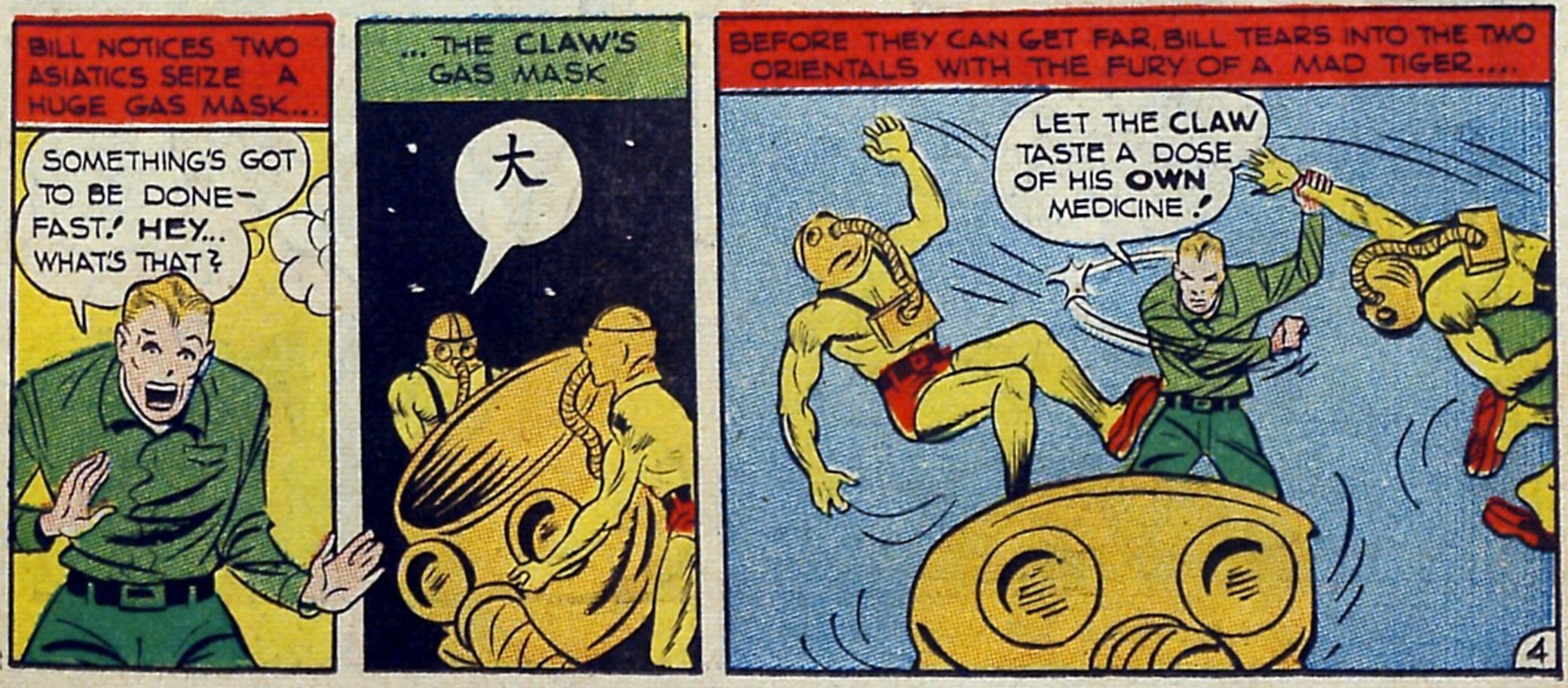
    The second part of Bill’s plan, after “find out where the Claw has stashed 2000 men” is “come find me if I disappear” and accordingly, in Daredevil Comics 003, the US Army locates the Claw’s base by following the extra set of train tracks that split off the main trunk and head directly into a cliff face. Once again, the Claw seems weaker than usual and the Army is pushing his forces back successfully enough that he orders his men to flood the base with poison gas. It is at this point that Bill has his best idea yet, as he steals the Claw’s enormous gas mask and chucks it down a convenient bottomless pit.

    The Claw is more affected by poison gas than the regular-sized humans in the room thanks to the fact that his big body needs more oxygen and thus are breathing in more gas, and while I love a well-rationalized weakness in a character it does call into question all future Claw foes for not immediately tear gassing him on sight.

    What I don’t love is that the Claw, already a distillation of Yellow Peril tropes, is one-upping himself by adopting what I just learned is called a wonton font in his speech bubbles. I think that it’s supposed to be adding emphasis when he is yelling but at this point he is almost always yelling.

     Daredevil Comics 004: The Claw brought into NYC in chains/in triumph. He almost instantly escapes.

    Seeking vengeance on Bill Hopkins, the Claw fords the Hudson River and in so doing becomes the first-ever super-villain to enter Hoboken.

    Bill doesn’t take this aggression lying down, and meets the Claw on a handy rooftop with a can of kerosene and a match, and this is a pretty good illustration of a though I have had while writing this: the Claw battling super-heroes is all well and good, but what I really enjoy is seeing him get it from regular folks. Bill Hopkins and his Home Alone energy might just be the best that the “Claw” feature ever gets, and it’s a real shame that this is the last we will be seeing of him.

    The Claw very reasonably exits via the river. So long forever, Bill. Next time: the Ghost!

  • MINOR SUPER-VILLAIN 539 UPDATE: THE CLAW (post-Daredevil, 1941)

    In keeping with my decision to split the Claw updates for 1941 by heroic foe, here are the details of his three-issue dalliance with engineer Bill Hopkins.

    When last we saw the Claw… he was in the Pacific, roughing up Adolf Hitler. But before that, at the end of his long back-and-forth with the Daredevil, there was the small matter of his asking Lucifer for aid and getting it, with the caveat that if he still lost in his next encounter with Daredevil he would be “banished into Asia forever!” And since he did lose, that means that he can’t return to America, right?

    Evidently not, because in  Daredevil Comics 002, the Claw kidnaps a train filled with 2000 soldiers as it passes through Pennsylvania, then sends a note to the president (note the custom signature) to ask for the complete US gold supply in ransom.

    Meanwhile, the Claw is showing his prisoners home movies designed to bend them to his will. Note the Hitler impression: in 1941 this is shorthand for being a megalomaniac rather than a genocidal megalomaniac (though in all cases it marks you as being a bit of an uninspired hack). Whether he gets the gold or not, the Claw intends to use these men in yet another attempt to conquer the US.

    One of these soldiers, Dick Hopkins, has a brother named Bill Hopkins, who has the radical idea to retrace the path of the original train in a second one and see if anything happens, which it does. This really erodes my confidence in the authorities of this fictional reality, frankly. You’d think “take a couple of lads and check the tracks between here and where the train disappeared” would be the logical first step to take but Bill seems to be the first one to think of it. 

    Perhaps the Claw was able to return to America by sacrificing some of his power to Lucifer, because Bill Hopkins’ thrown rocks and pistol shots are much more effective than such things as artillery and machine guns have been in the past.

    The second part of Bill’s plan, after “find out where the Claw has stashed 2000 men” is “come find me if I disappear” and accordingly, in Daredevil Comics 003, the US Army locates the Claw’s base by following the extra set of train tracks that split off the main trunk and head directly into a cliff face. Once again, the Claw seems weaker than usual and the Army is pushing his forces back successfully enough that he orders his men to flood the base with poison gas. It is at this point that Bill has his best idea yet, as he steals the Claw’s enormous gas mask and chucks it down a convenient bottomless pit.

    The Claw is more affected by poison gas than the regular-sized humans in the room thanks to the fact that his big body needs more oxygen and thus are breathing in more gas, and while I love a well-rationalized weakness in a character it does call into question all future Claw foes for not immediately tear gassing him on sight.

    What I don’t love is that the Claw, already a distillation of Yellow Peril tropes, is one-upping himself by adopting what I just learned is called a wonton font in his speech bubbles. I think that it’s supposed to be adding emphasis when he is yelling but at this point he is almost always yelling.

     Daredevil Comics 004: The Claw brought into NYC in chains/in triumph. He almost instantly escapes.

    Seeking vengeance on Bill Hopkins, the Claw fords the Hudson River and in so doing becomes the first-ever super-villain to enter Hoboken.

    Bill doesn’t take this aggression lying down, and meets the Claw on a handy rooftop with a can of kerosene and a match, and this is a pretty good illustration of a though I have had while writing this: the Claw battling super-heroes is all well and good, but what I really enjoy is seeing him get it from regular folks. Bill Hopkins and his Home Alone energy might just be the best that the “Claw” feature ever gets, and it’s a real shame that this is the last we will be seeing of him.

    The Claw very reasonably exits via the river. So long forever, Bill. Next time: the Ghost!

  • MINOR SUPER-VILLAIN 950: HANS MEYER

    (Daredevil Comics 004, 1941)

    Bart “Daredevil” Hill and his fiance Tonia Saunders are accompanying their friends Jeff and Sue Hart on their honeymoon (!) yacht trip when they encounter the killer combo of rough stormy seas and a mysterious lighthouse that sends them right onto a reef.

    Happily for all involved (except two sailors who are swept overboard and never mentioned again) the yacht is merely wedged rather than sinking and there is a convenient nearby island. An inhabited one, even, as is revealed when the owner, a Hans Meyer, boats over to check on his new neighbours. 

    As you might have noted from when he described himself as the local dictator , Meyer is a prime creep who uses a floating lighthouse to draw ships to his island so that he can hunt their crews for sport, a la Count Zaroff of “The Most Dangerous Game” fame. He barely waits until breakfast is over before he hunts and nearly kills Jeff Hart, and only the Daredevil’s timely intervention prevents the coup de grace.

    I must give Meyer credit here: unlike most people in comics who see a costumed super-hero popping up well outside of their normal territory but coincidentally proximal to some people from back home, he actually puts two and two together and identifies the Daredevil as Bart Hill, and he loves it. I imagine that when you hunt humans for sport you are just itching for the day a vigilante-type super-hero crosses your path.

    I also have to give it to the creative minds behind the Daredevil for continuing to think up reasons for him to be wearing that spiked belt. “It protects him against bear hugs” is a valid, if very specific, reason!

    Having trapped the Daredevil in a pit, Meyer gets to brag a bit, and we learn the other part of his misanthropy, as foreshadowed by his leering at the ladies in his initial appearance. Not only does he hunt and murder the men who land on his island but he “marries” any women who do, and as he very conspicuously does not have any women on his island, we must assume the worst for them.

    Despite seemingly bringing along every weapon he owns (including some very uncomfortable looking knives just kind of shoved through a strap around his ankle), Meyer’s hero hunt goes poorly. Through sheer chance, however, he manages to bury and seemingly kill Daredevil by starting an avalanche.

    Meyer immediately scurries back home to marry Tonia Saunders against her will (and just why is the officiant in a cool mask, you ask? Because it was on the cover that way, as far as I can tell) and then gets himself shot by Jeff Hart, who Meyer never actually went back to kill after he was interrupted in the first place and who has seemingly been crawling slowly toward his vengeance the entire time since. All in all, it’s a memorable honeymoon for the newly-minted Mr & Mrs Hart!

    Categorized in: Location (Pacific Island), Murder (Hunting Humans for Sport), Real Folk – Fictional (Count Zaroff)