The Curse of Skeleton Munroe

Category: Lev Gleason

  • MINOR SUPER-VILLAIN 942: THE SERPENT

    (Silver Streak Comics 015, 1941)

    The Serpent, a well-established and powerful crimelord, has been laying low due to the threat posed by the Daredevil, but all that is at an end now because as far as she can tell the Daredevil isn’t around any longer. She puts in a call to her men, and I really like the sequence that follows. Nothing can stop these guys from getting to work, not prison, not pool, not partying with babes.

    The Serpent’s plan is both simple and audacious: kidnap the children of the wealthy simultaneously in at least thirteen cities across the US, relying on the mass confusion of the event to hinder law enforcement long enough for her to collect the 10 million dollars ransom and skedaddle.

    It turns out that the Serpent was right to fear the Daredevil as he had not retired or been killed but had instead been lying low specifically to draw her out. Now that she has revealed herself, he jumps into action and, barring a brief spell in the Serpent’s dungeons (from which she has the audacity to try to ransom him back to the police!), he breaks up her operation in no time flat.

    The Serpent herself is captured after an attempt to assassinate the Daredevil at his home because he a) didn’t check to see if anyone was following him and b) walked back in uniform. Terrible secret identity hygiene, Daredevil!

    Though she is jailed (and makes a great face while being captured!), the Serpent joins the ranks of one-off characters who are just kind of out there with full knowledge of their enemy’s secrets. Luckily for the Daredevil, he existed in a less continuity-obsessed time than later heroes and so the Serpent never comes back to bite him for his carelessness.

    Categorized in: Animals (Snakes), Kidnappers (Ransom), Villains Who Know Their Heroic Foe’s Secret Identity

  • MINOR SUPER-VILLAIN 941: THE MUMMY MASTER

    (Silver Streak Comics 015, 1941)

    In a very comic book series of events, a rash of mummy thefts at the City Museum in NYC is followed by the emergence of a Nazi super-crook calling himself the Mummy Master.

    While my normal modus operandi is to lay out the story of the villains I cover in an abridged but linear fashion, here I must jump ahead to the reveal that the Mummy Master is in fact City Museum director Dr Kolb, because I need to talk about just what the heck is going on with this guy and what exactly he was thinking. 

    So: Kolb is a Nazi and he is either officially or unofficially working to hinder US defense production by targeting so-called “Dollar-a-Year Men” (a type of altruistic/patriotic rich guy explored recently in our discussion of the Death Battalion). On the surface his decision to become the Mummy Master is… not a good one, but one with a lot of thematic resonance and which uses a lot of close-at-hand resources: he has access to mummies and a ready-made HQ in the depths of the museum. He never really states it outright, but by stealing a bunch of mummies and then dressing his henchmen up like them he seems to be going for the same sort of shock factor as Herr Skull got with his Skull Men.

    The first Dollar-a-Year Man on the Mummy Master’s list is even kidnapped with the same mummy DIY philosophy: he receives a mummy case in the mail, is disturbingly cavalier about going to bed with it sitting about five feet away and is then captured by the very alive mummy inside and taken away in its former home.

    I would say that the first indication that Kolb/the Mummy Master is not a criminal genius comes at the culmination of the Henderson kidnapping. Surely the move is to dress up like movers and stick the mummy case in a truck, but the Mummy Master and his Mummy Gang just schlep the thing through the city streets. It’s like the idea of maintaining the theme is interfering with Kolb’s ability to do risk management.

    The abduction of the second man, Billings, is comparatively simple: just a bunch of fake mummies storming the guy’s office and grabbing him. It’s a dumb meathead plan, but it’s less dumb than the first, ostensibly clever plan so I must give it some credit.

    By this point, the Mummy Master’s haphazard approach to super-espionage has caught up to him and not only Captain Battle but Hale Battle and Battle associate Jane Lorrain are wandering around inside his lair – his capture is a foregone conclusion.

    Hale Battle of course takes a souvenir of the battle with the Mummy Master, in the form of a little mummy doll made out of some of his wrappings. Of note is the fact that Hale’s collection contains only the souvenirs that we have seen him collect, in contrast to other trophy displays like Green Arrow’s that are already stuffed full of trash upon their first appearance.

    Categorized in: Day Jobs (Museum Director), Fraud (Fake Mummy), Supranormal Beings (Mummies)

  • MINOR SUPER-VILLAIN 941: THE MUMMY MASTER

    (Silver Streak Comics 015, 1941)

    In a very comic book series of events, a rash of mummy thefts at the City Museum in NYC is followed by the emergence of a Nazi super-crook calling himself the Mummy Master.

    While my normal modus operandi is to lay out the story of the villains I cover in an abridged but linear fashion, here I must jump ahead to the reveal that the Mummy Master is in fact City Museum director Dr Kolb, because I need to talk about just what the heck is going on with this guy and what exactly he was thinking. 

    So: Kolb is a Nazi and he is either officially or unofficially working to hinder US defense production by targeting so-called “Dollar-a-Year Men” (a type of altruistic/patriotic rich guy explored recently in our discussion of the Death Battalion). On the surface his decision to become the Mummy Master is… not a good one, but one with a lot of thematic resonance and which uses a lot of close-at-hand resources: he has access to mummies and a ready-made HQ in the depths of the museum. He never really states it outright, but by stealing a bunch of mummies and then dressing his henchmen up like them he seems to be going for the same sort of shock factor as Herr Skull got with his Skull Men.

    The first Dollar-a-Year Man on the Mummy Master’s list is even kidnapped with the same mummy DIY philosophy: he receives a mummy case in the mail, is disturbingly cavalier about going to bed with it sitting about five feet away and is then captured by the very alive mummy inside and taken away in its former home.

    I would say that the first indication that Kolb/the Mummy Master is not a criminal genius comes at the culmination of the Henderson kidnapping. Surely the move is to dress up like movers and stick the mummy case in a truck, but the Mummy Master and his Mummy Gang just schlep the thing through the city streets. It’s like the idea of maintaining the theme is interfering with Kolb’s ability to do risk management.

    The abduction of the second man, Billings, is comparatively simple: just a bunch of fake mummies storming the guy’s office and grabbing him. It’s a dumb meathead plan, but it’s less dumb than the first, ostensibly clever plan so I must give it some credit.

    By this point, the Mummy Master’s haphazard approach to super-espionage has caught up to him and not only Captain Battle but Hale Battle and Battle associate Jane Lorrain are wandering around inside his lair – his capture is a foregone conclusion.

    Hale Battle of course takes a souvenir of the battle with the Mummy Master, in the form of a little mummy doll made out of some of his wrappings. Of note is the fact that Hale’s collection contains only the souvenirs that we have seen him collect, in contrast to other trophy displays like Green Arrow’s that are already stuffed full of trash upon their first appearance.

    Categorized in: Day Jobs (Museum Director), Fraud (Fake Mummy), Supranormal Beings (Mummies)

  • MINOR SUPER-VILLAIN 940: THE PARSON

    (Silver Streak Comics 014, 1941)

    The Parson is a weird little dude who takes over a gang of opportunistic London-based looters who have been taking advantage of the ongoing Blitz to make big bucks off of the misfortune of their fellows. Though the gang is initially against the notion of, again, a little weird dude muscling in on their racket, the Parson presses the issue with his powers of hypnotic domination, the source of which is as mysterious and unexplained as the reason for his nom de guerre. 

    (note the backward-speak in the above panel – this is the only instance of him using Zatara-style “magic words” in the story. After this it’s just big-eye hypnotism)

    We do, however know the Parson’s motivation for taking over the gang: he is in fact a Nazi agent working to destabilize London by encouraging the gang to greater and more violent crime, and he reports directly to – a very rude – Adolf Hitler.

    This is a Daredevil comic, which means that the Daredevil has to be in it, which means that he has to get to London somehow. This is achieved by having Bart “the Daredevil” Hill fly a bomber across the Atlantic to the British on a lark. Once he is on the ground, his super-hero intuition is strong enough that he immediately tracks the gang to their bunker lair.

    Though the Parson gets briefly gets the upper hand with a little quick hypnotism, the Daredevil’s willpower proves too great to be suppressed for long and he swiftly batters the whole gang into submission.

    A final note: though the Parson’s men are low-down dirty thieves and murderers, they are still unwilling to work with a Nazi, to their moderate credit.

    Categorized in: Ideology (Nazis), Power (Mind Control), Professions (Religious)

  • MINOR SUPER-VILLAIN 940: THE PARSON

    (Silver Streak Comics 014, 1941)

    The Parson is a weird little dude who takes over a gang of opportunistic London-based looters who have been taking advantage of the ongoing Blitz to make big bucks off of the misfortune of their fellows. Though the gang is initially against the notion of, again, a little weird dude muscling in on their racket, the Parson presses the issue with his powers of hypnotic domination, the source of which is as mysterious and unexplained as the reason for his nom de guerre. 

    (note the backward-speak in the above panel – this is the only instance of him using Zatara-style “magic words” in the story. After this it’s just big-eye hypnotism)

    We do, however know the Parson’s motivation for taking over the gang: he is in fact a Nazi agent working to destabilize London by encouraging the gang to greater and more violent crime, and he reports directly to – a very rude – Adolf Hitler.

    This is a Daredevil comic, which means that the Daredevil has to be in it, which means that he has to get to London somehow. This is achieved by having Bart “the Daredevil” Hill fly a bomber across the Atlantic to the British on a lark. Once he is on the ground, his super-hero intuition is strong enough that he immediately tracks the gang to their bunker lair.

    Though the Parson gets briefly gets the upper hand with a little quick hypnotism, the Daredevil’s willpower proves too great to be suppressed for long and he swiftly batters the whole gang into submission.

    A final note: though the Parson’s men are low-down dirty thieves and murderers, they are still unwilling to work with a Nazi, to their moderate credit.

    Categorized in: Ideology (Nazis), Power (Mind Control), Professions (Religious)

  • ALIENS AND SO FORTH ROUND-UP 031

    ALIENS AND SO FORTH ROUND-UP 031

    Great value for your alien and so forth dollar today: seven for the price of four!

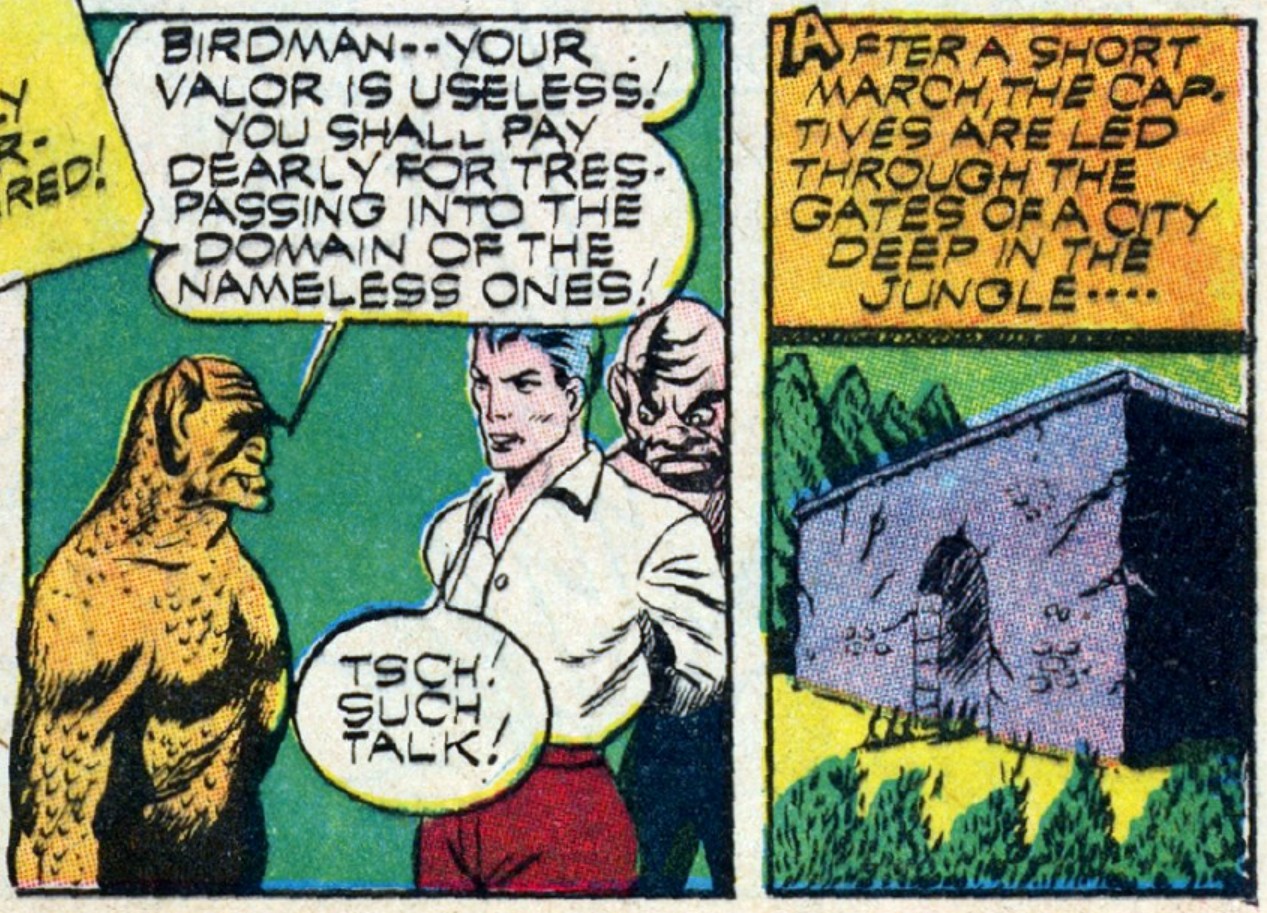
    the Nameless Ones: 

    “The Bingham Boys” was a short-lived feature about twin brothers Billy and Bobby Bingham and their dipshit friend Specs inserting themselves into the life of adventurer Dusty Travis. I their first appearance, the trio tag along on what turns out to be a flight to Mato Grosso, Brazil to search for a clue to the fate of lost Atlantis, for some reason.

    Dusty’s plane crashes thanks to Specs just randomly pushing buttons (I didn’t call him a dipshit for no reason) and the group are quickly set upon and captured by a group of morphologicaly-diverse beings called the Nameless Ones. In a tremendous display of both good and bad luck, the Nameless Ones’ leader – called the Oligarch – confirms that they are the descendants of Atlantis that the four are seeking, but also indicates that they will immediately be sacrificed.

    The Bingham Boys et al cannot be contained by a bunch of scaly weirdos, of course, and once they fight their way free it is time to learn the connection between Atlantis and this extremely inland city, right? WRONG, SUCKA. The Oligarch of the Nameless Ones is extremely serious about the “secret” part of “the secret of the Nameless Ones and Atlantis” and blows up the city rather than giving either Dusty Travis or the reader any kind of satisfaction. (Silver Streak Comics 015, 1941)

    Goors:

    Diver Kinks Mason is testing out a new diving apparatus when a rogue current drags him into an underwater cavern willed with the wreckage of lost ships. There, he encounters two battling groups of aquatic humanoids: the fish-eyed Goors and the conventionally-attractive Proconos.

    Kinks throws in with the Proconos due to the one-two punch of them being led by a hot lady and then telling him that the Goors are evil slavers. We can only hope that they were telling the truth because he proceeds to lead them in an attack that wipes the Goor city off the sub-oceanic map. Using war beasts that look like a cross between a plesiosaur and a duck, to boot! (Fight Comics 001, 1940)

    Grangonians: 

    Space adventurer Flint Baker and his reporter pal Mimi Wilson are noodling around in space one day when they happen upon an old worn-out planet full of immortal old people. These are not the Grangonians but a completely and annoyingly unnamed group. The Grangonians show up later, don’t worry.

    These old aliens have a problem: they discovered the secret to immortality too late and now they are trapped on an old planet. This reflects a kind of… folk belief?… that you get in old science fiction and especially in old science fiction comics, that planets have a sort of life cycle that starts out all swampy and primitive and covered in dinosaurs and ends in dusty ruins. If you’ve encountered this at all it’s probably in the notion of Venus being a younger and thus wetter planet than Earth that continues to crop up in comics into at least the early Sixties.


    Flint and Mimi transport the old aliens to a newly-discovered solar system full of young, vibrant planets, and sure enough they become young aliens as soon as they step foot on the surface of their new home. This is when the Grangonians come in, as their planet (Grango, natch) has been hit by a meteor and they also want to relocate to Planet Dinosaur. Though the Grangonians have more in the way of overt firepower, a combination of dinosaur attacks, old alien technology and Flint Baker’s heroic antics eventually drives them off.

    Both the Grangonians and the old aliens are essentially just regular humans, and while the notion that intelligent life basically looks the same wherever it evolves isn’t exclusive to the “planetary ages” style of sci-fi, it does usually go hand-in-hand with it – just as planets have a life-cycle, so too does the life on them emerge in predictable forms. (Planet Comics 005, 1940)

    Timid Giants:

    The Timid Giants are very appropriately found on the Planet of Timid Giants, where they just kind of keep to themselves. The planet very briefly sees some drama as a group of space explorers are terrified by the Giants’ size, but some light bullying by the Red Comet is sufficient to demonstrate how harmless the aliens are.

    The real threat on the planet are the Stickers, ant-sized aliens who live to torment the Giants and are all too happy to move on to human targets, including a shrunken Red Comet. The Stickers suck. I hate them and their weird cartoon baby faces.

    It turns out that the one thing that can spur the Timid Giants into action is a threat to the life of another, and so one of them eats the Stickers to save the Red Comet. This results in a sequence in which the Comet in turn has to fly his shrunken spaceship inside the giant to save him from being stuck internally, after which he fumigates the entire planet, and while I must still morally be against murdering an entire intelligent species by god do the Stickers make it hard. (Planet Comics 007, 1940) 

  • MINOR SUPER-VILLAIN 939: THE BLACK PHARAOH

    (Silver Streak Comics 014, 1941)

    After his initial defeat at the hands of Thun-Dohr, the villainous Sin Khaii is on the lookout for an ally in his war on humanity and he finds one in the pages of a tome called the Book of the Dead, and presumably it’s the Egyptian Book of the Dead because the candidate he lines up is called the Black Pharaoh, the only Pharaoh evil enough that he was cursed and sealed up in a pyramid to think about what he had done for all time. The only way he would be able to go free is if a) the pyramid moves, which will free the Pharaoh’s servant Tut-Mut, who b) must then find new guys to take the place of the Black Pharaoh and his cronies. All of this stands as a real lesson for those inclined to mete out mystic justice: if you’re going to seal away evil or otherwise prevent awfulness from getting everywhere and your work can only be undone by a very specific set of circumstances, don’t write those circumstances down anywhere.

    As usual, I attempted to figure out just who if anyone the Black Pharaoh is supposed to be, with the only real clue being that he was buried in “the oldest pyramid in Egypt,” and while there are a few contenders for that title due to the gradual development of pyramid technology, the oldest pyramid-shaped pyramid like the depicted in the story seems to be the Red Pyramid near Cairo. What does this tell us? Only that the Black Pharaoh was interred some time after 2563 BC, alas.

    Sin Khaii isn’t one to be deterred by any Ancient Egyptian mystics. He uses his dark majicks to transport the pyramid to the former site of the New York World’s Fair and then deploys a bug from the criminally-underutilized Pandora’s Box to infect passersby with Curiosity so that they will enter the structure and fall prey to Tut-Mut.

    The innocent people of Queens need not fear, however, for Thun-Dohr and his mentor the Dalai Lama (not that one) are on the case. Thun-Dohr ambushes the Black Pharaoh’s servants as they ransack a museum, only to be captured via some pretty cool shadow magic.

    Finally, the Black Pharaoh and Sin Khaii get down to business and formulate a plan: they are going to recreate Ancient Egypt on a grand scale by smothering the entire United States in a layer of sand. This is why the Pharaoh’s men are looting museums, to get all of their boss’ stuff back before it is buried forever.

    (the duo’s apocalyptic sandstorm is shown blowing across the Atlantic from Egypt, and there’s a part of me that wants to get really pedantic about the relative sizes of the two countries and point out just how thin the available sand would be spread, but we are dealing with magic after all. Presumably the sand would be multiplied somehow? I’m much more concerned about the state that Egypt was left in – just how much of that sand was load-bearing?) 

    If there’s one thing about shadow magic, it’s that you need shadows to use it, and the Dalai Lama deals with that by blowing out the candle that was supplying the particular shadows keeping Thun-Dohr bound. Thun-Dohr disrupts the ritual – is the sand just hovering somewhere in the mid-Atlantic? This has to be the kind of thing that inspires conspiracy theories in a comic book universe, particularly in the kind where super-heroic stuff isn’t front page news.

    Thun-Dohr and the Black Pharaoh engage in Thrilling Astral Combat (I think. Whenever two people are battling on a cloud I assume that this is shorthand for their astral forms duking it out in the Aetherial Realms, but in this case it’s possible that they have merely chosen the clouds as their battlefield for some unexplained reason) with Our Hero emerging victorious and the villainous Pharaoh at the bottom of the ocean, weighed down by his sins. After that it is a simple matter for Thun-Dohr and his mentor to restore the pyramid and sand to Egypt.

    As always, it’s kind of disappointing when an ancient evil that was sealed away for untold eons is dispatched with relative ease in the present day. After all, why go to all the trouble with the curse of eternal slumber if you could just murder the guy in the first place? I suppose the fact that the Black Pharaoh was royalty might have played into it somehow, though on the other hand “being murdered” has to be the most expected way to die for a historical royal. Give me more formidable primordial evils!

    Categorized in: Colour (Black), Origin (Resurrected Mummy), Royalty (Pharaoh)

  • MINOR SUPER-VILLAIN 938: HERR SKULL

    (Silver Streak Comics 014, 1941)

    Herr Skull is the leader of the Skull Men, a band of fascist saboteurs who dress up like ghoulish skeletons in order to facilitate their crimes. Why do they have spikes on top of their heads? I do not know the answer to that. Perhaps Herr Skull just thought the look needed a bit more to really pop.

    Spike aside, the plan works! The Skull Men are terrifying enough that their victims are caught completely off guard, as these unfortunate armoured truck guards demonstrate, and those who do not manage to flee are ruthlessly killed.

    Using the defense money stolen from the armoured truck job, Herr Skull and his men embark on a campaign of death and destruction around NYC, striking at aircraft, naval and ammunition production.

    The flaw in the Skull Men’s operation is exposed by Captain Battle and sidekick Hale Battle, who almost capture them during the armoured car job but are knocked out by a gas grenade long enough for the gang to make their escape. Simply put, Herr Skull’s whole plan hinges on the Skull Men’s victims being too frightened to fight back with no apparent backup plan for if they do. When the Battle duo infiltrate their sewer lair it’s all over.

    SKULL SCORE: visible eyes make it a 4, dropping to 3 because it’s just a mask.

    Categorized in: Body (Skulls), Generica (Herrs), Ideology (Crypto-Fascists)

    Silver Streak Comics 014 is the issue in which Hale Battle starts his ongoing souvenir collection. He adds one of the Skull Men masks to it at the end of the issue…

    … but the real start of his obsession is in the cliffhanger from their previous adventure which involved sinking a u-boat and from which he retained a torpedo propeller.

  • MINOR SUPER-VILLAIN 937: THE SCARLET SKULL

    MINOR SUPER-VILLAIN 937: THE SCARLET SKULL

    (Silver Streak Comics 013, 1941) 

    The Scarlet Skull was a real surprise to me! Going by cover dates, he debuted about the same time as the second/”real” Red Skull over at Marvel, which means that he was probably created in the window between the death of the original, George Maxon, and the debut of the Red Skull we will eventually know as Johann Shmidt. Obviously the fact that these are now considered to be two separate characters is all retcon nonsense but the idea of Don Rico noticing that the Red Skull was dead and snaffling him for Lev Gleason is a fun one.

    That said, here are the similarities between the Scarlet Skull and the Red Skull: they are both a) Nazis who b) wear red skull masks and c) like to dress in green. And that’s about all. 

    Rather than being a fascist mastermind, the Scarlet Skull is instead the muscle. He works for a spy named Sinhart and does what I would call a poor job of keeping super-heroes out of his house.

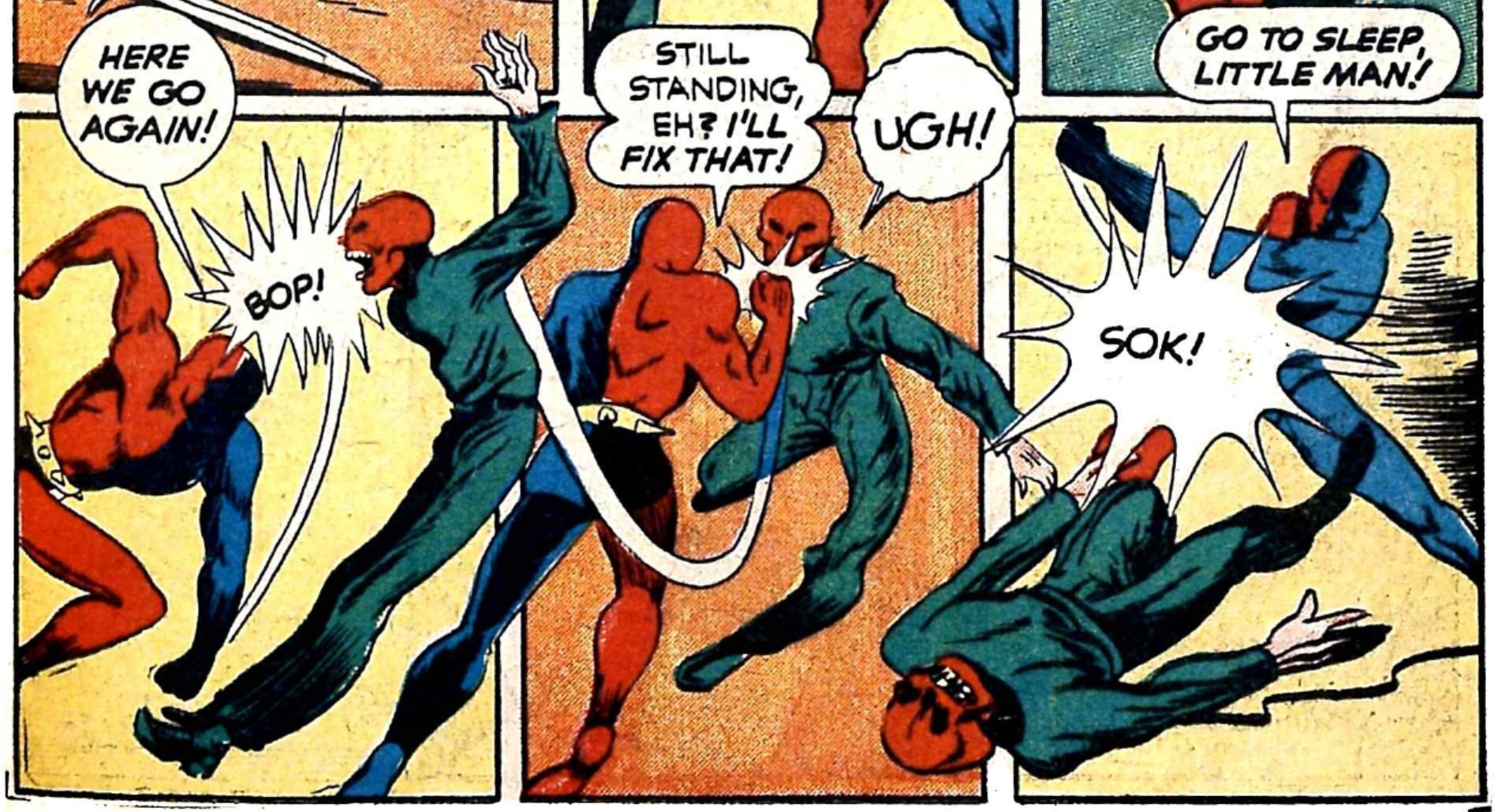
    So bad a job, in fact, that he facilitates the Daredevil’s infiltration mission by providing him with a handy all-concealing costume to wear while he does it.

    This allows Daredevil to learn Sinhart’s plan: to kidnap the President and replace him with a double in order to destabilize the US to generic fascist ends. The Scarlet Skull is supposed to be the one doing the kidnapping, so I guess he must have skills beyond getting beaten up in the wooded section of Sinhart’s back yard.

    The Scarlet Skull does manage to recover from a super-heroic beating in time to ambush Daredevil’s fiance Tonia Saunders and then parley that into a second ambush of Daredevil himself. Is this redemption? Will my opinion of him raise?

    It will not, I’m afraid. The Daredevil is more than a match for the Scarlet Skull, even when the former is shackled to a wall. The Skull, Sinhart and the false FDR (who has the unnecessarily cool name of Condor, by the way) are soon captured.

    SKULL SCORE: The one place that the Scarlet Skull comes out ahead of his counterpart! Unlike the Red Skull, the Scarlet Skull’s mask has no visible eyes, giving him a total score of 4/5, i.e., the best possible without having an actual skull face!

    Categorized in: Body (Skull), Colours (Scarlet), Ideologies (Nazis)

  • MINOR SUPER-VILLAIN 936: SIN KHAII

    (Silver Streak Comics 013, 1941)

    Sin Khaii, a lama at the same monastery that Thun-Dohr was raised at, has been cast out for unspecified reasons. His reaction to being an outcast – to steal Pandora’s Box and use it in a war on all humanity – would seem to retroactively justify the exile, however. Just why a Tibetan monastery would be the hiding place of Pandora’s Box is likewise left unexplored.

    Sin Kahii is able to use the Box to unleash fresh evils upon mankind, in the form of mosquito-like insects that are under his control. The first such is a plague called the Black Madness, which seems to act both as a traditional and deadly disease and as a vector for insanity, as seen above after Dr Benson Bell concocts a cure for it and his assistant is immediately driven to homicidal rage to keep it from being distributed.

    No madness or madman is a match for the mystic might of Thun-Dohr, however. Sin Khaii’s first plot is foiled with a sock to the jaw. Of Clavell, the madman. Sin Khaii remains unpunched.

    Since regular humans have proved to be no match for his foe, Sin Khaii’s next plan involves allying with someone more powerful, namely the ancient and evil Black Pharaoh (check in in a day or two for more on him). To that end, he levitates the Pharaoh’s whole damn pyramid and moves it from Giza to the former site of the New York World’s Fair (I was going to gripe about the comic missing an opportunity to feature the pyramid next to the Trylon and Perisphere but it seems like they were demolished with much more alacrity than I might have expected).

    As will be discussed further in the Black Pharaoh’s own entry, his imprisonment in the pyramid can only be ended when he and his servants’ places are taken by other people. Sin Khaii facilitates this via another Pandora’s Box bug, in this case “curiosity.” Could one argue that curiosity is not one of the evils contained in the box since Pandora already had it her curiosity was in fact foundational to the whole myth? I think that one could, but of course if we’re going to insist on mythic accuracy then Sin Khaii is going to have to be finding increasingly unlikely ways to weaponize hope, seeing as it’s the only thing that’s supposed to still be in the dang thing.

    Once the Black Pharaoh is free, he and Sin Khaii plot to destroy the United States but are once again foiled by the flying fists of Thun-Dohr. The pyramid (and all of the sand in Egypt) is restored to its proper resting place and Sin Khaii, still at large, swears further vengeance. Sadly for us plot resolution fans out there, the “Thun-Dohr” feature never returned after this second instalment and Sin Khaii is presumably at large to this day.

    Categorized in: Accessories (Pandora’s Box), Day Jobs (Lamas), Powers (Various Magical)