The Curse of Skeleton Munroe

Category: Nazi collaborator

  • MINOR SUPER-VILLAIN 539 UPDATE: THE CLAW (1940)

    (Silver Streak Comics 002, 006)

    As you may or may not recall, when I covered the Claw’s sole 1939 appearance I concluded that taken on its own, it read like one of those stories where a villain holds sway over an area by means of a fake monster and that if the Claw had never appeared again that’s what I would assume he was: just an illusion composed of papier mache and maybe a balloon or an image projected on a cloud.

    Well, surprise, surprise, because that wasn’t the only appearance of the Claw and in fact the vary next issue of Silver Streak Comics features him joining up with an unnamed but very recognizable Adolf Hitler in return for control of half of Europe following a Claw/Nazi victory.

    The first part of the Claw’s plan involves attacking allied shipping using his very cool underwater train/tank. Next, using super-powered artillery cannon to shell civilian population centres… somewhere. I mean, the cities all look pretty Western hemisphere but as the Claw’s original HQ on the island of Ricca was in the Pacific and he’s still close enough to there that the ships he sinks are being transported back to be used in Riccan munitions factories, so maybe he’s attacking the West coast of the United States? Not sure how that helps the Nazis, honestly, but it’s either that or his artillery is really really super and he’s bombing Europe.

    The Claw eventually gets impatient with just blowing things up and proves me wrong yet again by growing enormous and using his weird powers to set up a whirlpool so mighty that it not only draws in and dooms ships from across the ocean but also changes the world’s weather patterns, causing the tropics to freeze over. Bad!

    Our old pal and original Claw foe Jerry Morris is of course not going to take this, particularly after his previously-unmentioned younger brother Tad is lost at sea in the Claw’s oceanic chaos. He combines one of his signature astonishing super-science inventions – in this case a special bulb that emits light rays that instantly freeze water – with some cars stored in the hold of the ship he is on to create vehicles that are able to fabricate a sheet of ice to drive on across even the deepest water. And since the ice goes all the way to the bottom, these vehicles are able to neutralize the Claw’s maelstrom by creating a series of concentric ice walls around it.

    There ensues what is actually a pretty neat battle between ice-road cars and the submarine tank/train, with the cars attempting to hem in the train with walls while the train fires its artillery cannons upward – I would enjoy playing a video game about this! The Claw is ultimately killed in an explosion when the munitions on his train explode… OR IS HE?

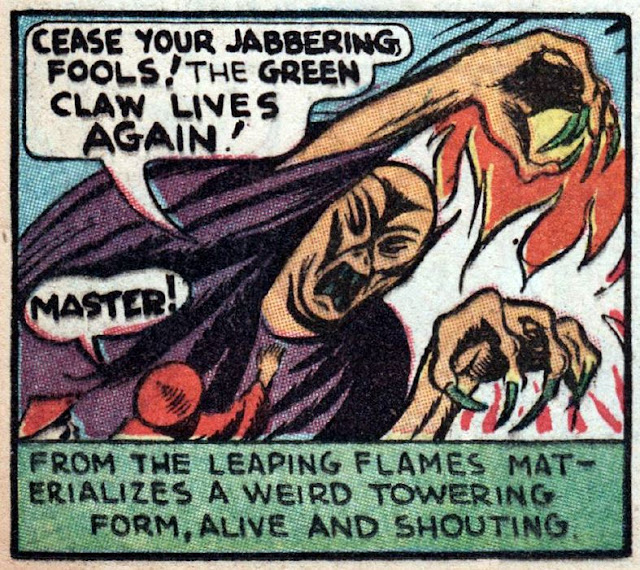
    He is not! And despite the assertion at the end of the previous story, Jerry Morris seems to have foregone taking the Claw’s body back to the US for dissection, perhaps because it was not technically a legal thing to do. Whatever the circumstances, the body ends up falling into the hands of a group of “devil worshippers” somewhere in Asia, but whether the Claw was the devil in question or not is hard to say (though in leaping back to life just as his body was consigned to the funeral pyre he certainly must have inspired some supernatural awe).

    Also, for this story alone, the Claw is referred to as the Green Claw and his claws are indeed coloured green for the occasion.

    The (Green) Claw’s opponent in this case is Major Carl Tarrant, who is either a soldier of fortune or a member of the local colonial police, but either way he simply must investigate the possibility of the Claw’s return. Tarrant manages to avoid the Claw’s cultists but is tracked down by the villain himself with some high-tech devices, then shrunk via magic and stuck in a metal box to gruesomely expire when the shrink spell wears off.

    The Claw then reveals his latest plan to take over the world: a kick-ass robot army! No notes, 10/10, a classic for a reason, just look at those cool robots.

    Tarrant of course has to spoil everything by getting out of the box before he gets squished. He destroys the robots by taking advantage of the Claw’s metal-destroying anti-bullet force field and then does one better by bombing the entire fortress/city to smithereens. But though the Claw is thwarted, HE YET LIVES. What horrors are we in store for in 1941?

    (just had to feature this cover from Silver Streak Comics 006, which I spent an inordinate amount of time being creeped out by – those hands! – as replicated in Jeff Rovin’s Encyclopedia of Super Villains)

  • MINOR SUPER-VILLAIN 701: FELON

    (Planet Comics 003, 1940)

    In his first appearance Felon is a fairly ordinary space pirate captain, terrorizing the spaceways with a fleet of cool black delta-shaped ships and a device that intercepts and disrupts communications across the Solar System.

    In this capacity, Felon gets absolutely trounced by Captain Nelson Cole: his men are beaten up and then blown out of the sky by Cole and the Solar Force. The survivors are taken into custody – Felon is not specifically mentioned but he either crashed somewhere or ended up in jail.

    Whatever happened,  the defeat must have really stuck with Felon, because he returns for revenge in Planet Comics 004, blasting a ray gun wildly into a ballroom occupied by celebrating Solar Force officers, killing at least twenty people but completely failing to achieve his goal of murdering Captain Nelson Cole.

    It’s shaping up to be another extended narrative of space cops vs space crooks when Felon, Cole and the entire Solar Force fleet just kind of blunder through a time portal (well, a time beam, technically) into the 20th Century. What a twist!

    While Cole and his crew are taking in the historical sights, Felon weighs up his options and immediately allies himself with the Nazis the Axis the Aggressor Nations, leading a surprise attack on the US that destroys half of New York City but crucially yet again completely fails to kill Cole or his men.

    Once it’s no longer a matter of humans vs aerial bombardment but futuristic space fleet vs 1940s aircraft, things quickly turn against Felon and the Aggressor Nations. Cole and his men force a global peace by the simple expedient of paralyzing all of the armies until the treaties are signed, and then chase Felon around until he hops back through the time beam ex machina vulcano to the relative safety of the future.

    Now the comic turns into an extended outer space chase but honestly it was all over for Felon once the bombing of NYC failed to take out Cole. The two have a final confrontation in Felon’s old bombed-out asteroid base that ends with Felon in the hoosegow.

  • MINOR SUPER-VILLAIN 589: THE TANKONAUT

    (Exciting Comics 005, 1940)

    Stretching the definition of “super-villain” to the very limits here: the Tankonaut is a superweapon developed by US arms manufacturer M.V. Gage under contract to a man who is very clearly meant to be Hitler but is referred to only as the Dictator. Whether this would have qualified as treason in mid-to-late 1940 is beyond me but the next part, where the Tankonaut is tested on US targets (including Washington DC!) extremely is.

    Not only does the Tankonaut have an excellent name (100% the only reason it made the grade as an entry here, even under my already very loose policies about super-vehicles) but it has a neat gimmick: it isn’t a tank at all! Rather, it is a big beefy truck that carries around its own armour plating and weaponry for rapid deployment/ quick and sneaky escape! It’s a neat variation on the old “drive the crime vehicle into the back of a truck” scheme for the truck to actually be the crime vehicle.

    Unfortunately for M.V. Gage and the Tankonaut, John Thesson, the Son of the Gods, is on the case. He discovers the Tankonaut’s secret identity of A Truck by the simple expedient of flipping it over with a long pole. As usual, once the super vehicle has been disabled the non-super humans are quickly rounded up.

  • MINOR SUPER-VILLAIN 528: THE BLACK HAND

    (Blue Ribbon Comics 016, 1941) 

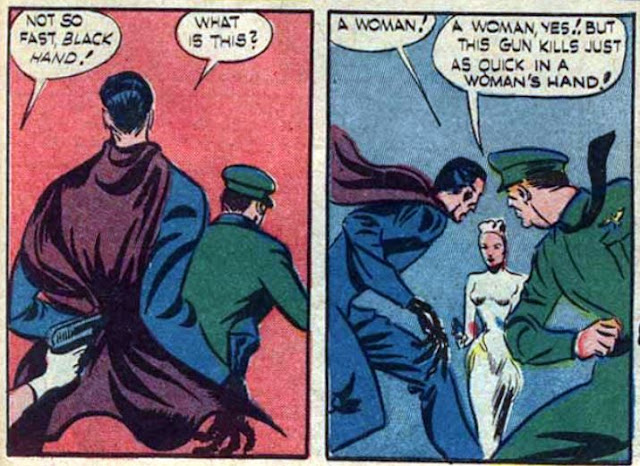
    There’s a quality that some comic book characters have and some do not and I never knew about it until I started writing this blog. That quality is called Standing in Clear View So That I Can Get a Screengrab of Them, and buddy, the Black Hand does not have it. This is about as good of a full look as you get of the guy in his first appearance.

    Enough complaining! The Black Hand is a spy of the Unaffiliated Freelancer subtype, which since he operates out of the US means that he steals US secrets for sale to the Nazis. Is a character who does business with Nazis better than one who is a Nazi? Marginally. The Black Hand is also the recurring villain of Captain Flag, who he is also responsible for becoming a super-hero due to his murder of Flag’s father and failure to proof his lair against narratively significant eagles.

    The Black Hand is called the Black Hand because of his black hand, which he usually conceals beneath a black glove and which is riddled with a deadly disease that the Black hand can transfer to a victim via a simple scratch of his horrible fingernails. It’s definitely a useful power (affliction?) for a villain to have but not one that has a chance of coming up in anyone’s super-power wishlist.

    Throughout his five appearances the Black Hand sports three distinct looks: the initial iteration (either afflicted with a deathly pallor or just overenthusiastic when applying foundation), a sort of suave mustachioed cat-burglar getup with no hint of the grave and then back to the deathly complexion with an added skull-like quality to the face. Realistically this can be put down to Captain Flag being a secondary character without a dedicated artist, but if that was the point of this blog then it would swiftly cease to be much fun.

    Notably, the suave version of the Black Hand wears his glove on the opposite side – could this indicate that he and the corpselike Black Hand are different characters? Perhaps the disease that gives them their name is also slowly killing them, which could account for the more ghoulish appearance of the original Hand over time?

    These questions will never be answered, sadly, as in-universe the Black Hand made a transition from spy the thief to pirate and Captain Flag was quick to invoke the Law of the Sea to hang him from the nearest yardarm. Out of universe, Captain Flag’s feature didn’t survive the cancellation of Blue Ribbon Comics and so the Black Hand had nobody to come back from the dead to torment.

  • MINOR SUPER-VILLAIN 446: THE ROOK

    (Mystery Men Comics 018, 1941)

    This here is the Rook, the only recurring antagonist of Golden Age duo the Lynx and Blackie the Mystery Boy. In terms of crime, he’s your basic thief and murderer with a sideline in opportunistic kidnapping and extortion. He does have several notable attributes, however:

    Tactics: The Rook has a hypnoray and he is going to use it, dammit. He’s not one of those fickle super-villains who blame their tools every time a plan doesn’t come together. The hypnoray is SOLID, it’s a VALUED MEMBER OF THE TEAM and it’s STAYING.

    The Rare Hate Triangle: In his first appearance, the Rook kills his henchman Killer Burke rather than split the take of their latest job with him. Killer’s brother Baldy Burke swears revenge and attempts to get it for the next four issues. It’s a very fun dynamic because Baldy also hates the Lynx, so his allegiance is fluid. Sometimes he teams up with the Lynx to get the Rook, sometimes the opposite. At least once, Baldy just pops up out of the Rook’s back seat and attempts to shoot him.

    More books should feature a wildcard antagonist! I can’t think of too many examples off the top of my head but those I can are terrific additions to the plot. Also, more super-villains should have non super-hero enemies given how they behave – if nothing else a guy like the Joker should be taking fire from opportunists any time he shows his face in public.

    Eyes: Not only does the Rook have really great staring eyes (and they just keep getting more intense – by the end of his appearances he’s got Muppet-style half ping pong balls going on) but the subjects of his hypnoray also have them. It’s a nice touch and I appreciate it.

    Physical Resilience (or Possibly a Series of Carefully-Planned Escape Routes): The Rook ends his first six appearances in the same way: missing, presumed dead. Specifically, he meets his theoretical end, in order, by fire, a fall, quicksand, drowning, explosion, and being thrown out a window onto sharp rocks and pounding surf far below. The Rook, in other words, operates on slasher movie villain rules – if he surely must have been killed but you don’t have a body then he isn’t dead. And the Lynx must have figured that out because in their final encounter he just breaks both of the Rooks legs rather than trying to kill him like he usually does.

    In conclusion: while the Rook himself isn’t the greatest villain in the world, virtually everything about him is worth incorporating into a villainous MO. Except for the part where he teamed up with literal Nazis. None of that.

  • MINOR SUPER-VILLAIN 366: THE SCAVENGERS

    (Military Comics 005, 1941) 

    The Scavengers are an interesting bunch, but all of the most interesting things about them are implied rather than stated. As seen above, they show up to loot and murder in the aftermath of WWII battles. The fact that they all look the same, like little rat-men, is probably meant to be a metaphorical signifier of their moral degradation but I like the implication that this is what happens to battlefield looters, like the the transformation of a ghoul or other cannibal. This of course means that there could be Scavengers throughout human history – fun!

    The Scavengers don’t actually get to do much scavenging in-story, sadly. Instead, they are captured by the Nazis and enlisted in their capacity as weird little creeps to dispose of the Blackhawks. And they do pretty well at it! Their downfall comes due to the interference of the excellently-named femme fatale Red Laura, who somewhat predictably falls for Blackhawk’s nobility and shirtlessness.

    Despite having a heroic last stand, pictured above, Red Laura actually manages to survive the issue. One hopes that she was a bit more picky about who she worked for going forward, because I am inordinately fond of her. It’s just such a good name!

    In conclusion, the Scavengers should be BRUNG BACK. Not only did they not all die at the end of the adventure (as the Blackhawks are about as likely to punch out as to shoot an opponent) but the idea of them cropping up in the aftermath of war throughout history is very cool! We need more types of human monster who wear their spiritual corruption on the outside, if only for greater variety in D&D.

  • MINOR SUPER-VILLAIN 291: QUEEN JARNA

    (Marvel Mystery Comics v1 025-026)

    Jarna here is Queen of the Lavarites, a group of aliens from Venus who coordinate with the Nazis (shown here as a chunky guy in his pyjamas about to be punched out by the Sub-Mariner). This is all regular comics stuff but there’s some fun highlights:

    a) the main Lavarite force is composed of these little roughnecks who talk in their own untranslated language and are clearly having a ball at all times. If your aliens have to look like humans they should absolutely look like fun humans.

    b) Lavarites have some extremely fun sexual dimorphism going on! Some wags over at the Marvel Wiki are of the opinion that Jarna here is a member of a second Venusian species who has become ruler of these little guys but that removes the much more fun option of them being some sort of eusocial species like bees  and that these are all her worker drone children. Or that Lavarite women are just fifty times larger than Lavarite men!

    (this is the first of two times that we cross over into Sexual Kink That I Don’t Fully Get territory)

    As with any good story involving a bunch of little guys, Namor gets Lilliputianed. (and there’s the other one!)

    Jarna is also surprisingly merciless in her attempt to do away with Namor – it’s just her bad luck that he’s also amphibious.

    Despite the fact that Namor lets her off with a warning in her first outing, Jarna is immediately back to her old tricks in the subsequent issue She’s working with the Nazis to build an underwater staging area for the invasion of the US, but good news: she’s planning on turning on them just as soon as they do the dirty work for her. Attempted world domination I can forgive but Nazi collaboration is a harder pill to swallow.

    Unfortunately it’s just Jarna in this issue – the Lavarites all seem to have gone back to Venus and I guess she hasn’t had time to hatch out another generation of them. I miss them.

    For some reason probably related to her status as a pretty girl Namor lets Jarna go at he the end of this story as well, and she’s stayed away ever since, possibly because he came very close to killing her on a couple of occasions there. I of course would love to see her BRUNG BACK, particularly if she is actually portrayed as the queen of a eusocial species of little guys that she gives birth to, and particularly if they aren’t defaulted to the insect version of such but reflect something more like naked mole-rat society or some other, weirder, model. Have ’em come back for revenge on the Sub-Mariner some time when he’s vulnerable!

    BONUS: this is perhaps the most perfectly drawn “amused disbelief” face I have ever seen 

    (said in a room with two people who had been surgically altered to be amphibious by the Antarctic-dwelling people of lost Atlantis, by the way)

  • MINOR SUPER-VILLAIN 285: DAKA

    (Marvel Mystery Comics v1 024, 1941) 

    Daka is Namor the Sub-Mariner’s uncle who is the first of many to usurp his throne while he’s off adventuring. He allies with the Nazis and the Seal People in a scheme to invade Argentina and it’s a testament to how little I can bring myself to care about Atlantean political drama that not even the Seal People can inspire me to write more about this guy.

  • MINOR SUPER-VILLAIN 279: THE CAT’S PAW

    (Marvel Mystery Comics v1 018-020, 1941)

    The Cat’s Paw gets a pretty classic intro: Dr Lin, the Angel’s old mentor and friend who was introduced in the previous issue, is ruthlessly murdered via high-speed application of poisoned dart. The Angel give chase, but fails to make the bust.

    The next day we see some of the Cat’s Paw’s scheme begin to emerge. She’s killing industrialists for some reason. But why?

    Here’s our first look at the villain in question, because I chose some odd images to clip. A couple of things about her stand out:

    -she’s our first example (if not necessarily Marvel’s first example – they’ve got a half-dozen other titles at this point) of a few things in a Marvel comic: a female super-villain, a proper costumed crook, themed weaponry in the form of a cat-claw launcher, and, kind of, a recurring villain.

    -on that last point: not really. Though the Cat’s Paw does appear in three issues worth of  Angel comics, it’s all one story, just decompressed a bit.

    -it is of course notable that she looks a bit like 90s Catwoman

    -most importantly: in the above image both the Cat’s Paw and the Angel are attending a costume party as themselves! A twofer! 

    Eventually, the Angel tracks the Cat’s Paw down to her HQ in one of the dozens of deserted castles that litter the mountains a short drive from NYC in any given comic book universe.

    Now for the disappointing news: the reason that the Cat’s Paw was killing all of those industrialists is that she was acting as a… catspaw for the Nazis in their bid to weaken US support for Britain (and here once more I must note that Marvel was really leading the pack on making Nazi villains for-real Nazis well before Pearl Harbor). She does rediscover her patriotism once her Nazi handler tries to bump her off, which is better than nothing, I suppose. 

    Here’s where I’d normally be decrying the comic for killing her off at the end, pointing out how ambiguous the “guess we’ll never find the corpse, oh well” nature of her death is, and call for her to be brung back as a legacy villain, but the Nazi collaboration is really sticking in my craw. Honestly if she hadn’t walked it back at the end I’d be all for the Cat’s Paw showing up as an Axis agent in period pieces going forward but as-is I reckon she can lie fallow.

  • MINOR SUPER-VILLAIN 279: THE CAT’S PAW

    (Marvel Mystery Comics v1 018-020, 1941)

    The Cat’s Paw gets a pretty classic intro: Dr Lin, the Angel’s old mentor and friend who was introduced in the previous issue, is ruthlessly murdered via high-speed application of poisoned dart. The Angel give chase, but fails to make the bust.

    The next day we see some of the Cat’s Paw’s scheme begin to emerge. She’s killing industrialists for some reason. But why?

    Here’s our first look at the villain in question, because I chose some odd images to clip. A couple of things about her stand out:

    -she’s our first example (if not necessarily Marvel’s first example – they’ve got a half-dozen other titles at this point) of a few things in a Marvel comic: a female super-villain, a proper costumed crook, themed weaponry in the form of a cat-claw launcher, and, kind of, a recurring villain.

    -on that last point: not really. Though the Cat’s Paw does appear in three issues worth of  Angel comics, it’s all one story, just decompressed a bit.

    -it is of course notable that she looks a bit like 90s Catwoman

    -most importantly: in the above image both the Cat’s Paw and the Angel are attending a costume party as themselves! A twofer! 

    Eventually, the Angel tracks the Cat’s Paw down to her HQ in one of the dozens of deserted castles that litter the mountains a short drive from NYC in any given comic book universe.

    Now for the disappointing news: the reason that the Cat’s Paw was killing all of those industrialists is that she was acting as a… catspaw for the Nazis in their bid to weaken US support for Britain (and here once more I must note that Marvel was really leading the pack on making Nazi villains for-real Nazis well before Pearl Harbor). She does rediscover her patriotism once her Nazi handler tries to bump her off, which is better than nothing, I suppose. 

    Here’s where I’d normally be decrying the comic for killing her off at the end, pointing out how ambiguous the “guess we’ll never find the corpse, oh well” nature of her death is, and call for her to be brung back as a legacy villain, but the Nazi collaboration is really sticking in my craw. Honestly if she hadn’t walked it back at the end I’d be all for the Cat’s Paw showing up as an Axis agent in period pieces going forward but as-is I reckon she can lie fallow.