The Curse of Skeleton Munroe

Category: android

  • SUPER-HERO FILE 005: THE HUMAN TORCH

    SUPER-HERO FILE 005: THE HUMAN TORCH

    (Marvel Comics 001, 1939)

    The Human Torch! The first major (and first overall) Marvel super-hero, despite the fact that my disorganized ass is writing about him third!

    The Human Torch is a synthetic man, aka an android (aka a synthezoid, which as far as I can tell means “cooler android” and won’t come into use until the 60s anyway) and created by Professor “Not Yet Phineas” Horton. Later stories will add all kinds of influences on and collaborators with Horton (including our recent subject Doctor Nemesis), but in the beginning it was just him, toiling away over his blonde creation.

    The Human Torch’s origin is shaped by three major factors: first, that Horton’s process was flawed in some strange way and as a result his android bursts into flame when exposed to oxygen. Secondly, there is the fact that Horton, despite the obvious scientific acumen and indeed genius on display in his creation, is seemingly devoid of any scientific curiosity outside of this. When confronted with the problem of a flaming android, Horton just throws his hands in the air and gives up without making any kind of real effort to mitigate the problem.

    Finally, the Torch is hampered by the fact that humanity at large, including Horton, is motivated by fame and fortune. Everyone who meets him wants to exploit him in some way, unless they are afraid of him – this is presumably why Horton’s first act upon creating him is to call in reporters rather than work on getting him to stop exploding.

    Though Horton can’t bring himself to work on a solution for the Torch’s problem, he balks at destroying his creation and so opts to seal him inside of an airless steel cylinder and then bury that cylinder in cement.

    Somehow, however, and perhaps relating to the fact that it was dropped into semi-solid cement from a decent height rather than laid down carefully and then covered up, the cylinder develops a crack through which enough air seeps in to set the Torch alight and cause him to burst his prison asunder. Everyone’s worst fears seem to be confirmed, as the newly self-aware android charges through the city streets, setting men, hats and telephone poles alight. A curious thing happens, however, and perhaps this reflects yet another failing on the part of Horton: the Human Torch realizes that he is hurting people and doesn’t want to. You should have talked to your artificial son, Professor, and then you might not have felt it necessary to seal him in concrete.

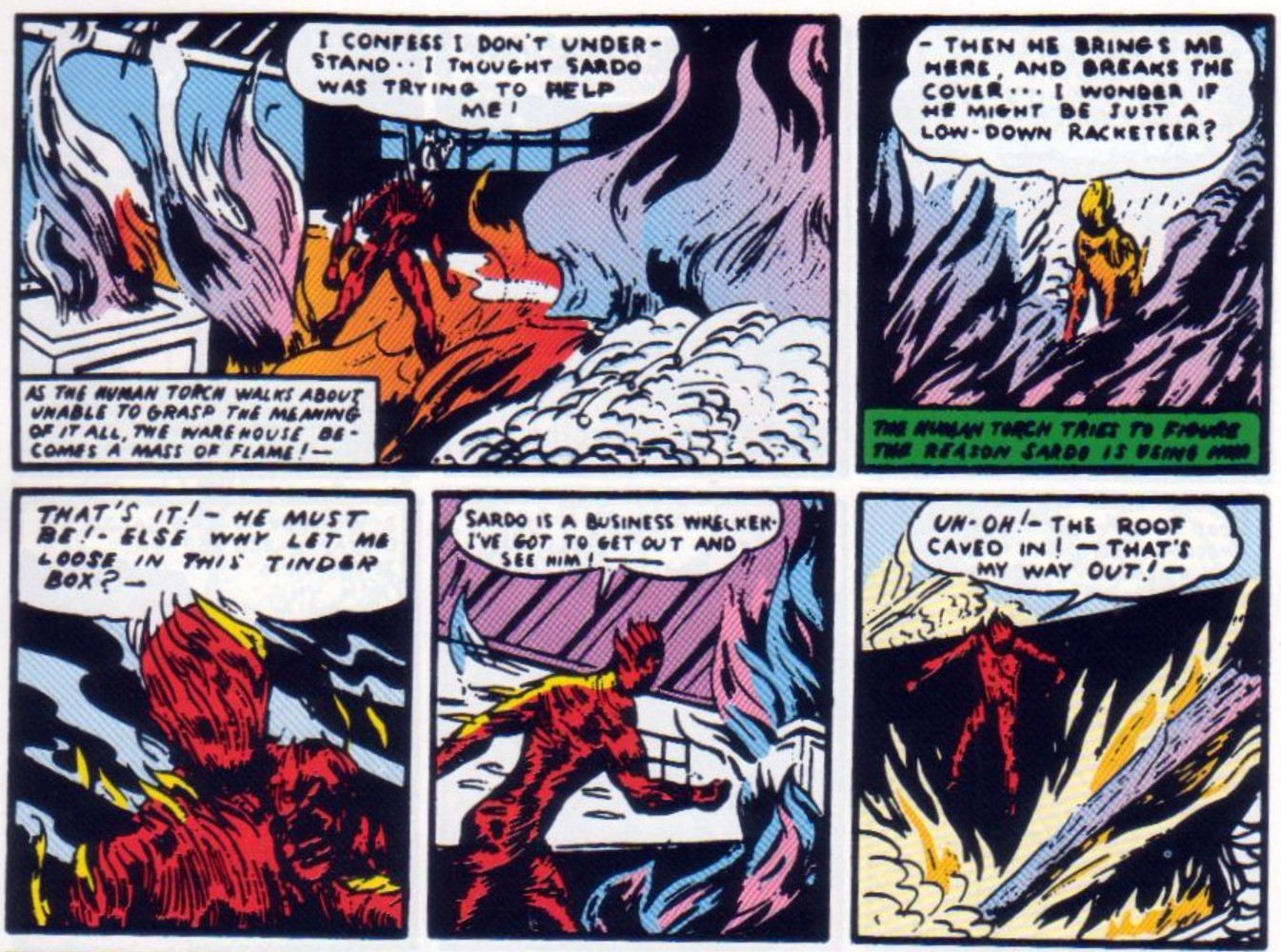
    In attempting to control his own flame (see? once again the child outstrips the parent), the Torch dunks himself in a swimming pool that turns out to belong to a criminal named Sardo who immediately sees the profit potential in a flaming man. Side note: Sardo also has a swimming pool that doubles as a vacuum chamber. Is there any use for such a thing beyond “elaborate deathtrap?”

    Sardo’s reaction to the Torch falls under theme #3 of this origin: Human Greed. He uses his weird pool to transfer the android to a sealed container and then uses him to burn down a warehouse as part of a protection racket scheme. Just like Horton, however, Sardo fails to reckon with the fact that the Torch might have opinions of his own about such things, and meets his end in their subsequent confrontation. 

    The Human Torch eventually figures out how to control his own flame thanks to Sardo’s stockpile of liquid nitrogen tanks – the nitrogen snuff the flame only temporarily but having done so a couple of times the Torch gets the hang of how to do so at will. We almost get a heartwarming father/son reunion as Horton argues for the Torch to be released into his custody, but then he goes and ruins it all by immediately starting to scheme about how much money he is going to make off of his creation’s back. This is the final straw as far as the Human Torch is concerned and he leaves via the most direct route: straight up.

    (Per Marvel Mystery Comics v1 002 this sets Horton’s house on fire and leads to his death, and the Torch isn’t sad about it)

    UPDATES

    Update 1940

  • MINOR SUPER-HERO ROUND-UP 049

    Pretty diverse bunch this time.

    the Lone Rider: 

    Another masked cowboy hero dispensing justice from the barrel of the gun in the Old Modern West to throw in the pile. The Lone Rider does have the distinction of having been created by Jack Kirby for a very short-lived comic strip and recycled by Eastern Color for comic book content. 

    Having read through a decent chunk of the Lone Rider’s appearances, I’m pretty sure that Texas never actually put in an appearance, and that Pepito had maybe one panel to shine in – those are the risks you run when you start off with a cast of characters entry, I suppose. (Famous Funnies 062, 1939)

    the White Streak: 

    Discovered by archaeologist Simms and his guide Ramon in a temple that is inside of a small mountain that has risen out of a dead volcano (which is in turn in the fictional country of Payan, in  actual South America), the White Streak is an android built by the ancient dead civilization of Utopia, which perished in war and gifted their creation to the future as a way to prevent war from destroying any more civilizations. And by “the White Streak” I mean “Manowar,” which was clearly intended to be his super-hero name but was changed  for some reason – he’s barely even referred to as the White Streak for the first issue. Whatever his name, he took his mission very seriously: if you were in the business of promoting or profiting from war you could expect a very violent visit from the White Streak.

    At first, Manowar’s powers were limited to his electric vision and a bit of enhanced agility, but over time they expanded to include super strength, an electrical force field that still sometimes unnervingly came out of his eyes, and electrical constructs (most frequently a ladder, for some reason). (Target Comics v1 001, 1940)

    UPDATES: 1940 

    Boystate: 

    Okay, so Boystate is an indeterminably large chunk of land somewhere in the US within a few hours drive from NYC, containing a city (Boyville, natch) and founded and run by a fellow known as the Skipper (the Confederate officer-looking fellow, above) and his aide the Captain (the other guy). Boystate is unsurprisingly populated by boys, and has as its charter a dedication to bringing those often troubled boys up to be fine upstanding men.

    Of course this is all taking place in a comic that is written and set in 1940, so the comic’s views on how boys might be guided into that upstanding manhood involve a lot of homemade militia activity and discipline through violence, as seen here as new recruit Speck is smacked down by Boystate Ranger V.Y.

    The other hallmarks of the Boystate comics are 1) a deep love of pointless callsigns – everyone is V.Y. or X-1 and travel from Point 6-A to Tower 2-R and on and on in a way that makes your eyes glaze over, and 2) an absurd variety of cosmic ray-powered sci-fi technology, courtesy of the Skipper’s genius.

    In addition to the identity-stripping numerical designations, Boystate is simply chockablock with pseudo-military ranks and divisions for the boys to aspire to join so that they can spend their time patrolling Boystate airspace and riding her borders and chasing down passing cars to check if they’re stolen… frankly, if they weren’t collectively the protagonists of a comic book series in which they are described a good and true and aspirational Americans I would be tempted to call Boystate a nightmarish authoritarian police state/cult. Did I mention that the Skipper not only has a machine that can take video of anywhere in Boystate but also one that can read minds? (Target Comics v1 001, 1940)

    Spacehawk:

    As a big fan of Basil Wolverton, I wish that he’d had more opportunities to create science fiction comics during the time that he was interested in doing so, but in the absence of that, Spacehawk is pretty great. A mind-reading physical titan of unknown origin who metes out justice to the scum of the Solar System, Spacehawk is much more of a space-based super-hero than his contemporaries, and his alien foes are appropriately Wolvertonian grotesques who reflect their evil nature in their outward appearances.

    Sadly, Novelty Press was The Company Where Whimsy Was Not Welcome, and in 1941 Spacehawk was relocated to Earth to battle the Axis instead of all of those unrealistic aliens. Don’t get me wrong: Basil Wolverton comics about Spacehawk beating up Nazis are still pretty great, just not as great as ones about him beating up aliens. The move to 1940s Earth does introduce the as-far-as-I-know never answered question of just where all of the humans in the earlier Spacehawk comics were from, which is a fun if brief diversion.

    Finally, there’s a very minor bit of suspense in the first few Spacehawk stories over just what he is under that mask of his – an alien? a robot? something weirder? – but it turns out that he’s a hunk. Spoilers, I guess. (Target Comics v1 005, 1940)

  • MINOR SUPER-HERO ROUND-UP 022

    There’s a little super-hero in all of us, I reckon.

    Volton: 

    Volton comes on strong. I mean, look at the guy: crotch-forward, power device on a chain welded around his waist, moisturized, in his lane. The very second he figured out how to have super-powers he was in his element.

    And because Volton (aka Guy Newton) HATES CRIME and HATES CRIMINALS he heads on down to the local police station in his only-the-most-confident-heroes-wear-them sweater vest and beats up cops until they let him be a semi-official vigilante. And he is much more qualified than the pack of ding dongs the Commissioner here has working for him – do any of them have electrically powered super strength or an electrical forcefield or the ability to suck the electricity out of a person to stun them? They do not. 

    Volton does such a good job beating up crooks that not only does the Commissioner come around on him but lets Volton date his daughter. This is the workaround for those fathers who ostentatiously display a shotgun when the new beau comes around, fellows: vigilante justice. (Cyclone Comics 001, 1940)

    Volton is our second encounter with a future member of Marvel’s team of public domain super-heroes-turned-Nazis the Battle-Axis, and it’s hard to say if Roy Thomas did him the most dirty or the least. His stated reasons for the heel turn are certainly the flimsiest of all the Battle-Axis members but just like his revised origin of having been struck by lightning they aren’t actually true, as this version of Volton is a prototype of the same kind of android as the Human Torch, taken along when Dr Nemesis Death split from Phineas Horton after helping him create android life but before turning to fascism.

    All this is interesting in a universe-building kind of way (the Human Torch has a little brother who hasn’t showed up in decades! What’s up with that?) but a bit of a missed opportunity in that the original version of Volton is more than a bit fascist. Why bother making the Human Meteor go Nazi for Ireland when you could have him be the android and simply let Volton follow his heart?

    the Red Knight:

    What can I say: I like super-hero-adjacent characters and stories of knightly adventure are full of those. The Red Knight, for example, is Sir Miles of Lorraine and he has special red chain mail! and that’s about it. Even worse, his adventures are set during the First Crusade, so there are likely to be fewer dragons and evil warlocks and more historic war crimes heinous enough to still come up in international relations. Lucky for me, the Red Knight series only had two installments and the second one (the one more likely to have war crimes in it) is missing! As it stands, the Red Knight spends most of his energy dealing with his evil uncle rather than in slaughtering all and sundry. (Cyclone Comics 001, 1940)

    Robo of the Little People:

    Like Electro before him, Robo here is actually a super-powered robot piloted remotely by a scientist (in this case a guy named Vedik). The gimmick in Robo’s case is that he was constructed as a giant robot by the inhabitants of an isolated Antarctic valley but once he started to explore the outside world for them it quickly became clear that his creators were in fact very small and Robo was the size of a regular human. 

    Robo probably would have transitioned into regular super-heroing at some point but since he only has a handful of appearances most of his adventures are concerned with day-to-day survival in our wacky world. (Cyclone Comics 002, 1940)

    The Eye:

    The Eye is just that: a huge, disembodied eye with associated lid, lashes, etc, that appears with or without a halo of flame to serve the cause of justice throughout the world. It is, without a doubt, an outlier in the group of beings that can be labelled “super-hero”.

    About the only thing that we know about the Eye is that it is a well-known figure world-wide. It’s been operating for long enough that legends of its deed are present in a number of different cultures and whispered of by the criminal fraternity. Other than that: nothing. The Eye sees injustice and metes out justice and that’s all.

    Actually, there is one other thing we can infer about the Eye: either its power levels or its willingness to act directly varies over time. Sometimes, as above, it takes the shortest route to justice, employing heat rays and knocking planes out of the air willy nilly. Other times (and particularly by its last few appearances), the Eye contents itself with passing off information to human agents such as lawyer Jack Barrister. Is the Eye periodically short on power? Is it bored of the lack of challenge inherent in eye-beam based justice?

    The Eye’s eye also flips from left to right sometimes. This is actually quite eerie! (Keen Detective Funnies v2 012, 1939)

  • MINOR SUPER-VILLAIN 176: Z

    (Captain Marvel Adventures 001, 1941)

    Z is (spoilers) an android built by Dr Sivana to destroy Captain Marvel. He’s a cool guy and a fun villain: slick, full of attitude, almost powerful enough to do the job. Plus he doesn’t seem to know he’s a robot, which I find to be a fun feature in an android character – it allows for shocking reveals! Z should definitely be BROUGHT BACK, if only as disposable muscle for Sivana. We wuz robbed of a smug android thug slouched over a chair cleaning his nails in the background of every Dr Sivana scene from 1941 on, I say!

    The really interesting thing about Z is the fact that he and Captain Marvel fight three times and each time, Captain Marvel is explicitly trying to kill him. I came into my ongoing “read all comics” project a lot less familiar with the Fawcett end of things so I was pretty bought in to the modern conception of Captain Marvel as some sort of Pure Being of Childlike Innocence and thus it was a lot more jarring to come into the realization that in his early days he was just as likely to resort to deadly force as Batman or Superman, probably a bit less often than the former and more than the latter. Honestly interested to see just when each adopts a code against killing relative to one another.

  • MINOR SUPER-VILLAIN 176: Z

    (Captain Marvel Adventures 001, 1941)

    Z is (spoilers) an android built by Dr Sivana to destroy Captain Marvel. He’s a cool guy and a fun villain: slick, full of attitude, almost powerful enough to do the job. Plus he doesn’t seem to know he’s a robot, which I find to be a fun feature in an android character – it allows for shocking reveals! Z should definitely be BROUGHT BACK, if only as disposable muscle for Sivana. We wuz robbed of a smug android thug slouched over a chair cleaning his nails in the background of every Dr Sivana scene from 1941 on, I say!

    The really interesting thing about Z is the fact that he and Captain Marvel fight three times and each time, Captain Marvel is explicitly trying to kill him. I came into my ongoing “read all comics” project a lot less familiar with the Fawcett end of things so I was pretty bought in to the modern conception of Captain Marvel as some sort of Pure Being of Childlike Innocence and thus it was a lot more jarring to come into the realization that in his early days he was just as likely to resort to deadly force as Batman or Superman, probably a bit less often than the former and more than the latter. Honestly interested to see just when each adopts a code against killing relative to one another.