The Curse of Skeleton Munroe

Category: Battle-Axis

  • MINOR SUPER-HERO ROUND-UP 103

    Soon there will be more minor super-heroes than there are humans for them to protect.

    the Sentinel:

    In 1783, on the Boston Common, the newly-minted Spirit of America charges a cannon with the “powders of patriotism” in anticipation that someday a champion will be needed to defend the new nation from destruction. Finally, in 1941 (the Civil War not, apparently, being enough of a reason), the cannon fires on its own and releases the Sentinel, mystic champion of the American people.

    As one might expect, the Sentinel is broadly superhuman: he can fly, is super strong and is immune to most harm. He also has a halo of fire that he can disappear into and shrink to a tiny flame, effectively rendering him invisible and allowing him to vex friend and foe alike with his comings and goings. Oddly, he has no other control over fire. (Liberty Scouts Comics 003, 1941)

    Doctor Nemesis:

    Doctor Nemesis is really Dr Jim Bradley, intern at Mercy Hospital in an unnamed city (that is probably meant to be NYC but later retconned as San Francisco) who has developed a foolproof truth serum and decided to keep it to himself rather than risk criminals getting their hands on it – presumably the concern is that they would use it to learn bank vault combinations and other secret information. Since he himself continually runs into situations in which a foolproof truth serum is a handy way to solve a crime, Bradley adopts a costumed identity and sets out to achieve a better tomorrow via a series of injections. 


    Doctor Nemesis might just be the most calling card-using super-person who we have yet encountered. He hands out at least four of them in his first adventure alone.

    Doctor Nemesis has a pretty simple crimefighting routine: identify a potential injustice and then drug everyone involved until he has a clear idea of who is responsible, then beat them up and have them give a drugged confession in front of a police witness. The police in turn are perfectly happy to receive these confessions that they technically haven’t coerced from people, though there has to be a clever defense attorney somewhere in Unnamed City who is just waiting to get a Doctor Nemesis client so that they can really dig into the admissibility of admissions given under the influence of mysterious vigilante juice.

    It’s been a while since we have encountered a character who was later revived and incorporated into the Battle-Axis, Marvel’s team of disaffected public domain Golden Age super-heroes who went over to the Nazis, but Doctor Nemesis here is one of them under the technically-but-not-really more badass name of Dr Death. As always, it’s hard to say just who got done dirtiest by Roy Thomas when he was assembling the Battle-Axis roster but Doctor Nemesis is certainly a candidate, if only because he doesn’t even have the Human’s Meteor’s flimsy “I’m Irish American and fuck the British” or the Spider Widow’s “the Commies killed my husband” excuses. Instead, he simply implies that the Nazis are paying him well.

    Subsequent writers (specifically Matt Fraction, if I have things right) clearly thought that Doctor Nemesis was worth revisiting. He was given a long career as a Nazi hunter to counteract his short career as a Nazi and briefly became a core X-Man, though nowadays every time I look up what he’s up to it seems that he has become weirder and more peripheral to the action than the last. (Lightning Comics v1 006, 1941)

    Lash Lightning **UPDATE**:

    I haven’t been very careful to delineate whether the character has been going by “Flash” or “Lash” Lightning due to the fact that it profoundly does not matter (they just call him “Lightning” in the stories themselves, for instance) but I might as well make note of this, the issue in which the actual change was made. (Lightning Comics v2 002, 1941)

    Marvo the Magician **UPDATE**:

    Up until the exact point pictured above, Marvo the Magician was unique among magical comic book super-heroes, for though many of them (including Zatara, the big cheese himself) are said to be using their magic to create illusions and fool the minds of others, it is all demonstrably lies (or more charitably a different definition of “illusion” than I am using), as they all produce material effects in the world. Only pure, beautiful Marvo can claim that he uses illusions and nothing more to frighten and confound his foes, and I have been checking.

    That is, up to this issue, when Marvo creates the “illusion” of an ocean liner (complete with a crooked sailor who kidnaps her and hands her over to pirates!) that the woman he is helping proceeds to board and sail away on. Unless the implication is that she has been so convinced that the liner exists that she has swum or perhaps hovered her way to her destination (well, part way to her destination), the inescapable fact is that this ship is more than a mere illusion. Nothing is certain in this wicked world, folks. (Lightning Comics v2 003, 1941)

  • MINOR SUPER-HERO ROUND-UP 022

    There’s a little super-hero in all of us, I reckon.

    Volton: 

    Volton comes on strong. I mean, look at the guy: crotch-forward, power device on a chain welded around his waist, moisturized, in his lane. The very second he figured out how to have super-powers he was in his element.

    And because Volton (aka Guy Newton) HATES CRIME and HATES CRIMINALS he heads on down to the local police station in his only-the-most-confident-heroes-wear-them sweater vest and beats up cops until they let him be a semi-official vigilante. And he is much more qualified than the pack of ding dongs the Commissioner here has working for him – do any of them have electrically powered super strength or an electrical forcefield or the ability to suck the electricity out of a person to stun them? They do not. 

    Volton does such a good job beating up crooks that not only does the Commissioner come around on him but lets Volton date his daughter. This is the workaround for those fathers who ostentatiously display a shotgun when the new beau comes around, fellows: vigilante justice. (Cyclone Comics 001, 1940)

    Volton is our second encounter with a future member of Marvel’s team of public domain super-heroes-turned-Nazis the Battle-Axis, and it’s hard to say if Roy Thomas did him the most dirty or the least. His stated reasons for the heel turn are certainly the flimsiest of all the Battle-Axis members but just like his revised origin of having been struck by lightning they aren’t actually true, as this version of Volton is a prototype of the same kind of android as the Human Torch, taken along when Dr Nemesis Death split from Phineas Horton after helping him create android life but before turning to fascism.

    All this is interesting in a universe-building kind of way (the Human Torch has a little brother who hasn’t showed up in decades! What’s up with that?) but a bit of a missed opportunity in that the original version of Volton is more than a bit fascist. Why bother making the Human Meteor go Nazi for Ireland when you could have him be the android and simply let Volton follow his heart?

    the Red Knight:

    What can I say: I like super-hero-adjacent characters and stories of knightly adventure are full of those. The Red Knight, for example, is Sir Miles of Lorraine and he has special red chain mail! and that’s about it. Even worse, his adventures are set during the First Crusade, so there are likely to be fewer dragons and evil warlocks and more historic war crimes heinous enough to still come up in international relations. Lucky for me, the Red Knight series only had two installments and the second one (the one more likely to have war crimes in it) is missing! As it stands, the Red Knight spends most of his energy dealing with his evil uncle rather than in slaughtering all and sundry. (Cyclone Comics 001, 1940)

    Robo of the Little People:

    Like Electro before him, Robo here is actually a super-powered robot piloted remotely by a scientist (in this case a guy named Vedik). The gimmick in Robo’s case is that he was constructed as a giant robot by the inhabitants of an isolated Antarctic valley but once he started to explore the outside world for them it quickly became clear that his creators were in fact very small and Robo was the size of a regular human. 

    Robo probably would have transitioned into regular super-heroing at some point but since he only has a handful of appearances most of his adventures are concerned with day-to-day survival in our wacky world. (Cyclone Comics 002, 1940)

    The Eye:

    The Eye is just that: a huge, disembodied eye with associated lid, lashes, etc, that appears with or without a halo of flame to serve the cause of justice throughout the world. It is, without a doubt, an outlier in the group of beings that can be labelled “super-hero”.

    About the only thing that we know about the Eye is that it is a well-known figure world-wide. It’s been operating for long enough that legends of its deed are present in a number of different cultures and whispered of by the criminal fraternity. Other than that: nothing. The Eye sees injustice and metes out justice and that’s all.

    Actually, there is one other thing we can infer about the Eye: either its power levels or its willingness to act directly varies over time. Sometimes, as above, it takes the shortest route to justice, employing heat rays and knocking planes out of the air willy nilly. Other times (and particularly by its last few appearances), the Eye contents itself with passing off information to human agents such as lawyer Jack Barrister. Is the Eye periodically short on power? Is it bored of the lack of challenge inherent in eye-beam based justice?

    The Eye’s eye also flips from left to right sometimes. This is actually quite eerie! (Keen Detective Funnies v2 012, 1939)

  • MINOR SUPER-HERO ROUND-UP 020

    Super-heroes! Minor ones. 

    the Tulpa:

    The Tulpa and its originator Tsang had the misfortune to appear only once, in Sun Publications’ only proper comic, Colossus Comics 001. This is… a shame? No, it’s probably not. As it stands, the Tulpa is an interesting idea: a Tibetan hermit Lama named Tsang manifests a superhuman thoughtform to battle a bandit/Nazi alliance who are preying on nearby monasteries, and as far as 1940s comics set in Asia go, the whole thing isn’t even that racist!*

    The Tulpa itself is a fairly generic bulletproof muscleman with a pretty great look – I tried to see if that sort of draped hood/cloak was an actual thing that people in Tibet wore at some point (it’s just plausible enough looking that it might be inspired by actual clothing) but with the current state of image searching I think it’s once again a case of me giving up once it becomes clear that I would have to do Actual Research to find the answer. I also really like the very subtle eyeliner/ domino mask.

    *it’s still racist, though. Just in comparison.

    Perhaps the most interesting aspect of the Tulpa is the fact that it has to be actively maintained by Tsang at a fairly high physical and mental cost. At one point he almost drops his ally down a cliff because a concerned member of the temple staff brings him some food and breaks his trance and later on that poor berated person is proven right because Tsang has to slither over to eat it cold lest he miss the climax of the story. I just think it’s neat when a super-character doesn’t have unlimited energy. (Colossus Comics 001, 1940)

    Icarion:

    What could meet the definition of a minor super-hero more than one who never actually appeared in a published story? Yes, poor Icarion (Child of the Sun) here was advertised on the back cover of Colossus Comics 001 as a feature in the second, never-produced issue. All we can say about him is that he could probably fly, but as a long-time comic-book thinker-abouter I have a few well-informed theories as to what his deal might have been:

    -descendant or reincarnation of Icarus

    -adventurer or archaeologist who has found Icarus’ (or more plausibly Daedalus’) wings

    -winged alien or other nonhuman with a very coincidental name

    -scientist or inventor who has created wing tech and chosen an allusive name

    -non-flying adventurer with winglike cape (least likely but still possible)

    Outside of an amazing lore dump from a long-lost journal or something, we shall never know. (Colossus Comics 001, 1940)

    Strongman:

    Strongman! Of course there was a Superman knockoff named Strongman, how could there not be? 

    Rather than being rocketed to Earth from a doomed planet, Strongman here has been doing yoga (secret yoga) for years and now has super strength and speed as well as invulnerability to small arms etc, super breath and even telescopic vision. Pretty good yoga! He’s also wearing a costume that today reads either “1930s sci-fi” or “WWII Nazi character created in the 1980s” (foreshadowing).

    As far as secret identities go, Strongman is Percy van Norton, bored playboy complete with monocle, cigarette holder and coterie of socialites who sail around the world on his yacht with him, simultaneously giving him a reason to be in conflict zones and complicating his attempts to intervene in those conflicts. He also has one of the snottiest expressions ever depicted on a playboy – Bruce Wayne could only dream.

    Strongman is the second character we have encountered to later be drafted into Roy Thomas’ Battle-Axis of public domain super-heroes-turned Nazis and I have to say that he’s the one I can actually see doing it, whether because I find his snotty expression so unlikable or because early on he’s very against the US entering WWII and doesn’t last long enough to get on board with the war effort, so I associate him with the kind of nativist/nationalist/fascist-adjacent types who kept on with those beliefs. I also appreciate that his revised serum-based origin also made him dumber. (Crash Comics Adventures 001, 1940)

    the Blue Streak:

    The Blue Streak (aka the Defender of the People) is an otherwise-unnamed man with a simple charter: protect the weak and persecuted from the strong. He’s got an aide named Tago and together they fly all over the world righting wrongs and toppling a series of vaguely fascist dictators and generals. Technically he’s just a guy in a costume but due to the nature of comic book storytelling he accomplishes several feats that could be called lightly superhuman. He’s the kind of character who would be referred to as being in “peak physical condition” in a handbook or a who’s who. I like him! He’s got a simple charter and he sticks to it and most importantly if he showed up in a comic as a Nazi I’d figure that something was up. (Crash Comics Adventures 001, 1940)

  • MINOR SUPER-HERO ROUND-UP 018

    More of these guys and their antics.

    Johnny Fox:

    Johnny Fox is a guy* from the Florida Everglades who visits his grandfather one day to find him the victim of a treacherous murder. And what’s worse, the murderer, one Peter Pokane, did so in order to steal a supply of “sun-shots”, i.e., invisibility pills.

    *and by “guy” I mean “Native American guy of the Seminole Tribe of Florida” but it’s a tricky thing to work into a concise sentence. Also tricky: the racial politics of the Johnny Fox comic! Johnny is a college-educated Seminole and thus free of a lot of the overt stereotypical behaviour of the day but also is a near-superhuman even without the invisibility pills, explicitly due to his Noble Savagery. Plus Peter Pokane’s major villainous trait is that he’s a “half-breed” which… must I explain why that sucks? What I’m saying is that it’s complicated.

    Johnny gets the sun-shots back by yeeting Peter Pokane out a penthouse window and begins fighting crime, invisible-style. Keeping in mind, of course, that he has to take a pill to turn invisible and another to turn back. Unless he gets hurt, which will turn him back immediately. Which happens a lot, because Johnny may be invisible, but his shadow never is. As far as invisibility goes, this version might have the most caveats I have ever seen. At least he doesn’t have to be nude.

    After a while the writers seem to get tired of the invisibility gimmick and have Pokane return just long enough to take the sun-shots to a watery grave (and it’s a rare villain who gets killed by the same hero twice). Johnny Fox is now just a regular bow-wielding New York City Private Detective… for about two issues, after which Johnny’s grampa’s ghost returns to teach him how to make them again. (Champion Comics 006, 1940)

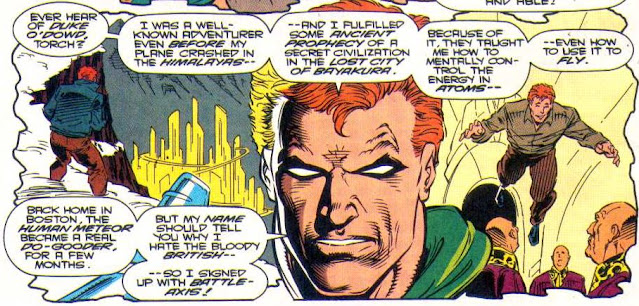
    the Human Meteor:

    Duke O’Dowd was just a regular Texan serving as a French Foreign Legionnaire until a couple of issues in, when his writers presumably realized that comics about the French Foreign Legion are boring, repetitive and usually pretty racist (though they probably cared more about the first two reasons). So they made Duke homesick, had him earn an honourable discharge and sent him on his way in a plane piloted by fellow Texan Kerry Flynn – an unlucky break for Flynn as it turned out, because somewhere over the Himalayas the two were caught up in a mysterious tornado and blown to the hidden city of Bayakura, a journey that only Duke O’Dowd survived.

    Hailed as the Great Deliverer, O’Dowd is introduced to Bayakuran scientist Dr Wah Le, who outfits him with the Wonder Belt, a superscientific device which provides him with super-strength, the power of flight and invulnerability to metal. Plus he gets a stun ray gun! And a very fun and goofy outfit!

    Duke puts down a rebellion by the very low-achieving heir to the throne of Bayakura (his aim was to take the riches of Bayakura to the outside world and live like a king but he decided to do so via a huge heist rather than the traditional and much safer option of embezzling from the kingdom while in power) and installs Wah Le in his place before heading to the outside world himself.

    Sadly, once O’Dowd rejoins the outside world he trades in the amazing Bayakuran national costume for a more traditional super-hero getup (though the Bayakurans seem to have varied up their outfits as well – perhaps their fashion industry was revitalized by O’Dowd’s fresh new looks). He also switches names from the Great Deliverer to the Human Meteor, which is admittedly more snappy. 

    The Human Meteor is also the first character we have encountered who will someday be done dirty by Roy Thomas in 1993’s Invaders v2. Briefly, Thomas had the idea to field a team of super-heroes who had defected to the Nazis against the Invaders and since he wasn’t allowed to use any actual Golden Age Marvel characters he instead opted for the public domain. 

    While my initial instinct is to reject this idea… I must admit that it’s not without merit. Plenty of otherwise rational people were also charmed by the fascists – it’s unreasonable to think that no superfolk would ever compromise one aspect of their morality for another (it is however a badly-written comic, because it’s a very 1990s comic). So what we’re going to do is not assume that we’ll get to it later (three years into this project and I still haven’t gotten to 1942, after all) and instead we’re going to evaluate just how much of a stretch it was for each character to end up as a Nazi.

    While Duke O’Dowd is an adventurer and thrill-seeker who joined the French Foreign Legion for a larf and never really expresses complex morality as opposed to simple justice-seeking, his stated reason for joining the Battle-Axis is that his Boston Irish blood demanded it, which… is plausible as a motivation for attending a few meetings but a huge stretch when it comes to attempting to kill Captain America. (Champion Comics 008, 1940)

    Robinhood Jones:

    “Rich guy who gives it all up to become a do-gooder hobo” wasn’t the most popular trend in early comics but I can conjure up at least half a dozen examples. Robinhood Jones has the added distinction of being a pretty direct pastiche of – you guessed it – Robin Hood and his Merry Men. Some highlights:

    Robin Hood – Robert Harrison Jones III

    Friar Tuck – Fry Tucker

    Little John – Little Jack Lee

    Will Scarlet – Bill Scarlet

    Alan-a-Dale – some guy named Allen

    There’s also a fairly delightful swap of archery for horseshoes as an all-purpose solution. Funnily enough, though Robinhood Jones squared off against the same crooked Sheriff of Sherwood City on thereabouts on two separate occasions he never encountered a clear Prince John analog. Or a Maid Marion, for that matter. (Champion Comics 007, 1940)

    the Black Ghost:

    AKA the Black Rider, the Black Ghost was an alternate identity adopted by cowboy hero Bronc Peeler (himself the character prototype for the slightly less outlandishly-named Red Ryder) on one of the many occasions in which he was framed as a crook and had to prove his innocence. Of note mostly for his very cool outfit consisting of jet black cowboy gear with a white bandit mask. (Popular Comics 039, 1939*)

    *Originally a comic strip that was reprinted in Popular Comics, if you’re truly interested.