The Curse of Skeleton Munroe

Category: Shadowman

  • DIVINE ROUND-UP 005

    Once again we add to the scriptures. 

    the Shadowman: 


    Like his predecessor/inspiration Yarko the Great, Mr Mystic also has a semi-friendly/ semi-adversarial relationship with the personification of death. In this case, Death is a guy in a cool suit with a half-cape, and he is called the Shadowman, presumably because of his perpetually-in shadow face.

    The Shadowman’s first couple of appearances cast him as a mysterious stranger who helps Mr Mystic in his battle against various evils (including scientist Ghantse, who the Shadowman seems to work for in his initial appearance). At this point the Shadowman is merely a mysterious man who has a miraculous ability to survive the most deadly of situations.

    In the 17 November 1940 Spirit Section, Mr Mystic ventures into the Land of Mythology on a quest for the Ring of the Gods, which turns out to be held by Death. This version of Death is a traditional Grim Reaper style skeleton in a robe, and he swears vengeance on Mr Mystic for the theft of the ring. 

    The Grim Reaper version of Death is never explicitly tied to the Shadowman, and it’s possible that they were intended to be different in some fundamental way – different aspects of death, perhaps. The Whole Ring of the Gods incident is not brought up by the Shadowman the next time he meets Mr Mystic (1 December 1940), so Mystic might be off the hook for that. It’s a bit of a moot point, however, as this installment of “Mr Mystic” is all about him saving the life of a little girl named Joan Barton, and it allows us to get more of a grip on the Shadowman’s code: he objects to bot murder and life-saving interventions as equally disruptive to the natural order. Mr Mystic now has two threats from Death hanging over him. 

    (this episode also establishes the deal with the Shadowman’s shadowy face: if you look at it sans shadow, you die) 

    The second-to-final Mr Mystic comic of the year (22 December 1940) features the Shadowman’s revenge on Mystic: he is going to seduce/kill his fiance Elena.

    While the Shadowman seems to have access to some sort of primordial seductive power relating to the inevitable entropic march toward the grave, he is not above employing cheap romantic comedy plot devices to drive a wedge between the lovers.

    Death is the inevitable winner of the contest, of course, and Elena goes off with him to… the afterlife? His home? Are they married now or is she just dead? We shall never know, alas, though we will see the Shadowman again.

    God Style: real anthropomorphic personification (The Spirit Section, 22 September, 1940)

    Jwang Tyoy:

    We don’t get a lot of the teachings of Jwang Tyoy beyond the fact that he is the god of a South American “anti-civilization” cult. The focus of the comic is much more focused on the very off-model pterodactyls that the cult leader uses to do he bidding, and for good reason!

    God Style: idol (Shadow Comics v1 004, 1940) 

    Kutu: 

    Kutu, aka Tuku, is possibly a moon god, definitely South American, and has the traditional jewel socketed into his idol for adventurers to steal and get into Big Trouble. 

    God Style: idol (Comics Magazine 002, 1936)  

    Nahapatan: 

    Nahapatan, the Golden Idol, is housed in a hidden Aztec city, where it is the subject of active worship. Does this stop Professor Roberts, his nephew Tim and adventurer Ken Masters from barging in and stealing it to put in Robert’s museum? It does not.

    God Style: idol (Masked Marvel 001, 1940)

  • DIVINE ROUND-UP 005

    Once again we add to the scriptures. 

    the Shadowman: 


    Like his predecessor/inspiration Yarko the Great, Mr Mystic also has a semi-friendly/ semi-adversarial relationship with the personification of death. In this case, Death is a guy in a cool suit with a half-cape, and he is called the Shadowman, presumably because of his perpetually-in shadow face.

    The Shadowman’s first couple of appearances cast him as a mysterious stranger who helps Mr Mystic in his battle against various evils (including scientist Ghantse, who the Shadowman seems to work for in his initial appearance). At this point the Shadowman is merely a mysterious man who has a miraculous ability to survive the most deadly of situations.

    In the 17 November 1940 Spirit Section, Mr Mystic ventures into the Land of Mythology on a quest for the Ring of the Gods, which turns out to be held by Death. This version of Death is a traditional Grim Reaper style skeleton in a robe, and he swears vengeance on Mr Mystic for the theft of the ring. 

    The Grim Reaper version of Death is never explicitly tied to the Shadowman, and it’s possible that they were intended to be different in some fundamental way – different aspects of death, perhaps. The Whole Ring of the Gods incident is not brought up by the Shadowman the next time he meets Mr Mystic (1 December 1940), so Mystic might be off the hook for that. It’s a bit of a moot point, however, as this installment of “Mr Mystic” is all about him saving the life of a little girl named Joan Barton, and it allows us to get more of a grip on the Shadowman’s code: he objects to bot murder and life-saving interventions as equally disruptive to the natural order. Mr Mystic now has two threats from Death hanging over him. 

    (this episode also establishes the deal with the Shadowman’s shadowy face: if you look at it sans shadow, you die) 

    The second-to-final Mr Mystic comic of the year (22 December 1940) features the Shadowman’s revenge on Mystic: he is going to seduce/kill his fiance Elena.

    While the Shadowman seems to have access to some sort of primordial seductive power relating to the inevitable entropic march toward the grave, he is not above employing cheap romantic comedy plot devices to drive a wedge between the lovers.

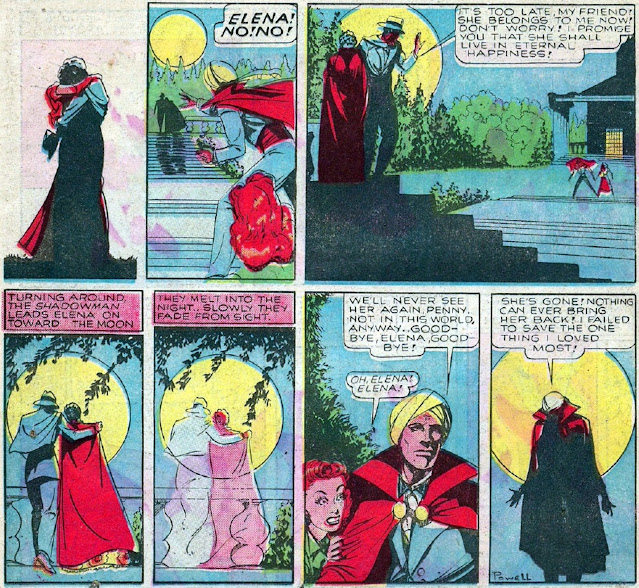
    Death is the inevitable winner of the contest, of course, and Elena goes off with him to… the afterlife? His home? Are they married now or is she just dead? We shall never know, alas, though we will see the Shadowman again.

    God Style: real anthropomorphic personification (The Spirit Section, 22 September, 1940)

    Jwang Tyoy:

    We don’t get a lot of the teachings of Jwang Tyoy beyond the fact that he is the god of a South American “anti-civilization” cult. The focus of the comic is much more focused on the very off-model pterodactyls that the cult leader uses to do he bidding, and for good reason!

    God Style: idol (Shadow Comics v1 004, 1940) 

    Kutu: 

    Kutu, aka Tuku, is possibly a moon god, definitely South American, and has the traditional jewel socketed into his idol for adventurers to steal and get into Big Trouble. 

    God Style: idol (Comics Magazine 002, 1936)  

    Nahapatan: 

    Nahapatan, the Golden Idol, is housed in a hidden Aztec city, where it is the subject of active worship. Does this stop Professor Roberts, his nephew Tim and adventurer Ken Masters from barging in and stealing it to put in Robert’s museum? It does not.

    God Style: idol (Masked Marvel 001, 1940)

  • MINOR SUPER-VILLAIN 817: ELENA

    (The Spirit Section, 9 June, 1940)

    Elena is Mr Mystic’s recurring female foe, the Tigress to his Zatara. Unlike the Tigress, however, Elena isn’t in it for the money but rather as an agent of chaos out to maximize the amount of war and bloodshed in the world, as in her first appearance, in which she is acting as the power behind the throne of fascist dictator Karoly Gore.

    The final confrontation between Elena and Mr Mystic is also the introduction of the concept that two magic users are unable to affect one another via magic, which is foundational to the Mr Mystic mythos and also a pretty good way to make your wizard duels more likely to be fist fights if that’s what you like to draw. Don’t worry about Elena in that last panel – it’s a deceptively short cliff, and Mr Mystic collars her soon after this jump.

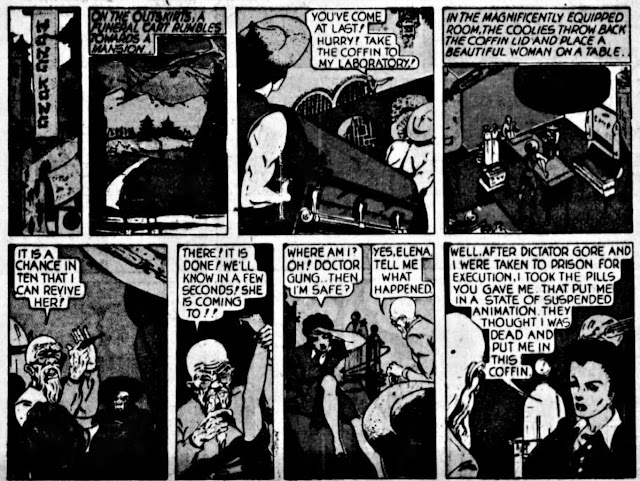
    Though she is set to be executed for her role in Karoly Gore’s administration, Elena escapes by means of some death-feigning pills provided by her old friend Dr Gung, and hopefully it’s the kind of fake death that put you in a coma of some sort because she has to be shipped from Central Europe to Hong Kong before Gung can wake her up and that would be a heckuva long time to stare at the inside of a coffin lid. Though Mr Mystic shows up soon after Elena to harsh the vibe, he focuses a bit more on Dr Gung’s unholy experiments than making sure that she doesn’t get away. Dr Gung WILL RETURN in the next Mad and Criminal Scientist Round-Up.

    Elena returns a few weeks later to interfere in the politics of the… Asian? country of Cadiwa, which is styled as India-ajacent, yes, but whose premier meets up with Elena in Nigeria and so, given the lack of any other geographic hints, I keep wanting to say is in Africa. This appearance marks the beginning of a potential romance between Elena and Mr Mystic, expressed by both when Elena is wounded while trying to escape.

    Budding romance or not, the next time that Mr Mystic pops in to check up on her he finds that she has been up to her old chaotic tricks and has been influencing King Bahroud of Cadiwa to declare war on his neighbours, thus ending centuries of peace. Clearly, this cannot stand. 

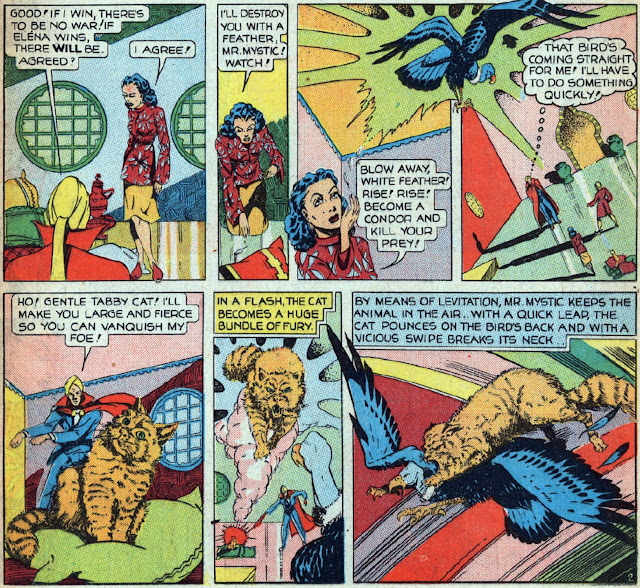
    Mr Mystic and Elena bicker their way into a magical duel, and while I said earlier that magic-users not being able to affect one another with their spells led to a lot of fist fights, that was only a partial truth, because it also leads to this kind of magical battle in which each party summons proxies, such as Mr Mystic’s giant kitty cat, to fight on their behalf. 

    Elena is defeated and reveals that her magic was granted to her by a “Cardin the Terrible” on the condition that she never lose a magical duel. Which she has just done, so bye-bye magical powers. Further, losing her magic causes Elena to turn into a small child.

    Now… there is an important question about this whole situation that is never actually answered: does Elena turn into a child as a part of the “lose a duel; lose your powers” curse as a cheeky little joke by Cardin the Terrible or because she was a child given the form of an adult as part of getting those powers? This is important mainly because Mr Mystic returns her to her adult form at the end of the episode and then they basically immediately become engaged, and it’s a very different situation, depending. 

    Cardin the Terrible himself shows up in the next installment, looking to torture Elena to death for failure, but we don’t learn too much more about him than this classic Bad Boss behaviour. Just why did he send an agent out into the world to spread chaos and war? Not a clue. What is certain however is that Mr Mystic totally murderizes him, which weirdly would indicate that he was less magical than his own protege.

    Elena spends the remainder of 1940 keeping her head down as Mr Mystic’s companion/fiance, though she does spend some time in the future as a captive of the Moon King and almost getting murdered in place of the Goddess of Fire.

    Elena’s run in the Spirit Section and as Mr Mystic’s fiance comes to an end in the second-to-last episode of the year, on 22 December, 1940. Mr Mystic had butted heads with his occasional ally/personification of death/future Divine Round-Up subject the Shadowman a few times in the weeks leading up to this, and the Shadowman’s response was to take away the thing that Mr Mystic loved best, i.e., Elena. There’s some pretty heavy allegory work going on that makes it unclear if Elena has fallen in actual love with the Shadowman and gone to live with him in the afterlife, or if the whole thing is just standing in for her dying and the love that Elena is expressing is just an expression of the natural cycle of life and death. Either way, Mr Mystic is sad, but worry not: he’s standing next to his new love interest Penny Douglas in that second last panel. The man move fast!

    So here’s to Elena, a fun villain and adequate supporting cast member who I hope is somewhere in a loving relationship with Death. Eat your heart out, Thanos.