The Curse of Skeleton Munroe

Category: Worth Carnahan

  • REAL PERSON ROUND-UP 005

    REAL PERSON ROUND-UP 005

    You can’t deny that they were real people.

    Adolf Hitler:

    This unnamed leader of the unnamed forces that the Flying Trio are battling on behalf of the little nation of Sylvania is a real Hitlerian fellow (Crash Comics Adventures 005, 1940) 

    Amelia Earhart:

    Two variations on a theme: using the story of the disappearance of Amelia Earhart as fodder for a damsel-in-distress story. The first (Amazing-Man Comics 018, 1940) involves the Shark rescuing Amelia Reinhardt from an old man who has her trapped in the jungle in hopes that she will fall for him. The second (Big Shot Comics 019, 1941) features aviator Rocky Ryan and his pal rescuing Amy Every from cartoonishly racist cannibals.

    Captain Kidd:

    Crooks try to pull a fast one by purchasing Captain Kidd’s authentic treasure chest and then “discovering” it after filling it with stolen gold (Cyclone Comics 001, 1940)

    Ethan Allen: 

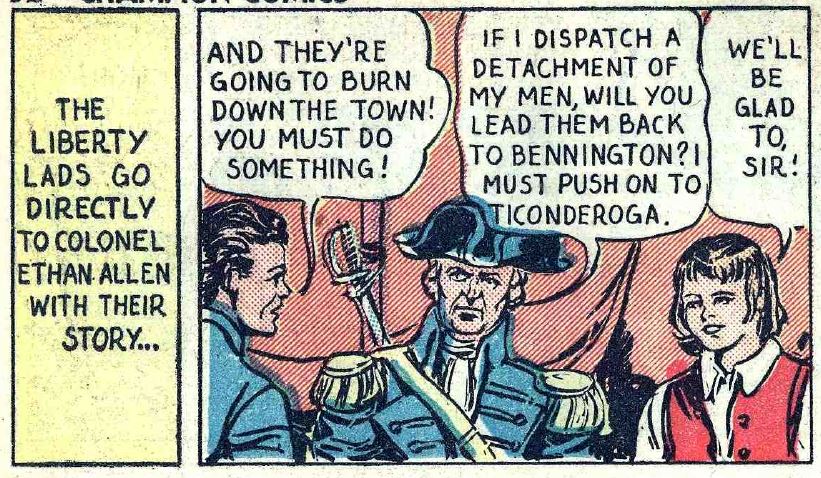
    The Liberty Lads are back at it, getting their grubby mitts all over the American Revolutionary War. This time they meet Ethan Allen and the Green Mountain Boys on the eve of the capture of Fort Ticonderoga. (Champion Comics 009, 1940)

    John Hancock and Samuel Adams:

    More Liberty Lads shenanigans. This time they’re saving Samuel Adams and John Hancock from capture by the British, something that as far as I can tell almost happened in our timeline. (Champ Comics 011, 1940)  

    Joseph Stalin:

    “Nilats,” leader of “Aissur” is tracked to his office in “Wocsom” by Strongman, who objects to the Aissurans’ invasion of the Balkan country of Rutania (Crash Comics Adventures 003, 1940)

    Orson Welles:

    For a while, Orson Welles’ ‘War of the Worlds’ broadcast is used as a shorthand for a reason that the cops blithely ignore multiple calls about some fantastic threat, only they certainly never do more than allude to the real thing. This time it’s giant mutant ivy plants and the dumb police are talking about a broadcast by “Worsen Welds”. (Amazing-Man Comics 006, 1939)

    Saladin:

    Makes a one-panel appearance in the otherwise undistinguished Crusades comic “Reynard the Fox”. (Cyclone Comics 005, 1940)

    Tecumseh:

    Whether “Metumseh” is a stand-in for Shawnee leader Tecumseh or they just mushed around his name to make up one for this fellow I cannot say, but they were certainly thinking of him while they did it. (Champion Comics 010, 1940)

  • MINOR SUPER-HERO ROUND-UP 021

    They’re just these guys, you know?

    the Solar Legion:

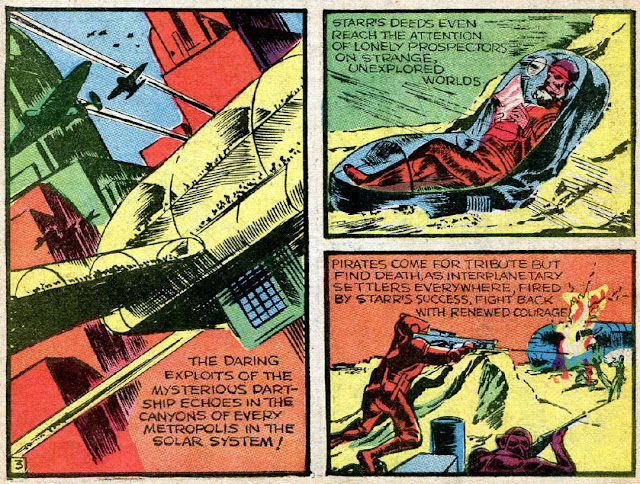
    The Solar Legion is the brainchild of Adam Starr, a 23rd Century man about whom very little is ever revealed. Emerging from a concealed base on Io, he sets out to rid the Solar System of the scourge of space piracy via the most direct route possible: blowing up all of the space pirates.

    Starr’s exploits have their intended effects: 1. many pirates are blown up and 2. the authorities are convinced of the need for an interplanetary peacekeeping force, aka the Solar Legion, with Starr as the head.

    Despite his new position of authority, the remaining four Solar Legion stories feature Adam Starr as a solo operator, hunting down pirates and settling factional disputes with his ray gun and two-fisted attitude. (Crash Comics Adventures 001, 1940)

    the Cat Man:

    The Cat Man is David Merrywether, who is orphaned in India after his father William brings his entire family along on a scientific expedition to collect butterflies and they run afoul of a hostile tribe (no word on whether William did something to draw their ire or if they were universally hostile to intruders – in either case the question of just why he would have his wife and two young children along on such a dangerous endeavour remains unaddressed). David, the only survivor, ends up being adopted by a tiger and spends his youth with her in an expository caption.

    (I really appreciate this “yadda yadda yadda” version of the Raised by Animals origin story. You’ve heard it all before, folks: he lived among the tigers and now he has tiger powers. He’s back in civilization because he saved a tiger’s life and that tiger’s mother owed him a favour. Now let’s get to the costumed antics!)

    Cat Man has all of the expected cat-related superpowers – enhanced dexterity, strength, speed and jumping ability – plus a few less common ones like the ability to speak to tigers and the ability to fall any distance and land on his feet without harm. He also has a cat’s enhanced night vision, which takes the form of literal beams of light that emit from his eyes. Fun!

    The Cat Man’s most striking power is that of having nine lives, bestowed on him by his adoptive tiger mama when he saved her cub. The problem with the “multiple lives” superpower has always been that it’s not interesting if it’s not used, with the result being that after two 1940 appearances Cat Man is down to seven lives. Surely this cannot be sustained going forward.

    Speaking of going forward, we will be hearing more out of Cat Man, one of the minor successes of the Golden Age. Changes are afoot once he has his own title in 1941, starting with a revisions to his much-derided original costume (personally, I like this costume. It very much feels like the sort of thing that someone who had spent their youth alone in a jungle might put together). See you then! (Crash Comics Adventures 004, 1940)

    UPDATE 1941

    Tornado Tom:

    Like the word-box says: Tornado Tom is just some guy who was sucked up by a tornado one day and when he came down again he was inhumanly strong, fast and durable. He also had amnesia, so even though he shares the name Tom Kenny with the famous voice actor of such characters as Spongebob Squarepants, he himself did not know that.

    Tornado Tom’s origin is never really explored and the two hints we get about the nature of his powers are a bit contradictory:

    Possible Mystical Origin: in Cyclone Comics 002, Tom battles some thugs in a stuffy apartment and is drained of vitality by the lack of fresh breezes. In a moment of desperation he calls out to Boreas, “God of Wind” and is revived and re-energized by a gust of air that blasts through the window. Talking points: was it a mystic tornado sent by the gods? Is Tom Kenny a descendant of Boreas or another Greco-Roman figure?

    Possible Biological Origin: In Cyclone Comics 005* Tornado Tom’s blood is asserted to have miraculous healing properties, possibly as  a result of his being some sort of mutant or mutate. Talking points: was it a radioactive tornado?

    This is all ultimately clutching at straws because Tornado Tom is a classic Golden Age cipher, much as I would like to know otherwise. (Cyclone Comics 001, 1940)

    * his blood is reportedly transfused into a dying man in Cyclone Comics 004 but that issue is currently unavailable.

    Mister Q:

    Your typical master of disguise style hero, with a manservant named Ying and a dog named Satan. I quite like Mister Q because I’m pretty sure that his name is derived from the idea of wartime Q-Ships, ie, warships disguised as harmless merchant vessels. It’s a neat name for a disguise-based crimefighter! (Cyclone Comics 001, 1940)

  • MINOR SUPER-VILLAIN 578: SEMMURABI

    (Champion Comics 010, 1940)

    Have you ever wondered what happened to the Chaldeans, the ancient Mesopotamian people whose height was from the 9th to 6th centuries BCE, who were mentioned frequently in the Bible and whose name was lent to a Babylonian dynasty? Well wonder no longer! They were merely tucked away in a little hidden city less than a day’s travel via horse from Jerusalem! At least until 1940, that is, because that’s when the city’s leader, a fellow named Semmurabi, made the mistake of being too horny. Or maybe he’d been kidnapping clueless tourists (sincerely clueless: they were roped in by an offer to show them the remains of Noah’s Ark on Mt Arrarat) to add to his harem forever and this was just the first time he’d done it to someone who knew a super-hero.

    In Semmurabi’s defense (for not knowing to keep a lower profile, not for kidnapping women) this is a very early Dr Miracle adventure and he can be excused for assuming that he wouldn’t meet opposition from a tuxedoed magic-man (but again, he will not be excused for the kidnapping). This also might explain why he makes the classic mistake of challenging a more powerful opponent to a magical duel in the astral realm: because he simply didn’t know better.

    Ignorance is no excuse in magic as in law and Semmurabi meets his end in the depths of a star. Sorry, Chaldea. You were ruled by a dope and now you pass into history. (Champion Comics 010, 1940)

  • MINOR SUPER-VILLAIN 578: SEMMURABI

    (Champion Comics 010, 1940)

    Have you ever wondered what happened to the Chaldeans, the ancient Mesopotamian people whose height was from the 9th to 6th centuries BCE, who were mentioned frequently in the Bible and whose name was lent to a Babylonian dynasty? Well wonder no longer! They were merely tucked away in a little hidden city less than a day’s travel via horse from Jerusalem! At least until 1940, that is, because that’s when the city’s leader, a fellow named Semmurabi, made the mistake of being too horny. Or maybe he’d been kidnapping clueless tourists (sincerely clueless: they were roped in by an offer to show them the remains of Noah’s Ark on Mt Arrarat) to add to his harem forever and this was just the first time he’d done it to someone who knew a super-hero.

    In Semmurabi’s defense (for not knowing to keep a lower profile, not for kidnapping women) this is a very early Dr Miracle adventure and he can be excused for assuming that he wouldn’t meet opposition from a tuxedoed magic-man (but again, he will not be excused for the kidnapping). This also might explain why he makes the classic mistake of challenging a more powerful opponent to a magical duel in the astral realm: because he simply didn’t know better.

    Ignorance is no excuse in magic as in law and Semmurabi meets his end in the depths of a star. Sorry, Chaldea. You were ruled by a dope and now you pass into history. (Champion Comics 010, 1940)

  • MINOR SUPER-HERO ROUND-UP 019

    Look at all these dang guys

    Lobo, the Flying Sleuth: 

    Lobo, the Flying Sleuth, aka the Lobo, had a pretty short run. But! He’s a cowboy and a pilot and a detective. That’s a lot of things! (Champion Comics 006, 1940)

    Doctor Miracle:

    We’ve seen guys like Dr Miracle before: the nigh-omnipotent magician with so much power at his fingertips that his only real challenge is in finding a foe tough enough that he doesn’t defeat them instantly. He’s even got the obligatory Huge Asian Manservant, a Nepalese man named Akim depicted with all of the racial sensitivity that one might expect from 1940s comics.

    Dr Miracle’s real mark of distinction is that he is also a scientific hero, as likely to be blasting a foe with disintegration rays as to be slinging spells. 

    It’s a neat bit of variation in his adventures and of course it gets dropped almost immediately, as his second appearance establishes him as a student of the Elders of the aptly-named City of the Elders in Tibet. After passing a test to show his magical aptitude, Dr Miracle is sent out into the world to battle injustice, with Akim coming along as a… gift? Unsettling. (Champion Comics 009, 1940)

    Doctor Hormone:

    Doctor Hormone exemplifies a particular sort of cultural ingestion/ regurgitation of scientific ideas that permeates all fiction but really found a home in the medium of comic books. Any sufficiently impressive scientific discovery can be reinterpreted as being tantamount to magic, the major example of which is of course the part that radiation would play as a catch-all origin in the Silver Age (and nanotech and genetic engineering in turn as time marched on) but as in any field there are many also-rans for every big hit: vitamins and radio waves and transistors (in the case of Silver Age Iron Man) as science-magic that can accomplish any task. With Doctor Hormone it’s hormones. Obviously.

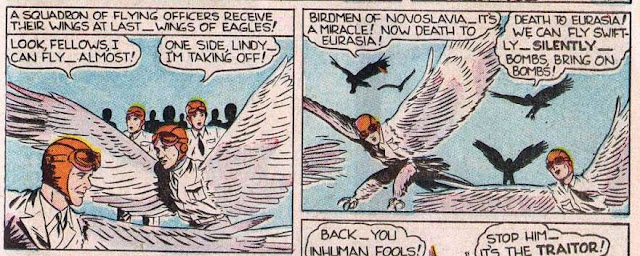
    As we join the Doctor and his destined-to-be-bullied granddaughter Jane Hormone, he has just been saved from age-related death by a youthening hormone. He and Jane subsequently set out to help the beleaguered nation of Novoslavia defend themselves from the depredations of Germany/Russia analog Eurasia.

    Hormone’s first major antagonist is Rassinoff, aka Assinoff, a Novoslavian official secretly working for Eurasia and dosed with donkey hormones by Jane due to his initial bad vibes. Assinoff is exactly the jackass that his form reflects and is a very satisfying villain to see be repeatedly defeated and humiliated.

    Highlighting some of the more noteworthy hormone effects: the youth hormone (calibrated to make anyone who takes it 25 years old) is cool and fun when used on the elderly but the implications of using it on the young swiftly become horrific. At least the baby was turned into an adult man to save his life – these poor boy scouts are signing up to be adult child soldiers.

    It’s not particularly visually interesting but Hormones second appearance concerns his deploying a gas-based hormone that turns Eurasians into Novoslavians, which raises the question of just what they thought a hormone was over at Popular Comics.

    In Popular Comics 056, Assinoff tries to destroy Hormone’s credibility by injecting Novoslavian citizens with random samples from a captured selection of Hormone’s work, which completely backfires when it turns out that the Novoslavian national character is extremely okay with being turned into some random animal. It’s a nation of furries! 

    These eagle-men pilots are the first of many Novoslavian animal-man hybrids, btw.

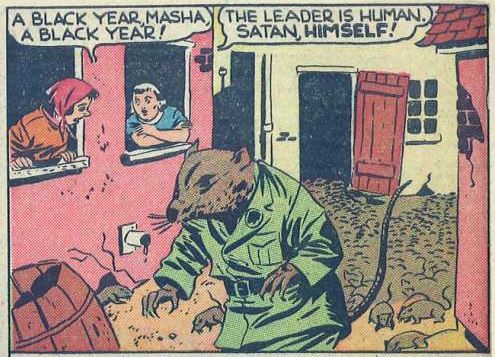
    Issue 57 of Popular Comics involves Novoslavian locust, wasp, termite and rat hybrids going out into the world to gather up plagues of their respective animals to unleash on Eurasia. Pictured here is the rat-man, my personal fave.

    The ultimate expression of Hormone’s hybridization efforts are these five Novoslavian volunteers who were turned into fleas and then restored to human form. Though they no longer look like fleas, they retain proportional jumping, flea-strength, etc, Spider-Man style. And the transformation is very gross-looking!

    So that’s Doctor Hormone in a nutshell: a bit light, plotwise, but full of charming characters and a cavalcade of new and interesting concepts in body horror. (Popular Comics 054, 1940)

    Martan the Marvel Man:

     I feel a bit bad making Martan follow Dr Hormone, honestly, because his adventures are at least as wild, but they aren’t as unique. In brief: Martan and his wife Vana are Antacleans, aliens from a super-advanced race a few million light years off. They kind of accidentally land on Earth and almost immediately get mixed up in the affairs of primitive humans. At first it’s regular old “they war amongst themselves, how foolish!” stuff but eventually they discover in incipient invasion by Antaclea’s ancient enemy the Martians and really throw their weight behind the Earth cause: supplying technology, setting up a world government etc. – Martan and Vana’s impact on the world is much greater than your typical comic book characters’. (Popular Comics 046, 1939)
  • MINOR SUPER-VILLAIN 577: THE BLACK LAMA

    (Champion Comics 010, 1940)

    It’s a small consolation but this guy isn’t actually a lama! Unlike the Mad Lama or the Four Lamas before him (and more than a few to come), this fellow is merely a bandit chief presumably called the Black Lama because he is Tibetan! It this better than a whole class of holy men being portrayed as evil scheming villains? A little! I also want to say that it’s because his headquarters are a former lamasery but I don’t know if I just made that up.

    The Black Lama is the third antagonist of twelve faced by adventurers Dash Dolan and Nalya Randolph (aka the Golden Goddess) on their quest to reunite the twelve diamonds known as the Dragon’s Teeth so that their patron Dr Ying can sell them and use the proceeds to defend China from a dastardly warlord. It’s a very video game or 80s cartoon setup: the two are taking the gems to sell when they are waylaid by the warlord’s soldiers and must use the Dragon’s Teeth as a distraction to save their lives. Twelve soldiers then grab one gem each and immediately scurry off to sell them to seemingly the most evil man they could think of, because each one is in the hands of a grade-A creep – most of them just kill the soldiers rather than pay them!

    The Black Lama is remarkable among this group mostly for his name – it’s that extra 5% that elevates him from mere villain to minor super-villain. Also he captures Nalya and attempts to marry her against her will, a classic villain move if ever there was one.

    The Lama has plans to dispose of Dash Dolan by dunking him into a cauldron of molten gold, This is a good and very gruesome deathtrap! It also should not surprise you to learn that the Black Lama himself meets his end in that very cauldron. You know what they say: you live by the cauldron of molten gold, you die by the cauldron of molten gold.

  • MINOR SUPER-VILLAIN 577: THE BLACK LAMA

    (Champion Comics 010, 1940)

    It’s a small consolation but this guy isn’t actually a lama! Unlike the Mad Lama or the Four Lamas before him (and more than a few to come), this fellow is merely a bandit chief presumably called the Black Lama because he is Tibetan! It this better than a whole class of holy men being portrayed as evil scheming villains? A little! I also want to say that it’s because his headquarters are a former lamasery but I don’t know if I just made that up.

    The Black Lama is the third antagonist of twelve faced by adventurers Dash Dolan and Nalya Randolph (aka the Golden Goddess) on their quest to reunite the twelve diamonds known as the Dragon’s Teeth so that their patron Dr Ying can sell them and use the proceeds to defend China from a dastardly warlord. It’s a very video game or 80s cartoon setup: the two are taking the gems to sell when they are waylaid by the warlord’s soldiers and must use the Dragon’s Teeth as a distraction to save their lives. Twelve soldiers then grab one gem each and immediately scurry off to sell them to seemingly the most evil man they could think of, because each one is in the hands of a grade-A creep – most of them just kill the soldiers rather than pay them!

    The Black Lama is remarkable among this group mostly for his name – it’s that extra 5% that elevates him from mere villain to minor super-villain. Also he captures Nalya and attempts to marry her against her will, a classic villain move if ever there was one.

    The Lama has plans to dispose of Dash Dolan by dunking him into a cauldron of molten gold, This is a good and very gruesome deathtrap! It also should not surprise you to learn that the Black Lama himself meets his end in that very cauldron. You know what they say: you live by the cauldron of molten gold, you die by the cauldron of molten gold.

  • MINOR SUPER-VILLAIN 576: GRUNDO THE GREAT

    (Champion Comics 010, 1940)

    There are a few things to like about Grundo the Great: his mustache, his name which sounds like it’s what Miss Grundy would be called in a 1960s Archie Comics fantasy series about the heroic students battling the teachers as evil warlords, the fact that he has a “crew of mad chemists and technicians” in his mountaintop castle somewhere in the Midwestern US… Lot of good stuff. His ultimate aim, to take over America, is a little standard but you have to admit that it’s villainous.

    If Grundo (his real name, by the way: Lars Grundo) has a major flaw, it’s in going too big, too early. In order to raise funds for his mad science crew he pulls a heist of the fabulous Taj Mah Jewels while they are being transported by plane, exactly the kind of crime that attracts the attention of a super-hero like the Human Meteor.

    (side note: this is the second “Taj Mahal Jewels” sound-alike I’ve encountered from the year 1940 – the first being the Green Mask and the Taj Lamah Jewels – and that’s the sort of coincidence that makes me think that there was a famous Taj Mahal Jewels exhibition in 1939 or 1940. Turns out that “Taj Mahal” is one of those search terms that really blows out your results with a lot of unrelated information. There was a “Taj Mahal Emerald” on display at the 1939 NY World’s Fair but that’s about as far as I’m going to get without doing actual research so I’ll just assume that that’s what inspired both)

    The Human Meteor does take an interest, and makes his way to Grundo’s mountain fastness. Grundo employs a really fantastic deathtrap: a door that opens up onto a sheer cliff that a puruer can be baited into charging through. It only works on an enemy who can’t fly, unfortunately for Grundo.

    Grundo and his crew are so completely outclassed by the Human Meteor that it’s a bit of a mercy when they are all blown to high heaven by their own bombs. Perhaps they would have had more of a chance to shine if they had faced off against a slightly less superhuman foe.

  • MINOR SUPER-VILLAIN 575: NAD NEUROD

    (Champion Comics 009, 1940) 

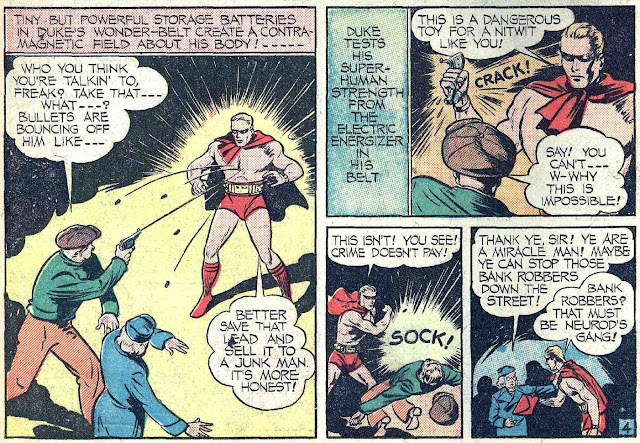
    Nad Neurod is a gang boss with an ambitious and not-uncommon-in-comics scheme: knock out the power and other utilities so that you can take advantage of the resultant confusion and loot an entire city (NYC in this case) at once! Even more importantly, he and his gang provide the perfect test/demonstration of the Human Meteor’s powers in his first foray into the outside world.

    (Nad Neurod is also exactly the kind of moniker that makes my Backward Name Senses tingle, but I’ll be danged if I can find any evidence of anyone named Dan Doruen existing ever, let alone in 1940. I’d put money on it being a reference to something, but sadly I must place it on the big Pile of Unsolvable Puzzles and move on with my life)

    Neurod and his cronies have a particular role to play, and that is to be a reasonably credible threat that a super-hero can thrash on their first outing, and they serve their purpose admirably – they completely flummox the authorities of New York City (probably) and are themselves flummoxed (and mostly killed) by the Human Meteor.

  • REAL PERSON ROUND-UP 004

    More of those pesky real people have gotten into my comic books!

    Andrew Jackson:

    Character Keith Kornell, aka the West Pointer, is a descendant of Andrew Jackson, something you would perhaps be more proud of in 1939 than today. (Top-Notch Comics 001, 1939)

    Benito Mussolini:

    He’s a fairly oblique reference to Benito Mussolini but I reckon that up-and-coming Filipino dictator Remy Mussoni fits the brief. (Wonderworld Comics 008, 1939)

    Billy the Kid:

    Appears in a questionably true story told by character Windy Parks (Western Picture Stories 004, 1937)

    the Dionne Quintuplets:

    “Ad-Ventures at the Circus” was a recurring feature throughout the life of Star Comics (1937-1939), and it’s a fascinating artifact of the time that someone more qualified than me should write about some day. Long story short it was a twee little comic about advertising mascots going to the circus to watch other advertising mascots perform. There’s maybe a 75/25 split between the Surprisingly Familiar and Surprisingly Unfamiliar mascots with regular appearances by Surprisingly Racist ones. It’s a bit like a Neolithic Foodfight!. 

    Everything about this feature is weird, from the slightly uncanny valley illustrations by Raphael Astarita to the fact that it doesn’t really seem to be sponsored content (other than a command appearance by NRG, mascot of heavy Star Comics advertiser Baby Ruth). And then the final extant installment comes around and we get the weirdest advertising mascots of all as the Quaker Oats Man leads the Dionne Quintuplets onto stage – five living humans given the same status as the Crackerjack kid or Mr Peanut or some anthropomorphic orange who used to work for Sunkist. It’s a grim reminder of just how commodified those poor kids were, right down to their “act” being a pantomime of them going about their day, just like they did in the weird zoo they grew up in. (Star Comics v2 007, 1939)

    Gene Autry:

    An adventuring version of the singing cowboy in modern times (the Funnies 030, 1939)

    George VI of England:

    This here visit by King Arnold and his unnamed Queen is certainly meant to evoke the 1939 tour of Canada and the US by King George VI of England and Queen Elizabeth, the future Queen Mother. (Wonderworld Comics 005, 1939)

    George Washington:

    Not quite an appearance by Washington as adjacent to him, but the fact that one of the Wizard’s ancestors is given credit for a key part of the history of the American Revolution is worth noting. (Top-Notch Comics 001, 1939)

    FDR:

    Misc Minor Appearances: Thanks secret agent K-51 for saving foreign royals (Wonderworld Comics 005, 1939) 

    the Mona Lisa:

    As the “Lona Dizzi”, painted by “Lombardo da Ginki” (“Dixie Dugan” strip, 1931)

    Paul Revere:

    Ride witnessed – and hide saved – by American Revolution-era child-patriots the Liberty Lads. (Champion Comics 008, 1940)

    Robert E. Lee:

    Wizard ancestor Thomas Whitney accepts the surrender of Robert E Lee at Appomattox, whether in place of Grant or prior to his showing up cannot be said. (Top-Notch Comics 001, 1939)

    Tom Mix:

    Like Gene Autry, Tom Mix was a movie cowboy who starred in adventure comics as a larger-than-life version of himself having rootin’ tootin’ Wild West adventures. Unlike Autry, Tom Mix generally starred in stories set in the Old West, as himself but in the past. Tom Mix also holds the special distinction of appearing in comics from this earliest example (that I have found, at least) to at least the early 50s, long after he had died in October, 1940. (The Comics 001, 1937)