The Curse of Skeleton Munroe

Category: Worth Carnahan

  • REAL PERSON ROUND-UP 004

    More of those pesky real people have gotten into my comic books!

    Andrew Jackson:

    Character Keith Kornell, aka the West Pointer, is a descendant of Andrew Jackson, something you would perhaps be more proud of in 1939 than today. (Top-Notch Comics 001, 1939)

    Benito Mussolini:

    He’s a fairly oblique reference to Benito Mussolini but I reckon that up-and-coming Filipino dictator Remy Mussoni fits the brief. (Wonderworld Comics 008, 1939)

    Billy the Kid:

    Appears in a questionably true story told by character Windy Parks (Western Picture Stories 004, 1937)

    the Dionne Quintuplets:

    “Ad-Ventures at the Circus” was a recurring feature throughout the life of Star Comics (1937-1939), and it’s a fascinating artifact of the time that someone more qualified than me should write about some day. Long story short it was a twee little comic about advertising mascots going to the circus to watch other advertising mascots perform. There’s maybe a 75/25 split between the Surprisingly Familiar and Surprisingly Unfamiliar mascots with regular appearances by Surprisingly Racist ones. It’s a bit like a Neolithic Foodfight!. 

    Everything about this feature is weird, from the slightly uncanny valley illustrations by Raphael Astarita to the fact that it doesn’t really seem to be sponsored content (other than a command appearance by NRG, mascot of heavy Star Comics advertiser Baby Ruth). And then the final extant installment comes around and we get the weirdest advertising mascots of all as the Quaker Oats Man leads the Dionne Quintuplets onto stage – five living humans given the same status as the Crackerjack kid or Mr Peanut or some anthropomorphic orange who used to work for Sunkist. It’s a grim reminder of just how commodified those poor kids were, right down to their “act” being a pantomime of them going about their day, just like they did in the weird zoo they grew up in. (Star Comics v2 007, 1939)

    Gene Autry:

    An adventuring version of the singing cowboy in modern times (the Funnies 030, 1939)

    George VI of England:

    This here visit by King Arnold and his unnamed Queen is certainly meant to evoke the 1939 tour of Canada and the US by King George VI of England and Queen Elizabeth, the future Queen Mother. (Wonderworld Comics 005, 1939)

    George Washington:

    Not quite an appearance by Washington as adjacent to him, but the fact that one of the Wizard’s ancestors is given credit for a key part of the history of the American Revolution is worth noting. (Top-Notch Comics 001, 1939)

    FDR:

    Misc Minor Appearances: Thanks secret agent K-51 for saving foreign royals (Wonderworld Comics 005, 1939) 

    the Mona Lisa:

    As the “Lona Dizzi”, painted by “Lombardo da Ginki” (“Dixie Dugan” strip, 1931)

    Paul Revere:

    Ride witnessed – and hide saved – by American Revolution-era child-patriots the Liberty Lads. (Champion Comics 008, 1940)

    Robert E. Lee:

    Wizard ancestor Thomas Whitney accepts the surrender of Robert E Lee at Appomattox, whether in place of Grant or prior to his showing up cannot be said. (Top-Notch Comics 001, 1939)

    Tom Mix:

    Like Gene Autry, Tom Mix was a movie cowboy who starred in adventure comics as a larger-than-life version of himself having rootin’ tootin’ Wild West adventures. Unlike Autry, Tom Mix generally starred in stories set in the Old West, as himself but in the past. Tom Mix also holds the special distinction of appearing in comics from this earliest example (that I have found, at least) to at least the early 50s, long after he had died in October, 1940. (The Comics 001, 1937)
  • MINOR SUPER-VILLAIN 574: DUKE DAROLDI

    (Champion Comics 007, 1940) 

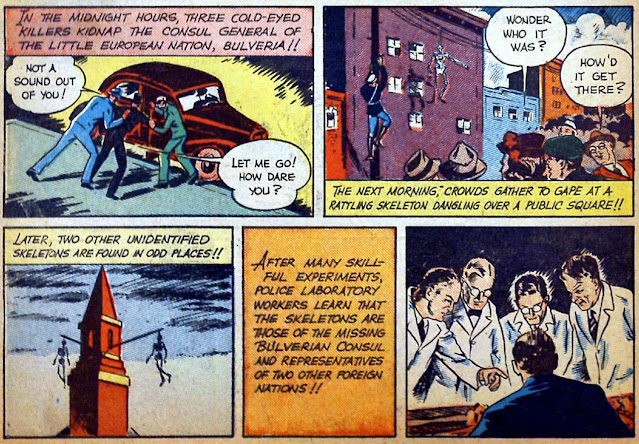
    Someone is kidnapping foreign dignitaries and then hanging their skeletons in public spaces! Weird! Sinister! Diplomatically complicated!

    The culprit turns out to be gang boss Duke Daroldi, who is killing the diplomats as part of an attempt to involve the US in WWII and then step in and take over once the combatants are all sufficiently weakened. This is a stunningly hubristic plan, especially considering the maybe five other guys in Daroldi’s gang. I assume that the steps goes something like:

    1. kill diplomats

    2. draw the US into the war in Europe

    3. ????

    4. profit

    We never get to see Duke Daroldi’s plan come to fruition, because Johnny Fox is on the case. He infiltrates Daroldi’s yacht using the surefire “get captured” method, escapes, is recaptured, learns that the diplomats are being skeletonized using the old classic method: a school of piranhas, escapes again and finally engages Daroldi in a high-stakes fistfight in the yacht’s crow’s nest. 

    Daroldi ultimately meets his end, not in his own piranha tank as would be narratively satisfying, but in a simple fall after being uppercutted out of the ship’s rigging by Johnny Fox. No followthrough. No commitment to the bit. Finis.

  • MINOR SUPER-VILLAIN 574: DUKE DAROLDI

    (Champion Comics 007, 1940) 

    Someone is kidnapping foreign dignitaries and then hanging their skeletons in public spaces! Weird! Sinister! Diplomatically complicated!

    The culprit turns out to be gang boss Duke Daroldi, who is killing the diplomats as part of an attempt to involve the US in WWII and then step in and take over once the combatants are all sufficiently weakened. This is a stunningly hubristic plan, especially considering the maybe five other guys in Daroldi’s gang. I assume that the steps goes something like:

    1. kill diplomats

    2. draw the US into the war in Europe

    3. ????

    4. profit

    We never get to see Duke Daroldi’s plan come to fruition, because Johnny Fox is on the case. He infiltrates Daroldi’s yacht using the surefire “get captured” method, escapes, is recaptured, learns that the diplomats are being skeletonized using the old classic method: a school of piranhas, escapes again and finally engages Daroldi in a high-stakes fistfight in the yacht’s crow’s nest. 

    Daroldi ultimately meets his end, not in his own piranha tank as would be narratively satisfying, but in a simple fall after being uppercutted out of the ship’s rigging by Johnny Fox. No followthrough. No commitment to the bit. Finis.

  • MINOR SUPER-VILLAIN 573: THE OWL

    (Champion Comics 005, 1940)

    Journalist Penny Wright is on the trail of a notorious spy named the Owl! While I am of course broadly anti-spoilers I will give you a hint to the Owl’s identity: there are four named characters in this comic and poor Hafiz Bey is murdered on the first page.

    Setting aside the compelling and difficult mystery of the Owl’s identity for a moment, we must consider the very concept of the notorious spy known for their distinctive appearance. I mean, yes, adopt a persona and stick to it while working so as to remove yourself from suspicion, but once you are known to be a man wearing thick glasses why continue to appear as such? Why is the Owl still running around as the Owl?

    The Owl of course turns out to be Cora Zender[s], popular diplomatic hostess, because of course he does. OR DOES HE? I put it to you that Cora is just a decoy, sent to take the fall while the real Owl gets away. After all, the only evidence pointing to Cora was the piece of her dress found in the garden – circumstantial at best! If the Owl and Cora were in fact the same highly successful spy then she surely would have at the very least dropped the easily spotted disguise, if not swapped it out for another look altogether! No, the only conclusion that can reasonably be reached is that Cora is not the Owl, merely a pawn, and that the real culprit is long gone.

    Or this was a throwaway story loosely plotted in haste in order to fill pages on an anthology book, but who’s gonna believe that?

  • MINOR SUPER-VILLAIN 572: JULES CARTIER

    (Champion Comics 005, 1940)

    “Revenge of the Zombies” is a feature that ran in Champion Comics from issues 003-005 and reads kind like it was written in a free-jazz fugue state, like once the 10-12 characters were introduced by issue 003, page 2, events just proceeded on their own with no real input from the writer. A huge cast gathers at the home of Dr Karl Hartmann in Haiti for no reason that is ever given. Various people are kidnapped. Various people turn out to be other people: the novelist is a police detective; the voodoo cult leader is a gang boss; two guests are crooks but it never pays off. Several people die.

    The most striking and interesting thing about the serial is the death’s head moth attack in issue 004 that takes out one of the crooks… wait, maybe they were there as disposable victims? After all, who could care if a criminal dies horribly?

    Champion Comics 005 saw the wrapping up of several serialized adventure stories in favour of more hero-driven fare (I have Lyle Kenton tagged as the protagonist of this story but he was simply the most proactive member of the cast – it was an ensemble jazz-fusion voodoo mystery). And since gang boss/ voodoo priest Jaques “Frenchy” Atell was already dead: enter Jules Cartier!

    Cartier, the former owner of Dr Hartmann’s mansion, has not been dead as everyone suspected but just been living in the basement, farming death’s head moths and using hypnotic mind control to turn people into zombies.

    When confronted, Cartier literally brings a knife to a gunfight, attempting to take on two armed men using only a throwing knife. It’s an honourable way to go for a complete dipshit. 

    Cartier’s plan comes out in the aftermath: discovering that he can produce high-quality silk from death’s head moths and that they enjoy drinking human blood, he researches a more sustainable alternative so that he can produce at a profitable level relocates to a cave to employ mind-controlled locals as both a labour force and blood supply. It’s a frankly ludicrous scheme – a cursory bit of searching indicates that Cartier is engaging in an astounding level of risk for something like thousands of dollars, which even in 1940 isn’t worth it. But of course, he was an insane textiles-based super-villain… who are we to dictate his priorities?

    And in the end it certainly was… a revenge of the zombies.

  • MINOR SUPER-VILLAIN 571: THE YELLOW SPIDER

    (Champion Comics 004, 1940)

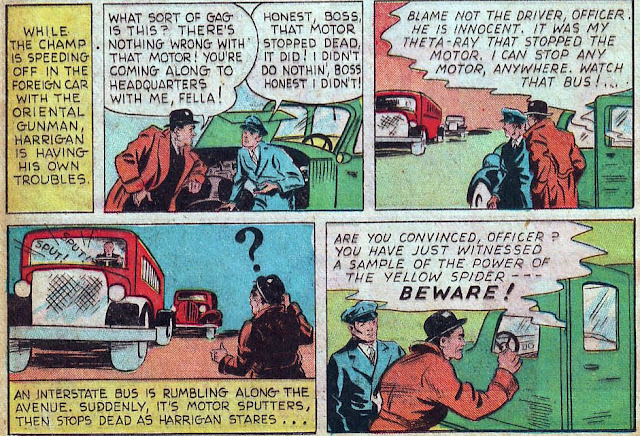
    Champion Comics 003 featured the murder of the Champ’s mentor Dr Marlin and at the conclusion of that adventure the blame for Marlin’s death seemed to rest squarely on the shoulders of his assistant Dr Katsu. Champion Comics 004, however, introduces a further development: Katsu was in fact working for a greater mastermind, the Yellow Spider!

    (and here I’m going to contrast my usual delight at a villainous note signed with a little cartoon with my deep sighs as I say that yes, the Yellow in Yellow Spider is 100% a racist thing. Early Champion Comics issues are even more comfortable with using racist tropes for their villains than the rest of the comics industry, and that’s saying something)

    The Yellow Spider is big on indirect action. Beyond employing goons to do his dirty work he also uses engine-killing rays and cuts in on radio and telephone signals to orchestrate events at a distance, such as his successful kidnapping of the Champ here, followed by his doing a solid for the unnamed police officer who was supposed to be driving him around.

    The Champ is brought to the Yellow Spider’s dirigible/ base, where he eventually learns that the Spider is in fact this one little guy who has popped up a couple of times previously as an agent of what turns out to be himself. It’s not explicit but quite possible he wants formula because he is puny (spoiler: much later it turns out that Dr Katsu pulled a double cross and had the formula all along. This Yellow Spider/ Champ beef is all a huge waste of everyone’s time).

    As the Champ was summarily evicted from the Yellow Spider’s dirigible at the end of issue 4, Champion Comics 005 is almost entirely concerned with busywork. To whit:

    -the Champ learns to fly a plane

    -the Champ and his pal Bird Kelly attack the dirigible, too late remember about the engine killing ray and are knocked out of the sky

    -the Champ travels back to Midwest University to talk to a ray expert

    -the ray expert is stranded on a mountain; the Champ must go rescue him

    -in consultation with the expert, the Champ crafts ray shielding for his plane

    -the Champ and Bird Kelly go back up in a now-shielded plane

    -the Champ STILL has to go on the dirigible and wreck the ray because it also explodes gunpowder and they only brought grenades for some reason

    -the Champ hops back over to his plane and explodes the dirigible, killing the Yellow Spider

    I will say that the Champ expressing some remorse over having killed an evil man (or at least not being up to watching the carnage) is a real departure for the Golden Age. Lotta righteous killing going on back then.

  • MINOR SUPER-VILLAIN 570: OO-LHAT

    (Champion Comics 003, 1940)

    There’s a lot to like about ol’ Oo-Lhat. He appears in a gross-sounding mist after explorer Walt Worthington and his aide Snowball (did you know that there was a whole category of racist nicknames for African American characters that has largely been forgotten and that involves naming them after something very black or very white? Well now you do) discover a lost Egyptian tomb containing a blazing scarab (the gem cut, not the insect) that drew them into a pocket dimension when touched.

    Oo-Lhat captures the duo and forces them to listen to his life story, employing a magical teevee called the Curtain of Ammon to do so.

    A priest of Osiris at Karnak, Oo-Lhat gives it all up and switches allegiances to Set in order to obtain gold, power and the love of a beautiful woman.

    This is where Oo-Lhat starts to make the transition from small-b to big-b Bad Guy. He makes his way to the Oasis of Memthet, where a cult had gathered to worship the same scarab encountered by Walt and pal. Oo-Lhat takes over by the simple expedient of murdering all of the other contenders.

    Discovering the pocket dimension accessible through the scarab, Oo-Lhat moved his cult into it and had them build a city, from which they raided caravans under the somewhat grandiose name of the League of Assassins – pretty sure just jumping out of a portal and stabbing someone is just regular murder, bro.

    The real appeal of the scarab dimension, though, was the fact that time essentially did not pass there and so the population was essentially immortal – even those killed by gross bodily trauma came back as weird ghosts. Possibly the best aspect of this is the fact that animals could not properly comprehend this state of being and so immediately died and came back, and as they presumably had an imperfect vision of themselves they came back wrong, leading to the city being full of weird lumpy camels.

    The timelessness of the scarab world eventually backfires on Oo-Lhat and his followers when the temple is buried in a sandstorm, trapping them for thousands of years with nothing to do but twiddle their thumbs.

    Oo-Lhat is all set to resume his ways as an “assassin” but his followers have other ideas. Presented with the choice of whether to leave or stay, every single one of them leaves. Including Oo-Lhat, after a little five-fingered persuasion from his lieutenant Kardak.

    The explorers eventually follow (along with some babes they found and fell in love with) and discover the final fate of Oo-Lhat and the League of so-called Assassins: time spent in the pocket dimension, it turns out, was not avoided so much as deferred: Oo-Lhat, the League and even the babes were reduced to skeletons the instant they exited.

  • MINOR SUPER-VILLAIN 569: NEPTINA

    (Champion Comics 002, 1939) 

    I can’t say for sure that whoever created Neptina sat down and said “I will make a lady version of Namor the Sub-Mariner” but it’s at least plausible. Neptina is the ruler of the undersea kingdom of Amloza, and has designs on a total conquest of the surface world as well as the depths.

    Neptina is, like Namor, a horny character. She captures US Navy Lieutenant Brad Fletcher early in her series and spends a considerable amount of mental, martial and political energy in subsequent installments in service of keeping him near her and away from other women.

    (note the little tuning fork thing that Neptina is holding – it works in concert with a telepathic receiver as a form of communication for the Fish-Men of Amloza. There are lots and lots of panels featuring characters who look like they’re playing with a toy from the 1920s when in fact they are talking to one another. It’s fun!)

    Neptina is shown to be a ruthless slaver with ranks of surface men pillaged from ships and equipped with gills in place of their human lungs. The reverse operation can be performed on Fish-Men to allow them to become fully amphibious, though the lungs involved must be harvested from a human. Neptina’s vanity is showcased when she demands that the lungs for her operation be harvested from a beautiful woman only. This also proves to be Neptina’s first major stumbling block, as Brad Fletcher immediately falls in love with movie star Norma Kane when she is brought to Amloza, and rescuing her is one of his major motivations for disrupting Neptina’s plans in early installments.

    More interesting than Neptina’s schemes is the biology of Amloza’s population. There appear to be at least two biological castes, with more humanoid Fish-Men Nobles like Brad Fletcher’s friend Gakk holding higher station than the fish-headed commoners (Neptina’s chief scientist Mogg is a regular Fish-Man and probably the most competent character in the comic, in a welcome nod to the foolishness of biological determinism).

    Complicating things further is the fact that the female population of Amloza appears to consist entirely of bodacious blonde babes in shell bras. If it were just Neptina I’d figure that she was a surface woman somehow elevated to the throne (the racial politics of the time would almost demand that a non-white/nonhuman group would instinctively subjugate themselves to a blonde bombshell), but this suggests the kind of sexual dimorphism we see in fantasy and sci-fi character design (mildly NSFW comic, but Oglaf as a whole is wildly NSFW).

    The other option, and the one I favour, is that the group represented by Neptina and the Fish-Men are two morphologically distinct but related species operating as a unified society – perhaps the Neptinans are naturally parthogenic (sp) which explains their seeming single gender, while the Fish-Men could lack any sexual dimorphism. The Fish-Men Nobles would thus represent hybrids of the two populations and thus their role as nobles could be seen as a bridge between the two.

    Speculative biology aside, here’s a timeline of Neptina’s deal:

    -after Brad Fletcher and Norma Kane escape, she acquires lungs from a second, less fortunate surface woman and makes her way to NYC.

    -while attempting to raise capital by selling some huge pearls, Neptina runs afoul of both the NYPD and a gang of crooks, who foolishly attempt to get rid of her via drowning and end up on the bottom of the harbour themselves.

    -the pearls in question are the sacred Tear Drops of Neptune and scientist Mogg, already a mite anti-monarchist in his leanings, embarks on a) a mission to recover them and b) an attempt to undermine Neptina’s plans of conquest.

    -also set against Neptina: Gakk the Fish-Man Noble and her own half-sister Mhersa, leader of a rebel group called the Maella.

    -Brad returns with a diplomatic envoy. Things are tense but civil until the surface folk help drive off an invasion by Dhakka Snail-Men. At this point, Neptina effectively reforms – Mogg has even seemingly forgiven her for making off with the sacred pearls. More dark: the US Government in the form of Brad Fletcher has forgiven her for the many crimes against its citizens in pursuit of a powerful alliance. 

    As 1940 closes, Brad, Norma, Neptina and Mogg are stranded mid-ocean and Mhersa has taken over Amloza. Will she be villainous enough to appear here? Find out when I make my way to the 1941 issues of Champ Comics!

  • MINOR SUPER-VILLAIN 569: NEPTINA

    (Champion Comics 002, 1939) 

    I can’t say for sure that whoever created Neptina sat down and said “I will make a lady version of Namor the Sub-Mariner” but it’s at least plausible. Neptina is the ruler of the undersea kingdom of Amloza, and has designs on a total conquest of the surface world as well as the depths.

    Neptina is, like Namor, a horny character. She captures US Navy Lieutenant Brad Fletcher early in her series and spends a considerable amount of mental, martial and political energy in subsequent installments in service of keeping him near her and away from other women.

    (note the little tuning fork thing that Neptina is holding – it works in concert with a telepathic receiver as a form of communication for the Fish-Men of Amloza. There are lots and lots of panels featuring characters who look like they’re playing with a toy from the 1920s when in fact they are talking to one another. It’s fun!)

    Neptina is shown to be a ruthless slaver with ranks of surface men pillaged from ships and equipped with gills in place of their human lungs. The reverse operation can be performed on Fish-Men to allow them to become fully amphibious, though the lungs involved must be harvested from a human. Neptina’s vanity is showcased when she demands that the lungs for her operation be harvested from a beautiful woman only. This also proves to be Neptina’s first major stumbling block, as Brad Fletcher immediately falls in love with movie star Norma Kane when she is brought to Amloza, and rescuing her is one of his major motivations for disrupting Neptina’s plans in early installments.

    More interesting than Neptina’s schemes is the biology of Amloza’s population. There appear to be at least two biological castes, with more humanoid Fish-Men Nobles like Brad Fletcher’s friend Gakk holding higher station than the fish-headed commoners (Neptina’s chief scientist Mogg is a regular Fish-Man and probably the most competent character in the comic, in a welcome nod to the foolishness of biological determinism).

    Complicating things further is the fact that the female population of Amloza appears to consist entirely of bodacious blonde babes in shell bras. If it were just Neptina I’d figure that she was a surface woman somehow elevated to the throne (the racial politics of the time would almost demand that a non-white/nonhuman group would instinctively subjugate themselves to a blonde bombshell), but this suggests the kind of sexual dimorphism we see in fantasy and sci-fi character design (mildly NSFW comic, but Oglaf as a whole is wildly NSFW).

    The other option, and the one I favour, is that the group represented by Neptina and the Fish-Men are two morphologically distinct but related species operating as a unified society – perhaps the Neptinans are naturally parthogenic (sp) which explains their seeming single gender, while the Fish-Men could lack any sexual dimorphism. The Fish-Men Nobles would thus represent hybrids of the two populations and thus their role as nobles could be seen as a bridge between the two.

    Speculative biology aside, here’s a timeline of Neptina’s deal:

    -after Brad Fletcher and Norma Kane escape, she acquires lungs from a second, less fortunate surface woman and makes her way to NYC.

    -while attempting to raise capital by selling some huge pearls, Neptina runs afoul of both the NYPD and a gang of crooks, who foolishly attempt to get rid of her via drowning and end up on the bottom of the harbour themselves.

    -the pearls in question are the sacred Tear Drops of Neptune and scientist Mogg, already a mite anti-monarchist in his leanings, embarks on a) a mission to recover them and b) an attempt to undermine Neptina’s plans of conquest.

    -also set against Neptina: Gakk the Fish-Man Noble and her own half-sister Mhersa, leader of a rebel group called the Maella.

    -Brad returns with a diplomatic envoy. Things are tense but civil until the surface folk help drive off an invasion by Dhakka Snail-Men. At this point, Neptina effectively reforms – Mogg has even seemingly forgiven her for making off with the sacred pearls. More dark: the US Government in the form of Brad Fletcher has forgiven her for the many crimes against its citizens in pursuit of a powerful alliance. 

    As 1940 closes, Brad, Norma, Neptina and Mogg are stranded mid-ocean and Mhersa has taken over Amloza. Will she be villainous enough to appear here? Find out when I make my way to the 1941 issues of Champ Comics!

  • MINOR SUPER-HERO ROUND-UP 016

    A pretty motley collection this time.

    the Ermine:

    A frontier vigilante who wears a reversible ermine skin outfit (white for winter wear, brown for regular), leaves an ermine tail as his calling card and can communicate/ is friends with with all the creatures of the forest (except for the ermine, presumably). The Ermine would be an interesting character if he wasn’t explicitly and murderously racist against Native peoples. He’s classed as a minor hero here because all of his recorded adventures involve him acting as the protector of two youths but I assume that he has a lot of hate crimes under his belt. (Star Ranger Funnies v1 015, 1938)

    the Lone Marshal:

    I have a strong suspicion that the Lone Marshal is a Lone Ranger knockoff. Obviously there’s no way to peer into the past and be sure, and admittedly the name was a really big influence on my opinion, but I’m sticking with it. He’s got a Sioux companion named Vajo and a horse named Lobo, so he’s just as not-technically-Lone as the Ranger is. (The Comics 001, 1937)

    Doctor Doom:

    Doctor Doom, “the Robin Hood of International Spies,” is some sort of freelance spy chief who we join as he works for the small Balkan nation of Returia as they fend off invasion plans by their rival, the similarly-small, not-as-Balkan Kingdom of Merovia. Doctor Doom and his double handful of associates are on the back foot for the entirety of their time battling the Falcon and never really manage to get the upper hand before the feature is cancelled but I assume that they would have come out on top eventually. (The Comics 001, 1937)

    Jungleman:

    Jungleman is your typical white-kid-raised-by-beasts jungle hero, in this case based out of Cambodia. He lives in a temple and collects treasure and repeatedly kidnaps a young woman named Louise until she falls in love with him – like I said, typical stuff. 

    The real thing that sets Jungleman apart from his peers is both the sheer number and variety of his animal companions and their tremendous attrition rate – he goes through two tigers in his first three appearances when most jungle heroes have to make one big cat last their entire career! 

    Eventually, Louise and her dad convince Jungleman to relocate to the US under the more civilized alias of “Mister Jay” and I was all set for a lot of the same kind of fish-out-of-water stuff that Ty-Gor spent a lot of his time on but no! Their ship gets wrecked and they just end up in a different jungle! It’s the old jungle switcherooo and I never saw it coming! (Champion Comics 002, 1939)

    **UPDATE** Bob Phantom **UPDATE**

    Star Comics 001, 1938 features a different guy named Bob Phantom, which only reinforces my paranoia vis-a-vis there being a joke or a reference that I’m missing about the last name Phantom. Also, given the slapdash nature of early comics and their record keeping, nobody actually knows who created this guy and so it’s entirely possible that he’s the same Bob Phantom and Harry Shorten and/or Irv Novick just took him from Centaur to MLJ and upgraded him from stage magician to super-hero.