The Curse of Skeleton Munroe

Category: heroes of the past

  • MINOR SUPER-HERO ROUND-UP 046

    Enjoy these ancient delights!

    the Black Spider:

    Mild-mannered district attorney Ralph Nelson, like many comic book lawmen, sallies forth at night in order to deal with criminals that the law can’t touch. Nelson is despised by his colleague Police Inspector Stern for being too soft on crime/ dedicated to the letter of the law to allow the cops to torture confessions out of people, while the Black Spider is hated by Stern for showing up the police by being so good at torturing confessions out of people. It’s a real dichotomy!

    Nelson’s secretary Peggy Dodge has a classic “love one identity and hate the other” relationship with the Black Spider and her boss that gets resolved when she learns his secret during the first Black Spider adventure. It’s a nice change of pace from your standard Lois/Clark arrangement, plus Peggy has the distinction of being one of the few noncostumed super-heroic aides to remember to wear a mask while on crime-fighting duty! (Super-Mystery Comics 003, 1940)

    Davey: 

    One day while fighting crime, Magno rescues Carole Landis and her kid brother Davey from a bombed-out building and learns about the crime that they were investigating and also that Davey is such a big Magno fan that he has his own Magno costume and also would Magno like to see it? Magno of course gives the kid the old brush-off.

    Seeing as he first met this kid after he had tagged along with his sister on a dangerous assignment, it should not have surprised Magno to find Davey chasing him down the street in full Magno cosplay. The two get mixed up in various life-or-death situations before Magno can get rid of Davey and by the time things calm down they have formed a battle-bond or something. Magno figures out how to temporarily give Davey a portion of his powers for about an hour (the time limit gets dropped eventually, presumably because bookkeeping isn’t very fun) and becomes the latest in a long line of super-heroes to have a sidekick with no code name. (Super-Mystery Comics v1 004, 1940)

    the Sparkler: 

    Red Morgan’s father has invented an invisibility suit, but what he should have been working on was a don’t-blab-your-secrets-all-over-town suit, because the local gang boss Baldy Spade has heard that there’s some big scientific discovery in the works and has sent a guy to kill Morgan Senior and steal it. A vengeance-minded Red dons the suit and exacts justice on Baldy before going on to have a handful of adventures as the Sparkler, so named because the suit flashes and sparks as it returns to its user to visibility. (Super Spy 001, 1940)

    the Night Hawk: 

    Horse Rancher John Rogers was murdered some time ago, and his unnamed son has seemingly wandered the West ever since, doing vigilante justice while looking for murderer Baldy Crane. In his one recorded adventure he finally locates and guns him down before riding into the sunset. (Super Spy 002, 1940)

  • MINOR SUPER-HERO ROUND-UP 046

    Enjoy these ancient delights!

    the Black Spider:

    Mild-mannered district attorney Ralph Nelson, like many comic book lawmen, sallies forth at night in order to deal with criminals that the law can’t touch. Nelson is despised by his colleague Police Inspector Stern for being too soft on crime/ dedicated to the letter of the law to allow the cops to torture confessions out of people, while the Black Spider is hated by Stern for showing up the police by being so good at torturing confessions out of people. It’s a real dichotomy!

    Nelson’s secretary Peggy Dodge has a classic “love one identity and hate the other” relationship with the Black Spider and her boss that gets resolved when she learns his secret during the first Black Spider adventure. It’s a nice change of pace from your standard Lois/Clark arrangement, plus Peggy has the distinction of being one of the few noncostumed super-heroic aides to remember to wear a mask while on crime-fighting duty! (Super-Mystery Comics 003, 1940)

    Davey: 

    One day while fighting crime, Magno rescues Carole Landis and her kid brother Davey from a bombed-out building and learns about the crime that they were investigating and also that Davey is such a big Magno fan that he has his own Magno costume and also would Magno like to see it? Magno of course gives the kid the old brush-off.

    Seeing as he first met this kid after he had tagged along with his sister on a dangerous assignment, it should not have surprised Magno to find Davey chasing him down the street in full Magno cosplay. The two get mixed up in various life-or-death situations before Magno can get rid of Davey and by the time things calm down they have formed a battle-bond or something. Magno figures out how to temporarily give Davey a portion of his powers for about an hour (the time limit gets dropped eventually, presumably because bookkeeping isn’t very fun) and becomes the latest in a long line of super-heroes to have a sidekick with no code name. (Super-Mystery Comics v1 004, 1940)

    the Sparkler: 

    Red Morgan’s father has invented an invisibility suit, but what he should have been working on was a don’t-blab-your-secrets-all-over-town suit, because the local gang boss Baldy Spade has heard that there’s some big scientific discovery in the works and has sent a guy to kill Morgan Senior and steal it. A vengeance-minded Red dons the suit and exacts justice on Baldy before going on to have a handful of adventures as the Sparkler, so named because the suit flashes and sparks as it returns to its user to visibility. (Super Spy 001, 1940)

    the Night Hawk: 

    Horse Rancher John Rogers was murdered some time ago, and his unnamed son has seemingly wandered the West ever since, doing vigilante justice while looking for murderer Baldy Crane. In his one recorded adventure he finally locates and guns him down before riding into the sunset. (Super Spy 002, 1940)

  • MINOR SUPER-HERO ROUND-UP 039

    MINOR SUPER-HERO ROUND-UP 039

    We’re reading Shield-Wizard Comics, bay-bee, so here’s some stuff about the Shield and the Wizard.

    the Shield UPDATE:

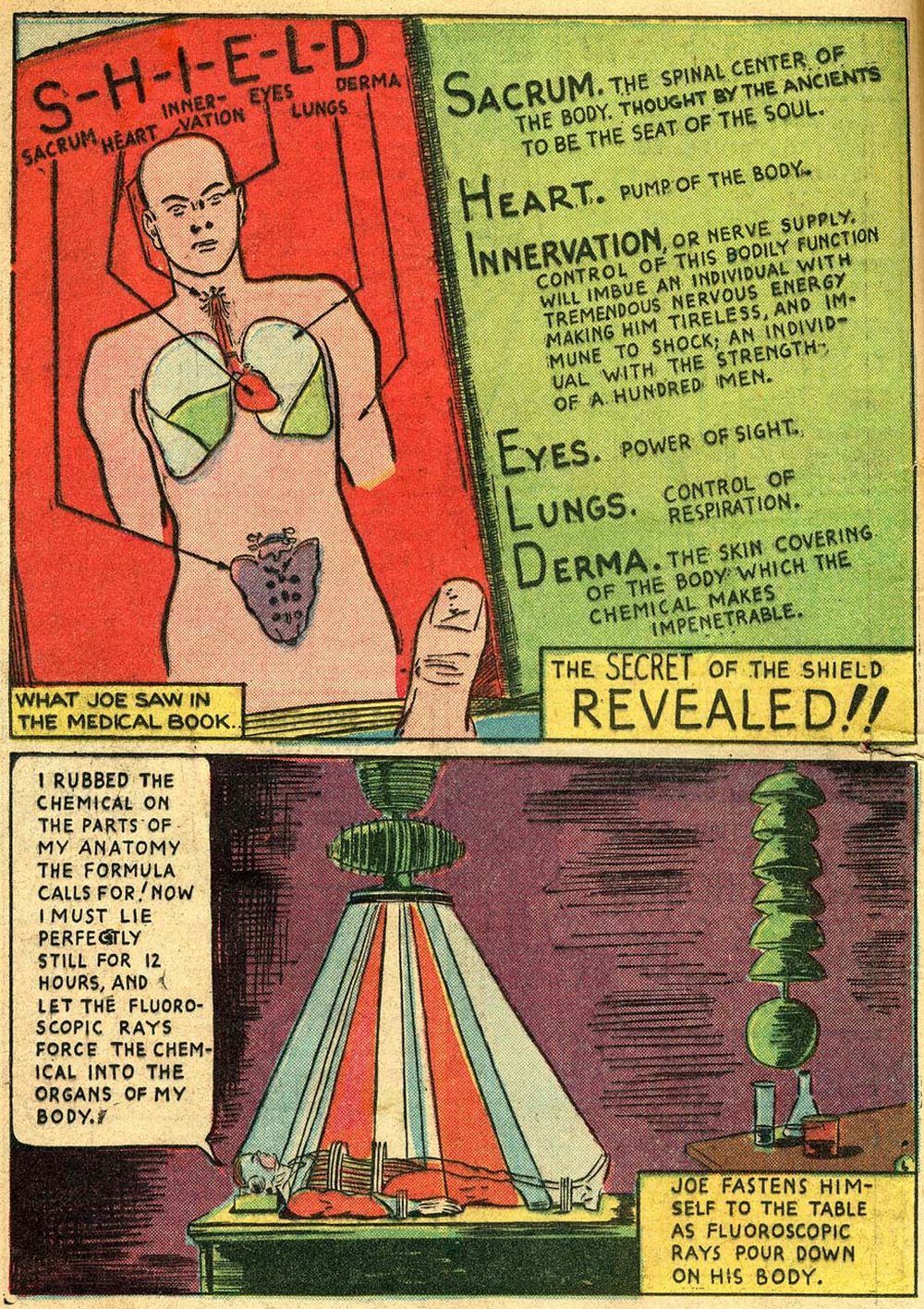
    In our original write-up of the Shield, we noted that the origin of his powers shifted from being solely down to his super-suit to being more of an ingrained thing over time, and the time is now! Yes, Shield-Wizard Comics 001 provides a slightly tweaked version of the Shield’s origin, in which Joe Higgins’ father Tom was not just a US Army Intelligence agent but a gifted scientist who discovered the secret of inducing superpowers but died juuuust before being able to tell Joe the full secret.

    Joe grows up to become a chemist himself but remains puzzled by his father’s last instructions to remember “anatomy formula S•H•I•E•L•D,” and with good reason, because it’s a nonsense jumble of anatomical parts that must have been put together only in the specific medical textbook that Joe eventually finds it in. But hey, he needed to find out where exactly to rub the chemical formula, and how would he otherwise know that it boiled down to “your eyes and skin, but especially the skin over your chest and groin” without that handy mnemonic device?

    The all-white costume that Joe is sporting before he settles down for a 12-hour session under the fluoroscopic ray shows up in at least a few retellings of the Shield’s origin going forward and I always thought that it was a pretty snappy look. Unfortunately, the rays dye his suit (and possibly his limbs?) in patriotic colours and so we get a red-white-and-blue Shield rather than merely a white one.

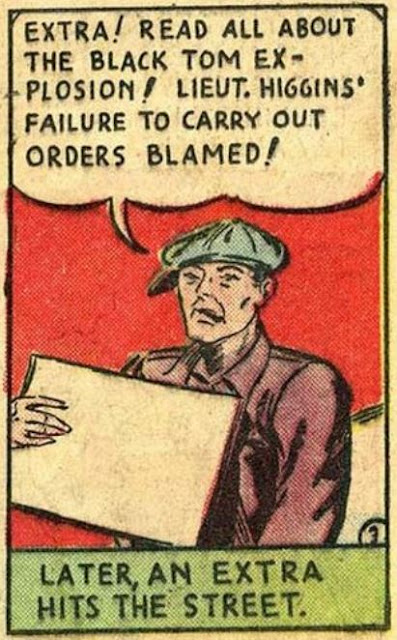
    The other tweak to the Shield’s origin is that rather than merely dying in the Black Tom Explosion of 1916, Tom Higgins is blamed for it, so the Shield now not only has a Batman-style motivation (spies killed my dad and now I must battle espionage) but also a Geoff Johns-Barry Allen-Flash one (I fight crime as part of my attempt to clear my father’s name). Thankfully, his first case involves rounding up the very German Hans Fritz and forcing him to confess, thus clearing Tom Higgins’ name without it becoming a whole thing. (Shield-Wizard Comics 001, 1940)

    the Wizard I:

    In the original account of the Wizard’s origin in Top-Notch Comics 001, the Whitney family’s close connection to American history is pretty thoroughly emphasized, with Whitneys present and getting things done at all major American wartimes. Well, Shield-Wizard Comics took up that gauntlet and ran with it: John Whitney organized the Mayflower expedition, and his son John Whitney organized the first Thanksgiving, and his son or grandson John Whitney thought up the idea of uniting the colonies. 

    But that wasn’t all: the third John Whitney’s son Blane (the main line of Whitneys only have time for three male names: John, Blane and Grover. All other named Whitneys are from dead end branches of the family tree, it seems) is just as super-human as his descendant, and in fact was the first of a line of Whitney family superhumans to call themself the Wizard (adopted as an ironic name after John Whitney was burned at the stake for witchcraft after acting on his son’s extrasensory visions to protect the colonies).

    The Wizard ends up making quite a big difference in the tides of the American Revolution, including:

    – informing Paul Revere that the British were approaching Concord and lighting the “one if by land, two if by sea” lanterns

    – showing up to participate in the fighting at Concord and turning the tide

    – wielding a cannon as a sidearm in the Battle of Bunker Hill and again at the Battle of Saratoga

    – saving Nathan Hale from being executed as a spy only not really because he chooses to die and be an inspiration instead

    – orchestrating the crossing of the Delaware and the surprise attack on the Hessian forces

    -very nearly getting Benedict Arnold before he gets away to join the British forces

    – proving instrumental in the capture of Major André

    – participating in several key battles, including the charge of Mad Anthony Wayne and the defeat of Cornwallis

    – orchestrating the support of the French for the revolution

     This original Wizard also creates a number of anachronistic inventions, including:

    – a glider that seems to function a bit more like a full-fledged airplane

    – a steam powered speedboat

    – something in between a deep sea diving rig and a scuba suit

    – a machine gun

    – radio communication

    – an electrified, battery-powered suit

    – a self-propelled sled

    – a tiny high-powered cannon

    All in all, the tale of the original Wizard holds up as a classic of the form, with the form being “super-heroes added to historical events.” Comics love to showcase the great moments of US history in particular, but as a comic book must prioritize action, any super-heroic character who is present must have an extraordinary amount of influence on history. It’s great! (Shield-Wizard Comics 001, 1940)

    the Wizard II:

    The second Wizard, like his father the original Wizard, is essentially a carbon copy of the modern character in appearance, name (Blane Whitney, natch) and abilities. Blane Whitney II also takes after his father in his commitment to inserting himself into important US historical events, including:

    – participating in various military engagements, including the defeat of the HMS Gurrierre, the Battle of Lake Erie, the Battle of the Thames (I think?) and the Battle of Bladensburg

    – saving William Henry Harrison from an assassination attempt

    – almost preventing the burning of the White House by the British

    – planning the defense of Fort McHenry and then participating in it

    – accidentally enabling Francis Scott Key to get inspired to write the Star-Spangled Banner

    This Wizard also has a lot of ahead of its time technology, including:

    – a version of his father’s glider

    – smoke (possibly tear gas) grenades

    – a dang tank

    The second Wizard obviously has less of a direct impact on the events of US history, if only because the War of 1812 has fewer Stand Up and Cheer moments than its predecessor. Still, he’s in there, and there’s every indication that we’d continue on to see a Civil War Wizard and a World War I Wizard and so forth, and the stated reason that we don’t see them is that as of Shield-Wizard Comics 003, the Wizard’s sidekick Roy the Super-Boy was too popular to not feature and so it was contemporary Wizard from then on out. (Shield-Wizard Comics 002, 1940)

    And speaking of Roy the Super-Boy:

    Tommy the Super-Boy:

    A part of any big project is choosing a methodology and then sticking to it and as my project is “reading all comics, in order” I had to figure out what “in order” meant. And while doing things in a month by month basis might be more true to the spirit of the experience, for my own sanity I opted to go alphabetical by year instead – the prep work alone for that other method hurts my head a bit to contemplate.

    All that is by way of explaining that Tommy, “the Original Super-Boy of History” (aka the original wonder-boy according to that one panel) is a retroactively created predecessor of the Wizard’s sidekick Roy the Super-Boy, who we will not meet until I have read the around 180 other comics between Shield-Wizard Comics 002 and Top-Notch Comics 008. He’s your classic orphan kid who gets to hang around a super-hero because he’s scrappy, and it turns out that that’s not unheard-of in historical youths.

    This particular scrappy kid, Tommy by name, is peeling potatoes when he meets an incognito Blane Whitney II and ends up discovering his secret identity after the Wizard participates in a sea battle and Tommy runs off afterward to berate Blane for cowardice, like a normal person does. And once you have discovered a super-hero’s identity, you get to become a super-hero! If you are a scrappy kid, of course. (Shield-Wizard Comics 002, 1940)

  • MINOR SUPER-HERO ROUND-UP 037

    MINOR SUPER-HERO ROUND-UP 037

    More cream rises from the milky depths of the Golden Age!

    Red Roberts, the Electro Man:

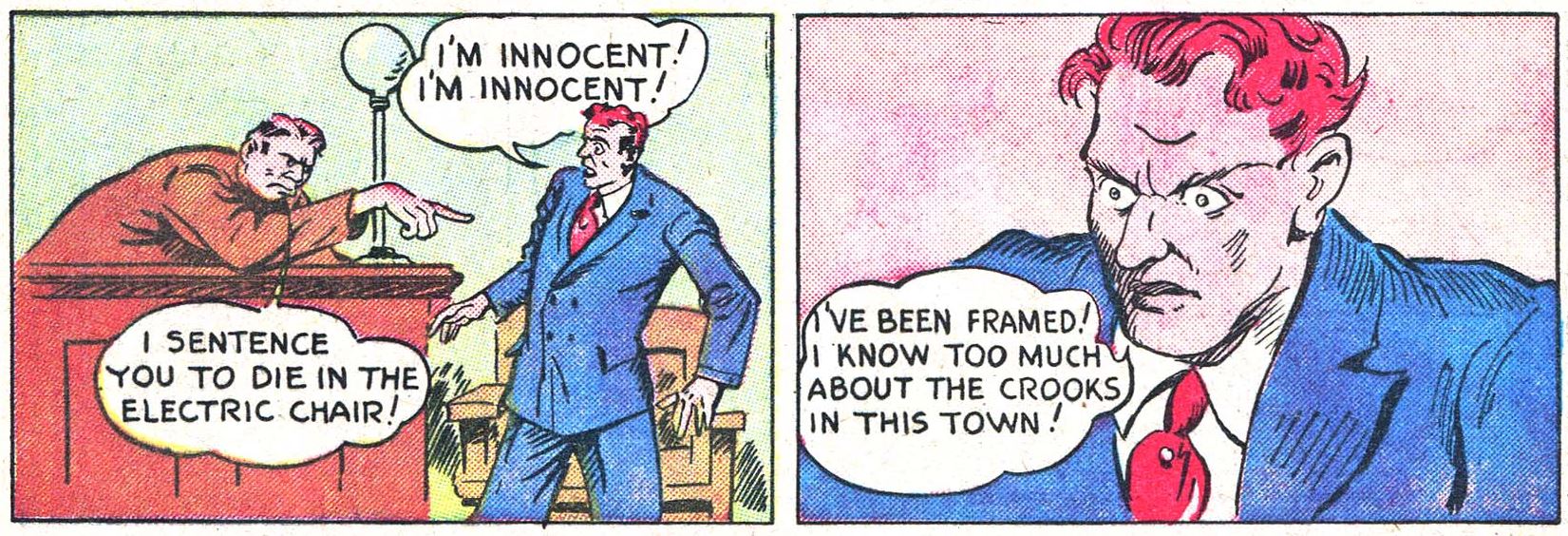
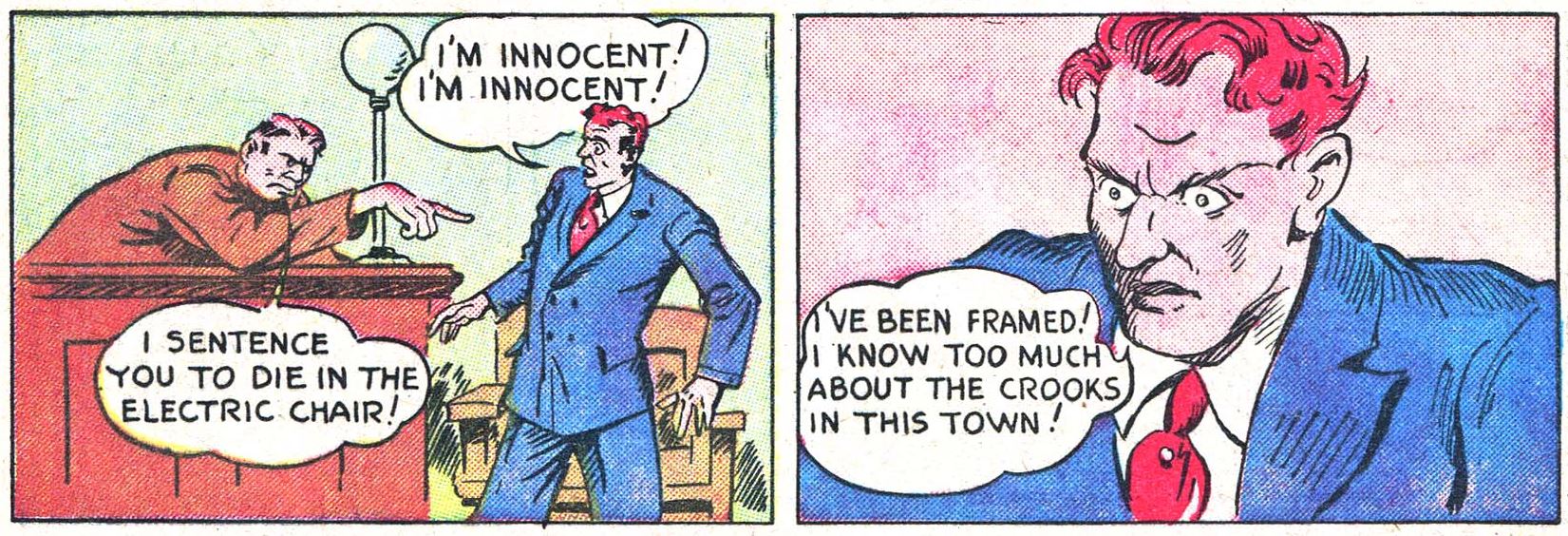
    It’s unclear what Red Roberts’ actual job is, but he is a guy who Knows Too Much about the corruption in the unnamed city he lives in and so he is framed for murder and fast-tracked to the electric chair.

    Luckily for Roberts, this is a comic book universe and being an innocent person sentenced to be executed via the electric chair means that you get sick-ass electricity powers instead of dying like everyone else. Red Roberts quickly parleys these powers into revenge on the city’s crooked mayor and his cronies and then cleans up crime around town for a couple of issues more for good measure. He doesn’t bother with a secret identity because at least half a dozen people were there to witness his origin, which must feel quite freeing. (Rocket Comics 001, 1940)

    the Phantom Ranger:

    There’s not much to distinguish the Phantom Ranger from his contemporaries in the ranks of Mysterious Cowboys Who Stick Around Just Long Enough to Help Out, but here goes: his horse is named Demon and he likes to ride around with his sleeves rolled up, which gives him a business casual look that I appreciate. (Rocket Comics 001, 1940)

    the Defender:

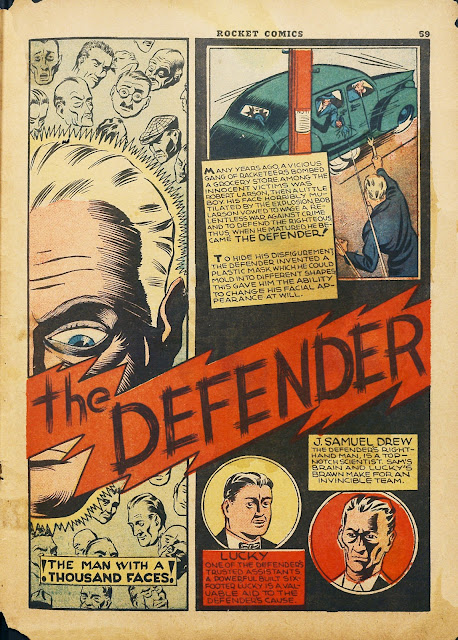
    Is the Defender (Robert Larson, who was scarred facially by criminals as a child and who now fights crime using a malleable rubberoid mask and two dedicated assistants) a take on pulp and comic character the Avenger (Richard Benson, whose face was rendered inhuman by the shock of losing his wife and child to criminals and who now fights crime using his own malleable face and 4-5 dedicated assistants)? I certainly think he is, but I don’t know if you could conclusively prove it. (Rocket Comics 002, 1940)

    Samson UPDATE:

    Samson being descended from the long-haired Biblical figure of the same name is not a new origin for the character, but once he had his own series it was time to explicitly lay it out in the form of his mother telling him in plain English that he is. Frankly, I’d much rather learn how he managed to get away with  having shoulder-length hair as a teenager in the early 1930s, but it’s just left as an exercise for the reader to figure out.

    No such luck for David, however. He remains an orphaned Boy Scout who Samson just found and adopted one day. David is not his actual name and we do not know his actual name. There is some early effort to play up his Boy Scout knowledge as valuable to the crimefighting enterprise but that soon falls by the wayside. (Samson 001, 1940)

  • MINOR SUPER-HERO ROUND-UP 037

    MINOR SUPER-HERO ROUND-UP 037

    More cream rises from the milky depths of the Golden Age!

    Red Roberts, the Electro Man:

    It’s unclear what Red Roberts’ actual job is, but he is a guy who Knows Too Much about the corruption in the unnamed city he lives in and so he is framed for murder and fast-tracked to the electric chair.

    Luckily for Roberts, this is a comic book universe and being an innocent person sentenced to be executed via the electric chair means that you get sick-ass electricity powers instead of dying like everyone else. Red Roberts quickly parleys these powers into revenge on the city’s crooked mayor and his cronies and then cleans up crime around town for a couple of issues more for good measure. He doesn’t bother with a secret identity because at least half a dozen people were there to witness his origin, which must feel quite freeing. (Rocket Comics 001, 1940)

    the Phantom Ranger:

    There’s not much to distinguish the Phantom Ranger from his contemporaries in the ranks of Mysterious Cowboys Who Stick Around Just Long Enough to Help Out, but here goes: his horse is named Demon and he likes to ride around with his sleeves rolled up, which gives him a business casual look that I appreciate. (Rocket Comics 001, 1940)

    the Defender:

    Is the Defender (Robert Larson, who was scarred facially by criminals as a child and who now fights crime using a malleable rubberoid mask and two dedicated assistants) a take on pulp and comic character the Avenger (Richard Benson, whose face was rendered inhuman by the shock of losing his wife and child to criminals and who now fights crime using his own malleable face and 4-5 dedicated assistants)? I certainly think he is, but I don’t know if you could conclusively prove it. (Rocket Comics 002, 1940)

    Samson UPDATE:

    Samson being descended from the long-haired Biblical figure of the same name is not a new origin for the character, but once he had his own series it was time to explicitly lay it out in the form of his mother telling him in plain English that he is. Frankly, I’d much rather learn how he managed to get away with  having shoulder-length hair as a teenager in the early 1930s, but it’s just left as an exercise for the reader to figure out.

    No such luck for David, however. He remains an orphaned Boy Scout who Samson just found and adopted one day. David is not his actual name and we do not know his actual name. There is some early effort to play up his Boy Scout knowledge as valuable to the crimefighting enterprise but that soon falls by the wayside. (Samson 001, 1940)

  • MINOR SUPER-HERO ROUND-UP 032

    Just a few more minor super-heroes.

    Paul Bunyan: 

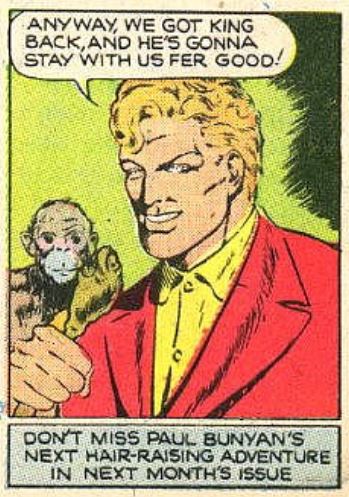
    What’s better than a regular two-fisted lumberjack protagonist? Paul Bunyan himself, that’s who. This version of Bunyan works in a modern-day lumber camp and has been toned down a bit with the suggestion that he’s just some guy who was born in Maine and grew to a mere ten feet tall. His adventures aren’t that much different than those of other lumberjack heroes, but there is something about an enormous man with a giant blue ox that add a bit of spice to the proceedings. (National Comics 001, 1940)

    (Bunyan gets an ape-man sidekick named King for a couple of issues and this is the best place I could think of to note that (National Comics 006, 1940))

    Wonder Boy:

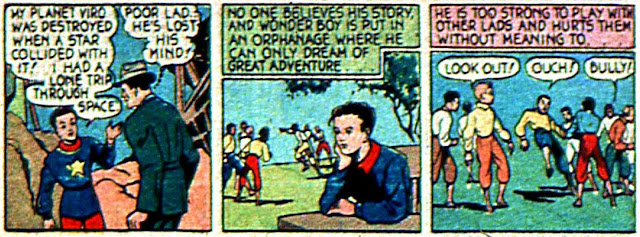
    Wonder Boy is an alien from the planet Viro who is a take on the Superman origin (last survivor of a destroyed planet rocketed to Earth where he is superhuman in comparison to the locals) while simultaneously being a prototype of Superboy (special super-powered boy who can only do good and is loved by all the world). DC Comics bought the rights to him along with all of the other Quality characters but has never seen fit to use him for anything, which I suppose is reasonable. (National Comics 001, 1940)

    Quicksilver:

    He’s got a lot of personality, that Quicksilver. Like other Golden Age super speedsters he handily outclasses most of his opponents and so the main draw is watching just how stylishly he beats them up. Much much later, Quicksilver will be brought back under the name Max Mercury and incorporated into the Flash family but that’s more than a few years out yet. (National Comics 005, 1940)

    the Phantom Knight:

    The Phantom Knight, aka Prince Philip of Kyle, is a very fun concept! As presented in his initial appearance, Philip is a real jerk, a man who cares about nobody and nothing but his horse Lightning.

    Philip is mean, vengeful, faithless and murderous. He kills two men in what were supposed to be bloodless contests because he felt that they insulted them. He joins and then deserts what is presumably the First Crusade, which could be a good act except that he deserts because there isn’t enough slaughtering and he gets bored.

    Philip eventually meets his end at the tusks of a wild boar and finds himself denied access to the afterlife until he makes up for his life of extreme dickishness, so he returns to Earth to do good as the Phantom Knight!.

    Now, here’s the problem: the Phantom Knight appeared twice, in OK Comics 001 and 002, and OK Comics 002 is not available to read anywhere that I know to look (well, there is a copy on ebay right now but I’m not prepared to pay $500 Canadian for the privilege). Thus, all that we really know about the Phantom Knight is that he was a colossal ass in life and now roams the mortal realm as a tormented spirit doomed to do good deeds. Is he still an ass? Is he operating in his home time period or has he been brought to the present – the location of Kyle is never established beyond being in Central Europe, so if he is operating in the modern day there’s a decent chance he fought some Nazis. (OK Comics 001, 1940)

  • MINOR SUPER-HERO ROUND-UP 022

    There’s a little super-hero in all of us, I reckon.

    Volton: 

    Volton comes on strong. I mean, look at the guy: crotch-forward, power device on a chain welded around his waist, moisturized, in his lane. The very second he figured out how to have super-powers he was in his element.

    And because Volton (aka Guy Newton) HATES CRIME and HATES CRIMINALS he heads on down to the local police station in his only-the-most-confident-heroes-wear-them sweater vest and beats up cops until they let him be a semi-official vigilante. And he is much more qualified than the pack of ding dongs the Commissioner here has working for him – do any of them have electrically powered super strength or an electrical forcefield or the ability to suck the electricity out of a person to stun them? They do not. 

    Volton does such a good job beating up crooks that not only does the Commissioner come around on him but lets Volton date his daughter. This is the workaround for those fathers who ostentatiously display a shotgun when the new beau comes around, fellows: vigilante justice. (Cyclone Comics 001, 1940)

    Volton is our second encounter with a future member of Marvel’s team of public domain super-heroes-turned-Nazis the Battle-Axis, and it’s hard to say if Roy Thomas did him the most dirty or the least. His stated reasons for the heel turn are certainly the flimsiest of all the Battle-Axis members but just like his revised origin of having been struck by lightning they aren’t actually true, as this version of Volton is a prototype of the same kind of android as the Human Torch, taken along when Dr Nemesis Death split from Phineas Horton after helping him create android life but before turning to fascism.

    All this is interesting in a universe-building kind of way (the Human Torch has a little brother who hasn’t showed up in decades! What’s up with that?) but a bit of a missed opportunity in that the original version of Volton is more than a bit fascist. Why bother making the Human Meteor go Nazi for Ireland when you could have him be the android and simply let Volton follow his heart?

    the Red Knight:

    What can I say: I like super-hero-adjacent characters and stories of knightly adventure are full of those. The Red Knight, for example, is Sir Miles of Lorraine and he has special red chain mail! and that’s about it. Even worse, his adventures are set during the First Crusade, so there are likely to be fewer dragons and evil warlocks and more historic war crimes heinous enough to still come up in international relations. Lucky for me, the Red Knight series only had two installments and the second one (the one more likely to have war crimes in it) is missing! As it stands, the Red Knight spends most of his energy dealing with his evil uncle rather than in slaughtering all and sundry. (Cyclone Comics 001, 1940)

    Robo of the Little People:

    Like Electro before him, Robo here is actually a super-powered robot piloted remotely by a scientist (in this case a guy named Vedik). The gimmick in Robo’s case is that he was constructed as a giant robot by the inhabitants of an isolated Antarctic valley but once he started to explore the outside world for them it quickly became clear that his creators were in fact very small and Robo was the size of a regular human. 

    Robo probably would have transitioned into regular super-heroing at some point but since he only has a handful of appearances most of his adventures are concerned with day-to-day survival in our wacky world. (Cyclone Comics 002, 1940)

    The Eye:

    The Eye is just that: a huge, disembodied eye with associated lid, lashes, etc, that appears with or without a halo of flame to serve the cause of justice throughout the world. It is, without a doubt, an outlier in the group of beings that can be labelled “super-hero”.

    About the only thing that we know about the Eye is that it is a well-known figure world-wide. It’s been operating for long enough that legends of its deed are present in a number of different cultures and whispered of by the criminal fraternity. Other than that: nothing. The Eye sees injustice and metes out justice and that’s all.

    Actually, there is one other thing we can infer about the Eye: either its power levels or its willingness to act directly varies over time. Sometimes, as above, it takes the shortest route to justice, employing heat rays and knocking planes out of the air willy nilly. Other times (and particularly by its last few appearances), the Eye contents itself with passing off information to human agents such as lawyer Jack Barrister. Is the Eye periodically short on power? Is it bored of the lack of challenge inherent in eye-beam based justice?

    The Eye’s eye also flips from left to right sometimes. This is actually quite eerie! (Keen Detective Funnies v2 012, 1939)

  • MINOR SUPER-HERO ROUND-UP 018

    More of these guys and their antics.

    Johnny Fox:

    Johnny Fox is a guy* from the Florida Everglades who visits his grandfather one day to find him the victim of a treacherous murder. And what’s worse, the murderer, one Peter Pokane, did so in order to steal a supply of “sun-shots”, i.e., invisibility pills.

    *and by “guy” I mean “Native American guy of the Seminole Tribe of Florida” but it’s a tricky thing to work into a concise sentence. Also tricky: the racial politics of the Johnny Fox comic! Johnny is a college-educated Seminole and thus free of a lot of the overt stereotypical behaviour of the day but also is a near-superhuman even without the invisibility pills, explicitly due to his Noble Savagery. Plus Peter Pokane’s major villainous trait is that he’s a “half-breed” which… must I explain why that sucks? What I’m saying is that it’s complicated.

    Johnny gets the sun-shots back by yeeting Peter Pokane out a penthouse window and begins fighting crime, invisible-style. Keeping in mind, of course, that he has to take a pill to turn invisible and another to turn back. Unless he gets hurt, which will turn him back immediately. Which happens a lot, because Johnny may be invisible, but his shadow never is. As far as invisibility goes, this version might have the most caveats I have ever seen. At least he doesn’t have to be nude.

    After a while the writers seem to get tired of the invisibility gimmick and have Pokane return just long enough to take the sun-shots to a watery grave (and it’s a rare villain who gets killed by the same hero twice). Johnny Fox is now just a regular bow-wielding New York City Private Detective… for about two issues, after which Johnny’s grampa’s ghost returns to teach him how to make them again. (Champion Comics 006, 1940)

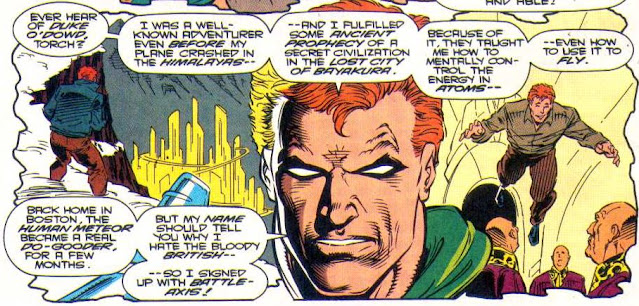
    the Human Meteor:

    Duke O’Dowd was just a regular Texan serving as a French Foreign Legionnaire until a couple of issues in, when his writers presumably realized that comics about the French Foreign Legion are boring, repetitive and usually pretty racist (though they probably cared more about the first two reasons). So they made Duke homesick, had him earn an honourable discharge and sent him on his way in a plane piloted by fellow Texan Kerry Flynn – an unlucky break for Flynn as it turned out, because somewhere over the Himalayas the two were caught up in a mysterious tornado and blown to the hidden city of Bayakura, a journey that only Duke O’Dowd survived.

    Hailed as the Great Deliverer, O’Dowd is introduced to Bayakuran scientist Dr Wah Le, who outfits him with the Wonder Belt, a superscientific device which provides him with super-strength, the power of flight and invulnerability to metal. Plus he gets a stun ray gun! And a very fun and goofy outfit!

    Duke puts down a rebellion by the very low-achieving heir to the throne of Bayakura (his aim was to take the riches of Bayakura to the outside world and live like a king but he decided to do so via a huge heist rather than the traditional and much safer option of embezzling from the kingdom while in power) and installs Wah Le in his place before heading to the outside world himself.

    Sadly, once O’Dowd rejoins the outside world he trades in the amazing Bayakuran national costume for a more traditional super-hero getup (though the Bayakurans seem to have varied up their outfits as well – perhaps their fashion industry was revitalized by O’Dowd’s fresh new looks). He also switches names from the Great Deliverer to the Human Meteor, which is admittedly more snappy. 

    The Human Meteor is also the first character we have encountered who will someday be done dirty by Roy Thomas in 1993’s Invaders v2. Briefly, Thomas had the idea to field a team of super-heroes who had defected to the Nazis against the Invaders and since he wasn’t allowed to use any actual Golden Age Marvel characters he instead opted for the public domain. 

    While my initial instinct is to reject this idea… I must admit that it’s not without merit. Plenty of otherwise rational people were also charmed by the fascists – it’s unreasonable to think that no superfolk would ever compromise one aspect of their morality for another (it is however a badly-written comic, because it’s a very 1990s comic). So what we’re going to do is not assume that we’ll get to it later (three years into this project and I still haven’t gotten to 1942, after all) and instead we’re going to evaluate just how much of a stretch it was for each character to end up as a Nazi.

    While Duke O’Dowd is an adventurer and thrill-seeker who joined the French Foreign Legion for a larf and never really expresses complex morality as opposed to simple justice-seeking, his stated reason for joining the Battle-Axis is that his Boston Irish blood demanded it, which… is plausible as a motivation for attending a few meetings but a huge stretch when it comes to attempting to kill Captain America. (Champion Comics 008, 1940)

    Robinhood Jones:

    “Rich guy who gives it all up to become a do-gooder hobo” wasn’t the most popular trend in early comics but I can conjure up at least half a dozen examples. Robinhood Jones has the added distinction of being a pretty direct pastiche of – you guessed it – Robin Hood and his Merry Men. Some highlights:

    Robin Hood – Robert Harrison Jones III

    Friar Tuck – Fry Tucker

    Little John – Little Jack Lee

    Will Scarlet – Bill Scarlet

    Alan-a-Dale – some guy named Allen

    There’s also a fairly delightful swap of archery for horseshoes as an all-purpose solution. Funnily enough, though Robinhood Jones squared off against the same crooked Sheriff of Sherwood City on thereabouts on two separate occasions he never encountered a clear Prince John analog. Or a Maid Marion, for that matter. (Champion Comics 007, 1940)

    the Black Ghost:

    AKA the Black Rider, the Black Ghost was an alternate identity adopted by cowboy hero Bronc Peeler (himself the character prototype for the slightly less outlandishly-named Red Ryder) on one of the many occasions in which he was framed as a crook and had to prove his innocence. Of note mostly for his very cool outfit consisting of jet black cowboy gear with a white bandit mask. (Popular Comics 039, 1939*)

    *Originally a comic strip that was reprinted in Popular Comics, if you’re truly interested.

  • MINOR SUPER-HERO ROUND-UP 017

    Another fresh hot basket of also-rans, just for you.

    the Mask:

    Scoop Cody, society reporter, is secretly vigilante crimefighter the Mask. He’s not terrific at concealing this fact – both love interest Elaine and villain Carlos figure it out during the course of the one extant Mask story – but he gets the job done. Of mild interest is that Scoop Cody is also the name of the Marvel’s reporter pal. (Star Comics v1 013, 1938*)

    the Phantom Rider: 

    The Phantom Rider is your standard masked cowboy, identity unknown. Given their similar names and that they are both Centaur Comics characters it is equally likely that he is a renamed Phantom o’ the Hills as it is that he is a separate creation. His horse is named Thunder. (Star Comics 016, 1938*)

    Air Man:

    Air Man is Drake Stevens, an ornithologist who embarks on a vigilante career after his father is murdered in an insurance scam on the high seas. He only makes a handful of appearances before Centaur folds, and here are the salient things about him:

    -Air Man is a “realistic” version of Hawkman, i.e., not realistic but in a slightly more plausible way than an antigravity belt. His wings are filled with helium and he has a little jet engine for propulsion (at least, as of his second appearance. Maybe he’s just very slowly gliding around in his first). He also has egg-shaped bombs, which isn’t relevant to the flying but is fun.

    -Air Man is not a generic bird-themed hero but in fact an albatross-themed protector of the seas, which is a niche that I have not encountered before and the closest that I can think of is the Marvel hero Stingray, and that’s just because they both fly and are ocean-based.

     -Air Man believes in protecting the high seas so much that he breaks up with his fiance rather than just… living in a lighthouse with her or whatever. Super-heroes love breaking up with people and then feeling noble about it. (Keen Detective Funnies 023, 1940)

    TNT Todd:

    TNT Todd had been a regular FBI agent having FBI agent adventures in Keen Detective Funnies for about a year when he became if not the earliest then certainly our first example of a non-super character getting a super-heroic makeover to fit comic trends (I tell a lie Tex Thomson/ Mr America has come up before but he made the switch in 1941). While overshadowed by fellow explosion-based hero the Human Bomb a year or so later I must admit to enjoying TNT Todd more on a conceptual level. Just a guy careening through a city via a series of explosions, theoretically helping people. (Keen Detective Funnies 021, 1940)

    *there are several issues of Star Comics from this time that are not readily available, including issues 012, 014 and 015. This means that both the Mask and the Phantom Rider could have earlier first appearances.

  • MINOR SUPER-HERO ROUND-UP 016

    A pretty motley collection this time.

    the Ermine:

    A frontier vigilante who wears a reversible ermine skin outfit (white for winter wear, brown for regular), leaves an ermine tail as his calling card and can communicate/ is friends with with all the creatures of the forest (except for the ermine, presumably). The Ermine would be an interesting character if he wasn’t explicitly and murderously racist against Native peoples. He’s classed as a minor hero here because all of his recorded adventures involve him acting as the protector of two youths but I assume that he has a lot of hate crimes under his belt. (Star Ranger Funnies v1 015, 1938)

    the Lone Marshal:

    I have a strong suspicion that the Lone Marshal is a Lone Ranger knockoff. Obviously there’s no way to peer into the past and be sure, and admittedly the name was a really big influence on my opinion, but I’m sticking with it. He’s got a Sioux companion named Vajo and a horse named Lobo, so he’s just as not-technically-Lone as the Ranger is. (The Comics 001, 1937)

    Doctor Doom:

    Doctor Doom, “the Robin Hood of International Spies,” is some sort of freelance spy chief who we join as he works for the small Balkan nation of Returia as they fend off invasion plans by their rival, the similarly-small, not-as-Balkan Kingdom of Merovia. Doctor Doom and his double handful of associates are on the back foot for the entirety of their time battling the Falcon and never really manage to get the upper hand before the feature is cancelled but I assume that they would have come out on top eventually. (The Comics 001, 1937)

    Jungleman:

    Jungleman is your typical white-kid-raised-by-beasts jungle hero, in this case based out of Cambodia. He lives in a temple and collects treasure and repeatedly kidnaps a young woman named Louise until she falls in love with him – like I said, typical stuff. 

    The real thing that sets Jungleman apart from his peers is both the sheer number and variety of his animal companions and their tremendous attrition rate – he goes through two tigers in his first three appearances when most jungle heroes have to make one big cat last their entire career! 

    Eventually, Louise and her dad convince Jungleman to relocate to the US under the more civilized alias of “Mister Jay” and I was all set for a lot of the same kind of fish-out-of-water stuff that Ty-Gor spent a lot of his time on but no! Their ship gets wrecked and they just end up in a different jungle! It’s the old jungle switcherooo and I never saw it coming! (Champion Comics 002, 1939)

    **UPDATE** Bob Phantom **UPDATE**

    Star Comics 001, 1938 features a different guy named Bob Phantom, which only reinforces my paranoia vis-a-vis there being a joke or a reference that I’m missing about the last name Phantom. Also, given the slapdash nature of early comics and their record keeping, nobody actually knows who created this guy and so it’s entirely possible that he’s the same Bob Phantom and Harry Shorten and/or Irv Novick just took him from Centaur to MLJ and upgraded him from stage magician to super-hero.