The Curse of Skeleton Munroe

Category: heroes of the past

  • MINOR SUPER-HERO ROUND-UP 015

    Once again we take you to the world of the minor super-hero. See them dance for your amusement. 

    the Mystic: 

    Later known as Kardak the Mystic, the Mystic is a stage magician who uses stage magic to battle crime, specializing in fraudulent mediums etc. His stage magic eventually gets rounded up to real magic, of course. (Top-Notch Comics 001, 1939)

    the Phantom o’ the Hills:

    The Phantom o’ the Hills is an otherwise unnamed masked cowboy who rights wrongs in the Old West. In his first adventure he avenges the death of his younger brother but whether that’s what got him into the vigilante game is not elaborated on. The only real thing that sets him apart from the ranks of other similar characters is his better-than-average name. (Western Picture Stories 001, 1937)

    Wonder Man:

    For all that (by some accounts) Will Eisner was explicitly told to make a Superman clone when he made him for Fox Features (and that DC successfully sued Fox into canning him), Wonder Man is only kind of like Superman. Maybe it’s my modern image of what Superman is like but he’s just a strong guy who jumps around catching artillery shells and beating up warmongers. Plus he gets his powers from a magic Tibetan ring! Plus he’s blonde! (Wonder Comics 001, 1939)

    Yarko the Great:

    There are three major things to know about Yarko the Great: 

    1. He’s a magic-slinging hero in the classic mold, i.e., an American who has learned the secrets of the Far East and turned them to a career in stage magic/ crimefighting.

    2. Like a lot of early Fox Features characters he was created by Will Eisner so his adventures tend to look pretty great.

    3. “Yarko the Great” is – and this is an informed opinion – categorically the worst name that any magic-using Golden Age hero was saddled with. 

    (Wonder Comics 002, 1939)

    Yarko UPDATE 1940

    *UPDATE* the Flame *UPDATE*:

    Just wish to draw everyone’s attentions to the really boss custom-painted boat that the Flame was tooling around in during his first adventure. Plus he had a butler named Jarvis! (Wonderworld Comics 003, 1939)

    **DOUBLE UPDATE**

    And he has a plane! (Wonderworld Comics 004, 1939)

  • MINOR SUPER-HERO ROUND-UP 014

    MINOR SUPER-HERO ROUND-UP 014

    Some real niche characters this time.

    the Lone Star Rider:

    An Old West hero so generic he only appeared once and never even got to track down the owlhoots who killed his parents in order to steal their land. Good gloves. (Smash Comics 002, 1939)

    Shock Gibson:

    Like Barry Allen after him, Charles (later Robert) Gibson is a young scientist working late into a stormy night when he is simultaneously struck by lightning and bathed in chemicals. Though he is called the Human Dynamo, for the first chunk of his career he functions as more of a Human Battery who stores an electrical charge that can be used to fuel various superhuman feats – super-strength, super-jumping (later full-on flight), and a shocking grasp.

    Shock Gibson goes through more than a few costume changes over the years – sadly this goofy helmet is axed during the first one – but one consistent element in his design is lotsa cool electricity crackle when he uses his powers. (Speed Comics 001, 1939)

    Shock Gibson UPDATE 1940: He loses the hat.

    the Man With 1000 Faces:

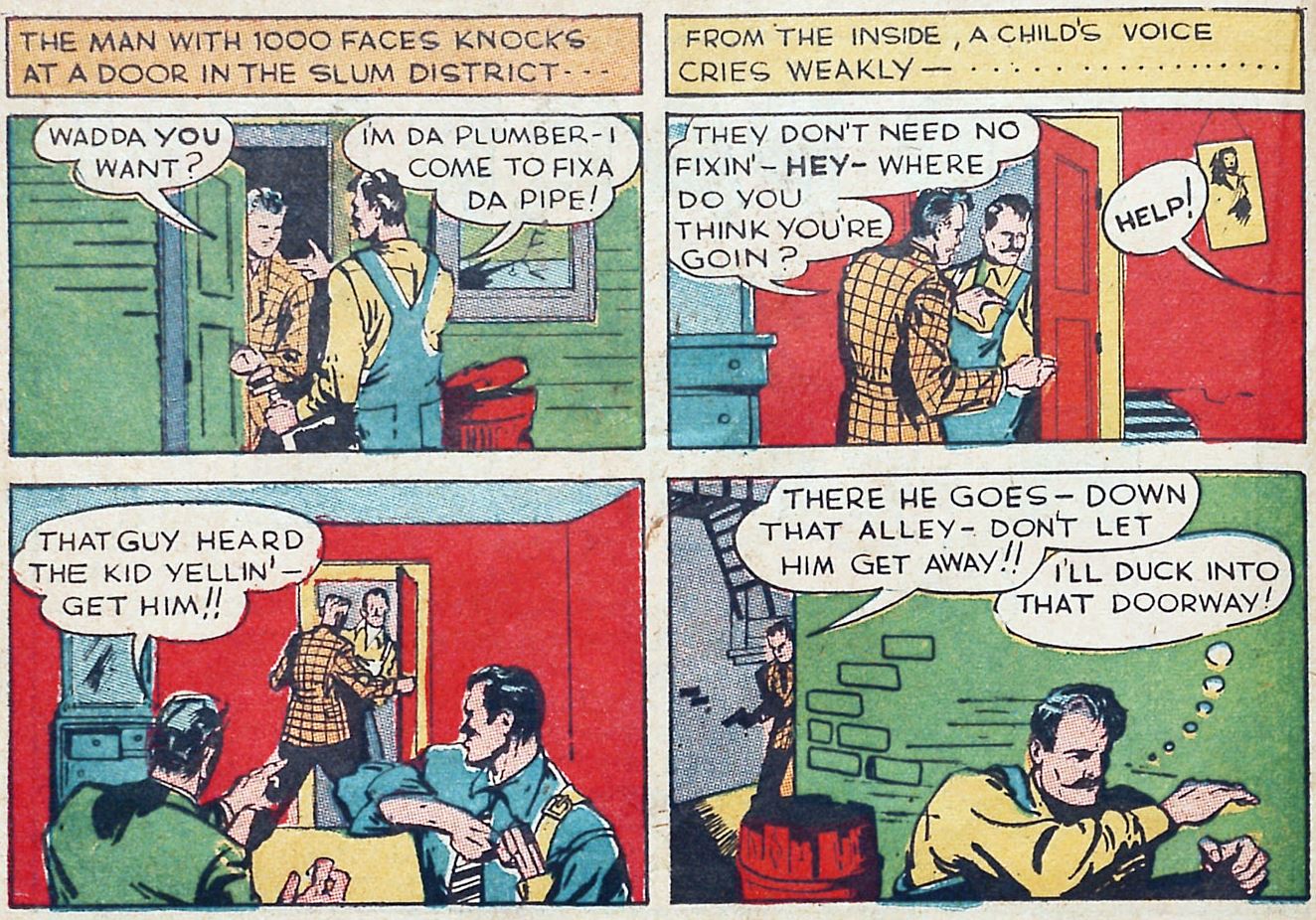
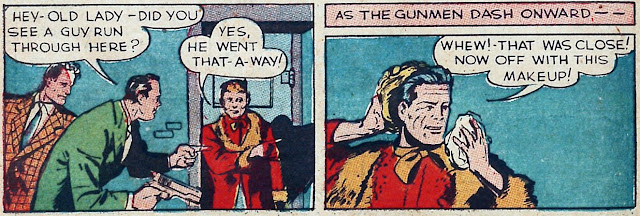
    Ted Parrish, famous film star, is bored with his humdrum life and so turns his considerable talent for quickchange artistry and disguise to the task of crimefighting. Just where he gets all of his accessories from is not elaborated on, so it’s equally likely that he scavenges them from the environment as it is that he just hauls around an enormous hockey bag full of clothing etc everywhere he goes.

    Parrish’s mission is obviously hampered somewhat by the fact that Los Angeles’ criminal fraternity knows that the Man With 1000 Faces exists and they should be on the lookout for him. How did they find out? Did Parrish blab to up the challenge and excitement of it all? (Speed Comics 001, 1939)

    the Wizard:

    Blane Whitney, AKA the Wizard, is the latest in seven generations of Whitneys (some of whom were also called the Wizard) to dedicate their lives in patriotic service to the USA. Plus he was a child prodigy who was charged to use his abilities to better mankind by Woodrow Wilson. Plus he’s an inventive genius in virtually all fields, particularly various forms of engineering. Plus he has nearly superhuman physical abilities and a mind so highly developed that it is superhuman in that he can employ remote viewing to locate dangers and clues.

    The Wizard was a pretty big player at MLJ in the 40s but has largely been abandoned in the various attempts to revive the MLJ characters at Archie and elsewhere – his biggest post-Golden Age appearance that I am aware of was as a super-villain fighting the Mighty Crusaders in the 60s. What does this say about the character – that he’s perfectly serviceable but not very conceptually exciting? Yes, I reckon that sums him up. (Top-Notch Comics 001, 1939)

    UPDATE 1940a

    UPDATE 1940b 

  • MINOR SUPER-HERO ROUND-UP 014

    Some real niche characters this time.

    the Lone Star Rider:

    An Old West hero so generic he only appeared once and never even got to track down the owlhoots who killed his parents in order to steal their land. Good gloves. (Smash Comics 002, 1939)

    Shock Gibson:

    Like Barry Allen after him, Charles (later Robert) Gibson is a young scientist working late into a stormy night when he is simultaneously struck by lightning and bathed in chemicals. Though he is called the Human Dynamo, for the first chunk of his career he functions as more of a Human Battery who stores an electrical charge that can be used to fuel various superhuman feats – super-strength, super-jumping (later full-on flight), and a shocking grasp.

    Shock Gibson goes through more than a few costume changes over the years – sadly this goofy helmet is axed during the first one – but one consistent element in his design is lotsa cool electricity crackle when he uses his powers. (Speed Comics 001, 1939)

    Shock Gibson UPDATE 1940: He loses the hat.

    the Man With 1000 Faces:

    Ted Parrish, famous film star, is bored with his humdrum life and so turns his considerable talent for quickchange artistry and disguise to the task of crimefighting. Just where he gets all of his accessories from is not elaborated on, so it’s equally likely that he scavenges them from the environment as it is that he just hauls around an enormous hockey bag full of clothing etc everywhere he goes.

    Parrish’s mission is obviously hampered somewhat by the fact that Los Angeles’ criminal fraternity knows that the Man With 1000 Faces exists and they should be on the lookout for him. How did they find out? Did Parrish blab to up the challenge and excitement of it all? (Speed Comics 001, 1939)

    the Wizard:

    Blane Whitney, AKA the Wizard, is the latest in seven generations of Whitneys (some of whom were also called the Wizard) to dedicate their lives in patriotic service to the USA. Plus he was a child prodigy who was charged to use his abilities to better mankind by Woodrow Wilson. Plus he’s an inventive genius in virtually all fields, particularly various forms of engineering. Plus he has nearly superhuman physical abilities and a mind so highly developed that it is superhuman in that he can employ remote viewing to locate dangers and clues.

    The Wizard was a pretty big player at MLJ in the 40s but has largely been abandoned in the various attempts to revive the MLJ characters at Archie and elsewhere – his biggest post-Golden Age appearance that I am aware of was as a super-villain fighting the Mighty Crusaders in the 60s. What does this say about the character – that he’s perfectly serviceable but not very conceptually exciting? Yes, I reckon that sums him up. (Top-Notch Comics 001, 1939)

    UPDATE 1940a

    UPDATE 1940b 

  • MINOR SUPER-HERO ROUND-UP 012

    They just keep on coming.

    the Champ:

    The Champ is Captain America if Dr Erskine was a nutritionist rather than a… biologist? Biochemist? Whatever Dr Erskine was a doctor of. A sickly, bullied boy, the Champ (no other name given) was so-called by his bullies because he won at nothing. Scientist Dr Marlin, pitying the Champ, provides him with an experimental food supplement that over a period of seven years transforms him into a physical and mental paragon, the Champ of everything. (I really appreciate the writing on the description of the supplement – one could almost suspect that someone behind the scenes was considering a merchandising spin-off)

    Though the Champ tangles with spies and the like he is at his essence a college athlete character and so a lot of his stories are concerned with the surprisingly high-stakes world of betting on and rigging varsity level athletics, which is… not the most exciting subject matter for a comic. (Champion Comics 002, 1939)

    the Golden Knight:

    The Golden Knight is a heroic Crusader, a fairly popular genre of historical hero in the Golden Age and one that is very much out of favour now. He’ll probably come up again because he operates in an even more heightened comic book reality version of the Crusades than most of his peers, as evidenced by his first adventure, in which he stumbles upon what amounts to a group of Saracen Fifth Columnists lurking in an underground fortress in the English countryside.

    The Golden Knight (aka Sir Richard of Warwick) is also notable for the nonchalance with which he receives a vision of a sword-bearing lady in a one-piece swimsuit telling him to go to war. Unflappable, we call it. (Fantastic Comics 001, 1939)

    UPDATE 1940

    the Arrow:

    The Arrow, a very early costumed hero indeed, is simply an enormous guy in a hoodie (I mean, it’s basically a hoodie) who alternately kills criminals with a bow and arrow and threatens to do so to get what he wants. I have a slightly outsized level of affection for him because he approaches superheroics like I do an open world game like Skyrim.

    The Arrow does eventually get a more super-heroic look (roman sandal style lacing on his shins, a belt) and about the same time he gets shunk down to more average human proportions, possibly because the idea of a roughly seven foot guy with a carefully guarded secret identity was getting hard to write around. (Funny Pages v2 010, 1938)

    UPDATE 1940 

    UPDATE 1941 

    Mister Midnite:

    mister midnite

    Mister Midnite is Neal Carruthers III, a wealthy sportsman who dresses up in a tuxedo and domino mask to fight crime, with a watch face set to midnight as his calling card and the police on his tail. The only thing that really sets him apart from the horde of other besuited vigilantes is his weirdo power, which is that he can shout “stop, time!” and cause clocks to stop. Although in rereading the first Mister Midnite story again… he might just be able to stop that one clock in that one clock tower? It’s a dumb and bizarrely specific power and Mister Midnite is just lucky that I find that kind of thing charming. (Silver Streak Comics 001, 1939)

    UPDATE 1940 (Silver Streak Comics 002, 1940)

  • MINOR SUPER-HERO ROUND-UP 010

    MINOR SUPER-HERO ROUND-UP 010

    MORE MLJ ACTION

    Doc Strong:

    Doc Strong is a famous scientist living in the year 2041, in a world where WWII dragged on for an entire century and a new Mongol Horde has swept in and conquered the battered remnants of civilization. The strangely Doc Savage-like Doc Strong gathers a group of like-minded scientists and starts a new civilization called the Isle of Right from which to strike back at the invaders with such inventions as a ray gun that solidifies shadows. (Blue Ribbon Comics 004, 1940)

    the Fox:

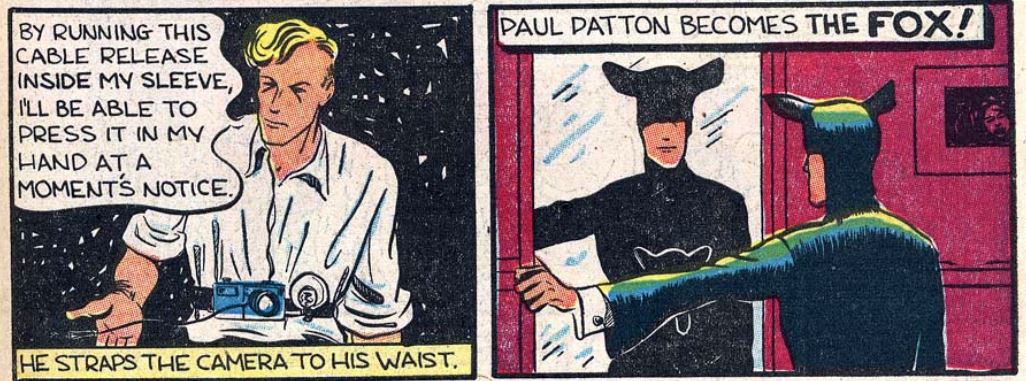
    Paul Patton, photographer for the Daily Globe, gets the tar beaten out of him by some fellows called the Night Riders and comes up with a plan:

    That’s right, he’s about halfway between Spider-Man and Batman. Okay, he’s mostly Batman but his wearable camera scheme anticipates Perter Parker’s epic work hack by about twenty years. The Fox’s first attempt at a costume is a bit rough, but eventually…

    … he adopts one of the top costumes of the Golden Age! His adventures may be a bit regular but he looks great doing it.

    BONUS FOX FACT: his “bat flies through the window” moment comes when he hears a song on the radio. (Blue Ribbon Comics 004, 1940)

    the Green Falcon: 

    The Green Falcon feature is essentially a Robin Hood Elseworlds story in which Robin is a knight instead of a forest outlaw and his pals Tiny Tuck and Jolly Roundfellow kind of encapsulate a few Merry Men each. Prince John is still there, and Maid Marion, but there are more swordfights than arrow tricks. Hey, I never said it was a particularly compelling Elseworlds story. It is more high concept than you usually get in a Golden Age comic, though. (Blue Ribbon Comics 004-015, 1940-1941)

    Ty-Gor:

    Ty-Gor is MLJ’s answer to Mowgli: a British child orphaned in the jungles of Malaysia and raised by tigers. Ty-Gor is a shortened form of his birth name, Tyrone Gorman, which he learns thanks to an absurd series of events pictured above.

    I don’t usually have a lot of time for jungle adventures but Ty-Gor does have a pretty fun twist in that after a half dozen issues he is brought to New York by explorer Dr Davis and his daughter Joan and Does Not Adapt. He’s just a wild kid who knows about five word maximum thrust into the public school system and causing havoc. It’s fun! (Blue Ribbon Comics 004, 1940)

    BONUS TY-GOR AS A BABY EATING GRAPES

  • MINOR SUPER-HERO ROUND-UP 007

    All Novelty Press edition!

    Dick Cole, Wonder-Boy: 

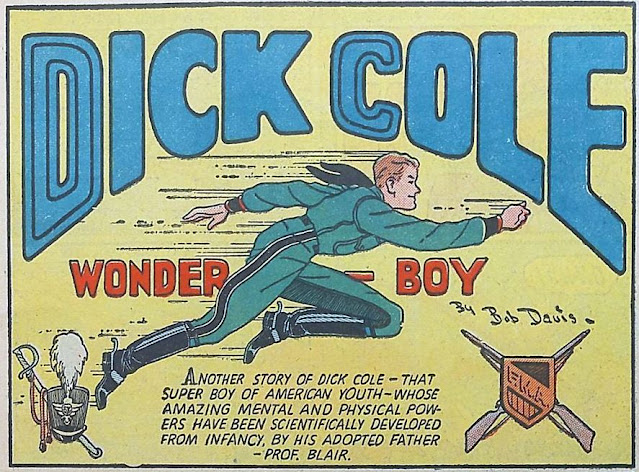
    Dick Cole was left on the front steps of scientist Professor Blair as a baby, and according to him there was an accompanying note requesting that he use his hitherto-untested experimental child-rearing techniques to bring the kid up to be superhuman. And it works! Dick Cole is stronger and faster and smarter than everyone else, and works to help those around him in whatever way he can.

    Sadly for me the Dick Cole series is set at a military academy, a surprisingly popular location in early comics. I think that the weird pseudo-military class structure that such places had/have was popular for the easy drama inherent in the noble protagonists being forced to kowtow to undeserving upperclassmen but reading comics about teenagers being assholes to each other for imaginary reasons palls quickly. (ADDENDUM: I wrote this at the beginning of my Dick Cole reading and am pleased to say that the military academy stuff isn’t as bad as it is in other comics of the time) (Blue Bolt v1 001, 1940)

    BONUS: here’s Dick Cole as a very cool baby.

    Sub-Zero:

    AKA Sub-Zero Man. Part of a Venusian expedition to Earth whose extremely awesome looking spaceship crashed through a frozen gas ball en route, killing everyone but Our Hero, who instead becomes uncontrollably and destructively super-cold.

    After a couple of issues of misunderstood wandering and being hunted, Sub-Zero endears himself to the city of Centro… Oregon? by saving it from a volcano. (highway signs place Centro somewhere between Los Angeles and Topeka, so it’s probably either Oregon or Northern California, and Oregon is closer to volcano country). There, he settles down to a regular super-hero life, albeit one with no secret identity, Centro slowly becomes NYC like so many other comic book cities and people basically forget the fact that he’s an alien. (Blue Bolt v1 001, 1940)

    the Phantom Sub: 

    A bunch of young men led by Jack Damon and Slim Dugan construct an advanced submarine in secret, as you do, and end up as wanted fugitives dispensing justice on the high seas via an electrified water cannon and some plucky attitudes. (Blue Bolt v1 001, 1940)

    Near the end of 1941 the Phantom Sub added the power of flight to its many features, and shortly after that the Phantom Sub crew were able to come in from the cold and begin aiding the US war effort. (Blue Bolt v2 006, 1941)

    the White Rider and Super Horse:

    During a stagecoach holdup, a youngster named Peter (no last name given) is orphaned and flung into a river that eventually flows into the mysterious Lost Valley, where he befriends and is raised by an old hermit named Jeb and a cool horse named Cloud. Eventually, the hermit dies of puma and Peter and Cloud make their way to the outside world where it turns out that due to the valley’s depth it somehow had more gravity and thus the two are super strong. Anyhow, Peter immediately hunts down and kills the bandit who orphaned him and resolves to stamp out crime as the White Rider and Super Horse. 

    Despite the superpowers the White Rider is a bit of a dud, hero-wise and Super Horse does most of the heavy lifting, both literally and metaphorically. (Blue Bolt v1 001)

  • MINOR SUPER-HERO ROUND-UP 005

    All Columbia Comic Corporation edition!

    Skyman: 

    Skyman (properly the Skyman but it just doesn’t scan for me) is a pilot hero, normally a ho-hum sort of character for me. But between his sci-fi super plane (the Wing), his blood-freezing stun ray (the Stasimatic) and his cool on-the-edge-of-being-too-busy costume there’s just enough super-hero peanut butter mixed in with the pilot chocolate to make it appealing (bonus running list of Skyman’s super science: atomic explosives, invisible glass phonograph, disitegrator ray, explosives-detonating ray and a ray that fuses gun barrels shut)

    After a few issues we learn that the Skyman is actually Allan Turner, wealthy good-for-nothing playboy who lost his parents to a plane crash when he was a child. If the Bruce Wayne parallel was 1:1 he would have grown up to become a noted slayer of planes, but that’s a villain’s origin. Instead, Allan Turner dresses up as a plane to fight criminals. It doesn’t make quite as much narrative sense as Batman does but it’s probably more fun to read than the other way around.

    Early Skyman also might just hold the record for the most overinflated torso in comics outside of parody characters. He gets a bit more proportional eventually but for a while there you’re concerned for his ability to live a normal life.

    the Face:

    The Face, like a lot of early comics heroes, draws a lot of elements from the pulps: a tuxedo-clad hero drives around in a souped up roadster fighting crime with his fists and an automatic – a pretty regular early super-guy. Even his secret identity of Tony Trent, radio station owner/ radio announcer is in the pulp-adjacent character wheelhouse.

    It was very exciting to me when I realized that the Face’s face is frequently referred to as a rubberoid mask, my favourite term for the kind of masks that only exist in comic books – perfectly realistic and naturalistic but also very easy to don and doff. This particular mask was made specially for Tony Trent by someone whose other major characteristic is being dead, which is apparently a combination that makes Trent feel quite jolly.

    Weirdly, in Big Shot Comics 006, the Face has a new, slightly less grotesque mask. No word on where he got this one but he goes back to the original pretty quickly.

    Marvelo, Monarch of Magicians:

    Created by Fred Guardineer, who also created Zatara over at DC Comics, Marvelo is… extremely similar to Zatara. Aside from their different approaches to dressing like a stage magician, I’d say that there are two slight differences between the characters: 

    1. Rather than speaking backward to cast spells, Marvelo shouts “Kalora!” as an all-purpose magic word.

    2. Marvelo’s manservant Zee is just a hair more racist than Zatara’s manservant Tong. It’s pretty close but I reckon Zee takes it.

    Big Shot Comics 017 reveals that Marvelo is the son of the ruler of the generically foreign South Pacific island of Brahama (hell on autocorrect). This doesn’t seem to have anything to do with him being a magic man but it’s nice to know. (Big Shot Comics 001, 1940)

    the Cloak:

    Jeff Cardiff, Spy Chief was a feature in Big Shot Comics from issue 1 (well, it was Jeff Cardiff, Spy-Master for the first issue or two but the point stands) with all kinds of foiled plots and plans and spies of both the vaguely fascist and vaguely communist varieties. In Issue 15, however, the spies adopt the reasonable policy of attempting to shoot on sight the man who has foiled so many of their plans and a wounded Jeff Cardiff goes to recuperate at his brother’s house.

    Long story short, Jed Cardiff is a coal magnate with a collection of “adventure curios”, including the namesake cloak of Revolutionary War-era costumed spy the Cloak and it being 1941 and a comic book, Jeff immediately adopts the Cloak identity as his own. It’s a fairly basic costumed hero shtick but I appreciate the effort and it’s always nice to see a more elaborate cape and cowl getup now and then. (Big Shot Comics 015, 1941)

    The original Cloak eventually shows up in a flashback and it turns out that his impact on the history of the American Revolution is only slightly less impactful than Superboy’s in the 1949 story in which he goes back in time and takes part in about half the major events of the war. I must say that I do love a retcon of a historical event. (Big Shot Comics 021, 1942)

  • MINOR SUPER-HERO ROUND-UP 005

    All Columbia Comic Corporation edition!

    Skyman: 

    Skyman (properly the Skyman but it just doesn’t scan for me) is a pilot hero, normally a ho-hum sort of character for me. But between his sci-fi super plane (the Wing), his blood-freezing stun ray (the Stasimatic) and his cool on-the-edge-of-being-too-busy costume there’s just enough super-hero peanut butter mixed in with the pilot chocolate to make it appealing (bonus running list of Skyman’s super science: atomic explosives, invisible glass phonograph, disitegrator ray, explosives-detonating ray and a ray that fuses gun barrels shut)
    After a few issues we learn that the Skyman is actually Allan Turner, wealthy good-for-nothing playboy who lost his parents to a plane crash when he was a child. If the Bruce Wayne parallel was 1:1 he would have grown up to become a noted slayer of planes, but that’s a villain’s origin. Instead, Allan Turner dresses up as a plane to fight criminals. It doesn’t make quite as much narrative sense as Batman does but it’s probably more fun to read than the other way around.

    Early Skyman also might just hold the record for the most overinflated torso in comics outside of parody characters. He gets a bit more proportional eventually but for a while there you’re concerned for his ability to live a normal life.

    the Face:

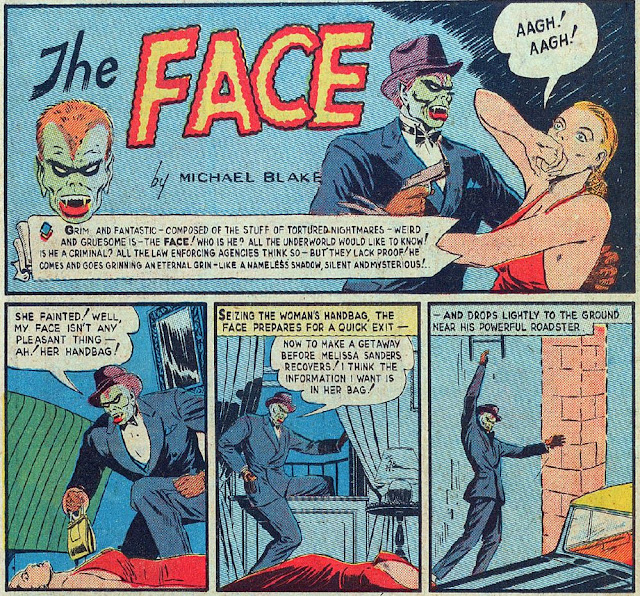
    The Face, like a lot of early comics heroes, draws a lot of elements from the pulps: a tuxedo-clad hero drives around in a souped up roadster fighting crime with his fists and an automatic – a pretty regular early super-guy. Even his secret identity of Tony Trent, radio station owner/ radio announcer is in the pulp-adjacent character wheelhouse.

    It was very exciting to me when I realized that the Face’s face is frequently referred to as a rubberoid mask, my favourite term for the kind of masks that only exist in comic books – perfectly realistic and naturalistic but also very easy to don and doff. This particular mask was made specially for Tony Trent by someone whose other major characteristic is being dead, which is apparently a combination that makes Trent feel quite jolly.

    Weirdly, in Big Shot Comics 006, the Face has a new, slightly less grotesque mask. No word on where he got this one but he goes back to the original pretty quickly.

    Marvelo, Monarch of Magicians:

    Created by Fred Guardineer, who also created Zatara over at DC Comics, Marvelo is… extremely similar to Zatara. Aside from their different approaches to dressing like a stage magician, I’d say that there are two slight differences between the characters: 

    1. Rather than speaking backward to cast spells, Marvelo shouts “Kalora!” as an all-purpose magic word.

    2. Marvelo’s manservant Zee is just a hair more racist than Zatara’s manservant Tong. It’s pretty close but I reckon Zee takes it.

    Big Shot Comics 017 reveals that Marvelo is the son of the ruler of the generically foreign South Pacific island of Brahama (hell on autocorrect). This doesn’t seem to have anything to do with him being a magic man but it’s nice to know. (Big Shot Comics 001, 1940)

    the Cloak:

    Jeff Cardiff, Spy Chief was a feature in Big Shot Comics from issue 1 (well, it was Jeff Cardiff, Spy-Master for the first issue or two but the point stands) with all kinds of foiled plots and plans and spies of both the vaguely fascist and vaguely communist varieties. In Issue 15, however, the spies adopt the reasonable policy of attempting to shoot on sight the man who has foiled so many of their plans and a wounded Jeff Cardiff goes to recuperate at his brother’s house.

    Long story short, Jed Cardiff is a coal magnate with a collection of “adventure curios”, including the namesake cloak of Revolutionary War-era costumed spy the Cloak and it being 1941 and a comic book, Jeff immediately adopts the Cloak identity as his own. It’s a fairly basic costumed hero shtick but I appreciate the effort and it’s always nice to see a more elaborate cape and cowl getup now and then. (Big Shot Comics 015, 1941)

    The original Cloak eventually shows up in a flashback and it turns out that his impact on the history of the American Revolution is only slightly less impactful than Superboy’s in the 1949 story in which he goes back in time and takes part in about half the major events of the war. I must say that I do love a retcon of a historical event. (Big Shot Comics 021, 1942)