The Curse of Skeleton Munroe

Category: Lance Hale

  • REAL PERSON ROUND-UP 023

    It’s an Axis-heavy Round-Up this time, for reasons which will soon become clear.

    Adolf Hitler:

    Daredevil Comics 001 might not have been the first comic book to feature its title character physically attacking Adolf Hitler on the front cover, but it makes up for this in sheer volume of different characters who are getting in on the act. And the comic itself is also 100% concerned with super-heroes beating up and otherwise inconveniencing Hitler.

    Hitler’s first appearance in the comic proper also includes a rogue’s gallery of Third Reich figures, including Josef Goebbels, Heinrich Himmler, Hermann Goering, Admiral von Roeder* and General Walther von Brauchitsch. Also present: the fortune teller who supposedly advised Hitler on a day-to-day basis.

    *more on him later 

    Though Daredevil is present to merely spy on the well-attended meeting above, he is found out and has to punch out not just Hitler but Goering and Goebbels as well in order to make his escape.

    Hitler’s second major humiliation in the issue comes at the hands claws of the Claw. He makes a deal with the giant villain on behalf of his Japanese allies, but the Daredevil gets involved in and ruins the whole operation.

    Hitler has to pay a hefty bribe just to get out with his skin intact. This is a fine illustration of why most villains don’t negotiate this sort of thing in person.


    Finally, the suprisingly hands-on Hitler is coordinating a Nazi invasion of Africa when the Daredevil and jungle hero Lance Hale get involved, giving the Daredevil the opportunity to land two more punches and a boomerang-assisted trip on the dictator.

    Lance Hale, meanwhile, pranks Hitler by giving him a shave with an incredibly accurate arrow, then almost body slams him to death before he is interrupted by Nazis. (Daredevil Comics 001, 1941) 

    Benito Mussolini: 

    A sad cameo from Il Duce after a portion of his fleet is sunk by the British. (Daredevil Comics 001, 1941) 

    Heinrich Himmler:

    Is Blackout’s Nazi foe Heinrich Himmel meant to be a version of Himmler or is it just a very Nazi collection of syllables? Hard to say. (Captain Battle Comics 001, 1941) 

    Hermann Goering: 

    Like Hitler, Goering is surprisingly willing to lead from the front in this issue. He loses a dogfight with Cloud Curtis and almost kills himself over it. (Daredevil Comics 001, 1941)

    Josef Goebbels:

    Goebbels, meanwhile, steals a codebreaking machine devised by by boy inventor Dickie Dean.

    He doesn’t manage to hang onto it for long before he gets beaten up and mummified by Dean and the Daredevil (and Zip Todd, of course). (Daredevil Comics 001, 1941)

    the Koh-i-noor Diamond: 

    Once more a big ol’ gem is given a name that sounds like “Koh-i-noor,” in this case the (baseball-sized!) Kohnoor Diamond. (Captain Battle Comics 002, 1941)

    Lord Haw-Haw: 

    Lord Garnett here is a bit of a rarity as he starts out as a masked spy who will be appearing in the next Generic Costumed Villain Round-Up and then, after shooting Whiz, King of Falcons (see the next Catalogue of Wounds) flees to Germany and takes up a career in propaganda broadcasting, where his distinctive and annoying laugh earns him the epithet “Lord Hee-Haw.”

    His new career doesn’t last very long, as he is shot down by the Silver Streak while doing some aerial broadcasting. (Daredevil Comics 001, 1941)

    Admiral von Roeder:

    Who is von Roeder is a very good question, because I can find no evidence that he actually existed. There are four plausible explanations for this:

    1. He’s a fictional Nazi who somehow got conflated with real ones. 

    2. There was an Admiral von Roeder but he was only noteworthy for exactly the length of time it took for this comic to be written and he thereafter sank into such obscurity that he is no longer remembered.

    3. The state of internet search is so wretched that a moderately obscure Nazi is currently unsearchable.

    4. They couldn’t come up with a real Nazi Admiral and so just made one up. 

    Regardless of his actual historicity, this von Roeder is beaten up by both Daredevil and a time-travelling Pirate Prince. (Daredevil Comics 001, 1941) 

    Winston Churchill: 

    Churchill invites both Daredevil and Silver Streak (and the most obnoxious version of Whiz, King of Falcons) to No. 10 Downing St to solicit their help with the war effort. (Daredevil Comics 001, 1941)

    More of this kind of thing

  • REAL PERSON ROUND-UP 023

    REAL PERSON ROUND-UP 023

    It’s an Axis-heavy Round-Up this time, for reasons which will soon become clear.

    Adolf Hitler:

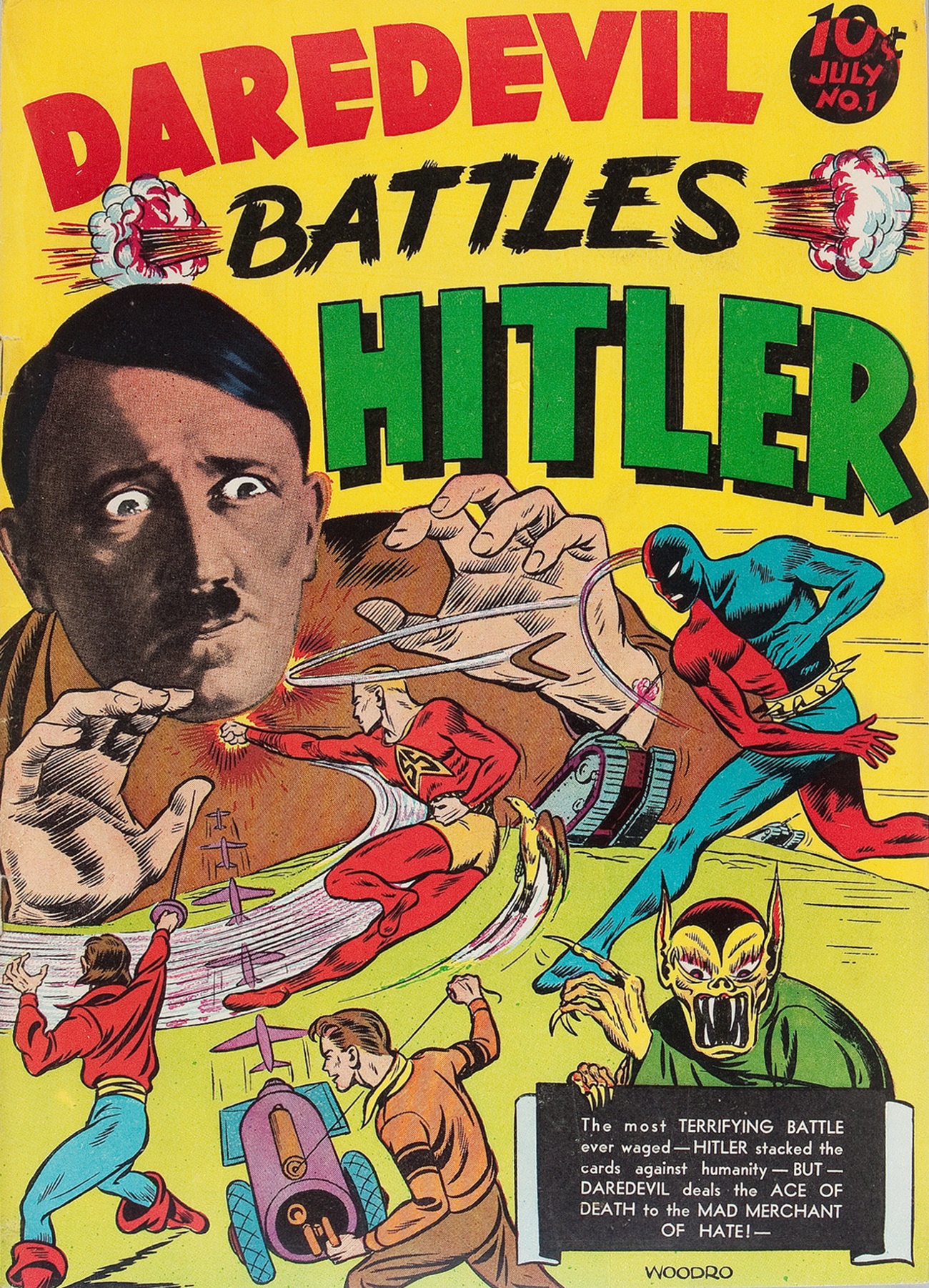
    Daredevil Comics 001 might not have been the first comic book to feature its title character physically attacking Adolf Hitler on the front cover, but it makes up for this in sheer volume of different characters who are getting in on the act. And the comic itself is also 100% concerned with super-heroes beating up and otherwise inconveniencing Hitler.

    Hitler’s first appearance in the comic proper also includes a rogue’s gallery of Third Reich figures, including Josef Goebbels, Heinrich Himmler, Hermann Goering, Admiral von Roeder* and General Walther von Brauchitsch. Also present: the fortune teller who supposedly advised Hitler on a day-to-day basis.

    *more on him later 

    Though Daredevil is present to merely spy on the well-attended meeting above, he is found out and has to punch out not just Hitler but Goering and Goebbels as well in order to make his escape.

    Hitler’s second major humiliation in the issue comes at the hands claws of the Claw. He makes a deal with the giant villain on behalf of his Japanese allies, but the Daredevil gets involved in and ruins the whole operation.

    Hitler has to pay a hefty bribe just to get out with his skin intact. This is a fine illustration of why most villains don’t negotiate this sort of thing in person.


    Finally, the suprisingly hands-on Hitler is coordinating a Nazi invasion of Africa when the Daredevil and jungle hero Lance Hale get involved, giving the Daredevil the opportunity to land two more punches and a boomerang-assisted trip on the dictator.

    Lance Hale, meanwhile, pranks Hitler by giving him a shave with an incredibly accurate arrow, then almost body slams him to death before he is interrupted by Nazis. (Daredevil Comics 001, 1941) 

    Benito Mussolini: 

    A sad cameo from Il Duce after a portion of his fleet is sunk by the British. (Daredevil Comics 001, 1941) 

    Heinrich Himmler:

    Is Blackout’s Nazi foe Heinrich Himmel meant to be a version of Himmler or is it just a very Nazi collection of syllables? Hard to say. (Captain Battle Comics 001, 1941) 

    Hermann Goering: 

    Like Hitler, Goering is surprisingly willing to lead from the front in this issue. He loses a dogfight with Cloud Curtis and almost kills himself over it. (Daredevil Comics 001, 1941)

    Josef Goebbels:

    Goebbels, meanwhile, steals a codebreaking machine devised by by boy inventor Dickie Dean.

    He doesn’t manage to hang onto it for long before he gets beaten up and mummified by Dean and the Daredevil (and Zip Todd, of course). (Daredevil Comics 001, 1941)

    the Koh-i-noor Diamond: 

    Once more a big ol’ gem is given a name that sounds like “Koh-i-noor,” in this case the (baseball-sized!) Kohnoor Diamond. (Captain Battle Comics 002, 1941)

    Lord Haw-Haw: 

    Lord Garnett here is a bit of a rarity as he starts out as a masked spy who will be appearing in the next Generic Costumed Villain Round-Up and then, after shooting Whiz, King of Falcons (see the next Catalogue of Wounds) flees to Germany and takes up a career in propaganda broadcasting, where his distinctive and annoying laugh earns him the epithet “Lord Hee-Haw.”

    His new career doesn’t last very long, as he is shot down by the Silver Streak while doing some aerial broadcasting. (Daredevil Comics 001, 1941)

    Admiral von Roeder:

    Who is von Roeder is a very good question, because I can find no evidence that he actually existed. There are four plausible explanations for this:

    1. He’s a fictional Nazi who somehow got conflated with real ones. 

    2. There was an Admiral von Roeder but he was only noteworthy for exactly the length of time it took for this comic to be written and he thereafter sank into such obscurity that he is no longer remembered.

    3. The state of internet search is so wretched that a moderately obscure Nazi is currently unsearchable.

    4. They couldn’t come up with a real Nazi Admiral and so just made one up. 

    Regardless of his actual historicity, this von Roeder is beaten up by both Daredevil and a time-travelling Pirate Prince. (Daredevil Comics 001, 1941) 

    Winston Churchill: 

    Churchill invites both Daredevil and Silver Streak (and the most obnoxious version of Whiz, King of Falcons) to No. 10 Downing St to solicit their help with the war effort. (Daredevil Comics 001, 1941)
    More of this kind of thing

  • DIVINE ROUND-UP 027

    I wonder if we’ll ever synthesize a unified theory of comic book religion out of this stuff.

    Isis:

    While attempting to thwart the magical con man Ahman-Ka-Lukor, Doctor Miracle calls upon the power of the Egyptian goddess Isis, who aids him by summoning the shade of the man whose reincarnated soul is now Ka-Lukor’s, and all so that Doctor Miracle can compare the two and make sure that he has the right man – it’s the most elaborate alternative to acquiring a photograph of the guy that I can imagine.

    Isis is depicted with a horns/sun disc/vulture headdress that is reasonably accurate to at least one era’s iconography, which is impressive enough for a just-wing-it medium like comics, but even more impressively for 1941 she is also totally topless, though also completely nipple-less.

    It’s not really anything to do with Isis, but Ka-Lukor has a cat familiar named Oasi who can turn into a lady who looks weirdly like the depiction of Isis and who caused me some confusion when I skimmed the story. I think that sh might just have represented another chance to draw a topless woman. (Champ Comics 013, 1941)

    the God of Hate: 

    The God of Hate is worshipped by the Claw’s followers at his skull castle in Tibet, and might just have the biggest head to body ratio that we have seen thusfar.

    Given the way that the God of Hate descends into the fiery pit and is then replaced with the Claw, it is possible that they are seen as aspects of the same being, that the Claw is the Earthly representative of the GoH, or even that the God works for the Claw, given the fanatical devotion that he elicits from his minions.

    Also: check out these guys. I’m sure that they came straight out of a National Geographic photo shoot but they also look quite cool. (Silver Streak Comics 007, 1941)

    the Great One: 

    This happens all the time when you’re a jungle adventurer: you rock up to an ancient temple to a near-forgotten god that is still worshipped with grisly rites and human sacrifice, and it turns out that there’s a big snake or other monster in there, just living it up. In this case, god of death the Great One has been played by Kadu, the Man-Eating Rat, who adventurer Lance Hale has personal beef with from a prior encounter, it seems. 

    God Style: Animist (Silver Streak Comics 011 1941)

    Moko:

    Moko is the god of a group of Tibetan bandits referred to as the Hoods, who I initially thought just had that weird yellow skin tone that comics used to render Asians with, but are later revealed or revised to be wearing cape and cowl getups. The actual worship of Moko is not detailed but does involve human sacrifice via a pit-and-pendulum style swinging blade.

    God Style: Idol (Silver Streak Comics 012, 1941)

  • DIVINE ROUND-UP 027

    I wonder if we’ll ever synthesize a unified theory of comic book religion out of this stuff.

    Isis:

    While attempting to thwart the magical con man Ahman-Ka-Lukor, Doctor Miracle calls upon the power of the Egyptian goddess Isis, who aids him by summoning the shade of the man whose reincarnated soul is now Ka-Lukor’s, and all so that Doctor Miracle can compare the two and make sure that he has the right man – it’s the most elaborate alternative to acquiring a photograph of the guy that I can imagine.

    Isis is depicted with a horns/sun disc/vulture headdress that is reasonably accurate to at least one era’s iconography, which is impressive enough for a just-wing-it medium like comics, but even more impressively for 1941 she is also totally topless, though also completely nipple-less.

    It’s not really anything to do with Isis, but Ka-Lukor has a cat familiar named Oasi who can turn into a lady who looks weirdly like the depiction of Isis and who caused me some confusion when I skimmed the story. I think that sh might just have represented another chance to draw a topless woman. (Champ Comics 013, 1941)

    the God of Hate: 

    The God of Hate is worshipped by the Claw’s followers at his skull castle in Tibet, and might just have the biggest head to body ratio that we have seen thusfar.

    Given the way that the God of Hate descends into the fiery pit and is then replaced with the Claw, it is possible that they are seen as aspects of the same being, that the Claw is the Earthly representative of the GoH, or even that the God works for the Claw, given the fanatical devotion that he elicits from his minions.

    Also: check out these guys. I’m sure that they came straight out of a National Geographic photo shoot but they also look quite cool. (Silver Streak Comics 007, 1941)

    the Great One: 

    This happens all the time when you’re a jungle adventurer: you rock up to an ancient temple to a near-forgotten god that is still worshipped with grisly rites and human sacrifice, and it turns out that there’s a big snake or other monster in there, just living it up. In this case, god of death the Great One has been played by Kadu, the Man-Eating Rat, who adventurer Lance Hale has personal beef with from a prior encounter, it seems. 

    God Style: Animist (Silver Streak Comics 011 1941)

    Moko:

    Moko is the god of a group of Tibetan bandits referred to as the Hoods, who I initially thought just had that weird yellow skin tone that comics used to render Asians with, but are later revealed or revised to be wearing cape and cowl getups. The actual worship of Moko is not detailed but does involve human sacrifice via a pit-and-pendulum style swinging blade.

    God Style: Idol (Silver Streak Comics 012, 1941)

  • ALIENS AND SO FORTH ROUND-UP 014

    We’ve hit a rich seam of aliums this month.

    Mermaid/ Reptile-Men:

    This city of Reptile-Men is ruled over by a Mermaid queen, and I am forced to contemplate, and not for the first time, whether this is an instance of a member or group of one species ruling over another or if it’s one of extreme sexual dimorphism. Whichever one it is, I do appreciate that the Reptile-Men have that really goofy wide stance going on with their lizard legs. (Weird Comics 003, 1940)

    Monkey Men: 

    Also known as the Cannibalistic Monkey Men, these beefy lads vex one of those hidden Ancient Roman colonies that are all over Africa and the Middle East by demanding tribute of human flesh. They eventually meet their match and are seemingly wiped out entirely when they try to eat KaƤnga and his new pal “Red” Longjohn. (Jungle Comics 007, 1940)

    Capris-Men:

    Earth is in need of radium, the only cure to a deadly plague that is ravaging the population, and so an expedition headed by Rex Dexter of Mars sets out to get some from the nearly 100% pitchblende planet Capris (okay, so it’s called a planet throughout the story but it’s got to be a dwarf planet or an asteroid or something based on travel timelines alone). The fantastic-looking native Capris-Men, aka the Capris Monsters, don’t take to kindly to this and mount an attack on the expedition, which leads the expedition to leave early, meaning that they don’t get enough radium to treat everyone.

    The obvious solution to this problem is, of course, to tow the entire planet(oid) into orbit around Earth, so that the healing power of ionizing radiation can eternally shine down on its inhabitants and make them the healthiest people in the universe. No word on what the Capris-Men thought about this development. (Mystery-Men Comics 002, 1939)

    the Cave Men and the Lizard Men:

    The Cave Men are basically just some extra hairy guys who live in a cave system called the Underground Empire beneath Rhodesia/modern day Zimbabwe. They are possibly immortal and are ruled by a white lady named Aldia, who is – the question is whether she bothered to share the secret of the Immortal Flame with her subjects.

    The thing that really sets the Cave Men apart is the quality of their enemies, the Lizard Men. Sure, they’re just a mindless horde of inhuman monsters who exist only to be righteously slaughtered by the heroic Lance Hale, but just look at their majestic fins! (Silver Streak Comics 004, 1940)

  • MINOR SUPER-VILLAIN 736: LURIDA

    (Silver Streak Comics 005, 1940)

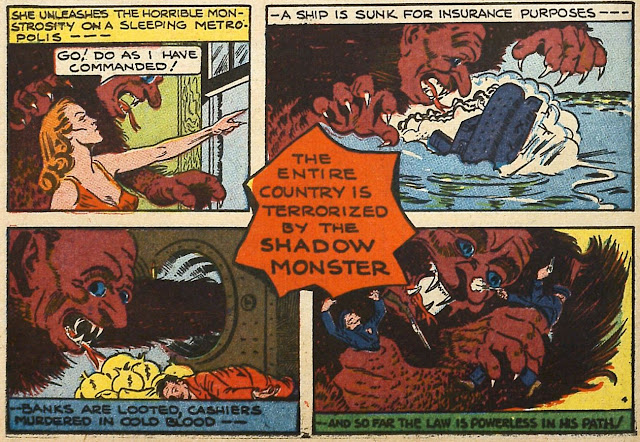
    I was just about to type that this was “a simple, straightforward super-hero comic story” and then immediately had to grapple with how to summarize the following: in the previous issue of Silver Streak Comics, adventurer Lance Hale set out to recover a treasure left by his uncle in an old mine in Rhodesia (now Zimbabwe). After helping the immortal Queen of the Underground Empire Aldia and her caveman subjects fight off a lizard man invasion (and incidentally becoming immortal himself, though this is never brought up again), Lance took the treasure with the stated intention of using it to help the needy back in America. Simple!

    This issue, we learn that this treasure includes an artifact known as the Gem of Evil and that a femme fatale named Lurida (very on-the-nose name) not only knows about it but somehow knows that Lance Hale has it. She steals the treasure with the help of some more-competent-than-usual henchmen and voila, summons herself the Shadow Monster.

    We don’t get a real run-down of the Shadow Monster’s abilities but on-panel it is at least physically invulnerable and able to grow to giant size, and so I must admit that I find Lurida’s use of it to commit bank robberies and insurance fraud to be a bit limited, imagination-wise. Not that I have any sort of Grand Scheme for what I would do with such a beast, mind, I just have a knee jerk sense that if you’re using magic or super science or mutant powers or whatever to do something as banal as insurance fraud then you’re Doing It Wrong.

    As a femme fatale, Lurida is obligated to make a stab at seducing Lance over to her side, just as Lance as a stalwart hero is obliged to insultingly turn her down, and after some monkey business with a fire-based deathtrap Lance manages to destroy both the Gem of Evil and the Shadow Monster, and Lurida completes the set by flinging herself into the same flame she had set for Lance. It’s not a great decision considering that no court in the land is equipped to prosecute somebody for shadow demon summoning, but it does tie up the episode in a real neat bow.

  • MINOR SUPER-VILLAIN 736: LURIDA

    (Silver Streak Comics 005, 1940)

    I was just about to type that this was “a simple, straightforward super-hero comic story” and then immediately had to grapple with how to summarize the following: in the previous issue of Silver Streak Comics, adventurer Lance Hale set out to recover a treasure left by his uncle in an old mine in Rhodesia (now Zimbabwe). After helping the immortal Queen of the Underground Empire Aldia and her caveman subjects fight off a lizard man invasion (and incidentally becoming immortal himself, though this is never brought up again), Lance took the treasure with the stated intention of using it to help the needy back in America. Simple!

    This issue, we learn that this treasure includes an artifact known as the Gem of Evil and that a femme fatale named Lurida (very on-the-nose name) not only knows about it but somehow knows that Lance Hale has it. She steals the treasure with the help of some more-competent-than-usual henchmen and voila, summons herself the Shadow Monster.

    We don’t get a real run-down of the Shadow Monster’s abilities but on-panel it is at least physically invulnerable and able to grow to giant size, and so I must admit that I find Lurida’s use of it to commit bank robberies and insurance fraud to be a bit limited, imagination-wise. Not that I have any sort of Grand Scheme for what I would do with such a beast, mind, I just have a knee jerk sense that if you’re using magic or super science or mutant powers or whatever to do something as banal as insurance fraud then you’re Doing It Wrong.

    As a femme fatale, Lurida is obligated to make a stab at seducing Lance over to her side, just as Lance as a stalwart hero is obliged to insultingly turn her down, and after some monkey business with a fire-based deathtrap Lance manages to destroy both the Gem of Evil and the Shadow Monster, and Lurida completes the set by flinging herself into the same flame she had set for Lance. It’s not a great decision considering that no court in the land is equipped to prosecute somebody for shadow demon summoning, but it does tie up the episode in a real neat bow.

  • MINOR SUPER-HERO ROUND-UP 040

    Lev Gleason’s finest!

    Lance Hale:

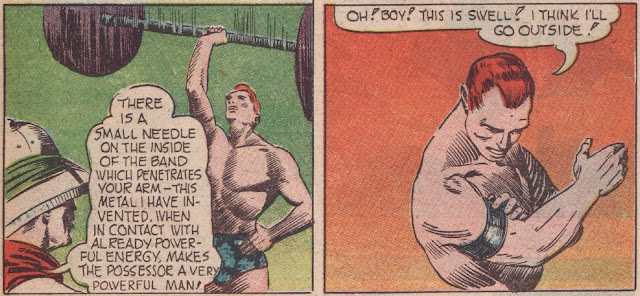
    Lance Hale is a soldier of fortune and jungle adventurer who is notable mainly for the fact that in his first appearance he is given super strength by a fellow with the pleasing name of Dr Grantland Grey so that he can help out on an expedition to the stars, and then after returning to Earth he just… stops using the armband that gives him his enhanced strength. He keeps on adventuring, don’t get me wrong, but as a regular jungle guy, ie, a colonialist race science fantasy figure. 

    Hale is slightly more interesting than his contemporaries in the jungle guy community by virtue of the variety of situations that he gets in: there’s the initial space trip that ends up turning into an interdimensional one and then a battle with invading animal men from a parallel world, a delve into a lost underground kingdom in which he incidentally becomes immortal, cursed demon-summoning gemstone action… I assume that the thrills are eventually going to stop coming but 1940 was almost all hits. (Silver Streak Comics 002, 1940)

    Mister Midnite **HERO UPDATE**:

    As you may or may not recall, Mister Midnite is a hero in the classic formal wear style who has one very specific power, to stop clocks by yelling “time stop!” Well! So we thought! It turns out that in his second appearance, Midnite demonstrates a second power, that of being teleported to a vaguely defined location, and also when he has shouts “time stop!” I really wish that there were more than two Mister Midnite stories so that we would have some more data to use in piecing all this together, but as of now I must assume that he has some sort of vaguely defined wishing power and that “time stop!” is its trigger phrase, like Johnny Thunder and “say you.” (Silver Streak Comics 002, 1940)

    the Silver Streak:

    The Silver Streak! Is notable for two (2) reasons, the first of which is that he is a the-title-of-the-comic-book character who doesn’t show up until issue 3, which is the opposite to how it often works, where the title character goes from proudly front and centre to gone in as many issues.

    The second and more interesting thing about the Silver Streak is his origin, which I have tried and failed to summarize in paragraph form, so here goes as bullet points:

    – the Silver Streak is a race car, or rather a series of race cars because every Silver Streak crashes, killing the driver. Nobody wants to drive for the Silver Streak team. The cars are crashing because they are being attacked by a giant fly.

    – the Silver Streak’s owner is Hindu mystic known only as the Swami. When an unnamed cab driver volunteers to drive the Silver Streak, the Swami hypnotizes him to be a great race car driver.

    – the unnamed driver is immediately killed by a giant fly.

    – BUT! The Swami has a hunch that the man is not in fact dead! He and a pal go to the cemetery and dig up the driver’s unmarked grave, and they are proved right! And what’s more, the prior hypnotic conditioning combined with the near-death experience has made the man (henceforth the Silver Streak) superhuman!

    The first adventure of the Silver Streak concludes with him stealing the latest prototype of his namesake car and using it to destroy the giant fly that “killed” him, and as presented he seems to have been on track to be a car-based super-hero. However, between Silver Streak Comics 003 and 004, the character was handed off from Jack Binder to Jack Cole and the Silver Streak became a guy with super speed, no car required. I don’t know if his origin is ever revised, but I do know that the Silver Streak has several sidekicks over the years and that they all get their powers via a blood transfusion from the man himself, so something’s going on there. Unless his blood was hypnotized too, of course – the Swami never returns, so his deal is never fully explored.

    Like a lot of super speed characters, the Silver Streak ends up being more about cool speed tricks than having a distinct personality, but he’s a fun read nonetheless. (Silver Streak Comics 003, 1940)

    UPDATE 1941 

    Dickie Dean, Boy Inventor:

    We love to see a boy inventor, if only because our brains have been warped enough by the Venture Brothers that we can’t help but imagine their dysfunctional adulthood, and by “we” I mean “I”. Dickie Dean here is particularly good fodder for that little thought experiment, as he is compelled to sign over his inventions to the US government by his misplaced sense of patriotism, so he’s either in for a rude awakening or an increasingly delusional relationship to reality as he gets older. 

    Some inventions that Dickie fails to patent in 1940 include: 

    – a device that can replay sound waves and visualize shadows up to 2-3 weeks old

    – a device designed to stop all war by making air as thick as molasses and thus preventing bullets etc from moving fast enough to do harm (importantly, this air is still breathable)

    – an enclosed, submersible speedboat equipped with a device that abates flood waters via rapid electrolysis

    He does sell a magnetic antigravity device for use as a mid-air brake for airplanes, but only because his father is in dire financial straits.

    Dickie Dean is also interesting for the fact that he is from New Castle, Pennsylvania, a real place with a regular amount of history but not otherwise a big name in city circles. Also I just reread the bit where I roasted Dickie for giving away his patents and I want to make it cleat that the part I think is foolish is giving them to, like, the FBI, not donating them to humanity. (Silver Streak Comics 003, 1940)

    UPDATE 1941