The Curse of Skeleton Munroe

Category: Dr Fate

  • MEDIA IN COMICS 016

    MEDIA IN COMICS 016

    Production on these Media in Comics showcases must sadly slow down now, for I have worked my way through my backlog. As evidence of this, today we are showcasing some magical books, which are genrally unique items that fall under nobody’s definition of mass media but which I want to include anyway, for fun’s sake.

    Books of Magic:
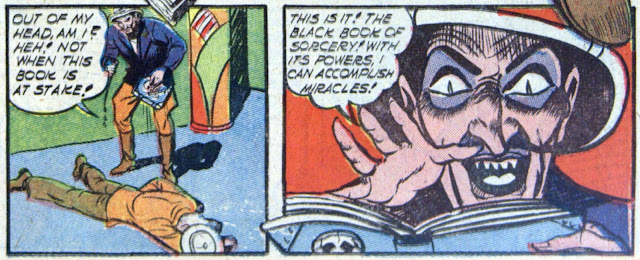
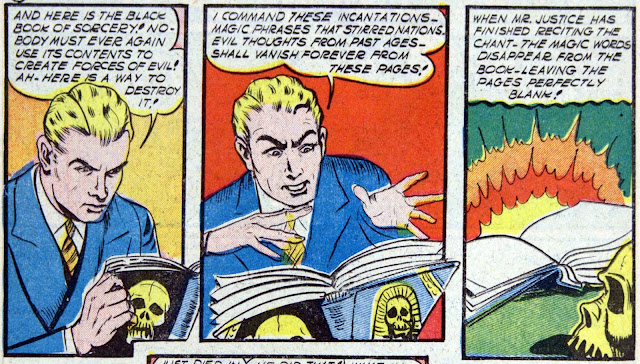
    You all remember the fabled Black Book of Sorcery that the wicked Egyptologist Ford committed all those murders for, well here it is! Until Mr Justice wipes its pages with a convenient self-destruct spell contained within it, that is.

    Origin: Ancient Egyptian 

    Status: Destroyed (Jackpot Comics 003, 1941)
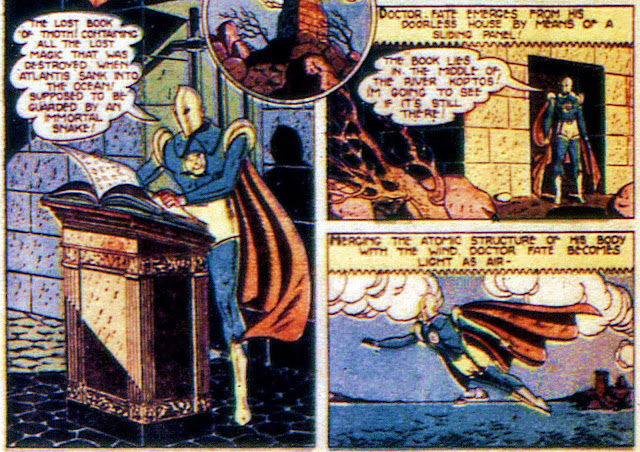
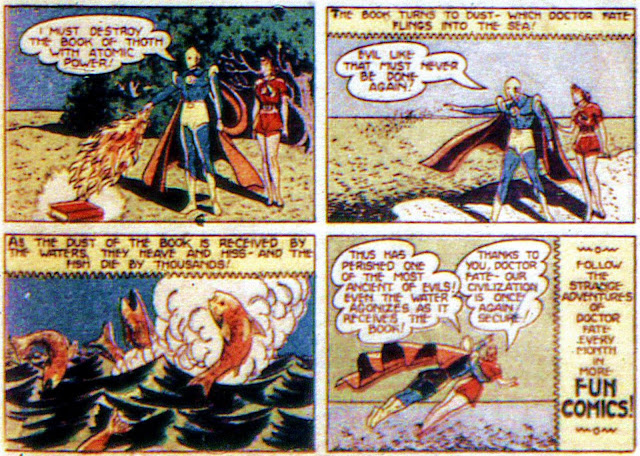
    The Lost Book of Thoth, containing all the magics of sunken Atlantis, is supposed to rest on the bottom of the Nile under the watchful eye of an immortal serpent. The plans of mice and men and whoever is in charge of everlasting snakes often go astray, alas, and the book is stolen by an unnamed mage and nearly used to destroy the world. Having solved that particular problem, Dr Fate doesn’t take any chances and reduces the book to a powder.

    Origin: Ancient Atlantis

    Status: Destroyed (More Fun Comics 058, 1941)
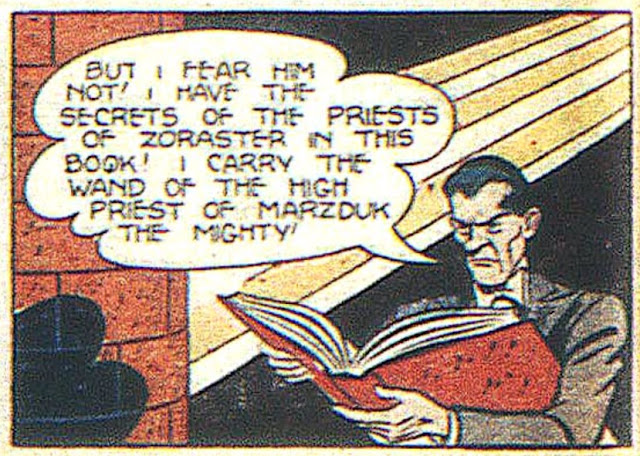
    The Secrets of the Priests of Zoraster (sic) might not be the official title of the book used by Haldane the Sorcerer, but it’s a pretty good title for a made-up book of magic and we have no other options. This one gets left behind in a secret passage rather than being destroyed, so it’s technically up for grabs.

    Origin: Persian? 

    Status: Extant (More Fun Comics 063, 1941)
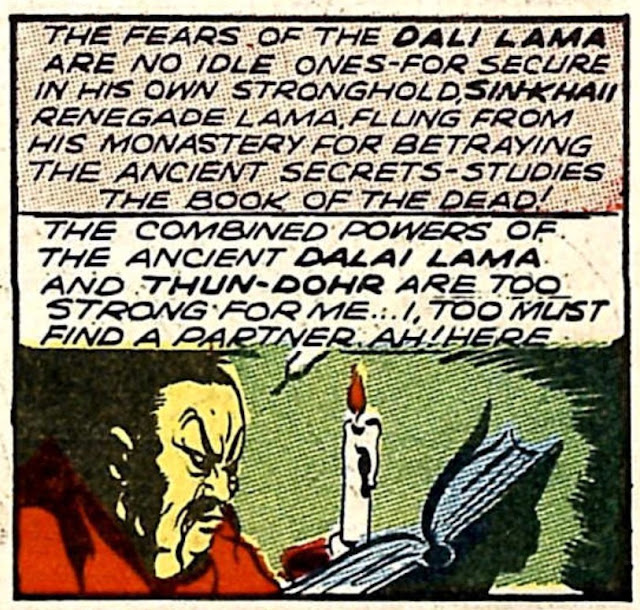
    Though Sin Khaii is an apostate Tibetan Buddhist, the Book of the Dead that he is referencing here is more likely to be the Egyptian on than the Tibetan, as he is using it to research the Black Pharaoh. He also casts spells out of it later!

    Origin: Ancient Egyptian 

    Status: Extant (Silver Streak Comics 014, 1941) 

    Theatre:
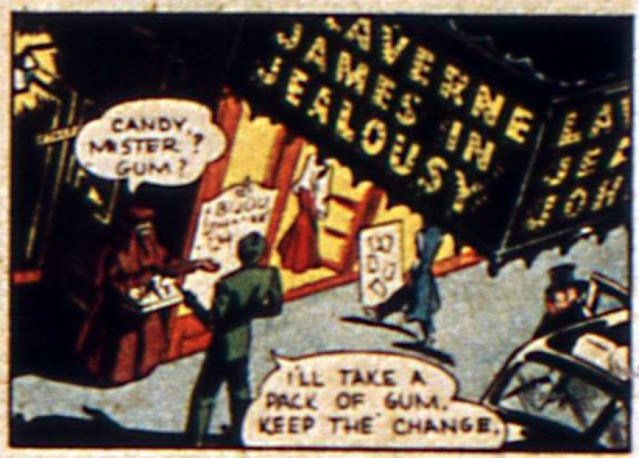
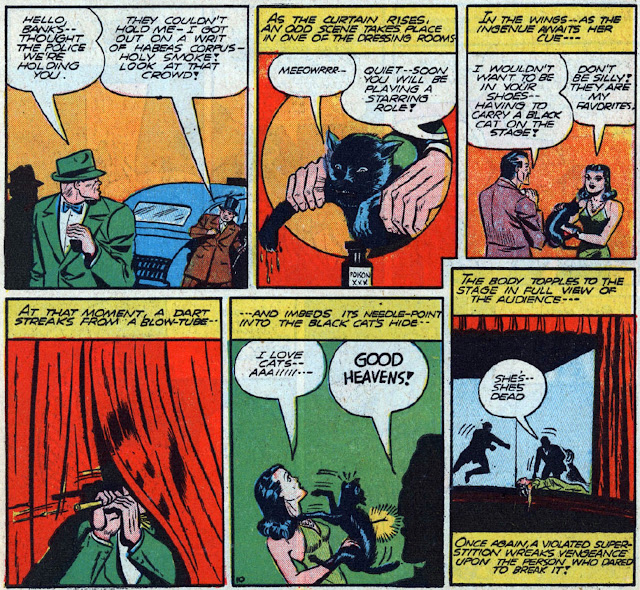
    Detective Larry Steele is called to the set of Jealousy to look into threats against star Laverne James, and then stays to solve the murder of Laverne James. More interesting than the murder mystery, however, is the mystery of just what is going on in this production.
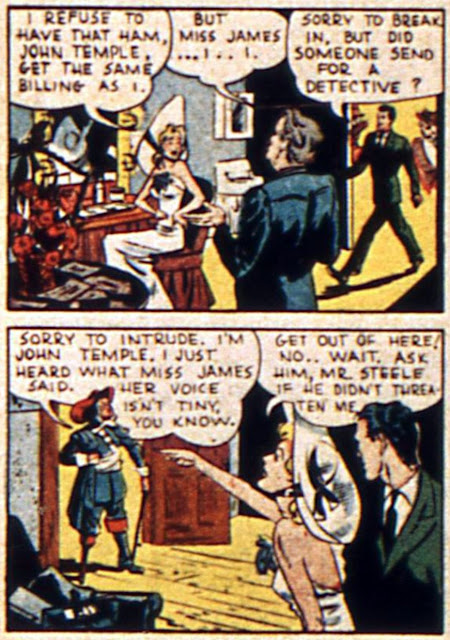
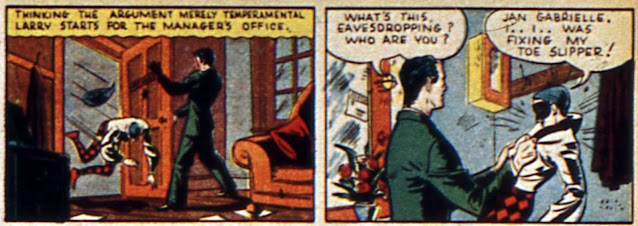
     

    We don’t actually see any of the on-stage action, but the costuming is extremely intriguing: James’ co-stars John Temple and Jan Gabrielle are dressed like off-model commedia dell’arte characters, while she looks more like a character from a Southern Gothic. Finally we have Peggy, who is part of the chorus line and is dressed like she is in a high-budget napkin advertisement. It’s a baffling selection. (Detective Comics v1 047, 1941) 
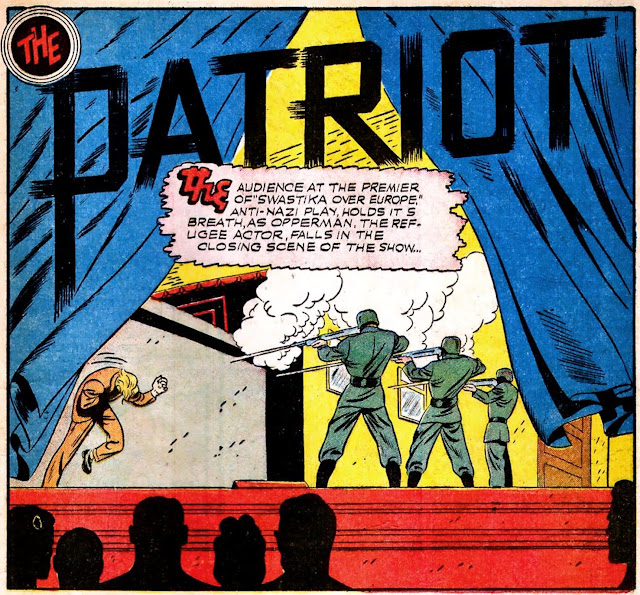
    Swastika Over Europe is a play designed to rally American support for the beleaguered nations of the Continent and as such is a target for sabotage by Nazi fifth columnists, as seen here when lead actor Opperman is murdered on-stage. (Marvel Mystery Comics v1 023, 1941)
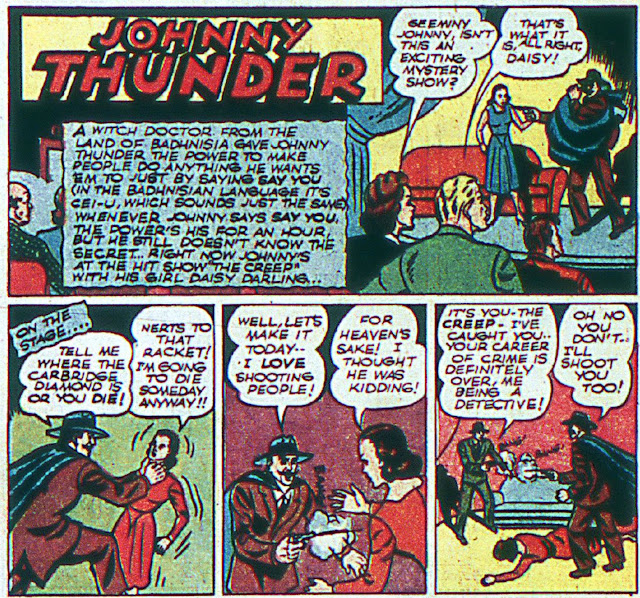
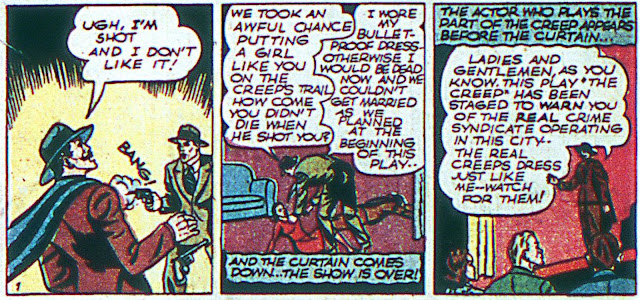
    Here we have The Creep, a play written expressly to warn the people of NYC about the threat of Crime & Corruption, Inc. I guess it works, because Johnny Thunder slapsticks them out of existence. (Flash Comics 013, 1941)
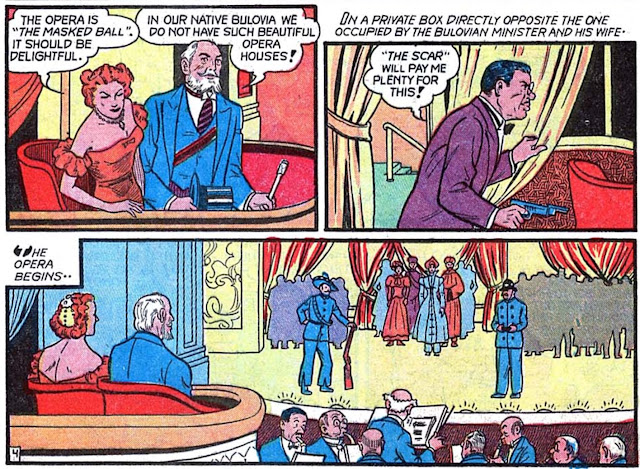
    Ordinarily getting such a good view of the stage would be very exciting to me as it would be a chance to divine some information about the production. Alas, this is an opera called The Masked Ball and so the only thing we can learn is that someone at the titular ball has come dressed as a police officer. (More Fun Comics 067, 1941)
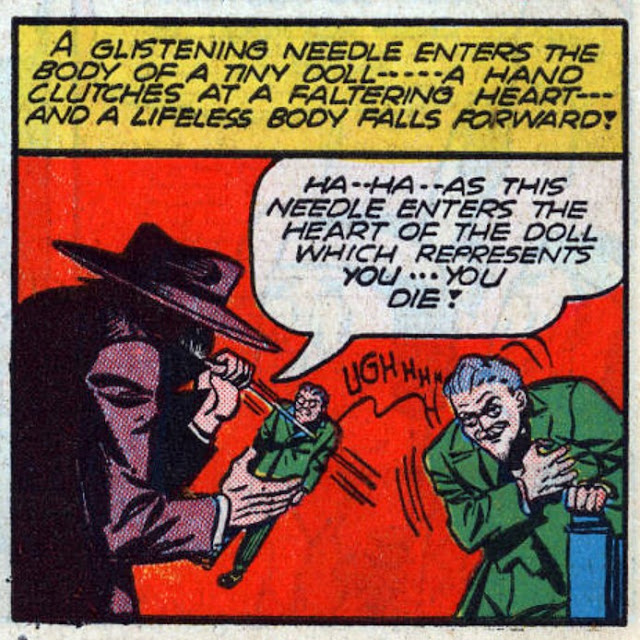
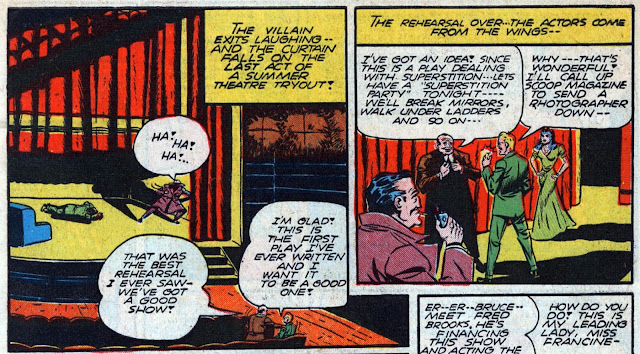
    The Superstition Murders is of course the play written by Johnny Glim the alter ego of the villainous Masked Man, who commits a series of superstition-themed murders in the hopes of tanking the production and thus securing the movie rights for his work. Though the motivation for the fictional killer is unrevealed, this seems to essentially be what the play is about as well. (Batman Comics v1 008, 1941)
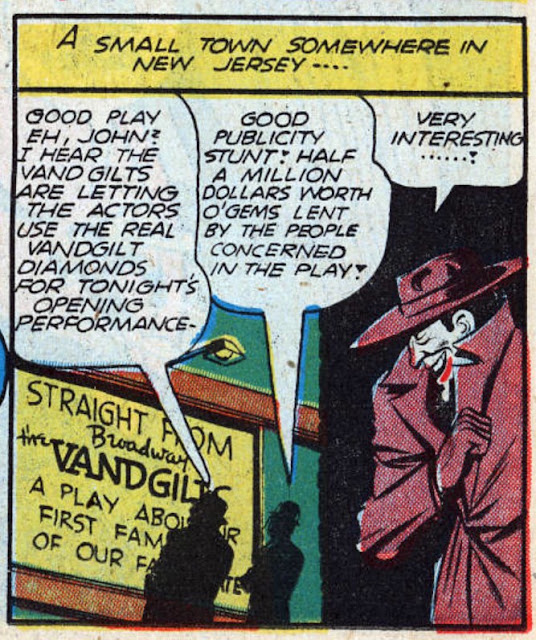
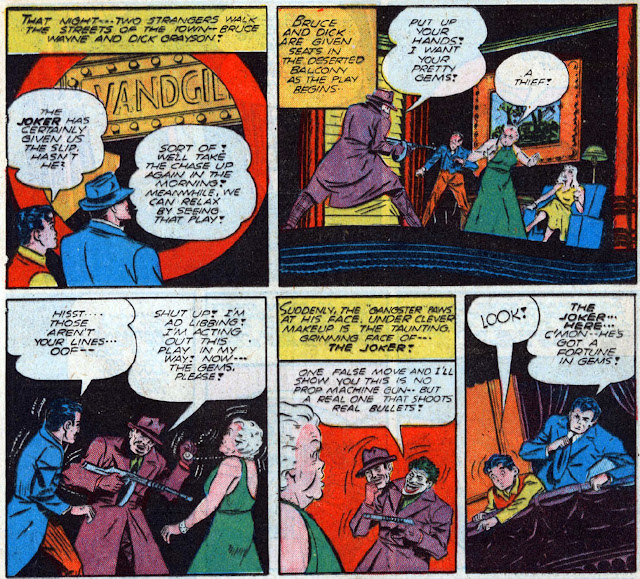
    Though there are many fine plays about the lives of the wealthy, there is no way The Vandgilts, about a real-life family who are on good enough terms with the production to lend them half a million dollars worth of jewellery, isn’t complete sycophantic mush. Luckily the Joker spices things up by robbing the actors mid-performance. (Batman Comics v1 008, 1941)
  • CATALOGUE OF WOUNDS 002

    CATALOGUE OF WOUNDS 002

    Just which comic book character has taken the most punishment down through the years? join me as we compile the definitive guide to bodily trauma in the super class. 

    Blackhawk:

    Blackhawk must set off an explosion from closer-than-optimal range and ends up getting lightly shredded. (Military Comics 003, 1941)

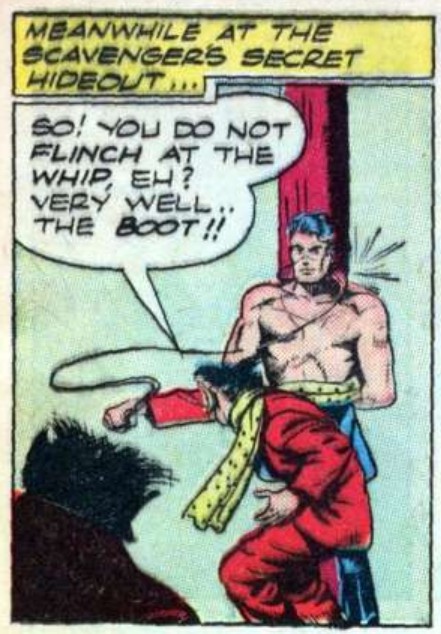
    Blackhawk’s next two adventures feature him getting whipped badly enough to mark up his torso, by the Black Tigress and the Scavengers, respectively. (Military Comics 004 & 005, 1941)

    Blackhawks:

    Blackhawk stalwart Andre is shot in the back by Nazis and then starts an avalanche with his own body to bury those same Nazis. Though he does survive, Andre is believed to be dead for the next six issues. (Military Comics 003, 1941)

    Blue Beetle:

    Blue Beetle is shot in a gang drive-by while in his civilian identity of Dan Garret. He only survives thanks to an operation to remove the bullet lodged two inches from his heart. Bonus fact: Dan has Type B blood! (Blue Beetle Comics v1 004, 1940)

    Dan Garret’s partner/ the Blue Beetle’s most dogged persecutor Mike Mannigan is a bit of a wound magnet. Here he is getting his skull creased by a bullet while attempting to round up one of the Sphinx’s men… (Mystery Men Comics 018, 1941)

    And here he is getting shot in the right arm. (Mystery Men Comics 026, 1941)

    Congo Bill:

    1941 is a bad year for Congo Bill’s shoulders. First he gets shot in the left… (Action Comics v1 038, 1941)

    … and then he gets a spear thrown clear through the right. (Action Comics v1 041, 1941)

    Dr Fate:

    Inza Cramer – long-time Dr Fate Companion/ eventual Dr Fate herself – takes a bullet meant for Kent “Dr Fate” Nelson by an agent of Mister X and is almost killed. (All-Star Comics 005, 1941)

    the Flash: 

    Jay “the Flash” Garrick gets his skull creased by a bullet while moving slow to avoid risking his secret identity. (All-Flash Quarterly 002, 1941)

    the Patriot: 

    Future Captain America stand-in the Patriot is shot and seemingly killed at the end of his story in Marvel Mystery Comics 024 but at the resolution of the cliffhanger in the next issue he turns out to have sustained a fashionable bullet crease to the skull. (Marvel Mystery Comics v1 024, 1941)

    the Ragman:

    Ambushed and shot up by agents of the Stinger, the Ragman survives thanks to a bulletproof vest, but evidence would suggest that he was shot at least once and possibly twice in the right arm. (Cat-Man Comics 003, 1941)

  • CATALOGUE OF WOUNDS 002

    CATALOGUE OF WOUNDS 002

    Just which comic book character has taken the most punishment down through the years? join me as we compile the definitive guide to bodily trauma in the super class. 

    Blackhawk:

    Blackhawk must set off an explosion from closer-than-optimal range and ends up getting lightly shredded. (Military Comics 003, 1941)

    Blackhawk’s next two adventures feature him getting whipped badly enough to mark up his torso, by the Black Tigress and the Scavengers, respectively. (Military Comics 004 & 005, 1941)

    Blackhawks:

    Blackhawk stalwart Andre is shot in the back by Nazis and then starts an avalanche with his own body to bury those same Nazis. Though he does survive, Andre is believed to be dead for the next six issues. (Military Comics 003, 1941)

    Blue Beetle:

    Blue Beetle is shot in a gang drive-by while in his civilian identity of Dan Garret. He only survives thanks to an operation to remove the bullet lodged two inches from his heart. Bonus fact: Dan has Type B blood! (Blue Beetle Comics v1 004, 1940)

    Dan Garret’s partner/ the Blue Beetle’s most dogged persecutor Mike Mannigan is a bit of a wound magnet. Here he is getting his skull creased by a bullet while attempting to round up one of the Sphinx’s men… (Mystery Men Comics 018, 1941)

    And here he is getting shot in the right arm. (Mystery Men Comics 026, 1941)

    Congo Bill:

    1941 is a bad year for Congo Bill’s shoulders. First he gets shot in the left… (Action Comics v1 038, 1941)

    … and then he gets a spear thrown clear through the right. (Action Comics v1 041, 1941)

    Dr Fate:

    Inza Cramer – long-time Dr Fate Companion/ eventual Dr Fate herself – takes a bullet meant for Kent “Dr Fate” Nelson by an agent of Mister X and is almost killed. (All-Star Comics 005, 1941)

    the Flash: 

    Jay “the Flash” Garrick gets his skull creased by a bullet while moving slow to avoid risking his secret identity. (All-Flash Quarterly 002, 1941)

    the Patriot: 

    Future Captain America stand-in the Patriot is shot and seemingly killed at the end of his story in Marvel Mystery Comics 024 but at the resolution of the cliffhanger in the next issue he turns out to have sustained a fashionable bullet crease to the skull. (Marvel Mystery Comics v1 024, 1941)

    the Ragman:

    Ambushed and shot up by agents of the Stinger, the Ragman survives thanks to a bulletproof vest, but evidence would suggest that he was shot at least once and possibly twice in the right arm. (Cat-Man Comics 003, 1941)

  • DIVINE ROUND-UP 013

    Piping hot deities for you this mornining.

    Sivu the Tiger God: 

    The worshippers of Sivu the Tiger God come to New York City to recover the jewelled eyes of their great idol, which are known as the Death Ruby and the Doom Ruby and held in the New York Museum and the collection of Beverly van Pell, respectively. Detective Dan Dare gets involved when he is hired by Mrs van Pell and the rubies ultimately stay right where they are. A shame, but at least we get to see that six-armed, four-legged, chubby, tiger-headed representation of Sivu, right?

    God Style: Idol. (Whiz Comics 003b, 1940) 

    Zeus: 

    The MLJ Hercules is the first super-hero of that name to actually be the demi-god in question, and he accordingly has a couple of meetings with his dad Zeus to discuss the state of the fight for truth and justice back on Earth. What I mostly want to point out about this version of the King of Olympus is that he’s probably the most flamboyantly dressed Zeus in comics before Jack Kirby illustrates him in Thor. 

    God style: Real (Blue Ribbon Comics 005, 1940)

    Charon: 

    A pretty by-the-numbers version of Charon who doesn’t deserve to be bullied by Dr Fate just because he needs to cross the Styx. He didn’t even try a bribe first!

    God Style: Real (More Fun Comics 056, 1940) 

    Wisdom: 

    The reason that Dr Fate is visiting the underworld is to check on whether his enemy Wotan is in fact dead, and to that end he is consulting with “Wisdom, who rules the world,” which I can only assume is another entry in the long tradition (that started four issues earlier with the origin of the Spectre) of alluding to the Abrahamic (or let’s face it: Christian) god via a combination of vague wording, blinding light and dialogue from an unseen source.

    God Style: Real (More Fun Comics 056, 1940) 

    (annoyingly, I can’t figure out where the bit about the seven gates to the underworld is from. It feels familiar and I wanted to see if it was from a non-Greek, non-Christian source because then this trip would be incorporating three whole mythologies, but there is simply too much “Gates of Hell” talk online to find it easily) 

  • DIVINE ROUND-UP 013

    Piping hot deities for you this mornining.

    Sivu the Tiger God: 

    The worshippers of Sivu the Tiger God come to New York City to recover the jewelled eyes of their great idol, which are known as the Death Ruby and the Doom Ruby and held in the New York Museum and the collection of Beverly van Pell, respectively. Detective Dan Dare gets involved when he is hired by Mrs van Pell and the rubies ultimately stay right where they are. A shame, but at least we get to see that six-armed, four-legged, chubby, tiger-headed representation of Sivu, right?

    God Style: Idol. (Whiz Comics 003b, 1940) 

    Zeus: 

    The MLJ Hercules is the first super-hero of that name to actually be the demi-god in question, and he accordingly has a couple of meetings with his dad Zeus to discuss the state of the fight for truth and justice back on Earth. What I mostly want to point out about this version of the King of Olympus is that he’s probably the most flamboyantly dressed Zeus in comics before Jack Kirby illustrates him in Thor. 

    God style: Real (Blue Ribbon Comics 005, 1940)

    Charon: 

    A pretty by-the-numbers version of Charon who doesn’t deserve to be bullied by Dr Fate just because he needs to cross the Styx. He didn’t even try a bribe first!

    God Style: Real (More Fun Comics 056, 1940) 

    Wisdom: 

    The reason that Dr Fate is visiting the underworld is to check on whether his enemy Wotan is in fact dead, and to that end he is consulting with “Wisdom, who rules the world,” which I can only assume is another entry in the long tradition (that started four issues earlier with the origin of the Spectre) of alluding to the Abrahamic (or let’s face it: Christian) god via a combination of vague wording, blinding light and dialogue from an unseen source.

    God Style: Real (More Fun Comics 056, 1940) 

    (annoyingly, I can’t figure out where the bit about the seven gates to the underworld is from. It feels familiar and I wanted to see if it was from a non-Greek, non-Christian source because then this trip would be incorporating three whole mythologies, but there is simply too much “Gates of Hell” talk online to find it easily) 

  • MINOR SUPER-VILLAIN 408: MR WHO

    (More Fun Comics 073, 1941) 

    It’s Mr Who! You know, from comics! I was very excited for this guy to turn up, as he’s one of those comic book characters I had heard about but never really read about, and… he’s okay.

    See, Mr Who was born all scrawny and seems to have been a weird kid (and to have had a shitty dad, jeez), so he channelled all of his efforts into science, and more specifically into developing a way to be big and strong and handsome. He ended up with Solution Z, a super-power drug that allowed him to alter his size and shape seemingly without limit, to recover from any injury, camouflage himself like a chameleon, etc. It’s a cool suite of powers that are somewhat undercut by his all-brown wardrobe (including cape!) accessorized with a single dark green neckerchief.

    In his first outing, Mr Who is on a campaign to steal beautiful things such as paintings and gems to surround himself with so as to leave behind his own perceived ugliness. Dr Fate gets involved and seemingly drowns him in the Hudson River for his troubles.

    But of course you can’t keep a good man with complete control over his own biology down, and Mr Who is soon making his way to shore as a highly unsettling fishman. (More Fun Comics 074, 1941)

    This time out, Mr Who sets his sights on power rather than material beauty – he uses his shapeshifting abilities to kidnap and replace… a mayor. I’ll be honest: the prior issue was, like a lot of Dr Fate stories, very much set in NYC and this guy is almost certainly supposed to be a generic off-brand version of Mayor Fiorello LaGuardia, but they changed him just a little too much and he’s falling into the uncanny valley for me. I think this would only affect someone who spends a fair amount of time squinting at old pictures of politicians to see if they’re being alluded to in comics art but unfortunately I’m someone who does that.

    Dr Fate of course foils this plan as well but we’ll be seeing Mr Who again as the Golden Age progresses, and then he’s one of the villains that Roy Thomas brings back in All-Star Squadron. I like Mr Who – he’s a good foil for half-helmet era Dr Fate, who is more of a wisecracking roughneck than the full-face version, which means that a moderately crafty fella can outfox him for a while.

  • MINOR SUPER-VILLAIN 397: ADAM IGOROVICH

    (More Fun Comics 071, 1941)

    Adam Igorovich! Your typical scientist unhinged by his treatment by the scientific community, who deemed his theories impractical and/or dangerous and/or insane, so now he is striking back at the world using those selfsame theories to get his back. If we’ve seen it once we’ve seen it a million times.

    There’s one important difference between the machinations of Adam Igorovich and those of, say, the Master (the last Russian-ish scientist we saw battle Dr Fate): while the master’s sonic death weapon was a finely tuned device capable of targeting everything from a person to a building, Igorovich’s technology is a solar magnet capable of stopping the rotation and orbit of the Earth and moving it closer to the Sun. The willingness to use apocalyptic technology like this in a simple worldwide extortion scheme is the difference between science and Mad Science. Take note, undergraduates!

    After he roasts portions of the Earth’s surface for a while via manipulation of it’s orbit (and what a wild thing to never be mentioned again, the fact that the whole world stopped moving for half a day. Twice!), Igorovich attracts the attention of Dr Fate and gets so thoroughly foiled that he chooses the classic mad scientist’s exit of blowing up his entire compound around him.

  • MINOR SUPER-VILLAIN 397: ADAM IGOROVICH

    (More Fun Comics 071, 1941)

    Adam Igorovich! Your typical scientist unhinged by his treatment by the scientific community, who deemed his theories impractical and/or dangerous and/or insane, so now he is striking back at the world using those selfsame theories to get his back. If we’ve seen it once we’ve seen it a million times.

    There’s one important difference between the machinations of Adam Igorovich and those of, say, the Master (the last Russian-ish scientist we saw battle Dr Fate): while the master’s sonic death weapon was a finely tuned device capable of targeting everything from a person to a building, Igorovich’s technology is a solar magnet capable of stopping the rotation and orbit of the Earth and moving it closer to the Sun. The willingness to use apocalyptic technology like this in a simple worldwide extortion scheme is the difference between science and Mad Science. Take note, undergraduates!

    After he roasts portions of the Earth’s surface for a while via manipulation of it’s orbit (and what a wild thing to never be mentioned again, the fact that the whole world stopped moving for half a day. Twice!), Igorovich attracts the attention of Dr Fate and gets so thoroughly foiled that he chooses the classic mad scientist’s exit of blowing up his entire compound around him.

  • SUPER-VILLAIN YEARBOOK: IAN KARKULL & WOTAN 1941

    What were Ian Karkull and Wotan up to in 1941?

    Ian Karkull is my Platonic Ideal of the Median Super-Villain: he has two
    Golden Age appearances (detailed here) and a handful of post-Silver Age
    ones but also was seemingly pulled out of a hat (probably by Roy Thomas) as the villain who did some sort of scheme that blasted the Justice Society with some sort of energies that made them age slower so that otherwise normal WWII veterans like Wildcat and the Sandman could be running around fighting crime well past retirement age. It’s a Big Deal and it means that Karkull has absolutely been mentioned far more than he’s actually appeared.

    1. More Fun Comics 069, ‘Untitled’:But we’re here to talk about 1941! What was Ian Karkull up to then? Well for one thing he wasn’t calling himself ‘Ian’ yet – that was presumably added at the same time that he was revived to irradiate the JSA. Karkull was seemingly just another scientist with a cool invention – a machine that turns people into shadows! – that he is determined to use for crime.

    Surprise of the year: Karkull has if not a good reason for turning to crime then at least a reason. While exploring the lost Saharan city of Ragnor with his partner Everett Dahlen he is betrayed and left for dead so that Dahlen could run off with a huge ruby. Is it the most rock-solid reason to turn to a life of crime? No, but it’s more of an origin than most Golden Age scientists get.

    Karkull’s first outing ends with him at large, albeit trapped in shadow form by Dr Fate as a sort of ad hoc punishment that is fairly out of line with his crimes of one murder and one bank robbery. That’s the Golden Age for you, I guess.

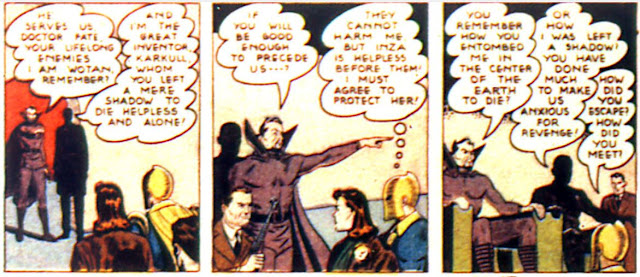
    2. More Fun Comics 070, ‘Untitled’: Not only is Karkull back in the next issue but he brought Wotan with him!

    In a development that is only a bit surprising, Dr Fate’s slapdash brand of vigilante justice has come back to bite him. Yes, Wotan was sealed in a stony cyst for all time and Karkull was left an intangible shadow but the problem with leaving enough foes just out and about like that is that they might team up, which is exactly what happened when Wotan’s wandering astral form (something you really should control for when imprisoning magic guys for all time) met Karkull’s shadowy one and they worked together to release Wotan’s actual body, albeit without his normal green skin for some reason (the colourist forgot that he was green).

    The Wotan/ Karkull team have a plan to conquer and/or attack the nations of Earth from their Arctic base using devices that control 3/4 of the classical elements, namely Earth, Wind and Fire. They accidentally (?) draw Dr Fate’s attention by attacking nearby teams of Arctic explorers with their wind weapon, leading to an ultimate 2 vs 1 confrontation in an Arctic dome!

    In a bit of an anticlimax, Dr Fate merely sidesteps their fire weapon, causing it to rebound and kill them both. Seemingly, at least – they’ll both be back when the continuity nerds start writing comics.

    IAN KARKULL

    Body Count: 6

    End-of-Year Status: Presumed Dead

    WOTAN

    Body Count:1905

    End-of-Year Status: Presumed Dead

    (Karkull kills his enemy; Wotan and Karkull jointly kill explorers; Wotan sinks battleship)

  • SUPER-VILLAIN YEARBOOK: WOTAN 1940

    What was Wotan up to in 1940?

    A trip back in time! A year or so ago when I was reading the 1940 issues of More Fun was before I started doing Super-Villain Yearbook posts and so I skipped poor Wotan, an injustice compounded by the fact that he is what I would call a Median Villain: one who has either enough appearances or importance to a hero’s history to be more than a minor villain but without the name recognition of a Capital S Super-Villain. Wotan has a bit of both: as Dr Fate’s first enemy he gets dredged up every once in a while when a magic guy (or gal, occasionally) is required.

    1. More Fun Comics 055, ‘Untitled’:  Wotan’s Golden Age appearances are pretty standard fare: he is introduced as an evil equivalent to Dr Fate, operating as some sort of magic crime boss – the ins and outs of his operation are less than clear as his main focus is eliminating Fate and his pal Inza Cramer. 

    As time goes on Dr Fate gets more ethereal and mystical and I just want to highlight how rock ’em sock’em, throw ’em out the window he was at the beginning. Just a brutal way to deal with a foe (and perhaps a few passing New Yorkers on the sidewalk below).

    2. More Fun Comics 056, ‘Untitled’: But of course throwing Wotan out of a window wasn’t going to stop him. Would it stop Dr Fate? Of Course it wouldn’t. He returns with a vengeance, quite literally: as revenge for Fate trying to kill him Wotan is going to blow up the whole damn world! Just try to stop that with a sock on the jaw, Fate!

    One sock to the jaw later, Dr Fate seals Wotan in a little rocky cyst for all time.

    Body Count: 0

    End-of-Year Status: Entombed