The Curse of Skeleton Munroe

Category: costumes

  • DIVINE ROUND-UP 029

    Comic book religion. Tricky stuff.

    Hercules: 

    The thing that really jumps out at you when you first encounter this version of Hercules is that he goes to Valhalla when he dies, which is weird. The second thing is that he is appearing in a Golden Age Marvel comic and so there might be fun storytelling ramifications considering the fact that Hercules is a moderately popular (and alive) Marvel Comics character with appearances from the mid-60s to today. Perhaps the fact that this is a pretty Roman mythology (aside from the Valhalla thing) and Hercules from  the Champions is from a Greek one can play into it.

    The third thing that jumps out at you comes on maybe your third reading of the comic in question, when you pay a bit more attention to that first panel in which Hercules is dying and realize that he is not only meant to have survived until some time after the founding of the United States but that the heavy shadowing on the faces of the people in that panel kind of implies that he might have been one of the Founding Fathers? There just aren’t enough clues in the art to tell for sure but I know Simon and Kirby’s tricks and making George Washington Hercules is just their style.

    After spending a while in Valhalla, Herc gets worried about the rise of fascism and decides to reincarnate as a mortal in order to be there to lend a hand when the US needs him (a real snub to his former fave of Rome) so he heads on back to be reborn as Marvel Boy. 

    God Style: Real (Daring Mystery Comics 006, 1940)

    Jupiter:

    Like his son Hercules, this version of Jupiter is very concerned with personal freedom and the fate of the United States in particular. Or maybe he’s just a good father who wants to support his son’s little projects.

    Whatever the reason, he shows up on his reincarnated son’s fifteenth birthday to deliver a cool super-hero uniform before making a very cool exit via lightning storm. 

    God Style: Real (Daring Mystery Comics 006, 1940)

    Father Patriot:

    Father Patriot is the brand-new anthropomorphic personification of the spirit of America created by an unknown comics scribe for the origin story of Major Victory. As I have already speculated behind that link, my only real guess as to why they might have done this is to avoid stepping on Quality Comics’ toes by using Uncle Sam for the role. I was going to complain about them not replacing him with one the less-used personifications of America like Brother Jonathan or Columbia, but on reflection I can see why they might have wanted to go with an all-new character. If nothing else, this means that they had free reign to add as much patriotic nonsense to his design as they wanted to, like his retinue of patriotic angels or the fact that he can whale on the Liberty Bell to impart strength unto his champion. They also got to design a set of patriotic clothing for him, and while it doesn’t quite match up to the classic Uncle Sam look I do appreciate his big gaudy belt buckle.

    Speaking of those mysterious angelic servants: does this indicate that the glories of to American Heaven are not exclusive to the mythology of Captain Fearless?

    God Style: Real (Anthropomorphic Personification) (Dynamic Comics 001, 1941)

    Maloo:

    No non-white and non-monotheistic group is immune to the threat of Golden Age comics just making up some random god that they supposedly worship, and the Aboriginal Australians are no exception. Maloo is a giant, vicious kangaroo who the Face is nearly sacrificed to but who ends up dead instead. Sorry, Maloo. Sorry, Aboriginal Australians.

    God Style: Animist (The Face 001, 1941) 

  • MINOR SUPER-HERO ROUND-UP 091

    Have a few mid-tier minor super-heroes, for a change.

    the Black Terror:

    Pharmacist Bob Benton is the kind of guy who will step in when a little kid is being roughed up by thugs, but despite this he is pretty relentlessly bullied by city Comptroller Rodney Clark* and (in a less overt but still insidious way) their mutual love interest Jean Starr.

    * Clark is such a bully, in fact, that I assumed that he was going to eventually turn out to be crooked but instead he gets murdered** after a couple of issues.

    ** In fact I was wrong when I wrote this: he is merely almost  murdered and seemingly never recovers sufficiently to return to the comic. I guess I was just hoping that he would get murdered because he is, again, such a bully.

    Perhaps because of this, Benton spends his spare time working on a “tonic for run-down people,” or so he says. I assume that he’s going for something closer to anabolic steroids, and thanks to his new assistant Tim Roland (the kid who was getting beaten up earlier), he stumbles upon the formula for something even better: formic ether! 

    Thanks to those sweet sweet formic ether fumes, Benton becomes a super-human and in a real break for society decides to keep on being a decent guy rather than setting out for revenge on all those people who pushed him around when he was weak (though he does take the opportunity to give Rodney Clark a black eye every issue until he’s murdered he retires). He gets his super suit in the most efficient way possible: by sending Tim down to the costume shop to see what they have in stock.

    The formic ethers give Benton tremendous strength and a sort of mid-tier invulnerability: he can shrug off a sock on the jaw no problem, and eventually proves to be bulletproof, but he gets knocked around and knocked out an awful lot. (Exciting Comics 009, 1941)

    Tim Roland:

    Though Bob tells Tim that he can’t join him on his quest for vigilante glory, he also just kind of leaves a smoking bottle of super power serum sitting out where anyone can get it – frankly he’s lucky not to have to team up with Rodney Clark. Instead, Tim – who has had the foresight to pick up a second costume for himself, but not to pick a super-hero name – huffs a little formic ether and gets straight to busting heads.

    Tim is the rare Golden Age sidekick who appears to be legitimately around eight to ten years old, instead of a stocky thirteen to fifteen like so many of his peers. Even more remarkably, he stays roughly in this age bracket for a couple of years, as far as can be ascertained (multiple artists mean that his height fluctuates quite a lot, but he pretty consistently wears short pants in his civilian identity). He’s also one of those orphan boys who just kind of falls into a super-guy’s orbit and becomes adopted by default. (Exciting Comics 009, 1941)

    The Black Terror dabbles in the common practice of leaving a calling card in his first appearance, and makes the baffling decision to go with his domino mask as a design, rather than the cool skull-and-crossbones on his chest.

    Categorized in: Accessories (Calling Cards), Body (Emotions – Terror), Origins (Chemical Mutates), Origins (Sidekicks)

    the Sphinx **UPDATE**:

    The Sphinx adopts the identity of the Domino Kid in order to have a very brief boxing career. (Exciting Comics 012, 1941)

    Categorized in: Origins (Secondary Identities)

    the Liberator:

    Like many super-heroes, the Liberator starts out as a weedy nerd. Specifically, he is Dr Nelson Drew, lecturer in Chemistry at Claflin College. He is, troublingly, in love with Annabel, one of his students, who also serves as one of his major bullies – she is not only bored by chemistry (but you chose to take the course, Annabel!) but also scornful of Drew for caring about it when so much is afoot in the world, but… I don’t actually know what her problem is? Like, chemistry was wildly consequential to the US war effort? Perhaps if he taught a social science I could see her point of view, if not agree with it. 

    While doing a little light research into Ancient Egyptian poisons (okay, this is arguably inconsequential), Drew discovers the lost formula for a drug called Lamesis which will supposedly make one into their physical ideal. Though skeptical, he brews up a batch and since his lab safety appears to be nonexistent (troubling indeed for a guy who is researching poisons) he immediately gets a snootful of the stuff, and  turns into a big ol’ hunk. I really enjoy how viscerally unpleasant the transformation process looks here – sadly this transformation conceit doesn’t last more than a couple of issues.

    This unexpected transformation isn’t a dream come true for Drew, and he spends his first outing in his new body – the Lamesis turns out to be a temporary thing, you see – trying to figure out how to turn back, and engages in his first bout of super-heroism after discovering that the scientist he was trying to consult with had been murdered by fascists. 

    I also enjoy the origin of the Liberator’s costume: there are plenty of super-heroes going around in their old Halloween costumes, but he might be the only one who gets his outfit by stealing someone else’s. Would he have become such an explicitly patriotic hero if he hadn’t ended up in a star-spangled shirt? (Exciting Comics 015, 1941)

    Categorized in: Accessories (Drugs), Day Jobs (College Professors), Origins (Patriotic Heroes)

    VERY MINOR UPDATES:

    John Thesson, aka the Son of the Gods, after being a character of no fixed address for his first several appearances, finally settles down: he was in Washington DC in Exciting Comics 006, but it wasn’t until 007 that it became clear that that is where he chose to hang his hat and offer his services to the US Government.

    The Mask sheds two of his assistants, Silk and Butch, as of Exciting Comics 007, and becomes of interest to the law somewhere between 009 and 010. 

  • MINOR SUPER-HERO ROUND-UP 089

    Just when you think that there couldn’t be any more super-heroes, another batch appears.

    Major Victory:

    After an unnamed soldier stationed at US Army Camp Courage dies in an attempt to prevent the camp’s arsenal from being bombed, his body is hauled away by angelic figures and ushered into the presence of a star-spangled old man.

    This, it turns out, is Father Patriot, a new and legally distinct anthropomorphic personification of the spirit of the United States. Were the folks at Chesler concerned about using Uncle Sam due to the fact that Quality Comics was already doing so? Perhaps! Regardless of his origin, Father Patriot revives the soldier as an exemplar of the self-sacrificing military hero. Unusually for a character who has been restored to life by a mystical force, Major Victory (as he is dubbed) does not come back with any powers but is instead gifted with a costume, an airfield base complete with high-powered radio receiver and an airplane and just told to have at it.

    Major Victory is not entirely without supernatural enhancement, however: if he’s ever in a big enough jam then Father Patriot can ring the Liberty Bell to give him a rush of strength sufficient to snap a steel chain.  (Dynamic Comics 001, 1941)

    Categorized in: Generica (Majors), Origin (Patriotic Heroes), Origin (Resurrected)

    Dynamic Man:

    I’m really kicking myself here. Back when I started this blog I was focusing on super-villains and only really talking about the weirder super-heroes, and while I eventually realized my error and started talking about every super-hero at least a little (hence the round-up framework – if I only have a small amount to say about any one hero there are three more to bulk out the post) I’m still playing catch-up. This is all to say that if I’d done things right to start with I’d already have an entry on the Marvel Comics Dynamic Man to point to instead of an assertion that one is coming up in a few month when Mystic Comics comes back around in my reading list.

    This is especially galling because both the Marvel and the Chesler Dynamic Mans are androids who emerge from their birthing tubes as their creators are dying in front of them. This is a fun coincidence, probably! There are of course plenty of differences between the two: the Chesler Dynamic Man is created specifically to combat the villainous Yellow Spot, while the Marvel one is more of an exercise in creation for its own sake. Chesler Dynamic Man is also possibly a magical construct rather than a humanoid robot. My evidence for this amounts to the fact that he was created by “authority on ancient black magic” Dr Moore, who talks about giving him “the power of steel, the speed of an eagle and the wisdom of the sages,” which is pretty poetic if you’re talking about an android and might be literal if you’re growing some sort of super-homunculus.

    Dynamic Man is a hero of the Superman variety, with the powers of flight, super strength and a general invulnerability to harm. He also wears these gloves that I find very distracting – sure, that long point that extends up the forearm is an interesting addition to the costume, but how does it stay in place? Does Dynamic Man have to apply a little spirit gum to his arm every time he gets dressed?

    Finally, Dynamic Man flies with every limb maximally akimbo, and continues to do so throughout his super-heroic career. It’s honestly kind of charming. (Dynamic Comics 001, 1941)

    Categorized in: Generica (Mans), Language (Superlatives – Dynamic), Origins (Magical Constructs)

    Hale the Magician:

    It’s 1541 and the young Englishman Hale (no first name given) and his father are the only two good – though still fairly racist – Europeans in South America and thus object to the brutal treatment of the indigenous peoples by the Spanish. They head up into the mountains to pledge their support to Chief Xingu of the Maoni Indians and soon find themselves locked in battle with a group of angry conquistadors. It’s a short-lived battle, as Xingu reveals himself to be a master of science and magic by producing a lightning storm from his spear. The Spanish sensibly flee, but not before killing Hale Sr.

    Thanks to his selfless heroism (and after passing a series of challenges), Hale the Younger is essentially adopted by Xingu, who teaches his new ward all the technomagical secrets of the Maoni. Together, they create the Magic Spearhead, an artifact that contains the sum of all those powers, but before they can test it out Hale is struck down by a jealous rival. Xingu places Hale’s body in a special tomb with the promise that he will return to life one day

    Cut to 1941, the prophesied time of Hale’s revival, and scientist Henry Starrett and his daughter Lois are on-hand to witness the grand event. After waiting for months, they run out of food and Starrett makes the oafish decision to smash open the tomb with a big stick. This vandalism must have been part of the prophecy, because smashing the tomb kills Starrett and restores Hale to life in what is possibly some sort of inadvertent sacrifice.

    Thanks to the Magic Spearhead, Hale has all of the limitless power of his fellows in the fraternity of comic book magicians and he returns to the States with Lois to use those powers for the good of mankind. In an extremely frustrating development, Hale never sees fit to attach the Magic Spearhead to a spear body, making it more like a weird magic knife, but maybe it’s just me and nobody else is bothered by this. I mean, Xingu had his magic coming out of a full-sized spear, Hale. (Dynamic Comics 001, 1941)

    Categorized in: Accessories (Spears), Magical Professions (Magicians), Origins (Resurrected)

    the Black Cobra:

    The Black Cobra is a standard unit of costumed vigilante. In day-to-day life he is Jim Hornsby, son and office clerk of District Attorney Hornsby, but when danger looms he suits up and starts slinging fists. It’s not a great costume, mind you, both because it’s too busy and, importantly not black. Plus I checked out his other appearances and that is the best that that cowl is ever going to look.

    The Black Cobra also has the one variation on the meek alter ego that is more grating than the disappointed love interest: the emotionally abusive disappointed parent. Hornsby Senior in contention for Worst Father in Comics. (Dynamic Comics 001, 1941)

    Categorized in: Animals (Cobras), Colours (Black), Day Jobs (Clerks)

  • MINOR SUPER-HERO ROUND-UP 087

    If the last group of minor Marvel super-heroes had a tiny chance of appearing in a modern comic book I would say that this group’s chances are tiny-plus. Like a further 5% chance. Except for Dynaman.

    Dynaman:

    Dynaman, aka Lagaro, which means “Dynaman”, was born in the ancient super-advanced Kingdom of Korug, located somewhere in the Atlantic Ocean. Endowed with super strength, a photographic memory and enhanced intelligence, the ability to fly and a general superiority to even his peers in the ancient Korugan super society, Dynaman had it all.

    Korug eventually suffers the fate of all ancient island super-societies and sinks into the sea, leaving Lagaro as the only survivor. He makes his way to Ancient Egypt (and the presence of the Sphinx when he does so gives us a more accurate guess than usual as to when in the past this adventure takes place, if only by telling us that it was some time after 2500 BCE) where he helps the heretofore unknown Pharaoh Khufor with a couple of problems (i.e., a giant caveman invasion). His further adventures go unrecorded.

    Dynaman, like Breeze Barton before him, is a simple concept (super guy) wrapped up in a lot of extra layers (last survivor of a super-race, in the past, somehow still looks like a 20th Century super-hero). This is one of two things that they have in common, with the other being that they were both brought back in the same Marvel Zombies sequel, only to be gruesomely killed off. (Daring Mystery Comics 006, 1940) 

    the Fin:

    The Fin is in reality Lieutenant Peter Noble, engineer in the US Naval Reserve, whose submarine is wrecked while on manoeuvres in the Atlantic. Noble, the only survivor, finds that for never-explained reasons he is able to breathe underwater and makes his way to the underground kingdom of Neptunia (a big cave). He then becomes the new Sub-Ruler of Neptunia via the traditional methods of attaining nobility: being a colossal jerk, picking a fight with the reigning Prince Ikor and shooting him in the head, then shooting anyone who disagrees with his rule.

    This would be the origin of a villain, if the Neptunii didn’t immediately declare him to be the reincarnation of their ancient hero the Fin, making him a bit less likely to blow them away. Over time he grows into the role and becomes the true champion of Neptunia, and hey, perhaps he is the real Fin after all, which might explain his water-breathing ability an innate ability to speak Neptunian.

    As with so many great super-hero costumes, the Fin’s is just thrown together out of some old crap that Peter Noble had lying around. (Daring Mystery Comics 007, 1941) 

    Blue Diamond:

    GOOD NEWS: Professor Elton Morrow’s Antarctic expedition was a success! He found a huge blue diamond!

    BAD NEWS: Morrow’s ship was sunk by Nazis on the way home.

    GOOD NEWS: He escaped the sinking ship and managed to bring the diamond with him!

    BAD NEWS: The Nazis shelled the bit of wreckage he was clinging to, causing the diamond to explode and riddle his body with shards. 

    The final bit of good news is that despite the loss of the diamond, the shards in Morrow’s body have somehow made him”super hard,” which is an inelegant way of saying resistant to pain, invulnerable to harm and extra dense or simply unable to be moved by something like a truck hitting him, and though he’s not precisely super strong, these features add up to produce something like super strength.

    After foiling a pretty low-stakes museum robbery, Morrow decides to adopt a costumed persona to continue fighting crime. Every time I see his costume I am surprised by a) just how much yellow is on it and b) just how big that diamond on the chest it. It’s also a wild move to have a completely exposed face and call yourself the Blue Diamond when you are the one guy who is prominently associated with a blue diamond. (Daring Mystery Comics 007, 1941) 

    the Silver Scorpion:

    Betty Barstow, secretary for private detective and huge asshole Dan Hurley, is secretly vigilante the Silver Scorpion. I want to say that Golden Age Marvel has very few female super-heroes compared to its contemporaries, but my reckoning is probably being biased by the fact that DC’s stable includes all of Quality and Fawcett’s female characters. I reckon that the percentage is pretty much the same on a per-publication basis.

    Betty’s origin as the Silver Scorpion is in fact identical to that of Barbara Gordon as Batgirl, in that she is on her way to a costume party when she stumbles upon the scene of a crime (in this case a bunch of counterfeiters operating out of a cemetery rather than whatever the Killer Moth was doing) and intervenes, armed with a pre-concealed identity and some martial arts knowledge. She only has three Golden Age appearances but they’re all pretty fun.

    Finally the obvious question when discussing the Silver Scorpion: what’s with the name? Why silver when her costume is mostly yellow and red? The answer: the silver scorpion in question is this little fellow on the back of her cape, though just what the significance of it is is left unsaid. It is a masquerade costume, after all – since when do they have to make total sense? (Daring Mystery Comics 007, 1941)

  • MINOR SUPER-HERO ROUND-UP 087

    If the last group of minor Marvel super-heroes had a tiny chance of appearing in a modern comic book I would say that this group’s chances are tiny-plus. Like a further 5% chance. Except for Dynaman.

    Dynaman:

    Dynaman, aka Lagaro, which means “Dynaman”, was born in the ancient super-advanced Kingdom of Korug, located somewhere in the Atlantic Ocean. Endowed with super strength, a photographic memory and enhanced intelligence, the ability to fly and a general superiority to even his peers in the ancient Korugan super society, Dynaman had it all.

    Korug eventually suffers the fate of all ancient island super-societies and sinks into the sea, leaving Lagaro as the only survivor. He makes his way to Ancient Egypt (and the presence of the Sphinx when he does so gives us a more accurate guess than usual as to when in the past this adventure takes place, if only by telling us that it was some time after 2500 BCE) where he helps the heretofore unknown Pharaoh Khufor with a couple of problems (i.e., a giant caveman invasion). His further adventures go unrecorded.

    Dynaman, like Breeze Barton before him, is a simple concept (super guy) wrapped up in a lot of extra layers (last survivor of a super-race, in the past, somehow still looks like a 20th Century super-hero). This is one of two things that they have in common, with the other being that they were both brought back in the same Marvel Zombies sequel, only to be gruesomely killed off. (Daring Mystery Comics 006, 1940) 

    the Fin:

    The Fin is in reality Lieutenant Peter Noble, engineer in the US Naval Reserve, whose submarine is wrecked while on manoeuvres in the Atlantic. Noble, the only survivor, finds that for never-explained reasons he is able to breathe underwater and makes his way to the underground kingdom of Neptunia (a big cave). He then becomes the new Sub-Ruler of Neptunia via the traditional methods of attaining nobility: being a colossal jerk, picking a fight with the reigning Prince Ikor and shooting him in the head, then shooting anyone who disagrees with his rule.

    This would be the origin of a villain, if the Neptunii didn’t immediately declare him to be the reincarnation of their ancient hero the Fin, making him a bit less likely to blow them away. Over time he grows into the role and becomes the true champion of Neptunia, and hey, perhaps he is the real Fin after all, which might explain his water-breathing ability an innate ability to speak Neptunian.

    As with so many great super-hero costumes, the Fin’s is just thrown together out of some old crap that Peter Noble had lying around. (Daring Mystery Comics 007, 1941) 

    Blue Diamond:

    GOOD NEWS: Professor Elton Morrow’s Antarctic expedition was a success! He found a huge blue diamond!

    BAD NEWS: Morrow’s ship was sunk by Nazis on the way home.

    GOOD NEWS: He escaped the sinking ship and managed to bring the diamond with him!

    BAD NEWS: The Nazis shelled the bit of wreckage he was clinging to, causing the diamond to explode and riddle his body with shards. 

    The final bit of good news is that despite the loss of the diamond, the shards in Morrow’s body have somehow made him”super hard,” which is an inelegant way of saying resistant to pain, invulnerable to harm and extra dense or simply unable to be moved by something like a truck hitting him, and though he’s not precisely super strong, these features add up to produce something like super strength.

    After foiling a pretty low-stakes museum robbery, Morrow decides to adopt a costumed persona to continue fighting crime. Every time I see his costume I am surprised by a) just how much yellow is on it and b) just how big that diamond on the chest it. It’s also a wild move to have a completely exposed face and call yourself the Blue Diamond when you are the one guy who is prominently associated with a blue diamond. (Daring Mystery Comics 007, 1941) 

    the Silver Scorpion:

    Betty Barstow, secretary for private detective and huge asshole Dan Hurley, is secretly vigilante the Silver Scorpion. I want to say that Golden Age Marvel has very few female super-heroes compared to its contemporaries, but my reckoning is probably being biased by the fact that DC’s stable includes all of Quality and Fawcett’s female characters. I reckon that the percentage is pretty much the same on a per-publication basis.

    Betty’s origin as the Silver Scorpion is in fact identical to that of Barbara Gordon as Batgirl, in that she is on her way to a costume party when she stumbles upon the scene of a crime (in this case a bunch of counterfeiters operating out of a cemetery rather than whatever the Killer Moth was doing) and intervenes, armed with a pre-concealed identity and some martial arts knowledge. She only has three Golden Age appearances but they’re all pretty fun.

    Finally the obvious question when discussing the Silver Scorpion: what’s with the name? Why silver when her costume is mostly yellow and red? The answer: the silver scorpion in question is this little fellow on the back of her cape, though just what the significance of it is is left unsaid. It is a masquerade costume, after all – since when do they have to make total sense? (Daring Mystery Comics 007, 1941)

  • MINOR SUPER-HERO ROUND-UP 083

    MINOR SUPER-HERO ROUND-UP 083

    Oh boy! Minor super-heroes!

    13: 

    13 (aka Thirteen, although the numerical version of the name is the official one) is the alias of Harold Higgins, whose life has been haunted by a series of misfortunes related to the number thirteen. A timeline of some of them:

    February 13, 1940: Harold’s brother Bob dies in a plane crash.

    March 13, 1940: Harold loses his life savings in the stock market.

    May 13, 1940: Harold’s sister Margy is paralyzed in a car accident.

    July 13, 1940: Harold’s father is lost at sea.

    September 13, 1940: Harold’s fiance is killed in a hit and run.

    April 13, 1941: Harold loses his job as a reporter to a crooked editor looking to cover up a story. 

    All of this (and more! A text story in Daredevil Comics 005 adds the facts that he was born on Friday the 13th, that minor tragedies like a broken leg or academic failure had frequently befallen him on the 13th of any given month and that at his thirteenth birthday party his childhood sweetheart Helen was killed by a falling chandelier) has clearly preyed on Harold’s mind, to the point that he is finding the number everywhere including his own name.

    Rather than, say, moving to a small shack in the woods to keep others safe from his constant misfortune, Harold decides to weaponize his bad luck by bringing it to criminals via his fists. Does this work, logically? Not really, but it’s a decent enough comic book origin.

    Like many super-heroes and villains, 13 flirts with the idea of leaving a calling card in his first adventure but doesn’t maintain the practice. In this case, it’s a calendar page with the 13th of the month circled. (Daredevil Comics 003, 1941)

    Finally, a couple of minor things about 13: In Daredevil Comics 004 we learn that like many of his peers he wears his costume under his clothes for quick-change action. Intriguingly, the above panel seems to imply that this includes his mask, which appears to be either acting as a liner for his hat or worn as a kind of bandana under it.

    Finally, in Daredevil Comics 006, 13 moves from the super-hero crammed streets of NYC to the lesser-served Boston.

    Categorized in: Abstract Concepts (Luck), Accessories (Calling Cards), Alphanumeric (Thirteen)

    Jinx: 

    Recently orphaned Darrel Creig has just inherited the family steel fortune, something that rankles his guardian, uncle and the only other potential heir Moldon Creig. Thus, a family outing to the Statue of Liberty, where Moldon and Darrel’s tutor Travers expedite the inheritance process by tossing him off the statue’s torch.

    Luckily for young Darrel, 13 happens to be present to stop an unrelated attempt to bomb the statue, and after saving the lad the two of them beat up Moldon and Travers and hand them over to the authorities.

    As we all know, if a costumed vigilante happens across an orphaned boy who can throw a punch they are allowed to keep them, which is just what happens with 13 and Darrel, and though Darrel’s connection to the bad luck theme is much more tenuous than Higgins (he is an orphan, if a wealthy one, and he is the very spooky age of thirteen years old) he is promptly given a slightly worse costume than 13’s and anointed as his sidekick Jinx. (Daredevil Comics 005, 1941)

    Categorized in: Abstract Concepts (Luck), Day Job (High School Students), Origin (Sidekicks)

    the Ghost: 

    The Ghost is a super-hero who seemingly exists solely to combat the menace of the Claw as he troubles America’s shores once more, Daredevil having moved on to less stressful pursuits.

    Though presented as a normal human man, the Ghost not only has the acrobatic prowess necessary to fight a giant across the rooftops of New York City but enough stamina to do so for seven hours straight. In their first encounter he manages to drive the Claw away by simply punching him thousands of times.

    The Ghost’s origin is unrevealed as of his final 1941 appearance but rest assured: we will learn it in 1942 (spoiler: it is not very interesting). (Daredevil Comics 005, 1941)

    Categorized in: Origin (Unknown), Supranormal Beings (Ghosts)

    the Fiery Mask: 

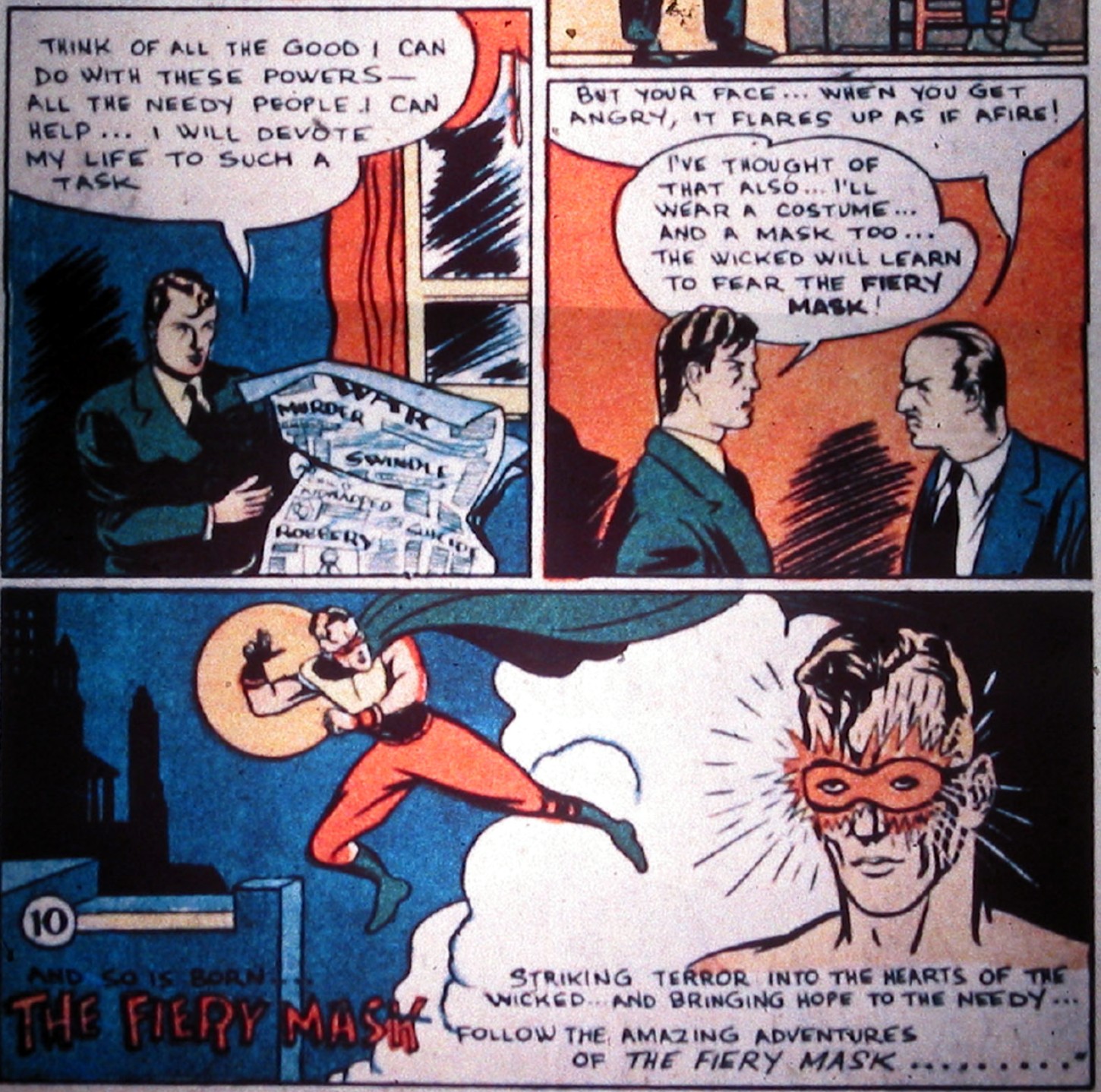
    The Fiery Mask! A hero whose modern depictions have consistently involved a morning star despite only ever actually wielding on on this cover. I’m not complaining, mind you – it’s just interesting to note where things come from.

    The Fiery Mask is in reality Jack Castle, a young doctor who accidentally tracks down the lair of the villainous Zombie Master and is in quick order captured and subjected to the fiend’s mind control device. Jack manages to resist the device long enough to enrage the Zombie Master, and in an effort to boost the power and overcome this resistance he causes it to explode.

    The strange energies given off by the device cause Jack to develop strange abilities, the most striking of which is a fiery glow that plays around his face when he is worked up, and which gives him his super moniker. He also has an invulnerability to heat and flame, a fiery touch and a range of non-heat-related powers like super strength, super breath and a hypnotic gaze. Also his origin is later heavily revised, but we can save that for the hundred years or so it will take to get to The Twelve. (Daring Mystery Comics 001, 1940)

    Categorized in: Elements (Fire), Objects (Masks), Origin (Radioactive Mutate)

  • MINOR SUPER-HERO ROUND-UP 083

    MINOR SUPER-HERO ROUND-UP 083

    Oh boy! Minor super-heroes!

    13: 

    13 (aka Thirteen, although the numerical version of the name is the official one) is the alias of Harold Higgins, whose life has been haunted by a series of misfortunes related to the number thirteen. A timeline of some of them:

    February 13, 1940: Harold’s brother Bob dies in a plane crash.

    March 13, 1940: Harold loses his life savings in the stock market.

    May 13, 1940: Harold’s sister Margy is paralyzed in a car accident.

    July 13, 1940: Harold’s father is lost at sea.

    September 13, 1940: Harold’s fiance is killed in a hit and run.

    April 13, 1941: Harold loses his job as a reporter to a crooked editor looking to cover up a story. 

    All of this (and more! A text story in Daredevil Comics 005 adds the facts that he was born on Friday the 13th, that minor tragedies like a broken leg or academic failure had frequently befallen him on the 13th of any given month and that at his thirteenth birthday party his childhood sweetheart Helen was killed by a falling chandelier) has clearly preyed on Harold’s mind, to the point that he is finding the number everywhere including his own name.

    Rather than, say, moving to a small shack in the woods to keep others safe from his constant misfortune, Harold decides to weaponize his bad luck by bringing it to criminals via his fists. Does this work, logically? Not really, but it’s a decent enough comic book origin.

    Like many super-heroes and villains, 13 flirts with the idea of leaving a calling card in his first adventure but doesn’t maintain the practice. In this case, it’s a calendar page with the 13th of the month circled. (Daredevil Comics 003, 1941)

    Finally, a couple of minor things about 13: In Daredevil Comics 004 we learn that like many of his peers he wears his costume under his clothes for quick-change action. Intriguingly, the above panel seems to imply that this includes his mask, which appears to be either acting as a liner for his hat or worn as a kind of bandana under it.

    Finally, in Daredevil Comics 006, 13 moves from the super-hero crammed streets of NYC to the lesser-served Boston.

    Categorized in: Abstract Concepts (Luck), Accessories (Calling Cards), Alphanumeric (Thirteen)

    Jinx: 

    Recently orphaned Darrel Creig has just inherited the family steel fortune, something that rankles his guardian, uncle and the only other potential heir Moldon Creig. Thus, a family outing to the Statue of Liberty, where Moldon and Darrel’s tutor Travers expedite the inheritance process by tossing him off the statue’s torch.

    Luckily for young Darrel, 13 happens to be present to stop an unrelated attempt to bomb the statue, and after saving the lad the two of them beat up Moldon and Travers and hand them over to the authorities.

    As we all know, if a costumed vigilante happens across an orphaned boy who can throw a punch they are allowed to keep them, which is just what happens with 13 and Darrel, and though Darrel’s connection to the bad luck theme is much more tenuous than Higgins (he is an orphan, if a wealthy one, and he is the very spooky age of thirteen years old) he is promptly given a slightly worse costume than 13’s and anointed as his sidekick Jinx. (Daredevil Comics 005, 1941)

    Categorized in: Abstract Concepts (Luck), Day Job (High School Students), Origin (Sidekicks)

    the Ghost: 

    The Ghost is a super-hero who seemingly exists solely to combat the menace of the Claw as he troubles America’s shores once more, Daredevil having moved on to less stressful pursuits.

    Though presented as a normal human man, the Ghost not only has the acrobatic prowess necessary to fight a giant across the rooftops of New York City but enough stamina to do so for seven hours straight. In their first encounter he manages to drive the Claw away by simply punching him thousands of times.

    The Ghost’s origin is unrevealed as of his final 1941 appearance but rest assured: we will learn it in 1942 (spoiler: it is not very interesting). (Daredevil Comics 005, 1941)

    Categorized in: Origin (Unknown), Supranormal Beings (Ghosts)

    the Fiery Mask: 

    The Fiery Mask! A hero whose modern depictions have consistently involved a morning star despite only ever actually wielding on on this cover. I’m not complaining, mind you – it’s just interesting to note where things come from.

    The Fiery Mask is in reality Jack Castle, a young doctor who accidentally tracks down the lair of the villainous Zombie Master and is in quick order captured and subjected to the fiend’s mind control device. Jack manages to resist the device long enough to enrage the Zombie Master, and in an effort to boost the power and overcome this resistance he causes it to explode.

    The strange energies given off by the device cause Jack to develop strange abilities, the most striking of which is a fiery glow that plays around his face when he is worked up, and which gives him his super moniker. He also has an invulnerability to heat and flame, a fiery touch and a range of non-heat-related powers like super strength, super breath and a hypnotic gaze. Also his origin is later heavily revised, but we can save that for the hundred years or so it will take to get to The Twelve. (Daring Mystery Comics 001, 1940)

    Categorized in: Elements (Fire), Objects (Masks), Origin (Radioactive Mutate)

  • MINOR SUPER-HERO ROUND-UP 082

    Lotta visually striking characters this time, plus Pioneer. 

    Pioneer: 

    Pioneer is a man of limited education and experience (and possibly intellect) who has seemingly lived his entire life at the bottom of the inescapable Death Gorge in Yellowstone Park. He comes into contact with the outside world when a trio of fleeing gangsters crash their car near his home and he nurses them back to health. The three then take Pioneer with them once they manage to attract help from outside of the gorge, with little real justification other than to use him as cover if they attract fire from police.

    Pioneer’s morality is simple enough that his disdain for killing cannot be alleviated with the promise of cash, and he captures his three erstwhile companions when they commit a murder while robbing a bank. Our final view of him is as he wanders into New York City traffic while clutching five thousand dollars in reward money, and since he never appears again I suppose we must assume that he was immediately flattened by a car. This is where my “Pioneer might be a stupid” theory comes from, as the man had just completed a car trip from Yellowstone to NYC, which takes at least 33 hours today. You’re telling me that he didn’t take in the fact that you might want to stay out of the way of these things in all that time?

    As presented, Pioneer is not really a super-hero. He’s presented as one, but his one adventure is taken up almost entirely with origin stuff, which in itself is interesting because we don’t actually learn just how he came to be in that gorge in the first place. I suppose he would have worked like a more benevolent version of the Incredible Hulk, travelling from town to town dispensing rough justice and broken English. If he hadn’t been hit by all those cars, that is. (Daredevil Comics 002, 1941)

    Categorized in: Origin (Unknown) 

    the Bronze Terror: 

    After his father is railroaded into a murder sentence in the corrupt Western town of Redfield, athletic wunderkind and hotshot lawyer Jeff Dixon returns home to help prove his innocence.

    Despite his legal background, Jeff turns to vigilante justice almost immediately, presumably due to the fact that all of the town’s officials are in the pocket of Scar Thornton, the real killer. Dixon’s chosen identity, the Bronze Terror, probably deserves a spot in the next Problematic Round-Up, but I’m giving him a reprieve because this comic is the definition of a well-meaning attempt to have a non-white character star in a comic that is still bogged down in all the tropes of in this case the Western genre (the name of the strip is “Real American No. 1,” for gosh sakes) and if I banished characters for that I recon that this space would feature a non-white super-hero some time in the 70s. If then.

    So, while on the plus side the Bronze Terror is a an entertaining and highly competent character who looks terrific (and is detail-oriented enough to get a mask for his horse so that it can also look cool), the negatives include:

    – all of the other Native American characters other than Jeff’s love interest Lilly being broad ethnic caricatures

    – Jeff’s status as a super-hero hanging on the fact that he went off and got a white man’s education, which is a pretty frequent trope in comics with Native American protagonists and stands as a counterpart to that of the white adventurer bringing his expertise to the jungle

    – yes, the costume looks great but I think that the broad objection that Native peoples have to the cultural appropriation of things like the war bonnet probably also applies to their use by comic book super-heroes. This one is going to keep coming up – American Eagle debuts at Marvel in 1981, and he’s wearing one

    (Daredevil Comics 002, 1941)

    Categorized in: Body (Emotions – Terror), Elements (Alloys – Bronze), Problematic Characters

    London: 

    London is a masked vigilante dedicated to stymieing the forces of Nazi Germany as they attempt to conquer Great Britain. Conceptually, he seems to have been built around the catch phrase “London can take it!” and while the name is certainly unique it does introduce some confusion as the character London is based out of the city of London.

    I appreciate London’s costume: while the combination of a mask and a suit or tuxedo is nothing new in comics, this might just be the first time I’ve seen a suit paired with a cape and cowl. Plus the cursive “L” symbol is cute.

    London is in actuality radio broadcaster Marc Holmes, who reports on his own costumed exploits as an employee of the BBC. He works closely with the British military and London law enforcement in both his civilian and costumed identities. (Daredevil Comics 002, 1941)

    Categorized in: Locations (Specific), Origin (Patriotic Characters)

    Pat Patriot: 

    Another in the seemingly endless parade of patriotic WWII super-heroes, Pat Patriot has the requisite flag based costume and dedication to Truth, Justice and the American Way, plus the clunky and also ominous-if-you-know-history sobriquet “America’s Joan of Arc.”

    An aircraft factory worker who kicks up a bit too much fuss about plant conditions and gets fired, Pat proceeds to unearth a conspiracy by her foreman to send aircraft engines to the Axis, all while wearing a patriotic costume from a play that she was in earlier in the evening. She has a mean right hook and a variety of skills (airplane piloting, marksmanship, etc) that see her through.

    In a truly American moment, Pat gets her super-hero name because her coworkers cannot conceive of someone being called the outlandishly foreign Patricia Patrios, and so rename her on the spot. (Daredevil Comics 002, 1941)

    Although Pat starts out as a worker in an airplane factory in an unidentified part of the US her career as a patriotic vigilante renders her unfit for a typical 9-5 job. By Daredevil Comics 006 she appears to be working as a newspaper reporter but whether that will continue to be her occupation as 1942 rolls around is anyone’s guess.

    Categorized in: Abstract Concepts (Patriotism), Origin (Patriotic Characters) 

  • MINOR SUPER-HERO ROUND-UP 077

    MINOR SUPER-HERO ROUND-UP 077

    Please enjoy about half of the Great Comics stable of characters.  

    Kangaroo Man:

    The Kangaroo Man is Jack Brian, who gets his name thanks to his animal companion: Bingo, an astonishingly well-trained kangaroo. 

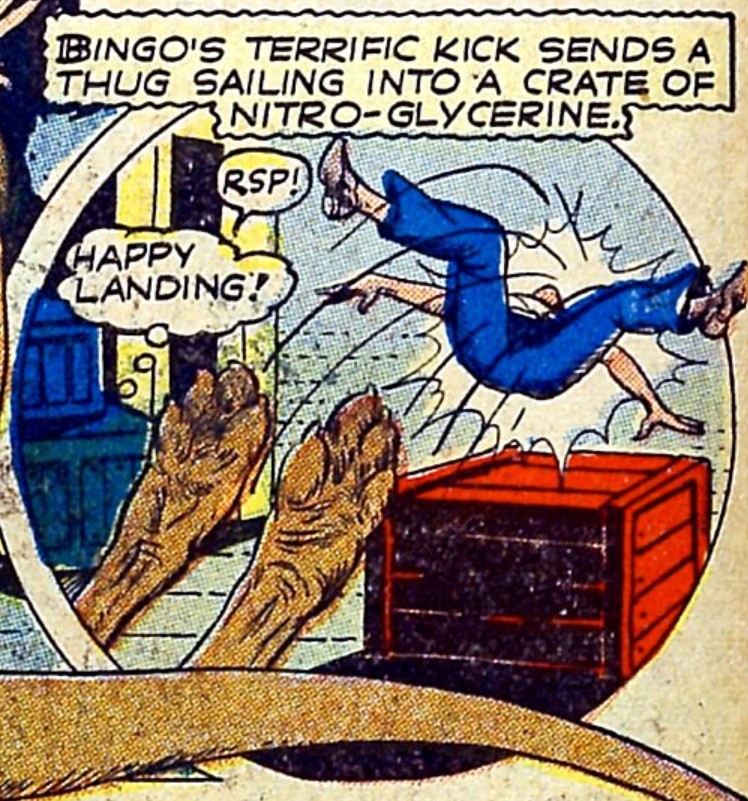
    Jack might be a pretty standard comic book adventurer, but Bingo, though his vocabulary is limited to a “rsp, rsp” sound, is of seemingly near-human intelligence and able to act essentially as another human character in the strip. Here’s Bingo parachuting out of an airplane, for example.

    Bingo also has a respectable body count for an animal hero – he does a lot of whacking explosives at people and people at explosives. (Choice Comics 001, 1941)

    Categorized in: Animals (Marsupials), Generica (Mans), Origins (Nonhuman)

    Atlas the Mighty:

    Atlas the Mighty has exactly one recorded adventure, in which he foils a band of fifth columnists who are stealing war materials in Oregon and then smuggling them to Canada. Or possibly the other way around. Though his name and his powers (super strength, invulnerability) evoke the Titan Atlas, Atlas the Mighty gets not one whiff of an origin and so any connection between the two is speculative at best. (Choice Comics 001, 1941)

    Categorized in: Famous Figures (Mythological), Language (Superlatives), Origins (Unknown)

    the Secret Circle:

    The Secret Circle are actually brothers Jim (heavyweight boxing champion), Larry (pole vault record holder) and Mac (track star) Storm. Does it bother me that there are three of them and they went with a circle rather than a triangle? Heck yes it does.

    Though there’s some indication that the Secret Circle are already established vigilantes, they really get going when gang boss Lou Pacone murders their father, Police Commissioner Storm (incidentally, this happens while all three brothers are out setting records in their chosen fields, and while I won’t go so far as to say that Commissioner Storm deserved to be murdered for being a bad father I will note that he would still be alive if he had taken the day off to support his sons instead of doing work that could have been delegated).

    Though Larry and Mac’s specialties do occasionally come in handy, all three Storm brothers spend most of their adventures punching out crooks, which kind of devalues Jim’s contributions. (Choice Comics 001, 1941)

    Categorized in: Generica (Circles), Origins (Crime Orphans)

    Fire-Eater: 

    Fire-Eater, aka Mike O’Malley, is a stage performer whose act consists of the same fire-eating and -exhaling that he employs in his crimefighting. This is very important for those of us who are interested in the in-universe origins of super-hero (and super-villain) costumes, because it means that Fire-Eater’s is in fact his stage outfit, and that he looks like that for professional reasons rather than as an expression of his secret inner self.

    Despite his name, Fire-Eater does not actually eat any fire in his two recorded adventures. Instead, he eats “sodium capsules” (yikes) that allow him to breath streams of flame hot enough to melt lead and iron, and with enough force to travel at least a few dozen feet. He also seems to be at least somewhat invulnerable to heat and flame, which is handy not just because he deals in the stuff but because like a lot of fire guys he mostly fights arsonists, together with his girlfriend, nurse Louise Peters (Choice Comics 001, 1941)

    Categorized in: Activities (Eating), Elements (Fire)

  • MINOR SUPER-HERO ROUND-UP 073

    It’s a fine day for a dose of minor super-heroes. 

    Alias X: 

    Alias, aka just X, is a mysterious master of disguise who has been cleaning up crime in NYC for the better part of a year and who, as of his first appearance, has now deigned to tell his origin story to Police Commissioner Malley and newspaper editor Hunch Armstrong.

    Turns out that X was a small-town taxi company owner who was railroaded and sent to prison for a crime he didn’t commit, and that after two years in prison he managed to escape, became a master of disguise by sheer willpower and set out to battle crime until he could track down the crooks who really committed the crimes he was convicted for and clear his name.

    The police commissioner must be a trusting guy, because he refrains from putting out an APB or whatever on Alias X after he hears this confession. 

    As far as I can tell from a skim of the 1942 portion of Alias X’s dozen or so adventures, he never catches up with the crooks who framed him – just one of the many loose ends of the comics. Please also note that Alias X is a calling card guy. (Captain Fearless Comics 001, 1941)

    Citizen Smith: 

    Citizen Smith! Plain old John Smith, who could be any one of us regular Americans! Just a regular guy! So why are we reading a comic book about him?

    Citizen Smith is in actuality John Smith, an aircraft factory worker in Washington DC and also an orphan consumed with the desire to know just who his parents were. While stewing on this after work one day he wanders up to the Tomb of the Unknown Soldier, where he receives both great news and a great shock as a ghostly figure appears and tells him that he, the Unknown Soldier, is Smith’s father.

    Smith’s new ghost dad charges him to keep America safe, with the promise that he will appear and aid his son if needed (sadly this does not occur in either of the two recorded Citizen Smith adventures). The newly-created Citizen’s Guardian of Liberty and Guardian of the American Way then sallies forth to whale on fifth columnists with his two good all-American fists.

    Now, I try to take comics as they are presented to me and not engage in a lot of “what if they were dead the whole time”-style fan theory nonsense but I will say that if I were writing a gritty early-2000s Citizen Smith reboot… all this ghost stuff would just be a hallucination brought on by his obsessions, right? Just a lonely man giving his life meaning by latching on to a powerful symbol to fill the hole in his life. But of course that is not who we are here. Citizen Smith is as he appears: a divinely ordained champion of the American Way. (Captain Fearless Comics 001, 1941)

    Miss Victory: 

    Miss Victory is Joan Wayne, a woman who works in Washington DC in secretarial and similar roles and who seems to have seen an opening for a two-fisted vigilante and filled it, no further origin necessary. There is some hint that her vigilantism is officially sanctioned in the first couple of panels of her first appearance, but if so she has very little oversight. She is much more willing to resort to violence than a lot of her female contemporaries, which is kind of refreshing.

    Miss Victory does share with our old friend the Eagle the inability to really settle on a costume design, so I’m sure that we’ll be revisiting her in that capacity. 

    Case in point: this revised version of her costume from her second appearance, in Captain Fearless Comics 002. As with most of her costume changes it’s a variation on the theme of her previous look and is probably explained by the fact that she  (Captain Fearless Comics 001, 1941) 

    Mr Miracle: 

    Mr Miracle is of course among the ranks of the obscure Golden Age characters who have the same name as a more well-known modern character, but he is also a member of a much more select fraternity: of characters whose origin involves a suicide attempt, though the precise reason that the unnamed man had for jumping is never given.

    The future Mr Miracle is pulled out of the water by a helpful stranger and brought to the great scientist Professor Rietz, who revives him via a twenty hour session under his “mind-ray,” only to be betrayed and shot by his assistant Sango at the final hour. Sango turns out to have been a foreign agent who was laying in wait for the mind-ray to be perfected, and now the hour has come.

    The still-unnamed man wakes to a ruined laboratory and a dying Rietz, who reveals to him in addition to saving his life, the mind-ray has given him great if unspecified powers. He then extracts a pledge from the man that he will use this power to aid mankind and promptly dies.

    The man creates a costume, renames himself Mr Miracle and sets out to use is vast array of abilities (transmutation, teleportation, telekinesis, intangibility, size control, flight, etc, etc. Though Mr Miracle is technically some sort of psychic mutate he is in effect a nigh-omnipotent comic book magic user) to bring Sango to justice. 

    Mr Miracle gets to honour the promise he made to Prof. Rietz precisely one more time (by sinking a u-boat) before fading into the mists of comic book obscurity. (Captain Fearless Comics 001, 1941)