The Curse of Skeleton Munroe

Category: super vehicle

  • MINOR SUPER-VILLAIN 913: CAPTAIN HOOD

    (Captain Aero Comics 001, 1941) 

    Captain Hood is your classic fascist of indeterminate allegiance, who has been holed up with a crew of pseudo-Nazis and pseudo-Imperial Japanese agents in a cave underneath Easter Island for four long years working on an “undersea tractor” designed to haul a cargo of explosives to the Panama Canal and then blow it up. Just why he requires a mask in order to oversee this operation is an exercise left for the reader – I prefer to imagine that he got into cosplay as a way to while away the long hours.

    Captain Hood makes two glaring errors over the course of this issue, the biggest of which is the fact that he is so punchy as the culmination of his plan approaches that he has his men open fire on the tramp steamer Suzy Q for merely approaching the island, with no indication that they are going to land. This of course enrages the ship’s captain and only survivor, adventurer Grit Grady. 

    The fact that Grady takes his revenge on Captain Hood by storming the cave and ultimately blowing the entire place, undersea tractor and all, to high heaven means that Hood never has to face up to his other, much larger error: choosing to set up shop on Easter Island.

    I feel like I’m going to be talking about this a lot, because Easter Island is a beloved exotic setting in comic books, but it is so far away from everything else. Once that undersea tractor was completed, the next step was going to be to drive it five thousand kilometres across the bottom of an ocean that was virtually unmapped at the time but speaking as someone with an Internet connection and thus a collection of maps at my disposal: it’s not a smooth path. I, personally, would not place a bet on Captain Hood making it there with his twenty thousand tons of explosives in one piece, no matter how good his tractor is.

  • MINOR SUPER-VILLAIN 913: CAPTAIN HOOD

    (Captain Aero Comics 001, 1941) 

    Captain Hood is your classic fascist of indeterminate allegiance, who has been holed up with a crew of pseudo-Nazis and pseudo-Imperial Japanese agents in a cave underneath Easter Island for four long years working on an “undersea tractor” designed to haul a cargo of explosives to the Panama Canal and then blow it up. Just why he requires a mask in order to oversee this operation is an exercise left for the reader – I prefer to imagine that he got into cosplay as a way to while away the long hours.

    Captain Hood makes two glaring errors over the course of this issue, the biggest of which is the fact that he is so punchy as the culmination of his plan approaches that he has his men open fire on the tramp steamer Suzy Q for merely approaching the island, with no indication that they are going to land. This of course enrages the ship’s captain and only survivor, adventurer Grit Grady. 

    The fact that Grady takes his revenge on Captain Hood by storming the cave and ultimately blowing the entire place, undersea tractor and all, to high heaven means that Hood never has to face up to his other, much larger error: choosing to set up shop on Easter Island.

    I feel like I’m going to be talking about this a lot, because Easter Island is a beloved exotic setting in comic books, but it is so far away from everything else. Once that undersea tractor was completed, the next step was going to be to drive it five thousand kilometres across the bottom of an ocean that was virtually unmapped at the time but speaking as someone with an Internet connection and thus a collection of maps at my disposal: it’s not a smooth path. I, personally, would not place a bet on Captain Hood making it there with his twenty thousand tons of explosives in one piece, no matter how good his tractor is.

  • MINOR SUPER-VILLAIN 895: THE GHOST OF THE DEEP

    MINOR SUPER-VILLAIN 895: THE GHOST OF THE DEEP

    (America’s Greatest Comics 001, 1941)

    The Ghost of the Deep, a dastardly fellow indeed. As the comic opens, a captive scientist named Hugo has just completed a mysterious formula for him, only to be rewarded with murder.

    In the following days, the Ghost attacks US West Coast shipping, each time leaving behind a calling card in the form of a message in a bottle.

    The Ghost even tries to silence Billy Batson’s fairly routine reporting on the attacks (but why leave a calling card if you don’t want everyone to know you’re responsible?) by taking Billy and his boss Sterling Morris for a proverbial ride. When this is predictably foiled by Captain Marvel, the Ghost of the Deep shows up long enough to demonstrate that he is also a classic comic book Bad Boss by drowning his hapless Teutonic minions.

    There is a bit of radio-based taunting, since Billy is a radio guy. Again, this kind of thing brings into question just why the Ghost of the Deep wants to shut Billy up.

    So just what is the Ghost of the Deep’s plan? And what is this mysterious formula that poor Hugo died for? Why, it’s the recipe for making a transparent, invulnerable alloy called Z-Metal, and using a fleet of tank-submarines composed of the stuff, the Ghost intends on conquering the United States. First stop: blowing up the Panama Canal.

    As for the Ghost’s real identity, well, it’s not revealed until later, but any cagey comics reader will immediately peg this smarmy rival radio man named Spriggins as the top suspect the instant that he walks on-panel. Presumably his cover serves the same purpose as Billy Batson’s: as a way of gathering information and justifying a lot of globetrotting as being in pursuit of a story.

    Ultimately, Spriggins’ plan has one fatal flaw: it fails to account for the presence of a magically super-strong fellow like Captain Marvel, who succeeds where the might of the US Navy cannot and smashes the Z-Metal fleet to smithereens. And then does the same to the Ghost of the Deep’s cool Z-Metal chainmail.

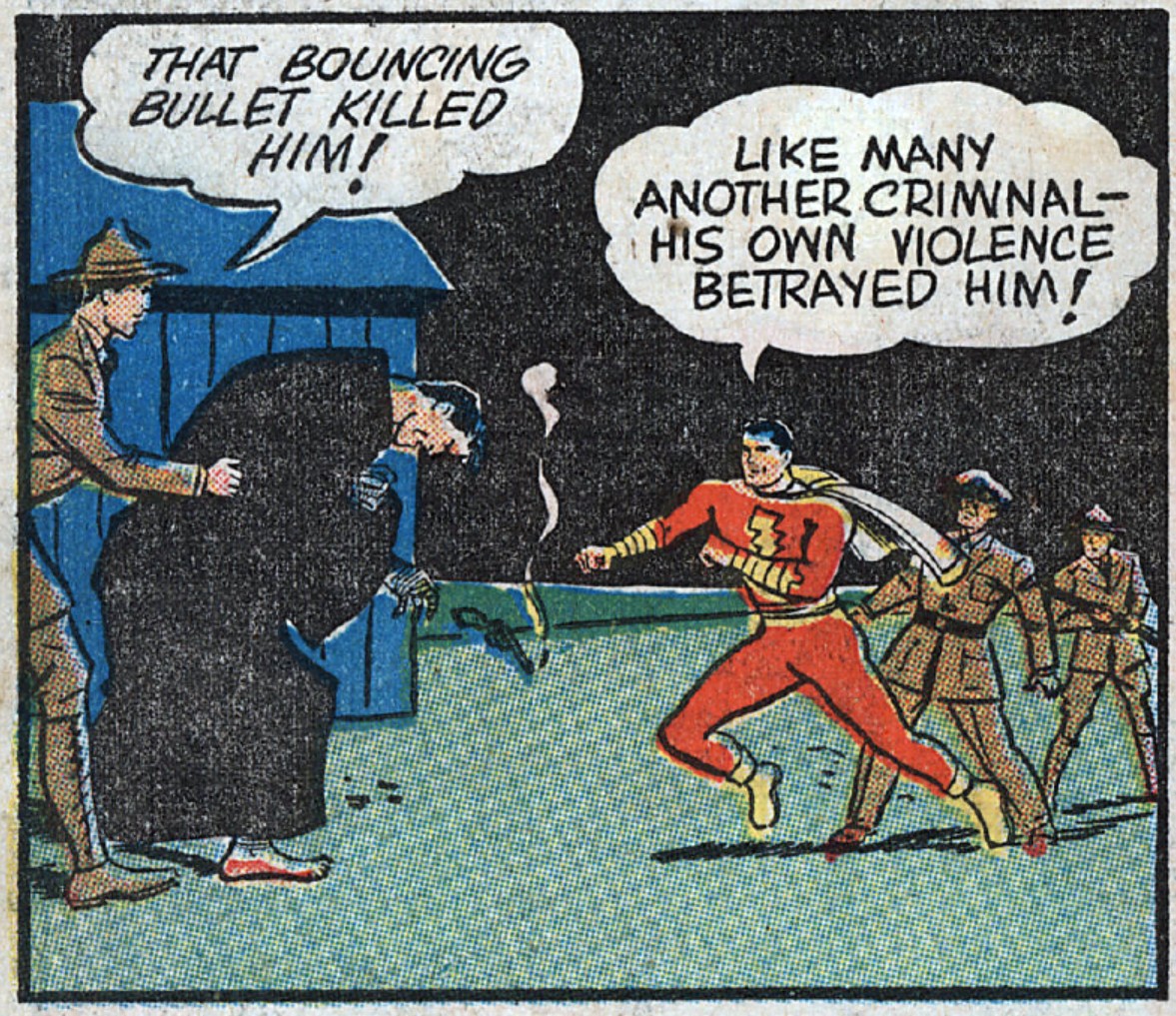
    The captured Spriggins makes one last attempt at striking out at the US by stealing an MP’s gun and taking out a nearby General, only to be intercepted by Captain Marvel and suffer the oft-joked-about but seldom-seen fate of the person who fires a bullet into an invulnerable super-hero’s chest only to have it bounce back and kill them instead. 

  • MINOR SUPER-VILLAIN 883: AMERICA SMASHER

    (Spy Smasher 002, 1941) 

    There are a few different kinds of evil opposites. There are your classic elemental opposites, like when a fire guy fights a water guy or an ice guy, and your thematic opposites, like when the Flash goes up against Turtle Man. Then there are your literal Bizarro-style mirror image opposites, which is the closest to what America Smasher is, but not quite. Instead, he is a declared opposing force to Spy Smasher: “if you are going to smash spies, which includes me*, then I am going to smash America, which includes you.” Plus, since he is a super-villain, America Smasher has literalized the smashing concept by adopting a spiked mail glove as his thing.

    Spy Smasher is on a bit of a hot streak with regard to being able to locate his villains’ bases while they are still in the planning stages, but rather than simply use this as an information-gathering opportunity as he did when he found Dark Angel’s HQ, this time he gets cocky due to America Smasher’s diminutive size and attempts to take on the whole room, and he pays for that with a bop on the head from the mailed fist. 

    *Whether America Smasher would count as a spy in any way other than the fact that he is a Spy Smasher enemy is a conversation for another day.

    Spy Smasher gets out of this predicament thanks to the fact that America Smasher hit him so hard that everyone thinks that he’s dead. There’s the usual back and forth between the two before Spy Smasher and Eve Corby are caught and imprisoned in a mysterious humming building full of men and tanks. Just where could they be?

    Turns out: inside an incredibly huge plane (containing, for example, a full tank corps and hundreds if not thousands of soldiers) that is about to bomb the US in advance of a full invasion by the Nazis.

    The plane is so big, in fact, that Spy Smasher finds plenty of handholds on it to a) prevent himself from falling to his death and b) make is way to the cockpit so that he can start pitching pilots out the window willy-nilly. And as a plane is nothing without its pilots, it crashes, taking America Smasher and all his hundreds of minions to their demise with it.

    America Smasher does not in fact die in the crash, but instead establishes a sewer lair in what is probably NYC (Spy Smasher comics are often hard to pin down, geography-wise, even though the characters all live and work in named cities. The problem is in distinguishing whether the action of a particular issue is supposed to be taking place in Washington DC, where Admiral Corby works, or NYC, where he and his daughter Eve reside. Or sometimes Virginia, where Alan Armstrong lives. Or another place entirely). 

    America Smasher does get up to more recognizable spy activity in this issue, primarily centred around inducing a German American man to betray his Secret Service agent son, but he also spends a lot of effort attempting to get revenge for his prior foiled plan, by killing Eve Corby in particular. Why her in particular? That’s a good question.

    America’s Greatest Comics 001 was published in November or December of 1941 and this story shows it in one very particular way: by having America Smasher explicitly be a Nazi. Even very slightly in advance of Pearl Harbor and the US entering the war, publishers were starting to get a little bit brave about perhaps suggesting that all these bad guys with German accents and monocles that they had been populating their rogues galleries for for that last couple of years were in fact Nazis.

    As mentioned previously, this issue sees America Smasher in reduced circumstances as he’s living in a sewer rather than a flying war base. He hasn’t entirely given up on the finer things in villainy, however, as evidenced by the enormous Art Deco iron maiden that acts as both the centrepiece of his lair and the primary means by which he inspires cooperation in his victims. Also, it is the instrument of his downfall when Spy Smasher pushes it over onto him!

    Not his ultimate downfall, however. That comes when he floods sewer base in attempt to kill Spy Smasher and in a classic case of Bad Boss leaves his henchmen behind to die with him, only for one of them to go mad with fear and blow up the whole damn sewer and America Smasher with it. (America’s Greatest Comics 001, 1941)

    The rumours of America Smasher’s death are once again exaggerated it seems, as he recovers his gauntlet from his shattered lair almost immediately (though just whose arm it was on in that pile of rubble remains a mystery. For that matter, just who made the decision to leave a human corpse under a light coating of rubble in the New York City sewers?).

    This final 1941 adventure is a bit anticlimactic after the previous heights and even mediums of villainy that America Smasher had aspired to: he trails Alan Armstrong and Eva and Admiral Corby to Alaska in order to steal the Army’s new Ski Tank prototype and then gets his block knocked off by Spy Smasher. He doesn’t even appear to die at the end of the issue but instead suffers the ignominy and shame of arrest. 

    America Smasher will return in 1942 – will his career continue to spiral ever farther downward? Tune in and see! (Whiz Comics 025, 1941)

  • MINOR SUPER-VILLAIN 883: AMERICA SMASHER

    (Spy Smasher 002, 1941) 

    There are a few different kinds of evil opposites. There are your classic elemental opposites, like when a fire guy fights a water guy or an ice guy, and your thematic opposites, like when the Flash goes up against Turtle Man. Then there are your literal Bizarro-style mirror image opposites, which is the closest to what America Smasher is, but not quite. Instead, he is a declared opposing force to Spy Smasher: “if you are going to smash spies, which includes me*, then I am going to smash America, which includes you.” Plus, since he is a super-villain, America Smasher has literalized the smashing concept by adopting a spiked mail glove as his thing.

    Spy Smasher is on a bit of a hot streak with regard to being able to locate his villains’ bases while they are still in the planning stages, but rather than simply use this as an information-gathering opportunity as he did when he found Dark Angel’s HQ, this time he gets cocky due to America Smasher’s diminutive size and attempts to take on the whole room, and he pays for that with a bop on the head from the mailed fist. 

    *Whether America Smasher would count as a spy in any way other than the fact that he is a Spy Smasher enemy is a conversation for another day.

    Spy Smasher gets out of this predicament thanks to the fact that America Smasher hit him so hard that everyone thinks that he’s dead. There’s the usual back and forth between the two before Spy Smasher and Eve Corby are caught and imprisoned in a mysterious humming building full of men and tanks. Just where could they be?

    Turns out: inside an incredibly huge plane (containing, for example, a full tank corps and hundreds if not thousands of soldiers) that is about to bomb the US in advance of a full invasion by the Nazis.

    The plane is so big, in fact, that Spy Smasher finds plenty of handholds on it to a) prevent himself from falling to his death and b) make is way to the cockpit so that he can start pitching pilots out the window willy-nilly. And as a plane is nothing without its pilots, it crashes, taking America Smasher and all his hundreds of minions to their demise with it.

    America Smasher does not in fact die in the crash, but instead establishes a sewer lair in what is probably NYC (Spy Smasher comics are often hard to pin down, geography-wise, even though the characters all live and work in named cities. The problem is in distinguishing whether the action of a particular issue is supposed to be taking place in Washington DC, where Admiral Corby works, or NYC, where he and his daughter Eve reside. Or sometimes Virginia, where Alan Armstrong lives. Or another place entirely). 

    America Smasher does get up to more recognizable spy activity in this issue, primarily centred around inducing a German American man to betray his Secret Service agent son, but he also spends a lot of effort attempting to get revenge for his prior foiled plan, by killing Eve Corby in particular. Why her in particular? That’s a good question.

    America’s Greatest Comics 001 was published in November or December of 1941 and this story shows it in one very particular way: by having America Smasher explicitly be a Nazi. Even very slightly in advance of Pearl Harbor and the US entering the war, publishers were starting to get a little bit brave about perhaps suggesting that all these bad guys with German accents and monocles that they had been populating their rogues galleries for for that last couple of years were in fact Nazis.

    As mentioned previously, this issue sees America Smasher in reduced circumstances as he’s living in a sewer rather than a flying war base. He hasn’t entirely given up on the finer things in villainy, however, as evidenced by the enormous Art Deco iron maiden that acts as both the centrepiece of his lair and the primary means by which he inspires cooperation in his victims. Also, it is the instrument of his downfall when Spy Smasher pushes it over onto him!

    Not his ultimate downfall, however. That comes when he floods sewer base in attempt to kill Spy Smasher and in a classic case of Bad Boss leaves his henchmen behind to die with him, only for one of them to go mad with fear and blow up the whole damn sewer and America Smasher with it. (America’s Greatest Comics 001, 1941)

    The rumours of America Smasher’s death are once again exaggerated it seems, as he recovers his gauntlet from his shattered lair almost immediately (though just whose arm it was on in that pile of rubble remains a mystery. For that matter, just who made the decision to leave a human corpse under a light coating of rubble in the New York City sewers?).

    This final 1941 adventure is a bit anticlimactic after the previous heights and even mediums of villainy that America Smasher had aspired to: he trails Alan Armstrong and Eva and Admiral Corby to Alaska in order to steal the Army’s new Ski Tank prototype and then gets his block knocked off by Spy Smasher. He doesn’t even appear to die at the end of the issue but instead suffers the ignominy and shame of arrest. 

    America Smasher will return in 1942 – will his career continue to spiral ever farther downward? Tune in and see! (Whiz Comics 025, 1941)

  • MINOR SUPER-HERO ROUND-UP 062

    We’re awash in minor super-heroes! 

    Golden Arrow: 

    Golden Arrow has a more convoluted origin than an Western hero has any right to, but I’ll do my best to summarize it without one million images. He is Roger Parsons, whose father, Professor Paul Parsons, develops advanced ballooning technology just before WWI breaks out and determines to test it out before donating it to the US government. To that end, he bundles his wife and infant son into a balloon and sets out on a cross-country voyage that turns out to have been a bit too well-publicized, because he is shot down by the villainous Brand Braddock while passing over the Western deserts. While Brand squirrels away Parsons’ technology until the day he can safely sell it on, the infant Roger is found by a prospector named Nugget Ned, who raises him as his own son.

    Life in the West suits Roger, and he grows up to be a physical paragon, a crack shot with the bow and arrow (with which he uses impractical but iconic golden-headed arrows, and yes, I do believe there is a story in which a crook goes around committing minor crimes in order to profit from gathering them up afterward) and a superb horseman on his faithful steed White Wind. Nugget Ned eventually dies of being Old, but passes on the truth of Roger’s parentage before he goes. Roger then takes back the ballooning technology from Brand (plus his twin sons Bronk and Brute) and donates it to the US Government. Along the way, he kind of falls into being a Western vigilante.

    Golden Arrow is also one of my classic examples of a character egregiously transitioning from the Modern to the Old West, since he is so firmly established as being in the present from the start. As usual, it’s not easy to pin down exactly when it happens, but it does. (Whiz Comics 002, 1940)

    UPDATE 1941 

    Spy Smasher:

    Spy Smasher is Alan Armstrong, a wealthy Virginia playboy who battles espionage threats to American democracy. He uses both his geographic proximity to Washington DC (via his Virginia estate) and his engagement to Eve Corby (daughter of Naval intelligence officer and eventual Chief of the US Secret Service Admiral Corby) to keep abreast of just what those threats might be and then sally forth to punch them in the face – smashing them, if you will.

    Though this setup might at first seem to be a recipe for a comic about a hero battling an endless series of nondescript men in suits, it is in fact the complete opposite, as Spy Smasher only smashes the most eccentric and flamboyant of spies, starting with the Mask, who does, yes, wear a suit most of the time, but trust me on this. He’s nutty.

    Something that I had forgotten about Spy Smasher is that they were extremely coy about his identity for the first year or so. It’s not a particularly mysterious mystery, as Armstrong is literally the only suspect and there is some allusion to the reader being able to figure it out.. They do make an attempt to imply that Armstrong could be the Mask, but there’s a period where Eve Corby knows the secret while the reader theoretically does not at I gotta assume that she would put 2 and 2 together if Spy Smasher was not Armstrong but Armstrong was still mysteriously sneaking off just before Spy Smasher and the Mask had a scrap. Basically what I’m saying is that this comic needed more white guys.

    Spy Smasher’s main bit of crime espionage-fighting technology is the Gyrosub (also Gyro-sub, Gyro Sub), a compact vehicle that combines the functions of a car, an airplane, a boat and a submarine and has a wide array of deployable weapons and technology as the story demands them. (Whiz Comics 002, 1940)

    UPDATES: 

    Smasher Spy 

    Doctor Voodoo: 

    Jungle heroes are all kind of samey: they fall into a few broad archetypes and have variably racist adventures in an abstract Jungle that frequently feels simultaneously Asian, African and South American (and indeed one of Doctor Voodoo’s own adventures involves Arab slavers raiding the Amazon from a very Sahara-like desert*). What is remarkable about Hal “Doctor Voodoo” Carey here is how he is both a white child who grew up in the jungle and excelled at jungle skills beyond his native peers and also simultaneously a magic white man from far away who brings modern science and medicine to the wilderness. How is this? Why, it is because the comic treats being a white guy as a kind of magical property that Hal has, and so even though he has never left the Amazon and learned all of his medicine from observing his father and reading his old textbooks, Hal identifies as and acts as an American doctor throughout the series.

    Hal practices his medicine among the Blanca, a tribe of “White Indians”, which is a term that I think originated in the pulps and is basically meaningless except to signal to the reader that the Blancas can be viewed as fully human. They are also the ones who give him the name “Doctor Voodoo” after deciding that his medical knowledge is magical in nature. Which I guess that it kind of is, given my earlier assertions. Annoying! (Whiz Comics 007, 1940)

    *this happens in Whiz Comics 017 if you’re interested 

    Maxinya the Heaven-Woman: 

    Doctor Voodoo’s companion/ love interest is Maxinya, the Heaven Woman, who is yet another kind of jungle hero in that she was abandoned when her explorer parents were seemingly killed in the collapse of an ancient temple and subsequently raised by jaguars. She can talk the language of jaguars and has jungle life down but ends up not having a lot to due because the focus is on Hal and he is the kind of misogynistic 40s hero who inists that adventure is no place for a lady.

    Not enough time is spent on the fact that Maxinya’s companion Jappa is a jaguar who is large enough to carry two adult humans on his back, who communicates with Maxinya and later Doctor Voodoo in an actual spoken language, with words. I feel like there’s a story there. (Whiz Comics 007, 1940)

    (it only comes up once, so I wouldn’t necessarily call it an essential part of his character, but here’s Doctor Voodoo engaging in Blanca Death Combat against his arch-foe Okoro)

    UPDATE 1941 – Dr Voodoo is flung back in time. 

  • MINOR SUPER-HERO ROUND-UP 060

    Some of those reeeeal obscure guys today. 

    Craig Carter:

    Archaeologist Craig Carter wants to give up all the stuffy academia and become a crime fighter, and since he lives in a comic book universe, the very day he tells his girlfriend about this objectively bad decision he receives a magical ring in the mail from an old colleague whose life he had saved. This ring grants its wearer the ability to summon the gods of antiquity to aid them – in Carter’s two adventures he summons Zeus, Mercury, Thor and Pluto, plus he gets Zeus to summon Pegasus for him, so presumably a whole world of magical beasts was also at his fingertips. Carter’s second adventure ends with Pluto deciding not to return to the ring, which presumably would have set him up as a long-term antagonist. Alas this was not to be, as his second appearance was also his final appearance.

    The ring is also hilariously sensitive with regards to its touch-activation, as seen here when a simple hand-pat causes Zeus to blow up the club. (Wham Comics 001, 1940)

    Detecto:

    Jack Strand is a radio scientist who has invented Detecto, a “wonder beam” that has “four unlimited powers”: the ability to send and receive short wave radio, an engine killing effect, a force field and the ability to paralyze living things. As in a few other cases that we have encountered, the line between Detecto as a beam and Detecto as a kind of ambient energy field is a bit blurry, but whatever it is, Strand installs a transmitter in his car, making it into what is essentially a magical object. Would he be better off with a more portable version of Detecto, particularly as at least one of the powers, the radio, is commonly possessed by many cars already? Maybe. Am I sad that this was the only story about Detecto? Certainly, particularly as this was very much a tale of highway-based crime and I would love to see Detecto go up against someone in an airplane or maybe a building. (Wham Comics 001, 1940)

    Blue Fire:

    Blue Fire is actually scientist Jack Knapp, who acquired his powers through the ever-popular method of an unexpected explosion in his chemistry laboratory. Please note also that he was about to drink an unspecified formula just before this explosion occurred – is it the same as the explosive chemical that gave him his powers or was he about to unlock an entirely different suite of abilities?

    Blue Fire takes his name from the halo of blue flames that surrounds him when his powers are active, Contrary to this external signifier, however, he does not have any kind of heat or flame based abilities but rather is an intangibility guy. This is by far the best thing about Blue Fire, by the way, and not just because of the name/power fakeout but because Blue Fire creator Louis Glanzman has effortlessly answered all of the nitpicky questions about intangibility (why can they still breathe? why don’t they fall through the floor? why can they pick things up?) by establishing that Jack Knapp is effectively the opposite of ooblek: he functions as if tangible until enough force is exerted by or on his body, so that he can pick up a book but that same book will pass right through him if thrown. It’s very neat and tidy!* 

    Blue Fire has to drink some of the chemical created in the initial explosion to activate his powers, after which he has them for two whole hours. This is an interesting twist to the whole question of a secret identity, lying somewhere between the Hulk’s “uncontrollable change for an indeterminate amount of time and the usual Archie Andrews-style running around in different hats that Superman and co. get up to. I’m surprised that I can’t think of another character with this kind of life-complicating power setup. (Wham Comics 002, 1940)

    *I am of course immediately imagining horror scenarios in which Blue Fire cannot breathe in a high wind or a high pressure atmosphere, where he jumps down from a small platform and then falls to the centre of the Earth, etc 

    Solarman: 

    Solarman and his mentor, the bat-eared Quino, are aliens from the enlightened planet Saturn who have been observing Earth for some time. Quino is so depressed over the crime and evil that is rampant on our planet that he almost heat-rays the entire thing before his Saturnian enlightenment kicks in and he reconsiders. Instead, the two hit upon a plan wherein Solarman will be blasted to Earth to fight crimes that the two have spotted via their viscopes and x-rayscopes.

    Though Solarman is said to have “many powers” by Quino, the only one he displays while on his sole recorded mission to Earth is some moderate super strength. Still, this is more than enough to beat up gangster Al Ravoni’s entire suite of henchmen and bring the fugitive himself to justice. Hopefully this kind of thing is enough to satisfy Quino’s righteous bloodlust. (Wham Comics 002, 1940)

  • MINOR SUPER-HERO ROUND-UP 060

    Some of those reeeeal obscure guys today. 

    Craig Carter:

    Archaeologist Craig Carter wants to give up all the stuffy academia and become a crime fighter, and since he lives in a comic book universe, the very day he tells his girlfriend about this objectively bad decision he receives a magical ring in the mail from an old colleague whose life he had saved. This ring grants its wearer the ability to summon the gods of antiquity to aid them – in Carter’s two adventures he summons Zeus, Mercury, Thor and Pluto, plus he gets Zeus to summon Pegasus for him, so presumably a whole world of magical beasts was also at his fingertips. Carter’s second adventure ends with Pluto deciding not to return to the ring, which presumably would have set him up as a long-term antagonist. Alas this was not to be, as his second appearance was also his final appearance.

    The ring is also hilariously sensitive with regards to its touch-activation, as seen here when a simple hand-pat causes Zeus to blow up the club. (Wham Comics 001, 1940)

    Detecto:

    Jack Strand is a radio scientist who has invented Detecto, a “wonder beam” that has “four unlimited powers”: the ability to send and receive short wave radio, an engine killing effect, a force field and the ability to paralyze living things. As in a few other cases that we have encountered, the line between Detecto as a beam and Detecto as a kind of ambient energy field is a bit blurry, but whatever it is, Strand installs a transmitter in his car, making it into what is essentially a magical object. Would he be better off with a more portable version of Detecto, particularly as at least one of the powers, the radio, is commonly possessed by many cars already? Maybe. Am I sad that this was the only story about Detecto? Certainly, particularly as this was very much a tale of highway-based crime and I would love to see Detecto go up against someone in an airplane or maybe a building. (Wham Comics 001, 1940)

    Blue Fire:

    Blue Fire is actually scientist Jack Knapp, who acquired his powers through the ever-popular method of an unexpected explosion in his chemistry laboratory. Please note also that he was about to drink an unspecified formula just before this explosion occurred – is it the same as the explosive chemical that gave him his powers or was he about to unlock an entirely different suite of abilities?

    Blue Fire takes his name from the halo of blue flames that surrounds him when his powers are active, Contrary to this external signifier, however, he does not have any kind of heat or flame based abilities but rather is an intangibility guy. This is by far the best thing about Blue Fire, by the way, and not just because of the name/power fakeout but because Blue Fire creator Louis Glanzman has effortlessly answered all of the nitpicky questions about intangibility (why can they still breathe? why don’t they fall through the floor? why can they pick things up?) by establishing that Jack Knapp is effectively the opposite of ooblek: he functions as if tangible until enough force is exerted by or on his body, so that he can pick up a book but that same book will pass right through him if thrown. It’s very neat and tidy!* 

    Blue Fire has to drink some of the chemical created in the initial explosion to activate his powers, after which he has them for two whole hours. This is an interesting twist to the whole question of a secret identity, lying somewhere between the Hulk’s “uncontrollable change for an indeterminate amount of time and the usual Archie Andrews-style running around in different hats that Superman and co. get up to. I’m surprised that I can’t think of another character with this kind of life-complicating power setup. (Wham Comics 002, 1940)

    *I am of course immediately imagining horror scenarios in which Blue Fire cannot breathe in a high wind or a high pressure atmosphere, where he jumps down from a small platform and then falls to the centre of the Earth, etc 

    Solarman: 

    Solarman and his mentor, the bat-eared Quino, are aliens from the enlightened planet Saturn who have been observing Earth for some time. Quino is so depressed over the crime and evil that is rampant on our planet that he almost heat-rays the entire thing before his Saturnian enlightenment kicks in and he reconsiders. Instead, the two hit upon a plan wherein Solarman will be blasted to Earth to fight crimes that the two have spotted via their viscopes and x-rayscopes.

    Though Solarman is said to have “many powers” by Quino, the only one he displays while on his sole recorded mission to Earth is some moderate super strength. Still, this is more than enough to beat up gangster Al Ravoni’s entire suite of henchmen and bring the fugitive himself to justice. Hopefully this kind of thing is enough to satisfy Quino’s righteous bloodlust. (Wham Comics 002, 1940)

  • MINOR SUPER-VILLAIN 844: ZOM

    (Weird Comics 002, 1940) 

    Space adventurers Blast Bennett and his pal Red are tooling around the Solar System one day when they are hailed by and then hauled aboard an enormous space vessel.

    This vessel is Plane-City, the mobile headquarters of the space pirate Zom. Actually, I don’t know if “space pirate” is quite the right label for Zom, as his main passion seems to be taking and keeping prisoners rather than the more traditional piratical pursuit of taking prisoners and then ransoming them back to their home government or loved ones. I mean, just look at that dank stone dungeon that he has installed on his spaceship, presumably at great expense!

    Zom’s downfall comes thanks to the terrible state of his security – firstly, they allow Blast to get their boss in a headlock and chain him up in his own dungeon, and then it turns out that they didn’t even bother to check their new prisoners – one of whom, may I remind you, is named Blast – for ray guns. Just professionally shameful.

    Zom’s prisoners are all freed via space parachute, while Zom and his men meet their end at the barrel of that same ray gun. Plane-City, alas, does not survive the altercation.

  • MINOR SUPER-HERO ROUND-UP 058

    A number of minor Fox Features characters for your perusal and delight.

    the Bird Man: 

    The Bird Man, descendant of “an ancient Indian god” (no further detail provided) uses his weird demigod wing-flaps to fly around the American Southwest and render aid to people. (Weird Comics 001, 1940)

    In Bird Man’s final appearance, in Weird Comics 004, he has conformed to the heroic norm a bit more by moving to a penthouse apartment in what might be NYC (please note that he keeps a little statue of his divine ancestor on top of his TV). He also has slightly more conventional wings in this appearance, but I have to say that I prefer the flaps.

    Typhon: 

    Typhon is a near-future undersea adventurer who not only has access to various super-submarines and ray guns and so forth but also sometimes has a magic ring that allows him to combat the various supernatural threats of the deep ocean. (Weird Comics 001, 1940)

    Thor, God of Thunder: 

    Thor, God of Thunder (the Norse god) gets restless one day in 1940 and decides to invest a mortal man with some of his power, making him Thor, God of Thunder (the super-hero). This is a not-uncommon origin story for a super-hero to have, but the really important thing to note is that the human, Grant Farrel, is not some paragon of virtue or descendant of Thor, and that he isn’t being sent out into the world to combat injustice on Thor’s behalf. No, he’s just kind of a sad sack who just got dumped and Thor hands him the power with a kind of “have fun with it” attitude. Grant seems like he might be the type to get into super-heroics of his own accord but he doesn’t really have any choice because Glenda, the girl who dumped him, is a real magnet for spy rings and secret invasions of France and so forth. They do eventually get back together, don’t worry.

    Like many of his contemporaries, Grant/Thor goes through a lot of different costume variants over the course of a short career, but the thing I really want to highlight is this very weird style of Viking helmet that both he and Original Thor wear in hist first three or four appearances. I mean, what’s with the discs? 

    Thor is of course wildly over-powered, as shown in this pretty awesome sequence in which he lassos an entire Luftwaffe attack on Paris and throws it at Berlin. He can also throw both his hammer and thunderbolts to devastating effect, and kind of alternates between flying under his own power and cartoonishly riding around on a big jagged bolt of lightning.

    In his final appearance, in Weird Comics 005, Thor is sans hammer for no particular reason. This doesn’t really slow him down but even so he gets a bit of divine aid via the gift of Thor’s strength-boosting gauntlet. (Weird Comics 001, 1940)

    Dynamite Thor:

    Dynamite Thor, the Explosion Man, is actually Peter Thor, wealthy mine owner and explosives expert. I was all ready to roast him for including his surname as part of his superhero identity, but on review of his five appearances it appears that the actual name he goes my is merely Dynamite. This also leaves me with no material with which to roast Thor’s fiance Glenda (same as our last Thor – what is it with Thors and Glendas?) for not realizing just who the mysterious man she so idolizes is.

    In his initial appearance, Dynamite Thor is merely a man with a belt-full of explosives and a pretty hammer-and nail approach to problem-solving. Crooks holed up in an old shack? Blow up the shack. Crooks getting away in a vehicle? A controlled explosion will bring a nearby object down and stop their flight. A big fire? Blow it up.

    By his second appearance in Weird Comics 007, someone had evidently decided that Dynamite Thor needed more of a hook or perhaps they just couldn’t figure out a good explosion-themed vehicle for him to fly around, because he gets his signature move which is absolutely the only reason that he is still talked about: he flies by the simple expedient of setting off a series of explosions under his ass. Finally, by his next appearance in Blue Beetle Comics 006, 1941, he is explicitly mentioned to be immune to these explosions, something that must have come as a great relief to him (edit to add: I was mistaken and they do make sure to mention that he is immune to explosions at the same time as he starts flying around on a column of them). (Weird Comics 006, 1940)