The Curse of Skeleton Munroe

Category: super vehicle

  • MINOR SUPER-HERO ROUND-UP 057

    Two MLJ Round-Ups in a row! They’re just churning out the heroes! 

    Galahad:

    Hey, it’s Galahad! Or rather a version of Galahad who is standing in for a pretty wide array of different Knights of the Round Table with lesser name brand recognition. It’s some clean-cut knightly action. (Top-Notch Comics 005, 1940)

    Shanghai Sheridan:

    Jack “Shanghai” Sheridan, aside from having a sounding like a cheeky nickname for a POW camp, is notable mostly for the fact that he is one of many characters who have “the Batman origin but for…”, in this case, the Batman origin but for the Japanese invasion of China. His adventures are nothing particularly special, alas. (Top-Notch Comics 005, 1940)

    Firefly:

    Oh hey, it’s the Firefly, wearing one of the great super-hero costumes of the Golden Age!

    The Firefly is really Harley Hudson, a young biochemist who sought to understand the tremendous proportionate strength possessed by insects and found that it was as a result of their “muscular coordination,” and further managed to unlock that same power within himself! Now he’s on an anti-crime crusade, and I’m not sure if he’s able to glow because of his muscular coordination abilities or he just has some phosphorescent paint slapped onto the front of his costume – the brief appearance of the character in the 60s Mighty Crusaders comic suggests the former, but they were also trying to make him some sort of equivalent of the Fireball and Inferno, so I don’t know if I’m going to take that as canon. (Top-Notch Comics 008, 1940)

    The Firefly also gets around in a “combination airplane and glider” called the Fireflier (or Fireflyer), which is an objectively great name for a subjectively terrible-looking vehicle. (Top-Notch Comics 009, 1940) 

    the Black Hood: 

    The Black Hood is perhaps the Archie/MLJ super-hero with the greatest number of different versions, both legacy and reboot-style. He also bumps the Wizard out of the top spot in Top-Notch as soon as he appears – someone at MLJ clearly really liked this guy from the start.

    This original Black Hood (and a pretty decent percentage of his successors) is named Kip Burland, and he was a New York cop until he attempted to arrest super-villain the Skull while he was doing some crime and ended up framed and then murdered for his troubles. Except the murder didn’t take, and Burland was found by an old hermit who nursed him back to health.

    In an amazing coincidence, the hermit in question turns out to be a former sheriff who was also framed by the Skull, and who took so long in training for his revenge/redemption that he grew too old for the job. This turns out to be a perfect combination: the Hermit teaches Kip all that he knows, and the Black Hood sallies forth to mete out justice to the Skull. (Top-Notch Comics 009, 1940) 

  • MINOR SUPER-VILLAIN 829: LOBELO

    (Thrilling Comics 008, 1940) 

    Lobelo is a modern day pirate, as you might guess from the splash panel above, and while my strong pro-pirate bias means that he was an easy inclusion in the ranks of the minor super-villain he is also a source of great frustration to me.


    First, though, I will note one thing that I really like about Lobelo and that is his array of costumes. Not only does he wear two distinct pirate outfits during the course of the adventure but he wears a separate classic early-1940s suit-cape-and-mask number while he is robbing the Metroploitan Museum in New York. This is clearly a man who loves an outfit – it’s like he’s padding out an action figure line over here.

    My problem with Lobelo is that he goes into piracy because he is the descendant of the famous 16th Century pirate Redhand. He sets up his headquarters on Redhand’s Crossbones Island and he is hunting for Redhand’s treasure with the help of Redhand’s map, which he stole from the museum. So why the heck doesn’t he call himself Redhand, or Redhand II, or something other than his own last name? The gall of it!

    (I’m also somewhat put out that the comic features a costume party and Doc Strange attends in a tuxedo rather than his super-suit. I suppose that Lobelo is attending in (one of) his super-villain outfit(s) at the very least)

    Lobelo has a pretty good run thanks to some poison he feeds Doc Strange at the party having a long-term weakening effect but ultimately comes up against the simple fact that he is a man armed with a sword versus a man who is completely invulnerable to harm and able to powerbomb a battleship. Lobelo is so outmatched here that maybe Doc Strange doesn’t need to kill him like a bear swatting a salmon, and yet he does. So long, Redhand Lobelo.

  • MINOR SUPER-HERO SPECIAL: THE SPIRIT

    For almost two years, this blog had a huge post buffer thanks to its origins as a Twitter thread. At it’s height, the buffer was almost two months long, but for most of its life there were somewhere between two weeks and a month of pre-written posts sitting at my fingertips, and that meant that I could establish certain habits, like trying to make sure that a Minor Super-Hero Round-Up containing the relevant protagonist was published before talking about the villains that they had faced off against, stuff like that. But over time the buffer eroded, as do all things, to the point that now I’m posting about comics that I just finished reading, like some sort of animal.

    All this is to say that I don’t have the usual four super-heroes required for a proper Minor Super-Hero Round-Up but the villains are piling up in my now days-long buffer so here’s a special one-hero one-shot:

    the Spirit: 

    Yeah, yeah, I hear you: we all know who the Spirit is. Why, he’s got to be a median super-hero at least, right? Well, tough. I have too many categorizations to keep track of as it is, and as influential as the Spirit is odds are that your parents don’t have a clue about him, so he fits the brief as specified by yours truly.

    The Spirit is ambitious young private detective Denny Colt, who attempts to bring in criminal scientist Dr Cobra and is doused in suspended animation fluid for his trouble. Believed dead, Colt is buried in Wildwood Cemetery and upon waking decides to become a spooky vigilante, with a lot more emphasis on the “spooky” in the early days. 

    “The Spirit” might just be the perfect synthesis of the nascent super-hero genre and the established newspaper adventure comics. It also has a large barrier to entry for the modern reader in the form of Ebony White, the Spirit’s driver/sidekick/ethnic stereotype African American comic relief character. Frankly, I don’t really want to spend a lot of time talking about Ebony, so here’s his weirdly positive Wikipedia article that kind of deemphasizes the fact that Will Eisner removed Ebony from the comic after repeated complaints about him in 1946. And also completely omits the fact that Ebony was instantly replaced by Blubber, a sidekick/ethnic stereotype comic relief Inuit character, in what I personally have always seen as a fit of creative pique on Eisner’s part.

    Aside from Ebony, the Spirit’s supporting cast consisted of Police Commissioner Dolan, friend of Denny Colt and initially the only one to know the Spirit’s secret identity, and the Commissioner’s daughter Ellen, the Spirit’s primary love interest and thorn in his side. Over time, the Spirit would also collect a galaxy of femmes fatale occupying basically every square on the D&D alignment chart, but they’re a bit thin on the ground in the 1940 comics. 

    The Spirit is a two-fisted criminologist, probably the best to ever wear the “suit + domino mask” costume, and embodies the pulp detective technique of Getting the Tar Beat Out of You Until You Get to the Bottom of Things. And of course you probably already knew all of that.


    The Spirit also handed out little tombstone calling cards/messages for his first few appearances, which I think is neat. (The Spirit, “The Origin of the Spirit”, June 2, 1940)
    ADDENDUM:

    However could I have forgotten that the Spirit also had a flying car, and one of the goofiest-looking ones in comics, to boot. 

  • MINOR SUPER-VILLAIN 797: JARK AND ZORG

    (Target Comics v1 007, 1940)

    Jark and Zorg, an alien duo of unknown provenance, continue the trend of Spacehawk villains who could broadly be described as space pirates. They also a) have a very hard pair of names to remember without accidentally mixing up some of the letters and b) are possibly the most phallic-looking alien designs that weren’t just ambulatory ding-dongs that I have ever seen.

    Jark and Zorg’s plan is… not simple, per se, but it doesn’t have a lot of steps. It goes like this: 

    1) get a planetoid and fit it with propulsion devices 

    2) fly around until you are in the path of a space freighter 

    3) use a tractor (bumper) beam to ensure that the freighter only crashes a little, so that the precious cargo is okay

    4) unleash a bunch of creatures called Snurls to wipe out the passengers and crew

    5) loot and profit

    It’s a solid enough plan, albeit one which requires a lot of advance effort and advanced technology, and Zorg even adds a step 6) kidnap a lady off of the first ship they bring down and transform her into an attractive phallus-alien for a little non-Jark companionship. Unfortunately for him, this particular lady is the same one who Spacehawk rescued from Grovak the Martian not two issues prior, and he seems to have some sort of Superman/Lois Lane ability to sense when she is in mortal peril, as despite Zorg’s certainty that their planetoid will never be discovered by the hero he is in fact already in orbit.

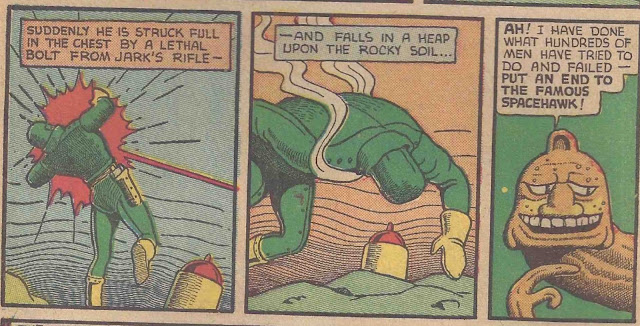
    Jark makes a go at taking care of Spacehawk with his atom rifle but it’s simply not enough firepower and he ends up mashed to a pulp.

    Zorg, building on his deceased partner’s efforts, seems to succeed where Jark failed, and further managed to unmask the Spacehawk to reveal that he was a robot the whole time!

    OR WAS HE? No, he wasn’t. Instead, the Spacehawk turns out to be a man with a collection of robot doubles that can substitute for him or otherwise aid him in his crusade against evil. Zorg ends up joining his partner in whatever afterlife that ding-dong aliens get and Spacehawk gets a smooch.

  • GENERIC COSTUMED VILLAIN ROUND-UP 021

    Another truckload of half-baked mooks for your viewing pleasure.

    The otherwise-normal gangsters who have gotten ahold of a piece of superscience and are using it for crime are an important part of the super-hero comic ecosystem. Here is a wonderful example of such in the form of a gang who have access to disintegrator ray pistols and are using them like regular guns during a bank robbery. Fantastic stuff. The Invisible Avenger hits them with a train. (Superworld Comics 002, 1940)

    He may be a mere hold-up man in a bandit mask (surely the lowest tier of costumed villainy until the invention of putting a nylon stocking on your head) but I am very pleased to tell you that this fellow’s real name is Solo Mogart. Also that he eventually gets beaten up by the Raven. (Sure-Fire Comics 002, 1940)

    This fairly nondescript gang of generically foreign spies have access to an invisible fighter plane and the best thing they could think to use it for was smuggling people into the US. Baffling! They make the mistake of tangling with flying cadet Lucky Byrd and end up in the slammer. (Target Comics v1 003, 1940)

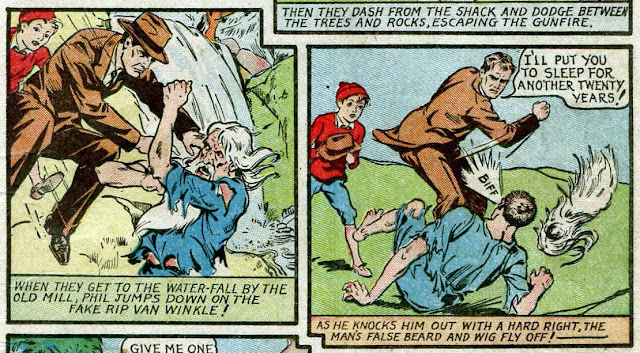
    This fellow is pretending to be Rip van Winkle or an analogous long-term sleeper for some reason related to moonshining. Maybe the full plot is interesting enough to be an entry on its own but sadly the extant copy of this comic is missing the first few pages of this story and so I have very little idea what is going on. He gets beat up and tossed in the clink thanks to crusading reporter Phil Manners. (Target Comics v1 003, 1940)

  • MINOR SUPER-VILLAIN 789: THE GRAND DICTATOR

    (Sure-Fire Comics 003a, 1940)

    The Grand Dictator, aka Miko, is on a mission to conquer the US, and he’s doing it from a cool flying fortress. Miko and his men are probably intended to be at least Nazi-adjacent, but they don’t really come off that way, at least as compared with their contemporaries. I mean, sure, they’ve got the uniforms and the attitude, but where are the dimwitted goons named Hans and Franz shouting “Jah, jah!” as they scuttle off to commit civilian atrocities?

    The Grand Dictator’s forces really stand out in the coolness of their military tech, including these very imposing flame guns…

    The aforementioned flying fortress (including the terrific detail that the GD’s forces have solved the problem of how to make something huge in the sky look like a cloud by stapling cotton batting to the bottom like it’s a prop in an elementary school play)…

    And in a bit of a combination of the first two, some fairly impractical-looking flame throwing planes.

    We’re still quite early in the career of Flash Lightning, and so he’s still kind of finding his level with regards to the relative power of he and his opponents. Case in point: the main challenge that Lightning faces in this issue is in getting his companion on the lower right to safety, after which he destroys the Grand Dictator’s entire operation with one big lightning bolt.

  • MINOR SUPER-VILLAIN 782: ERIC MACFADDEN

    (Superworld Comics 001, 1940*)

    Eric MacFadden is a criminal scientist who has some sort of longstanding beef with Hip Knox, the Super Hypnotist, that was presumably covered in Superworld Comics 001, a comics I have yet to encounter for the simple reason that it would cost me at least $ 2000 US.

    MacFadden’s signature technology is the extremely stylish mesh anti-hypnosis mask that he wears to protect him from Hip Knox’s super-hypnotism, and he even has extras made to shield his men from the same (not a guarantee from your typical self-obsessed super-villain), making them the Mask Gang.

    As Superworld Comics represents Hugo Gernsback’s sole foray into comic book publishing, people more familiar with the politics and personalities of the sci-fi pulps than I am have speculated that Eric MacFadden is in some way based on Bernarr Macfadden, an enemy of Gernsback’s, and I gotta say that he’s a plausible guy to base a super-villain on. Like, obviously a man’s whole life cannot be summed up by his Wikipedia article, but an anti-medicine physical culture weirdo who gave himself the name “Bernarr” because he thought it sounded like a lion’s roar is at the very least super-villain adjacent.

    If MacFadden is indeed based on Macfadden (he also changed his last name from “McFadden” to “Macfadden” because he thought that it was “a more masculine spelling!) due to a deep Gernsback/Macfadden beef then it would go a long way toward explaining the dynamic between the two, wherein MacFadden attempts to destroy Hip Knox and then Knox turns around and ritually humiliates MacFadden rather than seeking more traditional forms of justice, and for that reason Eric MacFadden joins the ranks of super-villains who are still at large as of their final appearance.

    I would also like to make a special note of the fact that despite Hip Knox developing anti-mask technology in Superworld Comics 002, MacFadden does not then abandon the masks entirely, as is so frequently the case with science villains when their tech is countered. MacFadden is savvy – he knows that Knox isn’t going to wear that big-ass backpack every time he leaves the house.

    *Still haven’t read Superworld Comics 001 but I am assured that he was in it.

  • MINOR SUPER-VILLAIN 776: THE BLUE SPARK

    (Super-Mystery Comics v1 002, 1940)

    In terms of crime, the Blue Spark is ambitious but not extraordinary: a little corporate extortion, some bank robbery, a few kidnappings. Nothing we haven’t seen a few hundred times by now.  When it comes to the trappings of super-villainy, however, the Blue Spark is on the cutting edge.

    Just look at that costume – it’s not quite the standardized super-villain getup we will eventually see on so many one-shot Batman villains but it’s pretty damn close, and particularly in an era in which most villains are still pairing a mask with a suit and tie or a robe. Even more impressive and ahead of its time is the Blue Spark’s choice to dress his henchmen in a simplified version of his own uniform. Just really impressive stuff.

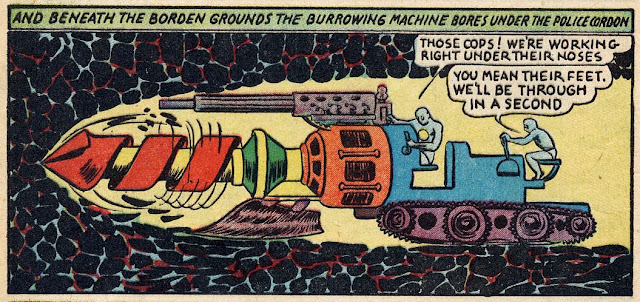
    The Blue Spark’s main gimmick, a heat ray cannon mounted on a truck, isn’t quite as remarkable but it is a pretty sweet bit of gear. Plus he has another one mounted on a cool-ass drilling machine!

    (it is somewhat unclear if the Blue Spark has a second ray that allows him to mind control people or if his heat ray doubles as a mind control ray, and determining this is not helped by the fact that he clearly has an aesthetic fondness for that particular style of scientific greebling on the outside of the rays. It’s a good clean visual on the mind control ray, I will say that)

    The Blue Spark’s henchmen (called the Blue Rubber Men at one point, btw) are not just well-dressed:  their costumes have  little nozzles in the chest that lets them be inflated like a balloon to render them immune to fisticuffs  – another idea that sounds like something out of a Silver Age comic, twenty years early.

    Technology or no, inflation fetish suits or no, the Blue Spark vs Magno is your classic case of a villain who is so little of an even match for the hero that the plotter’s concern must lie in keeping them apart for as long as possible because the instant they meet up, something like the above happens. Magno didn’t even give him a chance to blow up his suit, the poor guy.

  • MINOR SUPER-VILLAIN 776: THE BLUE SPARK

    (Super-Mystery Comics v1 002, 1940)

    In terms of crime, the Blue Spark is ambitious but not extraordinary: a little corporate extortion, some bank robbery, a few kidnappings. Nothing we haven’t seen a few hundred times by now.  When it comes to the trappings of super-villainy, however, the Blue Spark is on the cutting edge.

    Just look at that costume – it’s not quite the standardized super-villain getup we will eventually see on so many one-shot Batman villains but it’s pretty damn close, and particularly in an era in which most villains are still pairing a mask with a suit and tie or a robe. Even more impressive and ahead of its time is the Blue Spark’s choice to dress his henchmen in a simplified version of his own uniform. Just really impressive stuff.

    The Blue Spark’s main gimmick, a heat ray cannon mounted on a truck, isn’t quite as remarkable but it is a pretty sweet bit of gear. Plus he has another one mounted on a cool-ass drilling machine!

    (it is somewhat unclear if the Blue Spark has a second ray that allows him to mind control people or if his heat ray doubles as a mind control ray, and determining this is not helped by the fact that he clearly has an aesthetic fondness for that particular style of scientific greebling on the outside of the rays. It’s a good clean visual on the mind control ray, I will say that)

    The Blue Spark’s henchmen (called the Blue Rubber Men at one point, btw) are not just well-dressed:  their costumes have  little nozzles in the chest that lets them be inflated like a balloon to render them immune to fisticuffs  – another idea that sounds like something out of a Silver Age comic, twenty years early.

    Technology or no, inflation fetish suits or no, the Blue Spark vs Magno is your classic case of a villain who is so little of an even match for the hero that the plotter’s concern must lie in keeping them apart for as long as possible because the instant they meet up, something like the above happens. Magno didn’t even give him a chance to blow up his suit, the poor guy.

  • MINOR SUPER-VILLAIN 756: THE MOLE

    (Smash Comics 017, 1940) 

    The Mole is an eccentric inventor who has developed one of the all-time greatest examples of technology that would net more safe profit if marketed for industrial purposes than if used for crime: the drilling machine. Rather than approaching the mining or construction industreis, the Mole opts for the rush inherent in stealing high-value, hard-to-fence objects like the unspecified crown jewels on display in New York’s Maiden Lane.

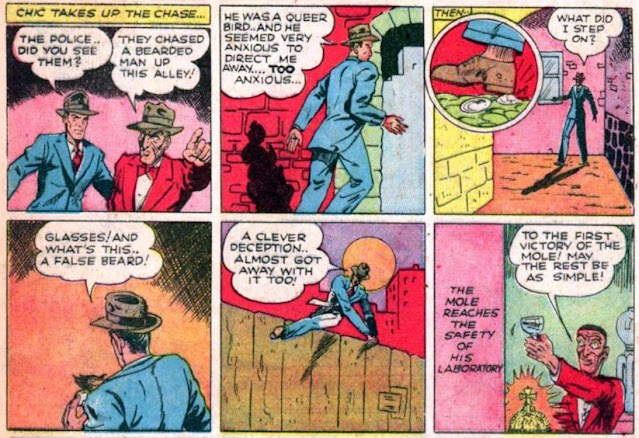
    In addition to the sheer digging power of his boring machine, the Mole’s plan involved showing up at the crown jewels exhibition in disguise and casting a lot of suspicion on himself, thus leading to the police wasting their time in searching for a nonexistent bearded man. I was going to spend some time roasting him for going to all this trouble to establish a false identity while wearing a very distinctive red suit and bow tie, but a) it totally works and b) the far more roastable offense is including this ruse in the first place, as it’s the only thing that ties him to the actual crime.

    Even so, the Mole is on track to get away with his crimes, until  he compounds them by littering. Crack reporter Chic Carter gets the break that he’s looking for when he is reminded that false beards exist by literally stepping on one, and once that happens it’s all over: all Chic has to do is beat up a single nerd and he’s solved the case and netted a free drilling machine in the process.