The Curse of Skeleton Munroe

Category: super vehicle

  • MINOR SUPER-VILLAIN 740: THE DEATH BATTALION

    (Smash Comics 007, 1940)

    You’re going to have to trust me because I have gathered no evidence, but I can state with some confidence that the American people of late 1939/early 1940 had a great deal of (perhaps wishful) hope in the effectiveness of the French Maginot Line, right up to the point at which the Nazis did an end run around it and into France. A fair number of war comics of the time (like the adventures of Corporal Collins, for example) feature defenses of the Line (or fictional versions of the Line) from the advancing Axis. Perhaps the most interesting version of this Maginot Line fandom is the concept of the US defending itself via “the Caldwell Line,” a series of floating fortresses running from Canada to Tierra del Fuego, if the caption box is to be believed (the floating fortress is another frequently referenced Golden Age idea that I have no other examples of beyond “dude, trust me”).

    The Axis powers (still creeping up to the line of just saying Nazis) respond to this defensive superiority by deploying their finest spies, under the leadership of Madame la Coquin here. And since the greatest enemy of the spy in America is Black X (in a Black X comic, at least), la Coquin and her cadre start their campaign by hatching a plot to kill him.

    As is usually the case in plots to preemptively murder the protagonist of a comic, this proves to be a very bad idea. The Black X manages to fake his own death with the help of a handy psychic illusion (courtesy of his aide Batu) and uncovers the whole operation, namely a secret underground base from which Madame la Coquin and her Death Battalion comrades plan to attack the Caldwell Line using manned torpedoes. An insane plan!

    Black X manages to foil the suicide runs of the first two Death Battalion members by radioing their positions to the US Coast Guard, but finds himself unable to do so when la Coquin takes out the final torpedo herself, because they are very horny for one another. And he almost saves her! Oh Black X, are you ever going to find love in the arms of someone who isn’t an enemy agent?

    (in one of my patented unproveable theories about comics published before my father was born, I reckon that la Coquin was originally going to be our old friend Madame Doom but they didn’t want to blow her up)

  • GENERIC COSTUMED VILLAIN ROUND-UP 019

    We may have gotten away from the “costumed” and “generic” is debatable but you can take the “villain” from my cold dead hands. 

    This guy is part of a gang who:

    -broke into Fort Knox via a secret tunnel

    -smashed up up all of the gold and mixed it into stone in a nearby quarry

    -transported that gold-bearing stone from the quarry to a mansion

    -melted down the gold and concealed it inside a series of bronze statues

    And while I suppose that you want to take a lot of care to conceal your movements when you are looting the US gold reserve I just have to be on record as saying that this is an unnecessarily complex scheme. Just book it for the border, fellows!

    Also Dynamo, stung by the razzing of government investigators, gilds the entire gang… thus killing them? before turning them in. Brutal stuff. (Science Comics 002, 1940)

    This very cool looking but unnamed spy chief has developed anti-Dynamo technology that renders him immune to the various beams and rays that usually assail the hero’s foes, which he uses to make off with some explosive wire that Dynamo and the nerds at his day job have made. He pulls off this theft pretty slickly but then completely fails to recognize the difficulty of attempting to pull off a scheme (in this case blowing up US military installations using explosive wire) while a super-hero is after you. It’s a real failure to recognize the opportunity to slay Dynamo while he can’t get you, unnamed spy chief! (Science Comics 004, 1940)

    John J. Hix, millionaire and asylum escapee, needs to get revenge on his old friend for some reason, so he puts on a cloak that makes him look like the ghost of a cat and hires some crooks to kidnap his friend’s daughter Doris Dare (a “society deb singer,” which is not a type of entertainer I am familiar with. Was it a thing? It’s hard to tell!) so that he can kill her. He is opposed by heroic police inspector the Duke and ends up blowing himself up rather than be captured. (Silver Streak Comics 002, 1940)

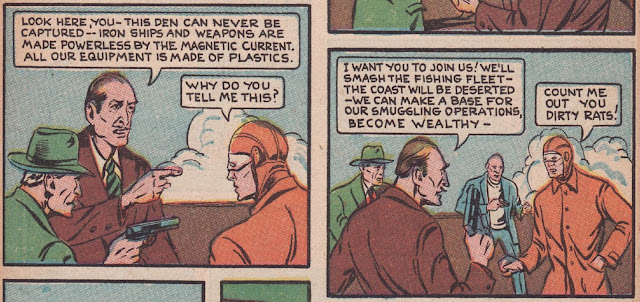
    The Sky Wolf encounters this goofy-but-also-cool magnetically-shielded fire-breathing duck/dragon/plane as it attacks fishing boats one day and traces it back to a similarly magnetically-shielded base where crooks armed with plastic guns inform him that all of this is essentially prep work in advance of setting up a smuggling operation.

    Now, issues of whether the expense involved in setting up this operation might cut substantially into any profits realized from it or indeed whether simply selling this magnetic bullet shield to one of the many armies extant in 1940 might be more profitable aside… my admittedly layman’s understanding of how smuggling works is that you really want to keep it as quiet as possible. Maybe I’m naive, but establishing a huge messy monster-infested exclusion zone might just… draw more attention to your operation? Like a masked pilot, for example? 

    Anyway, they all get blown up. (Silver Streak Comics 006, 1940)

  • GENERIC COSTUMED VILLAIN ROUND-UP 019

    We may have gotten away from the “costumed” and “generic” is debatable but you can take the “villain” from my cold dead hands. 

    This guy is part of a gang who:

    -broke into Fort Knox via a secret tunnel

    -smashed up up all of the gold and mixed it into stone in a nearby quarry

    -transported that gold-bearing stone from the quarry to a mansion

    -melted down the gold and concealed it inside a series of bronze statues

    And while I suppose that you want to take a lot of care to conceal your movements when you are looting the US gold reserve I just have to be on record as saying that this is an unnecessarily complex scheme. Just book it for the border, fellows!

    Also Dynamo, stung by the razzing of government investigators, gilds the entire gang… thus killing them? before turning them in. Brutal stuff. (Science Comics 002, 1940)

    This very cool looking but unnamed spy chief has developed anti-Dynamo technology that renders him immune to the various beams and rays that usually assail the hero’s foes, which he uses to make off with some explosive wire that Dynamo and the nerds at his day job have made. He pulls off this theft pretty slickly but then completely fails to recognize the difficulty of attempting to pull off a scheme (in this case blowing up US military installations using explosive wire) while a super-hero is after you. It’s a real failure to recognize the opportunity to slay Dynamo while he can’t get you, unnamed spy chief! (Science Comics 004, 1940)

    John J. Hix, millionaire and asylum escapee, needs to get revenge on his old friend for some reason, so he puts on a cloak that makes him look like the ghost of a cat and hires some crooks to kidnap his friend’s daughter Doris Dare (a “society deb singer,” which is not a type of entertainer I am familiar with. Was it a thing? It’s hard to tell!) so that he can kill her. He is opposed by heroic police inspector the Duke and ends up blowing himself up rather than be captured. (Silver Streak Comics 002, 1940)

    The Sky Wolf encounters this goofy-but-also-cool magnetically-shielded fire-breathing duck/dragon/plane as it attacks fishing boats one day and traces it back to a similarly magnetically-shielded base where crooks armed with plastic guns inform him that all of this is essentially prep work in advance of setting up a smuggling operation.

    Now, issues of whether the expense involved in setting up this operation might cut substantially into any profits realized from it or indeed whether simply selling this magnetic bullet shield to one of the many armies extant in 1940 might be more profitable aside… my admittedly layman’s understanding of how smuggling works is that you really want to keep it as quiet as possible. Maybe I’m naive, but establishing a huge messy monster-infested exclusion zone might just… draw more attention to your operation? Like a masked pilot, for example? 

    Anyway, they all get blown up. (Silver Streak Comics 006, 1940)

  • MINOR SUPER-VILLAIN 734: THE ROBOT MASTER

    (Silver Streak Comics 004, 1940)

    We open on a flashback, as this unnamed scientist and Captain Ken Keen of the Planet Patrol reminisce about the Comet of Death which has returned to the Solar System 100 years after it initially laid waste to the cities of Earth, Mars and Venus. And since the adventures of the Planet Patrol unlike many if not most Golden Age sci-fi comics is set in a defined time period, we know that that initial attack took place in the futuristic world of 1965 CE!

    Back in the even more futuristic world of 2065 CE, Keen and his Martian companion Nirma set out to investigate the comet, only to discover that it is in fact an enormous hostile spacecraft. Making their way inside, they find it to be crewed by extremely cool-looking octopoid “robot animals” that attack on sight.

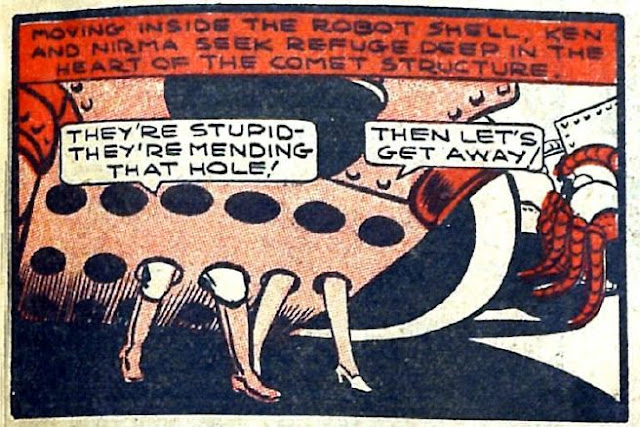
    Keen and Nirma get away from the robots in the objectively funny way of climbing inside a disabled one and sticking their feets out the bottom to scuttle way, tentacles dragging.

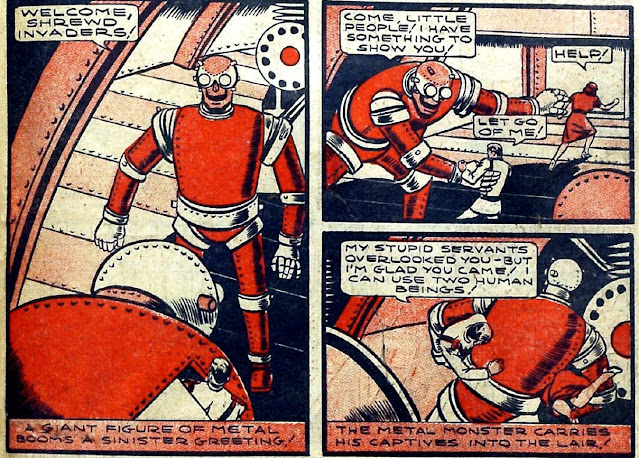
    This robot disguise is unfortunately not enough to fool the comet-ship’s owner, who turns out to be a huge, very cool-looking, robot with a human brain. This Robot Master (referred to as such in exactly one caption, but I have to call them something, don’t I?) is a Fletcher Hanks-style villain who hates humanity for unclear reasons and expresses that hate via attempted genocide. The 1965 attempt having failed, the Robot Master is back again for a second pass.

     
    Since the previous attempt to destroy humanity via drive-by death ray, the Robot Master seems to be gearing up for a more nuanced second approach, and is starting by converting Nirma and Keen to remote controlled cyborgs and sending them back as espionage assets. The rest of the plan is never elaborated upon, as Ken Keen’s cage is conveniently located within reach of a switch labelled “FOR MAGNETIC POWER” but which might as well say “PULL TO DEFEAT THE ROBOT MASTER” as it turns out to magnetize the entire ship in a way that completely immobilizes the ship’s robotic occupants. Keen and Nirma then escape and blow the entire place to high(er) heaven.

  • MINOR SUPER-VILLAIN 715: THE STEEL SHARK

    (Rocket Comics 001, 1940)

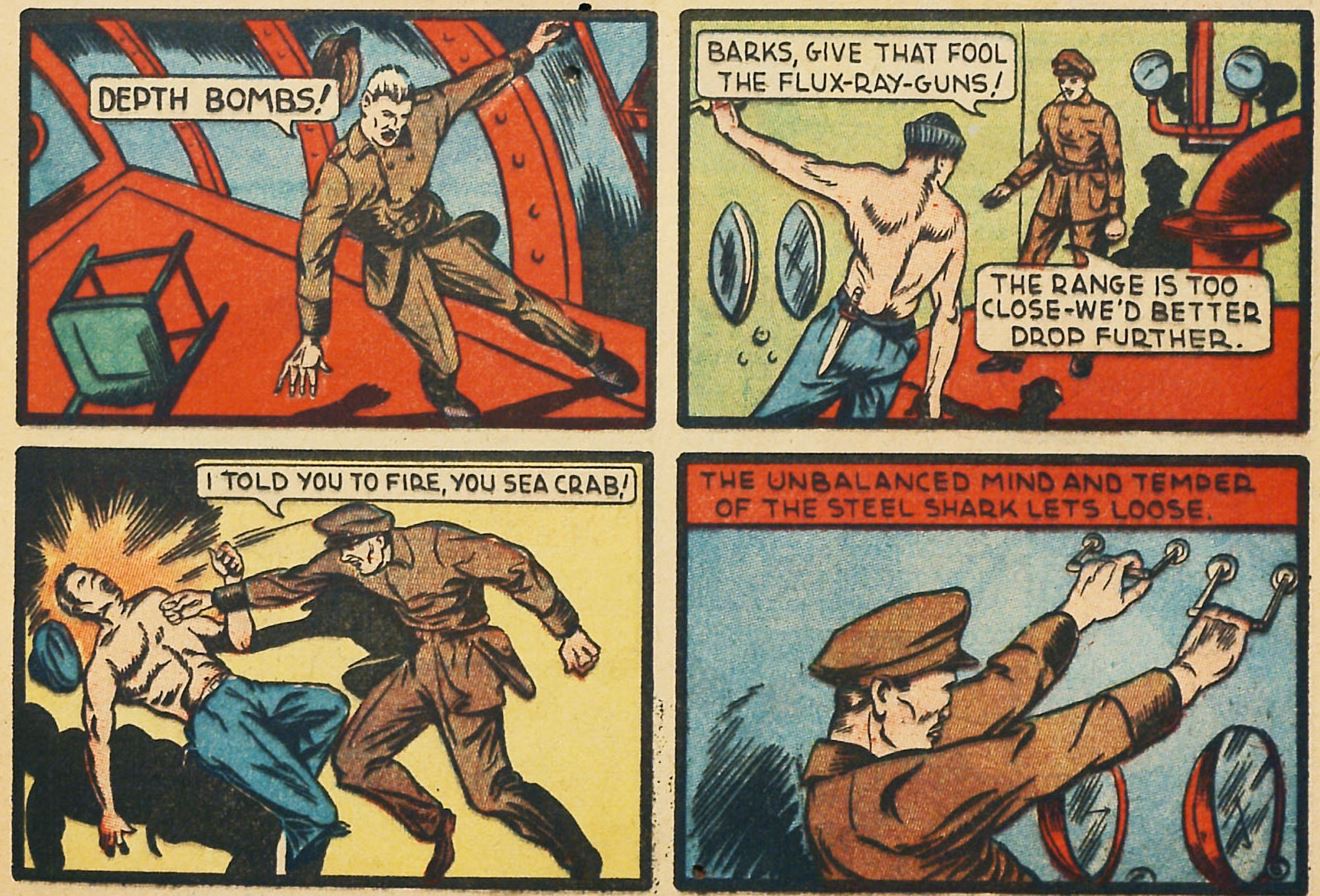
    The Steel Shark has a couple of distinctive notes right off the bat. Firstly, he is part of the elite society of villains who star in their own series and secondly that series is set in the far future world of the year 1960 CE, for no particular reason as far as I can tell. Indeed, I suspect that the people working on the strip did not themselves remember that is was set in the future as early as the second instalment but without some explicit indication of such I’m going to assume that all Steel Shark stories are set in the Swinging Sixties.

    The Steel Shark himself is a satisfyingly weird looking weirdo, right down to his weird green skin. After engaging in some submarine piracy using his vessel’s high-powered heat ray, he sets upon the idea of abducting the daughter of the governor of Monango Island, and does so handily after using unspecified technology to put the entire island into a deep sleep.

    (it’s not quite a calling card but I must take a second to point out this whimsical little detail: after the Steel Shark attempts to bash in the sleeping head of Lieutenant Dick Jones, his future nemesis, he leaves behind a… bruise? scab? in the shape of a submarine. Does the Steel Shark have a cool raised carving of a submarine on the butt of his revolver or has Fate stepped in to mark the pursuer with the sign of the pursued?)

    In a sad turn, the second and third instalments of the Steel Shark’s adventures are illustrated by a different hand, and though he continues to be an unstable madman he no longer looks like someone 2/3 of the way through a zombie metamorphosis. By his third outing even most of the high-tech accoutrements have fallen by the wayside and Lt Jones is merely having to contend with ordinary run-of-the-mill submarine piracy. Still: good name, good MO (submarine pirates is one of the best kinds of pirates) and of course it’s always fun when a villain’s series ends before they themselves are actually dealt with. Somewhere out there in th 1960s the Steel Shark even now.

  • MINOR SUPER-VILLAIN 715: THE STEEL SHARK

    MINOR SUPER-VILLAIN 715: THE STEEL SHARK

    (Rocket Comics 001, 1940)

    The Steel Shark has a couple of distinctive notes right off the bat. Firstly, he is part of the elite society of villains who star in their own series and secondly that series is set in the far future world of the year 1960 CE, for no particular reason as far as I can tell. Indeed, I suspect that the people working on the strip did not themselves remember that is was set in the future as early as the second instalment but without some explicit indication of such I’m going to assume that all Steel Shark stories are set in the Swinging Sixties.

    The Steel Shark himself is a satisfyingly weird looking weirdo, right down to his weird green skin. After engaging in some submarine piracy using his vessel’s high-powered heat ray, he sets upon the idea of abducting the daughter of the governor of Monango Island, and does so handily after using unspecified technology to put the entire island into a deep sleep.

    (it’s not quite a calling card but I must take a second to point out this whimsical little detail: after the Steel Shark attempts to bash in the sleeping head of Lieutenant Dick Jones, his future nemesis, he leaves behind a… bruise? scab? in the shape of a submarine. Does the Steel Shark have a cool raised carving of a submarine on the butt of his revolver or has Fate stepped in to mark the pursuer with the sign of the pursued?)

    In a sad turn, the second and third instalments of the Steel Shark’s adventures are illustrated by a different hand, and though he continues to be an unstable madman he no longer looks like someone 2/3 of the way through a zombie metamorphosis. By his third outing even most of the high-tech accoutrements have fallen by the wayside and Lt Jones is merely having to contend with ordinary run-of-the-mill submarine piracy. Still: good name, good MO (submarine pirates is one of the best kinds of pirates) and of course it’s always fun when a villain’s series ends before they themselves are actually dealt with. Somewhere out there in th 1960s the Steel Shark even now.

  • GENERIC COSTUMED VILLAIN ROUND-UP 017

    GENERIC COSTUMED VILLAIN ROUND-UP 017

    Buncha mooks this time.

    The ship that picked up scientist-adventurer Dean Denton and his pals from the island of Baron Blood just so happened to have a pseudo-Nazi spy (fake name Lieutenant James, code name K-192, real name unknown) committing murders on it for unclear reasons. Despite composing a crime scene to contain nothing but clues pointing to other members of the crew Denton rounds him up pretty quickly. (Masked Marvel 003, 1940)

    Pilot Prop Powers has to defend his ship and his cargo of gold bullion from this air pirate and his scurvy crew, and the story ends up glossing over his huge flying aerodrome a bit. Well, I think it’s cool, unnamed air pirate captain. I’m sorry they blew it up. (National Comics 001, 1940)

    Klotz, aka the Master Spy, has the distinction of being the first foe to battle the Shield. His greatest moment is pictured above, as the Shield is so absorbed in reading spy files that he doesn’t notice approximately fifty boxes of TNT being piled up behind him. Klotz also returns in the 1984 series The Original Shield because there’s nothing like battling an extremely old man to make for an exciting comic experience. (Pep Comics 001, 1940)

    This bunch of clowns work for a mysterious figure who has been murdering Hollywood stars in connection with a jewel-smuggling ring. They’re not in the story for very long before their employer murders them all with mustard gas – the henchman’s greatest occupational hazard is, as always, the boss. Why do all these murders over some simple smuggled jewelry? Because the mastermind is Biff Crossley, himself a famous actor, and he wants nobody who can possibly tie him to the crime left alive, that’s why. (Pep Comics 008, 1940)

    THE SUPER-VILLAINS OF HOLLYWOOD PODCAST: The super-villainy might be a bit generic but this story is fodder for a whole season of tSVoHpod: Crossley murders two other stars (one of them inside Grauman’s Chinese Theatre, using a bullet-firing compact) and tries to frame a third by pretending to be a target himself, he bumps off his own men, the Shield is there, and the whole thing ends with Crossley’s defiant suicide. Sensational! This is podcasting, baby!

  • FASCIST GOON CLEARING HOUSE 008

    Will they ever mend their evil ways?

    Like the Purple Shirts before them, the Black Legion exists mainly to represent the Forces of Unamericanism that Uncle Sam stands against, as they seek to win the hearts and minds of in this case the small Midwest community of Glen Valley (by shooting anyone who resists). The only real bit of innovation that they bring to the table are these rad machine gun motorcycles they go into battle on.

    They also have a nose cutout on their masks, which indicates that they prioritize comfort over style. (National Comics 005, 1940)

    The unnamed group that Uncle Sam fights in the next issue has a similar uniform in warm brown tones, and makes the interesting choice to wear it even while operating their submersible aircraft carrier base in the middle of the Pacific Ocean. That’s some real dedication to secrecy. (National Comics 006, 1940)

    The European-American Band, yet another take on the German-American Bund, is deceived and then dismantled in fairly short order by vacationing cartoonist-detective Pen Miller. (National Comics 006, 1940)

    No comic book analog of the German-American Bund is particularly kind in its depiction but the Moronia Bund might just be the most insulting. I’m not sure why all the Moronian Americans are bald – it doesn’t seem to be a requirement for entry as Perry “the Press Guardian” Chase is able to join up as a junior member to spy on them despite his luscious black locks. (Pep Comics 002, 1940)

    (surprisingly, the Moronia Bund – under the slightly more sleek name “the Moroniabund” manages to scrape up another bunch of bald fascists to make a second appearance in Pep Comics 003, but gets its ass just as thoroughly kicked by the Press Guardian as the first time)

  • FASCIST GOON CLEARING HOUSE 008

    Will they ever mend their evil ways?

    Like the Purple Shirts before them, the Black Legion exists mainly to represent the Forces of Unamericanism that Uncle Sam stands against, as they seek to win the hearts and minds of in this case the small Midwest community of Glen Valley (by shooting anyone who resists). The only real bit of innovation that they bring to the table are these rad machine gun motorcycles they go into battle on.

    They also have a nose cutout on their masks, which indicates that they prioritize comfort over style. (National Comics 005, 1940)

    The unnamed group that Uncle Sam fights in the next issue has a similar uniform in warm brown tones, and makes the interesting choice to wear it even while operating their submersible aircraft carrier base in the middle of the Pacific Ocean. That’s some real dedication to secrecy. (National Comics 006, 1940)

    The European-American Band, yet another take on the German-American Bund, is deceived and then dismantled in fairly short order by vacationing cartoonist-detective Pen Miller. (National Comics 006, 1940)

    No comic book analog of the German-American Bund is particularly kind in its depiction but the Moronia Bund might just be the most insulting. I’m not sure why all the Moronian Americans are bald – it doesn’t seem to be a requirement for entry as Perry “the Press Guardian” Chase is able to join up as a junior member to spy on them despite his luscious black locks. (Pep Comics 002, 1940)

    (surprisingly, the Moronia Bund – under the slightly more sleek name “the Moroniabund” manages to scrape up another bunch of bald fascists to make a second appearance in Pep Comics 003, but gets its ass just as thoroughly kicked by the Press Guardian as the first time)

  • MINOR SUPER-VILLAIN 686: COUNT ZONGARR

    (Pep Comics 003, 1940)

    Someone has been using super-fast jet planes to mine New York Harbor and the Shield wants to know why, and not just because he happened to be on one of the ships that was exploded as a result. He manages to grab onto one of the planes the next time they come around and finds out first hand that they are not only super fast but able to convert into submarines as well. And that their home base is a very cool Art Deco-ish city in an underwater cavern!

    The mastermind of this whole scheme turns out to be Count Zagnarr, exiled munitions manufacturer. Just why he has been exiled (and from where) is left unexplored, nor do we learn why he is believed dead. We do however learn the reason for his mining campaign: he is attempting to draw the US into WWII in the hopes of swooping in and taking over once all sides have sufficiently weakened one another. A classic scheme for a reason, even if we in retrospect can see where it would have had a pretty slim chance of working.

    Despite being plausibly dead, Count Zongarr acquits himself well when confronted with a patriotic superhuman and manages to take the Shield down using a poison gas gun. The weakened Shield (this issue marks the first Pep Comics indication that he powers are not all suit-based but internal but we’ll have to wait for my read of Shield-Wizard some time in early 2025 for the full retcon) is then loaded into a huge mine and dropped off near a shipping lane to be blown to high heaven.

    Here is where other technologically -inclined crooks could learn a couple of lessons from Count Zongarr. Lesson 1: Don’t leave even a weakened and bound enemy somewhere where they have access to wires or other delicate components. Or buttons or switches, for that matter.

    Lesson 2 is a bit specific but I reckon you could extrapolate. If your plan hinges on the use of sound-activated explosives then don’t for example keep them in a room where the sound that activates them can reach them, such as an open radio connection to the outside world. This is where the loosey-goosey Libertarian nature of a lot of super-villain operations comes into play – a proper OSHA audit would have those mines disarmed when not in use and stored in a soundproofed area.