The Curse of Skeleton Munroe

Category: super vehicle

  • MINOR SUPER-VILLAIN 686: COUNT ZONGARR

    (Pep Comics 003, 1940)

    Someone has been using super-fast jet planes to mine New York Harbor and the Shield wants to know why, and not just because he happened to be on one of the ships that was exploded as a result. He manages to grab onto one of the planes the next time they come around and finds out first hand that they are not only super fast but able to convert into submarines as well. And that their home base is a very cool Art Deco-ish city in an underwater cavern!

    The mastermind of this whole scheme turns out to be Count Zagnarr, exiled munitions manufacturer. Just why he has been exiled (and from where) is left unexplored, nor do we learn why he is believed dead. We do however learn the reason for his mining campaign: he is attempting to draw the US into WWII in the hopes of swooping in and taking over once all sides have sufficiently weakened one another. A classic scheme for a reason, even if we in retrospect can see where it would have had a pretty slim chance of working.

    Despite being plausibly dead, Count Zongarr acquits himself well when confronted with a patriotic superhuman and manages to take the Shield down using a poison gas gun. The weakened Shield (this issue marks the first Pep Comics indication that he powers are not all suit-based but internal but we’ll have to wait for my read of Shield-Wizard some time in early 2025 for the full retcon) is then loaded into a huge mine and dropped off near a shipping lane to be blown to high heaven.

    Here is where other technologically -inclined crooks could learn a couple of lessons from Count Zongarr. Lesson 1: Don’t leave even a weakened and bound enemy somewhere where they have access to wires or other delicate components. Or buttons or switches, for that matter.

    Lesson 2 is a bit specific but I reckon you could extrapolate. If your plan hinges on the use of sound-activated explosives then don’t for example keep them in a room where the sound that activates them can reach them, such as an open radio connection to the outside world. This is where the loosey-goosey Libertarian nature of a lot of super-villain operations comes into play – a proper OSHA audit would have those mines disarmed when not in use and stored in a soundproofed area.

  • MINOR SUPER-VILLAIN 685: SATAN

    MINOR SUPER-VILLAIN 685: SATAN

    (Pep Comics 002, 1940)

    Dateline: Florida! A huge and monstrous face has begun appearing in the clouds across the state to demand fealty! Coincidentally, armoured cars have been disappearing up and down the peninsula at about the same time as the facial appearances.

    The Comet is of course intrigued by this coincidence and decides to investigate. Plotting out the robberies on a map, he proceeds to the swamp located at the central point, and I’ve just realized that it’s a good thing that he’s right because the first thing he does is kick a man into the water and steal his boat and that would be a very embarrassing thing for a super-hero to have done to ,e.g., an innocent game warden. It’s no problem, though, because the guy was in fact an agent of Satan.

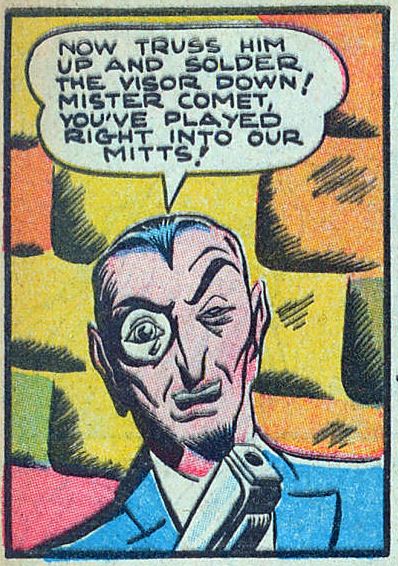
    Satan turns out to be a pretty cagey character: not only does he have a way of dealing with snoopers (dragging their boats through a whirlpool into his sub-swamp lair, as happens to the Comet) but he’s got an impressive level of knowledge of current super-hero news. He knows just who the Comet is and more importantly how to neutralize his major offensive ability, by welding his protective eye mask shut. And this is only the Comet’s second case!

    The mystery of both the monster in the clouds and the disappearing armoured cars, by the way, come down to the same thing: that old favourite, the mighty dirigible. One dirigible equipped with a high-powered projector and loudspeaker and a second with a powerful electromagnet, to be precise – as one is distracting everyone with a big face, the other is making off with the car and the cash (and the unfortunate driver and guards).

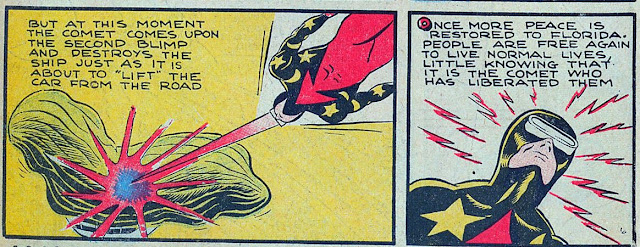
    Back to the Comet: Satan’s anti-super-hero savvy extends only so far. Despite his acumen in capturing the Comet and neutralizing his power, Satan has fallen prey to the super-villain’s hubris by leaving him to die in a deathtrap rather than merely shooting him in the head. You see, the really important thing about the Comet’s visor is that it’s just a sheet of glass and thus easily breakable, which the Comet does by the simple expedient of headbutting a rock. After that, it’s just a matter of utterly obliterating not only both dirigibles but the entire swamp base. Satan is toast.

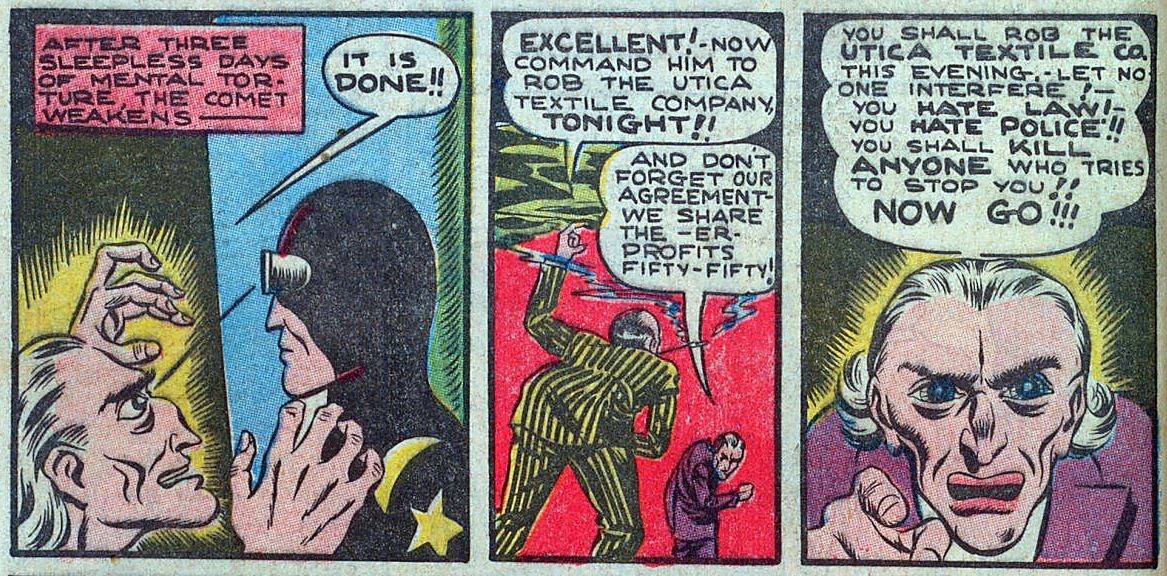
    OR IS HE? In a shock twist, Satan returns in Pep Comics 003 and manages to capture the Comet again, this time taking the trouble to pop him into a glass tube and thus completely neutralizing his powers! (and also delighting me personally, because the name Satan is very ambiguously used in his first appearance and I really appreciated this confirmation that it really is his nom du crime. For my records).

    Satan’s got big plans for the Comet – no cheesy deathtrap this time, no sir. Instead, he brings in put-upon hypnotist Doc Zadar in order to put the Comet to work for him.

    And this isn’t your namby-pamby “can’t be forced to violate your deeply-held morals” hypnotism, this is the real hard-core shit. The Comet goes on a destructive and violent crime spree under Satan and Zagnar’s direction. Notably, this is when he kills a whole bunch of cops, which informs the rest of his Golden Age career by making him one of the few super-heroes who the police have some real justification for constantly trying to gun down (I mean, they still shouldn’t just be trying to execute him in the street, but it’s nice to see them doing it for a reason other than “he’s running away from me even though I’m threatening to kill him!”)

    Once again Satan is undone by his own hubris: this time his failure to see that cheating and abusing the man who controls the actions of a living death ray generator might be a bad idea, and he gets gruesomely dissolved for his mistake. Unfortunately for Zagnar, he forgets the first rule of owning a living death ray generator: always put the safety cap back on. He too is dissolved and the Comet is free to have cops try to gun him down in the street forevermore.

    BONUS: All this Comet talk had me feeling nostalgic and I looked up 1983’s The Comet 001, which I had as a kid. It’s a pretty maudlin book primarily concerned with the Comet castigating himself over what a violent and murderous vigilante he was, and the splash page reflects this via the floating ghosts of the dead who haunt him – note all the cops from Pep Comics 003 at the top there. But just who is that at the lower left?

    I am 75+% certain that this is the monster face that Satan was projecting onto the clouds in Pep 002, which is a pretty hilarious thing to be haunting a depressed 80s super-hero. “I contributed to the death of the airship as a viable mode of transport when I murdered those dirigibles!”

    (the real if boring answer is that it probably is the face from the clouds but, as Satan himself is never actually pictured in the severely abridged version of the story in this comic, the face is being retconned into being his)

  • MINOR SUPER-VILLAIN 681: BARON HOFF

    (National Comics 006, 1940)

    Here’s what Baron Hoff brings to the table: 1. Scale. Hoff’s goal in this comic is to rob one (1) bank, and as a distraction from that crime he sets the entire island of Manhattan on fire.

    2. Look. Not only does he have a striking face and a killer grin but Baron Hoff has a real flair for villainous fashion. Some might balk at accentuating an aviator’s outfit with a monocle and jodhpurs and big puffy sleeves but he really makes it work. The only real misstep in his look is the toothbrush mustache, which pairs misleadingly with the pseudo-military brown outfit to make you think he’s some sort of Hitler analog. Do not waste your time: Hoff is not fascist, he just has poor taste in facial hair.

    3. Ride. I love an auto-gyro, and the fact that Baron Hoff not only flies around in one but uses its blades as a deadly obstacle to those seeking to enter the bank while he’s robbing it is just a bit of a bonus.

    Anyway, Hoff is up against super-speedster Quicksilver and such things as whirling blades of death mean nothing to such a fast man. Hoff is jailed in record time.

  • MINOR SUPER-VILLAIN 681: BARON HOFF

    (National Comics 006, 1940)

    Here’s what Baron Hoff brings to the table: 1. Scale. Hoff’s goal in this comic is to rob one (1) bank, and as a distraction from that crime he sets the entire island of Manhattan on fire.

    2. Look. Not only does he have a striking face and a killer grin but Baron Hoff has a real flair for villainous fashion. Some might balk at accentuating an aviator’s outfit with a monocle and jodhpurs and big puffy sleeves but he really makes it work. The only real misstep in his look is the toothbrush mustache, which pairs misleadingly with the pseudo-military brown outfit to make you think he’s some sort of Hitler analog. Do not waste your time: Hoff is not fascist, he just has poor taste in facial hair.

    3. Ride. I love an auto-gyro, and the fact that Baron Hoff not only flies around in one but uses its blades as a deadly obstacle to those seeking to enter the bank while he’s robbing it is just a bit of a bonus.

    Anyway, Hoff is up against super-speedster Quicksilver and such things as whirling blades of death mean nothing to such a fast man. Hoff is jailed in record time.

  • MINOR SUPER-HERO ROUND-UP 030

    Some real obscurities from the Hillman House of Ideas:

    the Sky Wizard:

    The Sky Wizard is an otherwise-unnamed super-scientist who seemingly dresses in his futuristic super suit 24/7. There’s not too much else to him other than that because he’s one of those characters who has so many gadgets and gizmos that all the narrative focus goes to them rather than him. A partial list: wing suits, super planes, super strength serum (the amazingly named “powerstrength formula”), a paralyzing Q-Ray gun…

    … and by far the coolest of the Sky Wizard’s accessories, his laboratory base, the grounds of which are composed of the elastic metal rubberium and which can be filled with helium so that the entire estate becomes a mobile floating island. (Miracle Comics 001, 1940)

    Dash Dixon:

    Dash Dixon works for an unnamed police department in an unnamed city in an undefined role (he is described only as a “top athlete with the police force” in his first appearance), Assigned to protect one Dr Lorenz and succeeding in doing so, Dixon is rewarded with a chance to be the subject of an experiment in which he is injected with “perpetual life rays” which render him super strong, at least partially invulnerable and presumably immortal.

    To counter the fact that the ray would seep out of Dixon’s body within 24 hours, Lorenz equips him with a suit of pliable metal that he will presumably have to wear for the rest of his presumably immortal existence. Two things about this suit:

    1. Dr Lorenz has a fantastic look with his lab getup and green dome helmet. Why Dixon’s suit is charitably Very Bad Looking is beyond me.

    2. It might not be clear from this picture but the suit includes a haircut-shaped black helmet held on by a strap. It can thus be implied that the ray will leak out of Dash Dixon’s scalp but will not do so from his face and hands.

    Frankly the whole suit thing gives me mild anxiety. If I were Dash Dixon I might just opt to receive my immortality treatment daily.

    One last thing about Dash Dixon is that the first issue seems to imply that he exists in a near future world with air taxis and commuter rockets but it doesn’t really come up otherwise. A mystery for the ages. (Miracle Comics 001, 1940)

    the Scorpion:

    A regular-style two-fisted vigilante, hated and feared by the underworld, occasionally wanted by the police, etc. The real thing that makes the Scorpion (aka Hal Ward) stand out is that he doesn’t really bother with a mask or any other way to not be immediately recognized by all of his mortal enemies. (Miracle Comics 001, 1940)

    Blanda the Jungle Queen:

    Blanda the Jungle Queen really lives up to her name by being the most by-the-book version of the White Goddess style of jungle adventurer, right down to the fact that she immediately abandons her adoptive people and their ways in a wave of horniness the second that a mediocre white guy hoves into view. (Miracle Comics 001 1940)

  • MINOR SUPER-VILLAIN 615: SANGLOR

    (Fantastic Comics 007, 1940)

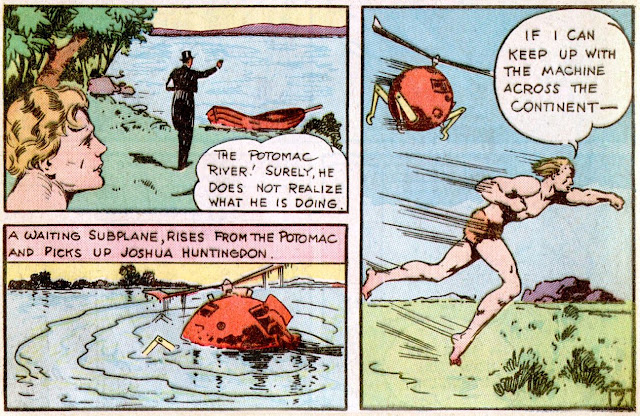
    Sanglor starts out strong. He immediately charms me with his aesthetic sense: his ‘Automatic Subplane’ spy drones are delightful, his ‘Flying Castle’ is simultaneously one of the most ridiculous and great-looking mobile bases I have ever seen and his costume manages to evoke the dress sense of a 1940s comic book movie villain in a way I have not seen since the Vampire, almost exactly 300 entries ago.

    He manages to mess things up almost immediately, of course. His plan is to take over the world by hypnotizing key politicians and diplomats etc., and then presumably induce them to shift the reins of political power his way. This is the kind of scheme that requires some degree of care to set up – you have to get all of your assets in place without causing undue suspicion, so having them for example act all weird and then disappear is problematic. People are noticing your plan, Sanglor.

    This is the first evidence of what I will call Sanglor Self-Sabotages. This one seems to stem from the fact that Sanglor works completely solo, without even a weird little lab assistant to test his hypnotic ray on to see if it makes people freak out in noticeable ways before using it in a sensitive espionage operation.

    The big upshot of this Sanglor Self-Sabotage is that Samson is on the case basically the instant that the scheme is put in motion

    The second Sanglor Self-Sabotage is an extension of the first: he has no real defenses. Once Samson makes his way to the Flying Castle his only real opposition is a crowd of tuxedo-clad diplomats flailing away with their soft fists.

    Sanglor does think to call out his drone army to deal with the intruder but they don’t seem to even be armed, despite their little gun barrels – they just fly at Samson until he smashes them all.

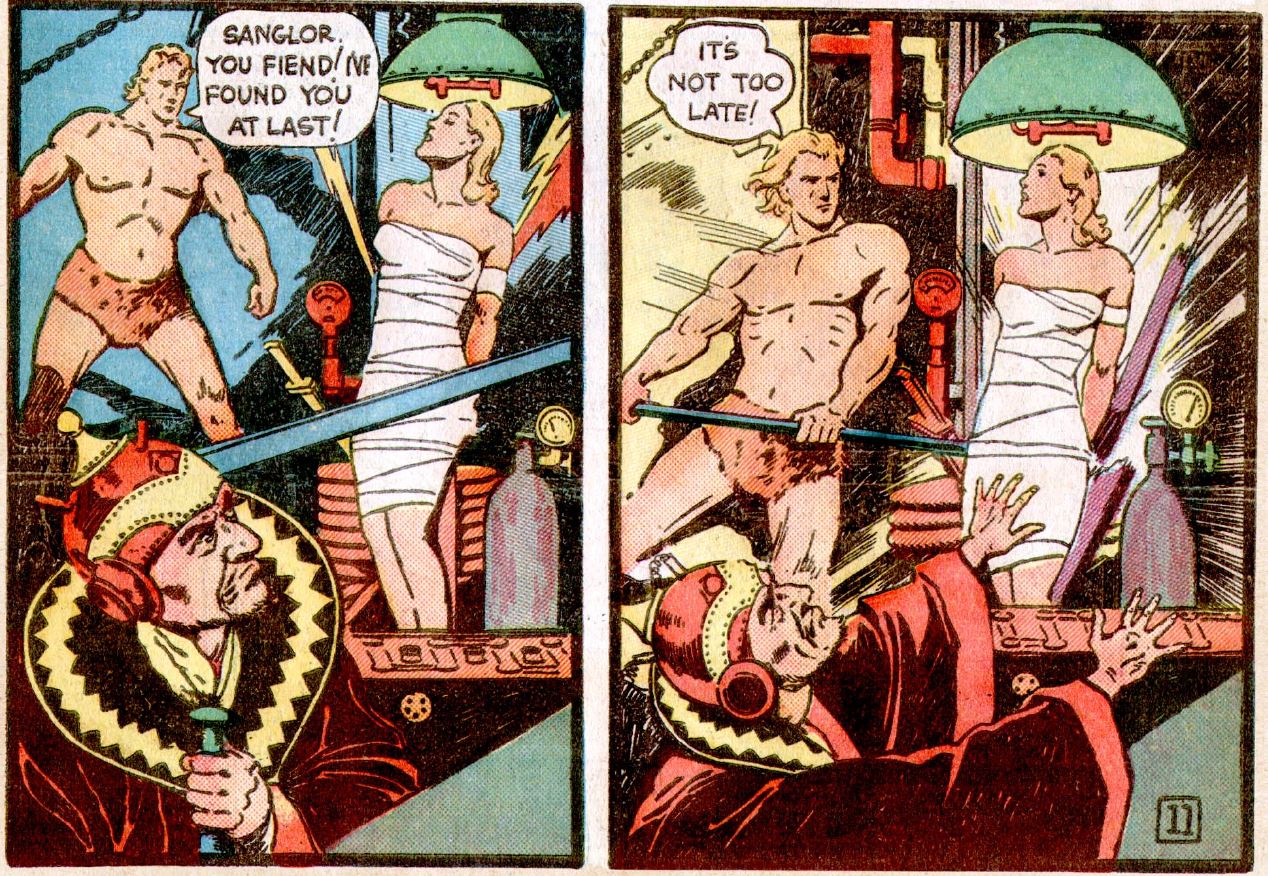
    The really big final Sanglor Self-Sabotage is revealed once Samson bursts into his inner sanctum: Sanglor is too busy being a weird creep to actively manage the defense of his headquarters. It’s not exactly clear what he’s doing with this young woman or who she is (it’s unlikely to be Miss Royce, a politician’s daughter in England and the only named female character in the story) but it’s real creep shit and it’s an unnecessary distraction from the approaching vigilante.

    Sanglor is probably still distracted as he flees through an industrial section of his base, because he can’t even run correctly – he manages to heave himself off what looks to be a pretty solid catwalk into the first available cauldron of boiling chemicals.

    I think that ultimately Sanglor serves as an object example of the need for villains to do a couple of trial runs before attempting world domination. If he’d attempted to take over a county or a small business first, maybe some of these kinks would’ve been worked out.

  • MINOR SUPER-VILLAIN 615: SANGLOR

    MINOR SUPER-VILLAIN 615: SANGLOR

    (Fantastic Comics 007, 1940)

    Sanglor starts out strong. He immediately charms me with his aesthetic sense: his ‘Automatic Subplane’ spy drones are delightful, his ‘Flying Castle’ is simultaneously one of the most ridiculous and great-looking mobile bases I have ever seen and his costume manages to evoke the dress sense of a 1940s comic book movie villain in a way I have not seen since the Vampire, almost exactly 300 entries ago.

    He manages to mess things up almost immediately, of course. His plan is to take over the world by hypnotizing key politicians and diplomats etc., and then presumably induce them to shift the reins of political power his way. This is the kind of scheme that requires some degree of care to set up – you have to get all of your assets in place without causing undue suspicion, so having them for example act all weird and then disappear is problematic. People are noticing your plan, Sanglor.

    This is the first evidence of what I will call Sanglor Self-Sabotages. This one seems to stem from the fact that Sanglor works completely solo, without even a weird little lab assistant to test his hypnotic ray on to see if it makes people freak out in noticeable ways before using it in a sensitive espionage operation.

    The big upshot of this Sanglor Self-Sabotage is that Samson is on the case basically the instant that the scheme is put in motion

    The second Sanglor Self-Sabotage is an extension of the first: he has no real defenses. Once Samson makes his way to the Flying Castle his only real opposition is a crowd of tuxedo-clad diplomats flailing away with their soft fists.

    Sanglor does think to call out his drone army to deal with the intruder but they don’t seem to even be armed, despite their little gun barrels – they just fly at Samson until he smashes them all.

    The really big final Sanglor Self-Sabotage is revealed once Samson bursts into his inner sanctum: Sanglor is too busy being a weird creep to actively manage the defense of his headquarters. It’s not exactly clear what he’s doing with this young woman or who she is (it’s unlikely to be Miss Royce, a politician’s daughter in England and the only named female character in the story) but it’s real creep shit and it’s an unnecessary distraction from the approaching vigilante.

    Sanglor is probably still distracted as he flees through an industrial section of his base, because he can’t even run correctly – he manages to heave himself off what looks to be a pretty solid catwalk into the first available cauldron of boiling chemicals.

    I think that ultimately Sanglor serves as an object example of the need for villains to do a couple of trial runs before attempting world domination. If he’d attempted to take over a county or a small business first, maybe some of these kinks would’ve been worked out.

  • MINOR SUPER-VILLAIN 593: THE INVINCIBLE FIVE

    (Exciting Comics 006, 1940)

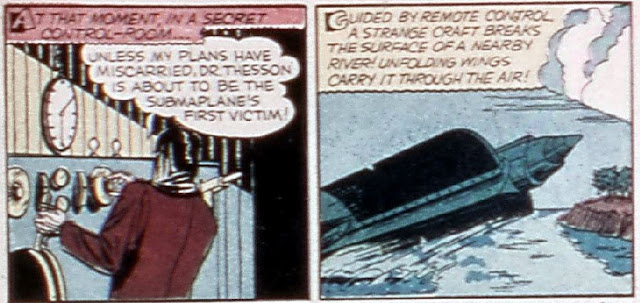
    The Invincible Five (good name!) are a mysterious group of hooded men who have been kidnapping skilled mechanics across the US in order to construct a fleet of vehicles known as Submaplanes.

    If you guessed that a Submaplane was either a submarine capable of flight or and airplane capable of operating underwater then give yourself a pat on the back because it is the former. Submaplanes also have some sort of electric forcefield, an electric ray cannon and appear to be remote controlled from a central location.

    Having seemingly done away with John “Son of the Gods” Thesson, whom they view as their only credible opposition, the Invincible Five proceed with their master plan: world conquest through intimidation and mass destruction. Various governments are given the opportunity to surrender peacefully then given the business when they refuse.

    (side note: these are some good hoods on the Invincible Five. The simple faces sketched on the front are a nice change from all of those regular-style hoods we usually see)

    Unsurprisingly, the leader of the Invincible Five is Burton, the sour-faced industrialist who turns up to advise FDR to surrender. Presumably at least some of his companions are also in on the scheme.

    It turns out that it was a good idea to try to kill John Thesson, because he ends up single-handedly taking down the entire operation by the simple expedient of punching people and things until the Submaplanes are grounded and the Invincible Five are in hand. Remember: if the only thing that stands between you and complete world domination is one person and you’re pretty sure that they’re dead: double check.

  • MINOR SUPER-VILLAIN 589: THE TANKONAUT

    (Exciting Comics 005, 1940)

    Stretching the definition of “super-villain” to the very limits here: the Tankonaut is a superweapon developed by US arms manufacturer M.V. Gage under contract to a man who is very clearly meant to be Hitler but is referred to only as the Dictator. Whether this would have qualified as treason in mid-to-late 1940 is beyond me but the next part, where the Tankonaut is tested on US targets (including Washington DC!) extremely is.

    Not only does the Tankonaut have an excellent name (100% the only reason it made the grade as an entry here, even under my already very loose policies about super-vehicles) but it has a neat gimmick: it isn’t a tank at all! Rather, it is a big beefy truck that carries around its own armour plating and weaponry for rapid deployment/ quick and sneaky escape! It’s a neat variation on the old “drive the crime vehicle into the back of a truck” scheme for the truck to actually be the crime vehicle.

    Unfortunately for M.V. Gage and the Tankonaut, John Thesson, the Son of the Gods, is on the case. He discovers the Tankonaut’s secret identity of A Truck by the simple expedient of flipping it over with a long pole. As usual, once the super vehicle has been disabled the non-super humans are quickly rounded up.

  • MINOR SUPER-VILLAIN 571: THE YELLOW SPIDER

    (Champion Comics 004, 1940)

    Champion Comics 003 featured the murder of the Champ’s mentor Dr Marlin and at the conclusion of that adventure the blame for Marlin’s death seemed to rest squarely on the shoulders of his assistant Dr Katsu. Champion Comics 004, however, introduces a further development: Katsu was in fact working for a greater mastermind, the Yellow Spider!

    (and here I’m going to contrast my usual delight at a villainous note signed with a little cartoon with my deep sighs as I say that yes, the Yellow in Yellow Spider is 100% a racist thing. Early Champion Comics issues are even more comfortable with using racist tropes for their villains than the rest of the comics industry, and that’s saying something)

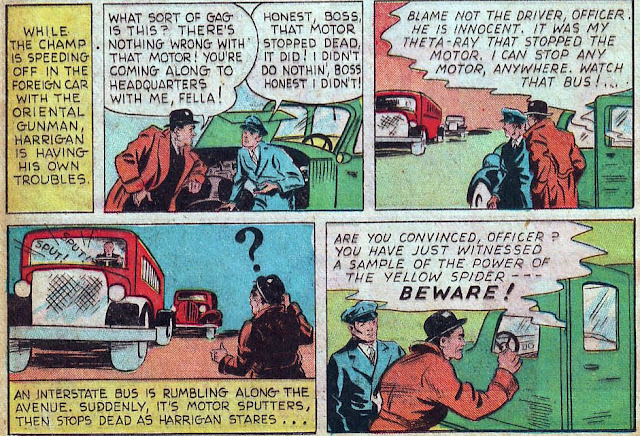
    The Yellow Spider is big on indirect action. Beyond employing goons to do his dirty work he also uses engine-killing rays and cuts in on radio and telephone signals to orchestrate events at a distance, such as his successful kidnapping of the Champ here, followed by his doing a solid for the unnamed police officer who was supposed to be driving him around.

    The Champ is brought to the Yellow Spider’s dirigible/ base, where he eventually learns that the Spider is in fact this one little guy who has popped up a couple of times previously as an agent of what turns out to be himself. It’s not explicit but quite possible he wants formula because he is puny (spoiler: much later it turns out that Dr Katsu pulled a double cross and had the formula all along. This Yellow Spider/ Champ beef is all a huge waste of everyone’s time).

    As the Champ was summarily evicted from the Yellow Spider’s dirigible at the end of issue 4, Champion Comics 005 is almost entirely concerned with busywork. To whit:

    -the Champ learns to fly a plane

    -the Champ and his pal Bird Kelly attack the dirigible, too late remember about the engine killing ray and are knocked out of the sky

    -the Champ travels back to Midwest University to talk to a ray expert

    -the ray expert is stranded on a mountain; the Champ must go rescue him

    -in consultation with the expert, the Champ crafts ray shielding for his plane

    -the Champ and Bird Kelly go back up in a now-shielded plane

    -the Champ STILL has to go on the dirigible and wreck the ray because it also explodes gunpowder and they only brought grenades for some reason

    -the Champ hops back over to his plane and explodes the dirigible, killing the Yellow Spider

    I will say that the Champ expressing some remorse over having killed an evil man (or at least not being up to watching the carnage) is a real departure for the Golden Age. Lotta righteous killing going on back then.