The Curse of Skeleton Munroe

Category: super vehicle

  • MINOR SUPER-HERO ROUND-UP 015

    Once again we take you to the world of the minor super-hero. See them dance for your amusement. 

    the Mystic: 

    Later known as Kardak the Mystic, the Mystic is a stage magician who uses stage magic to battle crime, specializing in fraudulent mediums etc. His stage magic eventually gets rounded up to real magic, of course. (Top-Notch Comics 001, 1939)

    the Phantom o’ the Hills:

    The Phantom o’ the Hills is an otherwise unnamed masked cowboy who rights wrongs in the Old West. In his first adventure he avenges the death of his younger brother but whether that’s what got him into the vigilante game is not elaborated on. The only real thing that sets him apart from the ranks of other similar characters is his better-than-average name. (Western Picture Stories 001, 1937)

    Wonder Man:

    For all that (by some accounts) Will Eisner was explicitly told to make a Superman clone when he made him for Fox Features (and that DC successfully sued Fox into canning him), Wonder Man is only kind of like Superman. Maybe it’s my modern image of what Superman is like but he’s just a strong guy who jumps around catching artillery shells and beating up warmongers. Plus he gets his powers from a magic Tibetan ring! Plus he’s blonde! (Wonder Comics 001, 1939)

    Yarko the Great:

    There are three major things to know about Yarko the Great: 

    1. He’s a magic-slinging hero in the classic mold, i.e., an American who has learned the secrets of the Far East and turned them to a career in stage magic/ crimefighting.

    2. Like a lot of early Fox Features characters he was created by Will Eisner so his adventures tend to look pretty great.

    3. “Yarko the Great” is – and this is an informed opinion – categorically the worst name that any magic-using Golden Age hero was saddled with. 

    (Wonder Comics 002, 1939)

    Yarko UPDATE 1940

    *UPDATE* the Flame *UPDATE*:

    Just wish to draw everyone’s attentions to the really boss custom-painted boat that the Flame was tooling around in during his first adventure. Plus he had a butler named Jarvis! (Wonderworld Comics 003, 1939)

    **DOUBLE UPDATE**

    And he has a plane! (Wonderworld Comics 004, 1939)

  • GENERIC COSTUMED VILLAIN ROUND-UP 011

    Some say they’re not generic enough but I think they’re trying their best.

    This fellow is part of a gang looking to hijack a shipment of railway guns from train engineer Runaway Ronson. I really enjoy the look of the padded suit they use to help survive crashing a car into a high-speed train but I really really enjoy the fact that they immediately scramble off into the woods and are never seen again, as if they were completely unrelated to the criminal plot. (Blue Bolt v1 007, 1940)

    This fellow’s a pseudo-Nazi spy named Ketler who goes up against Sub-Zero in an attempt to influence the very specific Torpedo Workers Union into striking and hindering part of the US defense program. I feel like he overestimates the usefulness of the mask as he doesn’t change anything else about his appearance when not murdering people but that’s not what gets him caught so I guess I’m the fool here.(Blue Bolt v2 002, 1941)

    Colourful enemy aces are the best/ only tolerable part of the absurd number of Golden Age comics about pilot-adventurers, so my little ears pricked up when American-flying-for-the-French Loop Logan was challenged to a dogfight by a Nazi called the Blue Duke but… there’s nothing to him. He’s just a guy with a name who’s been sabotaging French planes and shooting them down. Waste of a good name, if you ask me. (several days later note: it took me an embarrassingly long time to realize that this guy’s name was a play on the Red Baron) (Blue Ribbon Comics 004, 1940)

    These guys briefly terrorize New York (possibly – we have another instance of a city that is Clearly New York City But the Mayor is Wrong) with a futuristic tank mounted with a death ray. If they a) had a name and b) weren’t completely demolished by Mr Justice in about three panels they might have made the leap to full Minor Super-Villain status but as it stands they’re an object lesson in why ultra-powerful ghosts need a tougher class of enemy to be really entertaining. (Blue Ribbon Comics 010, 1941)

  • MINOR SUPER-HERO ROUND-UP 007

    All Novelty Press edition!

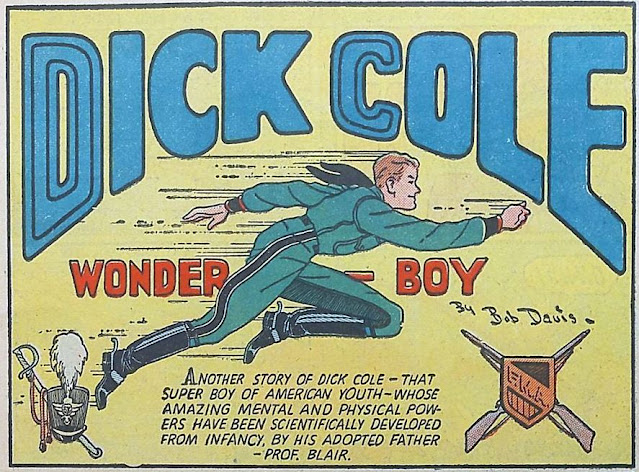
    Dick Cole, Wonder-Boy: 

    Dick Cole was left on the front steps of scientist Professor Blair as a baby, and according to him there was an accompanying note requesting that he use his hitherto-untested experimental child-rearing techniques to bring the kid up to be superhuman. And it works! Dick Cole is stronger and faster and smarter than everyone else, and works to help those around him in whatever way he can.

    Sadly for me the Dick Cole series is set at a military academy, a surprisingly popular location in early comics. I think that the weird pseudo-military class structure that such places had/have was popular for the easy drama inherent in the noble protagonists being forced to kowtow to undeserving upperclassmen but reading comics about teenagers being assholes to each other for imaginary reasons palls quickly. (ADDENDUM: I wrote this at the beginning of my Dick Cole reading and am pleased to say that the military academy stuff isn’t as bad as it is in other comics of the time) (Blue Bolt v1 001, 1940)

    BONUS: here’s Dick Cole as a very cool baby.

    Sub-Zero:

    AKA Sub-Zero Man. Part of a Venusian expedition to Earth whose extremely awesome looking spaceship crashed through a frozen gas ball en route, killing everyone but Our Hero, who instead becomes uncontrollably and destructively super-cold.

    After a couple of issues of misunderstood wandering and being hunted, Sub-Zero endears himself to the city of Centro… Oregon? by saving it from a volcano. (highway signs place Centro somewhere between Los Angeles and Topeka, so it’s probably either Oregon or Northern California, and Oregon is closer to volcano country). There, he settles down to a regular super-hero life, albeit one with no secret identity, Centro slowly becomes NYC like so many other comic book cities and people basically forget the fact that he’s an alien. (Blue Bolt v1 001, 1940)

    the Phantom Sub: 

    A bunch of young men led by Jack Damon and Slim Dugan construct an advanced submarine in secret, as you do, and end up as wanted fugitives dispensing justice on the high seas via an electrified water cannon and some plucky attitudes. (Blue Bolt v1 001, 1940)

    Near the end of 1941 the Phantom Sub added the power of flight to its many features, and shortly after that the Phantom Sub crew were able to come in from the cold and begin aiding the US war effort. (Blue Bolt v2 006, 1941)

    the White Rider and Super Horse:

    During a stagecoach holdup, a youngster named Peter (no last name given) is orphaned and flung into a river that eventually flows into the mysterious Lost Valley, where he befriends and is raised by an old hermit named Jeb and a cool horse named Cloud. Eventually, the hermit dies of puma and Peter and Cloud make their way to the outside world where it turns out that due to the valley’s depth it somehow had more gravity and thus the two are super strong. Anyhow, Peter immediately hunts down and kills the bandit who orphaned him and resolves to stamp out crime as the White Rider and Super Horse. 

    Despite the superpowers the White Rider is a bit of a dud, hero-wise and Super Horse does most of the heavy lifting, both literally and metaphorically. (Blue Bolt v1 001)

  • MAD AND CRIMINAL SCIENTIST ROUND-UP 007

    The mad scientists are usually up to something criminal, but the criminal scientists are often completely rational.

    Like a fair few of the scientists I speak of here, Dr Hayles here talks a big game but gets caught in the planning stages before he has the chance to prove to the world that he was right all along. In Hayles’ case it was kidnapping a bunch of boys that got him in trouble and operating on young boys’ brains in order to make them geniuses that he never got to prove before he was corralled by Marvelo, Monarch of Magicians. (Big Shot Comics 002, 1940)

    This here Count Alexis fellow is an agent of an unspecified foreign power who employs his extremely cool fleet of giant flying magnifying glasses in an attempt to destroy Boston. This, in turn, will cow the States into serving said unnamed country. It’s a bit of a flimsy plan, especially once you see Skyman beat the tar out of the mere two men operating one of the lenses and using that lens to melt the other four three (almost forgot that he captures two of them, as well as Count Alexis himself) 

    Count Alexis also lives in Vermont and is 100% the only villain on this blog as it currently stands to do so. Congratulations, Vermont! You made it! (Big Shot Comics 007, 1940)

    This unnamed scientist developed a steerable electrically-charged tornado called a “Force-Top” and attempted to extort the US into buying it but got pinched by Jeff Cardiff, Spy-Chief basically as soon as he put his plan into motion. (Big Shot Comics 007, 1940)

    As far as ways to extort the US (in this case into acclaiming Our Villain here as dictator), freezing entire cities solid isn’t a bad way to go, and Norgo goes for some big targets after his initial test freeze of a Florida beach: Boston, Chicago, San Francisco, St Louis and Washington DC. He might have gotten in with a chance if it hadn’t been for Skyman completely owning his plan and unfreezing all the cities in about half an hour – though the fact that he does so by exploding balls of “atomic power” over each city is at least a bit concerning. (Big Shot Comics 008, 1940)

  • MINOR SUPER-HERO ROUND-UP 005

    All Columbia Comic Corporation edition!

    Skyman: 

    Skyman (properly the Skyman but it just doesn’t scan for me) is a pilot hero, normally a ho-hum sort of character for me. But between his sci-fi super plane (the Wing), his blood-freezing stun ray (the Stasimatic) and his cool on-the-edge-of-being-too-busy costume there’s just enough super-hero peanut butter mixed in with the pilot chocolate to make it appealing (bonus running list of Skyman’s super science: atomic explosives, invisible glass phonograph, disitegrator ray, explosives-detonating ray and a ray that fuses gun barrels shut)

    After a few issues we learn that the Skyman is actually Allan Turner, wealthy good-for-nothing playboy who lost his parents to a plane crash when he was a child. If the Bruce Wayne parallel was 1:1 he would have grown up to become a noted slayer of planes, but that’s a villain’s origin. Instead, Allan Turner dresses up as a plane to fight criminals. It doesn’t make quite as much narrative sense as Batman does but it’s probably more fun to read than the other way around.

    Early Skyman also might just hold the record for the most overinflated torso in comics outside of parody characters. He gets a bit more proportional eventually but for a while there you’re concerned for his ability to live a normal life.

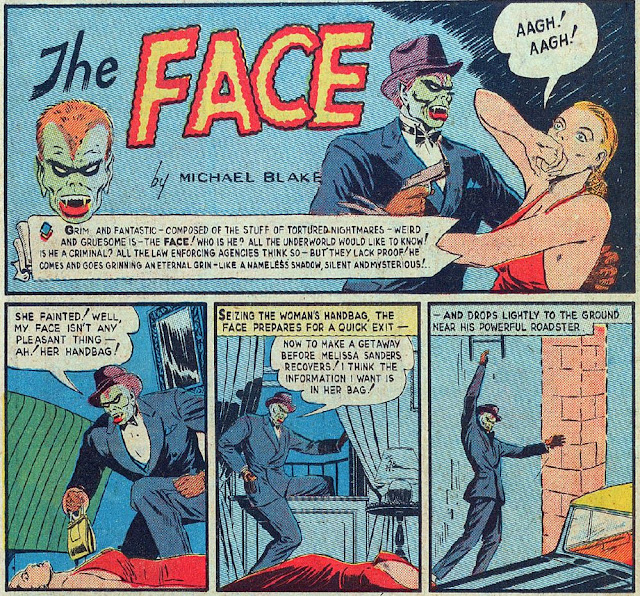
    the Face:

    The Face, like a lot of early comics heroes, draws a lot of elements from the pulps: a tuxedo-clad hero drives around in a souped up roadster fighting crime with his fists and an automatic – a pretty regular early super-guy. Even his secret identity of Tony Trent, radio station owner/ radio announcer is in the pulp-adjacent character wheelhouse.

    It was very exciting to me when I realized that the Face’s face is frequently referred to as a rubberoid mask, my favourite term for the kind of masks that only exist in comic books – perfectly realistic and naturalistic but also very easy to don and doff. This particular mask was made specially for Tony Trent by someone whose other major characteristic is being dead, which is apparently a combination that makes Trent feel quite jolly.

    Weirdly, in Big Shot Comics 006, the Face has a new, slightly less grotesque mask. No word on where he got this one but he goes back to the original pretty quickly.

    Marvelo, Monarch of Magicians:

    Created by Fred Guardineer, who also created Zatara over at DC Comics, Marvelo is… extremely similar to Zatara. Aside from their different approaches to dressing like a stage magician, I’d say that there are two slight differences between the characters: 

    1. Rather than speaking backward to cast spells, Marvelo shouts “Kalora!” as an all-purpose magic word.

    2. Marvelo’s manservant Zee is just a hair more racist than Zatara’s manservant Tong. It’s pretty close but I reckon Zee takes it.

    Big Shot Comics 017 reveals that Marvelo is the son of the ruler of the generically foreign South Pacific island of Brahama (hell on autocorrect). This doesn’t seem to have anything to do with him being a magic man but it’s nice to know. (Big Shot Comics 001, 1940)

    the Cloak:

    Jeff Cardiff, Spy Chief was a feature in Big Shot Comics from issue 1 (well, it was Jeff Cardiff, Spy-Master for the first issue or two but the point stands) with all kinds of foiled plots and plans and spies of both the vaguely fascist and vaguely communist varieties. In Issue 15, however, the spies adopt the reasonable policy of attempting to shoot on sight the man who has foiled so many of their plans and a wounded Jeff Cardiff goes to recuperate at his brother’s house.

    Long story short, Jed Cardiff is a coal magnate with a collection of “adventure curios”, including the namesake cloak of Revolutionary War-era costumed spy the Cloak and it being 1941 and a comic book, Jeff immediately adopts the Cloak identity as his own. It’s a fairly basic costumed hero shtick but I appreciate the effort and it’s always nice to see a more elaborate cape and cowl getup now and then. (Big Shot Comics 015, 1941)

    The original Cloak eventually shows up in a flashback and it turns out that his impact on the history of the American Revolution is only slightly less impactful than Superboy’s in the 1949 story in which he goes back in time and takes part in about half the major events of the war. I must say that I do love a retcon of a historical event. (Big Shot Comics 021, 1942)

  • MINOR SUPER-HERO ROUND-UP 005

    All Columbia Comic Corporation edition!

    Skyman: 

    Skyman (properly the Skyman but it just doesn’t scan for me) is a pilot hero, normally a ho-hum sort of character for me. But between his sci-fi super plane (the Wing), his blood-freezing stun ray (the Stasimatic) and his cool on-the-edge-of-being-too-busy costume there’s just enough super-hero peanut butter mixed in with the pilot chocolate to make it appealing (bonus running list of Skyman’s super science: atomic explosives, invisible glass phonograph, disitegrator ray, explosives-detonating ray and a ray that fuses gun barrels shut)

    After a few issues we learn that the Skyman is actually Allan Turner, wealthy good-for-nothing playboy who lost his parents to a plane crash when he was a child. If the Bruce Wayne parallel was 1:1 he would have grown up to become a noted slayer of planes, but that’s a villain’s origin. Instead, Allan Turner dresses up as a plane to fight criminals. It doesn’t make quite as much narrative sense as Batman does but it’s probably more fun to read than the other way around.

    Early Skyman also might just hold the record for the most overinflated torso in comics outside of parody characters. He gets a bit more proportional eventually but for a while there you’re concerned for his ability to live a normal life.

    the Face:

    The Face, like a lot of early comics heroes, draws a lot of elements from the pulps: a tuxedo-clad hero drives around in a souped up roadster fighting crime with his fists and an automatic – a pretty regular early super-guy. Even his secret identity of Tony Trent, radio station owner/ radio announcer is in the pulp-adjacent character wheelhouse.

    It was very exciting to me when I realized that the Face’s face is frequently referred to as a rubberoid mask, my favourite term for the kind of masks that only exist in comic books – perfectly realistic and naturalistic but also very easy to don and doff. This particular mask was made specially for Tony Trent by someone whose other major characteristic is being dead, which is apparently a combination that makes Trent feel quite jolly.

    Weirdly, in Big Shot Comics 006, the Face has a new, slightly less grotesque mask. No word on where he got this one but he goes back to the original pretty quickly.

    Marvelo, Monarch of Magicians:

    Created by Fred Guardineer, who also created Zatara over at DC Comics, Marvelo is… extremely similar to Zatara. Aside from their different approaches to dressing like a stage magician, I’d say that there are two slight differences between the characters: 

    1. Rather than speaking backward to cast spells, Marvelo shouts “Kalora!” as an all-purpose magic word.

    2. Marvelo’s manservant Zee is just a hair more racist than Zatara’s manservant Tong. It’s pretty close but I reckon Zee takes it.

    Big Shot Comics 017 reveals that Marvelo is the son of the ruler of the generically foreign South Pacific island of Brahama (hell on autocorrect). This doesn’t seem to have anything to do with him being a magic man but it’s nice to know. (Big Shot Comics 001, 1940)

    the Cloak:

    Jeff Cardiff, Spy Chief was a feature in Big Shot Comics from issue 1 (well, it was Jeff Cardiff, Spy-Master for the first issue or two but the point stands) with all kinds of foiled plots and plans and spies of both the vaguely fascist and vaguely communist varieties. In Issue 15, however, the spies adopt the reasonable policy of attempting to shoot on sight the man who has foiled so many of their plans and a wounded Jeff Cardiff goes to recuperate at his brother’s house.

    Long story short, Jed Cardiff is a coal magnate with a collection of “adventure curios”, including the namesake cloak of Revolutionary War-era costumed spy the Cloak and it being 1941 and a comic book, Jeff immediately adopts the Cloak identity as his own. It’s a fairly basic costumed hero shtick but I appreciate the effort and it’s always nice to see a more elaborate cape and cowl getup now and then. (Big Shot Comics 015, 1941)

    The original Cloak eventually shows up in a flashback and it turns out that his impact on the history of the American Revolution is only slightly less impactful than Superboy’s in the 1949 story in which he goes back in time and takes part in about half the major events of the war. I must say that I do love a retcon of a historical event. (Big Shot Comics 021, 1942)

  • MINOR SUPER-HERO ROUND-UP 004

    the Lone Warrior (and Dicky): 

    The Lone Warrior and Dicky are Stan and Dicky Carter, son of the now-deceased “world’s greatest scientist” and recipients of his Power Elixir injections, leaving them generically physically enhanced and well-equipped to battle pseudo-Nazi forces seeking to wreck America’s military. Plus he made them a land/ air/ sea plane/tank called the Wonder Ship which is very useful.

    There is of course a knee-jerk impulse to snidely point out that a guy called the Lone Warrior is never seen without his sidekick, but… I think it’s on purpose? They don’t explore it well but I reckon that it’s meant to be a joke: big tough dude calls himself the Lone Warrior and can’t avoid being tailed everywhere by his little brother? It’s not a bad joke! Too bad they only had 4 or so appearances and never really explored it. (Banner Comics 003, 1941)

    Samson:

    Samson from the comics is, unsurprisingly, based off of Samson from the Bible. In fact, he’s a descendant of the Biblical Samson, which seems hard to prove. Like his supposed ancestor, Samson possesses superhuman strength as long as his hair remains uncut, which in his case means that he must maintain a sort of shoulder-length mullet. His hair of course frequently gets cut for dramatic effect but luckily for Samson his other super power is that it will grow back preternaturally fast and always into the same style, like Wolverine’s.

    At some point in a comic I have not yet read Samson finds and adopts a boy named David. David has no super-powers and is in constant peril. He also has a scientist pal named Professor Brun who acts as a sort of Samson dispatcher using advanced surveillance tech to find trouble and a teleporter with the fun nmae of the “demoleculing ray” to send Samson and David to the scene.

    Finally, Samson is a stone cold killer. He wipes out crooks by the dozen with a frankly concerning lack of care for the legal process. (Fantastic Comics 001, 1939)

    Late in 1941, Samson got a bit of sprucing up. I don’t know if this was a deliberate attempt on the part of Fox Features to rectify the formulaic nature of Samson comics or it was a simple case of a new artist/ writer shaking things up but suddenly Samson had a supporting cast beyond David: namely a gal pal with the incredibly on-the-nose name of Lila Dee and a comic relief artist named J. Rembrandt Speedball. 

    The best addition, however, was… not exactly a secret identity for Samson but an Incognito Mode in which he dressed in street clothes, but since he was an enormous, long-haired guy what this entails is his wearing a huge overcoat buttoned to the neck with the collar flipped up over his mullet. Truly great. Sadly, this revamped Samson only appeared in a handful of issues before Fox Features had the troubles that lead to them halting production for a few years. Like most of their characters, he was never seen again.

    UPDATES: He really is the descendant of the Biblical Samson (Samson 001, 1940)

    Update 1941 

    the Flame:

    Found by Tibetan lamas as a baby and taught their mystic secrets, the Flame has a lot of the standard flame powers – immunity to fire and heat (and explosions), control over flame, a high enough body temperature that bullets melt on contact with him – a few more unusual ones – the ability to walk and climb on sheets of flame as if they were solid, the weirdly common Golden Age super power of appearing suddenly in the element that they embody, in this case any size flame down to a match – and surprisingly no actual ability to produce flame. Instead, he carries a pistol-sized flamethrower (over time, the amount of heat and flame produced by his body does increase, but he’s never at Human Torch level). The Flame’s enemies of course frequently attempt to set fire to him.

    While I appreciate the Flame’s classic costume stylings, he is ultimately a pretty generic guy. Plus he’s at least as bloodthirsty as his fellow Fox Features alum Samson. (Wonderworld Comics 003, 1939)

    (the Flame also has a very cool car, as seen in Big 3 002, 1940)

    Like Samson, the Flame eventually gets a more fleshed out world just in time for Fox Features to go to heck for a few years and then fail to bring him back. In the Flame’s case he does adopt a secret identity: as Gary Preston, private investigator. He is joined by former boxer and general goofball Pug and future Flame Girl (watch for future round-ups, I guess) Linda Dale.

    Flame UPDATE 1

    Flame UPDATE 2 

    Flame UPDATE 3

    Flame UPDATE 4 

    Stardust the Super Wizard:

    Stardust the Super Wizard is an enormous, nigh-omnipotent fellow who lives in a star and deals out bizarre and ironic punishments to a cartoonishly evil rogues gallery with incredible ease – the only real obstacle that he faces in an average adventure is the travel time between him and his villains. The second-greatest creation of outsider comics artist Fletcher Hanks (after Fantomah, of course), Stardust is well-known enough that I don’t really need to go into much detail on him here but it seemed weird to leave him out. (Fantastic Comics 001, 1939)

  • MAD AND CRIMINAL SCIENTIST ROUND-UP 005

    Just a little crypto-fascist saboteur named Dr Vee who battled Dynamic Man but I like his name and I like his style. His sartorial style. Not the fascism. (Mystic v1 002, 1940)

    Lemo here has a mechanical mole-style tank and reckons he can take over the world with it after almost destroying one (1) circus tent. It’s a good thing he was blown up by one of Marvel’s many Herculeses before he could get too far and get disappointed. (Mystic Comics v1 004, 1940)

    This fellow, known only as the Mystery Man, has been working on the problem of how to counter snipers in warfare, and the scheme that he has come up with involves breeding up vicious wolf-dogs, training them to hate a particular smell and then applying that smell to the shoes of enemy combatants so that the dogs hunt and kill them. There’s a slight problem with this plan that the two crypto-fascist gentlemen that he’s trying to sell this system to don’t seem to come on to, even when he offers to sell them the scent and the dogs and doesn’t mention offering a dedicated group of scent-applying agents (or maybe he had some smaller dogs trained to do the job and he was going to upsell them later).

    The Mystery Man only gets caught because he has been picking up hitchhiking college students and using them to train the dogs and the person responsible for their safety is friends with giant super-hero Mighty Man and long story short the Mystery Man gets eaten by dogs. (Amazing-Man Comics 009, 1940)

    This here unnamed fella has a four-step plan: 

    1. Capture the Iron Skull 

    2. Inject the Iron Skull with a serum that turns him completely to iron

    3. Inject his iron blood into robots to make them alive somehow

    4. Profit

    Steps 1 and 2 go fine but as seen above a major flaw in the plan is that the Iron Skull is now more powerful and mops the floor with his erstwhile captor. The robots don’t even show up! (Amazing-Man Comics 015, 1940)

  • MINOR SUPER-VILLAIN 469: THE GREAT ONE

    (Amazing-Man Comics 013, 1940)

    The Great One is a real testament to the fact that style is far more important than substance when it comes to super-villainy. On a purely objective level the Great One is average at best, with an entry-level costume and a scheme that was old back in the days of the pulps. But it’s the style that makes the villain, and if the Great One has anything , it’s style.

    The Great One’s scheme involves using a submersible aircraft carrier as a base of operations to capture planes using a magnetic tractor ray, then hypnotizing their crews into serving him as an army of loyal minions. If this happened in real life it would obviously be the news of the century but in any comic book universe it’s strictly cliche.

    But the Great One is making it work! He speechifies, he dresses his pilots up in weird brown sack uniforms, he names his submersible aircraft carrier “Eurania, the Floating Continent”. He’s such a grandiose, self-assured ass of a villain that I’m a bit surprised that he bothers to hold the Scarlet Ace at bay with a gun rather than trying to bluff him with sheer personality.

    The Great One’s downfall comes in two parts: first, after the Scarlet Ace discovers that the pilots can be shaken out of their mind control via a good sock to the jaw, he makes the key mistake jaw ordering them to beat him up rather than, say, employing firearms to take him out. As freed pilots join in the jaw-socking, all are freed with an exponential swiftness.

    The second part is unavoidable. There is no way that the Great One that so endeared himself to me would not do something as foolhardy as stand up in his biplane to gloat over his impending victory over the Scarlet Ace. I salute thee, Great One, a bombastic idiot to the end.

  • MINOR SUPER-VILLAIN 469: THE GREAT ONE

    (Amazing-Man Comics 013, 1940)

    The Great One is a real testament to the fact that style is far more important than substance when it comes to super-villainy. On a purely objective level the Great One is average at best, with an entry-level costume and a scheme that was old back in the days of the pulps. But it’s the style that makes the villain, and if the Great One has anything , it’s style.

    The Great One’s scheme involves using a submersible aircraft carrier as a base of operations to capture planes using a magnetic tractor ray, then hypnotizing their crews into serving him as an army of loyal minions. If this happened in real life it would obviously be the news of the century but in any comic book universe it’s strictly cliche.

    But the Great One is making it work! He speechifies, he dresses his pilots up in weird brown sack uniforms, he names his submersible aircraft carrier “Eurania, the Floating Continent”. He’s such a grandiose, self-assured ass of a villain that I’m a bit surprised that he bothers to hold the Scarlet Ace at bay with a gun rather than trying to bluff him with sheer personality.

    The Great One’s downfall comes in two parts: first, after the Scarlet Ace discovers that the pilots can be shaken out of their mind control via a good sock to the jaw, he makes the key mistake jaw ordering them to beat him up rather than, say, employing firearms to take him out. As freed pilots join in the jaw-socking, all are freed with an exponential swiftness.

    The second part is unavoidable. There is no way that the Great One that so endeared himself to me would not do something as foolhardy as stand up in his biplane to gloat over his impending victory over the Scarlet Ace. I salute thee, Great One, a bombastic idiot to the end.