The Curse of Skeleton Munroe

Category: slaver

  • MINOR SUPER-VILLAIN 466: THE MAD-MAN

    (Amazing-Man Comics 010, 1940)

    I am heartbroken. 

    Here’s a bit of trivia: most of the 465 entries before this were written about characters in comics I had already read and if there was something in them that made me feel particularly strong emotions then I had had time to process it and mull it over. Going forward, however, we’re looking at a lot of comics that are brand new to me.

    In that spirit, I must admit: the first few pages of this Shark adventure had me. I was all in. A non-human villain? An octopus, no less? A well-drawn octopus?! Move over Robin because Cephalopoda the Murder Octopus was all set to be my sensational character find of 1940.

    I should have known that it was too good to be true when Cephalopoda and the Shark squared up on page 2. Rather than engage in Exciting Combat Between Demigod and Octopode, Cephalopoda flees into a crevice and when the Shark follows he is swept deep into the bowels of the Earth. And that’s it! That’s a wrap on Cephalopoda! Sadness reigns!

    The Shark wakes up in a cavern deep under the Earth and is subsequently gathered up by a weird sub-Earth goon (trivia: those weird Bart Simpson head lumps this guy has instead of hair are very unsettling to me) and taken to a cool walking building.

    There he meets the Mad-Man (unofficial name), who I would normally think was pretty neat: a psychic megalomaniac who came to the centre of the Earth (so-called) to capture the lumpy-headed folk who live there and use them to conquer the world, plus the same high pressure environment that makes the lumpy-heads so strong has also crunched down the Mad-Man into a wee little fella.

    As I said, a guy like this is good, to me. A fun antagonist to have in your super-story! Sadly I cannot fully enjoy his villainy as he reveals that my beloved Cephalapoda was in fact being remotely controlled as a lure for the super-durable Shark. All of my dreams of an octopus super-villain have been dashed to pieces. I’m sure I’ll encounter one some day, but for now it’s just dreary old humans and humanoid aliens and extradimensional humanoids and humanoid robots. Plus a few more kinds of humanoids.

    The Mad-Man’s plan is to incapacitate the Shark, then implant the knowledge of how to perform a brain transplant into his lumpy-headed thrall. This all goes roughly to plan until the lumpy-head actually removes the Mad-Man’s brain, at which point his mental domination ends, the thrall runs off and the Shark is free to go. The Mad-Man’s brain moulders on a table under the Earth forevermore.

  • MINOR SUPER-VILLAIN 443: THE UGLY QUEEN

    (Mystery Men Comics 022-023, 1941)

    The Ugly Queen is our first real foray into the heady world of societal beauty standards as motivation for evil (though there’s an element of that sort of thing in Setap’s first appearance and we’ve certainly encountered a fair few characters rejected by society for ugliness and deformity). Her status as a royal is called into question by the end of her appearances but she does cut a powerful figure, with an undersea castle full of weird snake-men that she draws Rex Dexter of Mars to.

    Two things about the Ugly Queen’s appearance:

    -the design of her face is amazing. 

    -if what she’s looking for is acceptance rather than universal acclaim then the Ugly Queen has absolutely been looking in the wrong places. I’m only moderately Extremely Online and I could name more than a few places where she could, as they say, Get It.

    So yes, it’s clear that the real villain was societal beauty standards all along. Wait. No, it was the Ugly Queen – she just dropped “thousands of atomic bombs” on a city to kill one beautiful woman.

    She also captures handsome men and swaps their heads out for those of animals when they refuse her marriage demands. And while writing all this out I realized just what I liked most about the Ugly Queen: she isn’t doing any of this because she feels the sting of societal rejection. She’s doing it because it’s fun and the social stuff is a flimsy excuse. Like all of the best villains, the Ugly Queen is having a great time.

    Her first appearance ends with a cow-headed man flooding her underwater palace and seemingly killing all within, but worry not because in the very next issue:

    She’s back, baby.

    Once again I am struck by how cool the Ugly Queen looks. And she knows it! She clearly wore that superfluous helmet so that she could take it off dramatically in front of… some snake men, I guess.

    This time, Rex Dexter brings his fiance Cynde along and the Ugly Queen undercuts my previous point a bit by caring enough about how she looks to set up a mind transfer between the two of them so that she can rock Cynde’s conventionally attractive face. Although she does start gloating about it to Rex Dexter the second that she thinks that she has gotten away with it, so maybe it’s more of a prank body swap than a desperate attempt to be something else.

    All’s well that ends well, however, as the Queen’s snake-man subjects, who turn out to be slaves, immediately revolt once they see the Ugly Queen tied to a chair, and then once she is stabbed by one of them it turns out that the mind-transfer tech she had used was the kind that switches the minds back when either of them dies. Seems to go against the spirit of the malicious mind switch, but what do I know.

    In conclusion, the Ugly Queen rules, long live the Ugly Queen. It’s unlikely that someone will ever BRING BACK the character but I know I’d love to see her again.

  • MINOR SUPER-VILLAIN 432: THE CONQUEROR

    (Keen Detective Funnies 011, 1939)

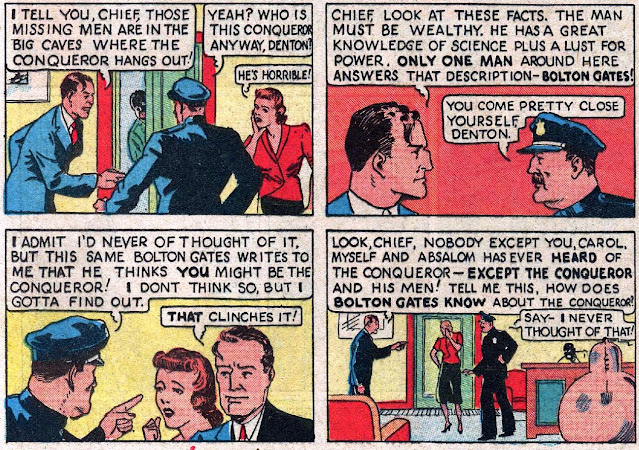
    The Conqueror is the major recurring foe of Dean Denton, Scientific Adventurer, about whom we will briefly aside: Dean Denton was created by Harry Campbell, who was also responsible for such characters as Ace of Space, Bruce Blackburn and the wretched Scarlet Seal, but also Wizard Wells and John Law, Scientiective, who form a kind of thematic triad of scientific detectives with Dean Denton.

    Dean Denton is definitely the most entertaining of the three to read (with the unfortunate caveat that his are the adventures that are most riddled with racial stereotypes. The Golden Age, folks!) due partially to his former occupation as a well-known ventriloquist but mostly to his archfoe the Conqueror, who beats John Law’s Avenger and Wizard Wells’ collection of no-name goons hands down.

    The Conqueror is actually rich guy Bolton Gates and over the course of a couple of dozen appearances he has my favourite villainous character arc: the villain of means with vast resources is foiled several times by Our Hero and ends up scrabbling around doing comparatively petty crimes for chump change. 

    In his first few appearances the Conqueror has a lavish estate under which is a technologically advanced lair filled with brainwashed minions. After Dean Denton blows all that up it seems like the Conqueror is forever seeking to recreate it with schemes that place him in positions of high status: not only does he pose as divine figures to dupe tribal groups in both Central America and Africa but he founds somewhere between two to three cults:

    Somewhat surprisingly, the White Crusaders, over which the Conqueror presided as the Master Crusader/ the White Master, was not a racially problematic group.

    Meanwhile the Cult of Astra was mostly a way to flimflam flaky Hollywood types and blackmail their studios with the threat of religion-related work stoppages (a scheme that nets him a two-episode arc on the Villains of Old Hollywood podcast).

    The third example is somewhere between a cult and his old habit of minion recruitment through mind control: he takes advantage of the conflict between the countries of Namreg and Feltia (and in case “Namreg” was too subtle for you they clash near the “Tonigam Line”) to capture and brainwash both Namreg and Feltian forces. 

    Even though the Conqueror gets away as per usual at the end of this scheme, it’s his last appearance in comics (that I know of, natch). One can imagine his conflict with Dean Denton continuing indefinitely and why not. It’s more fun than most things that might logically happen to a lone civilian trapped in the midst of two armies that he recently made enemies of. after all.

  • MINOR SUPER-VILLAIN 414: THE POWER

    (Amazing Man Comics 008, 1939)

    The worst thing about Minimidget is obviously his name. The best thing about him and his partner Ritty is the fact that unlike your Doll Mans or Atoms or Ants Men they are a) permanently six inches tall and b) proportionally as strong as a six-inch human being – they’re just lil’ guys wearing jodhpurs. A lot of their adventures are not so much about going out and finding excitement as dealing with the problems of being real real small.

    Such is the case when the two of them are spotted by agents of would-be world dictator the Power and spirited away to be part of his collection of oddities. It’s a real pickle, as the Power is about as over the top villainous as you get: he has a harem; he has slaves; he has a torture chamber full of nude men. His outfit, while fun in an ostentatious way, is that of a man who has never been told that he has had a bad idea. You can tell he has long fingernails because he read that it was symbolic of how little actual labour you had to do. Just the worst.

    Minimidget and Ritty eventually escape when one of the slave-scientists straps them to a bird. They make their way to the US and get word to the authorities and I guess that’s another power a couple of six-inch people have: when you say “something wild is happening thataway” the fact that you are something wild adds a bit of oomph to your claims.

    True to his jagoff nature, the Power attempts to flee in a plane as soon as the authorities start to close in. He is immediately shot down. Minimidget and Rittty are feted, technically, for stabbing a bird.

  • MINOR SUPER-VILLAIN 353: THE PURPLE HOODS

    (Master Comics 013-014, 1941) 

    I’m not going to lie: when I started reading this story I got excited for one of the more niche reasons I ever have. See, the prior Buck Jones story – the one with the Ghost Killer gang – was still wrapping up and I had a moment where I thought there would be some very exciting gang continuity if any of the former Ghost Killers, already relict of the White Arrow gang, had joined up with the Purple Hoods. That’s an unprecedented three gangs! Alas, Snake and Cope were sent to jail and the counter reset.

    Ephemeral hopes and dreams aside, the Purple Hoods are crass capitalist crooks: their big scheme involves kidnapping Mexican farm labourers and pressing them into slavery in a secret oil refinery. Ah, the romance of the Old West!

    And speaking of the Old West, this story is a perfect illustration of the weird liminal space that the West occupied in the 40s imagination: is Buck Jones an Old West marshal or a contemporary one? Does this issue offer any clues? The ascent of oil as a valuable resource does overlap with the Old West, and steel oil barrels of the kind pictured above are a 20th Century invention, but one of the major conflicts of the story is a business rivalry between two competing stagecoach lines and while I can find evidence of stagecoaches being used into the early 20th Century I doubt that they were such a going concern as that.

    What I’m getting at here is that I don’t know which way the anachronisms are going: is Buck Jones an Old West marshal with forward-thinking villains or a modern marshal in an overly romanticized setting? Who knows!

    (I must note that I do appreciate the Purple Hood leader getting his own special version of the gang costume)

    ADDENDUM:

    Two issues later (Master Comics 016, 1941), the story is clearly set in the Old West! Answers have been forthcoming at last!

  • MAD AND CRIMINAL SCIENTIST ROUND-UP 002

    Back again with another collection of science-villains who didn’t quite make the grade!

    Fritz Cardif here has a gunpowder-exploding ray and a lot of big plans. He probably would have made the main list except that I personally find his antics very dull, with the exception of the lil’ stinker moment pictured above. (Hit Comics 006, 1940)

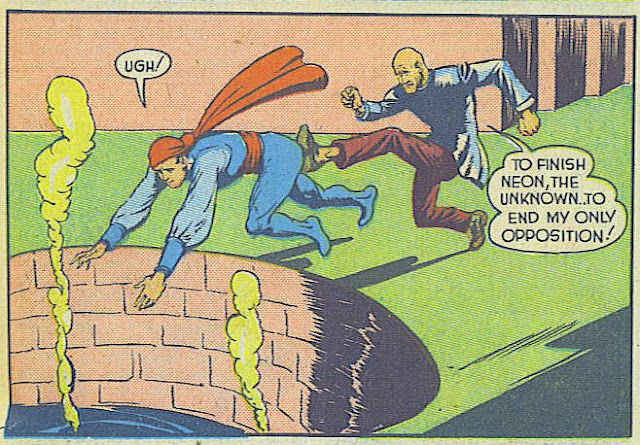
    Dr Marko figured on using kidnapped scientists as research slaves in his Grand Canyon hideout, but he too was corralled by Neon the Unknown. (Hit Comics 013, 1941)

    Professor Dorn here is your typical Nazi scientist obsessed with replicating the powers of the Sub-Mariner for the glory of the cause. He ends up lasting about fifteen minutes after meeting the real deal. (Marvel Mystery Comics v1 023, 1941)

     Dr Sunga has a pretty good scheme going wherein he seeming kills people by sending them a cursed wand that is actually harmless – seemingly the perfect crime! But the Golden Age Falcon figures out the trick: it’s actually the box that the wand is sent in that does the killing. Sunga of course ends up dead by his own fiendish device. (Daring Mystery Comics 005, 1940)

  • MAD AND CRIMINAL SCIENTIST ROUND-UP 002

    Back again with another collection of science-villains who didn’t quite make the grade!

    Fritz Cardif here has a gunpowder-exploding ray and a lot of big plans. He probably would have made the main list except that I personally find his antics very dull, with the exception of the lil’ stinker moment pictured above. (Hit Comics 006, 1940)

    Dr Marko figured on using kidnapped scientists as research slaves in his Grand Canyon hideout, but he too was corralled by Neon the Unknown. (Hit Comics 013, 1941)

    Professor Dorn here is your typical Nazi scientist obsessed with replicating the powers of the Sub-Mariner for the glory of the cause. He ends up lasting about fifteen minutes after meeting the real deal. (Marvel Mystery Comics v1 023, 1941)

     Dr Sunga has a pretty good scheme going wherein he seeming kills people by sending them a cursed wand that is actually harmless – seemingly the perfect crime! But the Golden Age Falcon figures out the trick: it’s actually the box that the wand is sent in that does the killing. Sunga of course ends up dead by his own fiendish device. (Daring Mystery Comics 005, 1940)

  • MINOR SUPER-VILLAIN 288: THE KING

    (Marvel Mystery Comics v1 025, 1941)

    The King is your regular old gang boss who decides to pivot from running a numbers racket to selling counterfeit pharmaceuticals, and if that was it he wouldn’t be listed here. The dang guy just wasn’t content to be regular, though. Some salient features of his crime time:

    -he made the fake drugs in a sprawling underground lab using kidnapped doctors

    -recalcitrant doctors ended up in a giant vat of boiling acid

    -he has a full suite of gadgets including acid, gas and regular bombs and a remote controlled exploding car for blowing up excess henchmen

    -he leaves a king playing card at the scene of his crimes

    -he uses a cigar holder, which isn’t villainous per se but always stands out so much to me that I must make note of it.

    He’s also very dumb? Like, the calling cards tie together various crimes in a way that they might not otherwise have been, and he leaves a license plate that’s registered in his name on the bomb-car. Plus he does a lot of unnecessary murdering and kidnapping that does a lot less to make people respect him and more to make them want to stop him, or, as in the case of the henchman he fails to fully blow up, kill him.

  • MINOR SUPER-VILLAIN 282: KHOR, THE BLACK SORCERER

    MINOR SUPER-VILLAIN 282: KHOR, THE BLACK SORCERER

    (Marvel Mystery Comics v1 022, 1941)

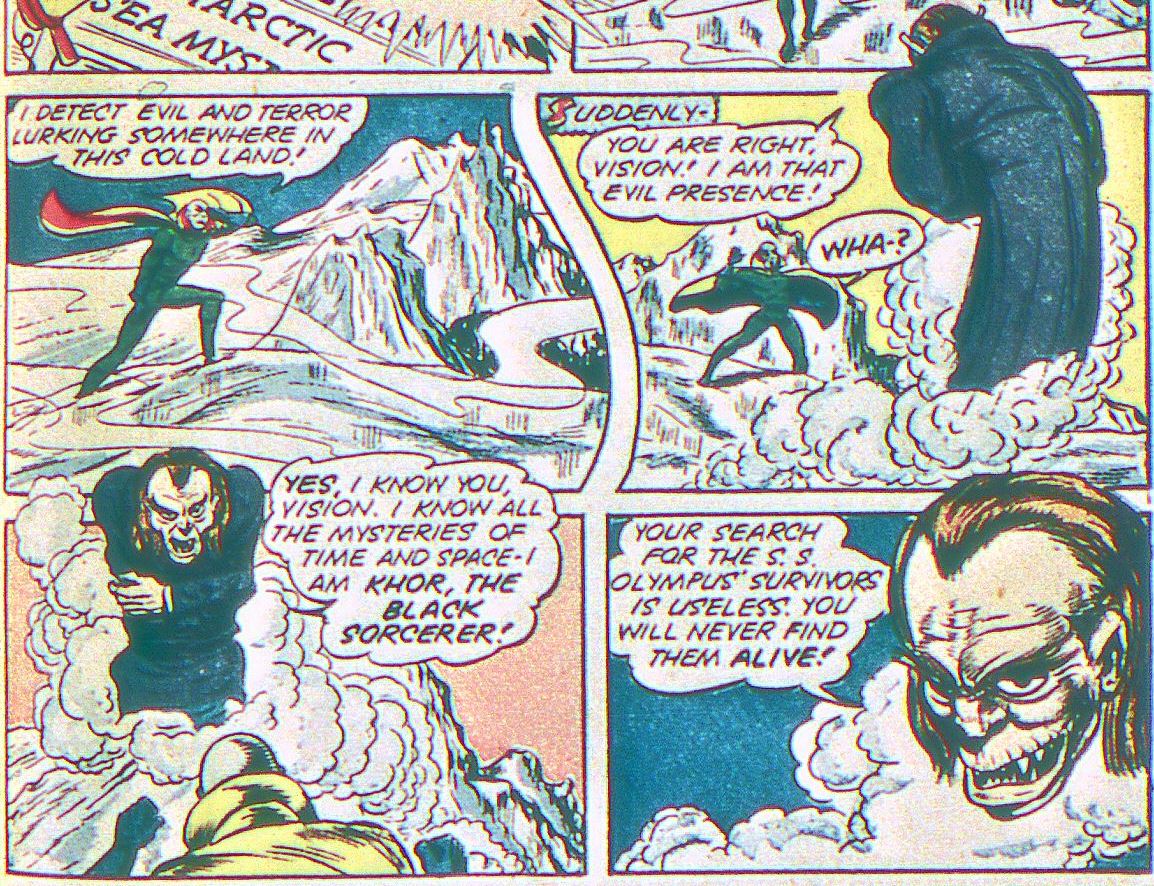
    Khor, the Black Sorcerer is one of those magical generalists I was talking about back when I wrote about the Mor the Mighty, with a diverse range of magic abilities including stun bolts, paralysis spells, teleportation spells and shrinking spells. He’s a Jack Kirby troll-man special who comes to the attention of the Vision when he kidnaps a whole-ass Antarctic science expedition because he’s a lonely immortal who doesn’t know how to make friends normally.

    By far the most interesting thing about Khor is that his home in the Antarctic tropical paradise the Land Where Time Stands Still has since been retconned as part of Marvel’s main Antarctic tropical paradise the Savage Land. This a fun bit of trivia, but more fun is the idea that throughout the whole convoluted history of the Savage Land (or at least from 1245 AD onward) an immortal French wizard is holed up in a little cave in the one location in the whole dang place not overrun with swamp men or ape men or dinosaurs, missing all the fun. Dante Alighieri is fighting literal demons in an alien amusement park while Khor spends the afternoon washing his robe. Delightful!

    It all ends with the Vision pitching Khor into a lava flow and freeing his collection of beefy old men. I won’t say that I won’t miss him, but I’ll always know that in any story set between 1245 and 1941 AD he’s there, in the Savage Land, bored out of his mind, and that’s enough.

  • MINOR SUPER-VILLAIN 282: KHOR, THE BLACK SORCERER

    MINOR SUPER-VILLAIN 282: KHOR, THE BLACK SORCERER

    (Marvel Mystery Comics v1 022, 1941)

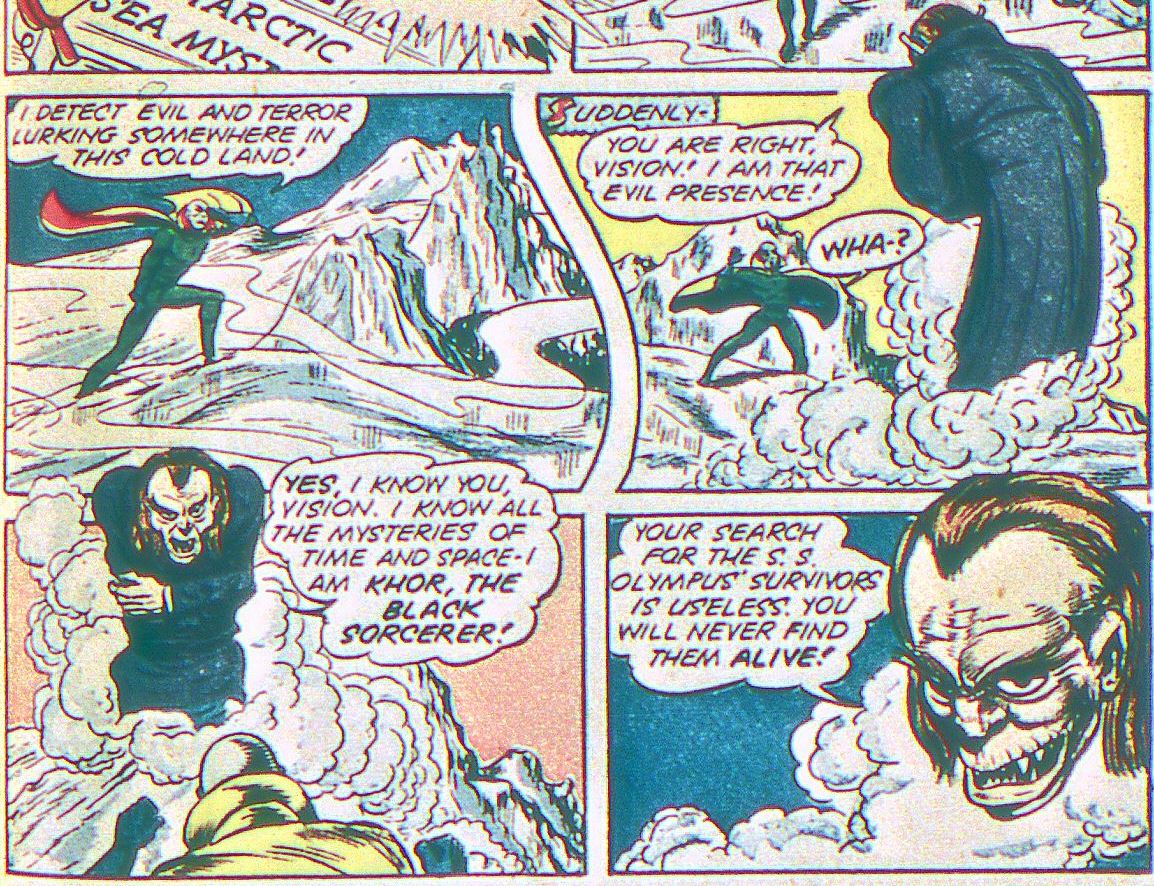
    Khor, the Black Sorcerer is one of those magical generalists I was talking about back when I wrote about the Mor the Mighty, with a diverse range of magic abilities including stun bolts, paralysis spells, teleportation spells and shrinking spells. He’s a Jack Kirby troll-man special who comes to the attention of the Vision when he kidnaps a whole-ass Antarctic science expedition because he’s a lonely immortal who doesn’t know how to make friends normally.

    By far the most interesting thing about Khor is that his home in the Antarctic tropical paradise the Land Where Time Stands Still has since been retconned as part of Marvel’s main Antarctic tropical paradise the Savage Land. This a fun bit of trivia, but more fun is the idea that throughout the whole convoluted history of the Savage Land (or at least from 1245 AD onward) an immortal French wizard is holed up in a little cave in the one location in the whole dang place not overrun with swamp men or ape men or dinosaurs, missing all the fun. Dante Alighieri is fighting literal demons in an alien amusement park while Khor spends the afternoon washing his robe. Delightful!

    It all ends with the Vision pitching Khor into a lava flow and freeing his collection of beefy old men. I won’t say that I won’t miss him, but I’ll always know that in any story set between 1245 and 1941 AD he’s there, in the Savage Land, bored out of his mind, and that’s enough.