The Curse of Skeleton Munroe

Category: DC Comics

  • MINOR SUPER-VILLAIN 335: THE THREAT

    (All-Flash 002, 1941) 

    The Threat is an example of a type of morality tale that was very popular in 40s and 50s comic books but never really went out of style: a tale of promise squandered in service to a life of crime. In this case, the subject is a crook named Tough Joe Connor, who swears revenge on Jim Kelley, the prosecutor who sent him to jail for ten years. 

    My summarizing powers are not up to this task, ergo, a timeline:

    1911 CE:

    -Jim Kelley sends Tough Joe Connor to jail. Connor swears revenge.

    -believing that Kelley got the better of him because he was more clever, Connor devotes himself to study.

    1917 CE:

    -Connor has become a model prisoner. He is a qualified lawyer, doctor and research scientist specializing in chemistry and physics. He is paroled 4 years early. On the outside, he is already wealthy due to research he did in prison.

    -Connor goes to visit Kelley. Ostensibly a good will visit, it is actually in order to provide an alibi: when thugs he has hired burst in and steal Kelley’s newborn baby, Connor takes a carefully choreographed bullet to the arm while “attempting to stop them”.

    -Connor meets and falls in love with a woman named Annie Crowley. They marry and he briefly goes straight (but keeps the baby).

    1923 CE:

    -Annie dies (possibly in childbirth, as they have a daughter). Connor resumes his quest for revenge and begins telling the boy, Roy, that Kelley killed his mother in order to turn him into a weapon against his own father.

    1937 CE:

    -Connor has consolidated underworld power in the region, becoming the Threat. He makes his first attempt on the life of now-Mayor Jim Kelley but both his criminal activities and his murder attempt are disrupted by the Flash. Roy heads to the family farm to lie low with his step-sister Ann.

    1941 CE:

    -The Threats’s power continues to grow. A second attempt on Mayor Kelley’s life ends with Joe Connor back in prison as one of his own henchmen.

    -Connor escapes in an old lye barrel. Severely burned, missing an eye, he adopts a series of new identities: an unnamed garage owner, plastic surgeon Doctor Cravath, mechanic Jake Boles. He finds Roy hiding out in the country and together they make an attempt on gubernatorial candidate Kelley’s life but once more the Flash steps in.

    -Connor makes one last push to kill now-Governor Kelley: he breaks Roy out of prison and arranges a big confrontation. All is for naught, as the Flash, Joan Williams and Ann Connor have pieced together the clues and revealed to Roy his real parentage. Faced with this and the futility of his life of revenge, Connor smokes a poisoned cigarette and dies.

    -Roy and Ann are now in love, which happens in these kinds of Secret Step-Sibling situations an unsettling amount.

    There are several interesting things about this sequence of events. The first, as seen above, is that young Roy, at age 5, chooses the name Roy Revenge for himself as part of his vendetta and keeps using it into his mid-twenties. It is, frankly, great – it’s exactly the kind of henchman name that a villain called the Threat would assign in a campy 60s comic, but earnestly, in the 40s.

    The second involves the fact that at this point Keystone City is not a thing and the Flash explicitly lives in New York City, which means that Jim Kelley was presumably Mayor of NYC (eroding La Guardia’s term by about four years) and Governor of New York (impacting Herbert H. Lehman).

    Meanwhile, the chronology of the story is fairly tentative – the actual timeframes are correct, but the dates are speculative. The crucial point is that four-year gap between Roy Revenge”s first attempt on Kelley’s life and the remainder of the story: as presented the bulk of the story is set in 1941, the year of publication, but the Flash is running around three years earlier than previously established. BUT! if we start the story in 1941 the bulk of the action takes place in 1945, which is even more temporally messy. Fun stuff for the old timeline!

    The Threat, ultimately, is a bit of a nothing villain but I like him nonetheless. Too bad about the wasted life, better luck next time, Joe.

    JUDGE AND JURY REVENGE KILLER SCORE: 0/1 

    (I know, he’s focused on the lawyer, but “judge and jury and prosecutor revenge killer” is just too long and even then someone is going to go after the witnesses and bailiffs. Better to be succinct)

  • MINOR SUPER-VILLAIN 335: THE THREAT

    (All-Flash 002, 1941) 

    The Threat is an example of a type of morality tale that was very popular in 40s and 50s comic books but never really went out of style: a tale of promise squandered in service to a life of crime. In this case, the subject is a crook named Tough Joe Connor, who swears revenge on Jim Kelley, the prosecutor who sent him to jail for ten years. 

    My summarizing powers are not up to this task, ergo, a timeline:

    1911 CE:

    -Jim Kelley sends Tough Joe Connor to jail. Connor swears revenge.

    -believing that Kelley got the better of him because he was more clever, Connor devotes himself to study.

    1917 CE:

    -Connor has become a model prisoner. He is a qualified lawyer, doctor and research scientist specializing in chemistry and physics. He is paroled 4 years early. On the outside, he is already wealthy due to research he did in prison.

    -Connor goes to visit Kelley. Ostensibly a good will visit, it is actually in order to provide an alibi: when thugs he has hired burst in and steal Kelley’s newborn baby, Connor takes a carefully choreographed bullet to the arm while “attempting to stop them”.

    -Connor meets and falls in love with a woman named Annie Crowley. They marry and he briefly goes straight (but keeps the baby).

    1923 CE:

    -Annie dies (possibly in childbirth, as they have a daughter). Connor resumes his quest for revenge and begins telling the boy, Roy, that Kelley killed his mother in order to turn him into a weapon against his own father.

    1937 CE:

    -Connor has consolidated underworld power in the region, becoming the Threat. He makes his first attempt on the life of now-Mayor Jim Kelley but both his criminal activities and his murder attempt are disrupted by the Flash. Roy heads to the family farm to lie low with his step-sister Ann.

    1941 CE:

    -The Threats’s power continues to grow. A second attempt on Mayor Kelley’s life ends with Joe Connor back in prison as one of his own henchmen.

    -Connor escapes in an old lye barrel. Severely burned, missing an eye, he adopts a series of new identities: an unnamed garage owner, plastic surgeon Doctor Cravath, mechanic Jake Boles. He finds Roy hiding out in the country and together they make an attempt on gubernatorial candidate Kelley’s life but once more the Flash steps in.

    -Connor makes one last push to kill now-Governor Kelley: he breaks Roy out of prison and arranges a big confrontation. All is for naught, as the Flash, Joan Williams and Ann Connor have pieced together the clues and revealed to Roy his real parentage. Faced with this and the futility of his life of revenge, Connor smokes a poisoned cigarette and dies.

    -Roy and Ann are now in love, which happens in these kinds of Secret Step-Sibling situations an unsettling amount.

    There are several interesting things about this sequence of events. The first, as seen above, is that young Roy, at age 5, chooses the name Roy Revenge for himself as part of his vendetta and keeps using it into his mid-twenties. It is, frankly, great – it’s exactly the kind of henchman name that a villain called the Threat would assign in a campy 60s comic, but earnestly, in the 40s.

    The second involves the fact that at this point Keystone City is not a thing and the Flash explicitly lives in New York City, which means that Jim Kelley was presumably Mayor of NYC (eroding La Guardia’s term by about four years) and Governor of New York (impacting Herbert H. Lehman).

    Meanwhile, the chronology of the story is fairly tentative – the actual timeframes are correct, but the dates are speculative. The crucial point is that four-year gap between Roy Revenge”s first attempt on Kelley’s life and the remainder of the story: as presented the bulk of the story is set in 1941, the year of publication, but the Flash is running around three years earlier than previously established. BUT! if we start the story in 1941 the bulk of the action takes place in 1945, which is even more temporally messy. Fun stuff for the old timeline!

    The Threat, ultimately, is a bit of a nothing villain but I like him nonetheless. Too bad about the wasted life, better luck next time, Joe.

    JUDGE AND JURY REVENGE KILLER SCORE: 0/1 

    (I know, he’s focused on the lawyer, but “judge and jury and prosecutor revenge killer” is just too long and even then someone is going to go after the witnesses and bailiffs. Better to be succinct)

  • MINOR SUPER-VILLAIN 334: THE MONOCLE

    (All-Flash Quarterly 001, 1941) 

    I love a foppish gang boss, and the Monocle might just be the most foppish I’ve seen in some time. He’s got all the accessories: the monocle, natch, but also the eccentric mustache, cigarette holder, neat suit with nosegay and tiepin and pocket square and to top it off one of the more eccentric comic book hobbies I have ever encountered: a twee little garden where he displays his stolen gems in artificial flowers. Pretty great stuff.

    The Monocle is also a technically-minded villain, whose main line is planning knockout gas-centric crimes but with a sideline in deathtraps – his booby-trapped HQ does a better job than most at almost bumping off the Flash.

    Of particular note is that the Monocle hits upon the same discovery as an unnamed criminal scientist the year before: that though the Flash moves fast enough that he uproots shrubs and blows the clothing off of people in his wake, he also moves slow enough that a stroboscopic lighting setup will make it possible to effectively aim a firearm at him. He might even have actually killed the Flash if, succumbing to the deathtrap-maker’s hubris, he hadn’t left mid-battle to check on his gem garden.

  • NOTES – SEPTEMBER 2023

    Memes of Yore:


     Women be loving hats. (All-Flash 001, 1941)

    Decoration:

    On the island nation of Felicia, the chairs are monogrammed with a big F (Master Comics 001, 1940) 

    UPDATE: And the shields.

    Drawn without reference:

    The majestic pterodactyl. (Master Comics 007, 1940)

  • MINOR SUPER-VILLAIN 333: THE FIVE FINGERS OF THE HAND

    MINOR SUPER-VILLAIN 333: THE FIVE FINGERS OF THE HAND

    (Leading Comics 001, 1941)

    As promised: the Five Fingers of the Hand! Though the Seven Soldiers would go on the fight more than a few teams of super-henchmen, the Fingers are distinguished by being (mostly) pre-established characters. Fun!

    Big Caesar:

    Big Caesar is whatever. A regular-style gang boss with a good name, elevated by being included in the gang. He appears just this once, in a scheme that involves cutting the power to Broadway and then doing a crimewave in the dark. The Crimson Avenger and Wing take him down without significant effort.

    The Dummy:

    Like Big Caesar, the Dummy appears for the first time in this issue. Unlike Big Caesar, the Dummy would go on to bigger things – so much so that I am declaring him a very marginal full super-villain, which makes this a cheeky Yearbook entry for his 1941. 

    When first seen, the Dummy has two points of interest: 1. he is an “infamous kidnapper” and 2. he may or may not be a real, inanimate ventriloquist’s dummy. Even his gang is convinced that he is a front for one of their number. 

    Per his talents, the Hand sets the Dummy up with a sweet kidnapping job: he grabs various Hollywood types and leaves behind a lifelike statue in their place. The ransom is thus to “return them to life”. Sadly, the sculptor that they must have had on retainer to produce the statues is not shown.

    The Dummy is eventually revealed to be alive, though whether he is a very short human with a penchant for sitting still or some sort of animate wooden doll is not explored. Also unexplored: why the Dummy’s back room is full of duplicates of the statues that he has already left in place of his victims, and why he has statues of the Vigilante and his second-best sidekick Billy Gunn – it’s tough to imagine a scenario in which they might be useful (other than as a heavy object under which to trap the Dummy, of course).

    Number of Episodes of the “Super-Villains of Hollywood” podcast: part of a compilation episode about villains who come to Hollywood to do crimes.

    Body Count: 0

    End-of-Year Status: Captured

    The Needle:

    The Needle is a recurring foe of the Star-Spangled Kid and Stripesy, a tall thin guy with a needle gun and a wild look in his eyes. Due to the fact that I only pay attention to the cover date on comics and that that never actually lines up with the release date, his first appearance in 1942 won’t hit this blog for some time – he’ll likely be Minor Super-Villain 555 or the like.

    Anyway, he steals a ray gun and tries to blow up the Panama Canal for some reason.

    Professor Merlin:

    As with the Needle, Professor Merlin’s first appearance doesn’t take place until 1942. This is especially embarrassing because he actually dies before his first appearance, like one of those RPGs where you can die during character creation.

    Merlin’s scheme involves scamming gold out of a rich old prospector by exploiting his well-known fear of freezing to death, then managing to collapse a mine on himself when he uses dynamite to blow open a lock that looks like you could pick it with a small enough finger. Nobody comes out on top here: Prof Merlin dies a dummy despite ostensibly being a Smart Crook and Green Arrow and Speedy don’t even play that much of a role in his downfall.

    Red Dragon:

    Our final Finger and the only one to have already shown up previously here, the Red Dragon is his usual terrible self: he takes advantage of an old myth in order to enslave a Native American tribe and force them to mine radium. Lucky for them that the Shining Knight turns up to actually fulfill the prophecy and  kick the Dragon’s rear. It’s a real evil comic book crime rendered a fair bit less enjoyable to read because of all the racism.

    So: the Five Fingers of the Hand. Top notch themed name for a henchman group hampered somewhat by the ease with which they were all taken out. Any time the Hand shows up he should have a different iteration of the Fingers with him, and that’s that. Bring ’em back, at least in name.

  • MINOR SUPER-VILLAIN 333: THE FIVE FINGERS OF THE HAND

    MINOR SUPER-VILLAIN 333: THE FIVE FINGERS OF THE HAND

    (Leading Comics 001, 1941)

    As promised: the Five Fingers of the Hand! Though the Seven Soldiers would go on the fight more than a few teams of super-henchmen, the Fingers are distinguished by being (mostly) pre-established characters. Fun!

    Big Caesar:

    Big Caesar is whatever. A regular-style gang boss with a good name, elevated by being included in the gang. He appears just this once, in a scheme that involves cutting the power to Broadway and then doing a crimewave in the dark. The Crimson Avenger and Wing take him down without significant effort.

    The Dummy:

    Like Big Caesar, the Dummy appears for the first time in this issue. Unlike Big Caesar, the Dummy would go on to bigger things – so much so that I am declaring him a very marginal full super-villain, which makes this a cheeky Yearbook entry for his 1941. 

    When first seen, the Dummy has two points of interest: 1. he is an “infamous kidnapper” and 2. he may or may not be a real, inanimate ventriloquist’s dummy. Even his gang is convinced that he is a front for one of their number. 

    Per his talents, the Hand sets the Dummy up with a sweet kidnapping job: he grabs various Hollywood types and leaves behind a lifelike statue in their place. The ransom is thus to “return them to life”. Sadly, the sculptor that they must have had on retainer to produce the statues is not shown.

    The Dummy is eventually revealed to be alive, though whether he is a very short human with a penchant for sitting still or some sort of animate wooden doll is not explored. Also unexplored: why the Dummy’s back room is full of duplicates of the statues that he has already left in place of his victims, and why he has statues of the Vigilante and his second-best sidekick Billy Gunn – it’s tough to imagine a scenario in which they might be useful (other than as a heavy object under which to trap the Dummy, of course).

    Number of Episodes of the “Super-Villains of Hollywood” podcast: part of a compilation episode about villains who come to Hollywood to do crimes.

    Body Count: 0

    End-of-Year Status: Captured

    The Needle:

    The Needle is a recurring foe of the Star-Spangled Kid and Stripesy, a tall thin guy with a needle gun and a wild look in his eyes. Due to the fact that I only pay attention to the cover date on comics and that that never actually lines up with the release date, his first appearance in 1942 won’t hit this blog for some time – he’ll likely be Minor Super-Villain 555 or the like.

    Anyway, he steals a ray gun and tries to blow up the Panama Canal for some reason.

    Professor Merlin:

    As with the Needle, Professor Merlin’s first appearance doesn’t take place until 1942. This is especially embarrassing because he actually dies before his first appearance, like one of those RPGs where you can die during character creation.

    Merlin’s scheme involves scamming gold out of a rich old prospector by exploiting his well-known fear of freezing to death, then managing to collapse a mine on himself when he uses dynamite to blow open a lock that looks like you could pick it with a small enough finger. Nobody comes out on top here: Prof Merlin dies a dummy despite ostensibly being a Smart Crook and Green Arrow and Speedy don’t even play that much of a role in his downfall.

    Red Dragon:

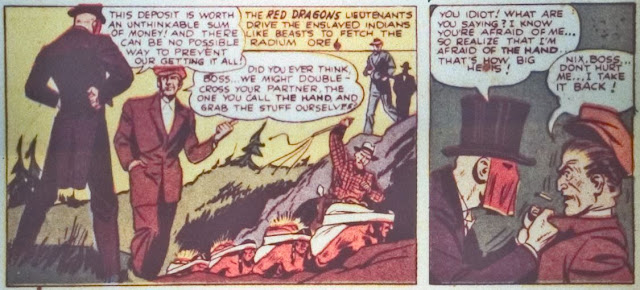
    Our final Finger and the only one to have already shown up previously here, the Red Dragon is his usual terrible self: he takes advantage of an old myth in order to enslave a Native American tribe and force them to mine radium. Lucky for them that the Shining Knight turns up to actually fulfill the prophecy and  kick the Dragon’s rear. It’s a real evil comic book crime rendered a fair bit less enjoyable to read because of all the racism.

    So: the Five Fingers of the Hand. Top notch themed name for a henchman group hampered somewhat by the ease with which they were all taken out. Any time the Hand shows up he should have a different iteration of the Fingers with him, and that’s that. Bring ’em back, at least in name.

  • MINOR SUPER-VILLAIN 332: THE HAND

    (Leading Comics 001, 1941)

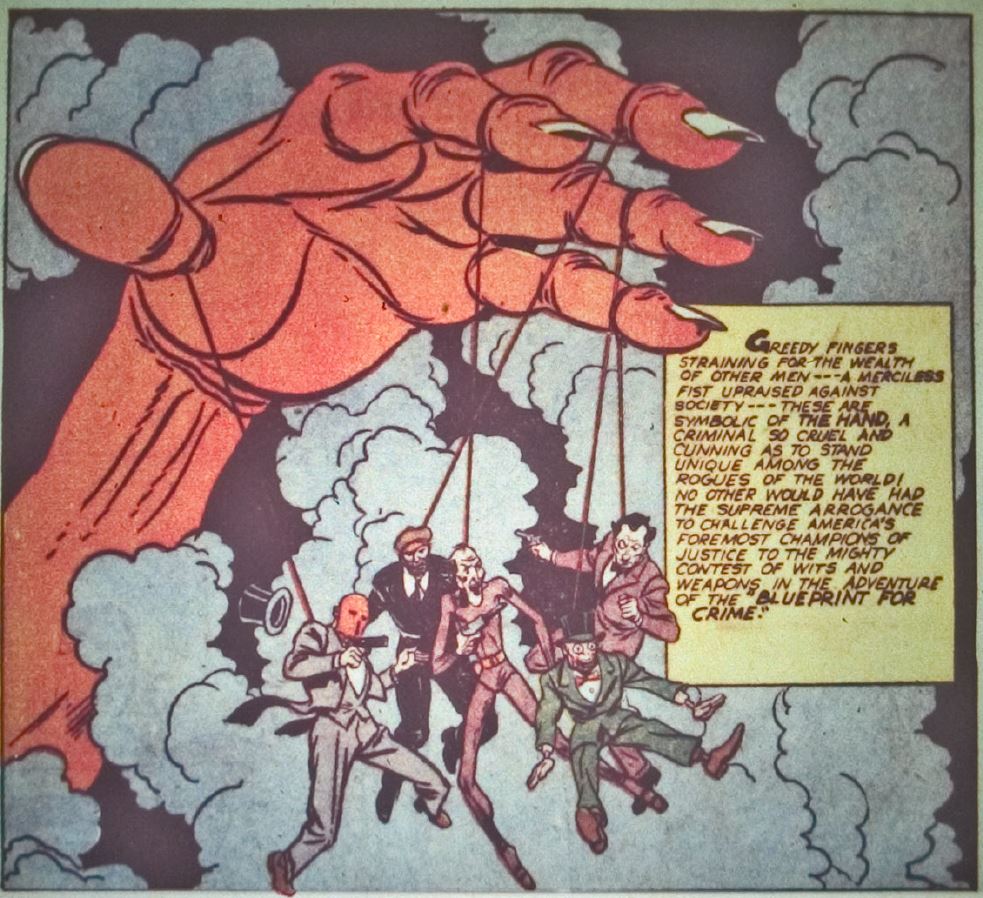
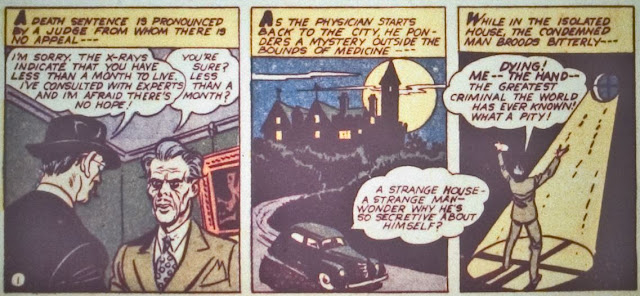
    The Hand holds the distinction of being both the first foe of the Seven Soldiers of Victory (all 9 or 10 of them) and the person who organized them as a team in the first place, and all as a way to get attention, essentially. As first presented, he is a master criminal so successful that he is unknown to the world at large who has just received word that he is dying with no hope of a reprieve.

    Somewhat understandably, the Hand decides to go out with a bang rather than a whimper, by recruiting five other super-villains to act as his “fingers” and carry out his most audacious crimes.

    We’ll get into the nitty gritty of the Five Fingers of the Hand in the next entry (because I have a system and I need to stick to it, okay?) but the long and the short of it is that the Hand gathers together pre-established supercrooks the Needle, Professor Merlin and the Red Dragon, never-before-seen supercrook the Dummy and lucky-to-be-considered schnook Big Caesar, outfits them with crime plans and sets them up in a classic Justice Society style “everyone split up and have a little adventure” adventure with what will become the Seven Soldiers of Victory.

    Though this might be the most reasonable reason for sending a taunting note to the forces of Law I have yet seen (after all, how greater the crime if it is actively opposed?), it remains a bad idea to do so, categorically, as evidenced by the fact that every one of the Five Fingers is summarily captured (or in the case of Professor Merlin, exploded) mid-caper, leading to the traditional final act of the JSA-style story wherein everyone comes together to beat up the mastermind.

    Who knows if the Hand could have handled them if he hadn’t been informed that his condition was, in fact, treatable just before the fight. Could he have taken on seven super-heroes if he still thought he was going to die? We will never know. Instead, he almost gets them with a lightning cannon but ends up being electrocuted by it, ironically dying just as he learned that he might have a chance to live.

    Or did he? No he didn’t, it turns out, because years later Len Wein wanted to bring back the Seven Soldiers of Victory and concocted a story wherein they were blasted through time, and who better to be responsible than their very first foe? And since that caper involved the Nebula Man, one of Grant Morrison’s favourite creeps, the Hand showed up in Seven Soldiers, too. He seems to have about a 30-year refractory period, so look for him on comic shelves sometime in 2036!

  • FASCIST GOON CLEARING HOUSE 001

    There are various groups of fascist goons in comics and doing an individual entry for each bunch would be a slog, so it’s time for another grouping of jerks!

    The Yellowshirts here put in a better showing than most and almost manage to take over NYC before they get beaten down by the Patriot. (Human Torch v1 004, 1941)

    Do the Brown Hoods sound kind of like how the Mafia was described in the 30s? Yes. Is that going to stop me from including them here? No. (More Fun Comics 036, 1938)

    The Yellow Battalion are most notable for their fancy hats, as they end up getting the tar beat out of them in roughly three panels by Red, White and Blue… (All American 005, 1939)

    … who also obliterate the slightly-more-organized Black Cross a couple of issues later (All American 008, 1939)

  • GENERIC COSTUMED VILLAIN ROUND-UP 004

    They’re back! They’re costumed! They’re generic!

    Shorty Jones/ Generic Mummy: 

    It’s a sad day for me but I fear I have to classify this fake mummy as a generic costumed villain, even though he has a shortsword, one of the top swords. Ultimately, he’s just a thief named Shorty Jones who robs the museum every night and even with the power of the fake mummy on his side Shorty just isn’t interesting enough to qualify as a minor super-villain. (Detective Comics v1 053, 1941)

    Gritter: 

    Doc Savage battled this guy (real name the pretty good Gritter; posing as the amazingly-named Captain Blackstone Toy) who had a very complicated plan to blackmail the US Armed Forces. Also his chief henchman was named Fuzzy. (Doc Savage Comics 004, 1941)

    Deputy Cal: 

    This lady bandit is in fact Deputy Cal of the Twin Forks Sheriff’s office. His idea to crossdress as a major part of his holdup persona totally pays off, but unfortunately for him he completely fails to disguise himself in any other way – same distinctive horse, same clothes, a very confrontational attitude to anyone looking into the holdups rather than keeping his head down – and he swiftly gets run in by the Fargo Kid. (Feature Comics 048, 1941)

    Unnamed Killer: 

    This unnamed stablehand is that most banal of killers, a jilted suitor going after the romantic rival. But he goes to such effort! It takes two tries – with a remote-controlled sailboat and a sniper rfle – to get the guy, at which point the Red Bee impersonates him and is attacked with battleaxe, scythe, pitchfork and trap door.

    Plus he dresses up as Death for one attempt! Truly this man was as close to non-generic as it’s possible to be while still being completely forgettable. (Hit Comics 014, 1941)