The Curse of Skeleton Munroe

Category: DC Comics

  • MINOR SUPER-VILLAIN 246: KARVAC

    (Flash Comics v1 014, 1941)

    Karvac himself is strictly ho hum territory: a would-be world conqueror who leads his army of heat ray-toting goons on a path of destruction before being beaten up by Hawkman. Snoresville, man.

    BUT: the method by which Karvac managed to acquire his army of heat ray-toting goons, now that’s the kind of comic book nonsense that we love around here.

    Karvac, you see, unearthed rites and rituals connected to Scorio, Alligator God of the Phoenicians, and established both a temple and cult of worshippers to Scorio in the Eastern US, in order to cast ancient ritual magics and bring Scorio to him.

    AND IT WORKS! Korvac summons a god! And that god promptly tells him how to make heat rays for his army of goons to tote! (it’s not exactly clear in the text whether the army of goons are also the Scorio cultists that Hawkman sees performing rituals at the temple earlier in the story, but it’s narratively satisfying to think so)

    Scorio eventually gets banished back to the otherworldly swamp that he usually hangs out in, and as far as I know has never made a return appearance. But he should! Korvac might’ve been a dud, but an ancient and vengeful alligator god who can hand out secret knowledge to evil men is a really neat foe for a guy like Hawkman, particularly once his reincarnation bullshit really gets going – Katar Hol might not know Scorio from a hole in the ground but Scorio knows a soul no matter how many times it’s been reborn. BRING BACK Scorio!
  • THE FATE OF ATLANTIS

    THE FATE OF ATLANTIS

    (Flash Comics v1 1941)

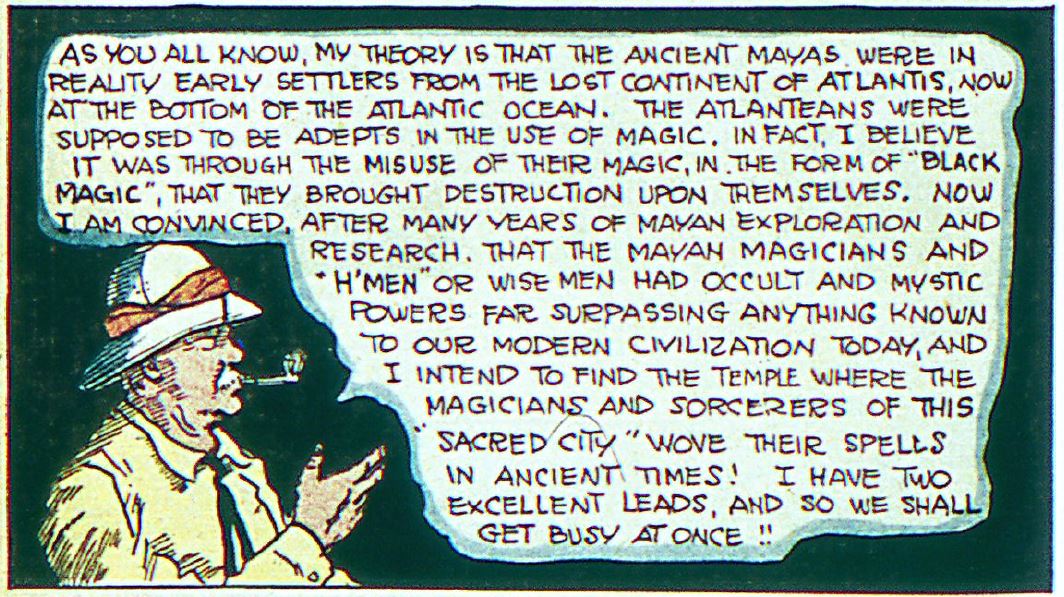
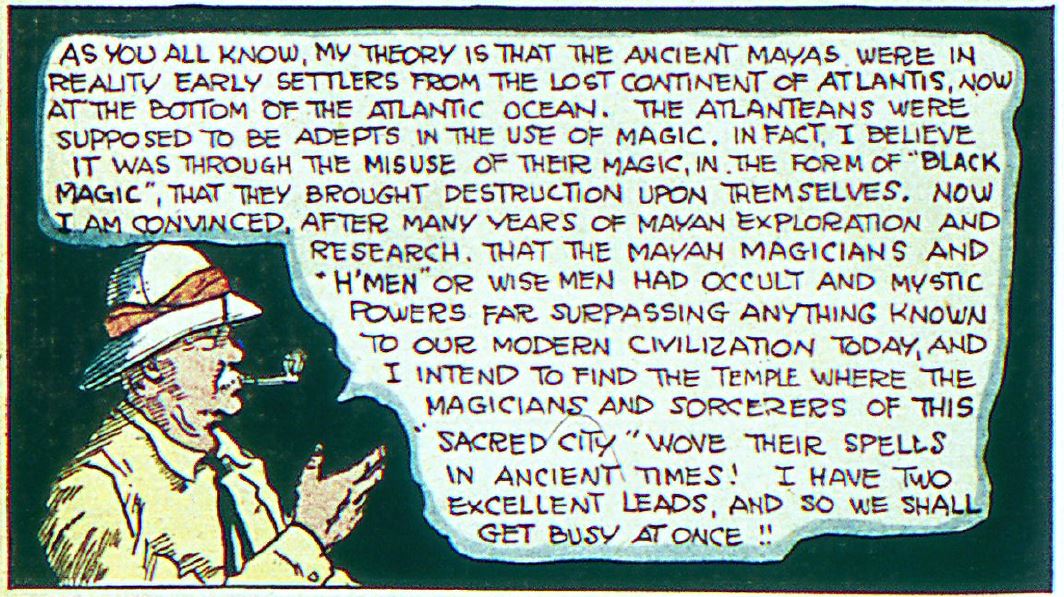
     This Minute Movies (“Secrets of Satan”, natch) installment posits that the Atlanteans blew themselves up via black magic and then settled in the Yucatan.

  • THE FATE OF ATLANTIS

    THE FATE OF ATLANTIS

    (Flash Comics v1 1941)

     This Minute Movies (“Secrets of Satan”, natch) installment posits that the Atlanteans blew themselves up via black magic and then settled in the Yucatan.

  • MINOR SUPER-VILLAIN 245: SATANA

    (Flash Comics v1 013, 1941)

     I am torn on Satana! Torn verily in twain!

    My standard critique of a comic book scientist-villain is that they would have been better off using their tech in a non-crime endeavor, but Satana is a brilliant and pioneering young surgeon living in 1941 and given what I know about the history of women in science I think it’s fair to say that if she had decided to make a go of it in academia then there’s a decent chance that all her research would have been stolen by some dude and she might have gotten credit years after her death, if ever. Also, her signature breakthrough involves transplanting human brains (and eyes!) into tigers, which while groundbreaking might be a hard sell to the ethics committee.

    On the other hand, her crime scheme is very bad. In short: she extorts rich men with threats of harm, then gets work as an entertainer called Satana the Tiger Girl at rich guy parties and has her tigers kill the ones that don’t pay up. She only does it once before getting caught by Hawkman, that we know of, but even if she varied the method by which the tiger was introduced to the rich guy, it’s not a sustainable business model. Stylish, yes, but not sustainable.

    Perhaps the best part of the story is when Hawkman comes across a couple of tigers engaging in humanlike behaviors and it nearly drives him insane, like he’s an HP Lovecraft character. Human habits like… sitting near a newspaper and holding a pipe in their mouth. 

    They kinda hint at a return appearance for Satana at the end of the story but she doesn’t actually come back until 2004, in the same Hawkman story that brought back the Thought Terror. She’s a substantially different character by that point, with ties to the Ultra-Humanite and a focus on making humanoid animals via genetic modification. I’ll revisit her when and if I manage to keep doing this long enough to get to that era. It’s good that they brought her back! She’s a fun character!

  • MINOR SUPER-VILLAIN 244: THE GREAT ARTURO

    (Flash Comics v1 013, 1941) 

    Like Crime & Corruption Inc before him, I almost skipped over the Great Arturo or banished him to the ranks of the generic villains, because a) the Great Arturo is a terrible villain name and b) he appears in a Les Watts comic. But the more I looked at this guy, the more it became clear that he was like a savoury stew made up of all the things I love about comic book creepos.

    We’ve already passed judgement on his name (bad), but let’s run down some of the other pertinent details of the Great Arturo’s career:

    Appearance: he’s seven feet tall and both dresses like a vampire and also looks like one – whether his widow’s peak, fangs and shadowed eyes are natural or stage makeup matters not.

    Motivation: According to his henchman Spider, Arturo just “went insane” one day and decided that he was going to acquire the US’ new warship tech or destroy it, which is meh so far as villainous origins go, but according to Arturo himself he sometimes believes that he is the Devil, and if you’re going to be an insane villain I think it’s important to go big. 

    Powers: According to his henchman Spider, Arturo was a great enough hypnotist that he held Spider completely in thrall to his will. Emphasis added because it’s entirely possible that ol’ Spider is just a fast talker looking to save his own hide.

    Hideout: He lives in a secret tomb that you enter through a hollow tree in a graveyard – one of the top secret lair types of all time.

    In conclusion, he’s a seven foot-tall goth hypnotist with a henchman named Spider who lives in a cemetery. Wotta catch!

    BONUS: About Les Watts, Radio Amateur

    I don’t think I’m going to do a full entry on ol’ Les, but in brief, he’s an earlier example of a character archetype that persists through to today, probably, the Teen Hobbyist (I initially went with Boy Hobbyist, because they are almost all boys). The Teen Hobbyist has a healthy obsession with the hot new tech of the day: ham radios, light aircraft, hot rods, CB radios, computers, the Internet… They don’t usually invent things, but they are completely up to date on the latest developments in their field, leaving the adults around them admiringly befuddled.

    Teen Hobbyists had their heyday in the 40s and 50s, but were still going strong in the 60s – Snapper Carr and Rick Jones were absolutely from the hot rodder school of Teen Hobbyist – and on into the 80s and 90s as Computer Whiz Kids and so forth. I’m sure there’s some version of them running round today.

    Les Watts (later renamed Les Sparks for some reason) is a kid who likes fooling around with ham radios, as do all his friends. He specializes in picking up hints of a crime in progress on the radio waves and then zooming to the location with a bunch of teens. That’s about it.

  • MINOR SUPER-VILLAIN 243: CRIME & CORRUPTION INC

    (Flash Comics v1 013, 1941)

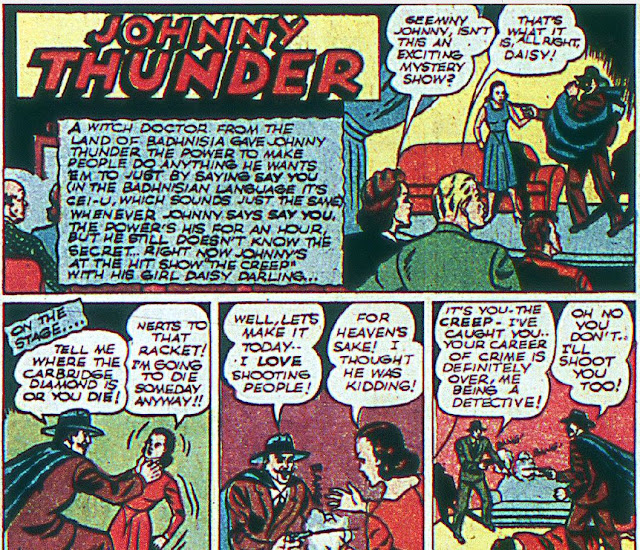
    I almost didn’t include these guys because Johnny Thunder lives in a heightened cartoon reality that only exists within the same world as the Spectre or Hawkman because of the technicality of them all being in the same club and hanging out together. But then, is the fact that New York is full of goofy-ass cartoon people in Johnny’s reality any more implausible than Alexander the Great blowing up a portion of the city without apparent consequence in Hawkman’s? I say thee nay. Besides, Johnny’s adventures almost never verge into super-villain territory… we gotta strike while we can!

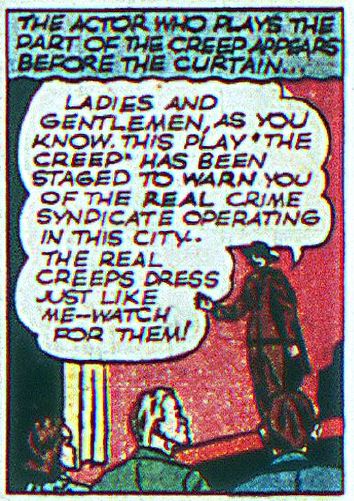
    So: we find Johnny and his best gal Daisy Darling attending a production of “the Creep”, starring actor Jan Marrimore (!) as the titular Creep (a stand-in for a real person playing a fictional villain in a super-hero universe: all my very specific interests are colliding!).

    At the end of the play, Marrimore reveals that the show is a stunt designed to publicize the existence and uniform of a crime syndicate operating in the city. Johnny of course immediately encounters one of these men, does not recognize him and is pickpocketed by him. After some back and forth involving ridiculous magic powers, the pickpocket swears to reform and all is well. OR IS IT?

    It’s not! The remaining members of the gang (which we only now learn the name of – thanks for nothing, Marrimore) swear bloody vengeance and set out to murder Johnny. It’s only the fact that he’s juiced up on Badhnisian thunderbolt magic that saves the poor oaf.

    And that’s that, really. Just a gang of costumed crooks, but they’re Johnny’s gang and he almost never gets to fight proper villains. Since they’re comedy characters they end up as paper-thin props for Johnny to bounce around, so there’s not much to say about them beyond what I will always say about the suit/cape combo: that I love it.

  • MINOR SUPER-VILLAIN 243: CRIME & CORRUPTION INC

    (Flash Comics v1 013, 1941)

    I almost didn’t include these guys because Johnny Thunder lives in a heightened cartoon reality that only exists within the same world as the Spectre or Hawkman because of the technicality of them all being in the same club and hanging out together. But then, is the fact that New York is full of goofy-ass cartoon people in Johnny’s reality any more implausible than Alexander the Great blowing up a portion of the city without apparent consequence in Hawkman’s? I say thee nay. Besides, Johnny’s adventures almost never verge into super-villain territory… we gotta strike while we can!

    So: we find Johnny and his best gal Daisy Darling attending a production of “the Creep”, starring actor Jan Marrimore (!) as the titular Creep (a stand-in for a real person playing a fictional villain in a super-hero universe: all my very specific interests are colliding!).

    At the end of the play, Marrimore reveals that the show is a stunt designed to publicize the existence and uniform of a crime syndicate operating in the city. Johnny of course immediately encounters one of these men, does not recognize him and is pickpocketed by him. After some back and forth involving ridiculous magic powers, the pickpocket swears to reform and all is well. OR IS IT?

    It’s not! The remaining members of the gang (which we only now learn the name of – thanks for nothing, Marrimore) swear bloody vengeance and set out to murder Johnny. It’s only the fact that he’s juiced up on Badhnisian thunderbolt magic that saves the poor oaf.

    And that’s that, really. Just a gang of costumed crooks, but they’re Johnny’s gang and he almost never gets to fight proper villains. Since they’re comedy characters they end up as paper-thin props for Johnny to bounce around, so there’s not much to say about them beyond what I will always say about the suit/cape combo: that I love it.

  • MINOR SUPER-VILLAIN 241: KING JUPO

    (Flash Comics v1 009, 1940)

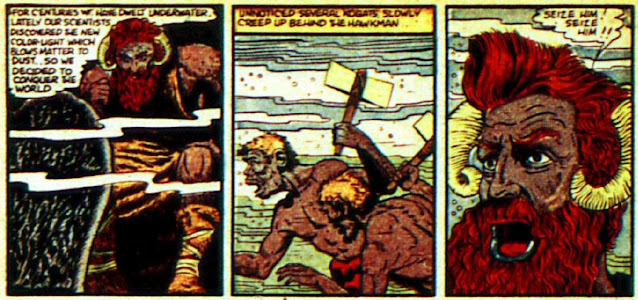
    King Jupo is the leader of the Kogats, a race of water-breathing caveman types who live beneath New York Harbor and have a fun mix of technologies, being armed with either stone axes or laser pistols. They’ve decided to invade the surface world, for no substantial reason other than that it seems like a good idea, and immediately run afoul of Hawkman. Needless to say, this does not end well, and the entire Kogats race, Jupo included, are destroyed when Hawkman collapses their city into an undersea trench, because genociding nonhuman races is okay in comics.

    I really like the Kogats – the contrast between the regular caveman guys and enormous Jupo is fun, plus Jupo himself – 10 feet tall, flaming red hair, ram’s horns – is visually striking. So what if their actual plan is ho hum regular comic stuff? I’m surprised that Roy Thomas never brought this guy back to fight the All-Star Squadron, but since he didn’t, they’re ripe to be BRUNG BACK, if only as part of the weirdly extensive network of subsea communities that Atlantis is part of. I wanna see Aquaman try to do diplomacy with this dude!

    This issue also features Hawkman meeting Poseidon who gives him the power to breathe underwater. I can’t actually figure out if he ever used this power again – it certainly doesn’t come up again in any Golden Age stories I’ve read, but it seems like the sort of thing your Roy Thomas or Geoff Johns would just love to incorporate into a story. Problem is, the fact that Hawkman has this power seems to be a mid-tier popular bit of trivia and finding out whether everyone is just talking about this story or not is a bit more effort than I care to expend.

  • MINOR SUPER-VILLAIN 241: KING JUPO

    (Flash Comics v1 009, 1940)

    King Jupo is the leader of the Kogats, a race of water-breathing caveman types who live beneath New York Harbor and have a fun mix of technologies, being armed with either stone axes or laser pistols. They’ve decided to invade the surface world, for no substantial reason other than that it seems like a good idea, and immediately run afoul of Hawkman. Needless to say, this does not end well, and the entire Kogats race, Jupo included, are destroyed when Hawkman collapses their city into an undersea trench, because genociding nonhuman races is okay in comics.

    I really like the Kogats – the contrast between the regular caveman guys and enormous Jupo is fun, plus Jupo himself – 10 feet tall, flaming red hair, ram’s horns – is visually striking. So what if their actual plan is ho hum regular comic stuff? I’m surprised that Roy Thomas never brought this guy back to fight the All-Star Squadron, but since he didn’t, they’re ripe to be BRUNG BACK, if only as part of the weirdly extensive network of subsea communities that Atlantis is part of. I wanna see Aquaman try to do diplomacy with this dude!

    This issue also features Hawkman meeting Poseidon who gives him the power to breathe underwater. I can’t actually figure out if he ever used this power again – it certainly doesn’t come up again in any Golden Age stories I’ve read, but it seems like the sort of thing your Roy Thomas or Geoff Johns would just love to incorporate into a story. Problem is, the fact that Hawkman has this power seems to be a mid-tier popular bit of trivia and finding out whether everyone is just talking about this story or not is a bit more effort than I care to expend.

  • MINOR SUPER-VILLAIN 242: THE WHITE RENEGADE

    (Flash Comics v1 010, 1940)

    I’ve alluded now and then to the colonialist assumptions that comics worked off of and that seemingly were endemic to the mindset of the American people. The White Renegade offers an example of the two major prongs of these assumptions, which boil down to the idea that the world is divided into White People and Everyone Else, and that:

    1. All offenses committed by Everyone Else against White people shall be repaid with great vengeance. 

    2. The greatest crime that a White Person can commit is to side with Everyone Else against White People.

    I’m only about 1/10 qualified to talk about this stuff, but I am an English major, so I’m fully qualified to notice it. Someone could probably work up an okay thesis by analysing Golden Age (and all other) comics set in colonized areas.

    So: the White Renegade. He’s called that because he’s a white person siding with South Pacific natives against other white people. The natives would have been in for it regardless, but whenever someone pulls this kind of thing in a comic you know that he’s not long for the world. And indeed, Cliff Cornwall tracks him down and takes him out. There’s not much to him to talk about really – he looks like a palate-swapped version of the Shadow, which is fun.

    The White Renegade! Racism! Colonialism! A cool outfit!