The Curse of Skeleton Munroe

Category: DC Comics

  • MINOR SUPER-VILLAIN 240: PROFESSOR KITZOFF

    (Flash Comics v1 008)
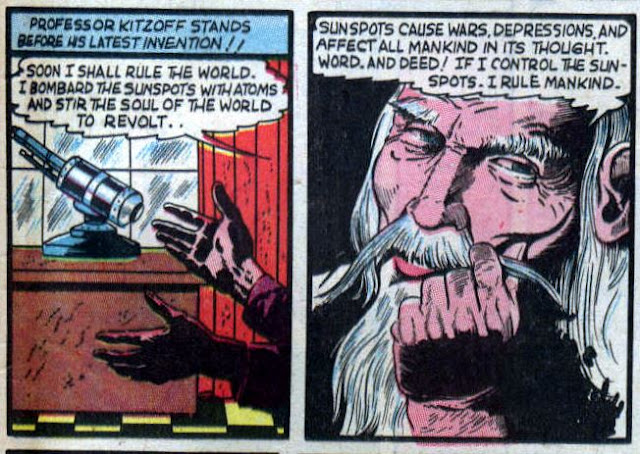
    Professor Kitzoff makes me sad because he is categorically not the Sunspot Wizard. Oh sure, someone at DC or in the fan community went back and assigned titles to all the untitled Golden Age stories and they called this one “the Sunspot Wizard”, but that’s nothing. I love an unofficial name as much as (probably more than) the next guy, but they have to a) come from the text of the story itself and b) can’t just be replacing the actual name by which the character is actually referred!

    So, yes, sad. Professor “Boring Name” Kitzoff has followed the popular criminal scientist path of making an astonishing breakthrough based on junk science – in this case the idea that sunspots affect world events. He has a cool ray that supposedly allows him to affect these sunspots and thus the fate of humanity, but luckily for humanity, Hawkman and his pal Doctor French are on the case and Kitzoff is hounded from New York to the Andes until being accidentally shot by one of his own henchmen. Ho hum.

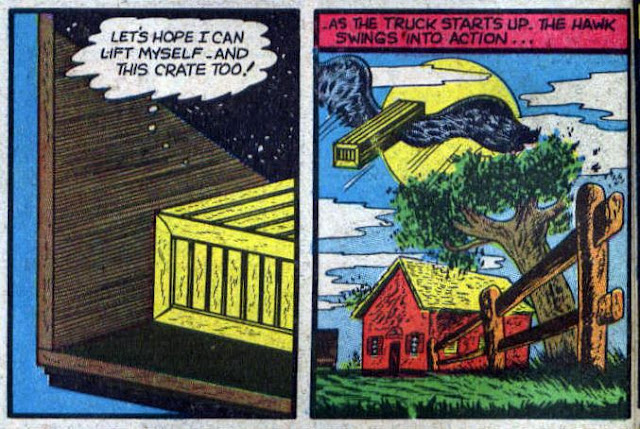
    My depression is only lifted by the fact that this is the adventure in which Hawkman is seemingly killed and his seeming corpse is nailed up in a coffin with lots of gaps between the boards for some reason, leading to one of the best images of the Golden Age:
  • MINOR SUPER-VILLAIN 239: DR BRINE

    (Flash Comics v1 008, 1940)

    Dr Brine should be in the soon-to-be-unveiled first roundup of minor mad and criminal scientists who don’t quite qualify as super-villains. He’s a guy in a purple pin-stripe suit who has a plan to steal a bunch of submarines and then profit from that somehow. There are two very important reasons for his inclusion here:

    1. He’s either a guy who named himself Dr Brine after getting into the submarine piracy game or (even better) he’s a guy who was named Jared Brine or similar and the souped up nominative determinism of the DCU steered him through grad school and right into a job hijacking submarines.

    2. His evil science specialty is that he figured outa way to make his henchmen semi-amphibious, and that the method in question, seen above, is that they must go raw vegan. 

    10/10 top-tier crime scientist, no notes. 

  • MINOR SUPER-VILLAIN 239: DR BRINE

    (Flash Comics v1 008, 1940)

    Dr Brine should be in the soon-to-be-unveiled first roundup of minor mad and criminal scientists who don’t quite qualify as super-villains. He’s a guy in a purple pin-stripe suit who has a plan to steal a bunch of submarines and then profit from that somehow. There are two very important reasons for his inclusion here:

    1. He’s either a guy who named himself Dr Brine after getting into the submarine piracy game or (even better) he’s a guy who was named Jared Brine or similar and the souped up nominative determinism of the DCU steered him through grad school and right into a job hijacking submarines.

    2. His evil science specialty is that he figured outa way to make his henchmen semi-amphibious, and that the method in question, seen above, is that they must go raw vegan. 

    10/10 top-tier crime scientist, no notes. 

  • MINOR SUPER-VILLAIN 238: THE CLUE CRIMINAL

    (Flash Comics v1 007, 1940)


    Long before guys like the Joker and the Riddler made leaving baroque clues to taunt the forces of Law ahead of your next crime a super-villain cliché, the Clue Criminal was out there getting things done, with a name that I must assume was used in a low-effort Batman pastiche some time in the late 60s.

    Speaking of names, the Clue Criminal steals actual real painting “the Blue Boy” and then goes on to do the same to “famed smiling picture” “Modern Louisa”. I guess the Mona Lisa wasn’t in Washington DC to be stolen at the time, but guess what, Gardner Fox, writer of Cliff Cornwall? I checked, and “the Blue Boy” was in California in 1940! Checkmate, me!

    Anyhow, the Clue Criminal perpetrates three art thefts before inexplicably pivoting to attempted zeppelin bombing – possibly the Clues were more important than the Crimes and it was easier to put one together for zeppelin sabotage than any of the theft-worthy art pieces in town. Whatever the reason, Cliff Cornwall proves as adequate at eleventh-hour riddle solving as Batman and/or Robin and the Clue Criminal is put away.

  • MINOR SUPER-VILLAIN 238: THE CLUE CRIMINAL

    (Flash Comics v1 007, 1940)


    Long before guys like the Joker and the Riddler made leaving baroque clues to taunt the forces of Law ahead of your next crime a super-villain cliché, the Clue Criminal was out there getting things done, with a name that I must assume was used in a low-effort Batman pastiche some time in the late 60s.

    Speaking of names, the Clue Criminal steals actual real painting “the Blue Boy” and then goes on to do the same to “famed smiling picture” “Modern Louisa”. I guess the Mona Lisa wasn’t in Washington DC to be stolen at the time, but guess what, Gardner Fox, writer of Cliff Cornwall? I checked, and “the Blue Boy” was in California in 1940! Checkmate, me!

    Anyhow, the Clue Criminal perpetrates three art thefts before inexplicably pivoting to attempted zeppelin bombing – possibly the Clues were more important than the Crimes and it was easier to put one together for zeppelin sabotage than any of the theft-worthy art pieces in town. Whatever the reason, Cliff Cornwall proves as adequate at eleventh-hour riddle solving as Batman and/or Robin and the Clue Criminal is put away.

  • MINOR SUPER-HERO 031: THUNDERBOLT

    (Flash Comics v1 007, 1940) 

    The epitome of minor: Johnny Thunder spent one issue as a costumed hero named Thunderbolt. It’s possible that he tried his hand at the costumed crimefighter game some other time – I’m hardly a Johnny Thunder expert – but this is the only time I know of.

  • MINOR SUPER-HERO 031: THUNDERBOLT

    (Flash Comics v1 007, 1940) 

    The epitome of minor: Johnny Thunder spent one issue as a costumed hero named Thunderbolt. It’s possible that he tried his hand at the costumed crimefighter game some other time – I’m hardly a Johnny Thunder expert – but this is the only time I know of.

  • MINOR SUPER-VILLAIN 237: CZAR THE UNKILLABLE MAN

    (Flash Comics v1 007, 1940)

    Like Echo or Hugo Strange’s Monster Men before him, Czar the Unkillable Man is arguably less a super-villain than a tool created by a super-villain, but where’s the fun in listing a buncha guys named Dr Samuels and Professor Tompkins or in this case Boris Nickaloff?

    Nickaloff is a bit of a mystery – he creates Czar by sculpting a complete human body – inside and out – out of “plasm-clay” and then shocking it to life with a shot of adrenaline. Is this meant to be mad science? Magic? A modern day Pygmalion story? No clues are given. Probably science if the adrenaline is any hint, but I prefer to think it’s reality-bending mad art.

    Nickaloff gets Czar to rob some banks and kill a bunch of people, and it’s here that he maybe turn out to be a bit less of a tool than old Echo after all, as he sets about his rampages with  a bit more gusto than is required. He also kidnaps Shiera Sanders in a fit of man-monster horniness, which is both telling and gross.

    Hawkman of course can’t let such wanton killing and reallocation of funds stand, and he eventually stumbles upon the Unkillable Man’s weakness: he still has to breathe. To be clear, he stumbles upon it because Nickaloff repeatedly states that it is Czar’s only weakness in a loud, clear voice, which favour Hawkman repays by killing the both of them via a set of bolas to the neck.

    (as seen above, Hawkman initially thinks that he is dealing with a vampire rather than a living statue and I must say that I love this kind of thing much much more than when the hero jumps to a wild conclusion that is correct. Keep up the dumbass guesses, Hawkman!)

    As an addendum, an honour! Hawkman gets a vote of thanks from the banks!

  • MINOR SUPER-VILLAIN 237: CZAR THE UNKILLABLE MAN

    (Flash Comics v1 007, 1940)

    Like Echo or Hugo Strange’s Monster Men before him, Czar the Unkillable Man is arguably less a super-villain than a tool created by a super-villain, but where’s the fun in listing a buncha guys named Dr Samuels and Professor Tompkins or in this case Boris Nickaloff?

    Nickaloff is a bit of a mystery – he creates Czar by sculpting a complete human body – inside and out – out of “plasm-clay” and then shocking it to life with a shot of adrenaline. Is this meant to be mad science? Magic? A modern day Pygmalion story? No clues are given. Probably science if the adrenaline is any hint, but I prefer to think it’s reality-bending mad art.

    Nickaloff gets Czar to rob some banks and kill a bunch of people, and it’s here that he maybe turn out to be a bit less of a tool than old Echo after all, as he sets about his rampages with  a bit more gusto than is required. He also kidnaps Shiera Sanders in a fit of man-monster horniness, which is both telling and gross.

    Hawkman of course can’t let such wanton killing and reallocation of funds stand, and he eventually stumbles upon the Unkillable Man’s weakness: he still has to breathe. To be clear, he stumbles upon it because Nickaloff repeatedly states that it is Czar’s only weakness in a loud, clear voice, which favour Hawkman repays by killing the both of them via a set of bolas to the neck.

    (as seen above, Hawkman initially thinks that he is dealing with a vampire rather than a living statue and I must say that I love this kind of thing much much more than when the hero jumps to a wild conclusion that is correct. Keep up the dumbass guesses, Hawkman!)

    As an addendum, an honour! Hawkman gets a vote of thanks from the banks!

  • MINOR SUPER-VILLAIN 236: THE SNOW-KING

    (Flash Comics v1 005, 1940)

    A simple concept, but an endearing one: the Snow-King is a famous spy who only works during the winter, hence the name. He’s possibly French (at least, he says “au revoir” a lot) and definitely cocky – he is so sure of success pulls the classic move of calling up the authorities to warn them of his next escapade.

    Eventually, crack government agent Cliff Cornwall is brought in on the case and works out just why the Snow-King is a cold-weather spy: he relies on the central heating units of the buildings he burgles to disperse sleeping gas throughout them. That solved, he is quickly caught.

    Love an arrogantly confident villain; love a suit accessorized with a cape; love the Snow-King. Should be BRUNG BACK as a legacy spy some day.