The Curse of Skeleton Munroe

Category: DC Comics

  • SUPER-VILLAIN YEARBOOK: THE PENGUIN 1941

    SUPER-VILLAIN YEARBOOK: THE PENGUIN 1941

    What was the Penguin up to in 1941?

    (Detective Comics v1 058) ‘Untitled’ **First Appearance**

    Heeeey, it’s the Penguin, the perennial second-tier Batman villain!

    The Penguin really hits the ground running: he’s already got his look and his suite of trick umbrellas, so all he really needs is his weird bird-obsession, which kicks in in 1942. 

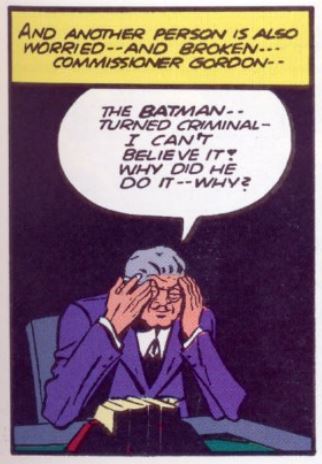
    As is frequently the case with a recurring villain, the Penguin’s first outing is one of his most successful: he takes over a gang using his gift for planning crimes and then when Batman starts to butt in he frames him but good.

    To really stick the landing, Penguin’s men kidnap Batman while he’s being transported to jail – Gotham’s finest are convinced that he is a crook! The Penguin is getting ready to bump him off! 

    Too bad for the Penguin that Robin shows up and the whole plan comes crashing down. Too bad for Batman and Robin that the Penguin actually manages to get away. The next story picks up where this one left off but that’s in 1942 so I’ll be telling you about it in like six months.

    BODY COUNT: 2

    END-OF-YEAR STATUS: At large.

  • SUPER-VILLAIN YEARBOOK: THE PENGUIN 1941

    What was the Penguin up to in 1941?

    (Detective Comics v1 058) ‘Untitled’ **First Appearance**

    Heeeey, it’s the Penguin, the perennial second-tier Batman villain!

    The Penguin really hits the ground running: he’s already got his look and his suite of trick umbrellas, so all he really needs is his weird bird-obsession, which kicks in in 1942. 

    As is frequently the case with a recurring villain, the Penguin’s first outing is one of his most successful: he takes over a gang using his gift for planning crimes and then when Batman starts to butt in he frames him but good.

    To really stick the landing, Penguin’s men kidnap Batman while he’s being transported to jail – Gotham’s finest are convinced that he is a crook! The Penguin is getting ready to bump him off! 

    Too bad for the Penguin that Robin shows up and the whole plan comes crashing down. Too bad for Batman and Robin that the Penguin actually manages to get away. The next story picks up where this one left off but that’s in 1942 so I’ll be telling you about it in like six months.

    BODY COUNT: 2

    END-OF-YEAR STATUS: At large.

  • MINOR SUPER-VILLAIN 219: THE FENCER

    (Detective Comics v1 057, 1941)

    A simple concept but a good one: the Fencer is the head of a vaguely-Axis espionage group that has been trying to kill anti-fascist author Jules Vortez for the past two issues using methods including causing plane crashes while still on the plane, duplicates, hypnosis and, sadly, blackface. Aside from the latter, this is exactly the sort of over-the-top behavior that should be going on all the time in a super-hero universe, so it’s only appropriate when the leader appears in costume, declares himself the “greatest fencer the world has ever known” and initiates a duel to the death with US secret agent Bart Regan.

    Unfortunately for the Fencer, though he ends up skewering Regan he doesn’t do a good enough job to finish him off and their duel soon resumes as a good old American punching competition, one which the Fencer loses. Still, a good show while it lasted!

  • MINOR SUPER-VILLAIN 219: THE FENCER

    (Detective Comics v1 057, 1941)

    A simple concept but a good one: the Fencer is the head of a vaguely-Axis espionage group that has been trying to kill anti-fascist author Jules Vortez for the past two issues using methods including causing plane crashes while still on the plane, duplicates, hypnosis and, sadly, blackface. Aside from the latter, this is exactly the sort of over-the-top behavior that should be going on all the time in a super-hero universe, so it’s only appropriate when the leader appears in costume, declares himself the “greatest fencer the world has ever known” and initiates a duel to the death with US secret agent Bart Regan.

    Unfortunately for the Fencer, though he ends up skewering Regan he doesn’t do a good enough job to finish him off and their duel soon resumes as a good old American punching competition, one which the Fencer loses. Still, a good show while it lasted!

  • MINOR SUPER-VILLAIN 218: THE LIGHTNING KILLER

    (Detective Comics v1 056, 1941)

    The Lightning Killer is a neat and potentially great concept that was ill-served by being featured in a 6-page middle-of-the-book strip like Cliff Crosby’s. As presented, he’s a mysterious killer who strikes only during thunderstorms and times his shots to lightning strikes so that they go unnoticed by witnesses. Unsurprisingly, he turns out to be the meteorologist Cliff consults midway through the story, as he is the only non-cop/ non-victim/ non-protagonist character featured.

    The Lightning Killer concept is cool enough that it deserves more! BRING him BACK, I say. Have the Lightning Murders play out over a year or two in the background of an ongoing, with thunderstorms being infrequent enough that he flies just under the radar but still leave an entire city on-edge! Or a recent murder could open up an investigation that reveals decades of seemingly unconnected slayings are the work of just one man! Neat stuff!

  • MINOR SUPER-VILLAIN 217: THE STONE IDOL

    (Detective Comics v1 056, 1941)

    The Stone Idol is a bit of a weird one: a miner living in the ghost town of Ghost Gulch City discovers silver on town land and recruits an unscrupulous group of circus performers to aid him in driving out the town’s remaining inhabitants so as to have all the silver for themselves. The actual Stone Idol is the circus strongman disguised as a local Native American statue in order to play on the local superstitions but really it’s a group effort.

    Sadly for Mad Mack the prospector and his circus of crime, the Stone Idol’s push to take over the town coincides with Bruce Wayne and Dick Grayson’s stay in a local hotel and the entire group of them die in a mine collapse while fighting Batman and Robin. Perils of living in a comic book world, I guess.

  • MINOR SUPER-VILLAIN 216: DR DEKER

    (Detective Comics v1 055, 1941)

    Dr Deker is a spy chief and a fifth columnist from the heady days before the US entered WWI, so of course he’s from an unnamed Fatherland and no further clarification is needed. He has the not-uncommon plan to kidnap prominent American scientists and steal their secrets, abetted by his very first acquisition: the Truth Machine, a device which unsurprisingly forces one to truthfully answer all questions.

    All of this is pretty comics-regular and poor ol’ Dr Deker would be consigned to the pile of discarded also-rans if not for two things: 1. the face that he is pulling in the third panel above and 2. the plan that he is detailing while making that face. Surely it is the mark of a true super-villain that when a method for causing insanity at range falls into his hands Deker’s sole thought is to use it on his own men, that installing an entire factory worth of fifth columnists and then rendering them into violent madmen would be a more desirable end than simply having complete control over a factory in the first place. 

    If you have the means to drive men insane then what other course is available? None, says Dr Deker, and that’s why he’s our Minor Super-Villain 216.

  • GENERIC COSTUMED VILLAIN ROUND-UP 003

    Yet another collection of also-rans and never-weres.

    Philip White: 

    Philip White here got exactly one panel into his career as a masked spy chief before Madam Fatal unmasked him. (Crack Comics 014, 1941)

    Basil: 

    An auctioneer named Basil ran an overly complicated scheme to steal the fabled Five Bloodstones of Mu. His plans were also undone by Madam Fatal and ended in his grisly demise. (Crack Comics 016, 1941)

    Unnamed Crook: 

    This unnamed thief almost got away with the Dare Diamond under the very nose of detective Larry Steele. (Detective Comics v1 049, 1941)

    Howard: 

    A baseball pitcher named Howard got up to some shady betting schemes and ended up a generic costumed villain. Let this be a lesson, kids. Also part of his big plan involved shooting himself in the arm with a gimmicked up baseball mitt-gun, which is an early sign that you might not be cut out for costumed villainy. (Detective Comics v1 052, 1941)

  • MINOR SUPER-VILLAIN 215: THE THREE DEVILS

    (Detective Comics v1 050, 1941) 

    The Three Devils are an early example of a fairly common minor super-villain archetype: the acrobat who turns their skill to criminal ends (and of course this is a subset of “circus folk who use their talents for crime” which itself is a subset of “talented professional turns their talent to crime” and then I guess above that is “criminals”). 

    I don’t think I’m going to bother calling it out every time it happens but they also appear in an early example of what will eventually be a staple of Batman story structure through the 60s, told in three acts:

    Act I: the villain’s novel methods allow them to triumph over Batman and Robin and get away with their goal – a lot of stories following this structure take place after the Comics Code, so usually this is a theft of some kind.

    Act II: Batman and Robin foil the villain’s scheme but they still get away.

    Act III: the villain is captured while attempting to achieve their goal.

    In this case, the Three Devils are flung to their deaths from a clock tower rather than being captured but like I said, it’s an early iteration of the format. It’s also a format that I noticed while reading Silver Age Batman stories, so it’ll be interesting to take note of how it develops and how much it is reflected in other super-hero comics of the time.

    The other interesting thing about the Three Devils is that despite falling to their deaths in 1941 they return in Batman Comics v1 107 in 1957 as the Daredevils:

    Now, I learned about this Three Devils/Daredevils connection on a fan wiki and so approached it with some skepticism but damned if they weren’t right about this one:

    They even use the same fence!

    Now 1957 is a tricky year – Barry Allen had just debuted as the Flash; Martian Manhunter is running around… this could just be an Earth-One retelling of the Three Devils story, scrubbed of some supernatural cruft. Or these could be the same characters, not actually dead after all – this is the kind of thing that inspired nerds to come up with stuff like Earth-Two-A and Earth-B and so forth.

  • MINOR SUPER-VILLAIN 215: THE THREE DEVILS

    (Detective Comics v1 050, 1941) 

    The Three Devils are an early example of a fairly common minor super-villain archetype: the acrobat who turns their skill to criminal ends (and of course this is a subset of “circus folk who use their talents for crime” which itself is a subset of “talented professional turns their talent to crime” and then I guess above that is “criminals”). 

    I don’t think I’m going to bother calling it out every time it happens but they also appear in an early example of what will eventually be a staple of Batman story structure through the 60s, told in three acts:

    Act I: the villain’s novel methods allow them to triumph over Batman and Robin and get away with their goal – a lot of stories following this structure take place after the Comics Code, so usually this is a theft of some kind.

    Act II: Batman and Robin foil the villain’s scheme but they still get away.

    Act III: the villain is captured while attempting to achieve their goal.

    In this case, the Three Devils are flung to their deaths from a clock tower rather than being captured but like I said, it’s an early iteration of the format. It’s also a format that I noticed while reading Silver Age Batman stories, so it’ll be interesting to take note of how it develops and how much it is reflected in other super-hero comics of the time.

    The other interesting thing about the Three Devils is that despite falling to their deaths in 1941 they return in Batman Comics v1 107 in 1957 as the Daredevils:

    Now, I learned about this Three Devils/Daredevils connection on a fan wiki and so approached it with some skepticism but damned if they weren’t right about this one:

    They even use the same fence!

    Now 1957 is a tricky year – Barry Allen had just debuted as the Flash; Martian Manhunter is running around… this could just be an Earth-One retelling of the Three Devils story, scrubbed of some supernatural cruft. Or these could be the same characters, not actually dead after all – this is the kind of thing that inspired nerds to come up with stuff like Earth-Two-A and Earth-B and so forth.