The Curse of Skeleton Munroe

Category: DC Comics

  • MEDIA IN COMICS 009

    MEDIA IN COMICS 009

    I hope you like media from comics, because I certainly do and I am going to keep doing these.

    Comics:

    Bullied bootblack Timothy Smith just wants to buy a comic book with his last nickel and he has a whole selection of Fox Features titles to choose from, but what draws his eye is a book called The Land of Magic, a comic so fantastical and majestical that he wishes himself away to live inside its pages the next time he gets beaten up. (Green Mask v1 007, 1941)

    We never actually see the Colossal Guy comic book, but this Colossal Guy superfan is evidence enough that he is a character with get-up and go. Enough to inspire Captain Bruce Blackburn to invent his alter ego of the Destroying Demon, in fact. (Feature Comics 039, 1940)

    “Ripley’s Believe it or Not” had enough cultural caché in its time that there are innumerable plays on it in comics, just as there were imitators in real life. These mostly differ by how successful a play on the name they have: “Don’t You Doubt It,” as consulted by Eve Colby as part of one of Spy Smasher’s cases, is about average. (Whiz Comics 005, 1940)

    Magazines:

    I have a lot of affection for the concept behind Jim Dolan, two-fisted magazine editor, who solves crimes and then writes about them for Daring Detective Magazine. The magazine itself is fine. (Slam-Bang Comics 001, 1940)

    Movies:

    We never learn more about The Big Snatch other than that it is a mystery thriller. The big joke here is of course that the star of the film is comics creator Joe Devlin. (Smash Comics 014, 1940)

    Likewise, we never learn much about the Western Hearts of the Range other than the fact that it starred the blowhard Sheriff O’Toole. (All-American Comics 021, 1940)

    Melody of 1941 here is likely a play on Broadway Melody of 1940 and as such a musical, and stars a couple of classic mixed-up name actors in Tyrone Taylor (Tyrone Power/ Robert Taylor) and Myrna Rogers (Myrna Loy/ Ginger Rogers). (Detective Comics v1 046 1940)

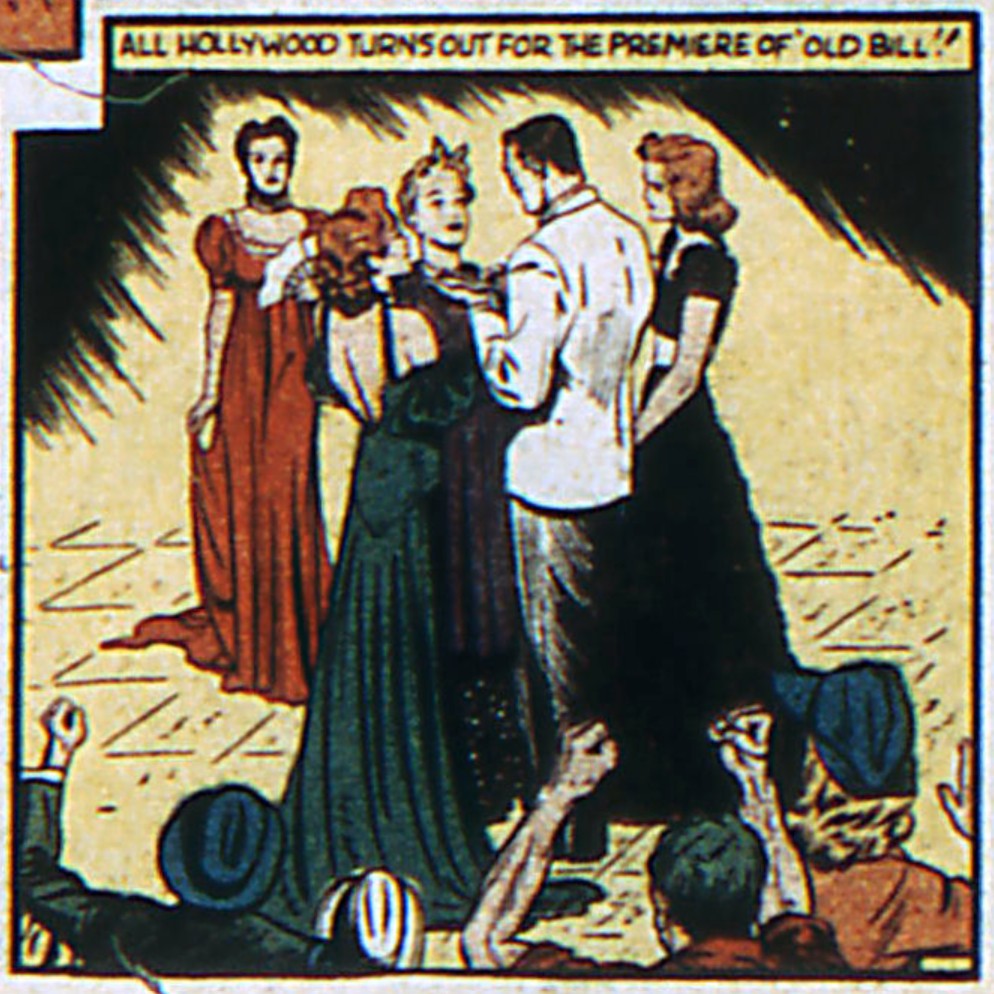
    We have no information at all about Old Bill. It has a pretty big premiere for a movie with such a drab name, so it must have something going for it. (Action Comics v1 028, 1940)

    Oriental Horror is the name of the hit movie that made Barry Moore’s name just before he quit acting, moved back to Center City to become a police scientist and adopted the identity of the Scarlet Seal based on the yellowface character he played in the movie. I would venture a guess that the film is not considered an enduring classic in the present day DC Universe. (Smash Comics 016, 1940)

    She Made Him Love Her! is the name of a romantic movie attended by Sisty and Dinky, aka the daughter of the future Red Tornado and the brother of teen cartoonist Scribbly, aka the future Cyclone Kids, after the former falls in undying love with the latter. And to be fair to her the duo are canonicall later married, so this is a proven tactic. Eventually.

    The movie itself might be loosely based on the film They Knew What They Wanted, or I might be grasping at straws. (All-American Comics 012, 1940)
  • MEDIA IN COMICS 008

    MEDIA IN COMICS 008

    We’re not out of the extremely crusty scan woods yet, but the media of comics must be recorded, folks. Hang in there.

    Books:

    When Diamond Jack defeats his early foe the Witch and transforms her book of magic into 1000 Ways to Cook Spinach, there is one big unanswered question: did this spinach cookbook already exist or did his ring magically compile 1000 recipes on its own? (Slam-Bang Comics 001, 1940)

    Early Batman foe the Wolf, meanwhile, got his start after suffering a head trauma and fixating on the crime thriller he was reading, titled The Crime Master. (Batman Comics v1 002, 1940)

    Human Knowledge, a book compiled by the sinister Professor Universe that contains “every fact known to man” is used by Slaughter Slade to imbue his assistant Dr Allirog with the mind of a human genius. (Special Edition Comics 001, 1940)

    Usually when you hear about a reclusive scholar writing a book about how “sinister persons or forces plan to deliberately stave off the return of national prosperity” you’re in for some paranoid fascist rantings, but in this case it’s the early 40s, so the sinister forces discussed in Prosperity’s Foe *are* the fascists. (Superman Comics 004, 1940)

    Wretched Marine character Strut Warren attempts to peddle a book called The Jolly Homemakers’ Manual around Bali in an attempt to win a prize, a typically tiresome adventure for the character. (Fight Comics 016, 1941)

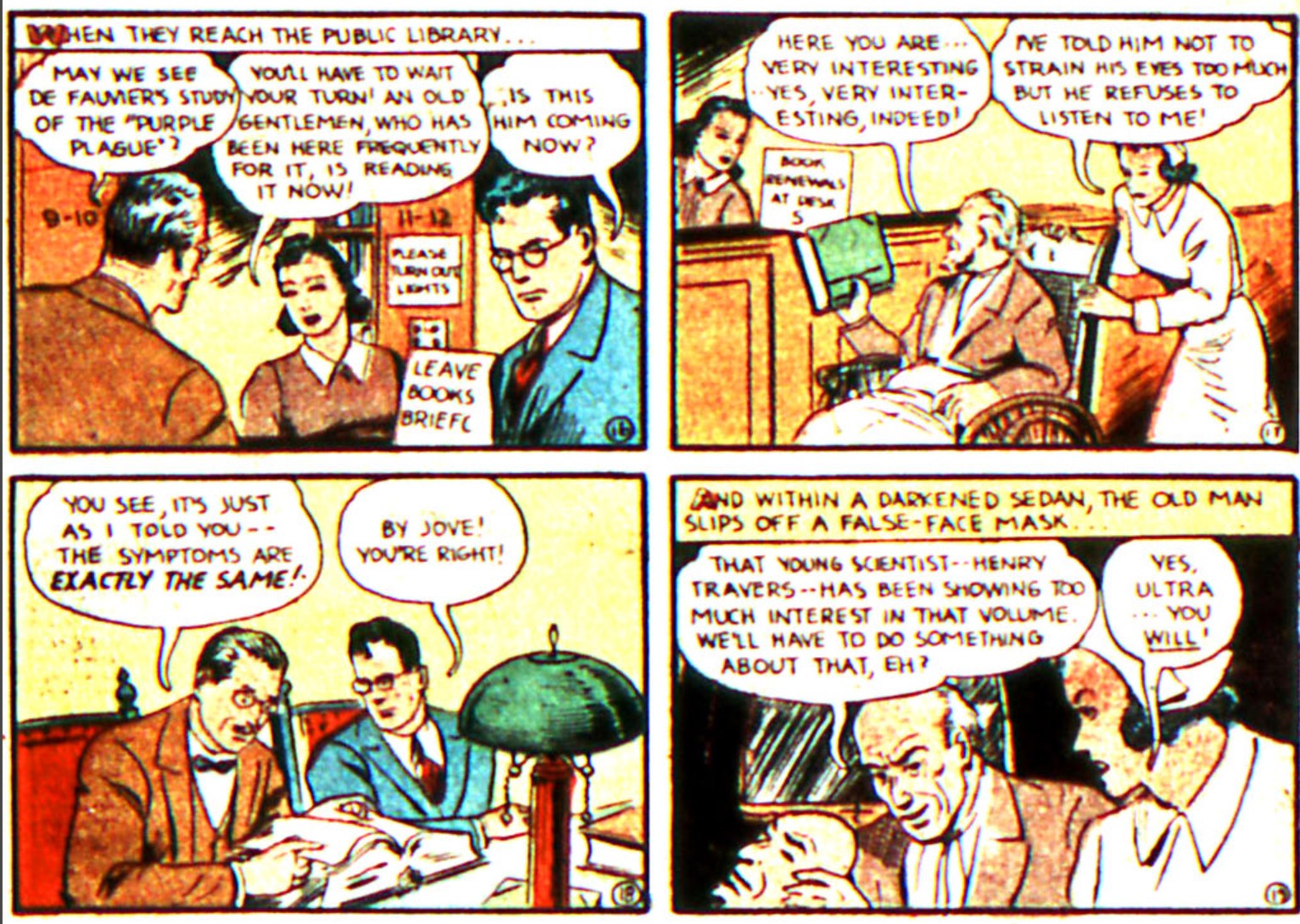
    When a mysterious virus called the Purple Plague starts ravaging Metropolis, Clark Kent and his pal Professor Henry Travers his the library to research a historical instance of the same disease, in a book also called The Purple Plague. It turns out that the Ultra Humanite had also checked out the same book and that it had given him the idea to unleash the modern plague in imitation of the original. (Action Comics v1 019, 1939)

    Movies:

    Air Circus is a airplane stunt-heavy film that is plagued by accidents while filming until pilot Gary Hawkes gets involved and exposes the scheming director’s plot to scuttle the production and then turn a quick buck by buying up the incomplete footage. (More Fun Comics 039, 1939)

    Its the same old story: a film called The General’s Daughter shoots some scenes at the Army installation where Skip Schuyler works, there’s a series of incidents and then Skip has to save the day. Not too sure what the movie is supposed to be about. (Adventure Comics 043, 1939)

    It may be the crustiest and crunchiest lowest quality scan here, but Public Enemy #13 is a pretty fun name for a movie and I think that that makes up for it, at least a little. (More Fun Comics 040, 1939)

    Newspaper Columns:

    “Around the Avenue” is one of those old-school society gossip columns that they used to have in papers, and while Rennie McCavoy here is playing into Wesley Dodds’ hands by writing him up as a wild party dude/ potential victim for the story’s villain, it’s hard to respect the journalistic effort involved in seeing a guy being quietly drunk at a nightclub and pouncing on him like this. (Adventure Comics 044, 1939)

  • MEDIA IN COMICS 007

    We’ve got some real early media for you today, so get ready for the crustiest scans of microfiche you ever saw.

    Movies:

    Steve Rogers and Bucky almost get to the movies to see a flick called Million Dollar Robbery before being interrupted by a real, if smaller-scale, robbery. BONUS: a classic case of real movies stars barely obfuscated by having their first names swapped, in Humphrey Raft and George Bogart, aka George Raft and Humphrey Bogart. (Captain America Comics 004, 1941)

    Hired to look into dirty dealings on the Stupendous Films lot, Slam Bradley and Shorty Morgan go undercover as stunt doubles. The comedy film that Shorty works on is never named, but Slam briefly works on a film called Jungle Man. (Detective Comics v1 004, 1937)

    Larry Steele’s own investigations into a series of high-profile kidnappings take him to the set of Too Much Money, a movie we never learn anything about. (Detective Comics v1 005, 1937)

    It’s just barely possible to make out that this movie that the Radio Squad boys watch is called The Fighting Cop. A bit on the nose, boys! (More Fun Comics 038, 1938)

    Music:

    Detective Bruce Nelson investigates a series of murders committed on stage while each victim was singing the same song. That song was originally called “The Night is Blue,” but is now known as “The Song of Death.” (Detective Comics 020, 1938)

    In Action Comics 006, a grifter named Nick Williams falsifies some contracts and begins licensing Superman’s name all over town, and one of the results of this is a song! Specifically, a big band tune called “You’re a Superman!”

    I wouldn’t call it the greatest song ever written (no song should include the word “resistless,” for example), but it’s not entirely terrible. (Action Comics v1 006, 1938)

    Newspaper Columns:

    Written by Paul Revere Sr, ultra-patriot and father to comic book adventure kid Paul Revere Jr, “America Awake!” is one of those exciting titles that works for an anti-Nazi column in 1941 and also potentially for a pro-Nazi one in the present. (Banner Comics 003, 1941)

    Jay Garson Jr, aka the Ragman, wrote his “Crime Does Not Pay” column right up until someone tried to kill him for it and he was forced to fake his own death. And then kept on writing it for a while afterward, seemingly mostly in order to give his old editor a hard time. (Cat-Man Comics 001, 1941)

    Radio Shows:

    In addition to “You’re a Superman!” Nick Wilson’s Superman-licensing deals included a Superman radio show, meaning that the DC Universe had one a full two years before we did.

    Wilson also mentions having sold movie and comic book rights, but as he is beaten up and forced to stop his scheme by the real Superman not long after this conversation it’s likely that those never saw the light of day. (Action Comics v1 006, 1938)

    Theatre:

    Slam Bradley and Shorty Morgan investigate the crimes of the Broadway Bandit by getting jobs on Broadway, specifically as tap dancers in a production called Love on Ice that despite its name seems to be a variety show rather than anything with a discernible plot. (Detective Comics v1 016, 1938)

    Renick’s Frolics, the show in which “The Song of Death” appears, is another of these variety productions. (Detective Comics v1 020, 1938)

    We learn nothing about Darkest Dawn other than the fact that someone is trying to kill the lead actress and Nadir, Master of Magic, is on the case. (New Adventure Comics 028, 1938)

  • MEDIA IN COMICS 007

    We’ve got some real early media for you today, so get ready for the crustiest scans of microfiche you ever saw.

    Movies:

    Steve Rogers and Bucky almost get to the movies to see a flick called Million Dollar Robbery before being interrupted by a real, if smaller-scale, robbery. BONUS: a classic case of real movies stars barely obfuscated by having their first names swapped, in Humphrey Raft and George Bogart, aka George Raft and Humphrey Bogart. (Captain America Comics 004, 1941)

    Hired to look into dirty dealings on the Stupendous Films lot, Slam Bradley and Shorty Morgan go undercover as stunt doubles. The comedy film that Shorty works on is never named, but Slam briefly works on a film called Jungle Man. (Detective Comics v1 004, 1937)

    Larry Steele’s own investigations into a series of high-profile kidnappings take him to the set of Too Much Money, a movie we never learn anything about. (Detective Comics v1 005, 1937)

    It’s just barely possible to make out that this movie that the Radio Squad boys watch is called The Fighting Cop. A bit on the nose, boys! (More Fun Comics 038, 1938)

    Music:

    Detective Bruce Nelson investigates a series of murders committed on stage while each victim was singing the same song. That song was originally called “The Night is Blue,” but is now known as “The Song of Death.” (Detective Comics 020, 1938)

    In Action Comics 006, a grifter named Nick Williams falsifies some contracts and begins licensing Superman’s name all over town, and one of the results of this is a song! Specifically, a big band tune called “You’re a Superman!”

    I wouldn’t call it the greatest song ever written (no song should include the word “resistless,” for example), but it’s not entirely terrible. (Action Comics v1 006, 1938)

    Newspaper Columns:

    Written by Paul Revere Sr, ultra-patriot and father to comic book adventure kid Paul Revere Jr, “America Awake!” is one of those exciting titles that works for an anti-Nazi column in 1941 and also potentially for a pro-Nazi one in the present. (Banner Comics 003, 1941)

    Jay Garson Jr, aka the Ragman, wrote his “Crime Does Not Pay” column right up until someone tried to kill him for it and he was forced to fake his own death. And then kept on writing it for a while afterward, seemingly mostly in order to give his old editor a hard time. (Cat-Man Comics 001, 1941)

    Radio Shows:

    In addition to “You’re a Superman!” Nick Wilson’s Superman-licensing deals included a Superman radio show, meaning that the DC Universe had one a full two years before we did.

    Wilson also mentions having sold movie and comic book rights, but as he is beaten up and forced to stop his scheme by the real Superman not long after this conversation it’s likely that those never saw the light of day. (Action Comics v1 006, 1938)

    Theatre:

    Slam Bradley and Shorty Morgan investigate the crimes of the Broadway Bandit by getting jobs on Broadway, specifically as tap dancers in a production called Love on Ice that despite its name seems to be a variety show rather than anything with a discernible plot. (Detective Comics v1 016, 1938)

    Renick’s Frolics, the show in which “The Song of Death” appears, is another of these variety productions. (Detective Comics v1 020, 1938)

    We learn nothing about Darkest Dawn other than the fact that someone is trying to kill the lead actress and Nadir, Master of Magic, is on the case. (New Adventure Comics 028, 1938)

  • CATALOGUE OF WOUNDS 004

    More wounds for the wound god!

    American Ace:

    Minor Marvel adventure hero Parry Wade, aka the American Ace, is riddled through the torso and crashes his plane after a dogfight. He gets better. (Marvel Mystery Comics v1 003, 1940)

    Black X:

    Shot in the left shoulder by agents of Vlamir Koran, then nearly dies of exposure while seeking aid. (Smash Comics 001, 1939)

    Black X’s aide Batu gets shot in the left shoulder on his next mission, while Black X himself gets his skull creased by a bullet. (Smash Comics 002, 1939)

    Finally, Black X gets his right arm broken by a guy named Taneo. (Smash Comics 005, 1939)

    Clip Carson:

    Shot in the left shoulder by the dastardly Mister K. (More Fun Comics 068, 1941)

    the Devil’s Dagger: 

    The Devil’s Dagger’s aide Pat Gleason is shot in the right leg by the dastardly Mr H. (Master Comics 015, 1941)

    Jim Dolan: 

    Two-fisted magazine editor Jim Dolan is not only thrown off a bridge to drown but machine gunned on the way down. Thankfully they only get his left shoulder. (Wow Comics 002, 1941)

    Ka-Zar:

    The Golden Age Ka-Zar is covered in shallow cuts as torture. (Marvel Mystery Comics v1 005, 1940)

    A few issues later he gets shot in the (left? side by an unscrupulous hunter. (Marvel Mystery Comics v1 011, 1940)

    And a few issues after that, the same unscrupulous hunter shoots him in the (left?) arm. (Marvel Mystery Comics v1 016, 1941)

    Tiny: 

    The Ragman’s sidekick Tiny is shot in the right arm by a Nazi. (Cat-Man Comics 005, 1941)

  • CATALOGUE OF WOUNDS 004

    More wounds for the wound god!

    American Ace:

    Minor Marvel adventure hero Parry Wade, aka the American Ace, is riddled through the torso and crashes his plane after a dogfight. He gets better. (Marvel Mystery Comics v1 003, 1940)

    Black X:

    Shot in the left shoulder by agents of Vlamir Koran, then nearly dies of exposure while seeking aid. (Smash Comics 001, 1939)

    Black X’s aide Batu gets shot in the left shoulder on his next mission, while Black X himself gets his skull creased by a bullet. (Smash Comics 002, 1939)

    Finally, Black X gets his right arm broken by a guy named Taneo. (Smash Comics 005, 1939)

    Clip Carson:

    Shot in the left shoulder by the dastardly Mister K. (More Fun Comics 068, 1941)

    the Devil’s Dagger: 

    The Devil’s Dagger’s aide Pat Gleason is shot in the right leg by the dastardly Mr H. (Master Comics 015, 1941)

    Jim Dolan: 

    Two-fisted magazine editor Jim Dolan is not only thrown off a bridge to drown but machine gunned on the way down. Thankfully they only get his left shoulder. (Wow Comics 002, 1941)

    Ka-Zar:

    The Golden Age Ka-Zar is covered in shallow cuts as torture. (Marvel Mystery Comics v1 005, 1940)

    A few issues later he gets shot in the (left? side by an unscrupulous hunter. (Marvel Mystery Comics v1 011, 1940)

    And a few issues after that, the same unscrupulous hunter shoots him in the (left?) arm. (Marvel Mystery Comics v1 016, 1941)

    Tiny: 

    The Ragman’s sidekick Tiny is shot in the right arm by a Nazi. (Cat-Man Comics 005, 1941)

  • CATALOGUE OF WOUNDS 003

    It’s a dangerous ol’ job, heroing. Thus, the Catalogue of Wounds!

    Green Lantern:

    While tied up in a burning house, Green Lantern must thrust his hands into the flames to escape. (All American Comics 031, 1941)

    Hawkgirl: 

    Hawkgirl is shot in the back by an agent of Mister X while acting as a Hawkman decoy on her very first outing in costume (All-Star Comics 005, 1941)

    Hawkman:

    Shot in the left shoulder by Alexander the Great. (Flash Comics 002, 1940)

    Shot in – I think – the left shoulder again while working on the case of the Hand. (Flash Comics 015, 1941) 

    Shot in the right shoulder for a change, as Carter Hall. (Flash Comics 019, 1941) 

    Perhaps Hawkman preferentially takes bullets to the left shoulder because he took an arrow there during his original incarnation as Prince Khufu. (Flash Comics 001, 1940)  

    Speaking of Prince Khufu, he (along Princess Shiera, off-panel) is famously stabbed by the evil Hath-Set. Hey, a fatal wound is still a wound. (Flash Comics 001, 1940)

    the Human Torch:

    During one of the periods in which the Human Torch is being hunted by the law, he takes a police slug to his right arm. (Marvel Mystery Comics v1 011, 1940)

    the King: 

    Gets his scalp creased by a bullet. (Flash Comics 003, 1940)

    And again a year later. (Flash Comics 016, 1941)

    Aquatic toughie the Scarlet Mermaid gives the King a fashionable bullet wound in the left shoulder while making her escape. (Flash Comics 019, 1941)

    the Pied Piper: 

    Shot in the right arm while wrasslin’ with the Black Panther’s panther. (Cat-Man Comics 004, 1941)

  • CATALOGUE OF WOUNDS 002

    CATALOGUE OF WOUNDS 002

    Just which comic book character has taken the most punishment down through the years? join me as we compile the definitive guide to bodily trauma in the super class. 

    Blackhawk:

    Blackhawk must set off an explosion from closer-than-optimal range and ends up getting lightly shredded. (Military Comics 003, 1941)

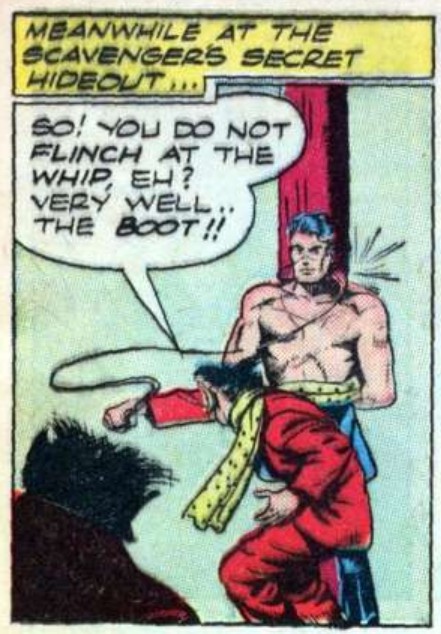
    Blackhawk’s next two adventures feature him getting whipped badly enough to mark up his torso, by the Black Tigress and the Scavengers, respectively. (Military Comics 004 & 005, 1941)

    Blackhawks:

    Blackhawk stalwart Andre is shot in the back by Nazis and then starts an avalanche with his own body to bury those same Nazis. Though he does survive, Andre is believed to be dead for the next six issues. (Military Comics 003, 1941)

    Blue Beetle:

    Blue Beetle is shot in a gang drive-by while in his civilian identity of Dan Garret. He only survives thanks to an operation to remove the bullet lodged two inches from his heart. Bonus fact: Dan has Type B blood! (Blue Beetle Comics v1 004, 1940)

    Dan Garret’s partner/ the Blue Beetle’s most dogged persecutor Mike Mannigan is a bit of a wound magnet. Here he is getting his skull creased by a bullet while attempting to round up one of the Sphinx’s men… (Mystery Men Comics 018, 1941)

    And here he is getting shot in the right arm. (Mystery Men Comics 026, 1941)

    Congo Bill:

    1941 is a bad year for Congo Bill’s shoulders. First he gets shot in the left… (Action Comics v1 038, 1941)

    … and then he gets a spear thrown clear through the right. (Action Comics v1 041, 1941)

    Dr Fate:

    Inza Cramer – long-time Dr Fate Companion/ eventual Dr Fate herself – takes a bullet meant for Kent “Dr Fate” Nelson by an agent of Mister X and is almost killed. (All-Star Comics 005, 1941)

    the Flash: 

    Jay “the Flash” Garrick gets his skull creased by a bullet while moving slow to avoid risking his secret identity. (All-Flash Quarterly 002, 1941)

    the Patriot: 

    Future Captain America stand-in the Patriot is shot and seemingly killed at the end of his story in Marvel Mystery Comics 024 but at the resolution of the cliffhanger in the next issue he turns out to have sustained a fashionable bullet crease to the skull. (Marvel Mystery Comics v1 024, 1941)

    the Ragman:

    Ambushed and shot up by agents of the Stinger, the Ragman survives thanks to a bulletproof vest, but evidence would suggest that he was shot at least once and possibly twice in the right arm. (Cat-Man Comics 003, 1941)

  • CATALOGUE OF WOUNDS 002

    CATALOGUE OF WOUNDS 002

    Just which comic book character has taken the most punishment down through the years? join me as we compile the definitive guide to bodily trauma in the super class. 

    Blackhawk:

    Blackhawk must set off an explosion from closer-than-optimal range and ends up getting lightly shredded. (Military Comics 003, 1941)

    Blackhawk’s next two adventures feature him getting whipped badly enough to mark up his torso, by the Black Tigress and the Scavengers, respectively. (Military Comics 004 & 005, 1941)

    Blackhawks:

    Blackhawk stalwart Andre is shot in the back by Nazis and then starts an avalanche with his own body to bury those same Nazis. Though he does survive, Andre is believed to be dead for the next six issues. (Military Comics 003, 1941)

    Blue Beetle:

    Blue Beetle is shot in a gang drive-by while in his civilian identity of Dan Garret. He only survives thanks to an operation to remove the bullet lodged two inches from his heart. Bonus fact: Dan has Type B blood! (Blue Beetle Comics v1 004, 1940)

    Dan Garret’s partner/ the Blue Beetle’s most dogged persecutor Mike Mannigan is a bit of a wound magnet. Here he is getting his skull creased by a bullet while attempting to round up one of the Sphinx’s men… (Mystery Men Comics 018, 1941)

    And here he is getting shot in the right arm. (Mystery Men Comics 026, 1941)

    Congo Bill:

    1941 is a bad year for Congo Bill’s shoulders. First he gets shot in the left… (Action Comics v1 038, 1941)

    … and then he gets a spear thrown clear through the right. (Action Comics v1 041, 1941)

    Dr Fate:

    Inza Cramer – long-time Dr Fate Companion/ eventual Dr Fate herself – takes a bullet meant for Kent “Dr Fate” Nelson by an agent of Mister X and is almost killed. (All-Star Comics 005, 1941)

    the Flash: 

    Jay “the Flash” Garrick gets his skull creased by a bullet while moving slow to avoid risking his secret identity. (All-Flash Quarterly 002, 1941)

    the Patriot: 

    Future Captain America stand-in the Patriot is shot and seemingly killed at the end of his story in Marvel Mystery Comics 024 but at the resolution of the cliffhanger in the next issue he turns out to have sustained a fashionable bullet crease to the skull. (Marvel Mystery Comics v1 024, 1941)

    the Ragman:

    Ambushed and shot up by agents of the Stinger, the Ragman survives thanks to a bulletproof vest, but evidence would suggest that he was shot at least once and possibly twice in the right arm. (Cat-Man Comics 003, 1941)

  • CATALOGUE OF WOUNDS 001

    CATALOGUE OF WOUNDS 001

    Among the many things that I have found interesting enough to keep track of over the years is just how many times super-heroes get wounded while going about their business. What does a shoulder look like after it’s been shot a dozen times, for example? If I had been really on the ball I would have also been noting every time someone was knocked out with a blow to the head as well, but we can’t all be perfect.

    Full catalogue here, such as it is. 

    the Angel:

    The Angel chars his own hands at least a bit while escaping from some ropes. (Marvel Mystery Comics v1 008, 1940) 

    The Angel is wounded and probably shot while escaping from an ambush by the Cat’s Paw’s men (Marvel Mystery Comics v1 019, 1941)

    Batman:

    Batman is shot in the left shoulder during an altercation with the Wolf’s men. (Batman Comics v1 002, 1940)

    Shot in the right shoulder by a fleeing crook. (Batman Comics v1 004, 1940)

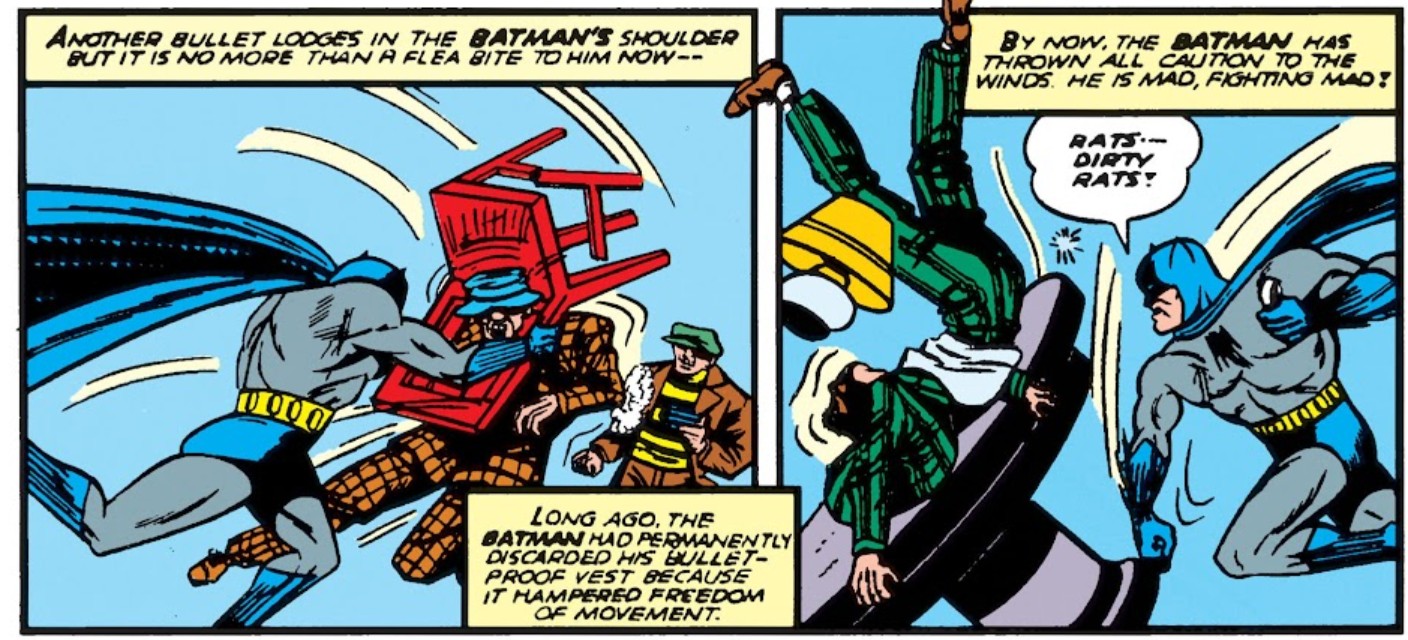
    While attacking a criminal hideout in a berserker rage, Batman is shot twice in the right shoulder and has a bullet glance off his ribs. (Batman Comics v1 005, 1941)

    Pirate Hook Morgan slashes Batman across the chest and hooks him in the left shoulder. (Detective Comics v1 054, 1941)

    Black Condor: 

    Black Condor is shot in the back by the Sapphire King’s men. (Crack Comics 005, 1940)

    Blackhawk:

    Blackhawk’s arm is non-specifically injured after an attack on Blackhawk Island. (Military Comics 001, 1941)

    the Deacon:

    The Deacon is shot in the right arm by the cops. (Cat-Man Comics 001, 1941) 

    Robin:

    Robin is beaten nearly to death by some gangsters (triggering Batman’s berserker attack above). (Batman Comics v1 005, 1941)