The Curse of Skeleton Munroe

Category: DC Comics

  • DIVINE ROUND-UP 019

    These pantheons are going to fill up if we’re not careful.

    Ammon-Ra:

    Worshipped by a secret sect in the hidden underground city-state of Ruxor in Egypt, Ammon-Ra, contrary to the above image, is probably just an idol that Yarko the Great is making speak so that he doesn’t have to keep magically duelling High Priest Ramma-Tep. 

    God style: Idol (Wonderworld Comics 018, 1940)

    Kila:

    Kila, the supposed Hindu God of Destruction, is represented here by a ruby idol. There’s not much else concrete to say about this particular god, because Sheldon Lenox, the fellow selling the idol, stages a series of crimes using a fake cult in order to get it back and that sort of thing really muddies the waters.

    God Style: Idol (Detective Comics v1 035, 1940)

    Kilu:

    In a classic set-up, a pirate captain and a wicked witch doctor have teamed up to control an island tribe using a hollow idol of the tribe’s god, Kilu. The whole operation is upended by the heroic Captain Fortune and the idol of Kilu is blasted by his ship’s cannon.

    God Style: Idol (Feature Comics 030, 1940)

    Koru: 

    Having heard about a fabulous fortune in rubies somewhere in the African jungle, adventure Tod Hunter and his monocled pal Tommy set out to steal them from their place on the idol of Koru, God of the Ruby Eye. Let me tell you, they are pretty put out when the worshippers of Koru very reasonably imprison them rather than allow them to waltz in and deface their sacred idol. 

    The duo (along with some other miscellaneous imprisoned treasure hunters) of course end up escaping and stealing all of the rubies, because they are the protagonists of an adventure story and thus are in the right, Along the way they discover that the idol of Koru is hollow and has a little guy living inside of it to speak in the god’s voice, just like every other giant idol in comics.

    God Style: Idol (New Adventure Comics 027, 1938) 

  • DIVINE ROUND-UP 018

    Idols, idols, idols! 

    the Great God Khwass: 

    Khwass, Great God of Vengeance, is a comparatively rare villain’s god who actually follows through on his promises. He is invoked vs Dr Fung by the daughter of a former foe and not only replies to her prayers but deploys sleeping gas and a weird monster to aid her in her quest for vengeance. 

    God Style: Real (Wonderworld Comics 016, 1940)

    Ice God Emul:

    Captain Venture and the Planet Princess Zyra’s great enemy, King Leon of Asteroid Djung, loves to subcontract out his villainy, and to that end he has engaged the services of Frigo, King of the Ice Planet. Frigo is to kill Captain Venture and deliver Zyra to King Leon for marriage but of course betrays him and slates all three for sacrifice to the Ice God Emul.

    The idol of Emul is destroyed in the subsequent battle and escape, and what’s interesting here is that Emul is explicitly just the idol. As Frigo states, “the god Emul is no more.” Wild.

    God Style: Idol (Master Comics 015, 1941)

    Bubastis & Isis:

    In an early adventure in Egypt, Zatara comes across a member of a lost archaeological expedition who is on the verge of death, and who is magically revealed to have found a lost temple to Bubastis. Travelling there in hopes of finding the rest of the expedition, Zatara encounters the ancient priest Amen-Hotep, who is part of one of those weird remnant Ancient Egyptian populations that exist under the sands of Egypt in adventure fiction, and whose priestly magics are comparable to Zatara’s own.

    The temple of Bubastis also turns out to be a temple to Isis, as Zatara discovers when he meets a less-powerful but still magically potent priestess of Isis and is almost sacrificed by her. Amen-Hotep seems to be an Isis worshipper as well, as he animates a statue of the goddess to smite Zatara with – it’s possible that the two goddesses are being conflated here.

    Zatara ends up melting the statue of Isis and disintegrating Amen-Hotep. The priestess is “sent away,” presumably with the rest of her people in tow, and the temple is turned over to the archaeologists to plunder.

    God Style: Real (Action Comics 005, 1938) 

    Khor: 

    Khor is known as the Blind God because the magical diamond that was the eye of his idol was stolen long ago, and since that diamond subsequently became the source of super-heroic adventurer Diamond Jack’s power, the priesthood of Khor is out for his blood.

    The high priest animates the idol of Khor and sends it to destroy Diamond Jack and recover the eye. This is impressive but not innovative – we just saw the Amen-Hotep do the same with a statue of Isis, after all – but what is is the custom roadster-cum-juggernaut that the thing rides around in. Was ever aan evil god so sporty?

    The whole thing ends back at the temple, as Diamond Jack disrupts the ritual that keeps Khor animated and the high priest ends up being crushed under the falling idol. So long, Khor. 

    God Style: Idol (Real?) (Slam-Bang Comics 004, 1940) 

  • DIVINE ROUND-UP 018

    Idols, idols, idols! 

    the Great God Khwass: 

    Khwass, Great God of Vengeance, is a comparatively rare villain’s god who actually follows through on his promises. He is invoked vs Dr Fung by the daughter of a former foe and not only replies to her prayers but deploys sleeping gas and a weird monster to aid her in her quest for vengeance. 

    God Style: Real (Wonderworld Comics 016, 1940)

    Ice God Emul:

    Captain Venture and the Planet Princess Zyra’s great enemy, King Leon of Asteroid Djung, loves to subcontract out his villainy, and to that end he has engaged the services of Frigo, King of the Ice Planet. Frigo is to kill Captain Venture and deliver Zyra to King Leon for marriage but of course betrays him and slates all three for sacrifice to the Ice God Emul.

    The idol of Emul is destroyed in the subsequent battle and escape, and what’s interesting here is that Emul is explicitly just the idol. As Frigo states, “the god Emul is no more.” Wild.

    God Style: Idol (Master Comics 015, 1941)

    Bubastis & Isis:

    In an early adventure in Egypt, Zatara comes across a member of a lost archaeological expedition who is on the verge of death, and who is magically revealed to have found a lost temple to Bubastis. Travelling there in hopes of finding the rest of the expedition, Zatara encounters the ancient priest Amen-Hotep, who is part of one of those weird remnant Ancient Egyptian populations that exist under the sands of Egypt in adventure fiction, and whose priestly magics are comparable to Zatara’s own.

    The temple of Bubastis also turns out to be a temple to Isis, as Zatara discovers when he meets a less-powerful but still magically potent priestess of Isis and is almost sacrificed by her. Amen-Hotep seems to be an Isis worshipper as well, as he animates a statue of the goddess to smite Zatara with – it’s possible that the two goddesses are being conflated here.

    Zatara ends up melting the statue of Isis and disintegrating Amen-Hotep. The priestess is “sent away,” presumably with the rest of her people in tow, and the temple is turned over to the archaeologists to plunder.

    God Style: Real (Action Comics 005, 1938) 

    Khor: 

    Khor is known as the Blind God because the magical diamond that was the eye of his idol was stolen long ago, and since that diamond subsequently became the source of super-heroic adventurer Diamond Jack’s power, the priesthood of Khor is out for his blood.

    The high priest animates the idol of Khor and sends it to destroy Diamond Jack and recover the eye. This is impressive but not innovative – we just saw the Amen-Hotep do the same with a statue of Isis, after all – but what is is the custom roadster-cum-juggernaut that the thing rides around in. Was ever aan evil god so sporty?

    The whole thing ends back at the temple, as Diamond Jack disrupts the ritual that keeps Khor animated and the high priest ends up being crushed under the falling idol. So long, Khor. 

    God Style: Idol (Real?) (Slam-Bang Comics 004, 1940) 

  • DIVINE ROUND-UP 017

    You’ll never believe it: more gods. 

    the Serpent Gods: 

    While pursuing crook Rango in the African jungle, Yarko the Great comes across a couple being sacrificed to the Serpent Gods by being flung into a pit of sacred serpents. But are the serpents the Serpent Gods themselves? There is no further context given, so we must assume that they are.

    God style: Animist (Wonderworld Comics 015, 1940) 

    Gorm: 

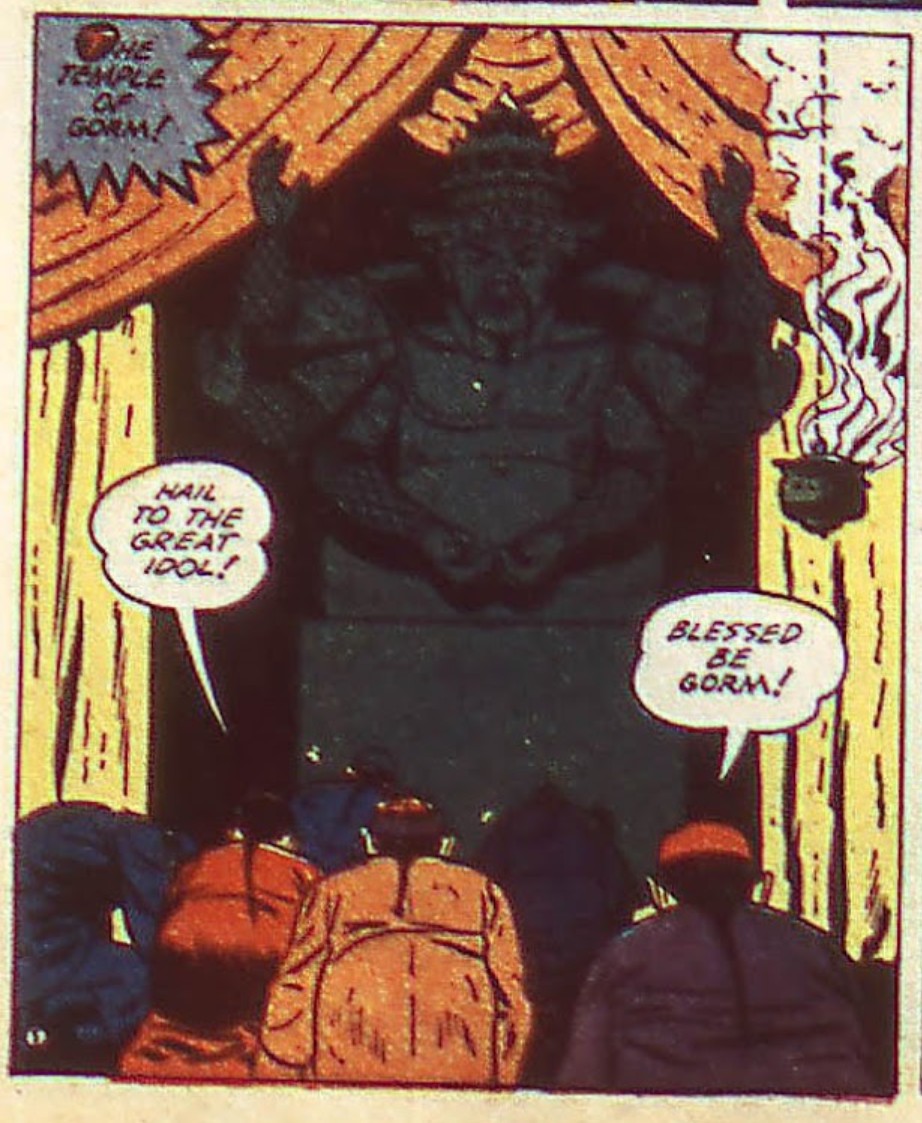
    Gorm is the god of the villainous Hatchet Cult, a gang that the Flash encounters early in his career, but since the Hatchet Cult is made up of white gangsters surgically made to look Chinese in order to throw the authorities off of their trail, one must assume that Gorm is just another part of the ruse (though for who’s benefit these guys are praying is a mystery to me).

    God Style: Idol (Flash Comics v1 022, 1941) 

    the Great God Orrab: 

    The Great God Orrab is yet another idol to which Our Heroes are almost sacrificed, ho hum. The interesting thing about this particular god, however, is that the hero in question is Blaze Barton, which placed Orrab in the year 50033 CE or thereabouts, and makes it very possible that his worshippers are in fact post-apocalyptic remnants worshipping the equivalent of a McDonaldland statue.

    God Style: Idol (Hit Comics 009, 1941)

    Hu, the Horse God: 

    Adventurer Lance Larkin and a lady named Marsha are looking for the “Land of the Flying Dragons” in Siberia, and wouldn’t you know it, they find it! And there are flying dragons (well, “pterodactyls”) there! There are also caveman-style Ape-Men riding the dragons, who swiftly capture Lance and Marsha and take them to be sacrificed at the altar of Hu, the Horse God. It is only the arrival of Lance’s loyal steed Satan, taken to be an earthly avatar of Hu, that saves the two.

    So just why do a bunch of cavemen who ride flying reptiles and have never seen a horse in their lives have a horse as their god? Because hundreds of thousands of years ago when they came to this prehistoric enclave they had horses and those horses saved them from disaster somehow. This inspired the reverence, but didn’t stop the horses from eventually dying out, which then inspired the taming of the “pterodactyls”.

    God-Style: Idol (More Fun Comics 067, 1941) 

  • DIVINE ROUND-UP 017

    DIVINE ROUND-UP 017

    You’ll never believe it: more gods. 

    the Serpent Gods: 

    While pursuing crook Rango in the African jungle, Yarko the Great comes across a couple being sacrificed to the Serpent Gods by being flung into a pit of sacred serpents. But are the serpents the Serpent Gods themselves? There is no further context given, so we must assume that they are.

    God style: Animist (Wonderworld Comics 015, 1940) 

    Gorm: 

    Gorm is the god of the villainous Hatchet Cult, a gang that the Flash encounters early in his career, but since the Hatchet Cult is made up of white gangsters surgically made to look Chinese in order to throw the authorities off of their trail, one must assume that Gorm is just another part of the ruse (though for who’s benefit these guys are praying is a mystery to me).

    God Style: Idol (Flash Comics v1 022, 1941) 

    the Great God Orrab: 

    The Great God Orrab is yet another idol to which Our Heroes are almost sacrificed, ho hum. The interesting thing about this particular god, however, is that the hero in question is Blaze Barton, which placed Orrab in the year 50033 CE or thereabouts, and makes it very possible that his worshippers are in fact post-apocalyptic remnants worshipping the equivalent of a McDonaldland statue.

    God Style: Idol (Hit Comics 009, 1941)

    Hu, the Horse God: 

    Adventurer Lance Larkin and a lady named Marsha are looking for the “Land of the Flying Dragons” in Siberia, and wouldn’t you know it, they find it! And there are flying dragons (well, “pterodactyls”) there! There are also caveman-style Ape-Men riding the dragons, who swiftly capture Lance and Marsha and take them to be sacrificed at the altar of Hu, the Horse God. It is only the arrival of Lance’s loyal steed Satan, taken to be an earthly avatar of Hu, that saves the two.

    So just why do a bunch of cavemen who ride flying reptiles and have never seen a horse in their lives have a horse as their god? Because hundreds of thousands of years ago when they came to this prehistoric enclave they had horses and those horses saved them from disaster somehow. This inspired the reverence, but didn’t stop the horses from eventually dying out, which then inspired the taming of the “pterodactyls”.

    God-Style: Idol (More Fun Comics 067, 1941) 

  • DIVINE ROUND-UP 016

    Gods aplenty! 

    Tyalpo: 

    The god worshipped by Ibis the Invincible villain Piang the Terrible. Probably real, in that Piang has real magical power that he calls upon Tyalpo to activate, even if the god himself shows up only in idol form.

    God Style: Idol (Real?) (Whiz Comics 009, 1940) 

    Goddess of the Jungle: 

    Sandor is a jungle hero who doesn’t so much adventure as get into one long series of scrapes and situations in Northern India, the second most popular location to be a jungle hero by my reckoning. One of those scrapes involves him nearly getting sacrificed to the Goddess of the Jungle, about whom we never really learn more than her name. 

    God Style: Invoked (New Comics 006, 1936)

    the Golden Dragon: 

    “The Golden Dragon” is a serial that ran in Adventure Comics for around three years (and in fact started back when the book was called New Comics), about a group of adventurers and soldiers of fortune travelling from China to Mongolia in search of the fabled treasure of the Golden Dragon, while fending off attempts by the villainous Torgadoff to halt their journey, presumably so that he can seek the treasure himself. 

    Adventure Comics 034 finds de facto expedition leader Ian Murray at the end of the trail, which turns out to be a very much still in-use Temple of the Golden Dragon, with Torgadoff turning out to be one of the high priests. Does this dampen his desire to strip the place of its treasure? Absolutely not! This is a 1930s adventurer we’re talking about! The presence of a non-Christian religious practice only increases his lust for gold!

    Even the treasure-hungry Murray is taken aback, however, when the Golden Dragon shows up and turns out to be a real, living creature – presumably some sort of giant snake rather than a more traditional dragon based on how dumb it seems to be. 

    Murray’s reverence for this wonder of the natural world extends about as far as his respect for other cultures, and he ends up blasting the Golden Dragon at the first opportunity (but not before tossing Torgadoff into it’s crushing coils). The death of their god causes the worshippers to retreat, and the heroic adventurers are able to loot the temple and retire to lives of ease and luxury.

    God Style: Animist (Adventure Comics 034, 1939) 

    the Golden God: 

    The Golden God is one of the innumerable gods worshipped by the uncountable made-up Amazon tribes that comics are full of, and like so many of these gods, the Golden God is sought out by adventurers because it is represented by an idol of solid gold. Heroic adventurers the Companions Three seek out the idol after being hired by a woman named Cassie Bennett to find her father, Professor Bennett, who is supposedly after it on anthropological grounds 

    As usual, the anthropological value of an artifact outweighs the fact that the idol in question is still being used, but that turns out to matter a bit less than it normally does because the Golden God has in fact been discarded in favour of an unnamed new god, This new god in turn is revealed to be the Companions’ antagonist Hook Harroday, who is himself after the gold.

    Harroday’s plan to messily murder the Companions Three falls apart under a barrage of punches, and the group escapes with the idol of the Golden God, which Professor Bennett sells to a museum in a real triumph for selfless anthropology. 

    God Style: Idol (Master Comics 015, 1941) 

  • DIVINE ROUND-UP 016

    Gods aplenty! 

    Tyalpo: 

    The god worshipped by Ibis the Invincible villain Piang the Terrible. Probably real, in that Piang has real magical power that he calls upon Tyalpo to activate, even if the god himself shows up only in idol form.

    God Style: Idol (Real?) (Whiz Comics 009, 1940) 

    Goddess of the Jungle: 

    Sandor is a jungle hero who doesn’t so much adventure as get into one long series of scrapes and situations in Northern India, the second most popular location to be a jungle hero by my reckoning. One of those scrapes involves him nearly getting sacrificed to the Goddess of the Jungle, about whom we never really learn more than her name. 

    God Style: Invoked (New Comics 006, 1936)

    the Golden Dragon: 

    “The Golden Dragon” is a serial that ran in Adventure Comics for around three years (and in fact started back when the book was called New Comics), about a group of adventurers and soldiers of fortune travelling from China to Mongolia in search of the fabled treasure of the Golden Dragon, while fending off attempts by the villainous Torgadoff to halt their journey, presumably so that he can seek the treasure himself. 

    Adventure Comics 034 finds de facto expedition leader Ian Murray at the end of the trail, which turns out to be a very much still in-use Temple of the Golden Dragon, with Torgadoff turning out to be one of the high priests. Does this dampen his desire to strip the place of its treasure? Absolutely not! This is a 1930s adventurer we’re talking about! The presence of a non-Christian religious practice only increases his lust for gold!

    Even the treasure-hungry Murray is taken aback, however, when the Golden Dragon shows up and turns out to be a real, living creature – presumably some sort of giant snake rather than a more traditional dragon based on how dumb it seems to be. 

    Murray’s reverence for this wonder of the natural world extends about as far as his respect for other cultures, and he ends up blasting the Golden Dragon at the first opportunity (but not before tossing Torgadoff into it’s crushing coils). The death of their god causes the worshippers to retreat, and the heroic adventurers are able to loot the temple and retire to lives of ease and luxury.

    God Style: Animist (Adventure Comics 034, 1939) 

    the Golden God: 

    The Golden God is one of the innumerable gods worshipped by the uncountable made-up Amazon tribes that comics are full of, and like so many of these gods, the Golden God is sought out by adventurers because it is represented by an idol of solid gold. Heroic adventurers the Companions Three seek out the idol after being hired by a woman named Cassie Bennett to find her father, Professor Bennett, who is supposedly after it on anthropological grounds 

    As usual, the anthropological value of an artifact outweighs the fact that the idol in question is still being used, but that turns out to matter a bit less than it normally does because the Golden God has in fact been discarded in favour of an unnamed new god, This new god in turn is revealed to be the Companions’ antagonist Hook Harroday, who is himself after the gold.

    Harroday’s plan to messily murder the Companions Three falls apart under a barrage of punches, and the group escapes with the idol of the Golden God, which Professor Bennett sells to a museum in a real triumph for selfless anthropology. 

    God Style: Idol (Master Comics 015, 1941) 

  • DIVINE ROUND-UP 015

    Hate and deception abound in this batch of deities.

    Wangwa, God of Hate: 

    Wangwa, God of Hate is the personal god of Okoro, medicine man of the Blancas and enemy of Doctor Voodoo. I’ve never decided if the Evil Medicine Man trope is mere condescension toward native spiritual practices or a porting over of the Evil Vizier archetype to jungle comics, and in all honesty it’s probably both. Anyway, Okoro fits the mould to a T and he worships the god of hate. Sorry he’s so fuzzy.

    God Style: Idol (Whiz Comics 008, 1940) 

    Cheops:

    Adventurer Clip Carson and his archaeologist companion Jim Blake are searching for the fabled lost tomb of Cheops one day when they find themselves in the midst of an entire cult dedicated to the worship of what is apparently the resurrected Pharaoh himself. Carson and Blake are captured by the cult, upon which the supposed Cheops – with very little prompting, mind you – reveals himself to be Sergeant Beatty of the local colonial government, out to seize the treasures of Cheops for himself. Blake and Carson of course escape, and along the way Beatty is exposed as a fraud and torn apart by his former devotees. 

    The deep need for modern Egyptians in adventure fiction to turn to Ancient Egyptian religion, but only in the most secret, cultish, conspiratorial way is another one of those things that you end up wondering about once you read it enough times. Is it merely a fun and easy way to inject some mysterious action into your story? If so, why does it crop up instories set in Egypt so much more than ones set in Greece of Italy? Is it racism again? 

    God Style: Complicated – Cheops/Khufu could be considered to be a deified ruler of Egypt, even though the practice of doing so became common something like a thousand years after his time. Plus this is just some dude posing as him. (Action Comics v1 016, 1939)

    Doolong: 

    Remember Korieg the Sea Devil from a little while ago? Well, the same island people who hate that guy just love to worship Doolong, “god of [their] ancestors”. Not too much detail on Doolong, other than a) his idol is just a little face mounted on the wall and b) he slings a very accurate prophecy – he totally predicts the arrival of Tex Thomson and his party on the island, even if the small matter of Tex being the Princess’ destined mate is inaccurate. 

    God Style: Idol (Real?) (Action Comics v1 011, 1939)

    the Druid God: 

    This is possibly only obvious to someone who lives in the area, but the “group of islands” being indicated in the above image is clearly Cape Breton, Nova Scotia. Was Cape Breton seen as a place just far enough outside of the everyday for things like shipwrecks and secret cults to happen in, or did “Reynolds of the Mounted” scribe and lifelong resident of New York State Art Pinajian just trace a random bit of Canadian coastline and call it a day?

    Speaking of shipwrecks and secret cults, the first of those happens when Sergeant Reynolds heads toward the last known location of missing rich guy Johnny Westlake. Like Johnny, Reynolds washes up on the shore and is found and nursed back to health by local Pierre Dulac.

    Westlake has been on the island long enough to be able to relate the local legend of the Druid Cave, a spooky cave surrounded by spooky rock formations and regarded with fear by the superstitious islanders, who believe that though the cave is full of gold it is also cursed and that anyone venturing inside will die. Reynolds and Westlake venture inside after finding a local fisherman dying on the nearby beach and discover that the cave does in fact contain an ancient treasure and that the curse is probably just plain old asphyxiation thanks to some natural gas deposits.

    Here’s where the cult comes in: the islanders just kind of spontaneously develop it after finding Westlake emerging from the cave shortly before an explosion rocks the countryside. Never trust a group who turn to human sacrifice as a first option, is what I always say.

    In the end, the real culprit behind the murders and explosions turns out to be Pierre Dulac, who, far from being an altruistic soul, has been manipulating the situation to bring maximum chaos as a distraction while he sneaks off with the treasure. He didn’t reckon with Reynolds’ tenacity, of course, and ends up exploding along with the treasure and all evidence of whatever fantastic culture produced the Druid Cave. The islanders just kind of scatter, presumably to keep the worship of the Druid God alive in secret.

    God Style: Invoked (Feature Comics 045, 1941)

  • ALIENS AND SO FORTH ROUND-UP 021

    A motley crew of mostly cavemen await ye. 

    Pleistocene Men: 

    When rich jerk Rodney Stark wants to take over the world, he know just where to go: the Arctic, where he can use his heat ray to thaw out a frozen tribe of prehistoric men to act as his personal army. Did he already know that they were there or was he just assuming that he could dig up a few guys just by sinking a hole any old place? Unclear.

    In what must have been an unexpected boon for Stark, the Pleistocene Men turn out to have been altered both physically and mentally by their long stay in the ice. Not only are they now super strong and invulnerable to harm, but they are also super smart for some reason? Stark just handwaves it by saying that the cold sharpened their intelligence, but in practical terms it means that they learn to speak English and fly planes super fast.

    Captain Marvel ends up dropping Stark and his entire caveman air force back down the hole he originally dug them out of, where presumably they froze solid again. Who knows how powerful they will become before next they are thawed? (Whiz Comics 007, 1940)

    Ape-Men:

    A simpler type of prehistoric remnant, these Ape-Men are encountered by boxer/adventurer Socko Strong on an isolated Atlantic island full of dinosaurs before the entire place blows up courtesy of a local volcano. (Adventure Comics 042, 1939)

    Bat Men of Venus: 

    These Bat Men have come from Venus to Earth c.50 030 CE to engage in some friendly diplomatic relations. Unfortunately for them, this is not long after a global catastrophe has not only drastically reduced the human population but unleashed the hostile Crust Dwellers onto the surface of the planet, and they are almost fatally menaced before being rescued by heroic Earthling survivor Blaze Barton. 

    Really appreciate a) bat people designs that really commit to the weirdness of bat faces b) gliding bat people c) seeing some different Venusian designs before the Venus = aquatic paradigm really sets in in the 1950s. (Hit Comics 002, 1940)

    Beast Men of Boota: 

    The Beast Men of Boota are just what it says on the tin: beast men (or at least hairy guys) who are from Boota, which I assume is what this forest village is called. They live in one of the innumerable lands beneath the Antarctic that are traversed by Cotton Carver, and briefly worship him as the Tunder Man, thanks to his surface world guns. (Adventure Comics 054, 1940)

  • DIVINE ROUND-UP 014

    Once again I present to you some deities. 

    Pelenona: 

    South Pacific adventurer Lance O’Casey almost gets sacrificed to the volcano goddess Pelenona on the of the same name because a different, more evil adventurer had made off with the island’s sacred temple jewels.

    The people of the same island also worship a shipwrecked circus gorilla as god-monster the Eepa, 

    God Style: Animist (Whiz Comics 008, 1940)

    the Creeping Death:

    The Jungle Twins were a pair of brothers who were separated as infants when their parents’ jungle expedition was attacked by raiders. William Dale was taken back to New York by a loyal nursemaid to grow up in the lap of luxury, while his brother Steve was left behind in the jungle to – you guessed it – become the toughest, baddest dude and rule over all he surveyed.

    Years later, William made his way back to the jungle to find Steve, and along the way he and his servant Dagoo were captured by apemen and left as sacrifices for their god, the Creeping Death, which turns out to be a whole river full of giant crocodiles! Dagoo gets them out of this scrape using some magic pipes to put the crocs to sleep, despite William being a total asshole to him. 

    God Style: Animist (Nickel Comics 001, 1940)

    Dagan the Only: 

    Cotton Carver is your classic Golden Age comics adventurer, and in one of his first outings he stumbles into a classic Golden Age adventure setting: a vast network of temperate, well-lit caverns beneath Antarctica. From then on, his adventuring career involves getting into scrapes in underground nation after underground nation as he looks for a way back to the surface world. After making a particularly perilous transition from the Land of the White Witch to the kingdom of Thule (pre-WWII, so not a red flag), Carver and his companions encounter a group of archers who are making their yearly pilgrimage to the shrine of Dagan the Only. 

    The actual worship of Dagan the Only is a bit of a mystery – he requires travellers of the Path of Peril between the LotWW and Thule to delivered living unto him, which suggests human sacrifice and triggers a bloody battle between the archers and Carver’s people, but that turns out to be a ruse by the princess of Thule to acquire their help in defeating an enemy. Later on, however, Cotton and his pals make the transition to the next underground land by being tossed into Dagan’s sacrificial pit. All we can say for sure is that he has a great name.

    God Style: Idol (Adventure Comics 039, 1939)

    the Devil God: 

    A cool-ass idol that Zero the Ghost Detective smashes up in order to banish a ghost in the Guatemalan jungle. Though Zero asserts that the ghost is operating under the Devil God’s will, I would say that it’s equally likely that the idol is his anchor to the material world. Also, we only have Zero’s word for it that this guy is named the Devil God.

    God Style: Idol (Real?) (Feature Comics 049, 1941)