The Curse of Skeleton Munroe

Category: DC Comics

  • DIVINE ROUND-UP 014

    Once again I present to you some deities. 

    Pelenona: 

    South Pacific adventurer Lance O’Casey almost gets sacrificed to the volcano goddess Pelenona on the of the same name because a different, more evil adventurer had made off with the island’s sacred temple jewels.

    The people of the same island also worship a shipwrecked circus gorilla as god-monster the Eepa, 

    God Style: Animist (Whiz Comics 008, 1940)

    the Creeping Death:

    The Jungle Twins were a pair of brothers who were separated as infants when their parents’ jungle expedition was attacked by raiders. William Dale was taken back to New York by a loyal nursemaid to grow up in the lap of luxury, while his brother Steve was left behind in the jungle to – you guessed it – become the toughest, baddest dude and rule over all he surveyed.

    Years later, William made his way back to the jungle to find Steve, and along the way he and his servant Dagoo were captured by apemen and left as sacrifices for their god, the Creeping Death, which turns out to be a whole river full of giant crocodiles! Dagoo gets them out of this scrape using some magic pipes to put the crocs to sleep, despite William being a total asshole to him. 

    God Style: Animist (Nickel Comics 001, 1940)

    Dagan the Only: 

    Cotton Carver is your classic Golden Age comics adventurer, and in one of his first outings he stumbles into a classic Golden Age adventure setting: a vast network of temperate, well-lit caverns beneath Antarctica. From then on, his adventuring career involves getting into scrapes in underground nation after underground nation as he looks for a way back to the surface world. After making a particularly perilous transition from the Land of the White Witch to the kingdom of Thule (pre-WWII, so not a red flag), Carver and his companions encounter a group of archers who are making their yearly pilgrimage to the shrine of Dagan the Only. 

    The actual worship of Dagan the Only is a bit of a mystery – he requires travellers of the Path of Peril between the LotWW and Thule to delivered living unto him, which suggests human sacrifice and triggers a bloody battle between the archers and Carver’s people, but that turns out to be a ruse by the princess of Thule to acquire their help in defeating an enemy. Later on, however, Cotton and his pals make the transition to the next underground land by being tossed into Dagan’s sacrificial pit. All we can say for sure is that he has a great name.

    God Style: Idol (Adventure Comics 039, 1939)

    the Devil God: 

    A cool-ass idol that Zero the Ghost Detective smashes up in order to banish a ghost in the Guatemalan jungle. Though Zero asserts that the ghost is operating under the Devil God’s will, I would say that it’s equally likely that the idol is his anchor to the material world. Also, we only have Zero’s word for it that this guy is named the Devil God.

    God Style: Idol (Real?) (Feature Comics 049, 1941) 
  • ALIENS AND SO FORTH ROUND-UP 020

    ALIENS AND SO FORTH ROUND-UP 020

    You won’t believe the aliens and alien-adjacent societies we got in here. 

    Scorpians and Subterrines: 

    When crack reporter Scoop Smith and his photographer pal Blimp Black fly to Mexico to investigate reports of an “invisible revolutionary army” they get the story in a very direct way when they are shot down and taken captive by the Scorpians, who dwell in the underground kingdom of Scorpia and are extremely on-theme about the scorpion thing at all times, as can be seen in in the throne room of Scorpian King Cortes and its five distinct bits of scorpion decor.


    Scoop and Blimp are escorted to the Horror Chamber to be eaten by giant scorpions, because even the Scorpian methods of execution are on brand. They escape thanks to a thrown rock and a handy earthquake and discover the Subterrines, a second underground civilization that is also seeking to overthrow the Mexican government.  

    While the Scorpians under King Cortes kind of vaguely evoke the conquistadors of old, the Subterrines are pretty explicitly the descendants of native Mexican peoples who fled underground and now seek to reclaim their lands (and may I say that “everyone has long white beards now” is about the most benign version of becoming troglodytic cave-dwellers). The two groups of course hate one another and set to battling to the death for the honour of conquering Mexico, only to be annihilated together by the Mexican army. (Whiz Comics 005, 1940)

    Ape Men:

    If you’ve ever wondered if there was a version of the Paul Bunyan story in which he had an ape man for a companion, well wonder no more, because it happened in National Comics, when King, the ape man in question, wanders out of the woods and starts attacking lumberjacks, only to find himself on the receiving end of a beatdown from Paul Bunyan himself. After this, the impressionable King adopts the lumberjack way of life and joins Paul’s supporting cast. (National Comics 006, 1940)

    Joins Paul’s supporting cast for one issue, that is, because in National Comics 007 a scientist shows up at camp with a lead on where King might hail from, prompting Paul and the lads to set out to return him to his people, and if you’ve ever wondered if there was a version of the Paul Bunyan story in which he traveled through India to the Himalayas, well, you are in luck. Paul and the lads find King’s tribe and for the second time in as many issues, Paul Bunyan has to fist fight a Himalayan Ape Man in order to make peace.

    Bat-Men:

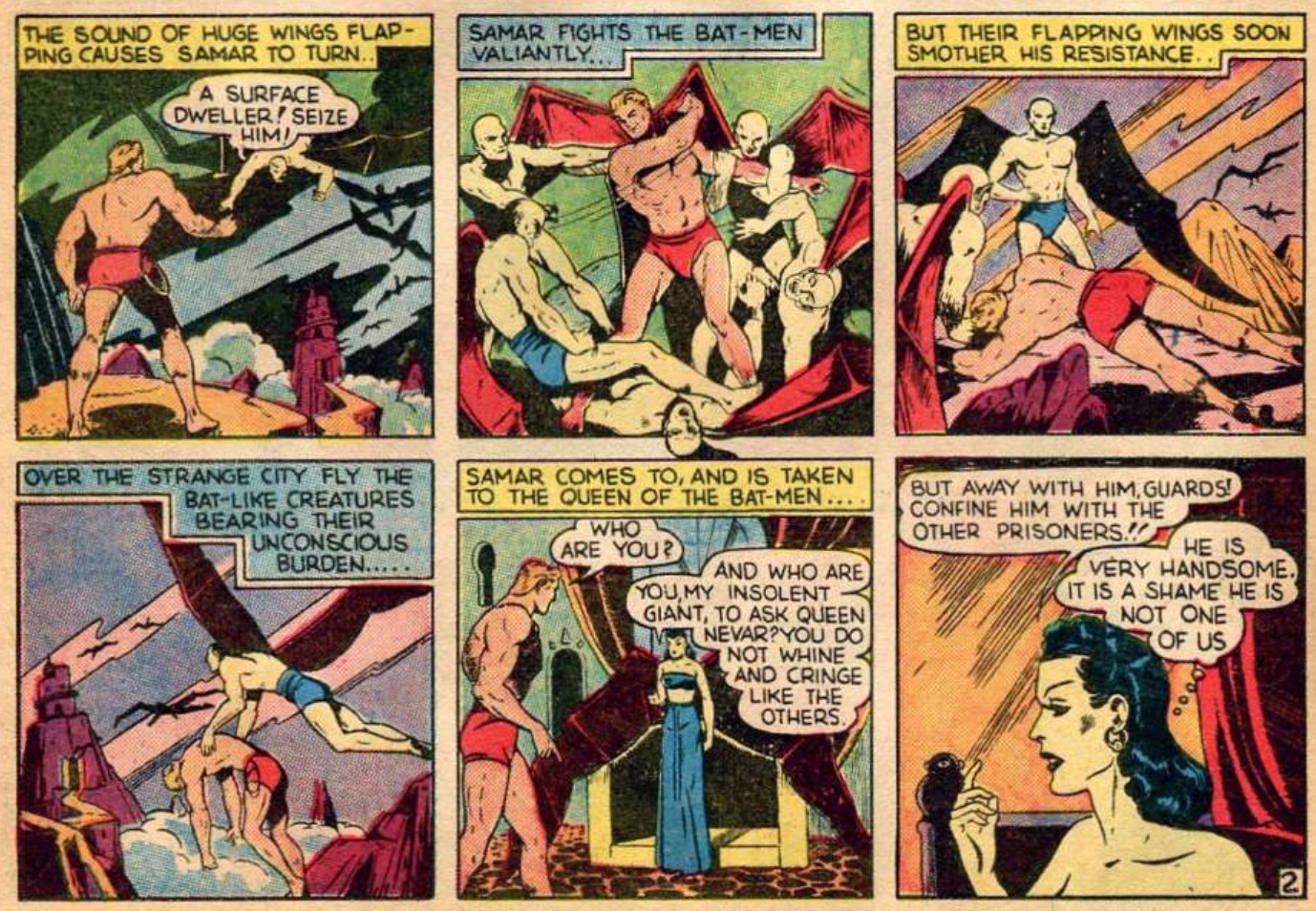
    Though the Bat-Men are very, very vampire-like – bat-winged humanoids who capture humans and drink their blood and can make humans into Bat-Men and are destroyed by sunlight – the keen senses of jungle-man Samar tell him that they are not, though he never really clarifies what they actually are. 

    The Bat-Men and their underground city are destroyed when they force Samar to battle a tyrannosaur in their gladiatorial arena and he inadvertently collapses the cave roof while killing the beast with a catapult. (Feature Comics 038, 1940)

    the Bat-Men of Mephis: 

    One of the many intelligent races to inhabit the planet Mephistos in the year 2500 CE, the Bat-Men of Mephis as their name suggests live in the tunnels beneath the city of Mephis, posing as statuary until it is time to attack. It’s a very urban adaptation, which is fun. I also appreciate their little ears. (Flash Comics v1 002, 1940)

  • ALIENS AND SO FORTH ROUND-UP 020

    You won’t believe the aliens and alien-adjacent societies we got in here. 

    Scorpians and Subterrines: 

    When crack reporter Scoop Smith and his photographer pal Blimp Black fly to Mexico to investigate reports of an “invisible revolutionary army” they get the story in a very direct way when they are shot down and taken captive by the Scorpians, who dwell in the underground kingdom of Scorpia and are extremely on-theme about the scorpion thing at all times, as can be seen in in the throne room of Scorpian King Cortes and its five distinct bits of scorpion decor.


    Scoop and Blimp are escorted to the Horror Chamber to be eaten by giant scorpions, because even the Scorpian methods of execution are on brand. They escape thanks to a thrown rock and a handy earthquake and discover the Subterrines, a second underground civilization that is also seeking to overthrow the Mexican government.  

    While the Scorpians under King Cortes kind of vaguely evoke the conquistadors of old, the Subterrines are pretty explicitly the descendants of native Mexican peoples who fled underground and now seek to reclaim their lands (and may I say that “everyone has long white beards now” is about the most benign version of becoming troglodytic cave-dwellers). The two groups of course hate one another and set to battling to the death for the honour of conquering Mexico, only to be annihilated together by the Mexican army. (Whiz Comics 005, 1940)

    Ape Men:

    If you’ve ever wondered if there was a version of the Paul Bunyan story in which he had an ape man for a companion, well wonder no more, because it happened in National Comics, when King, the ape man in question, wanders out of the woods and starts attacking lumberjacks, only to find himself on the receiving end of a beatdown from Paul Bunyan himself. After this, the impressionable King adopts the lumberjack way of life and joins Paul’s supporting cast. (National Comics 006, 1940)

    Joins Paul’s supporting cast for one issue, that is, because in National Comics 007 a scientist shows up at camp with a lead on where King might hail from, prompting Paul and the lads to set out to return him to his people, and if you’ve ever wondered if there was a version of the Paul Bunyan story in which he traveled through India to the Himalayas, well, you are in luck. Paul and the lads find King’s tribe and for the second time in as many issues, Paul Bunyan has to fist fight a Himalayan Ape Man in order to make peace.

    Bat-Men:

    Though the Bat-Men are very, very vampire-like – bat-winged humanoids who capture humans and drink their blood and can make humans into Bat-Men and are destroyed by sunlight – the keen senses of jungle-man Samar tell him that they are not, though he never really clarifies what they actually are. 

    The Bat-Men and their underground city are destroyed when they force Samar to battle a tyrannosaur in their gladiatorial arena and he inadvertently collapses the cave roof while killing the beast with a catapult. (Feature Comics 038, 1940)

    the Bat-Men of Mephis: 

    One of the many intelligent races to inhabit the planet Mephistos in the year 2500 CE, the Bat-Men of Mephis as their name suggests live in the tunnels beneath the city of Mephis, posing as statuary until it is time to attack. It’s a very urban adaptation, which is fun. I also appreciate their little ears. (Flash Comics v1 002, 1940)

  • DIVINE ROUND-UP 013

    Piping hot deities for you this mornining.

    Sivu the Tiger God: 

    The worshippers of Sivu the Tiger God come to New York City to recover the jewelled eyes of their great idol, which are known as the Death Ruby and the Doom Ruby and held in the New York Museum and the collection of Beverly van Pell, respectively. Detective Dan Dare gets involved when he is hired by Mrs van Pell and the rubies ultimately stay right where they are. A shame, but at least we get to see that six-armed, four-legged, chubby, tiger-headed representation of Sivu, right?

    God Style: Idol. (Whiz Comics 003b, 1940) 

    Zeus: 

    The MLJ Hercules is the first super-hero of that name to actually be the demi-god in question, and he accordingly has a couple of meetings with his dad Zeus to discuss the state of the fight for truth and justice back on Earth. What I mostly want to point out about this version of the King of Olympus is that he’s probably the most flamboyantly dressed Zeus in comics before Jack Kirby illustrates him in Thor. 

    God style: Real (Blue Ribbon Comics 005, 1940)

    Charon: 

    A pretty by-the-numbers version of Charon who doesn’t deserve to be bullied by Dr Fate just because he needs to cross the Styx. He didn’t even try a bribe first!

    God Style: Real (More Fun Comics 056, 1940) 

    Wisdom: 

    The reason that Dr Fate is visiting the underworld is to check on whether his enemy Wotan is in fact dead, and to that end he is consulting with “Wisdom, who rules the world,” which I can only assume is another entry in the long tradition (that started four issues earlier with the origin of the Spectre) of alluding to the Abrahamic (or let’s face it: Christian) god via a combination of vague wording, blinding light and dialogue from an unseen source.

    God Style: Real (More Fun Comics 056, 1940) 

    (annoyingly, I can’t figure out where the bit about the seven gates to the underworld is from. It feels familiar and I wanted to see if it was from a non-Greek, non-Christian source because then this trip would be incorporating three whole mythologies, but there is simply too much “Gates of Hell” talk online to find it easily) 

  • DIVINE ROUND-UP 013

    Piping hot deities for you this mornining.

    Sivu the Tiger God: 

    The worshippers of Sivu the Tiger God come to New York City to recover the jewelled eyes of their great idol, which are known as the Death Ruby and the Doom Ruby and held in the New York Museum and the collection of Beverly van Pell, respectively. Detective Dan Dare gets involved when he is hired by Mrs van Pell and the rubies ultimately stay right where they are. A shame, but at least we get to see that six-armed, four-legged, chubby, tiger-headed representation of Sivu, right?

    God Style: Idol. (Whiz Comics 003b, 1940) 

    Zeus: 

    The MLJ Hercules is the first super-hero of that name to actually be the demi-god in question, and he accordingly has a couple of meetings with his dad Zeus to discuss the state of the fight for truth and justice back on Earth. What I mostly want to point out about this version of the King of Olympus is that he’s probably the most flamboyantly dressed Zeus in comics before Jack Kirby illustrates him in Thor. 

    God style: Real (Blue Ribbon Comics 005, 1940)

    Charon: 

    A pretty by-the-numbers version of Charon who doesn’t deserve to be bullied by Dr Fate just because he needs to cross the Styx. He didn’t even try a bribe first!

    God Style: Real (More Fun Comics 056, 1940) 

    Wisdom: 

    The reason that Dr Fate is visiting the underworld is to check on whether his enemy Wotan is in fact dead, and to that end he is consulting with “Wisdom, who rules the world,” which I can only assume is another entry in the long tradition (that started four issues earlier with the origin of the Spectre) of alluding to the Abrahamic (or let’s face it: Christian) god via a combination of vague wording, blinding light and dialogue from an unseen source.

    God Style: Real (More Fun Comics 056, 1940) 

    (annoyingly, I can’t figure out where the bit about the seven gates to the underworld is from. It feels familiar and I wanted to see if it was from a non-Greek, non-Christian source because then this trip would be incorporating three whole mythologies, but there is simply too much “Gates of Hell” talk online to find it easily) 

  • ALIENS AND SO FORTH ROUND-UP 019

    ALIENS AND SO FORTH ROUND-UP 019

    Today we have, per usual, something from the comic I’m currently reading followed by some stuff from the archives. It’s a good system!

    Glompers: 

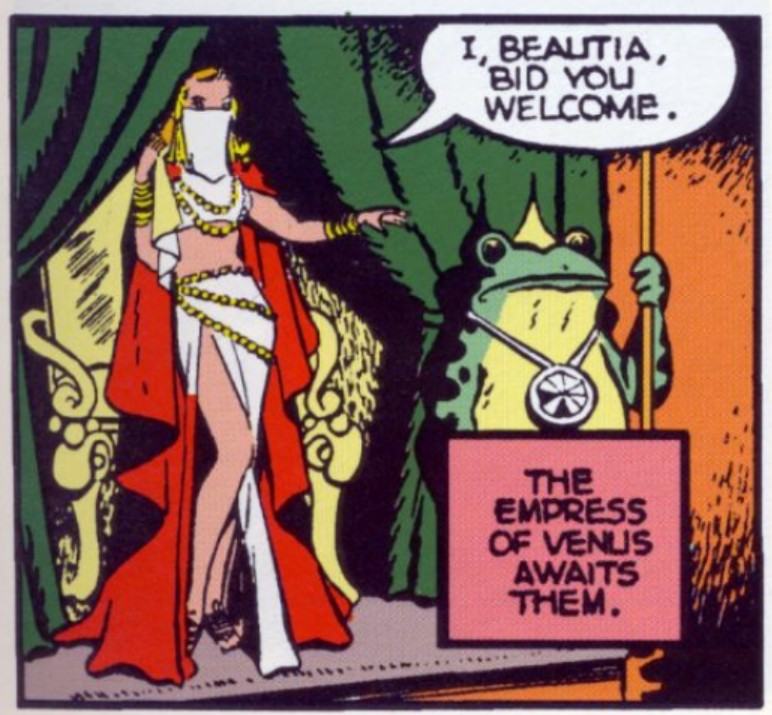
    We first meet the Glompers on the planet Venus after Dr Sivana has tricked Billy Batson and by extension Captain Marvel into joining him on an experimental rocket trip, with the intention of killing and/or stranding him there. They are immediately the most charming aliens I have ever seen, despite or perhaps because of the fact that they are just large frogs wearing trunks and little conical hats.

    The Glompers are ruled over by Beautia, Empress of Venus (later revealed to be Sivana’s daughter), and again I must emphasize just how friggin’ charming they are. Just look at his little spear! (Whiz Comics 003b, 1940)

    Sadly, as far as I can tell the Glompers only reappear one other time, as part of a plan by Dr Sivana to unleash them on Earth (Whiz Comics 015, 1941). The reformed-except-for-occasional-bursts-of-filial-duty Beautia expounds on the Glompers somewhat, revealing that they, like terrestrial frogs, are rapacious carnivores. Still charming! 

    In conclusion, since as far as I know the current DC Universe does not have a canonical native species on Venus and I have to say that I think that the Glompers should fill that roll. Make ’em big ol’ acid-spewing frog men!

    Alligator Men/Mermaids: 

    Rod Rian is an officer of Earth’s Sky Police in the year 2500 CE who finds himself on the planet Mephistos, having adventures among the various intelligent species that reside there. Perhaps the least explored of these are the friendly Alligator Men, who either coexist with a species of Mephistan mermaids or are yet another species with extreme sexual dimorphism. Either way: love a reptile man. (Flash Comics v1 011, 1940)

    Amazons of the Winged Death: 

    Don Drake, like Rod Rian, is an Earth man who finds himself on an alien world populated with all kinds of different species of intelligent life, in his case the planet Saro. Unlike Rod, Don’s adventures take place in the then-present day of 1935.

    The Amazons of the Winged Death are, as the name suggests, statuesque humanoid females. They ride horrible insects (the Winged Death of the name, natch) and are generally hostile, though Don does manage to ally with at least a few of them. (New Fun Comics 004, 1935)

    the Ape Men: 

    Brad Hardy, like Rod and Don, is an adventurer who finds himself in a world full of strange and often hostile creatures. Like Don, he is contemporary to the comic that he appears in, but unlike both of them, the world he finds himself in exists on Earth, in a cavernous realm below Mongolia. 

    The Ape Men (also Ape-Men and Apemen) are pretty typical: monkey faced humanoids with tails and a bad attitude. I do enjoy their Living Ape-God, who seems to just be the largest Ape Man. (More Fun Comics 009, 1936)

  • DEMONIC ROUND-UP 003

    Two shorts and two longs.

    Bajah:

    Minor Golden Age Marvel magician Dakor has to travel all the way to the fictional Indian kingdom of Nordu to rescue his friend’s daughter from one of those cults where they worship a random blonde white lady (one of the more embarrassing stupid pulp fiction concepts to make the jump to comics, in my opinion). All that is to set up the fact that the devil figure in this cult is the oft-invoked, never-seen Bajah, as seen above. (Mystic Comics v1 003, 1940)

    the Goat-Men: 

    The Goat-Men are a class of demon who serve Lucifer, and specifically the Lucifer seen in the last Demonic round-up, because this particular one is summoned by the Voodoo Man, just as his boss had been.

    The Goat-Men are fire demons, who can both breathe fire and create a ring of fire by walking in a circle around something or someone. Plus: the ring of fire gives you malaria. This is a pretty good collection of demonic powers, and while the part of me that writes about super-villains wants to say that they are insufficiently related to goats for my liking, anyone familiar with Medieval demonology will tell you that having a suite of abilities that are completely disconnected from both the demon’s physical appearance and one another is very accurate.

    Just like his boss, the Goat-Man proves to be intensely vulnerable to the sight of a cross, to the point of explosion. Just why hero Bob Warren had to light the cross he used on fire is perhaps best left unexplored. (Weird Comics 007, 1940)

    Kor Deno: 

    Kor Deno, a demon of some might, has been haunting the same family in… the rural United States? I’m pretty sure that’s where Warlock the Wizard hangs out… for generations. Any female member of the family who marries will be widowed by the demon soon after and for the latest and perhaps last scion, Valya, the curse has grown in scope to the point that Kor Deno has carried off all of her friends and family. 

    Warlock the Wizard is if nothing else a romantic, and so he challenges Kor Deno’s might in order that Valya might wed or at least kiss her love, Jim. He scores an early victory by using the the Golden Hand of Abraxas to crush the demon’s cool shadow form, but finds himself to have been overconfident, as both Jim and Valya are carried off to Kor Deno’s Black Kingdom immediately after he leaves them to finally make out.

    Kor Deno adopts the form of Simon the Hermit to lull Warlock into a false sense of security, but is unable to destroy him while he wields the Hand, and thus the Hand is what Kor Deno demands in exchange for Warlock’s freedom.

    Now armed with what he believes to be his enemy’s greatest weapon, Kor Deno attempts to slay Warlock, only to himself be destroyed by the still-greater might of the Lamp of the Gods. Bad luck, Kor Deno. (Nickel Comics 002, 1940) 

    Korieg the Sea Devil: 

    Like Bajah, Korieg the Sea Devil is invoked as a force of evilby the practitioner of a made-up Mysterious Asian Religion, in this case that practised by the inhabitants of a lost kingdom somewhere near Malaysia. No word on any of Korieg’s particulars, beyond the fact that they evidently float in water. (Action Comics v1 010, 1939) 

  • MINOR SUPER-VILLAIN 679: THE EXPLOSION OF KRYPTON

    (Action Comics 001, 1938)

    Does this first version of the explosion of Krypton really fit the category of minor super-villain? Absolutely not. “The planet got too old and blew up” is a natural disaster, albeit an extreme one.

    The second appearance of the Explosion of Krypton, in Superman v1 001, 1939, doesn’t even blame the explosion on old age. It just happens. So why categorize it such? Because basically every time it shows up going forward (and it’s going to be a while – we’re currently reading comics from 1940-41 and the next appearance of Krypton is in 1948) the blame rests squarely on someone’s shoulders, whether it be the Kryptonian Science Council’s bureaucratic stultification and/or short-sighted self interest dooming their own citizens or the latest villain-of-the-week getting an unearned boost to their C.V., someone takes the heat for this disaster. And when they do, I’ll be there to take note of it.

  • MINOR SUPER-VILLAIN 661: THE GUY WHO SHOT BATMAN’S PARENTS

    (Detective Comics 033, 1939)

    Can’t believe that I didn’t think of this before but The Guy Who Shot Batman’s Parents a) should already be here and b) is representative of a class of plot devices I’ll be calling Narrative Footballs. Narrative Footballs are big pivotal events, usually related to a character’s origin in some way, that get more and more significant over time and eventually become something that can be pinned to a villain in order to lend them a bit of gravitas. Sometimes they don’t even start out as the actions of a person: while the the Explosion of Krypton eventually becomes a very popular item on various villains’ C.V.s, it isn’t even blamed on Kryptonian society for the first decade or so. 

    The Guy Who Shot Batman’s Parents is just a guy until 1948, when he is identified as Joe Chill. I think he’s mostly Joe Chill still, but sometimes he’s the Joker (Batman (1989)) or Joe Chill was working for a big bad guy etc etc. I have no evidence here but I’ll bet a dollar that there’s a comic somewhere where it turns out that Ra’s al Ghul was behind it.

  • PROBLEMATIC ROUND-UP 001

    The kinds of character that are a part of comics history so it would be wrong to ignore them but are also pretty racist (usually – I’m sure that eventually I’ll find something else distasteful enough to put here) and unpleasant to dedicate a whole lot of time to. We’re going with a round-up!

    Our first culprit is George Harvard AKA Big Sun, a guy with a way too complicated plan to sell oil to the Axis out of the Florida Everglades under the cover of being a geological surveyor or prospector or something. He comes to the attention of adventurer Clip Carson due to not accounting for his partner maybe poking around looking for samples like their job is supposed to be? It’s a bad plan.

    I’m mad at myself for finding Big Sun’s mask so cool looking, but it’s mitigated by how dumb his gimmick is: he has a shiny breastplate on under his robe and he reveals it flasher-style to blind his foes. Hence the name, I guess. (More Fun Comics 069, 1941) 

    I didn’t even know that Zingaro was an Italian slur for people of Romani descent until I looked up this guy – just why it was used as the name of a fellow trying to take over Mexico I will never know. On the one hand he is stopped by weirdo character the Voice so that’s good. On the other, he gets away so there’s a chance he could appear again, which is bad. It’s okay though: the Voice only ever had two adventures and this is the second one.

    Thankfully there aren’t too many characters whose names are racial slurs. (Amazing-Man Comics 022, 1941)

    I don’t know if you could call it lucky, per se, but it is kind of fortunate for the purposes of this round-up that I’m hitting a lot of the major categories of racist super-villains all in one go. We’ll see if this questionable luck holds for the fourth entry.

    So: Banga the Elephant God is predicated on the old trope that indigenous peoples are so credulous and superstitious that they will believe that anything (eg, a big mean elephant with a guy in a skull mask on it) is a god or other supernatural occurrence – in this case the people of the hidden jungle civilization of Yenya are helped along by the fact that the human part of the Banga gestalt is actually their witch doctor (called a “wizard doctor” in this case, which is kind of a neat linguistic variation if nothing else). Banga is eventually unmasked by jungle hero Morak the Mighty and meets his dual ends.

    As with so many racist characters it is very unfortunate that Banga the Elephant God looks sick as hell. (Super-Magic Comics 001, 1941)

    The very next issue we have more of the same: a bunch of white guys dress up like the very cool looking Lizard-Lion Men of local legend and fleece ivory out of villagers in… Malaysia? If Rex King aka Black Fury stayed put between issues then it’s Malaysia.

    There’s not too much to these guys: one of them hides inside the statue of the Lizard-Lion in the local temple and says for the locals to bring all of their ivory hence and then costumed goons go beat up anyone who refuses. And then Black Fury beats them up. (Super-Magician v1 002, 1941)

    We didn’t hit all the greats in one go – there’s a lot of untapped racism coming up once we hit the comics of 1942 after all – but it’s a good – bad? – sample.