The Curse of Skeleton Munroe

Category: DC Comics

  • MINOR SUPER-VILLAIN 402: THE BLACK KNIGHT

    (More Fun Comics 073, 1941)

    As our tale begins, a figure in black knight’s armour roams New York City, destroying statuary seemingly at random.

    Johnny Quick soon gets involved and ferrets out a link between the destroyed pieces: they all once belonged to a man implausibly named Black Knight, who went bankrupt and was forced to sell them. The statues turned out to be worth a great deal more than Knight paid for them and the prevailing theory is that he has returned for revenge.

    In actual fact it was the art dealer, Sam Kirby, who was behind the attacks. He had swindled not only Black Knight but his customers as well, by selling them fakes, and was now trying to cover up this fact via what turns out to be a remote-controlled automaton. 

    QUESTIONS NOT ANSWERED IN THE TEXT:

    Was the guy’s name really Black Knight? The Golden Age Comics Style Guide usually recommended signposting nicknames quite heavily and since he wasn’t referred to as “Black” Knight we just have to assume that one or both of his parents were real pranksters.

    What was Sam Kirby’s deal? As presented, he didn’t fleece Knight so much as not retroactively compensate him once the real value of the statues came out. But why did he sell the collectors counterfeits? Why destroy the counterfeits and keep the originals? Did he just want to own the real ones or was he planning to sell them a second time? Why go to all of this trouble? And speaking of that…

    What’s with the robot? I tend to go on about villains using technology that could make them a large fortune in order to acquire a small fortune but this is really egregious. I’m not even going to look up how much you could get for a really good statue before saying that a bipedal remote-controlled robot with full human articulation is orders of magnitude more valuable to industry. Mining! Manufacturing! Hazardous materials handling! The applications are endless!

  • MINOR SUPER-VILLAIN 401: THE MASKED MAN

    (More Fun Comics 073, 1941)

    This is not a new development but having Johnny Quick and Green Arrow’s debuts so close together made me realize that a minor sea change had happened some time in 1941: whereas the earliest super-heroes would start out collaring regular crooks we’re entering an era in which super-villains are the norm! (that said, Aquaman’s debut is in this issue as well and he just blows up a few Nazis).

    As for the Masked Man (our fifth! Even if more than half of them are unofficial), he’s another themed deathtraps guy, killing members of the extremely tryhard History Club (members must have the same last name as a famous historical or mythological figure, but sometimes it’s the figure’s first name as their last name and also there’s a member named Frank d’Arcy who is a member under the extremely slim pretext of sharing a name with Joan of Arc AKA Jean d’Arc. Maybe it’s a club for guys too uninteresting to belong to any of the other weird themed organizations in comics). Needless to say my interest was piqued: themed deathtraps are a classic villain trope! These, however, are extremely perfunctory – shooting a guy named Lincoln but not in a theatre, stabbing a Caesar in his sleep… a little more theatricality would have gone a long way.

    More halfassed deathtraps: Ezra Samson is tied up next to a bomb that will collapse a building on him, Frank d’Arcy is tied up in a burning building, Amos Socrates is forced to drink poison at gunpoint and Leonard Achilles (great name!) is warned about his heel being targeted so he wears metal boots and is then killed via electrified mat. It’s all moderately thematic but feels perfunctory.

    And it is, in fact, perfunctory! The Masked Man is not killing the members of the History Club out of hatred or because of a weird compulsion but as a distraction! He’s actually club treasurer Ezra Samson attempting to cover up his long-term embezzlement of club funds by murdering everyone who would care, culminating in a fake attempt on his own life and a staging of Amos Socrates’ poisoning so that he would look like a guilty suicide. And he might have gotten away with it if Green Arrow and Speedy hadn’t been there to kill him with a car wreck at the end of the story.

    BONUS TROPHY ROOM

    Green Arrow and Speedy add the Masked Man’s fake round bomb to their already overstuffed trophy case.

  • MINOR SUPER-VILLAIN 400: THE HOOK

    (More Fun Comics 072, 1941)

    The Hook is in reality cannery cwner Rand Greer, who has a lucrative sideline in smuggling jewels inside of frozen fish (and a less lucrative hobby of murdering FBI agents).

    To justify the name, Greer has a hook hand concealed under a fake plastic hand (a pretty good one honestly – I reckon he’s holding a fish with it in the first image). There’s really nothing to this guy and I’d ordinarily banish him to the ranks of the generic villains if only to have a bit more excitement in entry number 400, but this marks the last appearance of Captain Desmo and I must say I’ll miss him. Truly he was the best of the pilot/ adventurers, even if his foes weren’t always worth writing home about.

  • MINOR SUPER-VILLAIN 399: THE MURDER MAESTRO

    (More Fun Comics 072, 1941) 

    The Murder Maestro comes out swinging with a rapid-fire campaign of musical murder. Over the course of two days he delivers five musical warnings followed by song-inspired deathtraps to members of the Tin Pan Alley Club, e.g., “I’m Walking on Air” delivered via singing telegram followed by an attempt to hang the recipient from a light aircraft.

    This of course leads to one of my favourite setups: a collection of possible suspects. Not as much as could be is done with this bunch – two are almost immediately targeted by the Murder Maestro, leaving only two actual suspects – but I still appreciate the effort.

    The Murder Maestro of course is Blind Harry Thorpe, the least likely of the suspects, who turns out to have Dr Mid-Nite-style “can only see in complete darkness” blindness. His murder spree was inspired by the fact that the Tin Pan Alley Club was a collective enterprise in which royalties were pooled and shared among the songwriter members, and of course fewer members meant more royalties for the survivors. Whether Thorpe had an excuse ready for when he was the only one left alive was left unexplored.

  • MINOR SUPER-VILLAIN 398: THE DARK VAPOR

    (More Fun Comics 072, 1941)

    The Dark Vapor (one of my trademark Unofficial Names) is just that: a misty entity that emerges from an old jar of mysterious provenance and possesses simple farmer Hiram Spiezel.

    The Vapor-driven Hiram immediately heads for the big city of Cliffland NJ and starts wheeling and dealing, becoming a stock marked player and a real estate tycoon almost overnight. And soon after that, he starts evicting tenants, bilking people and falsifying records: capitalism to Mega-Capitalism, all in a few short days.

    All this unwholesome business draws the attention of the Spectre, who quickly discovers that a) he cannot influence “Hiram Spiezel” like he could a normal man, b) “Spiezel” can see him, c) “Hiram Spiezel” is actually a banished evil entity from an ancient civilization picking up a bid for world conquest where it left off and d) the Dark Vapor entity is much more powerful than the Spectre. 

    The entity swiftly runs off the Spectre and gets back to the business of enacting a hostile takeover on the world. As an aside: I really appreciate the adaptability of this being – I mean, I assume that whatever civilization it originated in was not organized along the same lines as 1940s US capitalist society and yet it is perfectly comfortable in its new role as business mogul rather than Thunder Warlord or Priest-King or Grand Art Critic. Good job, Dark Vapor!

    Too bad for the Vape that the Spectre has an unspecified, vaguely Christian entity on speed dial, a literal deus ex machina for just such occasions. It supplies him with a power-boosting red aura, with which he in short order evicts the Vapor from Hiram Spiezel, hunts it down and imprisons it at the bottom of the sea, presumably to someday bedevil a civilization of intelligent octopuses with its preternatural pebble-stacking prowess.

    AND SPEAKING OF OCTOPUSES! I enjoyed the Dark Vapor’s machinations but absolutely the greatest thing about their adventure is this illustration of them as a metaphorical octopus ensnaring the US in their horrible flesh-toned tentacles. Always a delight!

  • MINOR SUPER-VILLAIN 398: THE DARK VAPOR

    (More Fun Comics 072, 1941)

    The Dark Vapor (one of my trademark Unofficial Names) is just that: a misty entity that emerges from an old jar of mysterious provenance and possesses simple farmer Hiram Spiezel.

    The Vapor-driven Hiram immediately heads for the big city of Cliffland NJ and starts wheeling and dealing, becoming a stock marked player and a real estate tycoon almost overnight. And soon after that, he starts evicting tenants, bilking people and falsifying records: capitalism to Mega-Capitalism, all in a few short days.

    All this unwholesome business draws the attention of the Spectre, who quickly discovers that a) he cannot influence “Hiram Spiezel” like he could a normal man, b) “Spiezel” can see him, c) “Hiram Spiezel” is actually a banished evil entity from an ancient civilization picking up a bid for world conquest where it left off and d) the Dark Vapor entity is much more powerful than the Spectre. 

    The entity swiftly runs off the Spectre and gets back to the business of enacting a hostile takeover on the world. As an aside: I really appreciate the adaptability of this being – I mean, I assume that whatever civilization it originated in was not organized along the same lines as 1940s US capitalist society and yet it is perfectly comfortable in its new role as business mogul rather than Thunder Warlord or Priest-King or Grand Art Critic. Good job, Dark Vapor!

    Too bad for the Vape that the Spectre has an unspecified, vaguely Christian entity on speed dial, a literal deus ex machina for just such occasions. It supplies him with a power-boosting red aura, with which he in short order evicts the Vapor from Hiram Spiezel, hunts it down and imprisons it at the bottom of the sea, presumably to someday bedevil a civilization of intelligent octopuses with its preternatural pebble-stacking prowess.

    AND SPEAKING OF OCTOPUSES! I enjoyed the Dark Vapor’s machinations but absolutely the greatest thing about their adventure is this illustration of them as a metaphorical octopus ensnaring the US in their horrible flesh-toned tentacles. Always a delight!

  • MINOR SUPER-VILLAIN 397: ADAM IGOROVICH

    (More Fun Comics 071, 1941)

    Adam Igorovich! Your typical scientist unhinged by his treatment by the scientific community, who deemed his theories impractical and/or dangerous and/or insane, so now he is striking back at the world using those selfsame theories to get his back. If we’ve seen it once we’ve seen it a million times.

    There’s one important difference between the machinations of Adam Igorovich and those of, say, the Master (the last Russian-ish scientist we saw battle Dr Fate): while the master’s sonic death weapon was a finely tuned device capable of targeting everything from a person to a building, Igorovich’s technology is a solar magnet capable of stopping the rotation and orbit of the Earth and moving it closer to the Sun. The willingness to use apocalyptic technology like this in a simple worldwide extortion scheme is the difference between science and Mad Science. Take note, undergraduates!

    After he roasts portions of the Earth’s surface for a while via manipulation of it’s orbit (and what a wild thing to never be mentioned again, the fact that the whole world stopped moving for half a day. Twice!), Igorovich attracts the attention of Dr Fate and gets so thoroughly foiled that he chooses the classic mad scientist’s exit of blowing up his entire compound around him.

  • MINOR SUPER-VILLAIN 397: ADAM IGOROVICH

    (More Fun Comics 071, 1941)

    Adam Igorovich! Your typical scientist unhinged by his treatment by the scientific community, who deemed his theories impractical and/or dangerous and/or insane, so now he is striking back at the world using those selfsame theories to get his back. If we’ve seen it once we’ve seen it a million times.

    There’s one important difference between the machinations of Adam Igorovich and those of, say, the Master (the last Russian-ish scientist we saw battle Dr Fate): while the master’s sonic death weapon was a finely tuned device capable of targeting everything from a person to a building, Igorovich’s technology is a solar magnet capable of stopping the rotation and orbit of the Earth and moving it closer to the Sun. The willingness to use apocalyptic technology like this in a simple worldwide extortion scheme is the difference between science and Mad Science. Take note, undergraduates!

    After he roasts portions of the Earth’s surface for a while via manipulation of it’s orbit (and what a wild thing to never be mentioned again, the fact that the whole world stopped moving for half a day. Twice!), Igorovich attracts the attention of Dr Fate and gets so thoroughly foiled that he chooses the classic mad scientist’s exit of blowing up his entire compound around him.

  • MINOR SUPER-VILLAIN 396: THE CIPHER

    (More Fun Comics 071, 1941)

    The Cipher is a fairly unremarkable oceangoing spy with a really great name. He attempts to extract some information on winter warfare tactics from a friend of Clip Carson (on behalf of unspecified employers – somewhat interestingly, the Cipher is explicitly a freelance spy) and gets blown up for his efforts.

  • MINOR SUPER-VILLAIN 395: THE GREAT CAESAR

    (More Fun Comics 071, 1941)

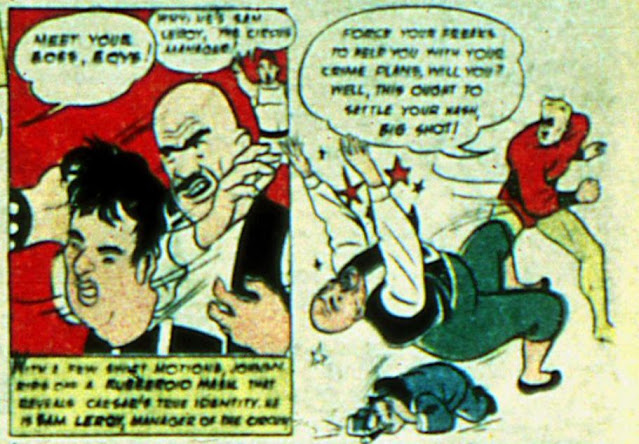
    The Great Caesar is the antagonist of the first published Johnny Quick adventure (though not, of course, the first overall Johnny Quick adventure – as revealed in the last round of Generic Costumed Villains he had a several-year career before this). He’s got the ever-popular array of circus of crime henchmen who he coerces to rob and kill at his pleasure. He also has the much dumber but just as popular “death as consequence of failure” policy which, while motivationally potent, is a staffing and HR nightmare in practise.

    The Great Caesar is eventually unmasked and revealed to be Sam Leroy, the circus manager. Hooray for Johnny Quick!

    More importantly, hooray for this marking one of the few actual uses of the term “rubberoid mask” in comics. I feel so validated!