The Curse of Skeleton Munroe

Category: tyrant

  • MINOR SUPER-VILLAIN 939: THE BLACK PHARAOH

    (Silver Streak Comics 014, 1941)

    After his initial defeat at the hands of Thun-Dohr, the villainous Sin Khaii is on the lookout for an ally in his war on humanity and he finds one in the pages of a tome called the Book of the Dead, and presumably it’s the Egyptian Book of the Dead because the candidate he lines up is called the Black Pharaoh, the only Pharaoh evil enough that he was cursed and sealed up in a pyramid to think about what he had done for all time. The only way he would be able to go free is if a) the pyramid moves, which will free the Pharaoh’s servant Tut-Mut, who b) must then find new guys to take the place of the Black Pharaoh and his cronies. All of this stands as a real lesson for those inclined to mete out mystic justice: if you’re going to seal away evil or otherwise prevent awfulness from getting everywhere and your work can only be undone by a very specific set of circumstances, don’t write those circumstances down anywhere.

    As usual, I attempted to figure out just who if anyone the Black Pharaoh is supposed to be, with the only real clue being that he was buried in “the oldest pyramid in Egypt,” and while there are a few contenders for that title due to the gradual development of pyramid technology, the oldest pyramid-shaped pyramid like the depicted in the story seems to be the Red Pyramid near Cairo. What does this tell us? Only that the Black Pharaoh was interred some time after 2563 BC, alas.

    Sin Khaii isn’t one to be deterred by any Ancient Egyptian mystics. He uses his dark majicks to transport the pyramid to the former site of the New York World’s Fair and then deploys a bug from the criminally-underutilized Pandora’s Box to infect passersby with Curiosity so that they will enter the structure and fall prey to Tut-Mut.

    The innocent people of Queens need not fear, however, for Thun-Dohr and his mentor the Dalai Lama (not that one) are on the case. Thun-Dohr ambushes the Black Pharaoh’s servants as they ransack a museum, only to be captured via some pretty cool shadow magic.

    Finally, the Black Pharaoh and Sin Khaii get down to business and formulate a plan: they are going to recreate Ancient Egypt on a grand scale by smothering the entire United States in a layer of sand. This is why the Pharaoh’s men are looting museums, to get all of their boss’ stuff back before it is buried forever.

    (the duo’s apocalyptic sandstorm is shown blowing across the Atlantic from Egypt, and there’s a part of me that wants to get really pedantic about the relative sizes of the two countries and point out just how thin the available sand would be spread, but we are dealing with magic after all. Presumably the sand would be multiplied somehow? I’m much more concerned about the state that Egypt was left in – just how much of that sand was load-bearing?) 

    If there’s one thing about shadow magic, it’s that you need shadows to use it, and the Dalai Lama deals with that by blowing out the candle that was supplying the particular shadows keeping Thun-Dohr bound. Thun-Dohr disrupts the ritual – is the sand just hovering somewhere in the mid-Atlantic? This has to be the kind of thing that inspires conspiracy theories in a comic book universe, particularly in the kind where super-heroic stuff isn’t front page news.

    Thun-Dohr and the Black Pharaoh engage in Thrilling Astral Combat (I think. Whenever two people are battling on a cloud I assume that this is shorthand for their astral forms duking it out in the Aetherial Realms, but in this case it’s possible that they have merely chosen the clouds as their battlefield for some unexplained reason) with Our Hero emerging victorious and the villainous Pharaoh at the bottom of the ocean, weighed down by his sins. After that it is a simple matter for Thun-Dohr and his mentor to restore the pyramid and sand to Egypt.

    As always, it’s kind of disappointing when an ancient evil that was sealed away for untold eons is dispatched with relative ease in the present day. After all, why go to all the trouble with the curse of eternal slumber if you could just murder the guy in the first place? I suppose the fact that the Black Pharaoh was royalty might have played into it somehow, though on the other hand “being murdered” has to be the most expected way to die for a historical royal. Give me more formidable primordial evils!

    Categorized in: Colour (Black), Origin (Resurrected Mummy), Royalty (Pharaoh)

  • MINOR SUPER-VILLAIN 887. MIGHTY ADWAHL

    (Wow Comics 002, 1941)

    Once Atom Blake, Boy Wizard sets off on his interplanetary search for his father, his first stop is Mercury. Why? For no stated reason and seemingly just because it’s the first planet out from the Sun, and for that matter, Blake’s reason for starting his search in space rather than on Earth is simply because he can. Once he arrives on Mercury, he is almost immediately captured by an intelligent species of hive-dwelling insectoids. 

    These Mercurians come very close to killing Blake before using their innate gifts of telepathic communication to determine that he does not in fact work for Mighty Adwahl, the planet’s tyrannical leader, who has systematically enslaved them to work in his mines. Side note: I really like the size variance in these Mercurians. Very fun species trait.

    Atom Blake, determined to help anyone in need, travels to Adwahl’s capitol city, where he is captured again, this time by a second species of Mercurian who are a bit more enthusiastic about serving the tyrant and who look a bit like green humanoid camels. When Blake is marched into the throne room for judgment he is shocked to discover that the Mighty Adwahl is… another human?!

    Mighty Adwahl is in fact a former gang boss named Scarface Louie, and is presented as having been a pretty bit deal circa Prohibition before fleeing the planet on a spaceship he stole from an inventor. The wildest part of this is that it seems to be public knowledge, since sixteen year-old Atom knows about it. Like, just imagine that the story of Al Capone ends with him using a hijacked shrink ray to escape into a subatomic world. Wild stuff.

    Mighty Adwahl demonstrates a remarkable lack of curiosity and summarily sentences Blake to a life of slavery in his gold mines rather than inquire as to how a teen boy might have made his way to Mercury. Though Atom does manage to lead a slave revolt among the miners, the subsequent storming of Adwahl’s throne room is spoiled somewhat by the fact that the first group of Mercurians decided to follow Atom’s lead and had already stormed the palace and killed him.

    (for the curious: Atom was completely right to come to Mercury, as the same Mercurian who initially captured him not only knew his father personally but is able to guide Atom to the time portal that his father left the planet through)

  • MINOR SUPER-VILLAIN 859: TOKO THE TERRIBLE

    (Whirlwind Comics 001, 1940)

    In the far future of 1980 CE, Earth is under threat of conquest from space. A mysterious ray has dissolved the nation of Slovania, and now a being called Toko the Terrible, Emperor of Saturn has issued an ultimatum: surrender to him or the entire Earth will suffer the same fate.

    This of course will not stand, and Earth sends their best guy (Bruce Barlow), to deal with the threat of Toko.

    Barlow, being a man of action, immediately attacks Toko and calls him insane, getting himself thrown into the very cool-sounding Prison of Invisible Bars for his trouble. This proves not to be a terrible, species-ending blunder by a real meathead as it might have originally appeared but instead a masterstroke of strategy, as while stewing behind (invisible) bars, he meets Professor Jenkins, first human on Saturn and the original inventor of the Ultra-Dissolvo-Raygun, bane of Slovania. Together, they bust Bruce out of jail, prevent the dissolving of Earth and turn the ray on Toko himself, which has the knockon effect of freeing the citizens of Saturn from his vile influence. Plus he had already conquered the rest of the Solar System, so they all get freed too!

  • MINOR SUPER-VILLAIN 859: TOKO THE TERRIBLE

    (Whirlwind Comics 001, 1940)

    In the far future of 1980 CE, Earth is under threat of conquest from space. A mysterious ray has dissolved the nation of Slovania, and now a being called Toko the Terrible, Emperor of Saturn has issued an ultimatum: surrender to him or the entire Earth will suffer the same fate.

    This of course will not stand, and Earth sends their best guy (Bruce Barlow), to deal with the threat of Toko.

    Barlow, being a man of action, immediately attacks Toko and calls him insane, getting himself thrown into the very cool-sounding Prison of Invisible Bars for his trouble. This proves not to be a terrible, species-ending blunder by a real meathead as it might have originally appeared but instead a masterstroke of strategy, as while stewing behind (invisible) bars, he meets Professor Jenkins, first human on Saturn and the original inventor of the Ultra-Dissolvo-Raygun, bane of Slovania. Together, they bust Bruce out of jail, prevent the dissolving of Earth and turn the ray on Toko himself, which has the knockon effect of freeing the citizens of Saturn from his vile influence. Plus he had already conquered the rest of the Solar System, so they all get freed too!

  • MINOR SUPER-VILLAIN 821: KONG

    (Thrilling Comics 003, 1940)

    I can’t really devote a lot of energy to Kong because he just kind of makes me tired, conceptually. He’s a Yellow Peril dictator who has devoted a fair amount of time and resources to stealing both military secrets and entire scientists from the US as a part of his bid for world domination, opposed only by Doc Strange and his companion Virginia Thompson. All very exciting stuff in theory, but it all resolves into a kind of mush – it’s not even as racist as it could be, which is good but not remarkable.

    In the spirit of writing something interesting, here are the good parts of Kong’s story: 

    1. Location: Kong is the dictator of the Asian kingdom of Kachukuo, which was pretty fun to recognize as a stand-in for Manchukuo, the Chinese puppet-state established by the Japanese in 1932. I’m always chuffed to see Manchukuo come up both because it doesn’t really do so very often and because I managed to get pretty far into adulthood before I learned about this entire country, and the joy of learning about it is still fresh in my mind. Not that the history of Manchukuo itself is particularly joy-inspiring, but learning is learning.

    2. Rays. I like Kong’s big chunky ray technology. He’s got a red ray that brings the scientists out of the suspended animation he put them in for transport, a blue mind control ray (blue and red seem to come from the same machine) and a green death ray. What can I say, I like a ray, and I like colours.

    3. Wild Hill Warriors. At one point Kong tries to get rid of Doc Strong by subjecting him to gladiatorial combat and I just really like the fact that he managed to scare up some Germanic warriors fresh from the sack of Rome for the task. They don’t do very well but they’re fun!

    That’s about it for Kong. Doc Strange inspires a revolution in Kachukuo, chucks the dictator into his own chemical soup and thaws out the scientists with a little Alosun, bish bash bosh, start the countdown to the next Fu Manchu knockoff showing up.

  • MINOR SUPER-VILLAIN 763: QUEEN SHEBA

    (Speed Comics 008, 1940)

    Shock Gibson has been reading magazines, specifically an expose on slave trading in Africa, and being of a heroic turn of mind he decides to do something about it. Making his way across the Atlantic, Shock engages in various animal-related hijinks before finally ambushing a slave caravan and using some elephant-based enhanced interrogation to learn just what is going on with all the slaving.

    Turns out to be a pretty classic jungle adventure scenario: a hidden kingdom smack in the middle of Africa with ties to some historical people, in this case called the Secret Kingdom and ruled by a direct descendant of the biblical Queen of Sheba (who is traditionally placed somewhere in the vicinity of Yemen but who are we, the geography police?). And it’s a twofer, as Queen Sheba is served by an order of knights descended from a group of crusaders who somehow found themselves in the Secret Kingdom (okay, maybe we are the geography police because crusaders would also make more sense in the vicinity of Yemen and I’m having a hard time letting go of that fact).

    No mere knight is a match for the electrically-charged muscles of Shock Gibson, however, and by defeating the guard at the border of the kingdom Shock gains access to a one-on-one meeting with the Queen. I must say that this is a astonishingly bad precedent to set as far as security is concerned – this knight is just lucky that Shock wasn’t a particularly adept assassin.

    Here’s where I almost decided not to feature Queen Sheba as a super-villain, because once Shock manages to interrogate her it turns out that her motivations are depressingly banal. She isn’t buying slaves in order to feed them into a soul gem to power a world-conquering battle robot or using them as biological material to create an army of flesh beasts or even doing mass human sacrifice to appease her dark gods, she’s just building a pyramid and can’t see any way to do so that doesn’t involve exploiting her lessers. It’s frankly depressing.

    If this were any other style of Secret Kingdom Ruler (white-bearded man, withered old crone, American crook running a scam, etc) then Shock Gibson would pull their pyramid down around their ears, but Queen Sheba is a bodacious babe and so instead he offers to use his amazing gifts to complete the thing in a matter of hours so long as the Queen subsequently releases her slaves. And then he only goes and does it!

    And then! Queen Sheba has the audacity to add a caveat to the deal! Specifically she is not going to release her slaves unless Shock goes and frees her son from the Black Knights who have taken him hostage. The gall of it! Especially after all of this pyramid nonsense! You know what a… well, not a good reason to have a bunch of slaves, certainly, but a better one than mindlessly building your kingdom’s twentieth pyramid: using them as an army to storm the castle where your son is a hostage.

    The Black Knights (full review tomorrow!) prove just as ineffectual at stopping high-voltage super-heroes as their law-abiding counterparts and Shock recovers the very informative (“Help! I’m the prince!”) young royal from his prison.

    Queen Sheba makes the obligatory offer for Shock to stay and become her kings, and while ordinarily I’d roast a hero for fleeing in terror before the advances of a lady like this, honestly this time Shock has it right: this woman is a monster.

  • MINOR SUPER-VILLAIN 716: DEVALO

    (Rocket Comics 002, 1940)

    “Rocket Riley, Prince of the Planets” was the namesake strip of Rocket Comics, about lab assistant and pilot Rocket Riley, his boss and amazing hair-haver Professor Sterling and Sterling’s daughter/ Riley’s fiance Griselda. While preparing for an official unveiling of Professor Sterling’s new interplanetary rocket ship, the trio are accosted by spy Kurt von Stengle and his hireling and the whole bunch of them end up accidentally blasting off in the out-of control rocket.

    After a brief stop on an unnamed asteroid where von Stengle’s hireling is eaten by Octopus Men, Rocket and crew end up crash landing on Saturn, where things go even more pear-shaped as they are captured by the planet’s dictatorial ruler, Devalo.

    Devalo, also known as Divalo, has a real Satanic look going on and so I spent some time looking for a classical link between Saturn, Satan, the quality of being saturnine, etc., only to find very little. I’m sure that it’s something I’ve encountered before if only due to a general linking of the more evil-flavoured bits of Greek and Roman mythology and Christian underworld imagery, but there doesn’t seem to be an official-enough link to show up in places like Brewer’s Dictionary of Phrase and Fable, or indeed, Wikipedia.

    Nevertheless, Devalo is both Saturnian and Satanic and I would bet a small sum of money that he won’t be the last character we meet who fits both of those descriptions.

    The Saturnian Saturnite society ruled by Devalo is caste-based, with the military at the top, supported by the enslaved scientist caste. All manual labour is done by the Zeroes, whose bodies have been enhanced and intelligences stunted for maximum efficiency.

    Since von Stengle is the kind of villain who would, for instance, try to commandeer a spacecraft that is currently careening through space, he seizes the opportunity afforded him when everyone is rounded up by Devalo’s men to suggest that they might team up to invade the Earth. Stupidly opportunistic in his evil, that’s von Stengle for you.

    Our heroes manage to escape Devalo’s palace along with Saturnite scientist Xenox and his daughter Ladana, but after an encounter with some Sharkmen the group is scattered and only Rocket and Griselda manage to make it back to Professor Sterling’s ship. And that’s it! Rocket Comics ended with issue 3 and Devalo gets to remain not just uncaptured but firmly in charge. All we can do is rest assured that he would have been deposed in one to ten issues if the series had continued.

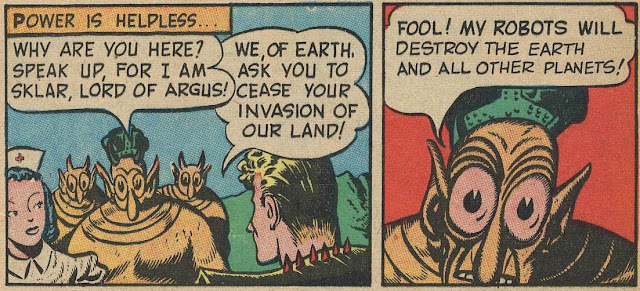
  • MINOR SUPER-VILLAIN 714: SKLAR

    (Prize Comics 006, 1940)

    It’s a regular day in Mongol-dominated New-New York City of the year 1982 CE: the people are oppressed in various ways and Power Nelson is around to help them solve some but not all of their problems. Suddenly! A space capsule lands and disgorges a trio of rampaging robots! This is a perfect task for Power Nelson to handle as it it a short-term solution to an immediate problem but very importantly does not require and attempt to change systemic problems. Smashy smashy!

    Nelson’s ally Zora Doone of the Interplanetary Red Cross soon informs him that the robots were sent to Earth from the planet Argus and he speeds there as past as possible, only to find himself outfoxed: Sklar, Lord of Argus has taken Zora hostage, necessitating an escape through the monster-filled Cave of Terror to remove her from danger and pad the pagecount.

    Power Nelson decides that the best solution to Argus’ and Earth’s problems is to depose the unpopular Sklar by way of a revolution, and let me say that this is a very galling thing for him to do. I’ve been bitching and moaning about how Nelson never gets around to freeing the people of Earth from the despotic reign of Seng I, the thing he was created to do, by the way and here he is, 15 minutes into his stay on Argus and elbow deep in revolution? What a piece of work.

    The revolution doesn’t prove to be strictly necessary, as Nelson ends up confronting Sklar one-on-one and just kind of tips him off of his volcano lair into the fiery depths below. I suppose it’s important for the populace to feel like they helped.

    Inspired by this, Nelson bids farewell to Zora Doone and finally, finally heads off to depose Emperor Seng I, a character who, might I remind you, he could crush with one hand and who he stands within five feet of in every single issue of Prize Comics. FINALLY.

    (this is very frustrating on a non-narrative level because the publicly available portions of Prize Comics 007 and 008 do not include the Power Nelson strip and somewhere in those two issues he goes from being a hero of the 1980s to one of the 1940s. Details are scarce, but it seems as though Nelson is flung back in time somehow, but does he actually depose Seng I first? No idea)

  • MINOR SUPER-VILLAIN 714: SKLAR

    (Prize Comics 006, 1940)

    It’s a regular day in Mongol-dominated New-New York City of the year 1982 CE: the people are oppressed in various ways and Power Nelson is around to help them solve some but not all of their problems. Suddenly! A space capsule lands and disgorges a trio of rampaging robots! This is a perfect task for Power Nelson to handle as it it a short-term solution to an immediate problem but very importantly does not require and attempt to change systemic problems. Smashy smashy!

    Nelson’s ally Zora Doone of the Interplanetary Red Cross soon informs him that the robots were sent to Earth from the planet Argus and he speeds there as past as possible, only to find himself outfoxed: Sklar, Lord of Argus has taken Zora hostage, necessitating an escape through the monster-filled Cave of Terror to remove her from danger and pad the pagecount.

    Power Nelson decides that the best solution to Argus’ and Earth’s problems is to depose the unpopular Sklar by way of a revolution, and let me say that this is a very galling thing for him to do. I’ve been bitching and moaning about how Nelson never gets around to freeing the people of Earth from the despotic reign of Seng I, the thing he was created to do, by the way and here he is, 15 minutes into his stay on Argus and elbow deep in revolution? What a piece of work.

    The revolution doesn’t prove to be strictly necessary, as Nelson ends up confronting Sklar one-on-one and just kind of tips him off of his volcano lair into the fiery depths below. I suppose it’s important for the populace to feel like they helped.

    Inspired by this, Nelson bids farewell to Zora Doone and finally, finally heads off to depose Emperor Seng I, a character who, might I remind you, he could crush with one hand and who he stands within five feet of in every single issue of Prize Comics. FINALLY.

    (this is very frustrating on a non-narrative level because the publicly available portions of Prize Comics 007 and 008 do not include the Power Nelson strip and somewhere in those two issues he goes from being a hero of the 1980s to one of the 1940s. Details are scarce, but it seems as though Nelson is flung back in time somehow, but does he actually depose Seng I first? No idea)

  • MINOR SUPER-VILLAIN 711: MAYTUS, KING OF THE BEASTS

    (Prize Comics 005, 1940)

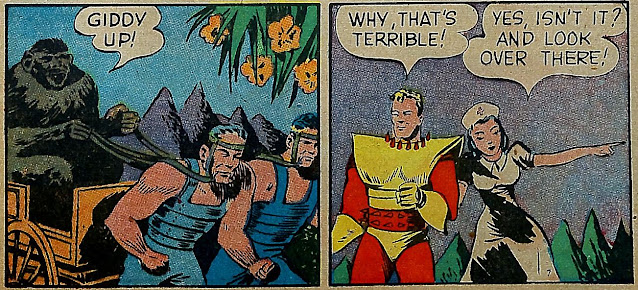
    Late in his first incarnation, Power Nelson makes the acquaintance of Zora Doone, agent of the Interplanetary Red Cross, and the two form a very horny-but-chaste relationship. At her behest, Nelson takes a break from not freeing the people of Earth from the tyrannical rule of Seng I to investigate conditions on planet Ato, where humans are ruled… BY APES!

    Yes, it’s a good old fashioned Planet of the Apes situation on Ato. Humans are treated as animals, act as beast of burden, are fed on garbage, etc, while apes get to be cops and wagon-drivers. It just ain’t fair!

    There isn’t really any exploration of why or how exactly the apes are in charge on Ato – the humans seem to be intelligent and verbal and the apes know it… Is this a race thing? It probably is, isn’t it – whether the writer consciously wrote it that way or not it’s got a lot in common with fantasies of white oppression under the heels of the “lesser” races (oh wait, I forgot that this is a comic set in a future in which the West has been conquered by the evil Mongol, isn’t it) . It’s also an interesting bit of commentary on the treatment of animals – that panel of the ape zookeeper feeding its charges garbage straight out of the can speaks of someone who has felt a pang of empathy for a creature in their time.

    King Maytus isn’t really your typical villain, just the head of an oppressive society, but I like his bluster. I also like seeing Power Nelson get mashed up by an elephant for a few panels before he inevitably comes out on top.

    For all my talk of racist allegories above, the situation on Ato is actually resolved far more peacefully than a similar one on a comic set on a Pacific Island would be. Sure Maytus is beaten up and threatened with death, but the story doesn’t end with, say, all of the apes being killed and/or reduced to servitude and/or stripped of their intelligence. In Golden Age comics terms it’s a triumph of diplomacy!